Solved Problems

Thevenin's Theorem

Master Network Theorems

Dr. Mithun Mondal

Tutorial 7 — Thevenin's Theorem

Any linear two-terminal network can be replaced by a single voltage source \(V_{TH}\) (the open-circuit voltage) in series with a resistance \(R_{TH}\). These problems cover finding the equivalent for circuits with independent sources, dependent sources (using a test source or the open-circuit/short-circuit method), and then using the equivalent to obtain a load current.

Network Theorems · Electric Circuit Analysis · 10 solved problems

Demonstrative VideoWalkthrough
Problem 1Load Current via Thevenin

Find the load current \(i\) using Thevenin's theorem.
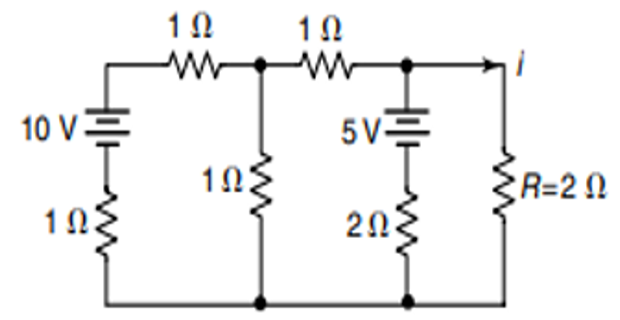
Circuit for Problem 1
Solution

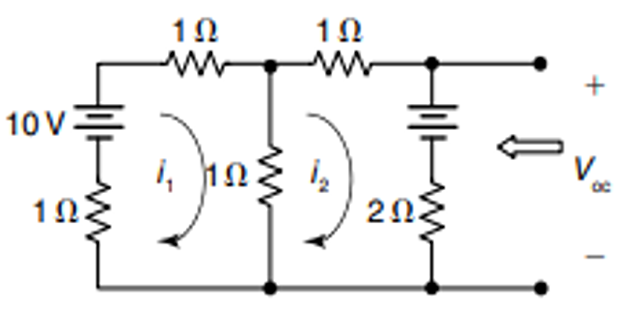
Remove the load \(R = 2\,\Omega\) and find the open-circuit voltage. Applying mesh analysis to the two left loops:

\[ \begin{aligned} 3 i_1 - i_2 &= 10\\ -i_1 + 4 i_2 &= -5 \end{aligned} \]

Solving (determinant \(= 11\)):

\[ i_1 = \frac{35}{11}\ \text{A},\qquad i_2 = -\frac{5}{11}\ \text{A} \]
Mesh-analysis diagram for Problem 1

The Thevenin (open-circuit) voltage:

\[ V_{TH} = 5 + 2 i_2 = 5 - \frac{10}{11} = \frac{45}{11}\ \text{V} \]
Resistance-network diagram for Problem 1

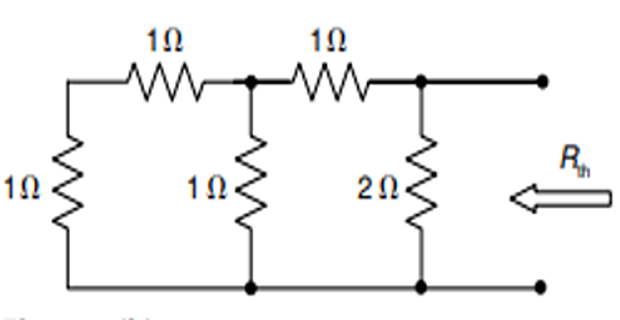
Deactivating the sources, the equivalent resistance seen from the load is:

\[ R_{TH} = \frac{\tfrac{5}{3} \times 2}{\tfrac{5}{3} + 2} = \frac{10}{11}\ \Omega \]

Reconnecting the 2 Ω load, the load current is:
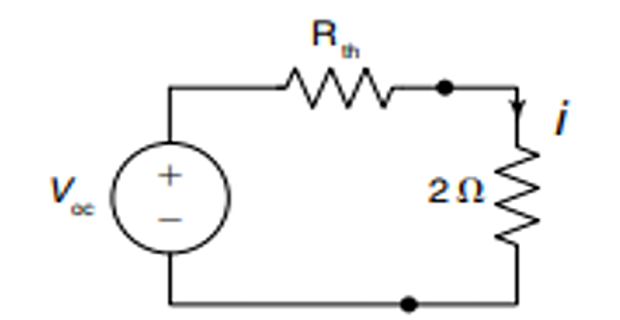
\[ i = \frac{V_{oc}}{R_{TH} + 2} = \frac{45/11}{10/11 + 2} = \frac{45}{32} = 1.40625\ \text{A} \]
Thevenin equivalent for Problem 1
Answer\(i = \dfrac{45}{32} = 1.406\ \text{A}\)
Problem 2Source Transformation

Find the current through the 15 Ω resistor using Thevenin's theorem.
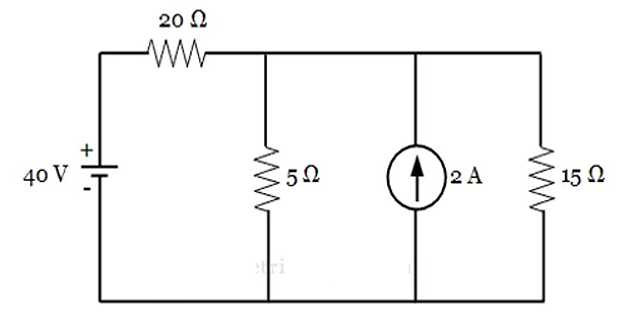
Circuit for Problem 2
Solution

Remove the 15 Ω load. Converting the 2 A–5 Ω pair to a 10 V source in series with 5 Ω and applying KVL:

\[ 20 I + 5 I + 10 - 40 = 0 \;\Rightarrow\; 25 I = 30 \;\Rightarrow\; I = 1.2\ \text{A} \]

The open-circuit voltage:

\[ V_{TH} = 10 + (5 \times 1.2) = 16\ \text{V} \]

Deactivating the sources, \(R_{TH} = 5 \parallel 20\), then the load current:

\[ R_{TH} = \frac{5 \times 20}{5 + 20} = 4\ \Omega,\qquad I_L = \frac{V_{TH}}{R_{TH} + R_L} = \frac{16}{4 + 15} = 0.842\ \text{A} \]
Answer\(I_{15\Omega} = 0.842\ \text{A}\)
Problem 3Ladder Network

Find the Thevenin voltage and resistance at terminals 1–2.
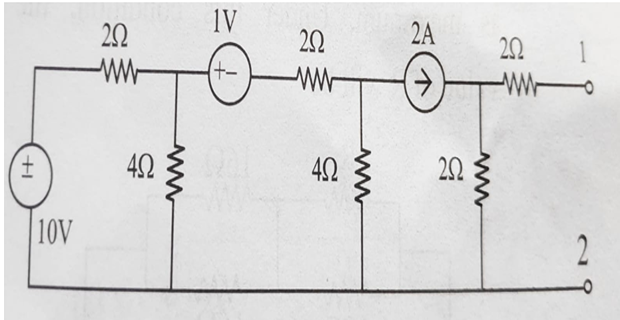
Circuit for Problem 3
Solution

For \(R_{TH}\), short-circuit the voltage sources and open-circuit the current source, then reduce the resistor ladder:

\[ R_{TH} = 4\ \Omega \]

The open-circuit voltage at terminals 1–2:
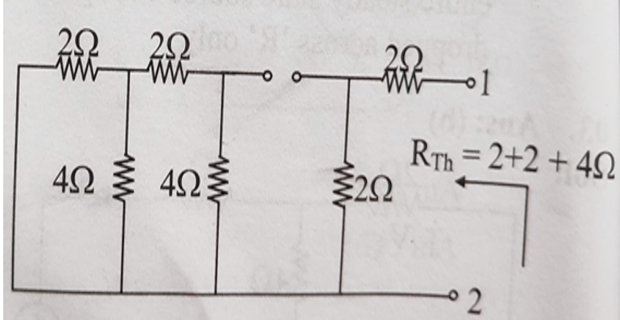
\[ V_{TH} = 4\ \text{V} \]
Resistance reduction for Problem 3
Answer\(V_{TH} = 4\ \text{V},\quad R_{TH} = 4\ \Omega\)
Problem 4Dependent Source (Test Source)

Find the Thevenin resistance at terminals P–Q.
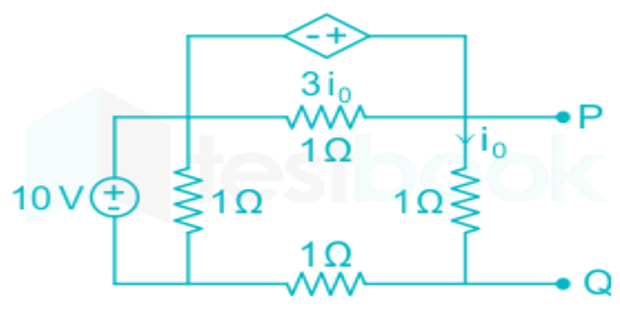
Circuit for Problem 4
Solution

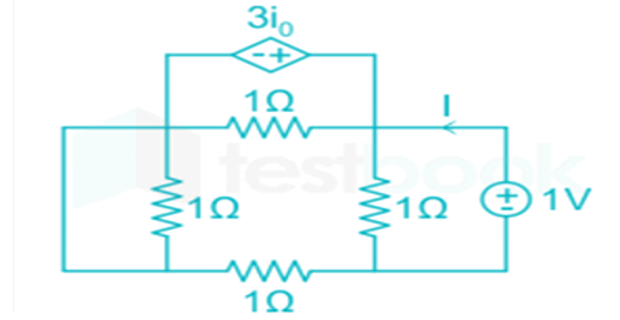
Because the circuit contains a dependent source \(3 i_0\), deactivate the independent 10 V source (short it) and apply a 1 V test source at P–Q. The resulting test current is:

\[ I = 1\ \text{A} \]

Hence:

\[ R_{TH} = \frac{V}{I} = \frac{1}{1} = 1\ \Omega \]
Test-source setup for Problem 4
Answer\(R_{TH} = 1\ \Omega\)
Problem 5Dependent Source (Voc / Isc)

Find the current flowing through A–B using Thevenin's theorem.
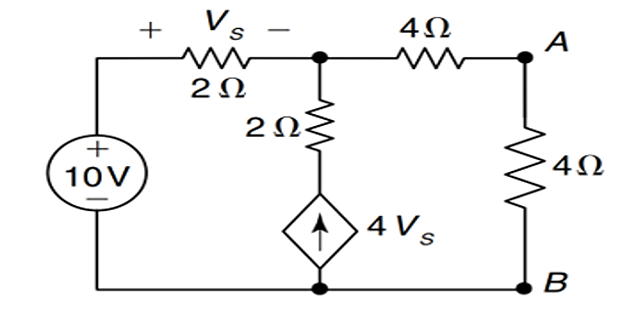
Circuit for Problem 5
Solution

Open-circuit the 4 Ω load. By KCL, with \(v_s = 10 - V_{oc}\) controlling the dependent source \(4 v_s\):

\[ \frac{V_{oc} - 10}{2} = 4 v_s = 4(10 - V_{oc}) \;\Rightarrow\; V_{oc} = 10\ \text{V} \]
Open- and short-circuit setups for Problem 5

Short-circuit terminals A–B and apply KCL at the node:

\[ \frac{V_1 - 10}{2} + \frac{V_1}{4} = 4 v_s = 4(10 - V_1) \;\Rightarrow\; V_1 = \frac{180}{19} = 9.47\ \text{V} \]

The short-circuit current and Thevenin resistance:

\[ I_{sc} = \frac{9.47}{4} = 2.368\ \text{A},\qquad R_{TH} = \frac{V_{TH}}{I_{sc}} = \frac{10}{2.368} = 4.22\ \Omega \]

Reconnecting the 4 Ω load, the current through A–B:

\[ I_{AB} = \frac{V_{TH}}{R_{TH} + 4} = \frac{10}{4.22 + 4} \approx 1.22\ \text{A} \]
Answer\(V_{TH} = 10\,\text{V},\ R_{TH} = 4.22\,\Omega,\ I_{AB} \approx 1.22\,\text{A}\)
Problem 6Dependent Sources

Find the Thevenin equivalent at terminals a–b.
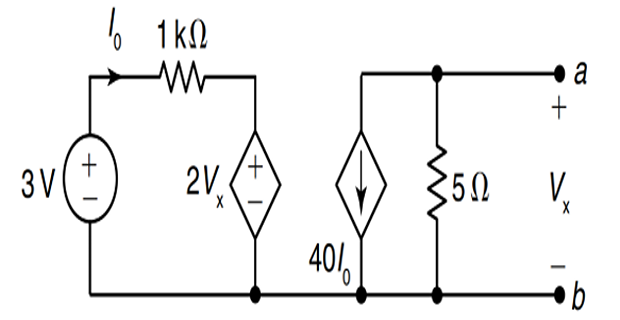
Circuit for Problem 6
Solution

By KVL around the left-hand loop:

\[ 1 \times 10^{3}\, I + \frac{V_0}{10^{4}} = 10 \times 10^{-3} \tag{i} \]

In the right-hand loop the dependent current source circulates through the resistor, so by KVL:

\[ V_0 = 30 \times 10^{3} \times (-75 I) = -225 \times 10^{4}\, I \tag{ii} \]

Substituting (ii) into (i) gives the open-circuit voltage:
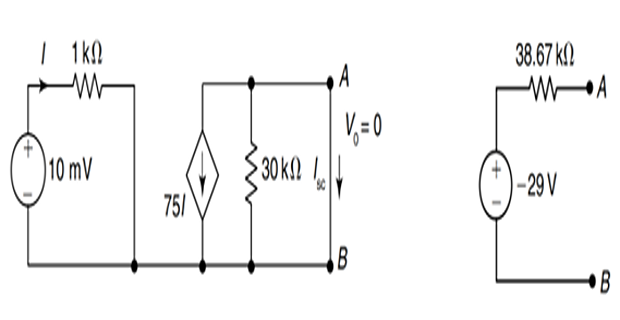
\[ \begin{aligned} 1 \times 10^{3} \left(-\frac{V_0}{225 \times 10^{4}}\right) + \frac{V_0}{10^{4}} &= 10 \times 10^{-3}\\ -4.44 \times 10^{-4} V_0 + 1 \times 10^{-4} V_0 &= 10 \times 10^{-3}\\ V_0 = V_{oc} &= -29\ \text{V} \end{aligned} \]
Short-circuit setup for Problem 6

Short-circuiting a–b makes \(V_0 = 0\), so the left loop gives \(I = 10^{-5}\,\text{A}\) and the short-circuit current is:

\[ I_{sc} = -75 I = -75 \times 10^{-5}\ \text{A} \]

The Thevenin resistance:

\[ R_{TH} = \frac{V_{oc}}{I_{sc}} = \frac{-29}{-75 \times 10^{-5}} = 38.67\ \text{k}\Omega \]
Answer\(V_{TH} = -29\ \text{V},\quad R_{TH} = 38.67\ \text{k}\Omega\)
Problem 7Dependent Source (Test Source)

Find the Thevenin resistance at terminals C–D.
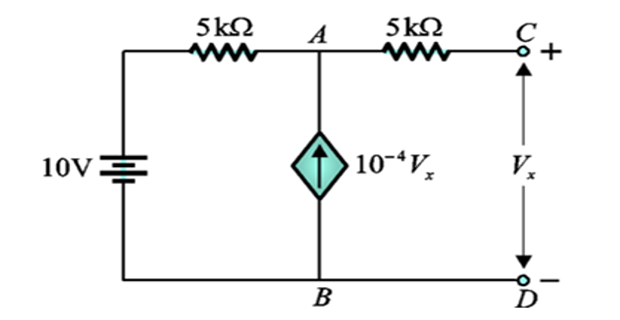
Circuit for Problem 7
Solution

Short the 10 V source and apply a test source \(V_x = 1\,\text{V}\) at C–D. With both 5 kΩ resistors meeting at node A and the dependent source \(10^{-4} V_x\) injecting into A, KCL gives \(V_A = 0.75\,\text{V}\), so the test current is:

\[ I_x = \frac{V_x - V_A}{5\text{k}} = \frac{1 - 0.75}{5000} = 5 \times 10^{-5}\ \text{A} \]

Therefore:

\[ R_{TH} = \frac{V_x}{I_x} = \frac{1}{5 \times 10^{-5}} = 20\ \text{k}\Omega \]
Answer\(R_{TH} = 20\ \text{k}\Omega\)
Problem 8Dependent Source (Voc / Isc)

Find the Thevenin equivalent at terminals a–b.
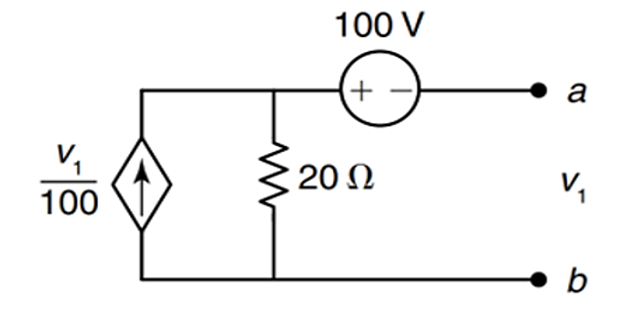
Circuit for Problem 8
Solution

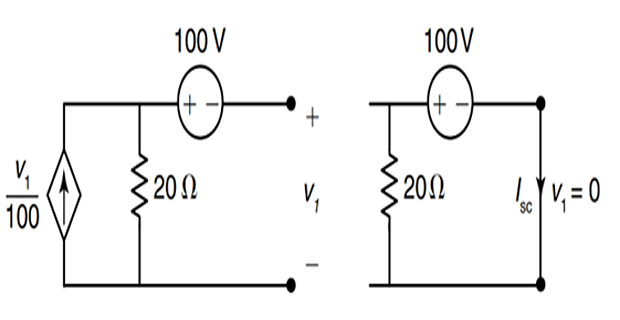
Short-circuit a–b: then \(v_1 = 0\), the dependent source \(v_1/100\) vanishes, and the 100 V source drives the 20 Ω:

\[ I_{sc} = \frac{100}{20} = 5\ \text{A} \]

Open-circuit a–b and apply KCL (with \(v_1 = v_{oc}\)):

\[ -\frac{v_{oc}}{100} + \frac{100 + v_{oc}}{20} = 0 \;\Rightarrow\; -v_{oc} + 500 + 5 v_{oc} = 0 \;\Rightarrow\; v_{oc} = -125\ \text{V} \]

The Thevenin resistance:

\[ R_{TH} = \left|\frac{V_{oc}}{I_{sc}}\right| = \frac{125}{5} = 25\ \Omega \]
Open- and short-circuit setups for Problem 8
Answer\(V_{TH} = -125\ \text{V},\quad R_{TH} = 25\ \Omega\)

Additional Practice Problems

Two self-contained worked examples with schematics: a Thevenin equivalent driven by an independent voltage source, and one driven by a current source.

Problem 9Voltage-Source Thevenin

For the circuit below, find the Thevenin equivalent at terminals a–b and the current delivered to a 4 Ω load. The source is 18 V, with a 6 Ω series resistor and a 3 Ω resistor across the terminals.

18V 6Ω a 3Ω Rₗ 4Ω b
Solution

Remove the load. The open-circuit voltage is the divider across the 3 Ω resistor:

\[ V_{TH} = 18 \times \frac{3}{6 + 3} = 6\ \text{V} \]

Deactivating the 18 V source (short), the resistance seen from a–b is the 6 Ω and 3 Ω in parallel:

\[ R_{TH} = \frac{6 \times 3}{6 + 3} = 2\ \Omega \]

Reconnecting the 4 Ω load:

\[ I_L = \frac{V_{TH}}{R_{TH} + R_L} = \frac{6}{2 + 4} = 1\ \text{A} \]
Answer\(V_{TH} = 6\ \text{V},\ R_{TH} = 2\ \Omega,\ I_L = 1\ \text{A}\)
Problem 10Current-Source Thevenin

A 3 A source has a 6 Ω resistor across it, then a 2 Ω resistor in series to terminal a. Find the Thevenin equivalent at a–b and the current into a 4 Ω load.

3A 6Ω 2Ω a Rₗ 4Ω b
Solution

Open-circuit a–b. No current flows in the 2 Ω series resistor, so all 3 A flows through the 6 Ω:

\[ V_{TH} = 3 \times 6 = 18\ \text{V} \]

Deactivating the current source (open it), the resistance seen from a–b is the 6 Ω and 2 Ω in series:

\[ R_{TH} = 6 + 2 = 8\ \Omega \]

With a 4 Ω load:

\[ I_L = \frac{V_{TH}}{R_{TH} + R_L} = \frac{18}{8 + 4} = 1.5\ \text{A} \]
Answer\(V_{TH} = 18\ \text{V},\ R_{TH} = 8\ \Omega,\ I_L = 1.5\ \text{A}\)