By the end of this chapter you should be able to:
Describe how a lap winding is connected and why it gives \(A = mP\) parallel paths.
Distinguish simplex, duplex and multiplex windings by their multiplicity \(m\).
Compute all four lap pitches from \(Z\), \(P\) and \(m\), checking the parity condition.
Explain why circulating currents arise in a lap winding and how equaliser rings suppress them.
Describe a wave winding and explain why it always has two paths.
Apply the integer condition \(Y_A = (Z \pm 2)/P\) and decide whether a wave winding is possible.
Explain the purpose of dummy coils and when they are needed.
Select between lap and wave for a given duty.
Lap Winding
Consecutive coils overlap each other — which is what "lap" means.
The finishing end of one coil is connected to a segment of the commutator, and the starting end of the next coil, whose side lies under a different pole, joins the same segment.
The conductors are connected in such a way that the number of parallel paths equals the number of poles.

Consider a machine with \(P\) poles and \(Z\) armature conductors. Then there will be \(P\) parallel paths, and each path will have \(Z/P\) conductors in series.
The number of brushes equals the number of parallel paths; half the brushes are positive and the remainder negative.
The reason is geometric. Because the commutator pitch is only one segment, a lap coil returns almost to where it began, and the winding closes on itself after passing just one pair of poles. Each closure creates a separate path, so there are as many paths as there are pole pairs traversed — that is, \(P\) paths in total.
Simplex, Duplex and Multiplex
A lap winding may be wound once round the armature or several times over, giving several independent windings sharing the same slots. The number of such windings is the multiplicity \(m\).

The number of parallel paths between the brushes is equal to the number of poles.
The number of parallel paths between the brushes is twice the number of poles.
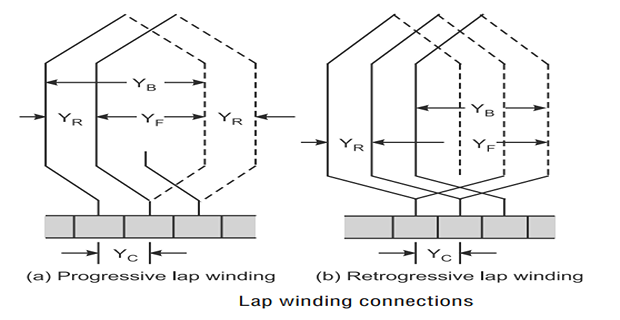
Lap Winding Pitches

The back pitch and front pitch must both be odd.
The winding advances round the armature; \(Y_C = +m\).
The winding works backwards; \(Y_C = -m\). It uses slightly more copper.
In practice the pitches are found in this order:
- Compute the average pitch \(Y_A \approx Z/P\).
- Set \(Y_B = Y_A + m\) and \(Y_F = Y_A - m\).
- Check that both are odd. If not, adjust \(Y_A\) by one and repeat.
- Then \(Y_R = 2m\), \(Y_C = \pm m\) and \(A = mP\).
The relation \(Y_A = Z/P\) is an approximation, and step 3 is where it gets corrected. With \(Y_B = Y_A + m\) and \(Y_F = Y_A - m\), both are odd only when \(Y_A\) and \(m\) have opposite parity.
So a simplex winding (\(m = 1\), odd) needs an even \(Y_A\), while a duplex winding (\(m = 2\), even) needs an odd one. The same armature cannot always accept both multiplicities without changing \(Y_A\), as Example 25.1 shows.

Problem. A 4-pole armature has 32 conductors. Find all the pitches and the number of parallel paths for (a) a simplex progressive lap winding and (b) a duplex lap winding.
(a) Simplex, \(m = 1\).
Both odd \(\checkmark\). Then
(b) Duplex, \(m = 2\). Trying the same \(Y_A = 8\):
Adjust \(Y_A\) to 9:
Comment. The duplex winding has twice the paths and therefore half the EMF and twice the current capability of the simplex one, on identical copper. Note that the average pitch had to be changed to satisfy parity — a reminder that \(Y_A = Z/P\) is a starting point, not a rule.
Equaliser Rings
In a lap winding, the EMFs induced in each parallel path may not be exactly equal.
This results in internal circulating currents in the armature circuit and in the brushes.
The consequences are excessive heating, sparking at the brushes and mechanical vibration.
To overcome this, equaliser rings are provided at the back of the armature.
Their function is to avoid unequal distribution of current at the brushes, thereby helping to obtain sparkless commutation.
In a lap winding each of the \(P\) paths lies under one particular pair of poles. If those poles differ at all — through unequal air gaps, eccentricity, or slightly different field coils — that path generates a different EMF from its neighbours, and current circulates between them through the brushes.
In a wave winding each of the two paths passes under every pole in turn, so any inequality is automatically averaged out. A wave winding equalises itself; a lap winding must be equalised by copper.
The equaliser rings join points in the winding that ought to be at the same potential — points separated by 360 electrical degrees, that is, by one pole pair. There are \(P/2\) such points for each position round the armature, so the number of distinct sets is
In practice only a fraction — commonly about one-third — are actually fitted, since each ring already handles a share of the circulating current and full equalisation is rarely worth the cost and space.
Some texts write the number of equaliser rings as \(m\), which collides badly with the multiplicity \(m\) of Section 25-2 — a different quantity entirely. This chapter reserves \(m\) for multiplicity throughout and refers to the equaliser count in words.
Note also that the ring count depends on the number of coils \(C\), not directly on the conductor count \(Z\). The two agree only for single-turn coils, where \(C = Z/2\).
Problem. A 4-pole lap-wound generator has 48 coils and is rated at 250 V, 200 A. Manufacturing tolerances leave one path generating 2 % more EMF than another; each path has a resistance of 0.05 \(\Omega\). Find the circulating current and the maximum number of equaliser rings.
EMF difference.
Circulating current. The two paths form a closed loop, so their resistances add:
As a fraction of rating.
Maximum equaliser rings.
Fitting about one-third gives roughly 8 rings in practice.
Comment. A 2 % mismatch — a trivial manufacturing variation — drives a circulating current equal to a quarter of the machine's rating. That current does no useful work whatever: it flows round inside the armature, dissipating \(I^{2}R\) and, worse, passing through the brushes where it adds to the current one brush must interrupt and subtracts from another.
The equaliser rings give this current a low-resistance path of its own at the back of the armature, so it never reaches the brushes. The heating remains, but the sparking does not.
Advantages and Disadvantages of Lap
Required for large current applications, because it has more parallel paths.
Suitable for low-voltage, high-current generators.
It gives less EMF compared with a wave winding.
It requires more conductors for the same EMF, which results in higher winding cost.
It makes less efficient use of the space in the armature slots.
It needs equaliser rings and as many brush sets as poles.
Wave Winding
One end of a coil is connected to the starting end of another coil which lies under a pole of the same polarity as the first coil.
The coils are connected in a wave shape, hence the name wave winding.
The conductors of a wave winding are split into two parallel paths, and each path has \(Z/2\) conductors in series.
The number of brushes is two — again equal to the number of parallel paths.
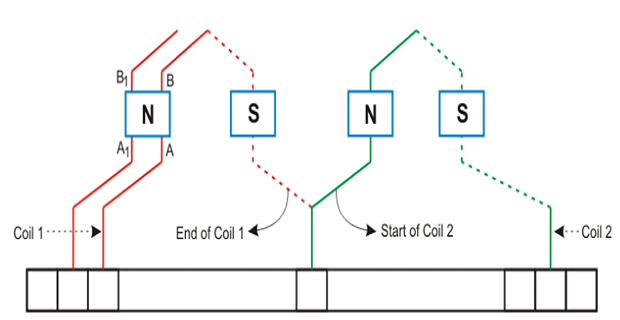
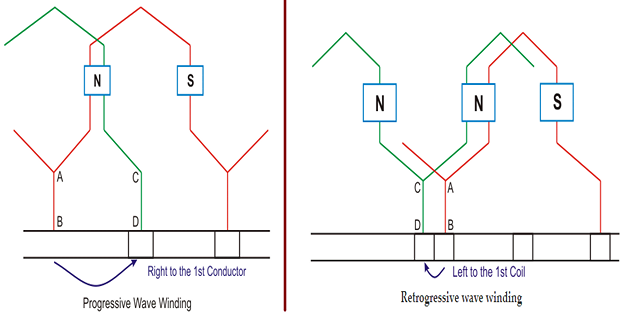
If, after one round of the armature, the coil falls in a slot to the right of its starting slot, the winding is progressive.
If, after one round of the armature, the coil falls in a slot to the left of its starting slot, the winding is retrogressive.
The reason there are only two paths is again geometric. Because the commutator pitch spans roughly a whole pole pair, a wave coil does not return near its start; it travels right around the armature, passing every pole in turn, before closing. Only two such traverses are possible — one in each direction from the brushes — so \(A = 2\) whatever the number of poles.
Wave Winding Pitches

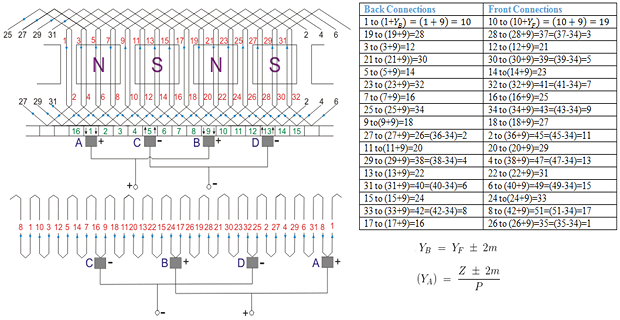
\(Y_B\) and \(Y_F\) are nearly equal to the pole pitch \(Y_P\), and may be equal or differ by \(\pm 2\) — plus for a progressive winding, minus for retrogressive.
Since \(Y_A\) must be an integer, a wave winding is not possible with every number of conductors. Take 8 conductors in a 4-pole machine:
Both are fractional, so the wave winding is not possible. But with 6 conductors:
For the case that fails, dummy coils are introduced, as Section 25-8 explains.
Problem. A 4-pole armature has 30 conductors. Find the pitches for both a progressive and a retrogressive simplex wave winding.
Average pitch.
Both integers, so both windings are possible.
Retrogressive (\(Y_A = 7\)):
Both odd \(\checkmark\), and \(Y_C = Y_A = 7\).
Progressive (\(Y_A = 8\)):
Both odd \(\checkmark\), and \(Y_C = 8\). Note that \(Y_B = Y_F = 8\) would be inadmissible, both being even.
Paths. In both cases \(A = 2\), with \(30/2 = 15\) conductors in series per path.
Comment. Compare with Example 25.1, where the same style of armature lap-wound gave 4 paths of 8 conductors. The wave winding puts nearly twice as many conductors in series, which is exactly why it produces the higher EMF.
Dummy Coils
A wave winding is possible only with particular combinations of conductors and slots.
It is not always possible to have, in the winding shop, standard stampings with the number of slots the design requires.
In such cases dummy coils are employed.
These coils are placed in the slots to give the armature mechanical balance, but they are not electrically connected to the rest of the winding.
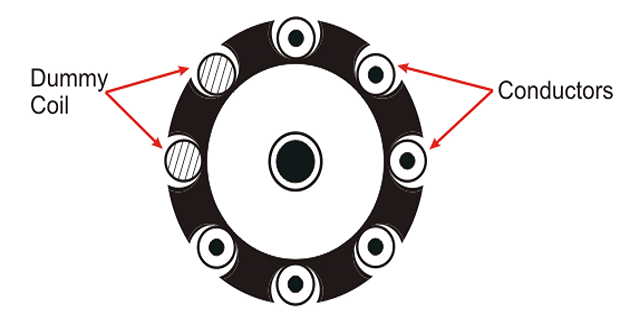
Problem. A 4-pole machine is to be wave-wound, and the only stamping available has 18 slots taking two coil sides each. Show that the winding is impossible as it stands, and find the remedy.
As it stands. Eighteen slots with two coil sides each give 18 coils, and with single-turn coils
Both fractional, so no wave winding is possible with 36 conductors on 4 poles.
The remedy. Wind only 17 coils and leave the 18th electrically unconnected:
Pitches.
Both odd \(\checkmark\). This is exactly the 34-conductor, 17-slot, 4-pole winding illustrated in Section 25-7.
Comment. One coil out of eighteen — about 5.6 % of the armature copper — is sacrificed to make the arithmetic work. The dummy coil still sits in its slot, taped and wedged exactly like the others, so that the rotor remains balanced and the slot loading uniform; only its ends are left unconnected to the commutator.
Advantages and Disadvantages of Wave
Only two brushes are required, though more may be added to make the number equal to the poles.
If one or more brush sets make poor contact with the commutator, satisfactory operation is still possible.
Gives sparkless commutation, because it has two parallel paths irrespective of the number of poles — and therefore needs no equaliser rings.
For a given \(P\) and \(Z\) it gives more EMF than a lap winding, so it is used in high-voltage, low-current machines. It suits small generators rated at about 500–600 V.
Cannot be used in machines of high current rating, because it has only two parallel paths.
Each path carries half the armature current, so the reactance voltage is higher for the same total current (Chapter 23).
Possible only for particular conductor counts, sometimes requiring dummy coils.
The wave winding is said to give sparkless commutation, yet Chapter 23 showed its reactance voltage is higher than a lap winding's. Both are true, and they refer to different effects.
Sparkless here means free from the circulating-current sparking of Section 25-4. Having only two paths, each passing under every pole, a wave winding cannot develop unequal path EMFs and so needs no equalisers.
Higher reactance voltage refers to the commutation of the individual coil, where \(E_r \propto I_a/A\), so halving the number of paths doubles it.
A wave winding avoids one cause of sparking and worsens another — which is precisely why it is chosen for high-voltage, low-current machines, where the second effect is small.
Comparison and Selection
| Feature | Lap winding | Wave winding |
|---|---|---|
| Parallel paths \(A\) | \(mP\) | 2 (for simplex) |
| Conductors per path | \(Z/mP\) | \(Z/2\) |
| Brush sets | \(P\) | 2 (more may be added) |
| Commutator pitch | \(Y_C = \pm m\) | \(Y_C = Y_A\) |
| Resultant pitch | \(Y_B - Y_F = 2m\) | \(Y_B + Y_F\) |
| Coils overlap? | Yes — consecutive coils lap | No — coils progress round |
| EMF for given \(Z\), \(P\) | Lower | Higher, by \(P/2\) |
| Current capability | Higher | Lower |
| Equaliser rings | Required | Not required |
| Dummy coils | Never needed | Sometimes needed |
| Possible for any \(Z\)? | Yes | No — \(Y_A\) must be an integer |
| Reactance voltage | Lower (\(\propto 1/A\)) | Higher |
| Typical duty | Low voltage, high current | High voltage, low current |


Because both windings deliver the same power from the same armature, the choice is never about capability but about packaging:
A useful rule of thumb: a wave winding is preferred up to about 500–600 V and moderate current; beyond a few hundred amperes a lap winding becomes necessary, and beyond that a duplex lap.
Problem. A 6-pole armature has 360 conductors, a flux of 20 mWb per pole and runs at 1000 rev/min. Each conductor may carry 15 A. Compare the terminal voltage, armature current and output for a simplex lap and a simplex wave winding.
Lap winding (\(A = P = 6\)):
Wave winding (\(A = 2\)):
| Winding | \(A\) | EMF | Current | Output |
|---|---|---|---|---|
| Simplex lap | 6 | 120 V | 90 A | 10.8 kW |
| Simplex wave | 2 | 360 V | 30 A | 10.8 kW |
Comment. Identical output, as it must be — the same copper cut by the same flux at the same speed converts the same power. The wave winding gives three times the voltage at a third of the current, the factor being \(P/2 = 3\).
The choice follows from the load. A 110 V lighting supply wants the lap winding; a 350 V traction motor wants the wave. And a machine needing 10.8 kW at 24 V would need duplex lap, since even simplex lap could not carry 450 A on six paths.
Summary and Key Formulas
In a lap winding consecutive coils overlap, both ends of a coil going to adjacent segments. It has \(A = mP\) paths, \(Z/mP\) conductors per path, and \(P\) brush sets.
Multiplicity \(m\) is 1 for simplex, 2 for duplex. Multiplexing raises the path count and lowers both the EMF and the reactance voltage.
Lap pitches: \(Y_B = Y_A + m\), \(Y_F = Y_A - m\), \(Y_R = 2m\), \(Y_C = \pm m\), with \(Y_A \approx Z/P\) — and both \(Y_B\) and \(Y_F\) must be odd.
Unequal path EMFs in a lap winding drive circulating currents, causing heating, sparking and vibration. Equaliser rings at the back of the armature give them a path away from the brushes; up to \(2C/P\) may be fitted.
In a wave winding coils progress round the armature, giving \(A = 2\) paths of \(Z/2\) conductors and needing only 2 brush sets.
Wave pitches: \(Y_R = Y_B + Y_F\), \(Y_C = Y_A\), and \(Y_A = (Z \pm 2)/P\) which must be an integer — so wave windings are not possible for every conductor count.
Dummy coils fill surplus slots for mechanical balance when the available stamping does not satisfy the integer condition; they are not electrically connected.
A wave winding needs no equalisers, because each path passes under every pole and averages any inequality automatically.
Both windings give the same output power; wave gives \(P/2\) times the voltage at \(2/P\) times the current.
Lap for high current, wave for high voltage.
| Quantity | Lap | Wave |
|---|---|---|
| Parallel paths | \(A = mP\) | \(A = 2m\) (2 for simplex) |
| Average pitch | \(Y_A \approx Z/P\) | \(Y_A = \dfrac{Z \pm 2}{P}\), integer |
| Back pitch | \(Y_B = Y_A + m\) | \(Y_B \approx Y_A\), odd |
| Front pitch | \(Y_F = Y_A - m\) | \(Y_F = 2Y_A - Y_B\), odd |
| Resultant pitch | \(Y_R = Y_B - Y_F = 2m\) | \(Y_R = Y_B + Y_F = 2Y_A\) |
| Commutator pitch | \(Y_C = \pm m\) | \(Y_C = Y_A\) |
| Conductors per path | \(Z/mP\) | \(Z/2\) |
| Brush sets | \(P\) | 2 |
| Equaliser rings | up to \(2C/P\) | none |
| Parity rule | \(Y_B\) and \(Y_F\) both odd in every double-layer winding | |
Common Mistakes
Taking \(Y_A = Z/P\) as exact for lap windings. It is a starting value; the parity check on \(Y_B\) and \(Y_F\) may force an adjustment.
Subtracting the pitches for a wave winding. Wave adds (\(Y_R = Y_B + Y_F\)); lap subtracts.
Forgetting the integer condition for wave windings. If \((Z \pm 2)/P\) is fractional the winding is impossible and a dummy coil is needed.
Getting \((Z-2)/P\) wrong. For \(Z = 8\), \(P = 4\) the two values are \(2\tfrac{1}{2}\) and \(1\tfrac{1}{2}\) — not \(3\tfrac{1}{2}\).
Confusing the multiplicity \(m\) with the number of equaliser rings. They are unrelated quantities that some texts unfortunately give the same symbol.
Thinking a dummy coil contributes EMF. It is electrically disconnected and serves only mechanical balance.
Assuming wave windings need equalisers. They do not — each path already spans every pole.
Expecting lap and wave to give different power. They give the same watts, differently packaged.
Thinking a wave winding always commutates better. It avoids circulating-current sparking but has a higher reactance voltage per coil.
Using \(Z\) where \(C\) is meant in the equaliser count. They agree only for single-turn coils.
Chapter Review
For every winding, check the parity of \(Y_B\) and \(Y_F\) before accepting an answer — and for wave windings check the integer condition first of all.
P25.1 A 6-pole armature has 48 conductors, simplex lap. Find all pitches and the number of paths.
Show answer
Both odd \(\checkmark\)\[Y_A \approx \frac{48}{6} = 8, \qquad Y_B = 8 + 1 = 9, \qquad Y_F = 8 - 1 = 7\]\[Y_R = 2, \qquad Y_C = \pm 1, \qquad A = mP = 6, \qquad \frac{Z}{A} = 8 \text{ conductors/path}\]P25.2 Repeat P25.1 for a duplex lap winding.
Show answer
With \(Y_A = 8\): \(Y_B = 10\), \(Y_F = 6\) — both even, invalid. Adjust to \(Y_A = 9\):\[Y_B = 11, \qquad Y_F = 7 \quad\text{- both odd} \ \checkmark\]\[Y_R = 4, \qquad Y_C = \pm 2, \qquad A = mP = 12, \qquad \frac{48}{12} = 4 \text{ conductors/path}\]P25.3 Is a simplex wave winding possible with 4 poles and 32 conductors? If so, find the pitches.
Show answer
Both fractional, so no wave winding is possible with 32 conductors on 4 poles. A dummy coil is required: using 30 conductors gives \(Y_A = (30+2)/4 = 8\), an integer.\[Y_A = \frac{32 \pm 2}{4} = \frac{34}{4} = 8.5 \quad\text{or}\quad \frac{30}{4} = 7.5\]P25.4 A 6-pole armature has 42 conductors. Find the wave-winding pitches.
Show answer
Neither is an integer, so the winding is impossible. With 40 conductors, \(Y_A = (40+2)/6 = 7\) \(\checkmark\), giving \(Y_B + Y_F = 14\) and \(Y_B = Y_F = 7\).\[Y_A = \frac{42 \pm 2}{6} = \frac{44}{6} = 7.33 \quad\text{or}\quad \frac{40}{6} = 6.67\]P25.5 A 4-pole lap generator has 60 coils. Find the maximum number of equaliser rings.
Show answer
In practice about one-third would be fitted, so roughly 10.\[\frac{2C}{P} = \frac{(2)(60)}{4} = 30 \text{ rings}\]P25.6 A 6-pole lap machine rated 400 V, 300 A has paths of resistance 0.06 \(\Omega\). One path generates 1.5 % more EMF than another. Find the circulating current.
Show answer
\[\Delta E = (0.015)(400) = 6.0~\mathrm{V}, \qquad R_{\text{loop}} = (2)(0.06) = 0.12~\Omega\]\[I_{\text{circ}} = \frac{6.0}{0.12} = 50~\mathrm{A} = 16.7\,\%\ \text{of rating}\]P25.7 An 8-pole armature has 400 conductors, 30 mWb per pole, at 600 rev/min. Compare the EMF for lap and wave windings.
Show answer
\[\Phi PNZ = (0.030)(8)(600)(400) = 57\,600\]The ratio is \(P/2 = 4\).\[E_{\text{lap}} = \frac{57\,600}{(60)(8)} = 120~\mathrm{V}, \qquad E_{\text{wave}} = \frac{57\,600}{(60)(2)} = 480~\mathrm{V}\]P25.8 Explain why a wave winding needs no equaliser rings.
Show answer
Equalisers are needed when parallel paths generate unequal EMFs. In a lap winding each path lies under one particular pair of poles, so any inequality between poles appears directly as an inequality between paths.In a wave winding each of the two paths travels right round the armature and passes under every pole in turn. Both paths therefore see the same average field, whatever the individual poles do, and no difference in EMF can arise. The winding equalises itself by its own geometry.
P25.9 A machine must deliver 20 kW at 240 V. Each conductor path may carry 20 A. Would a 4-pole simplex lap winding suffice?
Show answer
\[I_a = \frac{20\,000}{240} = 83.3~\mathrm{A}\]Just insufficient — 80 A against the 83.3 A required. The options are a duplex lap winding (\(A = 8\), giving 160 A), a machine with more poles, or heavier conductors.\[\text{simplex lap capability} = A \times 20 = (4)(20) = 80~\mathrm{A}\]A wave winding would be far worse, offering only \((2)(20) = 40\) A.
P25.10 Why does a duplex lap winding reduce the reactance voltage, and what does it cost?
Show answer
From Chapter 23, \(E_r = L\,(2I_a/A)/T_c\), so \(E_r \propto 1/A\). Doubling the multiplicity doubles \(A\) from \(P\) to \(2P\) and therefore halves the reactance voltage, easing commutation on a high-current machine.The costs: the EMF halves for the same \(Z\), so more conductors are needed for a given voltage; the winding may be double re-entrant, requiring brushes wide enough to tap both windings; and more equaliser rings are needed, since there are now more paths that can disagree.
MCQ 1. In a simplex lap winding the number of parallel paths is:
(a) 2 (b) \(P\) (c) \(2P\) (d) \(Z/2\)Show answer
(b) \(P\), since \(A = mP\) with \(m = 1\).MCQ 2. For a duplex lap winding, \(A\) equals:
(a) \(P\) (b) \(2P\) (c) \(P/2\) (d) 2Show answer
(b) \(2P\) — twice the number of poles.MCQ 3. The commutator pitch of a lap winding is:
(a) \(\pm m\) (b) \(Y_A\) (c) \(Z/P\) (d) \(2m\)Show answer
(a) \(\pm m\), so \(\pm 1\) for a simplex winding.MCQ 4. The resultant pitch of a lap winding equals:
(a) \(Y_B + Y_F\) (b) \(2m\) (c) \(Y_A\) (d) \(Z/P\)Show answer
(b) \(2m\), being \(Y_B - Y_F\) and always even.MCQ 5. Equaliser rings are required in:
(a) lap windings (b) wave windings (c) both (d) neitherShow answer
(a) lap windings, whose paths lie under different pole pairs and so may generate unequal EMFs.MCQ 6. Circulating currents in a lap winding cause:
(a) higher EMF (b) heating, sparking and vibration (c) better commutation (d) no effectShow answer
(b) excessive heating, sparking at the brushes and mechanical vibration.MCQ 7. For a simplex wave winding the average pitch is:
(a) \(Z/P\) (b) \((Z \pm 2)/P\) (c) \(\pm 1\) (d) \(2Z/P\)Show answer
(b) \((Z \pm 2)/P\), and it must be an integer.MCQ 8. Dummy coils are used to:
(a) increase the EMF (b) provide mechanical balance (c) reduce the current (d) equalise path EMFsShow answer
(b) provide mechanical balance. They are not electrically connected.MCQ 9. For the same \(Z\) and \(P\), a wave winding gives an EMF greater than lap by a factor:
(a) 2 (b) \(P\) (c) \(P/2\) (d) \(2/P\)Show answer
(c) \(P/2\), the ratio of the parallel-path counts.MCQ 10. A machine for very high current and low voltage should use:
(a) simplex wave (b) duplex wave (c) lap (d) Gramme-ringShow answer
(c) lap, and a duplex lap if the current is very large, since more paths share the current.
Describe the lap connection and explain geometrically why it gives as many paths as poles.
Define multiplicity and explain what is gained and lost by using a duplex winding.
Set out the procedure for finding the four lap pitches, explaining the role of the parity check.
Explain why circulating currents arise in a lap winding and how equaliser rings deal with them.
Describe the wave connection and explain why it has only two paths whatever the pole count.
Explain the integer condition on the average pitch and the role of dummy coils.
Explain why a wave winding needs no equalisers yet has a higher reactance voltage than a lap winding.
Given a required voltage and current, explain how you would choose between lap and wave.
The armature is now fully specified — its core, its coils, its winding and its commutator. Chapter 26 returns to the classification of Chapter 20 and develops the types of DC machine and their applications: separately excited, shunt, series and compound, each with the duties it suits.
From Chapter 27 the quantitative analysis begins in earnest with the EMF equation of a DC generator, in which the parallel-path count \(A\) established here appears directly — \(A = mP\) for lap, 2 for wave. Chapter 28 then takes up voltage build-up in a self-excited generator and the critical field resistance below which it will not build up at all.
The equaliser rings of Section 25-4 return in Chapter 30, when armature reaction distorts the field and makes the poles genuinely unequal under load — the condition that makes circulating currents worst.