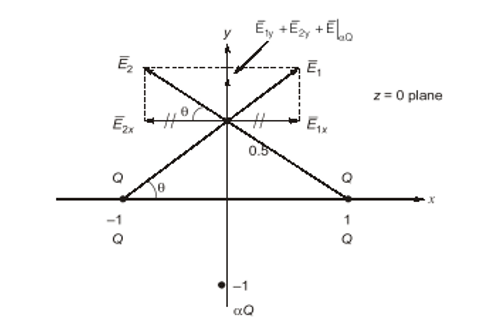
In the \((x, y, z)\) coordinate system, three point-charges \(Q, Q\) and \(\alpha Q\) are located in free space at \((-1, 0, 0)\), \((1, 0, 0)\) and \((0, -1, 0)\) respectively. The value of \(\alpha\) for the electric field to be zero at \((0, 0.5, 0)\) is ________ (rounded off to 1 decimal place).
Solution
Vector diagram showing field cancellation at \(y=0.5\)
From the figure, for the net Electric Field to be zero:
The given equation represents a magnetic field strength \(\bar{H}(r, \theta, \phi)\) in the spherical coordinate system, in free space. Here, \(\hat{r}\) and \(\hat{\theta}\) represent the unit vectors along \(r\) and \(\theta\), respectively. The value of \(P\) in the equation should be ________ (rounded off to the nearest integer).
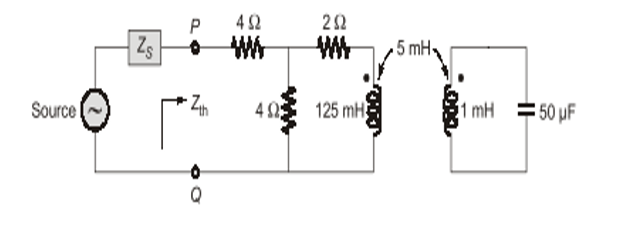
For the circuit shown in the figure, the source frequency is \(5000\) rad/sec. The mutual inductance between the magnetically coupled inductors is \(5\) mH with their self inductances being \(125\) mH and \(1\) mH. The Thevenin's impedance, \(Z_{\text{th}}\), between the terminals \(P\) and \(Q\) in \(\Omega\) is ________ (rounded off to 2 decimal places).
Main Circuit Diagram
Solution
Given: \(\omega = 5000\) rad/sec.
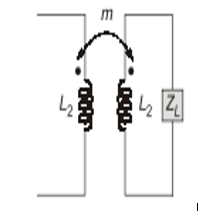
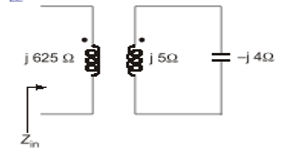
First, we analyze the input impedance of the transformer section.
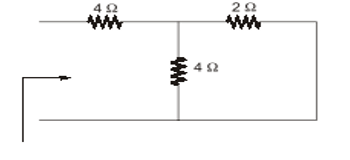
Since the input impedance of the coupled section is \(0 \, \Omega\), it acts as a short circuit. We can replace the transformer section with a wire. The circuit simplifies to a resistive network to find \(Z_{\text{th}}\) across terminals P and Q.
Resulting Resistive Network
Looking into terminals P-Q, we have the \(4\Omega\) resistor in parallel with the \(2\Omega\) resistor, and that combination is in series with the other \(4\Omega\) resistor.