Solved GATE Paper

GATE 2025 Electromagnetic Fields Questions and Solutions

Instructor: Prof. Mithun Mondal Institution: BITS Pilani Subject: Electromagnetic Fields
Question 01

Question 1

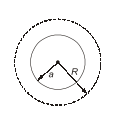
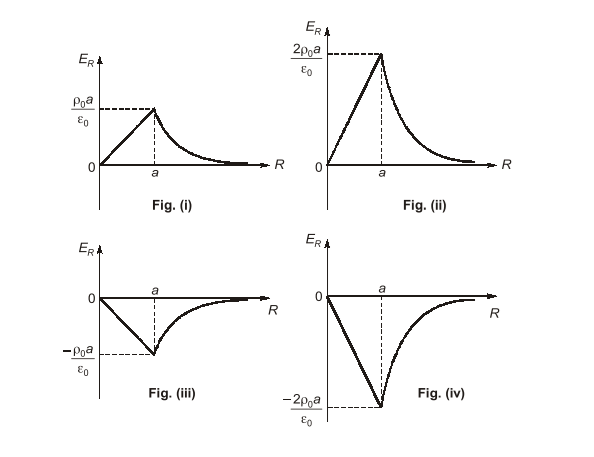
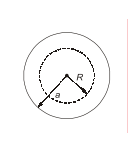
Which one of the following figures represents the radial electric field distribution \(E_R\) caused by a spherical cloud of electrons with a volume charge density \(\rho = -3\rho_0\) for \(0 \le R \le a\) (both \(\rho_0, a\) are positive and \(R\) is the radial distance) and \(\rho = 0\) for \(R > a\)?

GATE 2025 Electromagnetic Fields Q1 figure
  1. Fig. (i)
  2. Fig. (ii)
  3. Fig. (iii)
  4. Fig. (iv)

Solution

Given:

Equation
\[\rho_V = \begin{cases} -3\rho_0 \text{ C/m}^3 & 0 \le R \le a \\ 0 & R > a \end{cases}\]

Case (i): \(\boldsymbol{R \le a}\)

Equation
\[\begin{aligned} \oint \bar{D} \cdot d\bar{S} &= Q_{\text{enc}} = \int \rho_v dv \\ Q_{\text{enc}} &= -3\rho_0 \int_{0}^R R^2 dR \int_{0}^{\pi} \sin\theta d\theta \int_{0}^{2\pi} d\phi \\ &= -3\rho_0 \cdot \left[\frac{R^3}{3}\right]_0^R \cdot [-\cos\theta]_0^{\pi} \cdot [\phi]_0^{2\pi} \\ &= -\rho_0 R^3 \cdot (2) \cdot (2\pi) \\ &= -(4\pi R^3)\rho_0 \\[10pt] \text{From Gauss's Law: } & \\ D \cdot 4\pi R^2 &= -4\pi R^3 \rho_0 \\ D &= -\rho_0 R \\ E &= \frac{D}{\epsilon_0} = -\frac{\rho_0 R}{\epsilon_0} \\ \therefore \quad \bar{E} &= -\frac{\rho_0 R}{\epsilon_0} \hat{a}_r \end{aligned}\]
GATE 2025 Electromagnetic Fields Q1 figure

Case (ii): \(\boldsymbol{R > a}\)

Equation
\[\begin{aligned} Q_{\text{enc}} &= \int \rho_v dv \quad (\text{limit } R \text{ goes to } a) \\ &= -3\rho_0 \int_{0}^a R^2 dR \int_{0}^{\pi} \sin\theta d\theta \int_{0}^{2\pi} d\phi \\ &= -3\rho_0 \cdot \frac{a^3}{3} \cdot 2 \cdot 2\pi \\ &= -4\pi a^3 \rho_0 \\[10pt] \text{From Gauss's Law: } & \\ D \cdot 4\pi R^2 &= -4\pi a^3 \rho_0 \\ D &= -\frac{\rho_0 a^3}{R^2} \\ \therefore \quad \bar{E} &= \frac{-\rho_0 a^3}{\epsilon_0 R^2} \hat{a}_R \end{aligned}\]
GATE 2025 Electromagnetic Fields Q1 figure

Final Result:

Equation
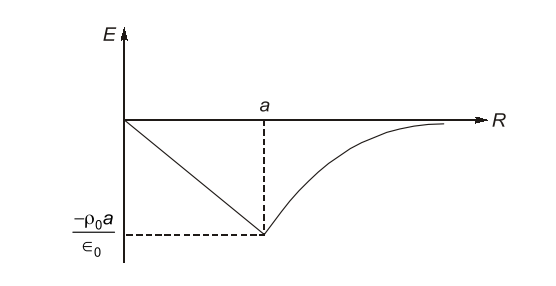
\[\bar{E} = \begin{cases} \dfrac{-\rho_0 R}{\epsilon_0} \hat{a}_r, & 0 \le R \le a \\[15pt] \dfrac{-\rho_0 a^3}{\epsilon_0 R^2} \hat{a}_r, & R > a \end{cases}\]

Graph:

GATE 2025 Electromagnetic Fields Q1 figure
C
Final Answer
Correct answer: C.
Question 02

Question 2

Let \(a_R\) be the unit radial vector in the spherical co-ordinate system. For which of the following value(s) of \(n\), the divergence of the radial vector field \(f(R) = a_R \frac{1}{R^n}\) is independent of \(R\)?

  1. \(-2\)
  2. \(-1\)
  3. \(1\)
  4. \(2\)

Solution

Given: \(\bar{f}(R) = \frac{1}{R^n} \hat{a}_R\)

In spherical coordinates, the divergence is given by:

Equation
\[\begin{aligned} \nabla \cdot \bar{f} &= \frac{1}{R^2} \frac{\partial}{\partial R} \left( R^2 f_R \right) \\ &= \frac{1}{R^2} \left[ \frac{\partial}{\partial R} \left( R^2 \cdot \frac{1}{R^n} \right) \right] \\ &= \frac{1}{R^2} \left[ \frac{\partial}{\partial R} (R^{2-n}) \right] \\ &= \frac{1}{R^2} \left[ (2-n)R^{2-n-1} \right] \\ &= (2-n)R^{1-n} \cdot R^{-2} \\ &= (2-n)R^{-n-1} \end{aligned}\]

For \(\nabla \cdot \bar{f}\) to be independent of \(R\), the term containing \(R\) must effectively disappear (become a constant or zero).

Case 1: The coefficient is zero

Equation
\[2 - n = 0 \quad \Rightarrow \quad n = 2\]

If \(n=2\), \(\nabla \cdot \bar{f} = 0\), which is a constant (independent of \(R\)).

Case 2: The exponent is zero

Equation
\[-n - 1 = 0 \quad \Rightarrow \quad n = -1\]

If \(n=-1\), \(R^{-n-1} = R^0 = 1\). Then \(\nabla \cdot \bar{f} = (2 - (-1)) \cdot 1 = 3\), which is a constant.

Therefore, the values are -1 and 2.

Final Answer
Correct answers: B, D.
Question 03

Question 3

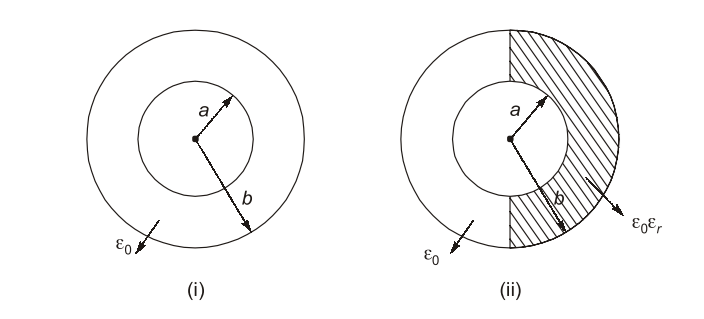
An air filled cylindrical capacitor (capacitance \(C_0\)) of length \(L\), with \(a\) and \(b\) as its inner and outer radii, respectively, consists of two coaxial conducting surfaces. Its cross-sectional view is shown in Figure (i). In order to increase the capacitance, a dielectric material of relative permittivity \(\epsilon_r\) is inserted inside 50% of the annular region as shown in figure (ii). The value of \(\epsilon_r\) for which the capacitance of the capacitor in figure (ii) becomes \(5C_0\) is:
Figures (i) and (ii)
  1. 4
  2. 5
  3. 9
  4. 10

Solution

GATE 2025 Electromagnetic Fields Q3 figure

The formula for a cylindrical capacitor is:

Equation
\[C_0 = \frac{2\pi\epsilon_0 L}{\ln\left(\frac{b}{a}\right)}\]

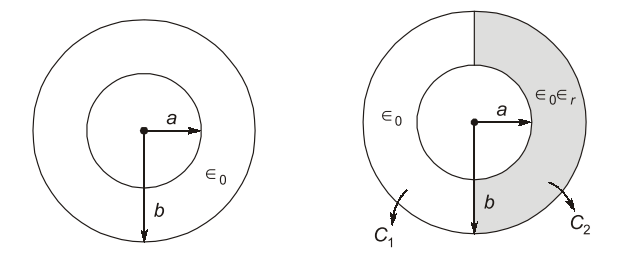
In Figure (ii), the capacitor is split into two parallel parts (each occupying half the circumference/volume):

  1. \(C_1\): Air-filled half (\(50\%\) of volume)
  2. \(C_2\): Dielectric-filled half (\(50\%\) of volume)

The equivalent capacitance for parallel capacitors is \(C_{\text{eq}} = C_1 + C_2\).

Equation
\[\begin{aligned} C_1 &= \frac{1}{2} \left( \frac{2\pi\epsilon_0 L}{\ln(b/a)} \right) = \frac{\pi\epsilon_0 L}{\ln(b/a)} \\[10pt] C_2 &= \frac{1}{2} \left( \frac{2\pi\epsilon_0 \epsilon_r L}{\ln(b/a)} \right) = \frac{\pi\epsilon_0 \epsilon_r L}{\ln(b/a)} \end{aligned}\]

Total Capacitance:

Equation
\[C_{\text{eq}} = \frac{\pi\epsilon_0 L}{\ln(b/a)} (1 + \epsilon_r)\]

Note that \(C_0 = \frac{2\pi\epsilon_0 L}{\ln(b/a)}\), so \(\frac{\pi\epsilon_0 L}{\ln(b/a)} = \frac{C_0}{2}\).

Equation
\[C_{\text{eq}} = \frac{C_0}{2} (1 + \epsilon_r)\]

Given Condition: \(C_{\text{eq}} = 5C_0\)

Equation
\[\begin{aligned} 5C_0 &= \frac{C_0}{2} (1 + \epsilon_r) \\ 10 &= 1 + \epsilon_r \\ \epsilon_r &= 9 \end{aligned}\]
C
Final Answer
Correct answer: C.
Previous2024
GATE Electromagnetic Fields