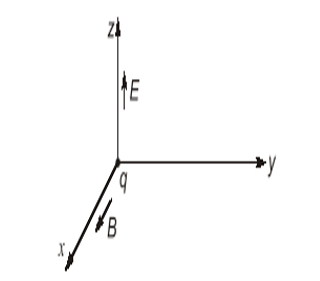
In the figure, the electric field \(E\) and the magnetic field \(B\) point to \(x\) and \(z\) directions, respectively, and have constant magnitudes. A positive charge `\(q\)' is released from rest at the origin. Which of the following statement(s) is/are true?
The charge will move in the direction of \(\mathbf{z}\) with constant velocity.
The charge will always move on the \(\mathbf{y}\)-\(\mathbf{z}\) plane only.
The trajectory of the charge will be a circle.
The charge will progress in the direction of \(\mathbf{y}\).
✓
Final Answer
Marks to all candidates (per official GATE key).
Question 02
Question 2
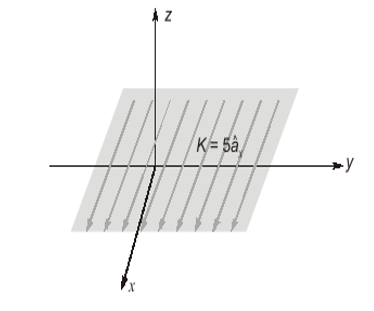
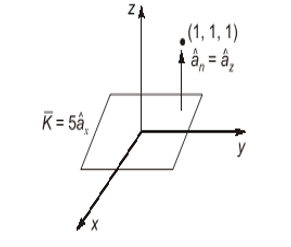
An infinite surface of linear current density \(\hat{K} = 5\hat{a}_x\) A/m exists on the \(x\)-\(y\) plane, as shown in the figure. The magnitude of the magnetic field intensity \((\mathbf{H})\) at a point \((1,1,1)\) due to the surface current in Ampere/meter is ________ (Round off to 2 decimal places).
Solution
The magnetic field due to an infinite sheet current is given by:
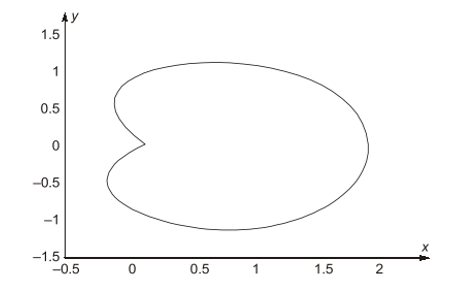
The closed curve shown in the figure is described by \(r = 1 + \cos\theta\), where \(r = \sqrt{x^2 + y^2}\); \(x = r\cos\theta, y = r\sin\theta\). The magnitude of the line integral of the vector field \(F = -y\hat{i} + x\hat{j}\) around the closed curve is ________ (Round off to 2 decimal places).
Solution
Curve \(C\) is given by \(r = (1 + \cos\theta)\). We need to find: