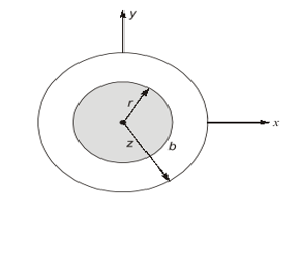
A long conducting cylinder having a radius \(b\) is placed along the \(z\)-axis. The current density is \(\vec{J} = J_a r^3 \hat{z}\) for the region \(r < b\) where \(r\) is the distance in the radial direction.
The magnetic field intensity \((\vec{H})\) for the region inside the conductor (i.e., for \(r < b\)) is:
Cross-section of the cylinder
\(\frac{J_a r^4}{4}\)
\(\frac{J_a r^3}{3}\)
\(\frac{J_a r^4}{5}\)
\(J_a r^3\)
Solution
Given:
Equation
\[\vec{J} = J_a r^3 \hat{z}\]
To find the current enclosed (\(I\)):
Equation
\[\begin{aligned}
I &= \int_S \vec{J} \cdot d\vec{s}; \quad \text{where } d\vec{s} = r dr d\phi \hat{z} \\
\Rightarrow I &= \int (J_a r^3 \hat{z}) \cdot (r dr d\phi \hat{z}) \\
&= J_a \int_{0}^{r} r^4 dr \int_{0}^{2\pi} d\phi \\
&= J_a \left[ \frac{r^5}{5} \right]_0^r \cdot [\phi]_0^{2\pi} \\
&= \frac{J_a (2\pi) r^5}{5}
\end{aligned}\]
If the magnetic field intensity \((\vec{H})\) in a conducting region is given by the expression \(\vec{H} = x^2\hat{i} + x^2y^2\hat{j} + x^2y^2z^2\hat{k}\) A/m, the magnitude of the current density, in A/m\(^2\), at \(x = 1\) m, \(y = 2\) m, and \(z = 1\) m is:
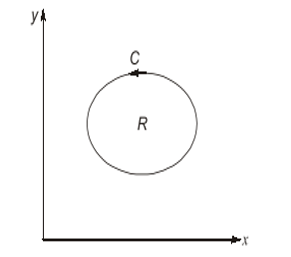
Let \(R\) be a region in the first quadrant of the \(xy\) plane enclosed by a closed curve \(C\) considered in counter-clockwise direction. Which of the following expressions does not represent the area of the region \(R\)?
\(\iint_R dx dy\)
\(\oint_C x dy\)
\(\oint_C y dx\)
\(\frac{1}{2} \oint_C (x dy - y dx)\)
Solution
We evaluate the area using Green's Theorem: \(\oint P dx + Q dy = \iint (\frac{\partial Q}{\partial x} - \frac{\partial P}{\partial y}) dA\). The area is \(\iint dA\).
\(\iint_R dx dy\): This is the standard definition of the Area of region \(R\).
\(\oint_C x dy\): Here \(P=0, Q=x\).
Equation
\[\iint_R \left(\frac{\partial x}{\partial x} - \frac{\partial 0}{\partial y}\right) dA = \iint_R (1) dA = \text{Area}\]
\(\oint_C y dx\): Here \(P=y, Q=0\).
Equation
\[\iint_R \left(\frac{\partial 0}{\partial x} - \frac{\partial y}{\partial y}\right) dA = \iint_R (-1) dA = -\text{Area}\]
This represents the negative area.
\(\frac{1}{2} \oint_C (x dy - y dx)\):
Equation
\[\frac{1}{2} \iint_R [1 - (-1)] dA = \frac{1}{2} \iint_R 2 dA = \text{Area}\]
C
Final Answer
Correct answer: C.
Question 04
Question 4
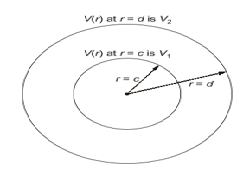
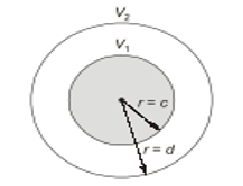
As shown in the figure below, two concentric conducting spherical shells, centred at \(r = 0\) and having radii \(r = c\) and \(r = d\) are maintained at potentials such that the potential \(V(r)\) at \(r = c\) is \(V_1\) and \(V(r)\) at \(r = d\) is \(V_2\). Assume that \(V(r)\) depends only on \(r\). The expression for \(V(r)\) in the region between \(r = c\) and \(r = d\) is:
\(V(r) = \frac{cd(V_2 - V_1)}{(d-c)r} - \frac{V_1 c + V_2 d - 2V_1 d}{d-c}\)