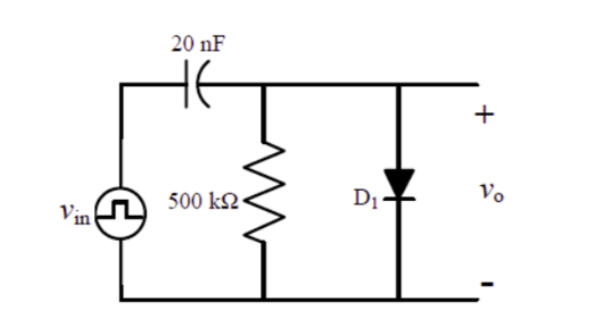
An asymmetrical periodic pulse train \( v_{in} \) of 10 V amplitude with on-time \( T_{ON} = 1\,ms \) and off-time \( T_{OFF} = 1\,s \) is applied to the circuit shown in the figure. The diode \( D1 \) is ideal. The difference between the maximum voltage and minimum voltage of the output waveform \( v_o \) in integer is V.
GATE 2021 Analog Electronics Q1 diode circuit diagram
Solution
In steady state, the capacitor charges to the peak input voltage when the diode is forward biased (ideal diode acts as a short).
Equation
\[V_C = V_{in,peak} = 10\,V\]
The output voltage is given by KVL:
Equation
\[V_{out} = V_{in} - V_C\]
During the ON time (\(T_{ON}\)), \(V_{in} = 10\,V\):
Equation
\[V_{out} = 10 - 10 = 0\,V\]
During the OFF time (\(T_{OFF}\)), \(V_{in} = 0\,V\) (assuming pulse goes 0 to 10V):
Equation
\[V_{out} = 0 - 10 = -10\,V\]
The difference between max and min output voltage:
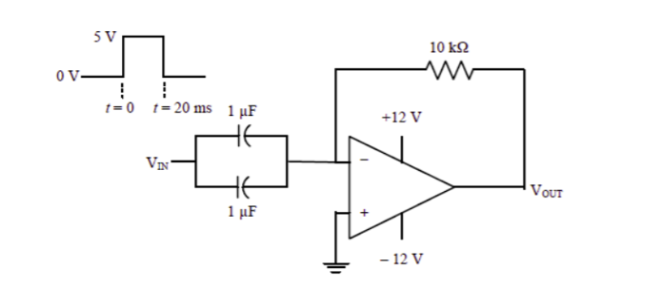
A circuit with an ideal op-amp is shown below. A pulse \( V_{IN} \) of 5 V amplitude and 20 ms duration is applied at the input and the capacitors are initially uncharged. The output voltage \( V_{OUT} \) at \( t = 0^{+} \), in integer, is \(\underline{\qquad}\) V.
GATE 2021 Analog Electronics Q2 capacitor circuit diagram
Solution
Both capacitors are uncharged at \( t = 0^{-} \), so at \( t = 0^{+} \) each holds zero volts and behaves as a short circuit. The path from \( V_{IN} \) to the inverting terminal then has zero impedance while the feedback element is the 10 k\(\Omega\) resistor.
The amplifier cannot hold the virtual ground, so with \( V_{IN} = +5\,V \) the output is driven hard to the negative rail.
Equation
\[V_{OUT}(0^{+}) = -12\,V\]
✓
Final Answer
Correct answer: \( -12\,V \)
Question 03
Question 3
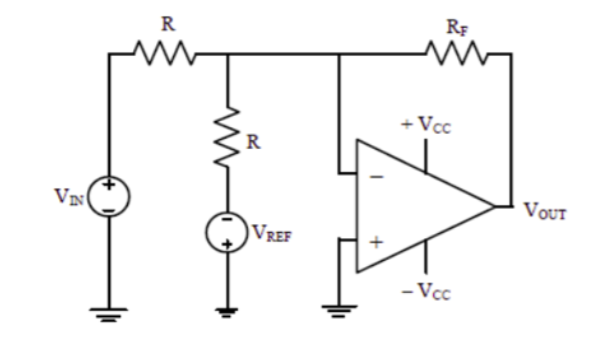
For the circuit with an ideal op-amp shown below, \( V_{REF} \) is fixed. If \( V_{OUT} = 1\,V \) for \( V_{IN} = 0.1\,V \) and \( V_{OUT} = 6\,V \) for \( V_{IN} = 1\,V \), the value of \( \frac{R_F}{R_{IN}} \) is \(\underline{\qquad}\) (rounded off to two decimal places).
GATE 2021 Analog Electronics Q3 circuit diagram
Solution
The stage is linear, so \( V_{OUT} \) is an affine function of \( V_{IN} \) in which the fixed \( V_{REF} \) contributes only a constant offset:
Equation
\[V_{OUT} = \pm\frac{R_F}{R_{IN}}V_{IN} + K, \qquad K = K(V_{REF})\]
Subtracting the two operating points eliminates \( K \), leaving the slope alone: