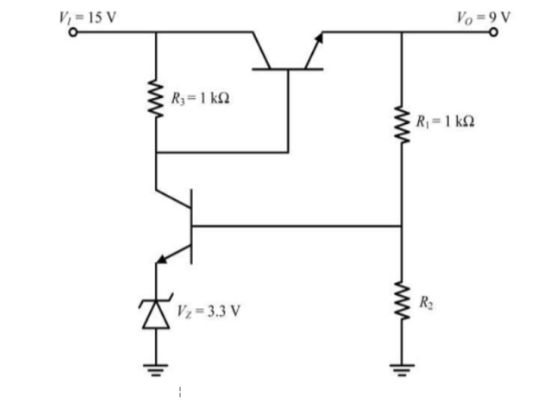
In the voltage regulator shown below, \( V_i \) is the unregulated voltage at 15 V. Assume \( V_{BE} = 0.7\,V \) and the base current is negligible for both BJTs. If the regulated output \( V_O = 9\,V \), find the value of \( R_2 \).
GATE 2020 Analog Electronics Q1 BJT circuit diagram
Solution
[Image of voltage regulator circuit analysis]
The emitter of the error-amplifier BJT is clamped by the Zener at \(V_Z = 3.3\,V\) and its base is driven from the \(R_1\)-\(R_2\) divider across \(V_O\). In regulation the base sits one \(V_{BE}\) above the emitter:
Equation
\[V_{tap} = V_Z + V_{BE} = 3.3 + 0.7 = 4\,V\]
With \(V_O = 9\,V\) applied across \(R_1 = 1\,\text{k}\Omega\) in series with \(R_2\):
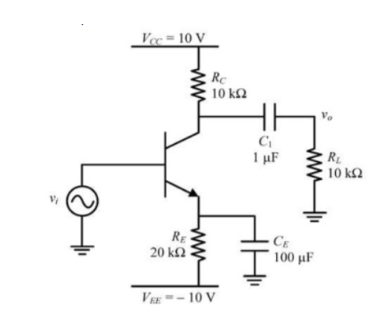
For the BJT in the amplifier shown below, \( V_{BE} = 0.7\,V \), \( \frac{kT}{q} = 26\,mV \). Assume the BJT output resistance \( r_o \) is very high and the base current is negligible. The capacitors are short-circuited at signal frequencies. The input \( v_i \) is direct coupled. Find the low-frequency gain \( \frac{v_o}{v_i} \) of the amplifier.
GATE 2020 Analog Electronics Q2 BJT circuit diagram
Solution
[Image of common emitter amplifier small signal model]
\(C_E\) bypasses \(R_E\) at signal frequencies, so the stage is a common emitter with signal load \(R_C \parallel R_L = 10\,k \parallel 10\,k = 5\,k\Omega\), and the gain is inverting:
Equation
\[|A_v| = \frac{0.465}{26} \times 5000 = 89.42\]
Equation
\[A_v = -89.42\]
Question 03
Question 3
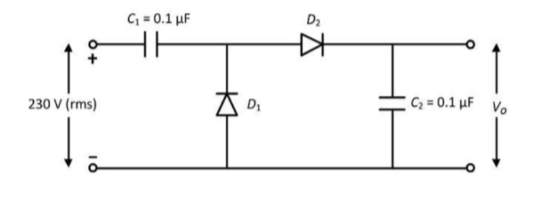
In the circuit shown below, all the components are ideal and the input voltage is sinusoidal. The magnitude of the steady-state output \( V_0 \) rounded off to two decimal places is ___ V.
GATE 2020 Analog Electronics Q3 circuit diagram
Solution
[Image of voltage doubler circuit diagram]
This is a voltage doubler circuit. Input peak voltage \(V_m = 230 \sqrt{2}\).
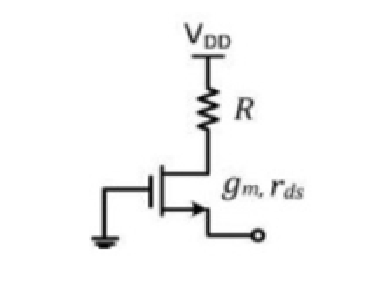
Using the incremental low-frequency small-signal model of the MOS device, find the Norton equivalent resistance of the circuit.
GATE 2020 Analog Electronics Q4 circuit diagram
Solution
The two terminals are the source and ground; the gate is grounded and \(V_{DD}\) is a small-signal ground, so \(R\) stands between drain and ground. Drive the source with a test voltage \(V_x\) that draws a test current \(I_x\), giving \(V_{gs} = -V_x\).
All of \(I_x\) flows through \(R\), so the drain sits at \(V_d = I_x R\). The channel current from drain to source is \(-I_x\):
An enhancement MOSFET of threshold voltage 3 V is used in a sample and hold circuit. The substrate is connected to -10 V. If the input voltage \( V_I \) lies between \( -10\,V \) and \( +10\,V \), find the minimum \( V_G \) for proper sampling and the maximum \( V_G \) for proper holding.
Solution
For sampling the switch must conduct for every input in the range, so \(V_{GS} > V_T\) has to hold at the worst case \(V_I = +10\,V\):
Equation
\[V_G - 10 > 3 \implies V_{G,\min} = 13\,V\]
For holding the switch must stay off for every input, so \(V_{GS} < V_T\) has to hold at the worst case \(V_I = -10\,V\):
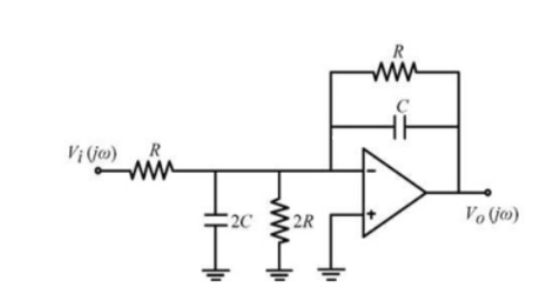
The \(2C\) and \(2R\) branches are tied to the virtual ground at the inverting terminal, so they carry no signal current and drop out of the transfer function, leaving \(\frac{V_o}{V_i} = -\frac{1}{1+j\omega RC}\).
Equation
\[f_c = 79.58\,Hz\]
Question 07
Question 7
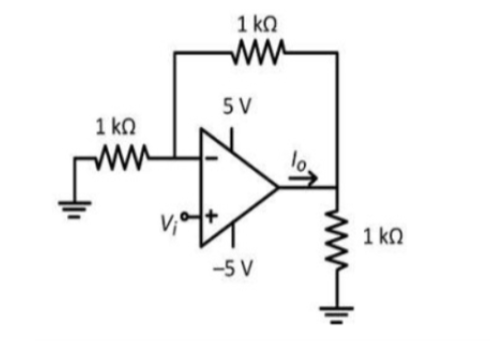
In the circuit shown below, all components are ideal. If \( V_i = 2\,V \), find the current \( I_o \) sourced by the op-amp in mA.
GATE 2020 Analog Electronics Q7 op-amp circuit diagram
Solution
[Image of non-inverting amplifier circuit analysis]
The stage is non-inverting with \( R_f = R_1 = 1\,k\Omega \), so the gain is 2:
The output node feeds two branches: the 1 k\(\Omega\) load to ground, and the 1 k\(\Omega\) feedback resistor into the inverting terminal, which the virtual short holds at \(V_i = 2\,V\).
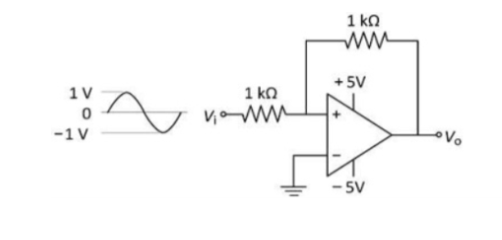
The components in the circuit below are ideal. If the op-amp is in positive feedback and the input voltage \( V_i \) is a sine wave of amplitude 1 V, find the output voltage \( V_o \).
GATE 2020 Analog Electronics Q8 op-amp circuit diagram
A non-inverted sine wave of 2 V amplitude
An inverted sine wave of 1 V amplitude
A square wave of 5 V amplitude
A constant of either 5 V or -5 V
Solution
[Image of Schmitt trigger hysteresis curve]
Given circuit is a non-inverting Schmitt Trigger (Positive Feedback). Output saturates to rail voltages:
Equation
\[V_o = \pm 5V\]
The two equal 1 k\(\Omega\) resistors place the non-inverting terminal at \(V_+ = \frac{V_i + V_o}{2}\), and the state changes when \(V_+ = 0\), that is when \(V_i = -V_o\). With \(V_o = \pm 5\,V\) the trip points are \(V_i = \mp 5\,V\).
The input is a 1 V sine, so \(|V_i|\) never reaches 5 V and no transition ever occurs. The output stays latched at whichever rail it started in, a constant \( +5\,V \) or \( -5\,V \).