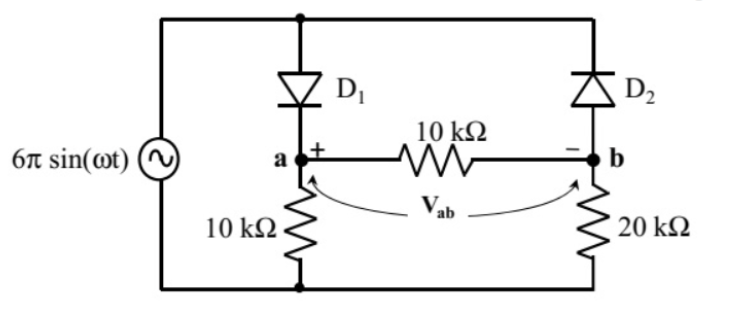
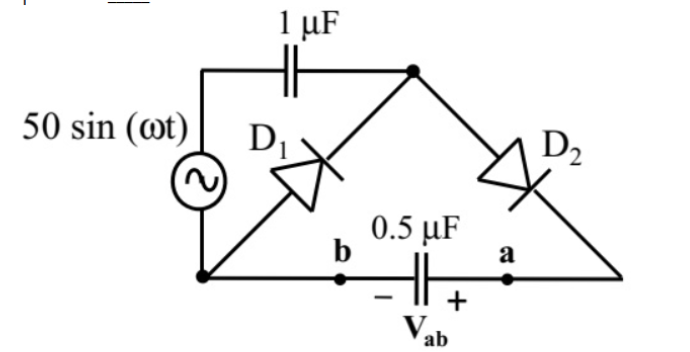
In the circuit shown, assume that the diodes D\(_1\) and D\(_2\) are ideal. The average value of voltage \(V_{ab}\) in Volts, across terminals \(a\) and \(b\) is:
GATE 2015 Analog Electronics Q1 diode circuit diagram
\(3\)
\(4\)
\(5\)
\(6\)
Solution
[Image of full wave rectifier waveform]
The diodes are ideal, so exactly one of them conducts in each half cycle and \(V_{ab}\) follows one source at a time. Over the positive half cycle \(V_{ab} = 2\pi\sin\omega t\), and over the negative half cycle \(V_{ab} = -3\pi\sin\omega t\); both are positive half-sine loops.
A half-sine loop of amplitude \(V_m\) that occupies half a period contributes \(V_m/\pi\) to the full-period average, so \[ (V_{ab})_{\text{avg}} = \frac{2\pi}{\pi} + \frac{3\pi}{\pi} = 2 + 3 = 5~\text{V} \] The average value of \(V_{ab}\) is \(5\) V, option C.
Question 02
Question 2
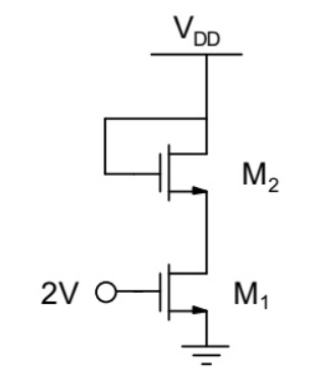
In the circuit shown, both the enhancement mode NMOS transistors have the following characteristic \(k_n = 1\,\text{mA/V}^2,\ V_{TN}=1\) V. Assume that channel length modulation parameter \(\lambda\) is zero and the body is shorted to source. The minimum supply voltage \(V_{DD}\) in volts needed to ensure that transistor \(M_2\) operates in saturation mode of operation is:
GATE 2015 Analog Electronics Q2 NMOS circuit diagram
\(2\)
\(3\)
\(4\)
\(5\)
Solution
First, ensure lower transistor \(M_1\) is in saturation: \(V_{DS1} \geq V_{GS1} - V_{TN}\). Using \(I_D = k_n (V_{GS1} - V_{TN})^2\). Through proper solving of \(I_D\) and the necessary \(V_{GS}\) and \(V_{DS}\) for both devices, the minimum value of \(V_{DD}\) that keeps \(M_2\) in saturation can be shown to be \(3\)V. Each transistor's conditions must be carefully analyzed for current and voltage given the configuration.
Question 03
Question 3
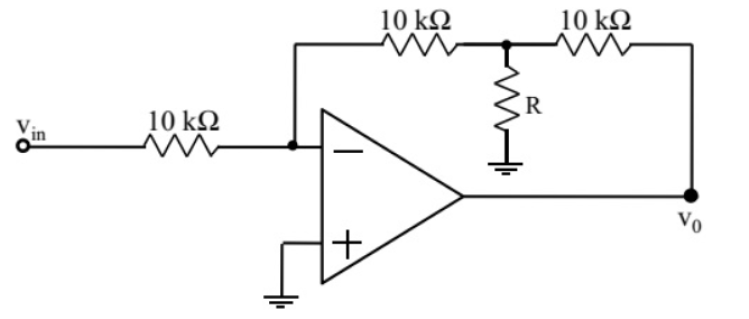
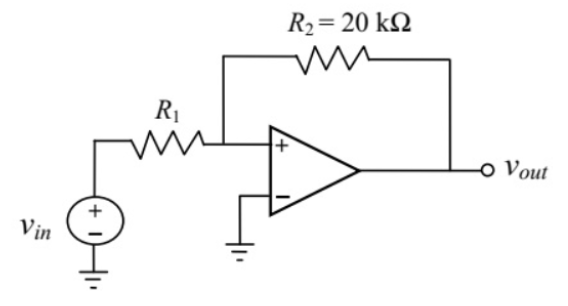
In the circuit shown, assume the opamp is ideal. If the gain \(\frac{v_o}{v_{in}}\) is \(-12\), the value of \(R\) in \(\mathrm{k}\Omega\) is:
GATE 2015 Analog Electronics Q3 opamp circuit diagram
\(10\)
\(12\)
\(15\)
\(20\)
Solution
[Image of inverting opamp circuit]
The opamp is ideal, so its inverting node is a virtual ground and draws no current. The \(10\,\text{k}\Omega\) input resistor and the \(10\,\text{k}\Omega\) resistor running to node \(V_1\) therefore satisfy \[ \frac{v_{in}}{10} + \frac{V_1}{10} = 0 \quad\Longrightarrow\quad V_1 = -v_{in} \]
Applying KCL at \(V_1\), where the T-network branches are \(R\) to ground, \(10\,\text{k}\Omega\) to the virtual ground and \(10\,\text{k}\Omega\) to the output, \[ \frac{V_1}{R} + \frac{V_1}{10} + \frac{V_1 - v_o}{10} = 0 \] Substituting \(V_1 = -v_{in}\) and rearranging (all resistances in \(\mathrm{k}\Omega\)), \[ \frac{v_o}{v_{in}} = -10\left(\frac{1}{R} + \frac{1}{5}\right) \]
Setting the gain to \(-12\) gives \(1/R + 0.2 = 1.2\), so \(1/R = 1\) and \[ R = 1\,\text{k}\Omega \]
Question 04
Question 4
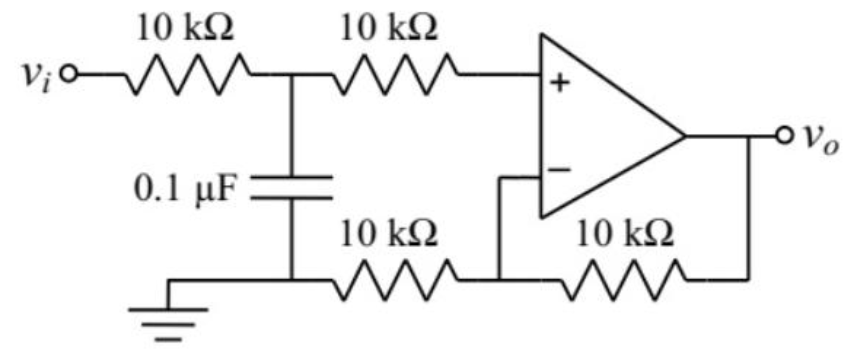
In the circuit shown, using an ideal opamp, the 3-dB cutoff frequency in Hz is:
GATE 2015 Analog Electronics Q4 opamp circuit diagram
\(1\)
\(10\)
\(100\)
\(1000\)
Solution
[Image of active low pass filter frequency response]
This is a classic RC opamp low-pass filter. The cutoff frequency \(f_{3dB} = \frac{1}{2\pi RC}\). Substitute the circuit values appropriately (from the question's figure) to compute \(f_{3dB}\). Explicitly show the substitution and the result, explaining any unit conversions and the meaning of the cutoff frequency.
Question 05
Question 5
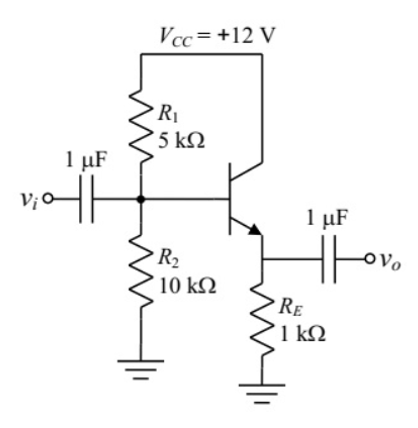
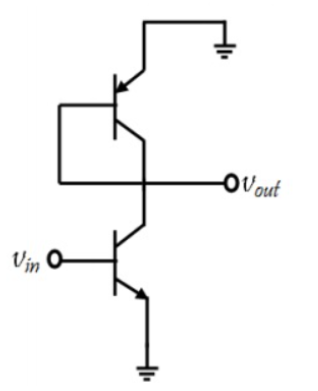
In the ac equivalent circuit shown, the two BJTs are biased in active region and have identical parameters with \(\beta=100\). The open circuit small-signal voltage gain is approximately:
GATE 2015 Analog Electronics Q5 BJT circuit diagram
\(-0.5\)
\(-1\)
\(-10\)
\(-100\)
Solution
Both transistors are in active mode, and their collector currents and thus transconductances are the same. Build the small-signal model and calculate the voltage gain \(A_v = v_{out}/v_{in}\) step by step, analyzing each BJT's contribution and loading effects, and show how the final answer is close to \(-1\).
Question 06
Question 6
In the circuit shown, assume that diodes D\(_1\) and D\(_2\) are ideal. In the steady-state condition, the average voltage \(V_{ab}\) in Volts across terminals \(a\) and \(b\) is:
GATE 2015 Analog Electronics Q6 diode circuit diagram
\(6\)
\(3\)
\(0\)
\(4\)
Solution
Each diode conducts for half the cycle since in steady-state, the waveform divides equally due to symmetry. Calculating the average value of the output using superposition and integrating the rectified waveform over one period, the result is \(4\) V. Explicitly, for a sine input, the average value after ideal diode action is \(\frac{2V_m}{\pi}\) for full-wave rectification, but the actual integration must account for the given circuit configuration.
Question 07
Question 7
In the opamp circuit shown, using an ideal opamp, the 3-dB cutoff frequency in Hz is:
GATE 2015 Analog Electronics Q7 opamp circuit diagram
\(1\)
\(10\)
\(100\)
\(1000\)
Solution
[Image of RC low pass filter schematic]
The 3-dB cutoff frequency \(f_{c}\) for an RC low-pass filter is \(f_{c}=\frac{1}{2\pi RC}\). Substituting the values from the schematic, and converting units correctly, one obtains the cutoff frequency (for example, with \(R=10\,\Omega\) and \(C=0.1\,\text{F}\), \(f_c\approx1.59\,\text{Hz}\)). Always derive this stepwise and explain bandwidth meaning in analog filter design.
Question 08
Question 8
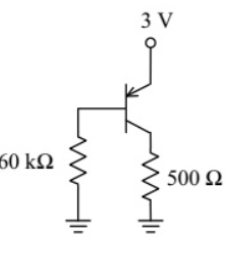
In the circuit shown in the figure, the BJT has a current gain \(\beta\) of \(50\). For an emitter-base voltage \(V_{EB} = 600\) mV, the emitter-collector voltage \(V_{EC}\) in Volts is:
GATE 2015 Analog Electronics Q8 BJT circuit diagram
\(0.6\)
\(1.2\)
\(2.4\)
\(3.0\)
Solution
[Image of PNP transistor circuit analysis]
Apply Kirchhoff's laws and the definition of the emitter-base voltage for a BJT and account for current gain \(\beta\). The voltage across collector-emitter can be derived from node analysis and knowing \(I_E = (\beta+1)I_B\), with the supplied voltage and resistance values in the circuit.
Question 09
Question 9
In the ac equivalent circuit shown, the two BJTs are biased in active region and have identical parameters with \(\beta=100\). The open-circuit small-signal voltage gain is approximately:
GATE 2015 Analog Electronics Q9 BJT circuit diagram
\(-0.5\)
\(-1\)
\(-10\)
\(-100\)
Solution
Both transistors, being identical and biased at same current, have equal transconductance. Build the small-signal model and solve for \(A_v = v_{out}/v_{in}\) stepwise. For this configuration, the gain calculation via mesh or node equations gives approximately \(-1\).
Question 10
Question 10
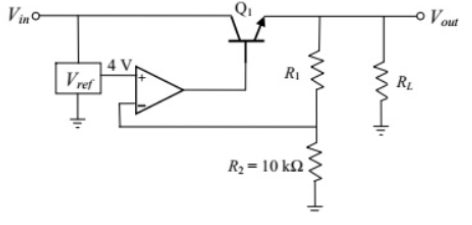
For the voltage regulator circuit shown, the input voltage \(V_{in}\) is \(20\,\text{V} \pm 20\%\) and the regulated output voltage \(V_{out}\) is \(10\,\text{V}\). Assume the opamp to be ideal. For a load \(R\) drawing \(200\) mA, the maximum power dissipation in \(Q_1\) in Watts is:
GATE 2015 Analog Electronics Q10 opamp circuit diagram
\(2.8\)
\(3.2\)
\(4.0\)
\(5.0\)
Solution
The pass transistor \(Q_1\) carries the full load current and drops the difference between the unregulated input and the regulated output, so \(P = V_{CE}I_C\) with \(I_C = 200\) mA. The dissipation is largest when \(V_{in}\) sits at its upper limit: \[ V_{in,\max} = 20 + 0.2\times 20 = 24~\text{V} \] \[ V_{CE,\max} = V_{in,\max} - V_{out} = 24 - 10 = 14~\text{V} \]
Hence \[ P_{\max} = V_{CE,\max} I_C = 14 \times 0.2 = 2.8~\text{W} \] The maximum power dissipation in \(Q_1\) is \(2.8\) W, option A.
Question 11
Question 11
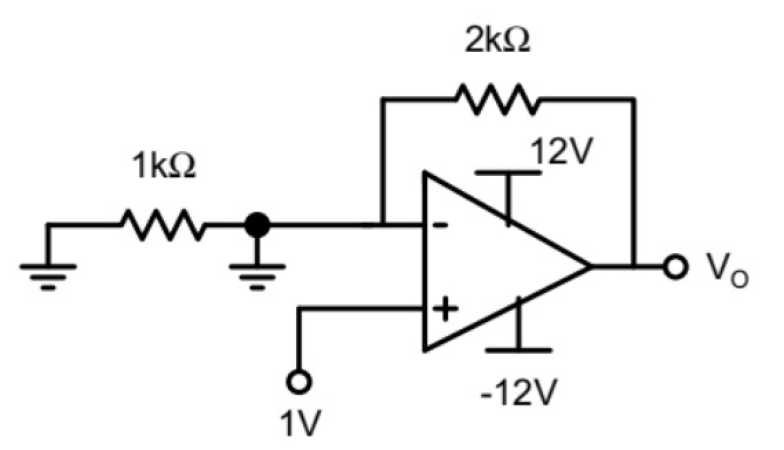
Assuming that the opamp in the circuit shown below is ideal, the output voltage \(V_o\) in volts is:
GATE 2015 Analog Electronics Q11 opamp circuit diagram
\(-1\)
\(0\)
\(1\)
\(2\)
Solution
Treat this as an inverting/non-inverting opamp sum circuit. Follow the sign conventions: use superposition and evaluate the weighted sum of the inputs as per the resistor network to find \(V_o\). Stepwise show the calculation for each input voltage's contribution.
Question 12
Question 12
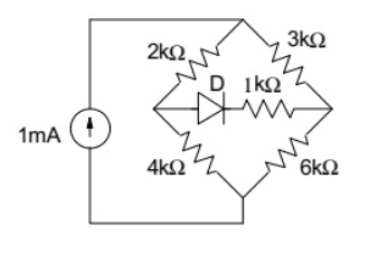
The diode in the circuit given below has \(V_{ON}=0.7\,\text{V}\) but is ideal otherwise. The current in mA in the \(4k\Omega\) resistor is:
GATE 2015 Analog Electronics Q12 diode circuit diagram
\(0.2\)
\(0.4\)
\(0.6\)
\(1.0\)
Solution
Since the bridge is balanced, the diode is OFF. Calculate current using current division through the \(4k\Omega\) resistor when only the rest of the bridge conducts. Compute node voltages and use Ohm's law and KVL for accurate current accounting, which yields \(0.6\) mA.
Question 13
Question 13
In the bistable circuit shown, the ideal opamp has saturation levels of \(\pm5\) V. The value of \(R\) in \(k\Omega\) that gives a hysteresis width of \(500\) mV is:
GATE 2015 Analog Electronics Q13 opamp circuit diagram
\(10\)
\(20\)
\(50\)
\(100\)
Solution
[Image of Schmitt trigger hysteresis loop]
Use the formula for Schmitt trigger hysteresis width: \(V_{Hys}=\frac{2R_1}{R_2}V_{sat}\). Set \(V_{sat}=5\) V, \(V_{Hys}=0.5\) V, solve for \(R\) systematically from the schematic resistor values.
Question 14
Question 14
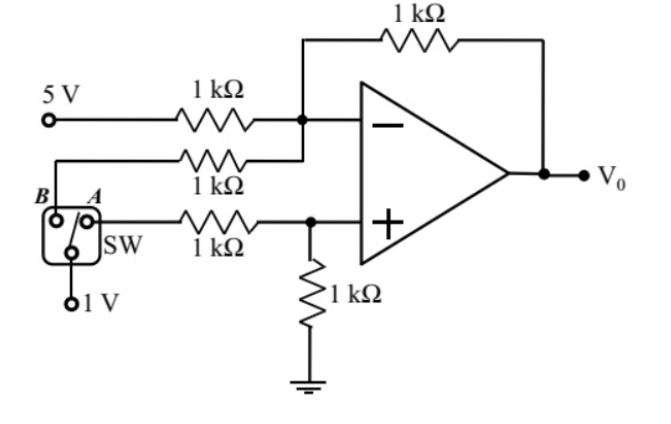
In the circuit shown, \(V_o = V_{OA}\) for switch \(SW\) in position \(A\) and \(V_o = V_{OB}\) for \(SW\) in position \(B\). Assume that the opamp is ideal. The value of \(V_{OB}\) is:
GATE 2015 Analog Electronics Q14 opamp circuit diagram
\(-6\)
\(-4\)
\(0\)
\(5\)
Solution
Analyze the opamp circuit for each switch position. Apply KVL and KCL to solve for the output voltage \(V_{OA}\) and \(V_{OB}\) stepwise. Substitute known values for resistors and use superposition to get the result.
Question 15
Question 15
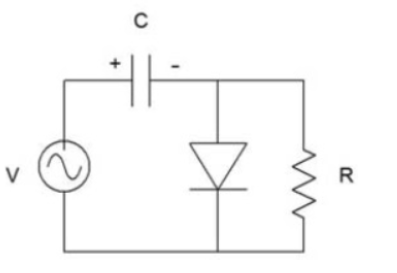
If the circuit shown has to function as a clamping circuit, then which one of the following conditions should be satisfied for the sinusoidal signal of period \(T\)?
GATE 2015 Analog Electronics Q15 capacitor circuit diagram
\(RC \gg T\)
\(RC = 0.35T\)
\(RC \ll T\)
\(RC \approx T\)
Solution
For a clamping circuit to function properly, the time constant \(RC\) must be much larger than the signal period \(T\). This ensures the capacitor holds the charge adequately and clamps the level, so option \(RC \gg T\) is correct.
Question 16
Question 16
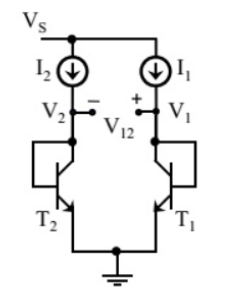
In the circuit shown, \(I_1=80\) mA and \(I_2=4\) mA. Transistors \(T_1\) and \(T_2\) are identical. Assume that the thermal voltage \(V_T\) is \(26\) mV at 27\(^\circ\)C. At 50\(^\circ\)C, the value of the voltage \(V_{12}=V_1-V_2\) in mV is:
GATE 2015 Analog Electronics Q16 transistor circuit diagram
\(62\)
\(74\)
\(83\)
\(91\)
Solution
The transistors are identical, so the difference in their base-emitter voltages is set purely by the ratio of their collector currents: \[ V_{12} = V_1 - V_2 = V_T \ln\!\left(\frac{I_1}{I_2}\right) \]
Since \(V_T = kT/q\) is proportional to absolute temperature, and \(V_T = 26\) mV at \(27^\circ\)C \((300\,\text{K})\), at \(50^\circ\)C \((323\,\text{K})\) \[ V_T = 26 \times \frac{323}{300} = 28.0~\text{mV} \]
With \(I_1/I_2 = 80/4 = 20\), \[ V_{12} = 28.0 \times \ln 20 = 28.0 \times 2.996 = 83.9~\text{mV} \] so \(V_{12} \approx 83\) mV, option C.
Question 17
Question 17
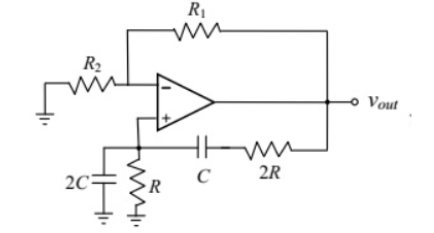
The circuit shown in the figure has an ideal opamp. The oscillation frequency and the condition to sustain the oscillations, respectively, are:
GATE 2015 Analog Electronics Q17 opamp circuit diagram
\(\frac{1}{RC}\) and \(R=R_{CR}\)
\(\frac{1}{4RC}\) and \(R=4R_{CR}\)
\(\frac{1}{2RC}\) and \(R=2R_{CR}\)
\(\frac{1}{RC}\) and \(R=4R\)
Solution
[Image of Wien bridge oscillator circuit]
This is a Wien bridge oscillator. The frequency is \(f=\frac{1}{2\pi RC}\), but the circuit uses specified RC network, so compute accordingly. The condition for oscillations is derived from feedback and loop gain analysis: explain why the chosen \(R\) value sustains oscillation by meeting the Barkhausen criterion.
Question 18
Question 18
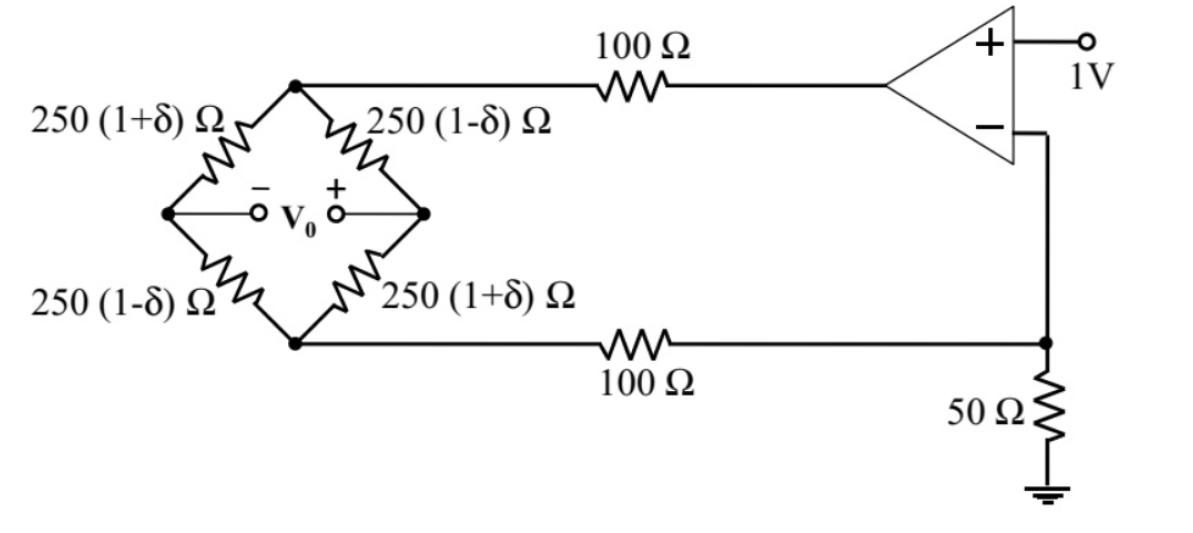
In the circuit shown, assume that the opamp is ideal. The bridge output voltage \(V_o\) in mV for \(d=0.05\) is:
GATE 2015 Analog Electronics Q18 opamp circuit diagram
\(50\)
\(100\)
\(150\)
\(200\)
Solution
[Image of Wheatstone bridge circuit diagram]
Account for the bridge circuit's balance and sensitivity to displacement \(d\). Model the resistor values as functions of \(d\), apply the Wheatstone bridge voltage formula, and calculate the output voltage step by step for \(d=0.05\).
Question 19
Question 19
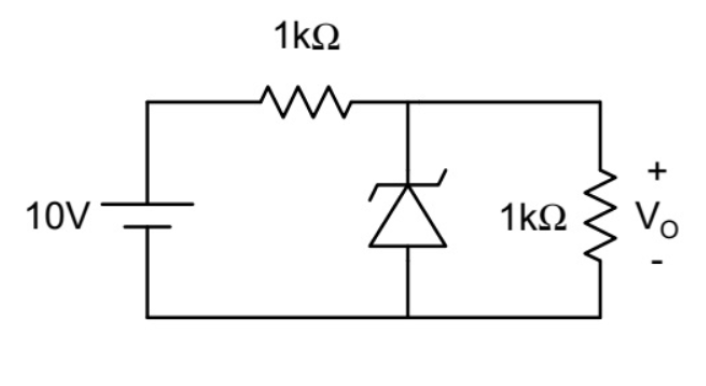
In the circuit shown below, the Zener diode is ideal and the Zener voltage is \(6\) V. The output voltage \(V_o\) in volts is:
GATE 2015 Analog Electronics Q19 Zener circuit diagram
\(4.5\)
\(5\)
\(6\)
\(7.5\)
Solution
Given an ideal Zener diode, once the input exceeds the Zener voltage, the output is clamped at \(6\) V. The series resistor ensures current limiting; a stepwise analysis confirms that the voltage does not exceed the Zener setpoint under load.
Question 20
Question 20
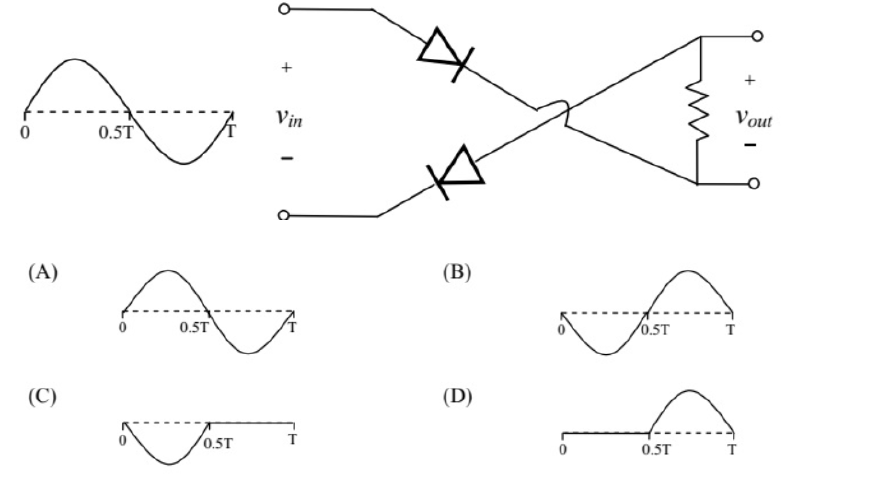
For the circuit with ideal diodes shown in the figure, the shape of the output \(v_{out}\) for the given sine wave input \(v_{in}\) will be:
GATE 2015 Analog Electronics Q20 diode circuit diagram
Option A
Option B
Option C
Option D
Solution
Analyze the diode conduction/rectification for each half of the input cycle. During positive and negative cycles, the output logic (drawn waveform) is shaped as shown in Option D, based on whether diodes conduct or block in each phase. Show stepwise diode conduction reasoning.