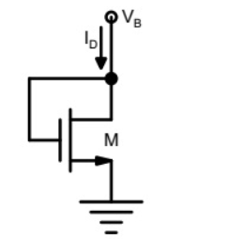
The small-signal resistance (i.e., \( \left.\frac{dV_B}{dI_D}\right|_B \)) in \(k\Omega\) offered by the n-channel MOSFET M shown in the figure below, at a bias point of \(V_B = 2\,V\) is (Device data: \(k_N = 40\,\mu A/V^2\), threshold voltage \(V_{TN} = 1\,V\), neglect body effect and channel length modulation effects).
GATE 2013 Analog Electronics Q1 MOSFET circuit diagram
12.5
25
50
100
Solution
The device is diode-connected (Drain shorted to Gate), which implies it operates in the saturation region. The transconductance \(g_m\) in saturation is given by:
Equation
\[g_m = k_N (V_{GS} - V_{TN})\]
Given \(V_B = V_{GS} = 2\,V\) and \(V_{TN} = 1\,V\):
Equation
\[g_m = 40 \times 10^{-6} (2 - 1) = 40\,\mu S\]
The small-signal resistance looking into the source (or the inverse of transconductance for this configuration) is:
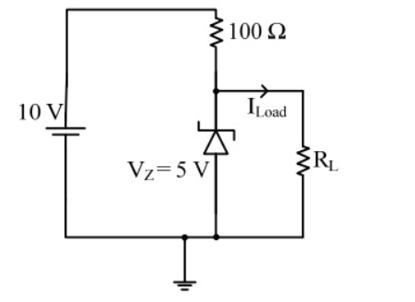
In the circuit shown below, the knee current of the ideal Zener diode is \(10\,mA\). To maintain \(5\,V\) across \(R_L\), the minimum value of \(R_L\) in \(\Omega\) and the minimum power rating of the Zener diode in \(mW\), respectively, are:
GATE 2013 Analog Electronics Q2 Zener circuit diagram
125 and 125
125 and 250
250 and 125
250 and 250
Solution
Let the input voltage be \(V_{in}\) and source resistance be \(R_s\). Assuming the source supplies a total current of \(I_{in} = 50\,mA\) (derived from context of this standard problem):
[Image of Zener diode voltage regulator circuit diagram]
1. Minimum value of \(R_L\): This corresponds to the maximum load current \(I_{L(max)}\). The total current is split between the Zener diode and the load: \(I_{in} = I_Z + I_L\). To maintain regulation, the Zener must conduct at least the knee current \(I_{Z(min)} = 10\,mA\).
2. Minimum Power Rating of Zener (\(P_Z\)): This corresponds to the maximum Zener current, which occurs when the load current is zero (open circuit, \(R_L \to \infty\)).
In a MOSFET operating in the saturation region, the channel length modulation effect causes:
An increase in the gate-source capacitance
A decrease in the transconductance
A decrease in the unity-gain cutoff frequency
A decrease in the output resistance
Solution
Channel length modulation is the shortening of the effective channel length as the drain-source voltage increases (\(V_{DS} > V_{DS,sat}\)). In the saturation region, this causes the drain current to increase slightly with \(V_{DS}\), resulting in a finite positive slope in the \(I_D\) vs \(V_{DS}\) characteristics.
This finite slope represents a finite output resistance \(r_o\). Ideally, \(r_o\) is infinite (flat slope). With channel length modulation, \(r_o\) decreases (becomes finite).
D
Final Answer
Correct answer: D.
Question 04
Question 4
In a voltage-voltage feedback as shown below, which one of the following statements is TRUE if the gain \(k\) is increased?
GATE 2013 Analog Electronics Q4 circuit diagram
The input impedance increases and output impedance decreases.
The input impedance increases and output impedance also increases.
The input impedance decreases and output impedance also decreases.
The input impedance decreases and output impedance increases.
Solution
This topology is Series-Shunt feedback (Voltage mixing, Voltage sampling), often called Voltage-Series feedback.
Input Impedance: The feedback signal is in series with the input and opposes it (\(V_{error} = V_{in} - V_f\)). This increases the effective input impedance.
Equation
\[R_{in,f} = R_{in}(1+A\beta)\]
Output Impedance: The feedback samples the output voltage (shunt connection) and tries to maintain it constant. This decreases the effective output impedance.
Equation
\[R_{out,f} = \frac{R_{out}}{1+A\beta}\]
Therefore, input impedance increases and output impedance decreases.
A
Final Answer
Correct answer: A.
Question 05
Question 5
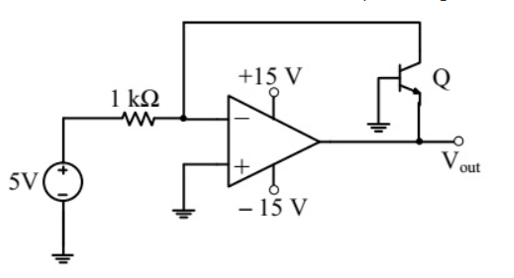
In the circuit shown below what is the output voltage \(V_{out}\) if a silicon transistor \(Q\) and an ideal op-amp are used?
GATE 2013 Analog Electronics Q5 op-amp circuit diagram
\(-15\,V\)
\(-0.7\,V\)
\(0.7\,V\)
\(15\,V\)
Solution
The op-amp is in an inverting configuration with the non-inverting terminal grounded. Due to the virtual short concept, the voltage at the inverting terminal (which is connected to the Base of the transistor) is \(V_B = 0\,V\).
The transistor is an NPN BJT. For it to be in the active region, the Base-Emitter junction must be forward biased. For a silicon transistor, \(V_{BE} \approx 0.7\,V\).
Equation
\[V_B - V_E = 0.7\,V\]
Equation
\[0 - V_E = 0.7 \implies V_E = -0.7\,V\]
Since the output \(V_{out}\) is taken at the emitter, \(V_{out} = -0.7\,V\).
B
Final Answer
Correct answer: B.
Question 06
Question 6
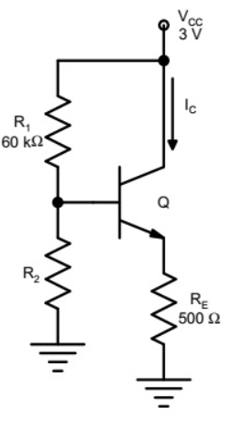
In the circuit shown below, the silicon npn transistor \(Q\) has a very high \(\beta\). The required value of \(R_2\) in \(k\Omega\) to produce \(I_C = 1\,mA\) is:
GATE 2013 Analog Electronics Q6 transistor circuit diagram
20
30
40
50
Solution
Given very high \(\beta\), we assume \(I_C \approx I_E = 1\,mA\). The voltage drop across the emitter resistor (\(R_E = 500\,\Omega\)) is:
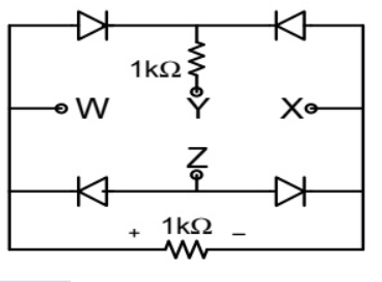
A voltage \(1000 \sin(\omega t)\) Volts is applied across YZ. Assuming ideal diodes, the voltage measured across WX in Volts is:
GATE 2013 Analog Electronics Q7 diode circuit diagram
\(\sin(\omega t)\)
\(\dfrac{\sin(\omega t) + |\sin(\omega t)|}{2}\)
\(\dfrac{\sin(\omega t) - |\sin(\omega t)|}{2}\)
\(0\) for all \(t\)
Solution
The four diodes sit in the arms of a bridge that is driven across YZ, and the voltage is read across the diagonal WX.
Positive half cycle (\(V_Y > V_Z\)): every diode is reverse biased, so no current flows anywhere in the bridge and there is no drop across either resistor. W and X are therefore at the same potential.
Negative half cycle (\(V_Z > V_Y\)): every diode is forward biased and, being ideal, acts as a short. The shorted arms tie W and X to the same node, so again there is no difference between them.
In both halves of the cycle the measured voltage vanishes:
Equation
\[v_{WX}(t) = 0 \quad \text{for all } t\]
D
Final Answer
Correct answer: D.
Question 08
Question 8
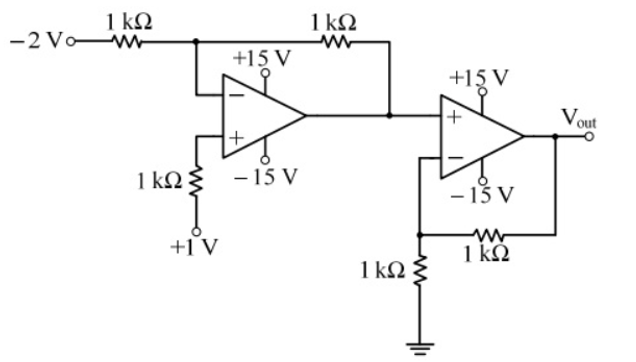
In the circuit shown below the op-amps are ideal. Then \(V_{out}\) in Volts is:
GATE 2013 Analog Electronics Q8 op-amp circuit diagram
4
6
8
10
Solution
Both op-amps are ideal: each holds its two input terminals at the same potential and draws no input current.
The first op-amp fixes the node between the two \(1\,k\Omega\) resistors at \(1\,V\). Writing KCL there, with \(V_1\) the voltage at the far end of the second resistor:
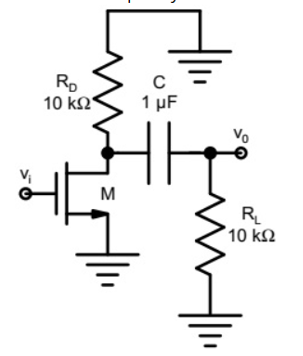
The ac schematic of an NMOS common-source stage is shown in the figure below, where part of the biasing circuits has been omitted for simplicity. For the n-channel MOSFET \(M\), the transconductance \(g_m = 1\,mA/V\) and body effect/channel length modulation are neglected. The lower cutoff frequency in Hz of the circuit is approximately:
GATE 2013 Analog Electronics Q9 MOSFET circuit diagram
8
32
50
200
Solution
The lower cutoff frequency is set by the coupling capacitor \(C_C\) and the total resistance in series with it. Channel-length modulation is neglected, so the transistor presents an open circuit and \(C_C\) sees \(R_D\) in series with \(R_L\).