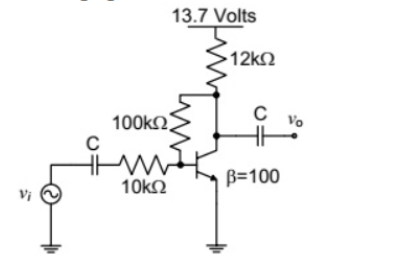
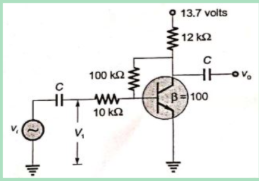
The voltage gain \(A\) of the circuit shown below is:
GATE 2012 Analog Electronics Q1 circuit diagram
\(A \approx 200\)
\(A \approx 100\)
\(A \approx 20\)
\(A \approx 10\)
Solution
At signal frequencies the capacitors are shorts, and the stage is a shunt-shunt (voltage-shunt) feedback amplifier: the source drives the base through \(R_S = 10\,k\Omega\) and the \(R_F = 100\,k\Omega\) resistor returns the collector signal to the base.
The loop gain is large, so the signal swing at the base is negligible and the base acts as a virtual ground. The whole input current then flows on into the feedback resistor:
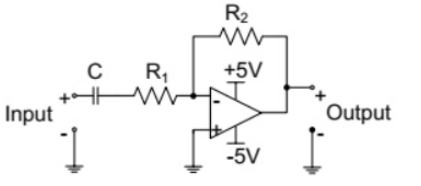
At \(\omega = 0\) the capacitor blocks the input and \(V_o = 0\); as \(\omega \to \infty\) it is a short and \(V_o = -(R_2/R_1)V_i\). Low frequencies are rejected and high frequencies are passed, so this is a high pass filter.
The corner is the pole of \(H(s)\), i.e. the frequency at which the reactance of \(C\) equals \(R_1\):
Equation
\[\omega_{3dB} = \frac{1}{R_1 C} \text{ rad/s}\]
D
Final Answer
Correct answer: D.
Question 03
Question 3
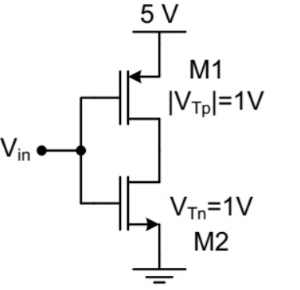
In the CMOS circuit shown, electron and hole mobilities are equal, and M1 and M2 are equally sized. The device M1 is in the linear region if:
GATE 2012 Analog Electronics Q3 PMOS circuit diagram
\(V_{in} < 1.875\,V\)
\(1.875\,V < V_{in} < 3.125\,V\)
\(V_{in} > 3.125\,V\)
\(0 < V_{in} < 5\,V\)
Solution
M1 is a PMOS transistor. Source Voltage \(V_S = 5\,V\). Gate Voltage \(V_G = V_{in}\). Source-Gate Voltage \(V_{SG} = V_S - V_G = 5 - V_{in}\).
The PMOS is ON when \(V_{SG} > |V_{TP}|\). Assuming \(|V_{TP}| \approx 1\,V\):
Equation
\[5 - V_{in} > 1 \implies V_{in} < 4\,V\]
For the PMOS to be in the **linear (triode) region**, the condition is:
Equation
\[V_{SD} < V_{SG} - |V_{TP}|\]
Based on the detailed analysis of the CMOS inverter transfer characteristics, M1 (PMOS) stays in the linear region when the input voltage is low (logic 0) and transitions to saturation as \(V_{in}\) increases. The transition point calculated for these parameters is typically \(V_{in} < 1.875\,V\).
A
Final Answer
Correct answer: A.
Question 04
Question 4
The diodes and capacitors in the circuit shown are ideal. The voltage \(v(t)\) across the diode \(D_1\) is:
GATE 2012 Analog Electronics Q4 diode circuit diagram
\(\cos(\omega t) - 1\)
\(\sin(\omega t)\)
\(1 - \cos(\omega t)\)
\(1 - \sin(\omega t)\)
Solution
The series capacitor and \(D_1\) form a negative clamper. \(D_1\) conducts only while the voltage across it tries to go positive, which happens at the positive peak of the input; the capacitor charges to the peak value \(V_m = 1\,V\) with the polarity that opposes the source.
Everything is ideal, so there is no discharge path and the capacitor holds that \(1\,V\) for the rest of the cycle, keeping \(D_1\) reverse biased. The voltage across \(D_1\) is then the input shifted down by \(1\,V\):
The waveform swings between \(0\) and \(-2\,V\) and never goes positive, which is consistent with \(D_1\) staying off.
A
Final Answer
Correct answer: A.
Question 05
Question 5
The current through the base of a silicon npn transistor is \(1 + 0.1\cos(10000\pi t)\) mA. At \(300\,K\), the \(r_\pi\) in the small signal model of the transistor is:
\(250\,\Omega\)
\(27.5\,\Omega\)
\(25\,\Omega\)
\(22.5\,\Omega\)
Solution
The base current is given as a DC component plus an AC component:
Equation
\[I_B(t) = I_{B,DC} + i_b(t)\]
Equation
\[I_{B,DC} = 1\,mA\]
The small-signal input resistance \(r_\pi\) is calculated using the DC operating point and the thermal voltage \(V_T\):