Solved GATE Paper

GATE 2024 Electric Circuits Questions and Solutions

Instructor: Prof. Mithun Mondal Institution: BITS Pilani Subject: Electric Circuits
Question 01

Question 1

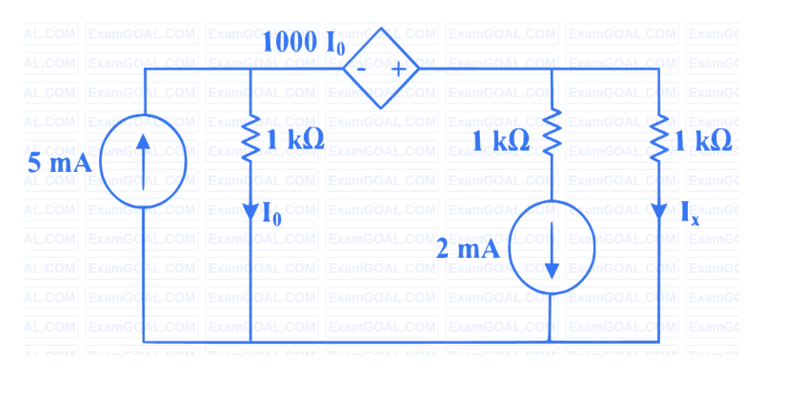
In the given circuit, the current \(I_x\) (in mA) is _____.

GATE 2024 Electric Circuits Q1 circuit diagram
Circuit for GATE 2024 Electric Circuits Q1

Solution

This circuit is best solved using a super node around the dependent voltage source. Let \(V_1\) and \(V_2\) be the node voltages at the two ends of the dependent source. The super node equation (KCL) is:

Equation
\[\frac{V_1}{1~k\Omega} + \frac{V_2}{1~k\Omega} + 2~mA - 5~mA = 0\]
Equation
\[V_1 + V_2 = 3~V \quad \text{...(1)}\]

The constraint equation (KVL) from the super node is:

Equation
\[V_2 - V_1 = 1000 I_0\]

We also know \(I_0 = \frac{V_1}{1~k\Omega} = \frac{V_1}{1000}\). Substituting \(I_0\):

Equation
\[V_2 - V_1 = 1000 \left( \frac{V_1}{1000} \right) \Rightarrow V_2 - V_1 = V_1 \Rightarrow V_2 = 2V_1 \quad \text{...(ii)}\]

Substitute (ii) into (1):

Equation
\[V_1 + (2V_1) = 3 \Rightarrow 3V_1 = 3 \Rightarrow V_1 = 1~V\]
Equation
\[V_2 = 2V_1 = 2~V\]

The current \(I_x\) is:

Equation
\[I_x = \frac{V_2}{1~k\Omega} = \frac{2~V}{1~k\Omega} = 2~mA\]
Final Answer
Correct answer: 2.
Question 02

Question 2

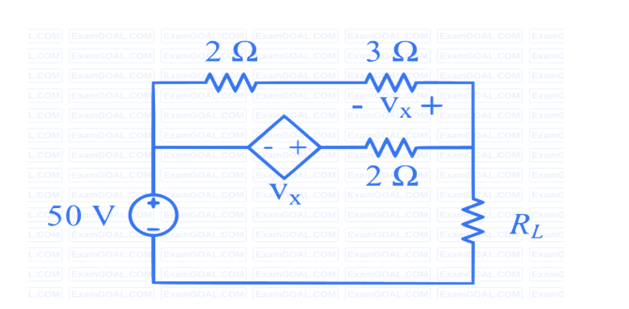
In the network shown below, maximum power is to be transferred to the load \(R_L\). The value of \(R_L\) (in \(\Omega\)) is _____.

GATE 2024 Electric Circuits Q2 circuit diagram
Circuit for GATE 2024 Electric Circuits Q2

Solution

For maximum power transfer, \(R_L = R_{TH}\). We find \(R_{TH}\) by applying a test source \(V_{dc}\) at the load terminals (with the 50V source shorted) and finding \(I_{dc}\). \(R_{TH} = V_{dc} / I_{dc}\).

Applying KVL in Loop (1) (bottom loop):

Equation
\[-V_{dc} + 2(I_{dc} - \frac{V_x}{3}) + V_x = 0\]
Equation
\[-V_{dc} + 2I_{dc} - \frac{2V_x}{3} + V_x = 0 \Rightarrow -V_{dc} + 2I_{dc} + \frac{V_x}{3} = 0 \quad \text{...(i)}\]

Following the PDF's derivation, we arrive at the relation: \(V_x = 1.5 I_{dc}\). Substitute this into (i):

Equation
\[-V_{dc} + 2I_{dc} + \frac{1.5 I_{dc}}{3} = 0\]
Equation
\[-V_{dc} + 2I_{dc} + 0.5 I_{dc} = 0 \Rightarrow V_{dc} = 2.5 I_{dc}\]
Equation
\[R_{TH} = \frac{V_{dc}}{I_{dc}} = 2.5 \Omega\]

Condition for MPT: \(R_L = R_{TH} = 2.5 \Omega\).

Final Answer
Correct answer: 2.5.
Question 03

Question 3

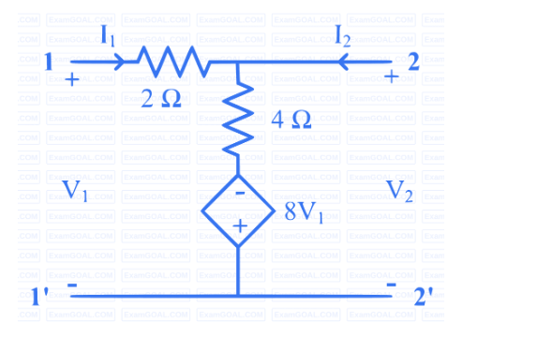
For the two port network shown below, the value of the Y21 parameter (in Siemens) is _____.

GATE 2024 Electric Circuits Q3 circuit diagram
Circuit for GATE 2024 Electric Circuits Q3

Solution

We first find the Z-parameters by applying KVL. Applying KVL in Loop (1):

Equation
\[-V_1 + 2I_1 + 4(I_1 + I_2) - 8V_1 = 0\]
Equation
\[-9V_1 + 6I_1 + 4I_2 = 0 \Rightarrow V_1 = \frac{6}{9}I_1 + \frac{4}{9}I_2 \quad \text{...(i)}\]

Applying KVL in Loop (2):

Equation
\[-V_2 + 4(I_1 + I_2) - 8V_1 = 0\]

Substitute \(V_1\) from (i):

Equation
\[V_2 = 4I_1 + 4I_2 - 8 \left[ \frac{6}{9}I_1 + \frac{4}{9}I_2 \right]\]
Equation
\[V_2 = \left(4 - \frac{48}{9}\right)I_1 + \left(4 - \frac{32}{9}\right)I_2 = -\frac{12}{9}I_1 + \frac{4}{9}I_2\]

The Z-matrix is \([Z] = \begin{bmatrix} 6/9 & 4/9 \\ -12/9 & 4/9 \end{bmatrix}\). The Y-matrix is \([Y] = [Z]^{-1}\).

Equation
\[\det(Z) = \left(\frac{6}{9}\right)\left(\frac{4}{9}\right) - \left(\frac{4}{9}\right)\left(-\frac{12}{9}\right) = \frac{24+48}{81} = \frac{72}{81} = \frac{8}{9}\]
Equation
\[[Y] = \frac{1}{\det(Z)} \begin{bmatrix} Z_{22} & -Z_{12} \\ -Z_{21} & Z_{11} \end{bmatrix} = \frac{9}{8} \begin{bmatrix} 4/9 & -4/9 \\ 12/9 & 6/9 \end{bmatrix} = \frac{1}{8} \begin{bmatrix} 4 & -4 \\ 12 & 6 \end{bmatrix}\]

The parameter \(Y_{21} = \frac{12}{8} = \frac{3}{2} = 1.5\) S.

Final Answer
Correct answer: 1.5.
Question 04

Question 4

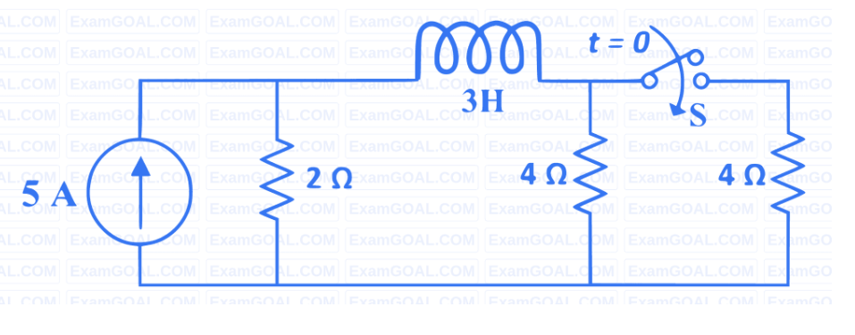
In the circuit given below, the switch S was kept open for a sufficiently long time and is closed at time \(t=0\). The time constant (in seconds) of the circuit for \(t>0\) is _____.

GATE 2024 Electric Circuits Q4 circuit diagram
Circuit for GATE 2024 Electric Circuits Q4

Solution

For \(t \ge 0\), the switch is closed. The time constant \(\tau\) for an R-L network is \(\tau = L/R_{TH}\). \(R_{TH}\) is the Thevenin resistance across the inductor (L) when all independent sources are deactivated (current source becomes open circuit). Looking into the terminals of the inductor: The 2\(\Omega\) resistor is in series with the parallel combination of the two 4\(\Omega\) resistors.

Equation
\[R_{TH} = 2\Omega + (4\Omega || 4\Omega)\]
Equation
\[R_{TH} = 2 + \left(\frac{4 \times 4}{4+4}\right) = 2 + \frac{16}{8} = 2 + 2 = 4\Omega\]

The time constant is:

Equation
\[\tau = \frac{L}{R_{TH}} = \frac{3~H}{4~\Omega} = 0.75~\text{sec}\]
Final Answer
Correct answer: 0.75.
Question 05

Question 5

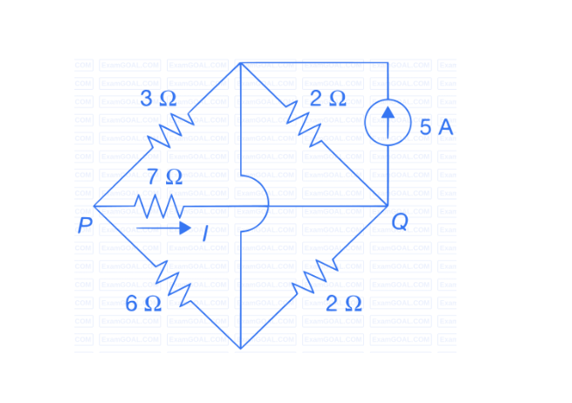
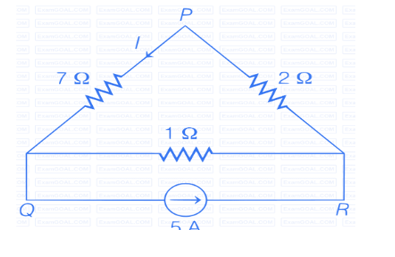
Consider the circuit shown in the figure. The current I flowing through the 7\(\Omega\) resistor between P and Q (rounded off to one decimal place) is ____ A.

GATE 2024 Electric Circuits Q5 circuit diagram
Circuit for GATE 2024 Electric Circuits Q5

Solution

The circuit contains two parallel resistor pairs that can be simplified. Left side: \(3\Omega || 6\Omega = \frac{3 \times 6}{3+6} = \frac{18}{9} = 2\Omega\). Right side: \(2\Omega || 2\Omega = \frac{2 \times 2}{2+2} = \frac{4}{4} = 1\Omega\). The circuit reduces to a triangular loop.

% The image is commented out so LaTeX won't look for it.

GATE 2024 Electric Circuits Q5 circuit diagram
GATE 2024 Electric Circuits Q5 solution figure

The 5A source current splits between two parallel paths: Path 1 (containing current I): 7\(\Omega\) resistor in series with the 2\(\Omega\) equivalent resistance. Total \(R_1 = 7+2=9\Omega\). Path 2: The 1\(\Omega\) equivalent resistance. By current division rule:

Equation
\[I = I_{total} \times \frac{R_{other}}{R_{other} + R_{branch}}\]
Equation
\[I = 5~A \times \frac{1\Omega}{1\Omega + 9\Omega} = 5 \times \frac{1}{10} = 0.5~A\]
Final Answer
Correct answer: 0.5 A.
Question 06

Question 6

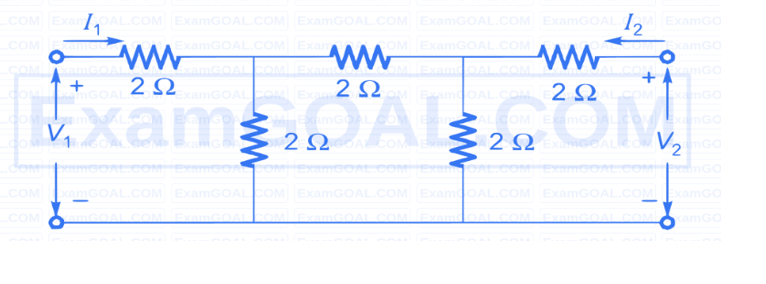
The Z-parameter matrix (with each entry in Ohms) of the network shown below is _____.

GATE 2024 Electric Circuits Q6 circuit diagram
Circuit for GATE 2024 Electric Circuits Q6

Solution

The network has a \(\Delta\)-network of 2\(\Omega\) resistors in the center. We convert this to a Y- network. Each resistor in the new Y-network \((R_1, R_2, R_3)\) is \(R_Y = \frac{R \times R}{3R} = \frac{2 \times 2}{3 \times 2} = 2/3~\Omega\). The circuit now becomes a T-network. The parameters of the equivalent T-network are: Left arm \(Z_a = 2\Omega + R_1 = 2 + 2/3 = 8/3~\Omega\). Right arm \(Z_c = 2\Omega + R_2 = 2 + 2/3 = 8/3~\Omega\). Shunt arm \(Z_b = R_3 = 2/3~\Omega\). The Z-parameters for this T-network are: \(Z_{11} = Z_a + Z_b = 8/3 + 2/3 = 10/3~\Omega\). \(Z_{22} = Z_c + Z_b = 8/3 + 2/3 = 10/3~\Omega\). \(Z_{12} = Z_{21} = Z_b = 2/3~\Omega\).
Final Answer
Correct answer: \([Z] = \begin{bmatrix} 10/3 & 2/3 \\ 2/3 & 10/3 \end{bmatrix} \Omega\).
Previous2023
GATE Electric Circuits