A connection is made consisting of resistance A in series with a parallel combination
of resistances B and C. Three resistors of value 10\(\Omega\), 5\(\Omega\), 2\(\Omega\) are provided.
Consider all possible permutations...
The ratio of maximum to minimum values of the resistances (up to second decimal place) is _____.
Max \(R_{eq}\): Place the largest resistor (10\(\Omega\)) in position A.
\(R_{eq,max} = 10 + (5 || 2) = 10 + \frac{5 \times 2}{5 + 2} = 10 + \frac{10}{7} = \frac{80}{7}\Omega\).
Min \(R_{eq}\): Place the smallest resistor (2\(\Omega\)) in position A.
\(R_{eq,min} = 2 + (10 || 5) = 2 + \frac{10 \times 5}{10 + 5} = 2 + \frac{50}{15} = 2 + \frac{10}{3} = \frac{16}{3}\Omega\).
We need \(Z_{load} = 0.5 + j0\).
Real Part = 0.5: \(\frac{1}{1 + \omega^2 C^2} = 0.5 \Rightarrow \omega^2 C^2 = 1\).
Imaginary Part = 0: \(\omega L - \frac{\omega C}{1 + \omega^2 C^2} = 0\).
Substitute \(\omega^2 C^2 = 1\) into the imaginary part:
\(\omega L - \frac{\omega C}{1 + 1} = 0 \Rightarrow C = 2L\).
Given \(\omega = 100~rad/s\) and \(L = 5~mH = 0.005~H\).
Equation
\[C = 2 \times (0.005~H) = 0.01~F = 10~mF\]
D
Final Answer
Correct answer: (D) 10 mF.
Question 04
Question 4
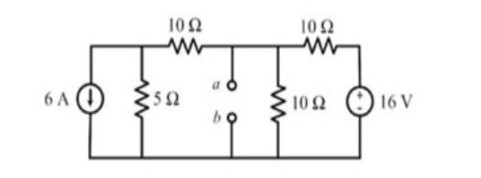
For the network given in figure below, the Thevenin's voltage \(V_{ab}\) is
Circuit for GATE 2017 Electric Circuits Q4
-1.5 V
-0.5 V
0.5 V
1.5 V
Solution
After the source transformations the network reduces to two branches meeting at a-b:
a \(-30\)~V source behind 15\(\Omega\) and an 8~V source behind 5\(\Omega\).
KCL at a, with b as reference, gives:
For the given 2-port network, the value of transfer impedance \(Z_{21}\) in ohms is _____.
Circuit for GATE 2017 Electric Circuits Q5
Solution
Number the \(\Delta\) nodes 1 and 2 (the upper terminals of port 1 and port 2) and 3
(the lower junction, which reaches the common terminal through the 2\(\Omega\) resistor).
The \(\Delta\) arms are \(R_{12} = 2\Omega\), \(R_{13} = 4\Omega\), \(R_{23} = 2\Omega\), so \(\sum R = 8\Omega\).
The equivalent Y arms are:
The network is now a T. The shunt arm is the path from node 3 to the common terminal,
\(R_3 + 2\Omega = 1 + 2 = 3\Omega\), and the series arms are \(R_1 = 1\Omega\) and \(R_2 = 0.5\Omega\).
For a T-network the transfer impedance is the shunt arm:
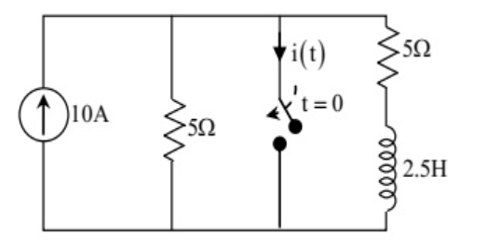
The switch in the circuit, shown in the figure, was open for a long time and is closed
at \(t=0\). The current \(i(t)\) (in ampere) at \(t = 0.5\) seconds is _____.
Circuit for GATE 2017 Electric Circuits Q7
Solution
For \(t < 0\): \(i_L(0^{-}) = 5A\) (from current division). \(i(0^{+}) = i_L(0^{+}) = i_L(0^{-}) = 5A\).
For \(t \to \infty\): Inductor is short. All 10A flows through the shorted inductor path. \(i(\infty) = 10A\).
\(\tau\) (for \(t > 0\)): closing the switch short-circuits the 5\(\Omega\) in series with the inductor,
so with the 10A source opened the inductor sees only the remaining 5\(\Omega\):
\(R_{th} = 5\Omega\) and \(\tau = L / R_{th} = 2.5 / 5 = 0.5\)s.
With \(i(t) = i(\infty) + [i(0^{+}) - i(\infty)]e^{-t/\tau}\):