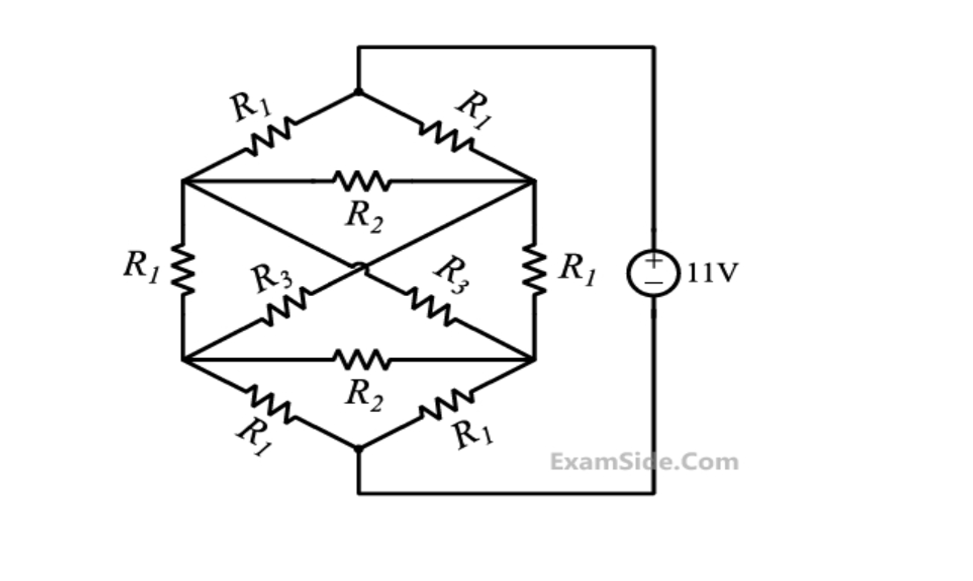
Consider the network shown below with \(R_1=1\Omega\), \(R_2=2\Omega\) and \(R_3=3\Omega\). The network
is connected to a constant voltage source of 11 V. The magnitude of the current (in
amperes) delivered by the voltage source is _____.
Circuit for GATE 2016 Electric Circuits Q1
Solution
By symmetry the two ends of \(R_2\) sit at the same potential, so \(R_2\) carries no current and can be removed. What remains is \(R_1\) in series with two identical \(R_1 \parallel R_3\) sections placed in parallel with each other:
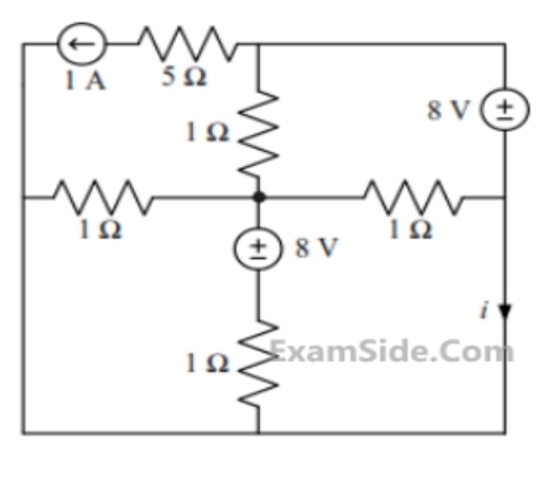
Now apply KCL at the node where \(i\) is marked. That node is fed by \(i\), by the \(1\,\Omega\) branch returning from the centre node, and by the \(5\,A\) source:
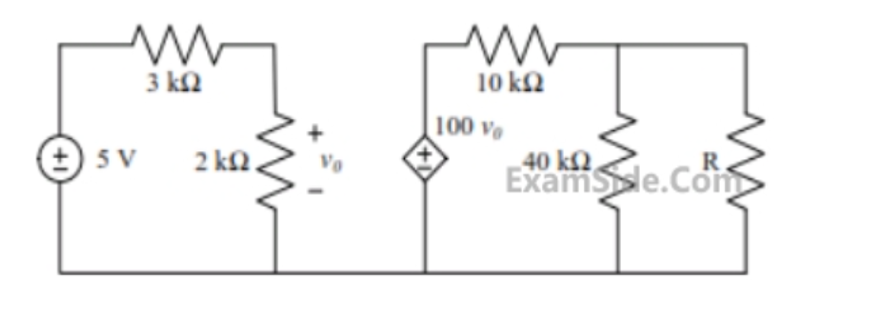
Find \(R_{TH}\) (looking into R terminals, \(v_g\) depends on source, but source is independent and deactivated, so \(v_g=0\), dependent source is 0V \(\to\) short):
Consider a two-port network with the transmission matrix: \(T = \begin{bmatrix} A & B \\ C & D \end{bmatrix}\). If the
network is reciprocal, then
\(T^{-1} = T\)
\(T^2 = T\)
Determinant(T) = 0
Determinant(T) = 1
Solution
For reciprocity, \(AD - BC = 1\), which is the determinant of the T matrix.
D
Final Answer
Correct answer: (D) Determinant(T) = 1.
Question 07
Question 7
An independent voltage source in series with an impedance \(Z_S = R_S + jX_S\) delivers
a maximum average power to a load impedance \(Z_L\) when
\(Z_L = R_S + jX_S\)
\(Z_L = R_S\)
\(Z_L = jX_S\)
\(Z_L = R_S - jX_S\)
Solution
The Maximum Power Transfer Theorem states that for maximum average power
transfer... the load impedance must be the complex conjugate of the source impedance: \(Z_L = Z_S^*\).
If \(Z_S = R_S + jX_S\) then \(Z_L = R_S - jX_S\).
D
Final Answer
Correct answer: (D) \(Z_L = R_S - jX_S\).
Question 08
Question 8
In the AC network shown in the figure, the phasor voltage \(V_{AB}\) (in Volts) is
(No image provided in PDF for this question)
0
\(5\angle 30^\circ\)
\(12.5\angle 30^\circ\)
\(17\angle 30^\circ\)
Solution
The voltage \(V_{AB}\) is across a parallel combination,
driven by a current source \(I = 5\angle 30^\circ~A\).
Impedance of left branch \(Z_1 = 5 - j3~\Omega\).
Impedance of right branch \(Z_2 = 5 + j3~\Omega\).
Equivalent impedance \(Z_{eq} = Z_1 || Z_2 = \frac{(5 - j3)(5 + j3)}{(5 - j3) + (5 + j3)} = \frac{25 + 9}{10} = 3.4\Omega\).
Voltage \(V_{AB} = I \times Z_{eq} = (5\angle 30^\circ) \times 3.4 = 17\angle 30^\circ~V\).
D
Final Answer
Correct answer: (D) \(17\angle 30^\circ\).
Question 09
Question 9
An AC source of RMS voltage 20V with internal impedance \(Z_s = (1 + 2j)\Omega\) feeds a load
of impedance \(Z_L = (7 + 4j)\Omega\).
The reactive power consumed by the load is
8 VAR
16 VAR
28 VAR
32 VAR
Solution
Total impedance \(Z_{total} = Z_s + Z_L = (1 + 2j) + (7 + 4j) = 8 + 6j~\Omega\).
Magnitude of RMS current \(|I_{rms}| = \frac{|V_{rms}|}{|Z_{total}|} = \frac{20}{|8 + 6j|} = \frac{20}{\sqrt{8^2 + 6^2}} = \frac{20}{10} = 2A\).
Reactive power consumed by the load \(Q_L = |I_{rms}|^2 \times X_L\), where \(X_L\) is the reactive part of \(Z_L\).
\(X_L = 4\Omega\).
\(Q_L = (2)^2 \times 4 = 16 \text{ VAR}\).