Solved GATE Paper

GATE 2014 Electric Circuits Questions and Solutions

Instructor: Prof. Mithun Mondal Institution: BITS Pilani Subject: Electric Circuits
Question 01

Question 1

Assuming an ideal transformer, the Thevenin's equivalent voltage and impedance as seen from the terminals \(x\) and \(y\) for the circuit in figure are:
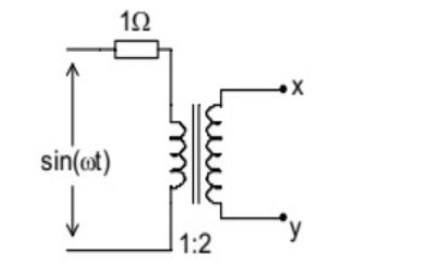
GATE 2014 Electric Circuits Q1 circuit diagram
Circuit for GATE 2014 Electric Circuits Q1
  1. \(2\sin(\omega t),\,4\,\Omega\)
  2. \(1\sin(\omega t),\,1\,\Omega\)
  3. \(1\sin(\omega t),\,2\,\Omega\)
  4. \(2\sin(\omega t),\,0.5\,\Omega\)

Solution

  1. The turn ratio is \(N_p:N_s = 1:2\).
  2. Thevenin Voltage (\(V_{Th}\)): \(V_{Th}\) is the open circuit voltage across the secondary. Since the primary current is zero, \(V_p\) equals \(V_S\).
    Equation
    \[V_{Th} = V_s \times \frac{N_s}{N_p} = \sin(\omega t) \times 2 = 2\sin(\omega t)\]
  3. Thevenin Impedance (\(Z_{Th}\)): The primary impedance \(Z_p\) is \(1\,\Omega\).
    Equation
    \[Z_{Th} = Z_p \times \left(\frac{N_s}{N_p}\right)^2 = 1\,\Omega \times (2)^2 = 4\,\Omega\]
A
Final Answer
Correct answer: (1) \(2\sin(\omega t),\,4\,\Omega\).
Question 02

Question 2

Norton's theorem states that a complex network connected to a load can be replaced with an equivalent impedance:

  1. in series with a current source
  2. in parallel with a voltage source
  3. in series with a voltage source
  4. in parallel with a current source

Solution

  1. Norton's theorem replaces a linear two-terminal circuit with an equivalent current source (\(I_N\)) in parallel with an equivalent resistance/impedance (\(R_N\) or \(Z_N\)).
  2. This is the distinction from Thevenin's theorem, which uses a series voltage source and impedance.
D
Final Answer
Correct answer: (4) in parallel with a current source.
Question 03

Question 3

The condition for maximum power transfer to a load impedance \(Z_L = R_L + jX_L\) from a source with internal impedance \(Z_S = R_S + jX_S\) is:

  1. \(R_L = R_S\) and \(X_L = X_S\)
  2. \(R_L = R_S\) and \(X_L = -X_S\)
  3. \(R_L = |Z_S|\) and \(X_L = 0\)
  4. \(Z_L = R_S\)

Solution

  • For a complex source impedance, maximum power is transferred when the load impedance is the conjugate of the source impedance, i.e., \(Z_L = Z_S^*\).
B
Final Answer
Correct answer: (2) \(R_L = R_S\) and \(X_L = -X_S\).
Question 04

Question 4

A two-port network is reciprocal if its admittance parameters satisfy which of the following conditions?

  1. \(y_{11} = y_{22}\)
  2. \(y_{12} = -y_{21}\)
  3. \(y_{12} = y_{21}\)
  4. \(y_{11}y_{22} - y_{12}y_{21} = 1\)

Solution

  • A two-port network is considered reciprocal if the ratio of the output current (Port 2) to the input voltage (Port 1) equals the ratio of the input current (Port 1) to the output voltage (Port 2) under appropriate open/short circuit conditions. In terms of the Y-parameters (Admittance parameters), this condition is \(y_{12} = y_{21}\).
  • The condition \(y_{11} = y_{22}\) indicates a symmetric network.
C
Final Answer
Correct answer: (3) \(y_{12} = y_{21}\).
Previous2013
GATE Electric Circuits