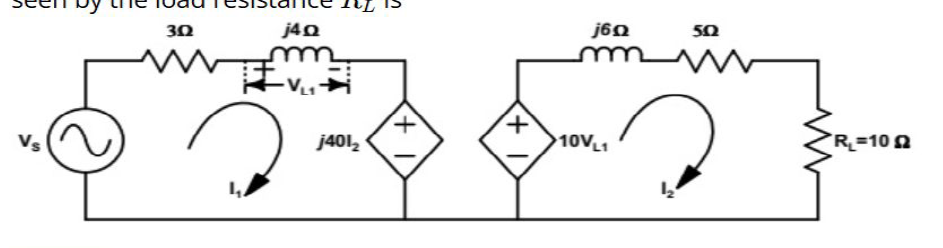
In the circuit shown below in the figure , if the source voltage \(V_{s}=100\angle53.13^\circ V\), then the Thevenin's equivalent voltage in Volts as seen by the load resistance \(R_L\) is:
Circuit for GATE 2013 Electric Circuits Q1
\(100\angle90^\circ\)
\(800\angle20^\circ\)
\(800\angle90^\circ\)
\(100\angle60^\circ\)
Solution
Thevenin Voltage (\(V_{Th}\)): \(V_{Th}\) is the open-circuit voltage across the load terminals. When \(R_L\) is open-circuited, the current \(I_2\) in the right loop is zero.
Dependent Source Value: Since \(I_2 = 0\), the dependent current source \(j40I_2\) becomes zero (open circuit).
Calculate \(V_{L1}\): \(V_{L1}\) is the voltage across the \(j4\,\Omega\) impedance in the left loop. We use the voltage divider rule:
A source \(v_{s}(t)=V \cos 100\pi t\) has an internal impedance of \((4+j3)\,\Omega\). If a purely resistive load connected to this source has to extract the maximum power out of the source, its value in \(\Omega\) should be:
\(3\)
\(4\)
\(5\)
\(7\)
Solution
Maximum Power Transfer (Resistive Load): The Maximum Power Transfer Theorem for an AC circuit with a purely resistive load (\(R_L\)) requires the load resistance to match the *magnitude* of the source impedance (\(Z_s\)).
The condition for maximum power transfer to a load impedance \(Z_L = R_L + jX_L\) from a source with internal impedance \(Z_S = R_S + jX_S\) is:
\(R_L = R_S\) and \(X_L = X_S\)
\(R_L = R_S\) and \(X_L = -X_S\)
\(R_L = |Z_S|\) and \(X_L = 0\)
\(Z_L = R_S\)
Solution
For a complex source impedance, maximum power is transferred when the load impedance is the conjugate of the source impedance, i.e., \(Z_L = Z_S^*\).
B
Final Answer
Correct answer: (2) \(R_L = R_S\) and \(X_L = -X_S\).
Question 04
Question 4
A two-port network is reciprocal if its admittance parameters satisfy which of the following conditions?
\(y_{11} = y_{22}\)
\(y_{12} = -y_{21}\)
\(y_{12} = y_{21}\)
\(y_{11}y_{22} - y_{12}y_{21} = 1\)
Solution
A two-port network is considered reciprocal if the ratio of the output current (Port 2) to the input voltage (Port 1) equals the ratio of the input current (Port 1) to the output voltage (Port 2) under appropriate open/short circuit conditions. In terms of the Y-parameters (Admittance parameters), this condition is \(y_{12} = y_{21}\).
The condition \(y_{11} = y_{22}\) indicates a symmetric network.