Let \(\hat{a}_r\), \(\hat{a}_\phi\) and \(\hat{a}_z\) be unit vectors along \(r\), \(\phi\) and \(z\) directions, respectively in the cylindrical coordinate system. For the electric flux density given by \(\vec{D} = (\hat{a}_r 15 + \hat{a}_\phi 2r - \hat{a}_z 3rz)\) Coulomb/m\(^2\), the total electric flux, in Coulomb, emanating from the volume enclosed by a solid cylinder of radius 3 m and height 5 m oriented along the \(z\)-axis with its base at the origin is:
\(108 \pi\)
\(54 \pi\)
\(90 \pi\)
\(180 \pi\)
Solution
The flux \(\psi\) crossing a closed surface is given by the Divergence Theorem:
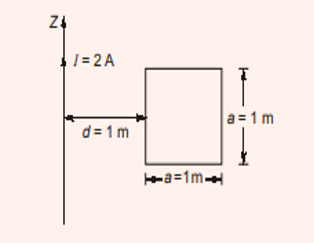
A conducting square loop of side length 1 m is placed at a distance of 1 m from a long straight wire carrying a current \(I = 2\) A as shown below. The mutual inductance, in nH (rounded off to 2 decimal places), between the conducting loop and the long wire is ________ .
Solution
Mutual inductance is defined as \(M = \frac{\phi}{I}\).
The magnetic field due to an infinitely long wire is:
The static electric field inside a dielectric medium with relative permittivity \(\epsilon_r = 2.25\), expressed in cylindrical coordinate system is given by the following expression:
where \(\hat{a}_r, \hat{a}_\phi, \hat{a}_z\) are unit vectors along \(r\), \(\phi\) and \(z\) directions, respectively. If the above expression represents a valid electrostatic field inside the medium, then the volume charge density associated with this field in terms of free space permittivity, \(\epsilon_0\), in SI units is given by:
\(4 \epsilon_0\)
\(5 \epsilon_0\)
\(3 \epsilon_0\)
\(9 \epsilon_0\)
Solution
First, determine the Electric Flux Density \(\vec{D}\):