A rectangular waveguide of width \(w\) and height \(h\) has cut-off frequencies for \(\text{TE}_{10}\) and \(\text{TE}_{11}\) modes in the ratio \(1 : 2\). The aspect ratio \(w/h\), rounded off to two decimal places, is ________ .
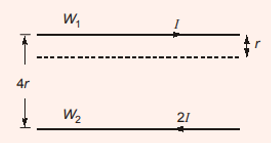
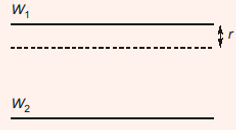
Two identical copper wires \(W_1\) and \(W_2\) placed in parallel as shown in the figure, carry currents \(I\) and \(2I\), respectively, in opposite directions. If the two wires are separated by a distance of \(4r\), then the magnitude of the magnetic field \(\vec{B}\) between the wires at a distance \(r\) from \(W_1\) is:
\( \frac{\mu_0 I^2}{2\pi r^2}\)
\( \frac{6\mu_0 I}{5\pi r}\)
\( \frac{\mu_0 I}{6\pi r}\)
\( \frac{5\mu_0 I}{6\pi r}\)
Solution
The magnetic flux density (\(\vec{B}\)) at a distance \(\rho\) due to an infinite line carrying current \(I\) is given by:
Equation
\[|\vec{B}| = \frac{\mu_0 I}{2\pi \rho}\]
1. Field due to wire \(W_1\):
At distance \(r\) from \(W_1\):
Equation
\[|\vec{B}_1| = \frac{\mu_0 I}{2\pi r} \tag{i}\]
2. Field due to wire \(W_2\):
The point of interest is at a distance \(r\) from \(W_1\). Since the total separation is \(4r\), the distance from \(W_2\) is \(4r - r = 3r\).
Total Field:
Using the right-hand thumb rule, since the currents are in opposite directions, the magnetic fields due to both wires add up in the region between the conductors.