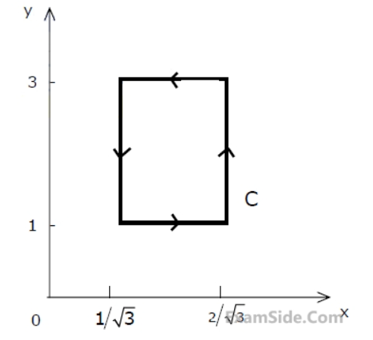
If \(\vec{A} = xy \hat{a}_x + x^2 \hat{a}_y\), then \(\oint \vec{A} \cdot d\vec{l}\) over the path shown in the figure is:
Solution
We need to evaluate the line integral \(\oint_C \vec{A} \cdot d\vec{l}\).
Using Green's Theorem:
Equation
\[\oint_C M dx + N dy = \iint_R \left( \frac{\partial N}{\partial x} - \frac{\partial M}{\partial y} \right) dx dy\]
Here, \(M(x,y) = xy\) and \(N(x,y) = x^2\).
Calculate Partial Derivatives:
Equation
\[\frac{\partial N}{\partial x} = 2x, \quad \frac{\partial M}{\partial y} = x\]
So, the integrand becomes \((2x - x) = x\).
Limits of Integration:
From the figure (assuming standard unit placement based on context):
\(x\) ranges from \(1/\sqrt{3}\) to \(2/\sqrt{3}\).
\(y\) ranges from \(1\) to \(3\).
Evaluation:
Equation
\[\begin{aligned}
\text{Integral} &= \int_{x=1/\sqrt{3}}^{2/\sqrt{3}} \int_{y=1}^{3} x \, dy \, dx \\
&= \int_{x=1/\sqrt{3}}^{2/\sqrt{3}} x [y]_{1}^{3} \, dx \\
&= \int_{x=1/\sqrt{3}}^{2/\sqrt{3}} x (3 - 1) \, dx \\
&= \int_{x=1/\sqrt{3}}^{2/\sqrt{3}} 2x \, dx \\
&= \left[ x^2 \right]_{1/\sqrt{3}}^{2/\sqrt{3}} \\
&= \left( \frac{2}{\sqrt{3}} \right)^2 - \left( \frac{1}{\sqrt{3}} \right)^2 \\
&= \frac{4}{3} - \frac{1}{3} \\
&= 1
\end{aligned}\]
If the scattering matrix \([S]\) of a two port network is:
Equation
\[[S] = \begin{bmatrix} 0.2 \angle 0^\circ & 0.9 \angle 90^\circ \\ 0.9 \angle 90^\circ & 0.1 \angle 90^\circ \end{bmatrix}\]
then the network is:
lossless and reciprocal
lossless but not reciprocal
not lossless but reciprocal
neither lossless nor reciprocal
Solution
1. Reciprocity Check:
A network is reciprocal if the S-matrix is symmetric (\(S_{ij} = S_{ji}\)).
Equation
\[S_{12} = 0.9 \angle 90^\circ, \quad S_{21} = 0.9 \angle 90^\circ\]
Since \(S_{12} = S_{21}\), the network is reciprocal .
2. Lossless Check:
For a network to be lossless, the S-matrix must be unitary. Specifically, the sum of the squares of the magnitudes of any column must equal 1 (\(\sum |S_{i1}|^2 = 1\)).
Checking the first column:
Equation
\[|S_{11}|^2 + |S_{21}|^2 = |0.2|^2 + |0.9|^2 = 0.04 + 0.81 = 0.85\]
Since \(0.85 \neq 1\), the network is not lossless .
C
Final Answer
Correct answer: C .
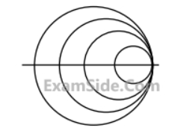
Many circles are drawn in a Smith chart used for transmission line calculations. The circles shown in Fig. represent:
unit circles
constant resistance circles
constant reactance circles
constant reflection coefficient circles
Solution
The circles shown in the figure (complete circles tangential to the right-hand side of the chart) represent constant resistance circles .
Constant reactance circles appear as arcs extending from the right-hand side.
Constant reflection coefficient circles (SWR circles) are concentric circles centered at the origin of the chart.
B
Final Answer
Correct answer: B .