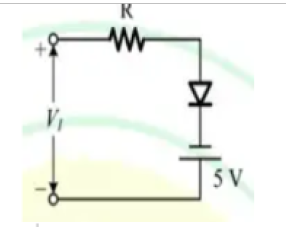
The diode in the circuit below is ideal. The input voltage in volts is given by \( V_i = 10 \sin(100\pi t) \) where time \( t \) is in seconds. The time duration in ms, rounded off to two decimal places, for which the diode is forward biased during one period of the input is ___.
GATE 2025 Analog Electronics Q1 diode circuit diagram
Solution
While the diode is off no current flows, so there is no drop across \( R \) and the anode sits at \( V_i \). The 5 V source is connected with its positive terminal at the bottom rail, so the cathode is held at \( -5\,V \). The diode is therefore forward biased whenever
Writing \( \theta = 100\pi t \), the condition \( \sin\theta > -\frac{1}{2} \) holds over \( -\frac{\pi}{6} < \theta < \frac{7\pi}{6} \), an interval of \( \frac{4\pi}{3} \) out of every \( 2\pi \). Hence
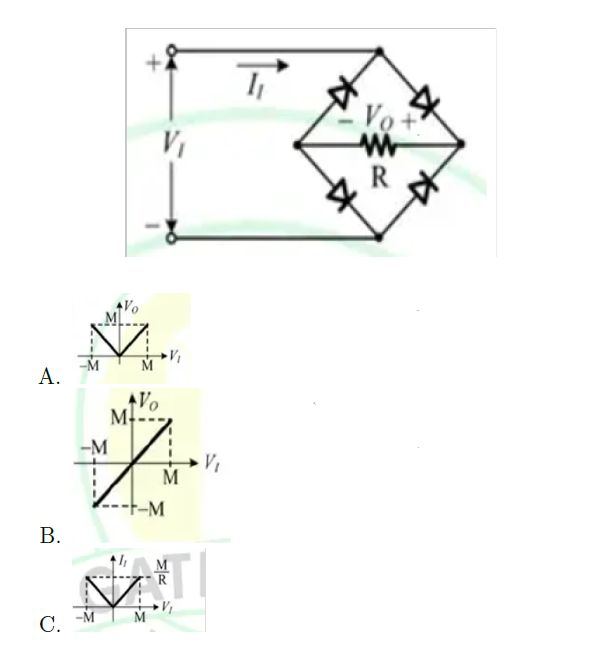
All the diodes in the circuit are ideal. Which of the following plots is/are correct when \( V_i \) is swept from \(-M\) to \(+M\)?
[Plot A]
[Plot B]
[Plot C]
[Plot D]
GATE 2025 Analog Electronics Q2 diode circuit diagram
Solution
D
Final Answer
Correct options: A and D.
Question 03
Question 3
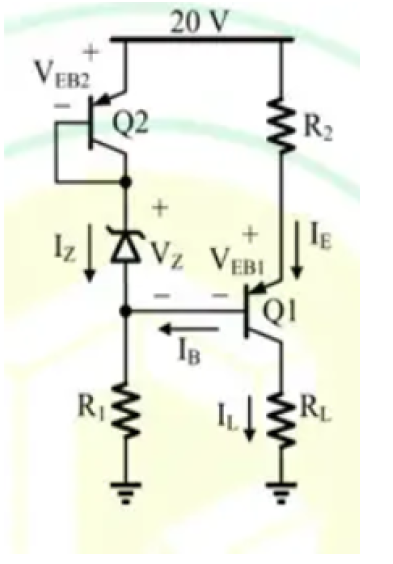
In the circuit shown, the identical transistors Q1 and Q2 are biased in the active region with \(\beta = 120\). The Zener diode is in breakdown with \( V_Z = 5\,V \) and \( I_Z = 25\,mA \). If \( I_L = 12\,mA \) and \( V_{EB2} = V_{EB1} = 0.7\,V \), then the values of \( R_1 \) and \( R_2 \) in k\(\Omega\), rounded to one decimal place, are ___ and ___, respectively.
0.6 and 0.4
1.4 and 2.5
14.0 and 25.0
6.0 and 4.0
GATE 2025 Analog Electronics Q3 Zener circuit diagram
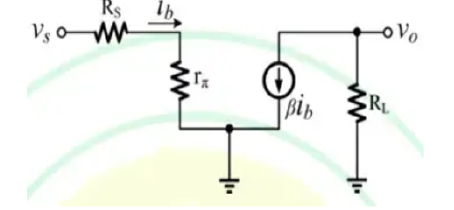
A simplified small-signal equivalent circuit of a BJT-based amplifier is shown below. The small-signal voltage gain \( \frac{v_o}{v_s} \) in V/V is ___.
\( \frac{-\beta R_L}{R_S + r_\pi} \)
\( \frac{+\beta R_L}{R_S} \)
\( \frac{-\beta R_L}{R_S} \)
\( \frac{+\beta R_L}{R_S + r_\pi} \)
GATE 2025 Analog Electronics Q4 BJT circuit diagram
Solution
The input loop is \( R_S \) in series with \( r_\pi \), so
Equation
\[i_b = \frac{v_s}{R_S + r_\pi}\]
The controlled source \( \beta i_b \) draws its current downward out of the output node, so that same current flows up through \( R_L \) from ground into the node:
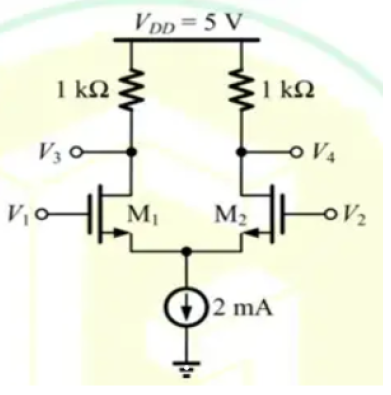
Identical MOSFETs M1 and M2 in the circuit are ideal and biased in saturation. Both have transconductance \( g_m = 5\,mS \). The input signals are \( V_1 = 2.5 + 0.01\sin t \), \( V_2 = 2.5 - 0.01 \sin t \). The output signal \( V_3 \) in volts is ___.
\( 3 + 0.05\sin t \)
\( 3 - 0.10\sin t \)
\( 4 + 0.10\sin t \)
\( 4 - 0.05\sin t \)
GATE 2025 Analog Electronics Q5 MOSFET circuit diagram
Solution
DC analysis: set the signal components to zero. The 2 mA tail current splits equally, so \( I_{D1} = I_{D2} = 1\,mA \). With \( R_D = 1\,k\Omega \) and \( V_{DD} = 5\,V \):
Which of the following statements is/are TRUE regarding ideal MOSFET-based DC-coupled single-stage amplifiers with finite load resistors?
The common-gate amplifier has an infinite input resistance.
The common-source amplifier has an infinite input resistance.
The input and output voltages of the common-source amplifier are in phase.
The input and output voltages of the common-drain amplifier are in phase.
Solution
A - Common-gate input resistance infinite? FALSE. Input is at source (low, \( 1/g_m \)). B - Common-source input resistance infinite? TRUE. Gate (no current): input resistance infinite. C - Common-source amplifier input/output in phase? FALSE. 180° phase shift. D - Common-drain amplifier input/output in phase? TRUE. Source follower—no phase inversion.
Correct statements: B and D.
Question 07
Question 7
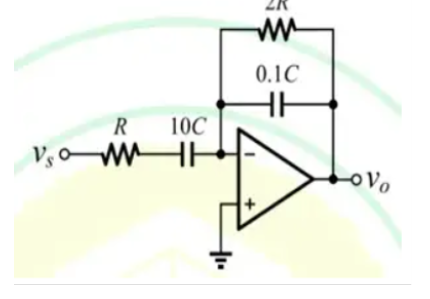
All components in the band-pass filter below are ideal. The lower 3 dB frequency of the filter is 1 MHz. The upper 3 dB frequency in MHz, rounded to the nearest integer, is ___.
GATE 2025 Analog Electronics Q7 filter circuit diagram
Solution
The input branch, \( R \) in series with \( 10C \), sets the lower (high-pass) corner; the feedback network, \( 2R \) in parallel with \( 0.1C \), sets the upper (low-pass) corner:
Which of the following statements is/are TRUE with respect to an ideal op-amp?
It has an infinite input resistance.
It has an infinite output resistance.
It has an infinite open-loop differential gain.
It has an infinite open-loop common-mode gain.
Solution
A - TRUE (no current into inputs). B - FALSE (ideal output resistance is zero). C - TRUE (ideal open-loop differential gain infinite). D - FALSE (ideal open-loop common-mode gain is zero: perfect CMRR).