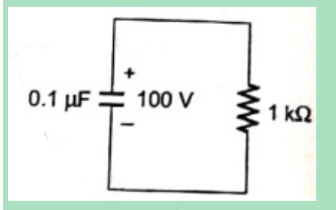
A 0.1\(\mu\)F capacitor charged to 100 V is discharged through a 1k\(\Omega\) resistor.
The time
in ms (round off to two decimal places) required for the voltage across the
capacitor to drop to 1V is _____.
Circuit for GATE 2019 Electric Circuits Q1
Solution
This is a standard RC discharge circuit. The voltage across the capacitor \(v_c(t)\) is given
by:
Equation
\[v_c(t) = V_0 e^{-t/\tau}\]
Where \(V_0 = 100~V\) and the time constant \(\tau = RC\).
Equation
\[\tau = R \times C = (1 \times 10^3 \Omega) \times (0.1 \times 10^{-6} F) = 10^{-4}~\text{sec}\]
We need to find the time \(t_1\) when \(v_c(t_1) = 1~V\).
Rounding to two decimal places, \(t_1 = 0.46\) ms.
✓
Final Answer
Correct answer: 0.46 ms.
Question 02
Question 2
The RL circuit of the figure is fed from a constant magnitude, variable frequency
sinusoidal voltage source \(V_{IN}\). At 100 Hz, the R and L elements each have a voltage
drop \(U_{RMS}\). If the frequency of the source is changed to 50 Hz, then new voltage drop
across R is:
Circuit for GATE 2019 Electric Circuits Q2
\(\sqrt{\frac{5}{8}}u_{rms}\)
\(\sqrt{\frac{2}{3}}u_{rms}\)
\(\sqrt{\frac{8}{5}}u_{rms}\)
\(\sqrt{\frac{3}{2}}u_{rms}\)
Solution
At \(f = 100\) Hz: \(|V_R| = |V_L|\) implies \(R = X_L\).
The voltage drop \(V_R = U_{RMS}\).
The total voltage \(V_{in} = \sqrt{V_R^2 + V_L^2} = \sqrt{U_{RMS}^2 + U_{RMS}^2} = \sqrt{2}U_{RMS}\).
At \(f' = 50\) Hz (half frequency): The new reactance is \(X_L' = X_L / 2 = R / 2\).
The new total impedance \(Z' = \sqrt{R^2 + (X_L')^2} = \sqrt{R^2 + R^2/4} = \frac{R\sqrt{5}}{2}\).
The new current \(I' = \frac{V_{in}}{|Z'|} = \frac{\sqrt{2}U_{RMS}}{R\sqrt{5}/2} = \frac{2\sqrt{2}U_{RMS}}{R\sqrt{5}}\).
The new voltage drop across R is \(V_R' = I' \times R\).
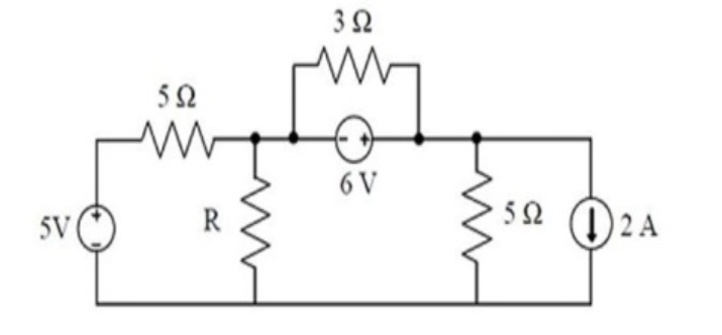
The minimum number of equations required to analyze the circuit shown in Fig.
Circuit for GATE 2019 Electric Circuits Q3
Solution
Using nodal analysis: The number of equations = (Number of essential nodes - 1).
An essential node is where 3 or more elements meet.
The circuit has 4 essential nodes.
Choosing one as reference leaves 3 nodes. This requires 3 node voltage equations.
✓
Final Answer
Correct answer: 3.
Question 04
Question 4
The condition for maximum power transfer to a load impedance \(Z_L = R_L + jX_L\) from a source with internal impedance \(Z_S = R_S + jX_S\) is:
\(R_L = R_S\) and \(X_L = X_S\)
\(R_L = R_S\) and \(X_L = -X_S\)
\(R_L = |Z_S|\) and \(X_L = 0\)
\(Z_L = R_S\)
Solution
For a complex source impedance, maximum power is transferred when the load impedance is the conjugate of the source impedance, i.e., \(Z_L = Z_S^*\).
B
Final Answer
Correct answer: (2) \(R_L = R_S\) and \(X_L = -X_S\).
Question 05
Question 5
A two-port network is reciprocal if its admittance parameters satisfy which of the following conditions?
\(y_{11} = y_{22}\)
\(y_{12} = -y_{21}\)
\(y_{12} = y_{21}\)
\(y_{11}y_{22} - y_{12}y_{21} = 1\)
Solution
A two-port network is considered reciprocal if the ratio of the output current (Port 2) to the input voltage (Port 1) equals the ratio of the input current (Port 1) to the output voltage (Port 2) under appropriate open/short circuit conditions. In terms of the Y-parameters (Admittance parameters), this condition is \(y_{12} = y_{21}\).
The condition \(y_{11} = y_{22}\) indicates a symmetric network.