By the end of this chapter you should be able to:
State the SI base and derived units used in circuit analysis, and convert between engineering prefixes without error.
Define electric charge and current, and relate them by differentiation and integration.
Distinguish conventional current from electron flow, and direct current from alternating current.
Define voltage as energy per unit charge, and interpret the polarity marks on an element.
Apply the passive sign convention to decide whether an element absorbs or supplies power.
Use conservation of power as a check on any solved circuit.
Classify elements as active or passive, and identify the four types of dependent source.
Compute the energy consumed by a load and the cost of that energy.
Introduction
Electric circuit theory is the single most important course in an electrical engineering curriculum, and it is the point of entry for almost every other subject you will meet: electrical machines, power systems, control, electronics, communication and instrumentation all rest on it. The reason is simple. Circuit theory takes a physical object made of copper, silicon and iron — an object properly described by Maxwell's equations — and replaces it with a model: a small number of idealised elements connected at points, obeying algebraic and differential equations that an undergraduate can actually solve.
That replacement is a deliberate approximation. A real resistor has a little inductance; a real wire has resistance; a real capacitor leaks. We ignore all of it, because at the frequencies and dimensions of most engineering practice the error is negligible and the simplification is enormous. The whole of Part 1 of this book is an exercise in taking that idealised model seriously and pushing it as far as it will go.
Two definitions are worth fixing at the outset, because the words are used loosely in conversation and precisely in this book.
An electric circuit is an interconnection of electrical elements that provides at least one closed path for current.
An electrical network is any interconnection of elements. Every circuit is a network, but a network with no closed path is not a circuit.
The distinction matters when we come to network topology and two-port descriptions later in the book. For now, treat "network" as the general term and "circuit" as the special case that can carry current.
Systems of Units
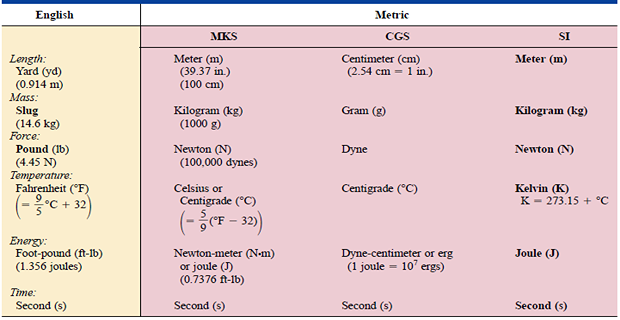
Measurement in engineering requires a language of units that everyone agrees on. Historically the English system and the metric system (subdivided into MKS and CGS) competed. In 1960 the General Conference on Weights and Measures adopted Le Système International d'Unités, abbreviated SI in every language, and it is the system used throughout this book.
The SI rests on seven base units, from which all others are derived:
| Quantity | Base unit | Symbol |
|---|---|---|
| Length | metre | m |
| Mass | kilogram | kg |
| Time | second | s |
| Electric current | ampere | A |
| Thermodynamic temperature | kelvin | K |
| Amount of substance | mole | mol |
| Luminous intensity | candela | cd |
Note that the ampere — not the coulomb — is the base electrical unit. Charge is defined from current, not the other way round, even though it is more natural to teach charge first.
| Quantity | Symbol | Unit | Abbrev. | In base units |
|---|---|---|---|---|
| Charge | \(q\) | coulomb | C | \(\mathrm{A\cdot s}\) |
| Voltage | \(v\) | volt | V | \(\mathrm{kg\cdot m^{2}\cdot s^{-3}\cdot A^{-1}}\) |
| Resistance | \(R\) | ohm | \(\Omega\) | \(\mathrm{kg\cdot m^{2}\cdot s^{-3}\cdot A^{-2}}\) |
| Conductance | \(G\) | siemens | S | \(\mathrm{kg^{-1}\cdot m^{-2}\cdot s^{3}\cdot A^{2}}\) |
| Capacitance | \(C\) | farad | F | \(\mathrm{kg^{-1}\cdot m^{-2}\cdot s^{4}\cdot A^{2}}\) |
| Inductance | \(L\) | henry | H | \(\mathrm{kg\cdot m^{2}\cdot s^{-2}\cdot A^{-2}}\) |
| Power | \(p\) | watt | W | \(\mathrm{kg\cdot m^{2}\cdot s^{-3}}\) |
| Energy | \(w\) | joule | J | \(\mathrm{kg\cdot m^{2}\cdot s^{-2}}\) |
| Frequency | \(f\) | hertz | Hz | \(\mathrm{s^{-1}}\) |
Circuit quantities span an extraordinary range — a picofarad capacitor and a gigawatt generating station appear in the same discipline. Rather than write long strings of zeros we attach a prefix representing a power of ten. In engineering notation the exponent is always a multiple of three, which keeps every number aligned with a named prefix.
| Multiplier | Prefix | Symbol | Typical use |
|---|---|---|---|
| \(10^{12}\) | tera | T | national energy consumption (TWh) |
| \(10^{9}\) | giga | G | generating-station output (GW) |
| \(10^{6}\) | mega | M | transmission voltage (MV), resistance (M\(\Omega\)) |
| \(10^{3}\) | kilo | k | distribution voltage (kV), resistance (k\(\Omega\)) |
| \(10^{-3}\) | milli | m | signal currents (mA), inductance (mH) |
| \(10^{-6}\) | micro | \(\mu\) | capacitance (\(\mu\)F), leakage current |
| \(10^{-9}\) | nano | n | capacitance (nF), switching times |
| \(10^{-12}\) | pico | p | stray capacitance (pF) |
The four arithmetic rules for powers of ten are worth committing to memory, because you will apply them constantly and a slip of one decade is the most common numerical error students make.
Note that addition and subtraction require the exponents to match first; multiplication, division and exponentiation do not.
Problem. Express (a) \(0.000047~\mathrm{F}\), (b) \(2\,200\,000~\Omega\) and (c) \(0.0035~\mathrm{A}\) in engineering notation with an appropriate prefix.
Solution.
In each case the mantissa has been adjusted so that the exponent is a multiple of three and the leading digits lie between 1 and 999. This is the form you should quote every numerical answer in for the rest of the book.
Charge and Current
All matter is built from atoms, and every atom consists of electrons, protons and neutrons. The proton and the electron carry equal and opposite charge of magnitude
with the electron negative and the proton positive. An atom containing equal numbers of each is electrically neutral.
Charge is the most basic quantity in an electric circuit. It is the property of matter responsible for electrical phenomena, measured in coulombs (C). Two facts about it govern everything that follows:
Charge is conserved. Charge is neither created nor destroyed in a circuit; it is only transported. This is the physical basis of Kirchhoff's current law in the next chapter.
Charge is mobile. It can be transferred from one place to another, and in the process converted to another form of energy — heat in a filament, torque in a motor, light in an LED.
The coulomb is a very large unit. Since one electron carries \(1.602 \times 10^{-19}\) C, a single coulomb represents
Laboratory charges are consequently measured in pC, nC or \(\mu\)C. It is worth pausing on this number: a current of one ampere, which is unremarkable in a domestic appliance, moves more than six billion billion electrons past a point every second.
Inside a copper wire at room temperature with no source connected, free electrons are already in motion — a chaotic thermal motion driven by energy absorbed from the surroundings, in which electrons continually collide with positive ions and with each other, changing speed and direction. Over any interval, the number of electrons crossing a given cross-section from left to right exactly equals the number crossing from right to left. There is motion, but there is no current.
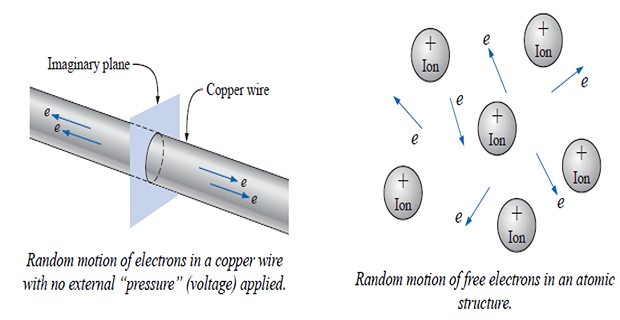
Connect a battery and this changes. At the expense of chemical energy the battery maintains a surplus of electrons at its negative terminal and a deficit at its positive terminal. The free electrons in the wire now drift towards the positive terminal, superimposed on their random motion, while the positive ions merely oscillate about fixed positions. The battery absorbs electrons at its positive terminal and resupplies them at the negative, sustaining the drift indefinitely.
The drift velocity is remarkably slow — of the order of millimetres per second — even though the electric field that causes it is established through the circuit at close to the speed of light. This is why a lamp lights instantly although no individual electron travels from the switch to the bulb in that time.
Electric current is the time rate of change of charge, measured in amperes (A). Formally,
where \(i\) is in amperes, \(q\) in coulombs and \(t\) in seconds. One ampere is one coulomb per second.
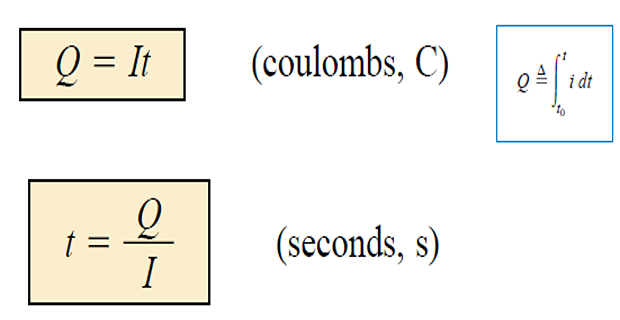
Inverting the relation, the charge transferred between times \(t_0\) and \(t\) is
These two equations are a differentiation–integration pair, and which one you reach for depends entirely on what you are given. If charge is described as a function of time, differentiate to get current. If current is described as a function of time and you want the charge delivered over an interval, integrate.
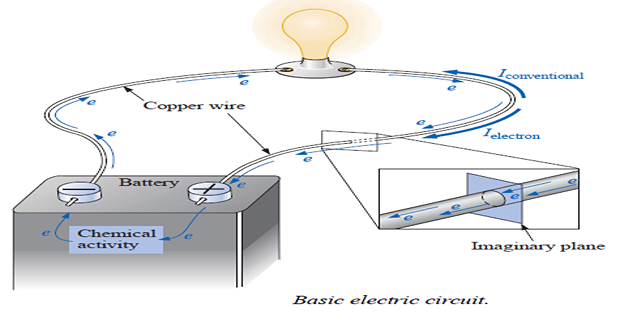
Here is a historical awkwardness you simply have to absorb. By universal convention, the direction of current is taken as the direction of positive charge flow. In a metallic conductor the actual carriers are electrons, which are negative, so the electrons drift in the direction opposite to the conventional current arrow.
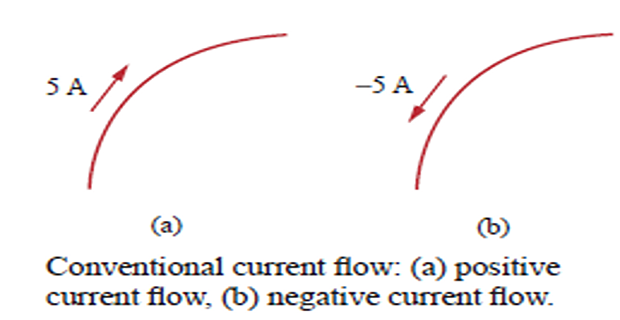
This convention was fixed by Benjamin Franklin before the electron was discovered, and it has never been worth changing. It causes no error whatsoever: every equation in circuit theory is written in terms of conventional current, and provided you use it consistently the answers are correct. In semiconductor devices the convention is more than a convention, since holes — genuinely positive carriers — do move in the direction of conventional current.
A negative current value is not an error either. A current of \(-5\) A in a given direction simply means 5 A flowing the other way. Since the reference direction on a circuit diagram is usually assigned before the circuit is solved, negative answers are routine and carry useful information.
Direct current (dc) — a current that remains constant with time. Conventionally denoted by the capital letter \(I\). Produced by batteries, rectifiers and photovoltaic cells.
Alternating current (ac) — a current that varies sinusoidally with time. Denoted by the lower-case letter \(i\). Produced by rotating generators; it is the form in which electrical energy is transmitted and distributed worldwide.
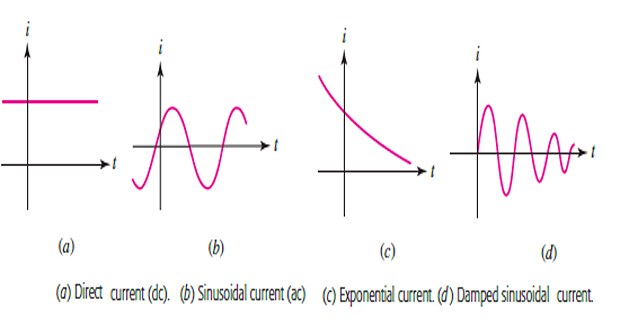
The notation matters and is used consistently throughout this book: upper-case symbols (\(I\), \(V\), \(P\)) denote constant or dc quantities, lower-case symbols (\(i\), \(v\), \(p\)) denote quantities that may vary with time. Other time-varying waveforms — exponential, sawtooth, triangular, pulse — also occur and are handled by the same equations.
Problem. How much charge is represented by 4 600 electrons?
Solution. Each electron carries \(-1.602 \times 10^{-19}\) C, so
The negative sign is not optional — it records that the carriers are electrons. Note also how small the result is: even several thousand electrons amount to a femtocoulomb-scale charge.
Problem. The total charge entering a terminal is given by \(q = 5t \sin 4\pi t~\mathrm{mC}\). Calculate the current at \(t = 0.5~\mathrm{s}\).
Solution. Differentiate, applying the product rule to \(5t\) and \(\sin 4\pi t\):
Now substitute \(t = 0.5\) s, noting that \(4\pi(0.5) = 2\pi\), so \(\sin 2\pi = 0\) and \(\cos 2\pi = 1\):
A frequent slip here is to differentiate only one of the two factors. Whenever charge is given as a product of a polynomial and a trigonometric function, the product rule is unavoidable.
Problem. Determine the total charge entering a terminal between \(t = 1~\mathrm{s}\) and \(t = 2~\mathrm{s}\) if the current is \(i = \left(3t^{2} - t\right)~\mathrm{A}\).
Solution. Integrate the current over the stated interval:
Both limits must be substituted. Evaluating only the upper limit — a very common error — would give 6 C, which is the charge delivered from \(t=0\), not from \(t=1\).
Voltage
Current will not flow of its own accord. Moving an electron through a conductor in a particular direction requires work, and that work is performed by an external electromotive force, otherwise called voltage or potential difference.
The voltage \(v_{ab}\) between two points \(a\) and \(b\) is the energy required to move a unit positive charge from \(b\) to \(a\), measured in volts (V):
where \(w\) is energy in joules and \(q\) is charge in coulombs. It follows immediately that
A potential difference of one volt exists between two points when one joule of energy is exchanged in moving one coulomb of charge between them.

Voltage is always measured between two points. There is no such thing as "the voltage at a point" until a reference point — usually the ground or datum node — has been declared. Changing either point changes the reading.
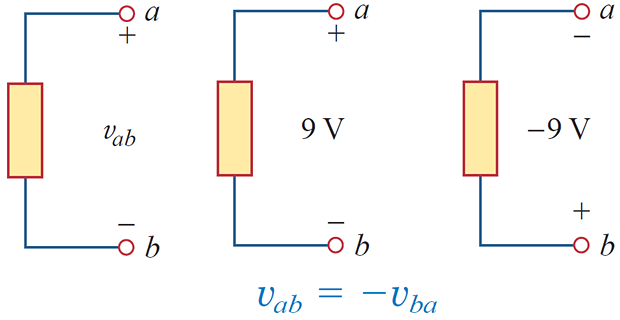
The \(+\) and \(-\) signs drawn on an element define the reference polarity, not a physical fact. They are an assumption made before solving, exactly like the reference arrow for current.
Reversing the polarity marks reverses the sign of the answer:
\[v_{ab} = -v_{ba}\]A potential difference of \(+9\) V from \(a\) to \(b\) is identical to \(-9\) V from \(b\) to \(a\). Both statements describe the same physical situation.
As with current, a constant voltage is called a dc voltage and is written \(V\); a sinusoidally varying voltage is an ac voltage, written \(v\). A battery produces the former, a generator the latter.
Problem. An energy source forces a constant current of 2 A to flow through a lamp for 10 s. If 2.3 kJ is given off as light and heat, calculate the voltage drop across the lamp.
Solution. First find the charge transferred. Since the current is constant,
The voltage is then the energy per unit charge:
Because the current is constant, \(q = \int i \, dt\) reduces to the product \(It\). Had the current varied with time, the integral would have been unavoidable.
Power and Energy
Voltage and current alone are not enough. A lamp rated at 240 V is useless information until we know how much power it draws, because power determines the size of the conductor, the rating of the switch and the electricity bill.
Power is the time rate of expending or absorbing energy, measured in watts (W):
Combining this with the definitions of voltage and current gives the central result of this section by the chain rule:
Instantaneous power is the product of the instantaneous voltage across an element and the instantaneous current through it. It may be positive or negative, and the sign carries physical meaning — which brings us to the single most important convention in circuit analysis.
The product \(vi\) is ambiguous until we say how the reference arrow for current relates to the reference polarity for voltage. The rule adopted universally is:
The passive sign convention is satisfied when current enters through the positive terminal of an element. Then \(p = +vi\), and a positive result means the element is absorbing power.
If current enters through the negative terminal, the convention is violated and \(p = -vi\). Equivalently, keep \(p = vi\) but reverse the sign of one variable.
Two readings of the same situation are always available, and they are equivalent:
An element with \(p = -30\) W under the passive sign convention is delivering 30 W to the rest of the circuit. Sources normally deliver and resistors always absorb, but a battery being charged absorbs, and a capacitor discharging delivers — so never assume from the name of the element. Compute the sign.

Energy can be neither created nor destroyed, only transferred. Applied to a circuit at any instant, this gives an extremely useful result:
The algebraic sum of the power associated with every element in a circuit is zero at every instant. Equivalently, the total power supplied equals the total power absorbed:
This is the most valuable check you have. Once a circuit is fully solved, compute the power for every element and add them. If the sum is not zero to within rounding, there is an error somewhere in the solution. Use it on every problem you solve.
Integrating power over time gives the energy absorbed or supplied by an element:
Energy is the capacity to do work, measured in joules (J). The joule is inconveniently small for electrical supply, so utilities bill in watt-hours, and
The kilowatt-hour — one "unit" on an electricity bill — is simply the energy consumed by a 1 kW load running for one hour.
Problem. Find the power delivered to an element at \(t = 3~\mathrm{ms}\) if the current entering its positive terminal is \(i = 5\cos 60\pi t~\mathrm{A}\) and the voltage is (a) \(v = 3i\), (b) \(v = 3\,\dfrac{di}{dt}\).
Solution (a). The element is resistive, with \(v = 3i = 15\cos 60\pi t\) V. Since current enters the positive terminal, the passive sign convention is satisfied and
At \(t = 3~\mathrm{ms}\) the argument is \(60\pi(3\times10^{-3}) = 0.18\pi~\mathrm{rad} = 32.4^{\circ}\), so
Positive, as it must be: a resistive element can only absorb.
Solution (b). Now the element is inductive:
using the identity \(2\sin\theta\cos\theta = \sin 2\theta\). At \(t = 3~\mathrm{ms}\) the argument is \(120\pi(3\times10^{-3}) = 0.36\pi~\mathrm{rad} = 64.8^{\circ}\), giving
The negative sign says the element is delivering power at this instant. That is entirely proper for an inductor: it stores energy during part of the cycle and returns it during another, and the instantaneous power alternates in sign. Chapter 11 develops this into the distinction between real and reactive power.
Problem. A 12 V battery drives a current of 2 A through a series combination of a 4 \(\Omega\) and a 2 \(\Omega\) resistor. Verify that power is conserved.
Solution. The battery: current leaves its positive terminal, so it violates the passive sign convention and
Each resistor absorbs, with \(p = i^{2}R\):
Summing all three:
The 24 W supplied by the battery is exactly accounted for by the 24 W dissipated in the two resistors. Whenever your power balance fails to close, suspect a sign error before suspecting arithmetic.
Circuit Elements
An element is the basic building block of a circuit — the smallest part into which a circuit can be divided for the purpose of analysis. Every element falls into one of two classes.
Passive elements are incapable of generating energy. They either dissipate it (the resistor) or store and return it (the capacitor and the inductor). Chapter 6 treats the last two in detail.
Active elements are capable of generating energy. Generators, batteries and operational amplifiers are active. The most important active elements for our purposes are voltage and current sources.
A useful test: connect the element to a passive network and ask whether energy can flow out of it indefinitely. If yes, it is active.
An ideal independent source is an active element that provides a specified voltage or current completely independent of the rest of the circuit.
An ideal independent voltage source maintains its specified terminal voltage no matter what current the circuit draws. It will supply whatever current is necessary to hold that voltage.
An ideal independent current source maintains its specified current no matter what voltage appears across it. It will develop whatever terminal voltage is necessary to hold that current.
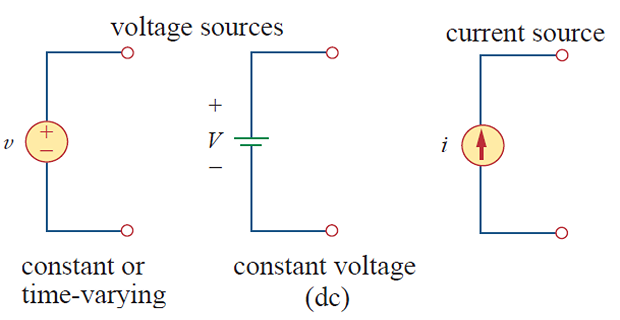
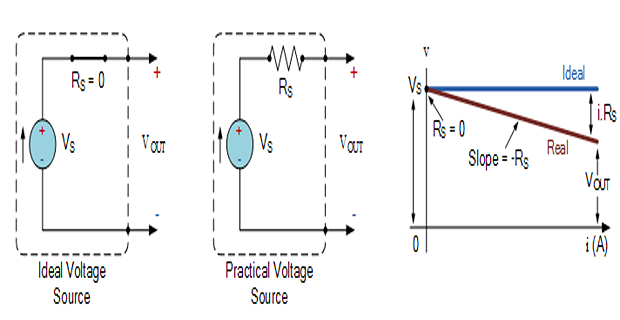
Both ideal sources are, of course, impossible. A real battery has internal resistance, so its terminal voltage droops under load; a real current source has finite internal conductance. Chapter 4 shows how to model practical sources and convert between the two forms.
An ideal dependent source is an active element whose output is controlled by a voltage or current elsewhere in the circuit. They are drawn as diamonds to distinguish them from the circles used for independent sources — a convention worth respecting, since confusing the two makes a circuit unsolvable.
Since the controlling quantity may be either a voltage or a current, and the controlled output may likewise be either, there are exactly four types:
| Type | Output | Control constant | Typical use |
|---|---|---|---|
| VCVS | \(v = \mu v_{x}\) | gain \(\mu\), dimensionless | ideal amplifier, op-amp model |
| CCVS | \(v = r\, i_{x}\) | transresistance \(r\), \(\Omega\) | current-sensing circuits |
| VCCS | \(i = g\, v_{x}\) | transconductance \(g\), S | FET small-signal model |
| CCCS | \(i = \beta\, i_{x}\) | gain \(\beta\), dimensionless | BJT small-signal model |
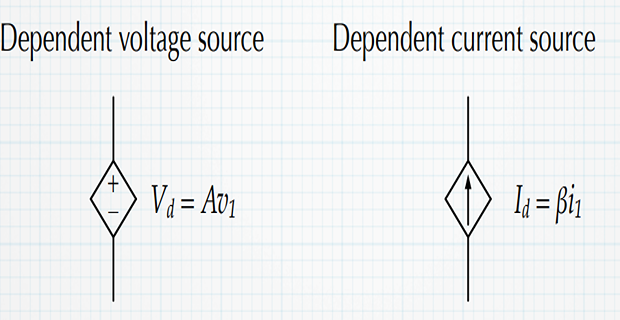
Dependent sources are not a mathematical curiosity — they are how transistors and amplifiers enter circuit analysis. Every small-signal transistor model in your electronics course is a resistive network with one dependent source in it. When you meet nodal and mesh analysis in Chapter 3, the controlling variable will need one extra equation, and that is the only complication they introduce.
Problem. An element carries a current \(i_x = 4\) A. A CCVS elsewhere in the circuit produces \(v = 5 i_x\) and carries a current of 2 A entering its positive terminal. Determine the power associated with the dependent source and state whether it absorbs or supplies.
Solution. The controlled voltage is
Current enters the positive terminal, so the passive sign convention holds and
The result is positive, so this dependent source is absorbing 40 W. This surprises many students, who assume a source must deliver. A dependent source does whatever the controlling variable and the surrounding circuit require of it, and absorbing power is perfectly legitimate.
Practical Engineering Applications
The most immediate application of this chapter is the bill that arrives every month. A domestic energy meter records energy, not power, in kilowatt-hours. For a load of constant power \(P\) watts operating for \(t\) hours,
This single calculation underlies every efficiency argument in electrical engineering — why an LED replaced the incandescent lamp, why standby power matters, and why utilities charge industrial consumers for poor power factor, as Chapter 11 explains.
Problem. A household runs a 1.5 kW water heater for 3 hours a day and five 60 W lamps for 5 hours a day. At a tariff of ₹7.00 per kWh, find the monthly (30-day) energy cost.
Solution. Water heater:
Lamps — five of them at 60 W each is 300 W, or 0.3 kW:
Observe that the heater, running for fewer hours, accounts for three-quarters of the bill. Power rating dominates over running time whenever the ratings differ by an order of magnitude.
Battery manufacturers rate capacity in ampere-hours (Ah) rather than coulombs, but the two are the same physical quantity — charge. Since 1 Ah is one ampere flowing for 3600 s,
A 5000 mAh phone battery therefore stores \(5 \times 3600 = 18\,000\) C of charge. At a nominal 3.7 V this represents an energy of \(w = qv = 18\,000 \times 3.7 = 66.6\) kJ, or about 18.5 Wh. Comparing that with the 180 kWh of the previous example gives a vivid sense of the scale separation between electronics and power engineering — roughly four orders of magnitude.
Conductor sizing. Current determines the cross-section of a cable, because power dissipated as heat rises as the square of current. A wiring error here is a fire risk, not merely an inefficiency.
Resistor power rating. A component is chosen not only for its resistance but for the power it must dissipate without overheating — a direct application of \(p = vi\).
Electric vehicle range. Battery capacity in kWh divided by consumption in kWh per kilometre gives range. Both quantities come straight from this chapter's definitions.
Cathode-ray and electron-beam devices. A beam current of a few microamperes accelerated through several kilovolts delivers the energy that produces an image or a weld, with \(w = qv\) giving the energy per electron.
A Problem-Solving Strategy
Circuit problems reward method far more than cleverness. The following six steps are worth following explicitly until they become automatic — and worth returning to whenever a problem defeats you.
Define the problem carefully. Read what is actually asked. Identify the quantity required and its units before touching a formula.
Draw and label the circuit. Mark every reference polarity and every current arrow, including the ones you are guessing. An unlabelled diagram guarantees sign errors.
List what is known and what is unknown. Count the unknowns; you will need the same number of independent equations.
Choose a method and set up the equations. Ohm's law and Kirchhoff's laws in Chapter 2, nodal or mesh analysis in Chapter 3, a theorem in Chapter 4 — the more tools you have, the shorter the route.
Solve, keeping units throughout. Carry the units through the algebra; a dimensional inconsistency will expose an error long before the arithmetic does.
Check the answer. Is the magnitude physically plausible? Does the power balance to zero? Substituting back into the original equations costs a minute and catches most mistakes.
Step 6 is the one students skip and engineers never do. Conservation of power gives you an independent check on almost every problem in this book — use it.
Summary and Key Formulas
An electric circuit is an interconnection of elements providing at least one closed path for current; a network is any interconnection.
Charge is the basic electrical quantity, measured in coulombs. The electronic charge is \(1.602 \times 10^{-19}\) C, and charge is conserved.
Current is the time rate of change of charge, \(i = dq/dt\), measured in amperes. Conventional current is taken in the direction of positive charge flow, opposite to electron drift in a metal.
Voltage is energy per unit charge, \(v = dw/dq\), measured in volts. It is always defined between two points and depends on the assigned reference polarity.
Power is the rate of energy transfer, \(p = dw/dt = vi\), measured in watts. Energy is its integral, measured in joules or kilowatt-hours.
Under the passive sign convention, current entering the positive terminal gives \(p = +vi\) and a positive value means absorption.
The algebraic sum of power over all elements of a circuit is zero at every instant.
Elements are passive (resistor, capacitor, inductor) or active (sources, amplifiers). Sources are independent, drawn as circles, or dependent, drawn as diamonds, in four types: VCVS, CCVS, VCCS and CCCS.
| Quantity | Relation | Unit | Notes |
|---|---|---|---|
| Electronic charge | \(e = 1.602 \times 10^{-19}\) | C | \(1~\mathrm{C} = 6.24\times10^{18}\) electrons |
| Current | \(i = \dfrac{dq}{dt}\) | A | differentiate the charge |
| Charge | \(q = \displaystyle\int_{t_0}^{t} i\,dt\) | C | both limits required |
| Charge, constant current | \(q = It\) | C | special case only |
| Voltage | \(v = \dfrac{dw}{dq}\) | V | \(1~\mathrm{V} = 1~\mathrm{J/C}\) |
| Polarity reversal | \(v_{ab} = -v_{ba}\) | V | same physical situation |
| Instantaneous power | \(p = \dfrac{dw}{dt} = vi\) | W | passive sign convention assumed |
| Conservation of power | \(\sum p = 0\) | W | use as a check on every solution |
| Energy | \(w = \displaystyle\int_{t_0}^{t} vi\,dt\) | J | \(1~\mathrm{Wh}=3600~\mathrm{J}\) |
| Energy cost | \(\text{Cost} = \dfrac{Pt}{1000}\times\text{tariff}\) | ₹ | \(P\) in W, \(t\) in h |
Common Mistakes
Treating a negative answer as an error. A negative current or voltage means the actual direction or polarity is opposite to the reference you assumed. The magnitude is still correct. Do not "fix" it by dropping the sign.
Ignoring the passive sign convention. Writing \(p = vi\) when the current enters the negative terminal reverses the meaning of the answer, turning a source into a load. Check the terminal the current enters before multiplying.
Confusing power with energy. A 100 W lamp does not consume "100 W per hour". It consumes energy at the rate of 100 W, and consumes 100 Wh in an hour. The watt already contains "per second".
Substituting only the upper limit of a definite integral. When finding charge over an interval, both limits must be evaluated. This is the single most common slip in Section 1.3 problems.
Forgetting the product rule. Differentiating \(q = 5t\sin 4\pi t\) as though the \(5t\) were a constant loses an entire term.
Adding powers of ten with unequal exponents. \(2\times10^{3} + 5\times10^{2} \neq 7\times10^{3}\). Match the exponents first.
Assuming sources always supply and resistors always absorb. A resistor always absorbs, but a source may absorb — a charging battery and the dependent source in Example 1.8 both do.
Quoting an answer without units, or with the wrong prefix. Answers in this subject are meaningless without units, and a factor-of-1000 prefix error is indistinguishable from a wrong answer in an examination.
Mixing degrees and radians. When evaluating \(\cos 60\pi t\) the argument is in radians. Setting a calculator to degrees is a classic source of wrong power values.
Chapter Review
Work these before opening the answers. Quote every result to four significant figures with correct units.
P1.1 How many electrons are represented by a charge of \(-3.2~\mu\mathrm{C}\)?
Show answer
\[n = \frac{3.2\times10^{-6}}{1.602\times10^{-19}} = 1.998\times10^{13}~\text{electrons}\]P1.2 The charge entering a terminal is \(q = \left(10 - 10e^{-2t}\right)~\mathrm{mC}\). Find the current at \(t = 0.5~\mathrm{s}\).
Show answer
\[i = \frac{dq}{dt} = 20e^{-2t}~\mathrm{mA}, \qquad i(0.5) = 20e^{-1} = 7.358~\mathrm{mA}\]P1.3 A current \(i = 6e^{-t}~\mathrm{A}\) flows into a terminal. Find the charge delivered between \(t = 0\) and \(t = 1~\mathrm{s}\).
Show answer
\[q = \int_{0}^{1} 6e^{-t}\,dt = 6\left(1 - e^{-1}\right) = 3.793~\mathrm{C}\]P1.4 A constant current of 5 A flows for 2 minutes through an element across which the voltage drop is 10 V. How much energy is absorbed?
Show answer
\[q = It = 5 \times 120 = 600~\mathrm{C}, \qquad w = vq = 10 \times 600 = 6~\mathrm{kJ}\]P1.5 An element absorbs 100 W with 20 V across it. Determine the current, and state which terminal it enters.
Show answer
Since the element absorbs, \(p = +vi\) and the current enters the positive terminal.\[i = \frac{p}{v} = \frac{100}{20} = 5~\mathrm{A}\]P1.6 A 2 kW air conditioner runs 6 hours a day for 30 days. At ₹8.50 per kWh, what is the cost?
Show answer
\[W = 2 \times 6 \times 30 = 360~\mathrm{kWh}, \qquad \text{Cost} = 360 \times 8.50 = 3060~\text{rupees}\]P1.7 In a three-element circuit, element A supplies 50 W and element B absorbs 18 W. What is the power associated with element C, and does it absorb or supply?
Show answer
Taking absorbed power as positive, \(p_A = -50\) W. Conservation requiresElement C absorbs 32 W.\[-50 + 18 + p_{C} = 0 \;\Rightarrow\; p_{C} = +32~\mathrm{W}\]P1.8 The voltage across an element is \(v = 10\cos 2t\) V and the current entering its positive terminal is \(i = 4\sin 2t\) A. Find the instantaneous power at \(t = 0.4~\mathrm{s}\).
Show answer
At \(t = 0.4\) s, \(4t = 1.6~\mathrm{rad}\) and \(\sin 1.6 = 0.9996\), so \(p = 19.99~\mathrm{W}\).\[p = vi = 40\sin 2t\cos 2t = 20\sin 4t~\mathrm{W}\]P1.9 Express in engineering notation with a prefix: (a) \(0.00000082~\mathrm{F}\), (b) \(15\,600\,000~\mathrm{W}\), (c) \(0.047~\mathrm{H}\).
Show answer
(a) \(0.82~\mu\mathrm{F}\) or \(820~\mathrm{nF}\) · (b) \(15.6~\mathrm{MW}\) · (c) \(47~\mathrm{mH}\)P1.10 A 12 V car battery is rated at 60 Ah. How much energy does it store, in kWh?
Show answer
Equivalently \(q = 60 \times 3600 = 216~\mathrm{kC}\) and \(w = 12 \times 216\,000 = 2.592~\mathrm{MJ}\).\[W = VQ = 12 \times 60 = 720~\mathrm{Wh} = 0.72~\mathrm{kWh}\]
MCQ 1. The unit of electric charge is the:
(a) ampere (b) coulomb (c) volt (d) jouleShow answer
(b) coulomb. The ampere is the unit of current, the volt of potential difference and the joule of energy.MCQ 2. Conventional current in a metallic conductor flows in the direction of:
(a) electron drift (b) positive charge flow (c) the magnetic field (d) decreasing resistanceShow answer
(b) positive charge flow, which in a metal is opposite to the actual electron drift.MCQ 3. One volt is equivalent to:
(a) 1 J/s (b) 1 C/s (c) 1 J/C (d) 1 N·mShow answer
(c) 1 J/C. Option (a) is the watt, (b) is the ampere and (d) is the joule.MCQ 4. An element has 10 V across it and 2 A entering its negative terminal. The element:
(a) absorbs 20 W (b) supplies 20 W (c) absorbs 5 W (d) supplies 5 WShow answer
(b) supplies 20 W. The passive sign convention is violated, so \(p = -vi = -20\) W, which means 20 W is delivered.MCQ 5. The number of electrons in one coulomb is approximately:
(a) \(1.602\times10^{-19}\) (b) \(6.24\times10^{18}\) (c) \(6.02\times10^{23}\) (d) \(3.6\times10^{3}\)Show answer
(b) \(6.24\times10^{18}\). Option (c) is Avogadro's number, a different quantity entirely.MCQ 6. One kilowatt-hour equals:
(a) 1000 J (b) 3600 J (c) \(3.6\times10^{6}\) J (d) \(10^{6}\) JShow answer
(c) \(3.6\times10^{6}\) J. Option (b) is one watt-hour.MCQ 7. A dependent source is represented on a circuit diagram by a:
(a) circle (b) diamond (c) rectangle (d) triangleShow answer
(b) diamond. The circle is reserved for independent sources; the triangle usually denotes an amplifier.MCQ 8. The transconductance of a VCCS has units of:
(a) ohms (b) siemens (c) volts (d) dimensionlessShow answer
(b) siemens. Output current divided by controlling voltage has units of A/V = S.MCQ 9. Which of the following is a passive element?
(a) battery (b) operational amplifier (c) inductor (d) generatorShow answer
(c) inductor. It stores and returns energy but cannot generate it. The other three are active.MCQ 10. If the total charge entering a terminal is \(q = 2t^{2}\) C, the current at \(t = 3\) s is:
(a) 6 A (b) 12 A (c) 18 A (d) 36 AShow answer
(b) 12 A. \(i = dq/dt = 4t\), so \(i(3) = 12\) A. Option (c) is the value of \(q\) at that instant, a common trap.
Electrons drift through a copper wire at only a few millimetres per second, yet a lamp lights the instant the switch closes. Explain the apparent contradiction.
Why is it meaningless to speak of "the voltage at point \(a\)" without further qualification, while it is perfectly meaningful to speak of "the current in element \(a\)"?
An ideal voltage source is short-circuited. What does the model predict, and why is this a signal that the model has been pushed beyond its range of validity?
Explain why conservation of power must hold instant by instant, and not merely on average over a cycle.
A dependent source can absorb power. Reconcile this with the statement that dependent sources are active elements.
Charge is conserved and energy is conserved. Which of these two conservation laws gives rise to Kirchhoff's current law, and which to the power balance? Speculate on what the other conservation law might give — you will meet the answer in Chapter 2.
Everything in this chapter has been definitional — quantities, units and conventions, with no way yet to relate the voltage across an element to the current through it. Chapter 2 supplies exactly that missing link. Ohm's law connects \(v\) and \(i\) for a resistor, and Kirchhoff's two laws connect the voltages and currents of different elements according to how they are wired together. With those three statements added to the definitions you now have, every resistive DC circuit in existence becomes solvable.
Before moving on, make sure you can apply the passive sign convention without hesitation. It is the one idea from this chapter that will be used on literally every page of the remaining eighteen.