Utilization of Electrical Energy
1. Introduction & Overview
The subject encompasses conversion of electrical energy into mechanical, thermal, chemical and radiant forms; choice of equipment and machines; economic operation and energy management; quality of supply and power factor; and safety practices and standards.
Advantages of Electrical Energy
Technical advantages include easy generation from various sources, effortless transmission over long distances, convenient and accurate control, wide range of speed and power capability, and high efficiency of conversion. On the economic and environmental side, electrical energy offers cleanliness (no smoke, ash, or fumes at point of use), lower operating and maintenance cost, reliable and instantly available power, quiet operation with no vibration, and compatibility with automation and IoT.
Forms of Energy Conversion
| Conversion | Device / Process | Industrial Use |
|---|---|---|
| Electrical → Mechanical | Motors, Drives | Pumps, fans, lifts, mills |
| Electrical → Thermal | Furnaces, ovens, heaters | Melting, hardening, drying |
| Electrical → Chemical | Electrolytic cells | Plating, refining, H₂ production |
| Electrical → Radiant | Lamps, lasers, IR sources | Lighting, photometry, curing |
| Electrical → Acoustic | Speakers, sonar | Sound, signalling, underwater |
| Electrical → Mechanical (traction) | Traction motors | Trains, EVs, trams, metros |
2. Electric Drives & Industrial Motors
Classification of Electric Drives
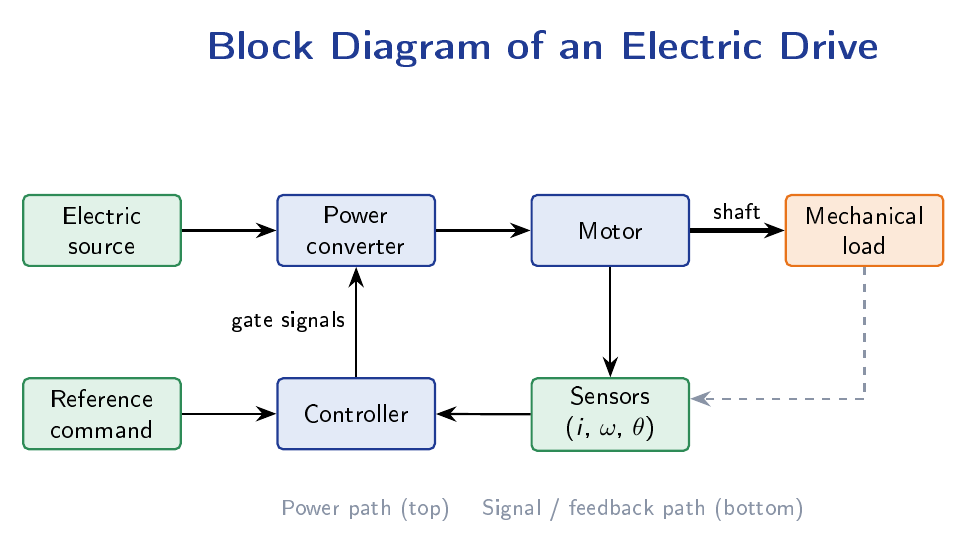
Electric drives are classified in four principal ways. Based on the group of machines driven: group drive (one motor drives several machines through a line shaft, now obsolete), individual drive (one motor per machine), and multi-motor drive (separate motors for each operation of a single machine, e.g., paper mills). Based on speed: constant speed, variable speed (continuous or stepped), and multi-speed. Based on supply: DC drives, AC drives (single-phase and three-phase), and hybrid (rectifier-fed DC or inverter-fed AC). Based on control: manual/contactor, scalar (V/f), vector/field-oriented (FOC), and direct torque control (DTC).
Group vs. Individual vs. Multi-motor Drive
| Feature | Group Drive | Individual Drive | Multi-motor Drive |
|---|---|---|---|
| Capital cost | Low (one motor) | Moderate | High |
| Flexibility of speed | None | Independent for each machine | Independent per operation |
| Power factor | Better (large motor) | Poorer (small motors) | Engineered |
| Efficiency at part load | Poor (line shaft losses) | Better | Best |
| Continuity of work | One fault stops all | Faults are isolated | Isolated |
| Examples | Old textile mills | Lathes, pumps, fans | Paper mills, rolling mills, lifts |
Speed–Torque Characteristics of Common Motors
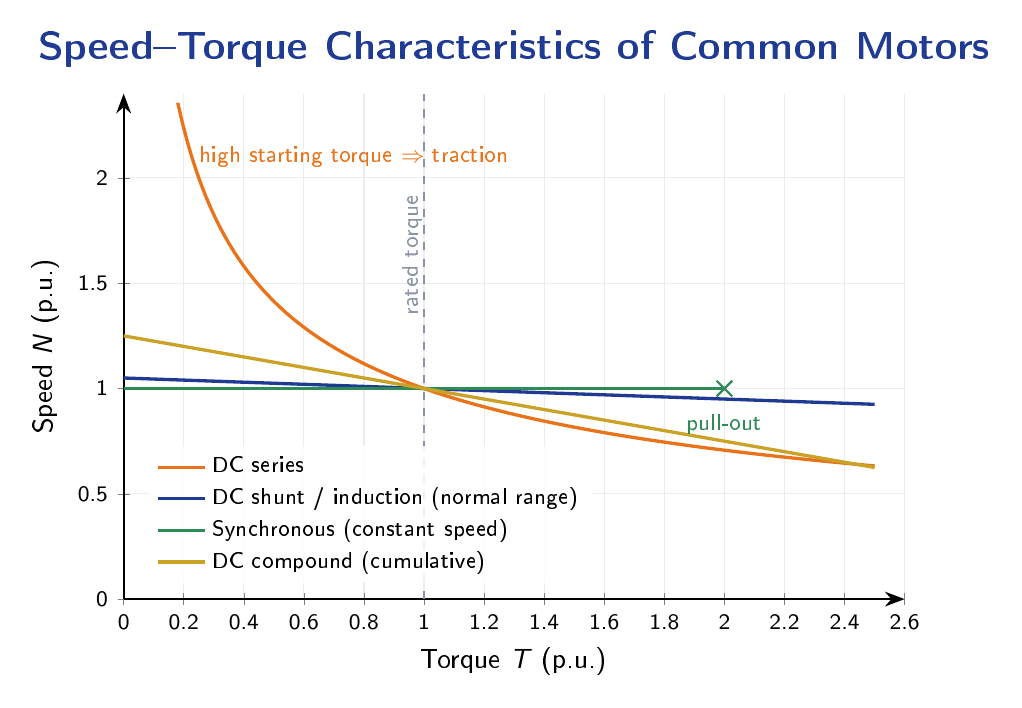
The DC shunt and induction motors exhibit a nearly flat characteristic — nearly constant speed — making them ideal for lathes, pumps, and fans. The DC series motor delivers high starting torque and speed that varies inversely with load — ideal for traction, cranes, and hoists. The synchronous motor operates at absolutely constant speed \(N_s\) — used for compressors, mills, and power factor correction. The DC compound motor has a drooping characteristic with moderate starting torque — suitable for shears, presses, and elevators.
Speed Control of Motors
DC Motor
The DC motor speed relation is \(N \propto (V - I_a R_a)/\phi\). Three methods are used. Armature-voltage control varies \(V\) at constant \(\phi\), providing below-base speed constant-torque operation (Ward–Leonard, chopper, controlled rectifier). Field (flux) control weakens \(\phi\) at constant \(V\), giving above-base speed constant-power operation. Armature-resistance control inserts resistance in series — this is lossy and used only for starting.
Induction Motor
The induction motor speed is \(N = (1-s) \cdot 120f/P\). Key methods include stator-voltage control (narrow range, for fans/pumps), V/f scalar control (maintaining constant air-gap flux from a VFD, from near-zero to base speed — the industry standard), rotor-resistance control (for slip-ring IM only), and vector/FOC and DTC for closed-loop servo-grade dynamics.
Electrical Braking of Motors
| Method | Principle | Application |
|---|---|---|
| Regenerative | Motor speed exceeds synchronous; machine acts as generator, energy returned to supply | Down-gradient traction, EV deceleration, hoist lowering — highest efficiency |
| Dynamic / Rheostatic | Armature disconnected from supply and connected across a resistor; KE dissipated as I²R | Cranes, lifts, machine tools when regeneration not possible |
| Plugging (counter-current) | Supply polarity (DC) or phase sequence (IM) reversed; motor torque opposes motion | Rapid stopping in machine tools, printing presses — severe duty |
| Mechanical (friction) | Brake shoes or discs | Final-stop and parking; always retained for safety |
Industrial Drive Applications
| Industry | Application | Preferred Motor / Drive |
|---|---|---|
| Steel mills | Reversing rolling mill | DC drive / Cycloconverter-fed synchronous motor |
| Steel mills | Auxiliaries (fans, pumps) | Squirrel-cage IM with VFD |
| Textile | Spinning, weaving | 3-phase IM with V/f drive |
| Paper | Multi-section paper machine | Multi-motor IM drives, master–slave control |
| Cement | Kilns, crushers | Slip-ring IM, synchronous motors |
| Cranes & hoists | Lifting | Slip-ring IM, dynamic braking |
| Lifts (elevators) | Passenger / freight | PMSM with closed-loop FOC |
| Machine tools | Lathes, milling | Servo / PMSM |
| Pumps, fans, blowers | Variable flow | IM + VFD (energy-saving) |
| EVs | Traction | PMSM / BLDC / Induction |
3. Selection & Rating of Motors
Choice of Motor — Governing Factors
Motor selection involves four categories of considerations. Electrical: nature of supply (AC/DC, single-phase/three-phase), voltage and frequency, starting current and torque, power factor and efficiency. Mechanical: speed (constant, variable, multi-speed), direction of rotation and reversal, type of load (continuous, intermittent, shock), coupling and transmission. Environmental: ambient temperature, humidity, dust, chemical fumes, explosive atmosphere, and enclosure type (TEFC, ODP, flame-proof). Economic: capital cost, running cost (energy plus maintenance), life expectancy and reliability, and spare parts availability.
Types of Mechanical Loads
Mechanical loads are characterised by their torque–speed profiles. Constant-torque loads (conveyors, cranes, reciprocating compressors) require the same torque regardless of speed. Variable-torque (fan/pump) loads follow \(T \propto \omega^2\), making VFDs particularly energy-efficient. Constant-power loads (winders, machine tool spindles) require constant power over a speed range. Traction loads have a composite characteristic requiring high torque at start, transitioning to constant power.
Duty Classes (IEC 60034-1)
| Duty Class | Name | Description / Typical Machine |
|---|---|---|
| S1 | Continuous | Constant load for indefinitely long time. Pumps, fans, conveyors. |
| S2 | Short-time duty | Constant load for time less than thermal time constant, then long rest. Sluice gate motors. |
| S3 | Intermittent periodic | Sequence of identical load–rest cycles, no thermal equilibrium. Lifts, cranes. |
| S4 | Intermittent with starting | Includes appreciable starting period. Hoist motors. |
| S5 | Intermittent with braking | Includes starting and braking. Reversing rolling mills. |
| S6 | Continuous with intermittent load | Constant-on but load varies. Machine tool drives. |
| S7 | Continuous with start–brake | As S6 plus electric braking. Plate rolls. |
| S8 | Continuous with load-speed change | Variable load and speed without rest. Traction. |
Determination of Motor Rating — Equivalent RMS Method
For a variable or fluctuating load, the motor must be rated for the equivalent (RMS) current, which gives the same heating effect as the actual load cycle:
Analogous expressions apply for torque and power:
Insulation Classes & Permissible Temperature Rise
| Class | Max. Hot-spot | Permissible Rise (40°C ambient) | Typical Material |
|---|---|---|---|
| Y | 90°C | 50°C | Cotton, silk, paper (unimpregnated) |
| A | 105°C | 65°C | Impregnated cotton, varnish |
| E | 120°C | 80°C | Polyester enamels |
| B | 130°C | 90°C | Mica, glass fibre, asbestos with bond |
| F | 155°C | 115°C | Mica, glass fibre with silicone bond |
| H | 180°C | 140°C | Silicone elastomers, mica, glass |
| C | >180°C | — | Mica, ceramic, glass without binder |
4. Electric Heating
Advantages of Electric Heating over Fuel Heating
Electric heating offers cleanliness (no smoke, ash, or fumes), high efficiency (greater than 75%), easy and accurate temperature control, selective or localised heating, no pollution at the point of use, better working conditions, low labour cost, and a compact footprint.
Modes of Heat Transfer
Three fundamental modes govern heat transfer in electric furnaces. Conduction follows Fourier's law: \(Q = -kA\,dT/dx\). Convection follows Newton's law: \(Q = hA(T_s - T_\infty)\). Radiation follows the Stefan–Boltzmann law: \(Q = \varepsilon\sigma A(T_s^4 - T_a^4)\).
Classification of Electric Heating Methods
Direct Resistance Heating
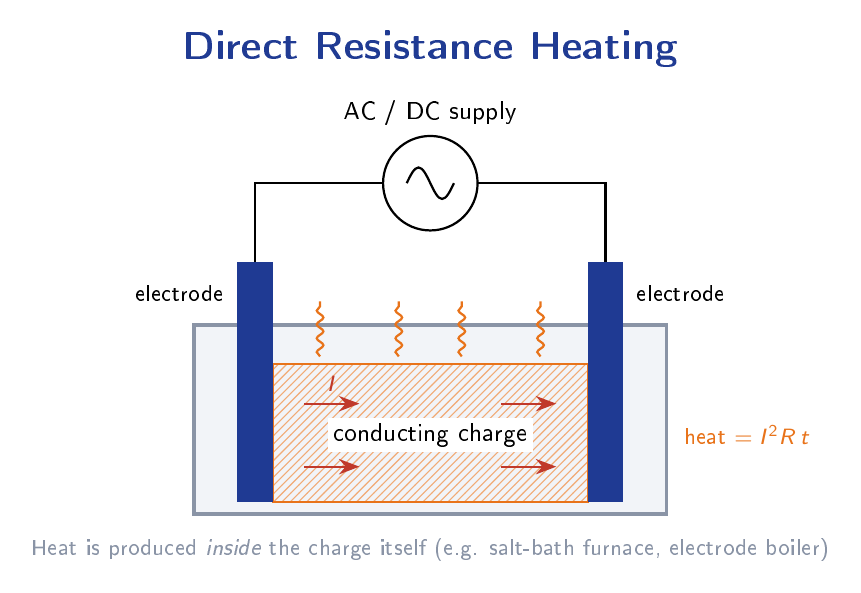
Current is passed directly through the material to be heated, generating \(I^2R\) loss inside it. This method achieves high efficiency (90–95%), rapid and uniform heating, but is applicable only to conducting charges.
Applications: Salt-bath furnaces, electrode boilers, billet heating before forging, immersion heaters.
Indirect Resistance Heating
A separate heating element (Nichrome, Kanthal, or SiC) is heated by \(I^2R\); heat is then transferred to the charge by radiation and convection. The design equation for the heating element is:
where \(\sigma\) is the Stefan–Boltzmann constant, \(\varepsilon\) is emissivity, and \(d\), \(l\) are the diameter and length of the wire. A good heating element material must have high resistivity, high melting point, low temperature-coefficient of resistance, oxidation resistance, and mechanical strength.
Heating Element Materials
| Material | Max. Temp. | Resistivity | Melting Point | Remarks |
|---|---|---|---|---|
| Nichrome (Ni 60–80%, Cr 11–22%) | 1150°C | 109 μΩ·cm | 1400°C | General-purpose, atmospheric |
| Kanthal (Fe-Cr-Al) | 1300°C | 145 μΩ·cm | 1500°C | Higher-temp ovens |
| SiC (Globar) | 1600°C | 1000 μΩ·cm | ~2700°C | High-temp furnaces, rod form |
| Molybdenum | 1800°C | 5.7 μΩ·cm | 2620°C | Vacuum / H₂ atmosphere only |
| Tungsten | 2500°C | 5.5 μΩ·cm | 3380°C | Vacuum furnaces, lamp filaments |
| Graphite | 2500°C | 800 μΩ·cm | 3500°C (sublime) | Reducing atmosphere |
Electric Arc Furnaces
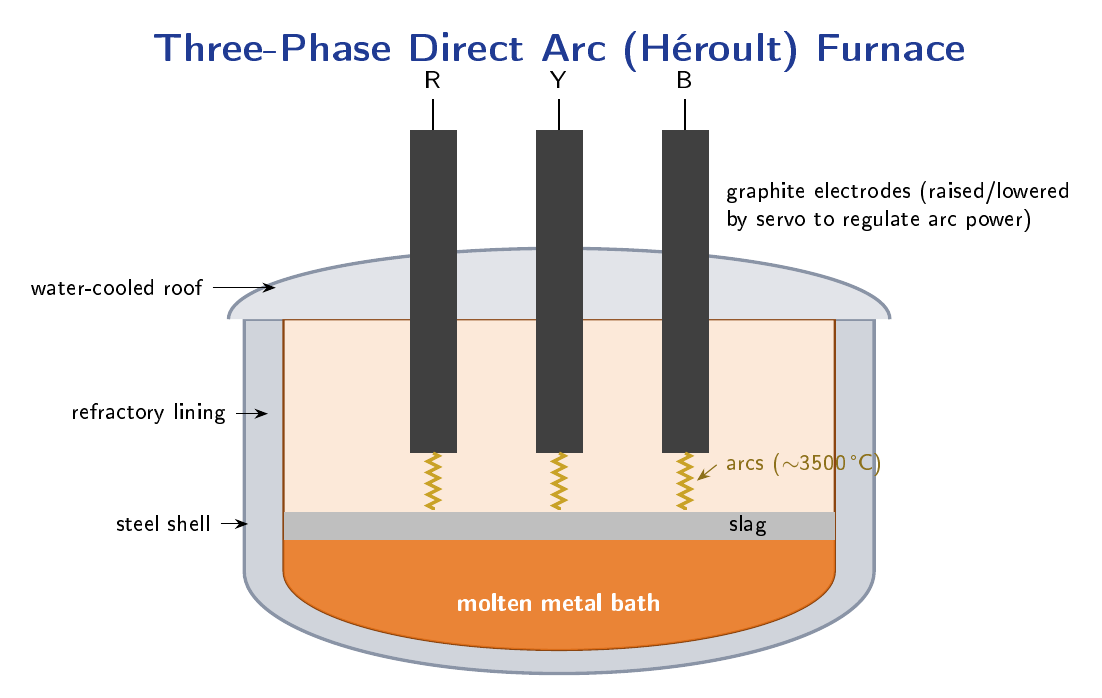
In a direct arc furnace, the arc is struck between the electrodes and the charge; the charge is part of the electric circuit and reaches the highest temperatures. This type is used primarily for steel making in mini-mills. In an indirect arc furnace, the arc is struck between two electrodes and heat is transferred to the charge by radiation; the charge is not in the electric circuit. This configuration is used for non-ferrous alloys and brass.
Induction Heating — Principle
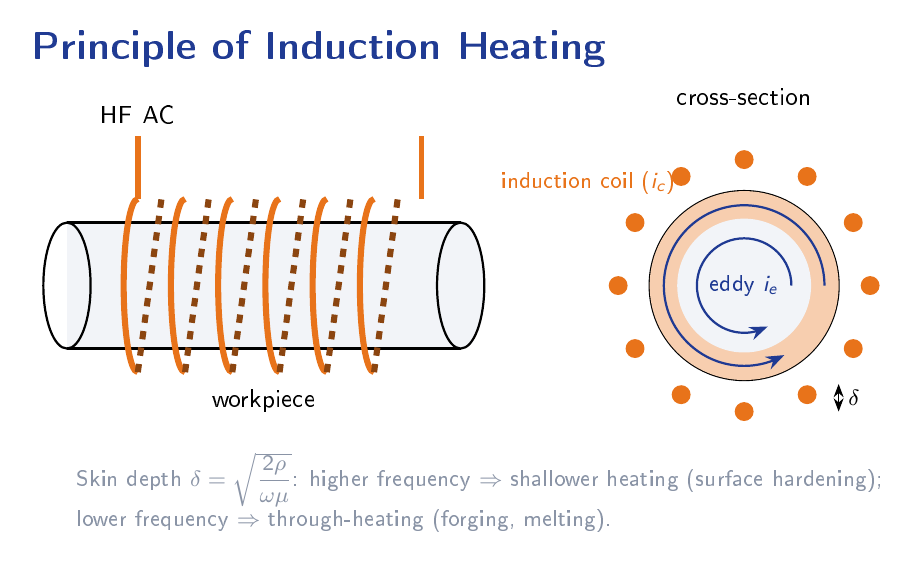
An alternating magnetic field induces eddy currents in the conducting charge; the resulting \(I^2R\) losses heat it. The induced power is proportional to:
The skin depth (depth to which induced currents penetrate) is a critical design parameter:
Higher frequency produces shallower heating — ideal for surface hardening. Lower frequency produces deeper heating — suitable for through-melting.
Types of Induction Furnaces
The core-type induction furnace (low frequency, 50 Hz) works like a transformer with molten metal as a one-turn short-circuited secondary. It heats by Joule loss and electromagnetic stirring. Applications: brass, copper, aluminium melting.
The coreless induction furnace (medium to high frequency, 500 Hz–10 kHz for steel, up to MHz for precious metals) has no iron core; a coil surrounds a refractory crucible. It provides fast melting, clean processing, and accurate control. Applications: steel, special alloys, vacuum melting.
Dielectric (High-Frequency) Heating
An insulating material placed between two electrodes forms a capacitor. The alternating electric field causes dipole rotation, dissipating energy as heat throughout the volume of the material. The dissipated power is:
Applications: Plywood gluing, drying of paper and textiles, plastic moulding, food cooking (microwave at 2.45 GHz), pre-heating of plastic powders before injection moulding, vulcanising of rubber, sterilisation of pharmaceuticals.
Comparison of Electric Heating Methods
| Method | Temp. Range | Efficiency | Suitable For | Typical Application |
|---|---|---|---|---|
| Direct resistance | Up to 1500°C | 90–95% | Conductors | Salt bath, billet heating |
| Indirect resistance | Up to 1100°C | 60–80% | Anything | Ovens, room heaters |
| Direct arc | Up to 3500°C | 60–75% | Conductors | Steel making |
| Indirect arc | 1500°C | 50–60% | Anything | Non-ferrous alloys |
| Core induction | Up to 1500°C | 70–80% | Magnetic, conducting | Brass, Cu, Al melting |
| Coreless induction | Up to 2000°C | 65–75% | Anything conducting | Steel, alloys, vacuum |
| Dielectric | Up to 200°C | 40–60% | Insulators | Plastic, food, gluing |
| Microwave | Up to 250°C | 50–65% | Insulators with water | Food, drying, sintering |
5. Electric Welding
Resistance Welding
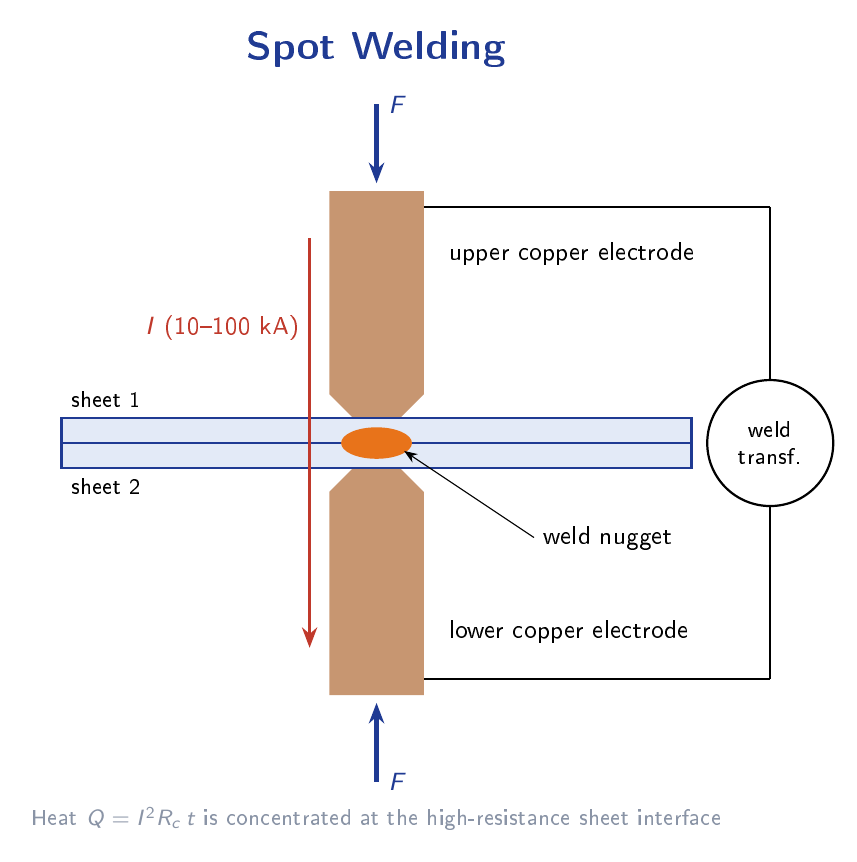
Heat developed in resistance welding:
where \(I\) is the welding current (10–100 kA), \(R\) is the contact resistance, and \(t\) is the duration (a few electrical cycles). Resistance welding types include spot welding (thin sheets, automotive body panels), seam welding (continuous, for fuel tanks), projection welding (multi-spot on embossed surfaces), butt welding (rods, pipes, wires), flash welding (chain links, rails), and percussion welding (precision joints).
Arc Welding — Principle
An electric arc is struck between the electrode and the workpiece. The intense heat (3500–6000°C) melts both the parent metal and the electrode (filler), forming a weld pool that solidifies as the joint. The voltage–current characteristic of an arc is drooping (negative incremental resistance):
\(V_a = a + b\, l_a + (c + d\, l_a)/I\), where \(l_a\) = arc length.
Since arc voltage drops with increasing current, the power source must have a constant-current (CC) characteristic to maintain arc stability.
Types of Arc Welding
| Process | Distinct Feature | Application |
|---|---|---|
| Carbon Arc | Non-consumable carbon electrode + separate filler | Brazing, cutting, copper repair |
| Metal Arc (SMAW) | Coated consumable electrode ("stick") | General fabrication, site work |
| TIG (GTAW) | Non-consumable tungsten electrode under inert gas (Ar) | Stainless steel, aluminium, titanium — high-quality, thin sections |
| MIG / MAG (GMAW) | Consumable wire under inert or active gas | Auto bodies, structural steel |
| Submerged Arc | Arc covered by granular flux | Thick plates, pipes, pressure vessels |
| Atomic Hydrogen | Arc in H₂ atmosphere, very high temperature | Special steels, high-melting alloys |
| Plasma Arc | Constricted ionised gas jet (15,000°C) | Precision cutting, micro-welding |
Welding Power Supplies
All welding power supplies must provide a constant-current or constant-voltage drooping characteristic with adjustable current and a low open-circuit voltage (~50–90 V) for operator safety. The AC welding transformer is a step-down, leakage-reactance type — cheap and low-maintenance but limited to ferrous metals and subject to arc-blow. The DC welding generator or rectifier provides a smooth arc without blow problems and allows polarity control — suitable for all metals. Modern inverter welders are light, portable (less than 10 kg vs. 100 kg for conventional sets), highly efficient, and capable of digital control of arc parameters including pulse welding and synergic MIG programs.
AC vs. DC Welding — Comparison
| Parameter | AC Welding | DC Welding |
|---|---|---|
| Arc stability | Less stable | More stable |
| Power factor | 0.3–0.4 (lagging) | >0.7 |
| Open-circuit voltage | 70–90 V | 60–80 V |
| Polarity control | Not possible | Possible (SP / RP) |
| Cost | Lower | Higher |
| Arc blow | Severe (on magnetic work) | Mild |
| Suitable metals | Mainly ferrous | All metals |
| Efficiency | 80–85% | 70–75% |
6. Electrolysis & Electrochemical Processes
Faraday's Laws of Electrolysis
First Law: The mass of a substance deposited at an electrode is proportional to the quantity of electricity passed:
Second Law: For the same quantity of electricity, the masses deposited at different electrodes are proportional to their chemical equivalents:
Here \(Z\) is the electrochemical equivalent (g/C), \(E\) is the chemical equivalent (g), and \(Q = It\) (coulombs).
Applications of Electrolysis
Electroplating: The article serves as the cathode; the plating metal is the anode; the electrolyte contains the plating-metal salt. Used for copper, nickel, chromium, zinc, gold, and silver plating for decoration and corrosion protection.
Electrotyping: Reproduction of letterpress printing surfaces and engravings in copper shells, used in the printing industry.
Electroforming: Manufacture of articles by deposition on a removable mandrel — used for reflectors, gramophone records, and precision screens.
Electrometallurgy: Electrorefining of copper, silver, gold, lead, and tin; electrowinning of aluminium (Hall–Héroult process), magnesium, and sodium from molten salt; electroextraction of zinc, cadmium, and manganese from aqueous solutions.
Manufacture of Chemicals: NaOH, Cl₂, and H₂ via the chlor-alkali process; hydrogen and oxygen via water electrolysis; KMnO₄ and KClO₃ production.
Anodising: Aluminium is made the anode in dilute H₂SO₄, building a thick oxide layer that provides hardness, corrosion protection, and the ability to accept dyes.
Electroplating — Operational Parameters
| Metal | Electrolyte | Current Density (A/dm²) | Voltage | Temp. (°C) |
|---|---|---|---|---|
| Copper | CuSO₄ + H₂SO₄ | 2–5 | 1–6 V | 20–40 |
| Nickel | NiSO₄ + NiCl₂ + H₃BO₃ | 3–5 | 4–12 V | 40–60 |
| Chromium | CrO₃ + H₂SO₄ | 10–20 | 6–12 V | 35–55 |
| Zinc | ZnSO₄ / ZnCN | 1–2 | 1–6 V | 20–35 |
| Silver | AgCN + KCN | 0.3–1 | 0.7–1.5 V | 20–30 |
| Gold | K[Au(CN)₂] | 0.5–1 | 3–12 V | 30–70 |
Worked Example — Faraday's Law
\(m = \frac{31.75}{96485} \times 2{,}160{,}000 = 710.7 \text{ g} \approx \mathbf{0.71 \text{ kg}}\) of copper.
7. Illumination Engineering
Fundamental Photometric Quantities
| Quantity | Symbol / Unit | Definition |
|---|---|---|
| Luminous flux | \(\phi\) [lumen] | Total light energy radiated per second |
| Luminous intensity | \(I\) [cd = lm/sr] | Flux emitted per unit solid angle |
| Illuminance | \(E\) [lux = lm/m²] | Flux per unit area of receiving surface |
| Luminance (Brightness) | \(L\) [cd/m²] | Intensity per unit projected area of source |
| Mean Spherical Candle Power | MSCP | Mean intensity over 4π steradians |
| Mean Horizontal Candle Power | MHCP | Mean intensity in the horizontal plane |
| Luminous efficacy | \(\eta\) [lm/W] | Lumens output per watt of input power |
Laws of Illumination
Inverse Square Law
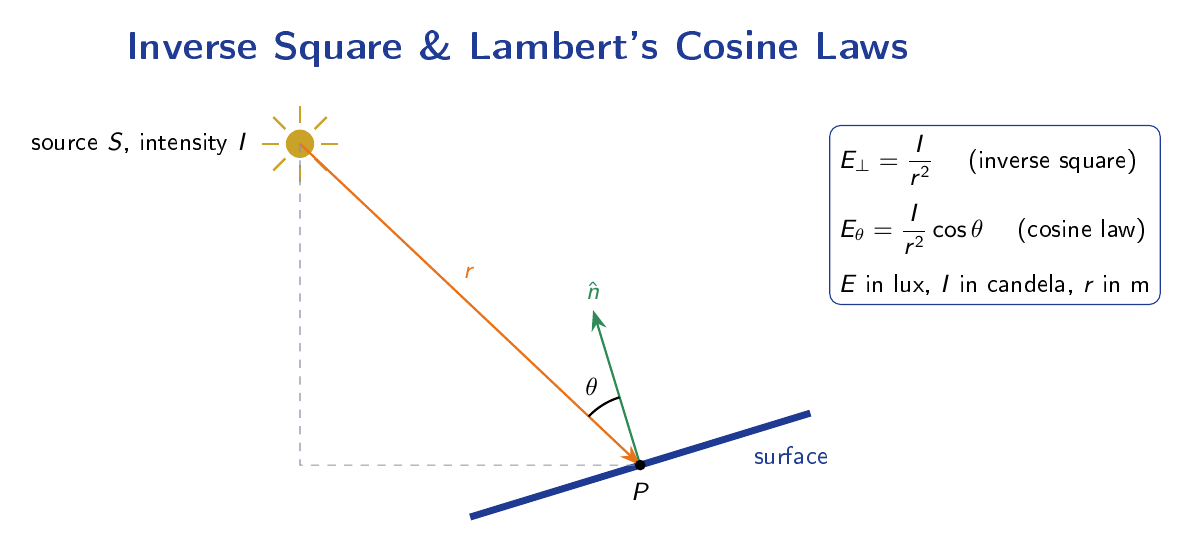
Illuminance on a plane perpendicular to the line from source \(S\), at distance \(r\):
Lambert's Cosine Law
If the surface normal makes angle \(\theta\) with the ray from the source:
Polar Curves and MSCP
A polar curve is a graph of luminous intensity \(I(\theta)\) plotted around a source in polar coordinates. The Mean Spherical Candle Power (MSCP) is obtained graphically using Rousseau's Construction: draw a semicircle of radius \(r\) on the vertical axis of the polar curve; for each angle \(\theta\), project \(I(\theta)\) horizontally onto a vertical line at the corresponding point; the mean ordinate of the resulting Rousseau curve equals \(r\cdot\overline{I}\), giving MSCP = \(\overline{I}\). Total flux is:
Types of Light Sources
| Lamp Type | Efficacy (lm/W) | Life (hours) | CRI | Application |
|---|---|---|---|---|
| Incandescent (GLS) | 8–18 | 1,000 | 100 | Domestic (obsolete) |
| Halogen tungsten | 16–25 | 2,000–4,000 | 100 | Spotlights, automobiles |
| Fluorescent tube (T8) | 50–80 | 7,000–15,000 | 60–85 | Offices, classrooms |
| Compact Fluorescent (CFL) | 50–70 | 6,000–10,000 | 80 | Domestic (phasing out) |
| Mercury Vapour (HPMV) | 35–60 | 12,000–24,000 | 50 | Streets (legacy) |
| Sodium Vapour (LPSV) | 100–200 | 18,000 | ~0 | Highways (monochromatic yellow) |
| Sodium Vapour (HPSV) | 80–130 | 24,000 | 25 | Streets, security |
| Metal Halide | 70–115 | 6,000–20,000 | 65–90 | Stadia, industrial |
| LED | 80–200+ | 25,000–50,000 | 70–95 | All modern applications |
Fluorescent Tube — Operating Sequence
The fluorescent tube contains argon gas plus mercury vapour, with a phosphor coating on the inner glass surface. The operating sequence is as follows: (1) at switch-on, glow discharge in the starter heats the bimetallic strip; (2) the strip closes, allowing heavy current to pre-heat the tube electrodes; (3) the strip cools and contacts open, causing the choke to induce a high voltage (~1 kV); (4) the tube strikes, the mercury arc emits UV radiation, and the phosphor converts it to visible light; (5) the choke now acts as a current-limiting reactor to stabilise the discharge.
LED — Solid-State Lighting
A forward-biased p-n junction emits photons by radiative recombination of electrons and holes. The photon energy equals the semiconductor band gap:
Wavelength (and therefore colour) is determined by the band gap of the semiconductor (GaN, InGaN, AlGaInP). White light is produced by a blue LED with a yellow phosphor (YAG:Ce), an RGB triple-chip, or a UV LED with RGB phosphors. Key advantages: efficacy up to 200+ lm/W, life greater than 50,000 hours, instant-on, dimmable, mercury-free, compact, robust, and directional.
Lighting Scheme Design — Lumen Method
The required total luminous flux is:
where \(E\) is the required illuminance (lux), \(A\) is the floor area, UF is the utilisation factor, and MF is the maintenance (depreciation) factor. The number of luminaires required:
where \(n\) is the number of lamps per fitting.
Recommended Illuminance Levels (IES / BIS SP 72)
| Location / Task | Recommended \(E\) (lux) |
|---|---|
| Casual seeing, corridors | 50–100 |
| Domestic living room, classrooms | 150–300 |
| Offices, drawing rooms (general) | 300–500 |
| Precision work, drawing offices, laboratories | 500–1000 |
| Fine inspection, jewellery, electronic assembly | 1000–2000 |
| Surgical (operating theatre) | 10,000–20,000 |
| Street lighting (residential / arterial) | 5 / 15–30 |
| Floodlighting (sports, large areas) | 200–500 |
Street Lighting Design
The spacing-to-mounting-height ratio should satisfy \(S/H \leq 4\)–6 depending on luminaire distribution. Mounting height is typically 8–12 m on major roads and 5–7 m on residential streets. Configurations include single-side, staggered, or central twin arrangements. The average illuminance on the carriageway:
where \(W\) is the carriageway width and \(S\) is the pole spacing.
8. Electric Traction
Advantages and Disadvantages of Electric Traction
Advantages: high starting torque and rapid acceleration; no emission at point of use (crucial for urban areas); high overload capacity (~200–300%); regenerative braking returns energy to the network; centralised energy generation at lower cost; low maintenance compared to steam or diesel; and quiet, comfortable operation.
Disadvantages: heavy capital investment in overhead equipment, third rail, and substations; power supply interruption halts service; communication interference from AC traction; inflexibility limited to electrified routes; and skilled supervision requirements.
Systems of Electric Traction — Comparison
| System | Voltage | Conductor | Motor | Application |
|---|---|---|---|---|
| DC 600 V | 600 V DC | 3rd rail | DC series | Underground (London, New York) |
| DC 750 V | 750 V DC | 3rd rail / OHE | DC series | Metros (older systems) |
| DC 1500 V | 1500 V DC | OHE | DC series | Suburban (Mumbai legacy) |
| DC 3000 V | 3000 V DC | OHE | DC series | Main line (Italy, Belgium) |
| AC 25 kV, 50 Hz | 25 kV AC | OHE | 3-phase IM via VVVF | Main lines (India, Europe) — modern standard |
| AC 15 kV, 16⅔ Hz | 15 kV AC | OHE | Series commutator | Germany, Switzerland |
Traction Motors — Desirable Characteristics
A traction motor must provide high starting torque; a speed–torque characteristic such that \(N \propto 1/\sqrt{T}\); capacity to withstand overload; easy speed control; and capability for regenerative braking. Physically, it must be compact and light (fitting under the coach floor), robust to shock, vibration, dust, and water ingress, and have low maintenance requirements (brushless if possible).
Suitable motor types: DC series (traditional — high starting torque, automatic load sharing); AC series commutator (single-phase low-frequency, German and Swiss railways); 3-phase induction squirrel cage with VVVF drive (modern standard — brushless, robust); PMSM / BLDC (high-speed rail, metros, EVs — highest power density).
Speed–Time Curve of a Train
Train Performance — Key Definitions
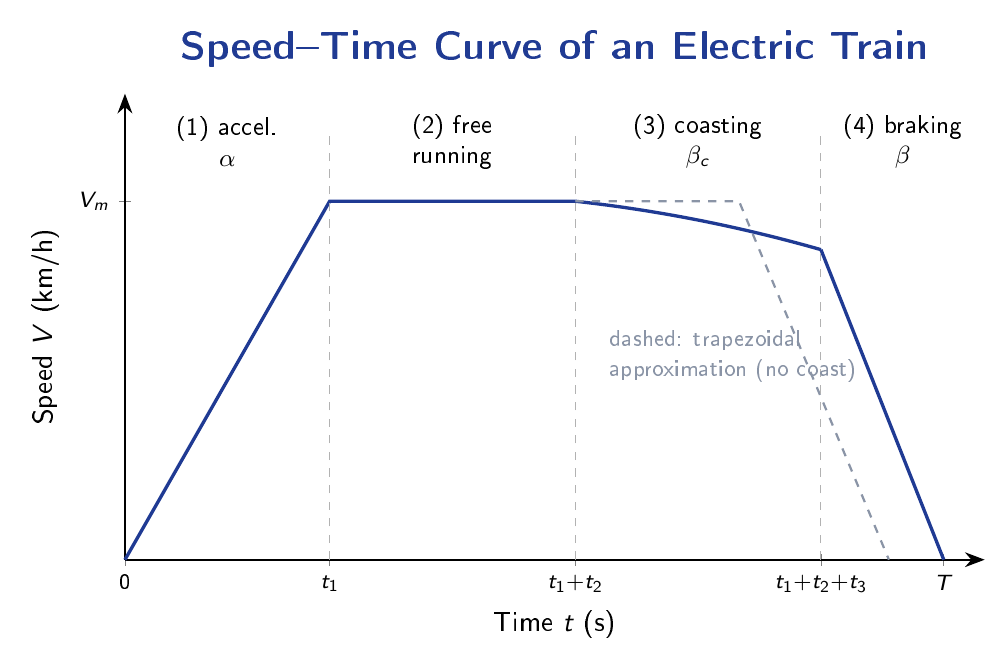
The crest (maximum) speed \(V_m\) is the highest speed attained. The average speed \(V_a\) is the distance between stops divided by the run time. The schedule speed \(V_s\) is the distance divided by the sum of run time and stop time.
Using the trapezoidal approximation (with acceleration \(\alpha\), retardation \(\beta\), crest speed \(V_m\), run distance \(D\), and total run time \(T\)):
Train Resistance
Train resistance \(R_t\) opposes motion on level, straight track. The empirical Davis-type formula gives specific resistance:
where \(A\) is the speed-independent component (bearing and flange friction), \(Bv\) is the speed-proportional term (rolling resistance, oscillations), and \(Cv^2\) is the aerodynamic drag (dominant at high speed). Typical values for passenger stock on open track: 40–80 N/tonne; curvature adds 0.4–0.8 N/t per degree; gradient adds ±98G N/t per percent slope.
Tractive Effort and Power
Total tractive effort required by a train:
where \(F_a = M_e\,\alpha\) (accelerating effort, with effective mass \(M_e = 1.05\)–\(1.15\,M\) accounting for rotational inertia), \(F_g = \pm\,M g \sin\theta \approx \pm 98 M G\) (gradient force, \(G\) in %), and \(F_r = r M\) (train resistance, typical 50–80 N/tonne for railways). Power at wheels: \(P = F_t \cdot v\).
The coefficient of adhesion sets the limit on tractive effort:
Typical \(\mu = 0.20\)–0.35 depending on rail condition.
\(\alpha = 0.8/3.6 = 0.222 \text{ m/s}^2\)
\(F_a = 1.1 \times 350{,}000 \times 0.222 = 85{,}470 \text{ N}\)
\(F_g = 98 \times 350 \times 1 = 34{,}300 \text{ N}\)
\(F_r = 50 \times 350 = 17{,}500 \text{ N}\)
\(F_t = 85470 + 34300 + 17500 = \mathbf{137.3 \text{ kN}}\)
\(P = 137{,}270 \times 16.67 = \mathbf{2.29 \text{ MW}}\)
Specific Energy Consumption
Specific energy at the wheel rim:
Specific energy consumption at the motor input:
Typical values: suburban EMU 35–70 Wh/t-km; mainline electric locomotive 15–25 Wh/t-km; metro/urban rail 40–90 Wh/t-km.
Electric Braking in Traction
| Method | Principle | Application |
|---|---|---|
| Regenerative | Motor acts as generator; energy returned to OHE | Trains with capable substations; EVs with batteries |
| Rheostatic / Dynamic | Generated energy dissipated in resistors | Metros, DEMU, trams; long down-gradients |
| Plugging | Reverse supply direction; motor torque opposes motion | Cranes, hoists, machine tools (severe duty) |
| Eddy current brake | Stator induces eddy currents in moving disc/rotor | High-speed trains; supplementary brake |
| Mechanical (friction) | Brake shoes / discs — final stop | All vehicles — emergency, parking |
Modern VVVF Drive Architecture
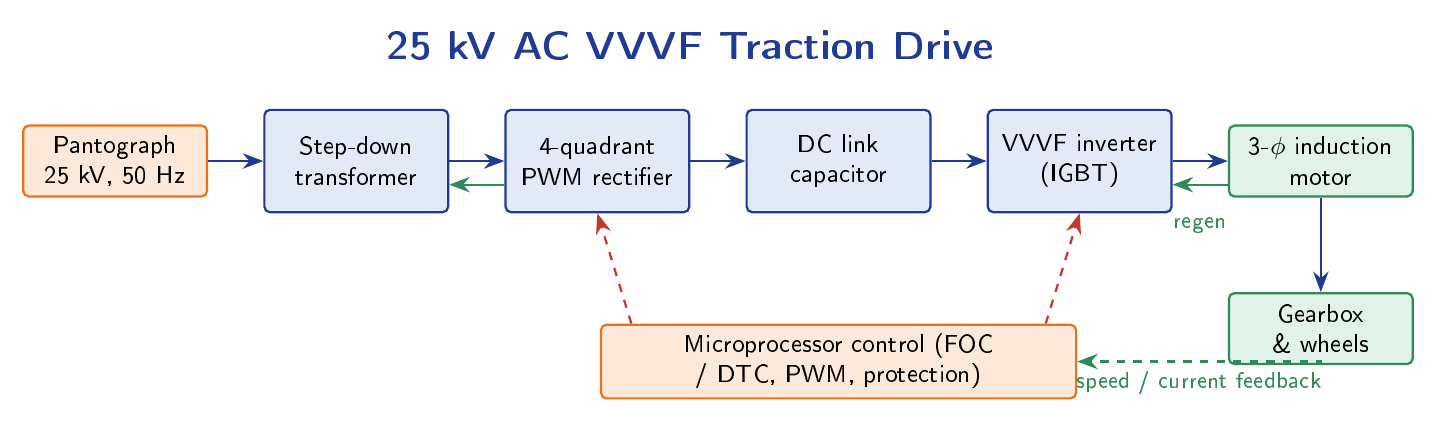
The power chain in a modern 25 kV AC mainline traction unit follows: 25 kV AC OHE → pantograph → step-down transformer → 4-quadrant PWM line converter (rectifier with near-unity power factor) → DC link (capacitor + brake chopper) → VVVF PWM inverter → 3-phase induction (or PMSM) traction motor → gearbox → wheel. The entire chain is supervised by a microprocessor control system implementing V/f, field-oriented control (FOC), or direct torque control (DTC), with feedback from speed and current sensors.
9. Refrigeration & Air Conditioning
Coefficient of Performance (COP)
The maximum (Carnot) COP for a given temperature pair is:
One ton of refrigeration = 3.516 kW = 12,000 BTU/h (heat absorbed to freeze one short ton of water in 24 hours).
Vapour-Compression Refrigeration Cycle
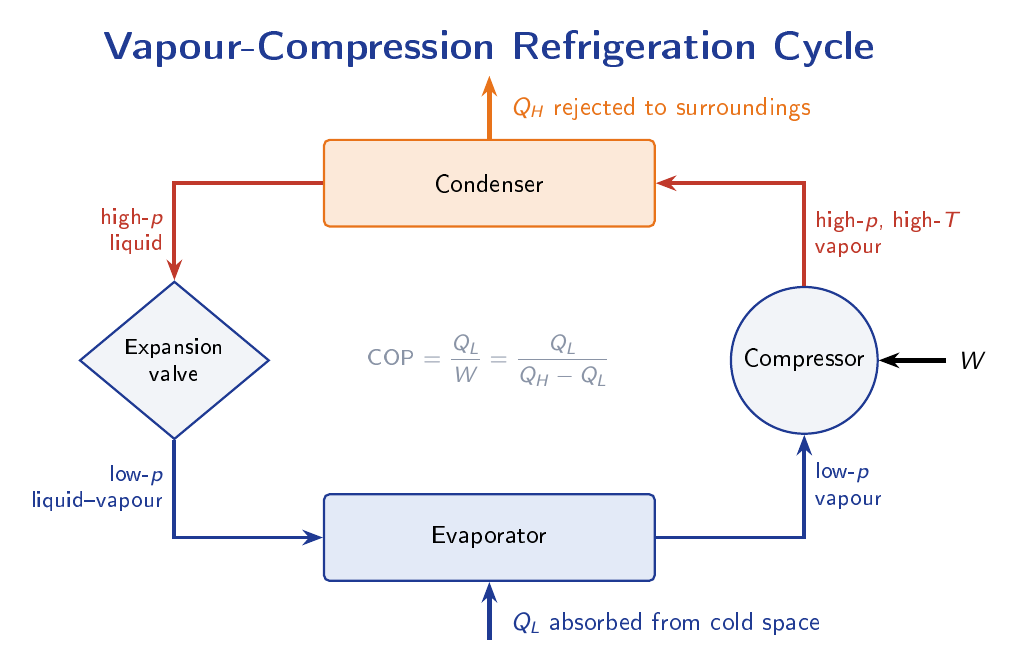
The standard vapour-compression cycle operates in four thermodynamic processes. (1→2) Isentropic compression: low-pressure, low-temperature vapour is compressed by the compressor to high pressure and high temperature. (2→3) Isobaric heat rejection in condenser: superheated vapour condenses to saturated liquid, rejecting heat \(Q_H\) to the environment. (3→4) Isenthalpic throttling: high-pressure liquid passes through the expansion valve, dropping to low pressure as a two-phase mixture. (4→1) Isobaric heat absorption in evaporator: the two-phase mixture evaporates, absorbing heat \(Q_L\) from the refrigerated space.
Vapour Absorption System
The vapour absorption system replaces the compressor with a generator, absorber, and solution pump. The working pairs are NH₃–H₂O or H₂O–LiBr. The system is driven by heat (waste heat, solar, or steam) rather than shaft work, making it suitable where electrical energy is costly but heat is abundant.
Air Conditioning
Air conditioning controls temperature (heating or cooling), humidity (humidification or dehumidification), air motion and distribution, and air purity through filtration. Types include window units, split systems, packaged units, central chilled-water systems, and variable refrigerant flow (VRF) systems.
Common Refrigerants
| Refrigerant | NBP (°C) | ODP | GWP | Use / Remarks |
|---|---|---|---|---|
| R-11 (CFC) | 23.7 | 1.0 | 4750 | Phased out (Montreal Protocol) |
| R-12 (CFC) | −29.8 | 1.0 | 10900 | Old domestic — banned |
| R-22 (HCFC) | −40.8 | 0.05 | 1810 | Being phased out (2030) |
| R-134a (HFC) | −26.1 | 0 | 1430 | Automotive AC, domestic |
| R-410A (HFC blend) | −51.6 | 0 | 2088 | Split AC, heat pumps |
| R-32 (HFC) | −51.7 | 0 | 675 | New residential AC |
| R-717 (NH₃) | −33.3 | 0 | 0 | Industrial, cold storage |
| R-744 (CO₂) | −78.4 | 0 | 1 | Trans-critical cycles, commercial |
| R-1234yf (HFO) | −29.5 | 0 | 4 | New automotive AC standard |
10. Power Factor Improvement
Power factor is the ratio of real power to apparent power:
Disadvantages of Low Power Factor
A low power factor results in larger current for the same real power, increasing \(I^2R\) losses; it requires bigger conductors, transformers, and switchgear; causes poor voltage regulation; reduces the kilowatt capacity of generators; and attracts higher electricity tariffs with penalty clauses.
Methods of Power Factor Improvement
| Device | Principle | Application |
|---|---|---|
| Static capacitors | Supply leading kVAr in parallel | Industrial and commercial loads — most common |
| Synchronous condenser | Over-excited synchronous motor draws leading current | Substations, EHV systems |
| Phase advancer | Auxiliary commutator machine injecting at slip frequency | Large slip-ring IM (legacy) |
| Active power filters / STATCOM | Power-electronic converter injects compensating current | Modern utility and industrial applications |
kVAr Required for Power Factor Correction
The reactive power needed to improve power factor from \(\cos\varphi_1\) to \(\cos\varphi_2\):
\(\tan\varphi_1 = 1.020\), \(\tan\varphi_2 = 0.329\).
\(Q_c = 300 \times (1.020 - 0.329) = \mathbf{207.3 \text{ kVAr}}\).
Most Economical Power Factor
For a typical HT industrial consumer tariff: Bill \(= C_d \cdot (\text{kVA}_{max}) + C_e \cdot (\text{kWh}) +\) p.f. penalty. The most economical power factor (Wadhwa) is:
where \(C_c\) is the annual cost of power factor correction equipment per kVAr and \(C_d\) is the annual saving in maximum demand charge per kVA.
\(\cos\varphi_2^{*} = \sqrt{1 - (100/600)^2} = \sqrt{0.972} = 0.986\).
Hence correcting beyond ≈ 0.99 is uneconomical.
11. Energy Conservation & Audit
Why and How
Energy conservation is driven by finite fossil resources, environmental and climate targets, energy security and import dependence, the cost of new generation and transmission capacity, and direct savings to the consumer. Key conservation measures include use of high-efficiency motors (IE3, IE4), variable-frequency drives on pumps and fans, LED lighting with occupancy sensors, power-factor correction, efficient transformers and distribution, heat recovery, regenerative braking, and cogeneration or trigeneration.
Energy Audit
The Energy Conservation Act 2001 (India) mandates energy audits for designated energy-intensive consumers and sets up BEE Star Labelling and the Energy Conservation Building Code. Three levels of audit are recognised: a preliminary or walk-through audit identifies obvious losses without instrumentation; a detailed or diagnostic audit involves measurement, data logging, and a full energy balance; and an investment-grade audit adds detailed economic analysis of energy conservation measures (ECMs).
The key performance indicator is the specific energy consumption (SEC):
Common audit instruments include clamp meters, power analysers, lux meters, anemometers, IR thermometers or thermal cameras, ultrasonic flow meters, and combustion analysers.
BEE Star Labelling Programme
The Bureau of Energy Efficiency (BEE) Star Programme rates appliances from 1 to 5 stars (refreshed periodically). Mandatory labels cover air conditioners, refrigerators, fans, motors, and distribution transformers; voluntary labels cover LEDs, TVs, and washing machines. Each additional star typically corresponds to 8–12% less energy consumption.
Motor Efficiency Classes (IEC 60034-30)
International motor efficiency classes: IE1 (Standard), IE2 (High Efficiency), IE3 (Premium), IE4 (Super-Premium), and IE5 (Ultra-Premium, planned).
Energy Conservation Building Code (ECBC)
ECBC 2017 (updated 2023 for ENS — Energy Neutral Specifications) sets minimum performance requirements for the building envelope, lighting, HVAC, electrical systems, and renewables in commercial buildings with a connected load of 100 kW or more.
12. Summary & References
Key Take-Aways
Drives & Motors
Select motor by matching speed–torque characteristic to load; consider duty class and enclosure. Use the RMS / equivalent current method for sizing variable-load motors. VFD-driven induction motors are the dominant industrial drive today.
Heating, Welding, Electrolysis
Resistance (direct and indirect), arc, induction, and dielectric heating — each chosen by material type and required temperature. Welding heat is governed by \(H = I^2Rt\) for resistance welding; arc fusion requires a constant-current supply. Faraday's laws govern all electrochemical processes.
Illumination
Inverse-square law combined with the cosine law drives lighting design. The lumen method yields the required number of luminaires. LED is now universal, offering the highest efficacy and life of any lamp technology.
Traction & Allied Topics
The 25 kV AC plus 3-phase induction motor with VVVF is the modern railway standard. The speed–time curve leads to expressions for average speed, schedule speed, and specific energy consumption. Regenerative braking, power factor correction, and energy auditing together constitute a holistic approach to energy management.
Recommended Textbooks
- H. Partab, Art and Science of Utilization of Electrical Energy, Dhanpat Rai & Co.
- E. Openshaw Taylor, Utilization of Electric Energy, Universities Press.
- C.L. Wadhwa, Generation, Distribution and Utilization of Electrical Energy, New Age International.
- J.B. Gupta, Utilization of Electric Power and Electric Traction, S.K. Kataria & Sons.
- N.V. Suryanarayana, Utilization of Electric Power including Electric Drives & Electric Traction, New Age International.
- G.K. Dubey, Fundamentals of Electrical Drives, Narosa.
- P.C. Sen, Power Electronics and Electric Drives.
- B.K. Bose, Modern Power Electronics and AC Drives, Prentice Hall.
- IES Lighting Handbook, Illuminating Engineering Society.
Key Standards
- IEC 60034 — Rotating electrical machines
- IEC 60076 — Power transformers
- IS 8789 — Squirrel cage induction motors
- IEEE C57.91 — Loading of transformers
- IEC 60034-30 — Motor efficiency classes (IE1–IE5)
- ASHRAE Handbook — HVAC and refrigeration
- BEE Star Programme — India energy labelling
- ECBC 2017 — Energy Conservation Building Code (India)
- Energy Conservation Act 2001 — India