Switchgear and Protection
A Comprehensive Course — Concepts, Mathematical Foundations, and Practical Schemes
Introduction to Switchgear and Protection
What is Switchgear?
Switchgear is the collective term for apparatus used to switch, control, meter, regulate, and protect electrical equipment. It includes circuit breakers, isolators, fuses, relays, CTs, PTs, lightning arresters, and bus bars.
Functions
- Isolation of the faulty section
- Continuity of supply
- Protection of equipment and personnel
- Switching during normal and abnormal states
Key Components
- Circuit Breaker (CB)
- Protective Relay
- Current / Potential Transformer
- Fuse, Isolator, Earth Switch
- Bus bar, Lightning Arrester
Essential Qualities of a Protective System
Faults are inevitable — caused by insulation failure, lightning, mechanical damage, or human error. Without adequate protection, the consequences include equipment damage, system instability, cascading outages, and loss of life. A protective system must satisfy the following six qualities:
- Reliability — operate correctly whenever required.
- Selectivity — trip only the faulty section, preserving supply to the rest.
- Sensitivity — detect the smallest expected fault current or voltage deviation.
- Speed — minimise equipment damage and maintain system stability.
- Stability — remain inoperative during external faults and power swings.
- Economy — cost proportional to the criticality of the protected element.
Typical values: \(T_{\text{relay}} \approx 1\) cycle; overshoot \(\approx 0.05\)–\(0.1\,\text{s}\); CB clearing \(\approx 2\)–5 cycles. Total clearing is roughly 3–8 cycles (60–160 ms at 50 Hz). Grading margin between successive protection zones is 0.3–0.5 s.
Zone of Protection and Overlap Principle
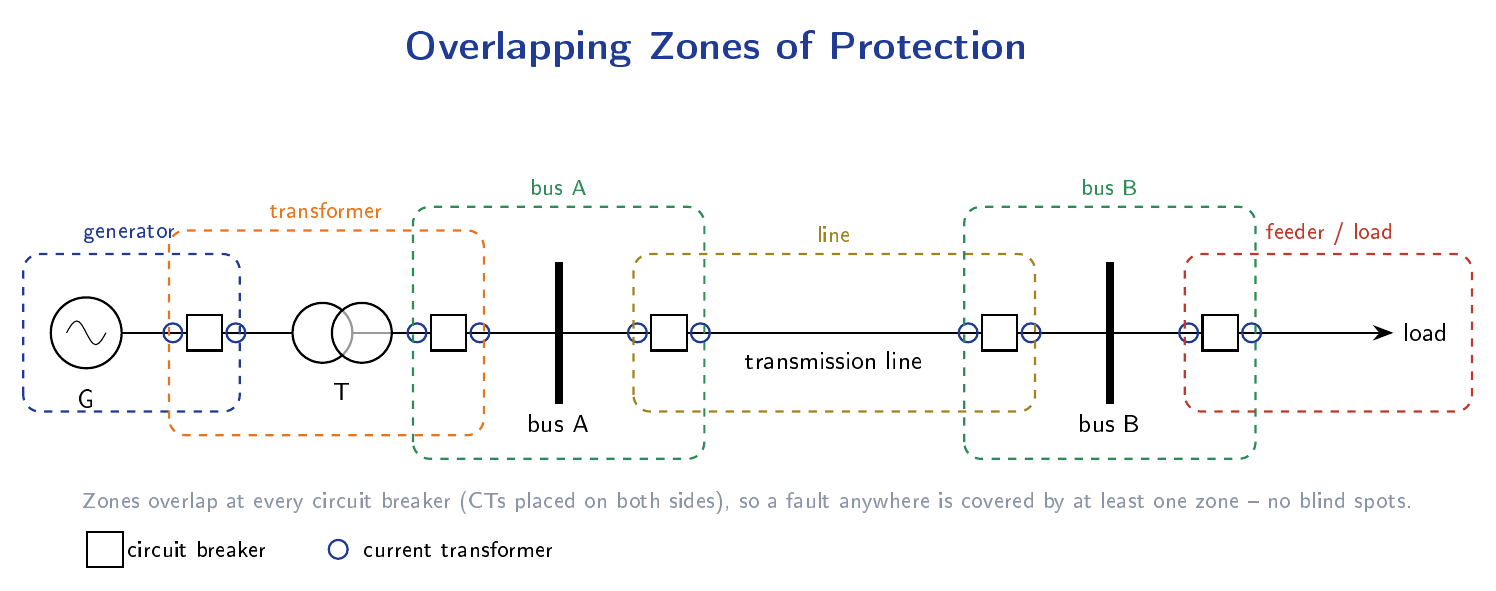
Every element in a power system — generator, transformer, transmission line, bus bar, and load — is assigned a zone of protection bounded by current transformers. A critical design rule is that adjacent zones overlap slightly at every CT location.
Each zone is bounded by CTs and deliberately overlaps the next at every CT location. The overlap region ensures that no point in the network is left unprotected, even for faults located exactly between two CTs.
Primary and Backup Protection
Primary (Main) Protection
- First line of defence
- Fast: operates in <2–3 cycles
- Selective for the protected zone
Backup Protection
- Operates if primary protection fails
- Time-delayed (graded margin)
- Relay backup / Breaker backup / Remote backup
Single-Line Diagram Conventions
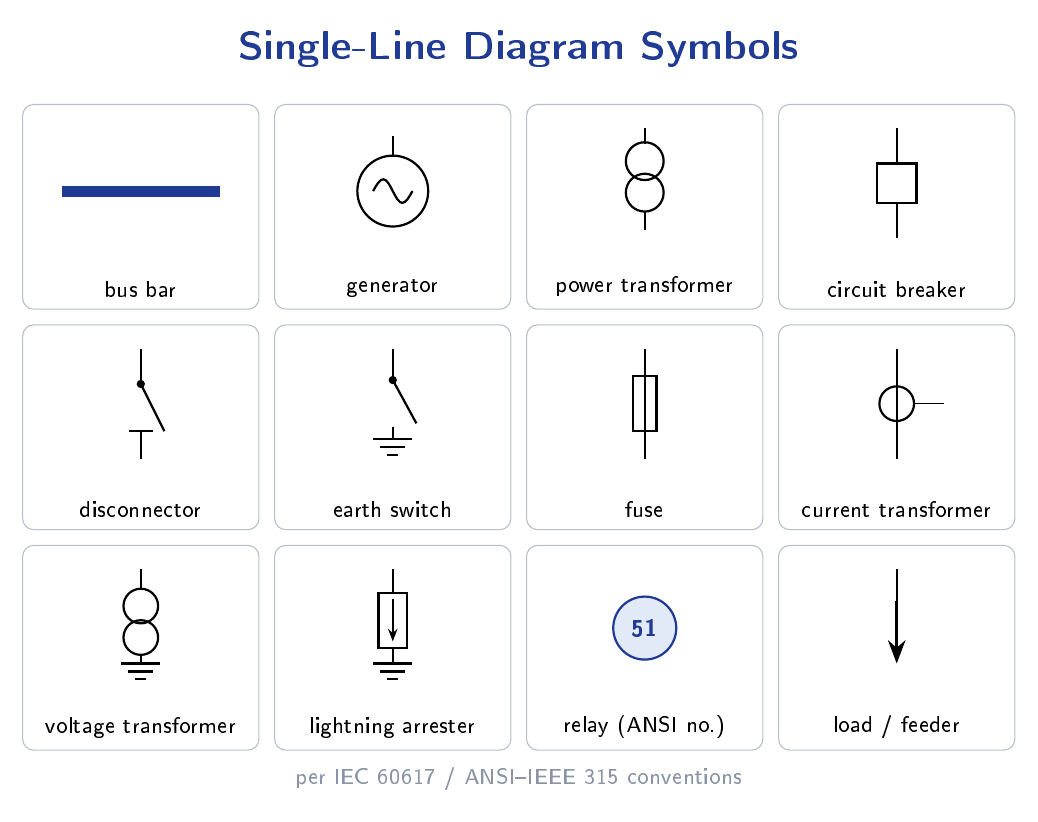
A single-line diagram (SLD) collapses a three-phase network into one line per bus, overlaid with standardised symbols. It is the lingua franca of protection engineers. European practice follows IEC 60617; North American practice follows ANSI/IEEE 315, using ANSI device numbers (50, 51, 87, …).
1878: Edison's lead-lined fuse — first overcurrent device. 1901: J. N. Kelman — first oil CB (Boston Edison, 40 kV). 1905: Fortescue's induction-disc relay; universal torque equation. 1918: Fortescue presents symmetrical components at AIEE. 1928: Merz-Price differential protection (Liverpool feeders). 1956: First SF₆ breaker (Westinghouse); 1960s — vacuum interrupters. 1969: First static distance relays (English Electric). 1983: First commercial numerical relay (ABB SPAU). 2003: IEC 61850 ratified — Ethernet enters the substation.
Power System Faults and Analysis
Classification of Faults
Symmetrical Faults (~5%)
- Three-phase (LLL) and three-phase-to-ground (LLLG)
- Most severe; analysed using positive-sequence network only
- Relatively rare in practice
Series Faults
- One conductor open
- Two conductors open
Unsymmetrical Faults (~95%)
- Line-to-ground (LG): ~70% of all faults
- Line-to-line (LL): ~15%
- Double line-to-ground (LLG): ~10%
Common Causes
- Lightning strikes
- Insulation breakdown
- Wind, ice, or vegetation contact
- Equipment failure
Short-Circuit Current in a Synchronous Machine
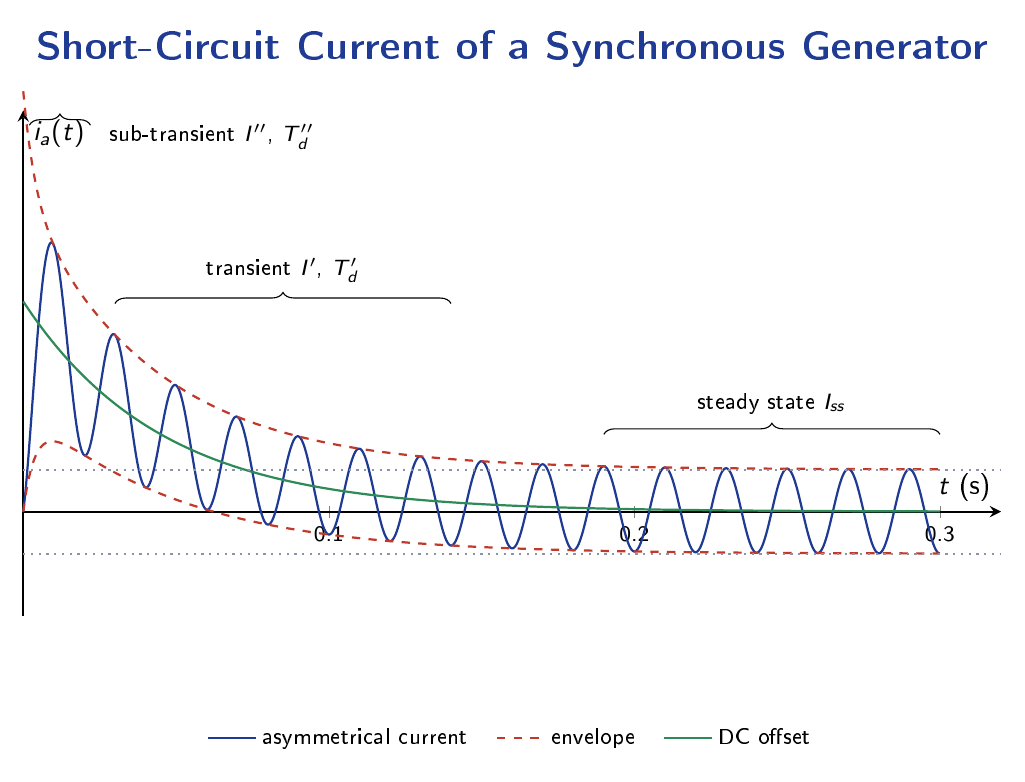
For a generator with sub-transient, transient, and steady-state reactances, the total fault current following a symmetrical three-phase fault is:
| Regime | Current | Reactance Range (pu) |
|---|---|---|
| Sub-transient | \(I'' = E / X_d''\) | 0.10–0.25 |
| Transient | \(I' = E / X_d'\) | 0.20–0.40 |
| Steady-state | \(I = E / X_d\) | 1.00–2.50 |
The DC offset is maximum when the fault occurs at the voltage zero (\(\alpha = 0\)). The asymmetry factor at half-cycle is:
Per-Unit System
System: 100 MVA, 11 kV generator with \(X_d'' = 0.20\) pu feeds a 100 MVA, 11/132 kV transformer (\(X_T = 0.10\) pu) and a 132 kV line of reactance \(X_L = 30\,\Omega\). A 3-φ fault occurs at the line end.
\(Z_{\text{base,HV}} = 132^2/100 = 174.24\,\Omega \;\Rightarrow\; X_{L,pu} = 30/174.24 = 0.172\) pu.
\(X_{\text{th}} = 0.20 + 0.10 + 0.172 = 0.472\) pu.
\[ I_{f,pu}=\frac{1.0}{0.472}=2.12,\;\;\text{MVA}_{sc}=\frac{100}{0.472}\approx 212\,\text{MVA} \]
\[ I_{\text{base,HV}}=\frac{100\times10^3}{\sqrt{3}\times132}=437.4\,\text{A}\;\Rightarrow\; \boxed{I_f=928\,\text{A}} \]
The line reactance must be referred to the HV-side base. Confusion between \(V_{\text{base}}\) on the two sides of every transformer is the most frequent error in per-unit calculations.
Symmetrical Components
Fortescue's Theorem (1918)
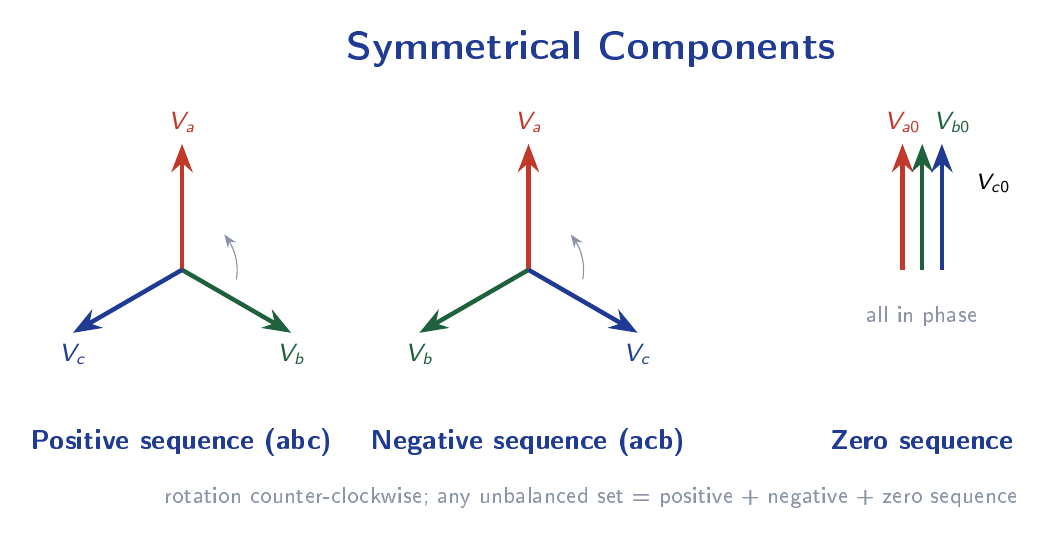
Any unbalanced three-phase set of phasors can be resolved into three balanced sets: a positive-sequence (a–b–c), a negative-sequence (a–c–b), and a zero-sequence (all in phase) set. With \(a = 1\angle 120°\), \(a^2 = 1\angle 240°\), and the identity \(1 + a + a^2 = 0\):
Sequence Networks of Power System Elements
| Element | \(Z_1\) | \(Z_2\) | \(Z_0\) |
|---|---|---|---|
| Transmission line | \(Z_L\) | \(Z_L\) | \(\approx 3\,Z_L\) |
| Synchronous generator | \(X_d''\) or \(X_d'\) | \(\approx X_d''\) | 0.15–0.6 \(X_d''\) |
| Transformer (per phase) | \(Z_T\) | \(Z_T\) | Depends on connection |
| Static load (Y-grounded) | \(Z_L\) | \(Z_L\) | \(Z_L + 3Z_n\) |
For transformer zero-sequence paths: a Yg/Yg transformer passes zero-sequence current on both sides; a Yg/Δ connection allows zero-sequence current to circulate only in the delta winding; a Δ/Δ transformer provides no zero-sequence path externally. Neutral grounding impedance \(Z_n\) appears as \(3Z_n\) in the zero-sequence network.
Unsymmetrical Fault Analysis — Sequence Network Connections
Line-to-Ground (LG) Fault
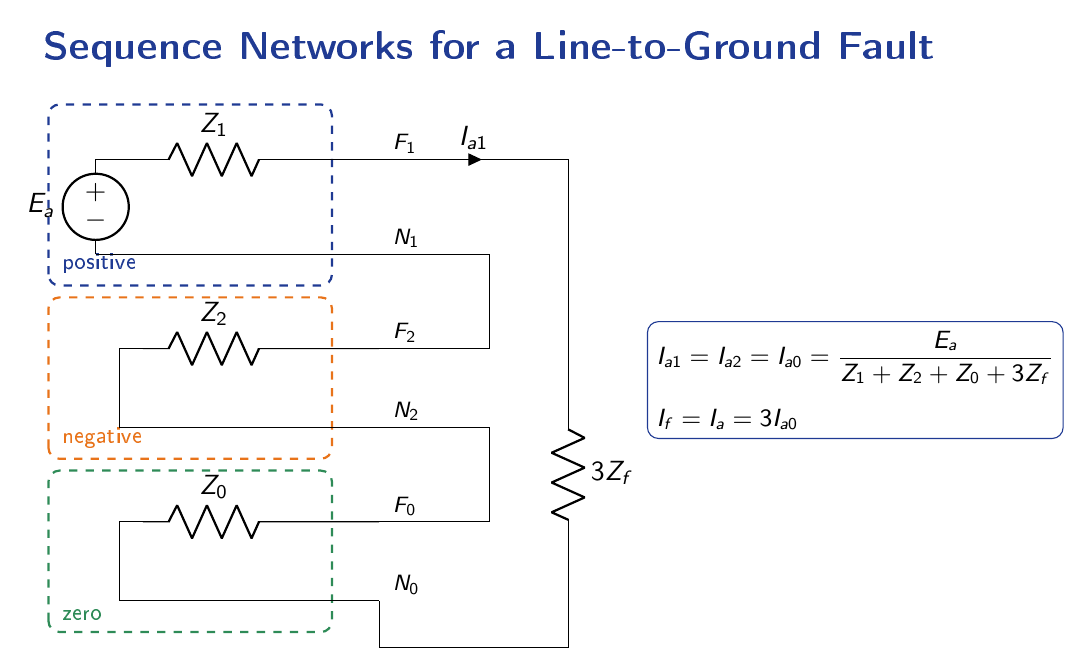
Phase a shorted to ground through \(Z_f\). Boundary conditions: \(I_b = I_c = 0\), \(V_a = Z_f I_a\). All three sequence currents are equal:
The three sequence networks are connected in series. For a solid LG fault near a generator where \(Z_0 < Z_1\), the LG fault current can exceed the three-phase fault current.
Line-to-Line (LL) Fault
Networks: \(Z_1\) and \(Z_2\) connected in parallel.
Double Line-to-Ground (LLG) Fault
Network connection: \(Z_1\) in series with the parallel combination of \(Z_2\) and \((Z_0 + 3Z_f)\).
| Fault Type | Sequence Network Connection |
|---|---|
| LLL / LLLG | Positive sequence only |
| LG | \(Z_1\), \(Z_2\), \(Z_0\) in series |
| LL | \(Z_1\), \(Z_2\) in parallel |
| LLG | \(Z_1\) series with (\(Z_2 \parallel Z_0\)) |
Circuit Breakers
A circuit breaker makes and breaks currents under both normal and fault conditions, isolating faulty sections automatically on receipt of a relay trip signal. The standard operating duty cycle is O–0.3 s–CO–3 min–CO (Open, Close-Open sequence).
| Classification Basis | Examples |
|---|---|
| Voltage class | LV (<1 kV), MV (1–52 kV), HV (52–245 kV), EHV (>245 kV) |
| Arc-quench medium | Air, Bulk Oil (BOCB), Minimum Oil (MOCB), SF₆, Vacuum, Air-blast |
| Service | Indoor, Outdoor, Generator CB, GIS |
| Operating mechanism | Spring, Pneumatic, Hydraulic, Magnetic actuator |
| Construction | Live tank, Dead tank |
Arc Phenomenon and Arc Interruption
On contact separation, the tiny remaining contact area causes huge current density, melting and vaporising the contact tips. The ionised metal vapour forms a conducting arc plasma. The arc voltage follows a drooping V–I characteristic:
Arc interruption is governed by two classical theories. Slepian's Race Theory requires that the rate of dielectric recovery across the gap exceeds the Rate of Rise of Recovery Voltage (RRRV). The Energy Balance Theory (Cassie/Mayr) requires that heat removed from the arc column exceeds heat generated at the moment of current zero.
Mayr's and Cassie's Arc Models
Recovery and Restriking Voltage
With damping resistance \(R\) (under-damped case):
Critical resistance for non-oscillatory recovery: \(R_c = 2\sqrt{L/C}\). Current chopping occurs in vacuum and SF₆ CBs interrupting low inductive currents; the abrupt interruption of \(\tfrac{1}{2}LI_c^2\) produces a transient overvoltage:
CB Ratings
| Rating Parameter | Description |
|---|---|
| Rated voltage | Highest system L-L RMS (e.g. 12, 36, 72.5, 145, 245, 420, 800 kV) |
| Rated current | Continuous RMS (e.g. 1250, 2000, 3150, 4000 A) |
| Breaking capacity | \(S_{br}=\sqrt{3}\,V\,I_{br}\) (MVA) or \(I_{br}\) (kA sym RMS) |
| Making capacity | \(I_{mk}\approx 2.55\,I_{br}\) (peak; \(\sqrt{2}\times1.8\) factor) |
| Short-time current | Withstood for 1 or 3 s (kA RMS) |
CB Types — Comparison
| Feature | Air-blast | BOCB | MOCB | SF₆ | Vacuum |
|---|---|---|---|---|---|
| Voltage range (kV) | 132–1100 | ≤ 66 | 33–220 | 11–800 | ≤ 36 (single-break) |
| Breaking time (cycles) | 1–2 | 5–8 | 3–5 | 2–3 | 2–3 |
| Maintenance | Medium | High | High | Low | Very low |
| Fire risk | None | Yes | Yes | None | None |
| Environmental concern | Noise | Oil | Oil | GWP ~23 500 | None |
Current trend: Vacuum CBs dominate at ≤ 36 kV; SF₆ CBs prevail above 36 kV. Air-blast is no longer specified for new HV installations. Eco-friendly alternatives (C₄F₇N/CO₂ "AirPlus", fluoronitrile) are emerging for EHV.
Isolators, Disconnectors, and Earth Switches
A disconnector (isolator, ANSI 89) provides a visible air gap for maintenance safety. It has no arc-quench medium and must be operated only at near-zero current. It is interlocked with the CB and must never be opened under load. An earth switch (89E) connects a de-energised section to ground before maintenance, discharging residual capacitive charge.
To isolate a feeder: (1) Open CB → (2) Open line-side isolator → (3) Open bus-side isolator → (4) Close earth switch. Restore in strict reverse order. IEC 61850-6 (SCL) bay controllers enforce this sequence via mechanical and logical interlocks.
Auto-Reclosing
Approximately 80–90% of overhead-line faults are transient (lightning, swinging conductors, animals). After CB tripping, a dead-time delay allows arc deionisation, after which reclosure restores supply. If the fault persists, the CB locks out after a preset number of shots.
Three-pole reclose trips all phases and reduces transient stability margin. Single-pole auto-reclose (SPAR) trips only the faulted phase for LG faults (>70% of EHV faults), keeping the two healthy phases in service during the dead time (\(t_d \ge 0.6\,\text{s}\)). SPAR requires per-phase trip capability and secondary-arc analysis.
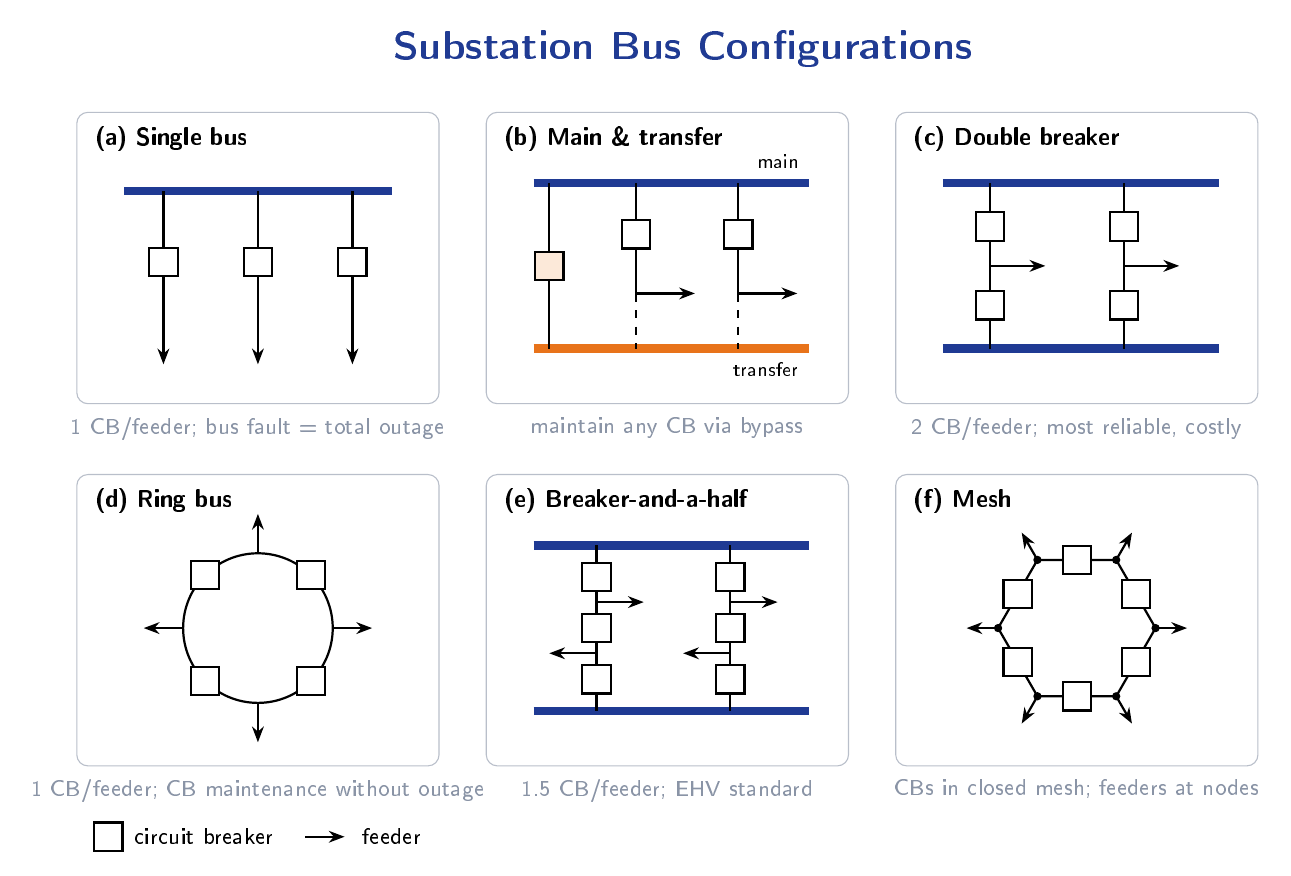
Substation Bus Configurations
Fuses
A fuse is a thermal protective device whose element melts when current exceeds a predetermined value for a specified time. The fundamental thermal characteristic is the I²t relationship:
| Term | Definition |
|---|---|
| Rated current \(I_n\) | Maximum continuous safe current |
| Minimum fusing current \(I_f\) | Smallest current that will melt the element |
| Fusing factor \(K_f\) | \(I_f / I_n\) — typically 1.4–2.0; HRC: 1.1–1.4 |
| Cut-off current \(I_c\) | Peak prospective fault current intercepted before arcing |
| Pre-arcing time | Time from fault inception to arc initiation |
| Total operating time | Pre-arcing time + arcing time |
HRC Fuses and Discrimination
A High Rupturing Capacity (HRC) fuse uses a silver or copper ribbon element in a ceramic body filled with quartz sand. The sand absorbs arc energy, forming a fulgurite. Breaking capacity reaches 80 kA at 415 V. Two fuses in series discriminate (downstream blows first) when:
gG — general purpose, full-range protection (line protection); aM — motor circuits, back-up only (does not protect against overloads); aR / gR — semiconductor protection with fast I²t characteristic.
Instrument Transformers: CTs, VTs, and CCVTs
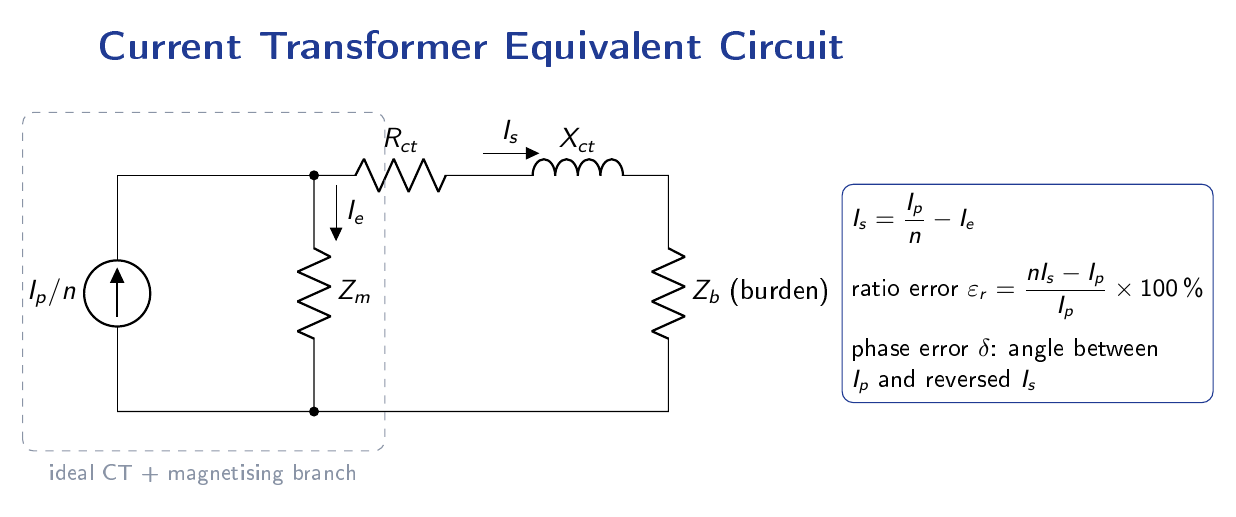
Protective relays operate at ~1 A and 110 V; primary systems carry thousands of amperes at hundreds of kilovolts. Instrument transformers translate primary signals to safe, standardised secondary values while preserving phase and magnitude. Standard secondaries: CTs at 1 A or 5 A (1 A preferred for long cable runs); VTs at 110 V (L–L) or 110/√3 V (L–N).
With the primary energised, opening the CT secondary removes the demagnetising MMF. The full primary MMF saturates the core and the induced secondary EMF rises to dangerous kV levels at every flux reversal — a severe hazard to insulation and personnel. Always short the secondary terminals before disconnecting any downstream burden.
CT Equivalent Circuit and Errors
CT Accuracy Classes and the Knee Point
CT accuracy classes split into two families. Metering classes (IEC: 0.1, 0.2, 0.5, 1.0, 3) are highly accurate near rated current but deliberately saturate early under faults to protect meters. Protective classes (IEC 5P, 10P, PX) must faithfully reproduce fault currents up to the Accuracy Limit Factor (ALF).
Example designation: 5P20, 15 VA — class 5P (5% composite error limit), ALF = 20, burden = 15 VA. The knee point is defined (IEC 61869-2) as the point on the excitation curve where a 10% rise in secondary EMF \(E_s\) causes a 50% rise in excitation current \(I_e\).
CT Saturation: AC and DC Components
Two saturation regimes exist. AC saturation occurs when the peak secondary EMF exceeds the knee-point voltage. DC saturation is more severe: the fault DC offset drives core flux unidirectionally, saturating the CT far below its symmetrical capability. The required knee-point voltage accounting for the DC transient is:
The transient dimensioning factor \(K_{td} = 1 + X/R\). IEC transient CT classes: TPX (no flux limit), TPY (small air gap, ≤10% remanence), TPZ (larger gap, very low remanence).
Voltage Transformers and CCVTs
Electromagnetic VTs (EMVTs) are conventional two-winding transformers, economical up to ~132 kV. Above 132 kV, the Capacitive Voltage Transformer (CCVT/CVT) — a two-stage capacitive divider plus an intermediate EMVT tuned by a series reactor — is preferred. The CCVT also doubles as a power-line carrier (PLC) coupling capacitor, serving measurement, protection, and communication simultaneously.
A ferro-resonant loop forms when the non-linear inductance of an iron-cored VT resonates with system capacitance after a switching event. Sustained sub-harmonic overvoltages (½, ⅓ fundamental) overheat cores and cause spurious trips. Mitigation: damping resistor across the open-delta secondary (~25–100 W) or active ferro-resonance suppression.
Protective Relays
Key Relay Terminology
| Term | Definition |
|---|---|
| Pickup | Smallest operating quantity that causes relay operation |
| Reset / Drop-off | Largest value at which relay returns to inoperative state |
| Reset ratio | Reset ÷ Pickup — typically 0.85–0.95 |
| PSM (Plug Setting Multiplier) | \(I_{\text{fault (sec)}} / I_{\text{relay setting}}\) |
| TMS (Time Multiplier Setting) | Scalar factor that shifts the time-current characteristic |
| Burden | VA consumed by relay at rated current/voltage — affects CT/VT sizing |
Universal Torque Equation
The induction disc relay produces torque proportional to two phase-shifted fluxes. The general Universal Torque Equation underpins every electromechanical relay type:
Setting individual constants to zero or specific values realises different relay characteristics: OC relay (\(K_1 > 0\) only); voltage relay (\(K_2 > 0\)); directional relay (\(K_3 > 0\)); impedance relay (\(K_1 > 0\), \(K_2 < 0\)); reactance relay (\(K_1, K_3\) with \(\tau = 90°\)).
ANSI/IEEE Device Numbers (IEEE C37.2)
| No. | Function | No. | Function |
|---|---|---|---|
| 21 | Distance (impedance) | 51 | AC time overcurrent (IDMT) |
| 24 | Volts/Hz (over-excitation) | 52 | AC circuit breaker |
| 25 | Synchronism / Synchrocheck | 59 | Overvoltage |
| 27 | Undervoltage | 63 | Pressure (Buchholz) |
| 32 | Reverse power | 64 | Earth-fault detection |
| 40 | Loss of field / excitation | 67 | Directional overcurrent |
| 46 | Negative-sequence current | 68 | Power-swing blocking |
| 49 | Thermal overload | 78 | Out-of-step tripping |
| 50 | Instantaneous overcurrent | 79 | Auto-reclose |
| 50N | Instantaneous earth fault | 81 | Frequency (over/under/df/dt) |
| 51N | Time earth fault | 87 | Differential (G/T/L/B suffix) |
| 86 | Lock-out auxiliary | 89 | Disconnector / earth switch |
IDMT Overcurrent Relay Characteristic (IEC 60255-151)
| Characteristic | \(k\) | \(\alpha\) | Typical Use |
|---|---|---|---|
| Standard Inverse (SI) | 0.14 | 0.02 | General feeder coordination |
| Very Inverse (VI) | 13.5 | 1.0 | Lines with high fault-current variation |
| Extremely Inverse (EI) | 80 | 2.0 | Coordination with fuses, cable feeders |
| Long-Time Inverse (LTI) | 120 | 1.0 | Overload protection |
Two relays R₁ (downstream) and R₂ (upstream); end-of-feeder fault \(I_f = 4000\,\text{A}\); CT₁ = 400/1 A, CT₂ = 600/1 A. Both relays set to 100% and 125% of rated current respectively; Standard Inverse (SI) characteristic.
For R₁: \(\text{PSM}_1 = \frac{4000/400}{1.0} = 10\); \(t_1 = \text{TMS}_1 \times \frac{0.14}{10^{0.02}-1} \approx \text{TMS}_1 \times 2.97\). With TMS₁ = 0.1: \(t_1 \approx 0.30\,\text{s}\).
For R₂ (grading margin 0.4 s): \(t_2 = 0.30 + 0.40 = 0.70\,\text{s}\). \(\text{PSM}_2 = \frac{4000/600}{1.25} = 5.33\). \(\text{TMS}_2 = \frac{0.70 \times (5.33^{0.02}-1)}{0.14} \approx 0.17\).
Directional Overcurrent Relay
Required where fault current can flow in either direction — parallel feeders and ring mains. Operating torque depends on the phase angle between current and polarising voltage:
Maximum torque occurs at \(\theta = \tau\) (Maximum Torque Angle, MTA). The most common connection is the 90° quadrature scheme: phase-A current polarised by \(V_{bc}\).
Distance Protection
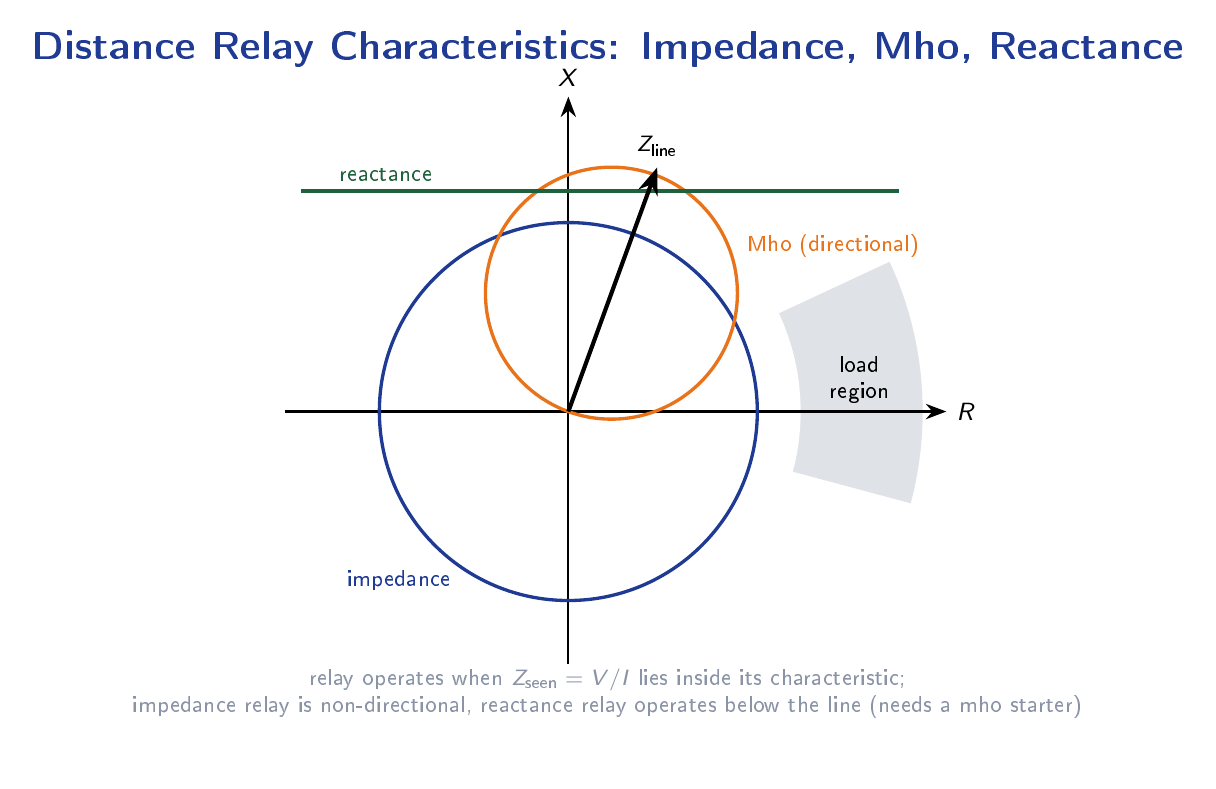
For long transmission lines, overcurrent protection is unsatisfactory because source impedance variation alters fault current, heavy load leaves a small margin to fault-level, and coordination is difficult for multi-source systems. A distance relay measures \(Z_R = V_R/I_R\) — approximately proportional to the fault distance — and operates when \(Z_R < Z_{\text{set}}\).
Three-Zone Distance Protection
| Zone | Reach | Time Delay | Purpose |
|---|---|---|---|
| Zone 1 | 80% of protected line | Instantaneous | Main fast protection |
| Zone 2 | 100% of line + 20–50% of next | ~0.3–0.4 s | Covers far end of own line |
| Zone 3 | 100% + 100% + 25% | ~1 s | Remote backup |
Types of Distance Relay Characteristics
| Type | R–X Boundary | Directional? | Best Application |
|---|---|---|---|
| Impedance | Circle centred at origin | No (needs separate dir. unit) | General |
| Reactance | Horizontal line in R–X | No | Short lines with arc resistance |
| Mho (admittance) | Circle through origin | Inherently directional | Long lines; most common at EHV |
| Offset Mho | Shifted circle (3rd quadrant) | Yes | Backup and power-swing blocking |
| Quadrilateral | Four piecewise lines | Yes (programmable) | Numerical relays; load encroachment |
System: 220 kV line AB (100 km, \(z_1 = 0.4\,\Omega/\text{km}\ @\ 80°\)) followed by line BC (80 km). CT: 1000/1 A; VT: 220 000/110 V. Impedance ratio \(k_Z = 1000/2000 = 0.5\).
\(Z_{AB} = 40\,\Omega\), \(Z_{BC} = 32\,\Omega\) (primary).
Zone 1 (80% of AB): \(Z_{R1} = 0.8 \times 40 \times 0.5 = \mathbf{16\,\Omega}\) secondary.
Zone 2 (AB + 50% BC): \(Z_{R2} = (40+16) \times 0.5 = \mathbf{28\,\Omega}\) secondary.
Zone 3 (1.25 × (AB + BC)): \(Z_{R3} = 1.25 \times 72 \times 0.5 = \mathbf{45\,\Omega}\) secondary.
A large Zone-3 reach can intersect the heavy-load region in the R–X plane and cause nuisance tripping on stressed but stable load. Load-encroachment blinders or quadrilateral characteristics with adjustable resistive cut-off are the solution — a lesson underlined by the 14 August 2003 NE USA blackout.
Power Swing and Out-of-Step Protection
A power swing is the slow oscillation of generator rotor angles following a disturbance. The apparent impedance traces a trajectory through the R–X plane. If it enters a distance zone, the relay may trip erroneously. The two-blinder method distinguishes a power swing from a fault based on the time (\(>50\,\text{ms}\)) taken for impedance to cross between the two blinders:
Slow crossing of the outer and inner blinders (\(\Delta t > 50\,\text{ms}\)): Power swing → activate Out-of-Step Blocking (ANSI 68). Completed crossing all the way through: pole-slip → activate Out-of-Step Tripping (ANSI 78), preferably at the voltage zero of the swing.
Pilot Protection Schemes for Transmission Lines
For lines longer than ~50 km, pilot relaying provides instantaneous tripping along the entire line length. Communication media include wire pilot (up to 25 km), Power Line Carrier (30–500 kHz, PLC), and microwave/fibre-optic.
| Scheme | Local Condition for Trip | Key Notes |
|---|---|---|
| DUTT | Zone-1 trip and send; remote trips on receipt | Signal loss → no trip (secure) |
| PUTT | Zone-1 OR (Zone-2 AND receive) | Permissive under-reach; Zone-1 sends permission |
| POTT | Zone-2 (forward) AND receive | Permissive over-reach; preferred with fibre/microwave |
| DCB | Zone-2 AND (NOT receive after Δt) | Blocking; suits noisy PLC channels |
| DCUB | Same as DCB with unblock guard tone | Rides through carrier loss |
Differential Protection
Principle of Differential Protection
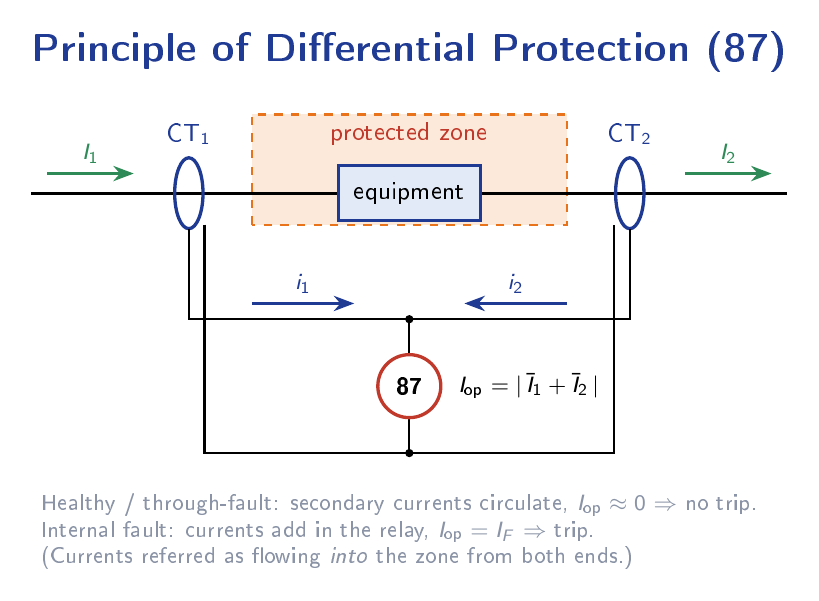
The fundamental idea is to compare currents entering and leaving a protected zone. With both CTs marked with current flowing into the zone:
For a healthy system or external (through) fault, \(I_1 + I_2 \approx 0\) and \(I_{\text{op}} = 0\). For an internal fault, \(I_{\text{op}}\) equals the total fault current flowing into the zone.
Percentage (Biased) Differential Protection
Simple Merz-Price differential protection is vulnerable to CT mismatch, CT saturation on through-faults, and magnetising inrush in transformers. The solution is a percentage-biased characteristic with a slope \(k\) (typically 20–40%):
Dual-slope relays add a steeper slope to ride through high through-fault CT saturation. Typical settings: pickup 0.2–0.4 pu; Slope 1 = 25%; Slope 2 = 50–70%.
Transformer Differential Protection (87T) — Special Considerations
- Turns ratio: CT ratios on each side chosen so secondary currents balance at full load.
- Phase shift: For Δ–Y transformers, a 30° shift is compensated by interposing CTs (or numerically in IEDs).
- Magnetising inrush: 6–12× rated current, rich in 2nd harmonic (>15%) → 2nd-harmonic restraint prevents maloperation.
- Overexcitation: 5th-harmonic restraint is used.
- On-load tap changer: CTs sized at the nominal tap; the bias slope accommodates the full tap range.
Restricted Earth Fault (REF) Protection (64REF)
For a Y-grounded transformer winding, REF provides high sensitivity to internal earth faults near the neutral — a region where the main differential relay (87T) is insensitive due to the low fault current. Three phase CTs are connected in residual and a neutral CT is added:
The high-impedance REF type uses a stabilising resistor to prevent operation during through-fault CT saturation:
Bus Bar Differential Protection (87B)
The bus bar is the most critical node — an internal bus fault causes multiple simultaneous equipment outages. High-impedance bus differential places a series stabilising resistor and non-linear resistor (metrosil) across the relay to ride through CT saturation during external through-faults:
Low-impedance numerical bus protection uses digital sampling of all CTs simultaneously with dynamic bias and CT-saturation detection algorithms.
Equipment Protection
Generator Protection
| Hazard / Condition | ANSI Function | Notes |
|---|---|---|
| Stator phase / earth faults | 87G, 87N / 64G | Percentage diff; 95% neutral voltage scheme |
| Rotor earth fault | 64F | DC or AC injection method |
| Loss of field | 40 | Mho relay offset into 4th quadrant of R–X plane |
| Negative-sequence heating | 46 | \(I_2^2 t = K\) (K=10 turbo, 40 hydro) |
| Reverse power / motoring | 32 | Pickup 0.5–3% of rated active power |
| Under/overvoltage | 27 / 59 | — |
| Frequency | 81 | Over/under/df/dt (rate of change) |
The stator earth fault 95% scheme senses neutral voltage \(V_n = f\,V_{\text{ph}}\). Setting \(V_n^{\text{pickup}} = \alpha V_{\text{ph}}\) (typically \(\alpha = 5\%\)) covers (1−α) = 95% of the winding from the line end. The remaining 5% near the neutral is covered by a third-harmonic neutral undervoltage (27TN) or neutral-injection (64S) scheme.
Transformer Protection
| Fault / Abnormality | Protection (ANSI) |
|---|---|
| Internal phase and earth faults | Differential (87T) |
| Internal EF near neutral | REF (64REF) |
| Incipient faults / gas evolution | Buchholz (63), Sudden Pressure |
| External through-faults | Overcurrent (51), EF (51N) |
| Overload | Thermal (49), oil/winding temp (26W/26O) |
| Over-fluxing | Volts/Hz (24): \(V/f > 1.1\,\text{pu}\) |
| Tank earth fault | Frame leakage / tank earth relay |
Buchholz Relay
A gas-actuated relay located in the pipe between the transformer tank and conservator. The top float (alarm, 63B-1) detects slowly-evolving gas from incipient hotspots or partial discharge. The bottom flap (trip, 63B-2) responds to the oil-gas surge from a violent internal fault (pickup velocity ~0.7–1.5 m/s). Dissolved Gas Analysis (DGA) further interprets H₂, CH₄, C₂H₂, C₂H₄, CO, CO₂ via the Duval triangle or Rogers ratio method.
Induction Motor Protection
| Hazard | ANSI Function |
|---|---|
| Overload | 49 (thermal replica model) |
| Locked rotor / stall | 51LR, 14 |
| Single phasing (loss of phase) | 46 (negative-sequence) |
| Earth fault | 51N / 50N |
| Undervoltage | 27 |
| Differential (large motors) | 87M |
Typical \(K = 3\)–8 (accounts for additional rotor heating from negative-sequence currents). Trip when \(\theta > \theta_{\lim}\).
Generator Synchronisation (ANSI 25)
Before paralleling a generator to the bus, four conditions must be matched: voltage magnitude (\(\Delta V \le 5\%\)), frequency (\(\Delta f \le 0.1\)–0.3 Hz, running just above system frequency), phase angle (\(\Delta\phi \le 5\)–10°), and phase sequence (verified at commissioning). The synchrocheck relay (25) permits CB closure only when all conditions are within the window.
Closing a CB 90° out of phase imposes ~1.4 pu shaft torque — broken couplings and stator end-winding damage have resulted in practice. Always verify the synchrocheck relay function during commissioning.
Travelling Waves, Lightning, and Surge Arresters
Travelling Waves on Transmission Lines
Overhead line: \(v \approx 3\times10^8\,\text{m/s}\), \(Z_c \approx 300\)–500 Ω. Underground cable: \(v \approx 1.5\times10^8\,\text{m/s}\), \(Z_c \approx 30\)–60 Ω.
Important boundary cases: open end (\(Z_t = \infty\)) → \(\Gamma = +1\), voltage doubles; short circuit (\(Z_t = 0\)) → \(\Gamma = -1\), voltage zero, current doubles; cable from line (\(Z_t < Z_c\)) → voltage attenuated, current amplified.
Lightning Strokes and Surge Arresters
Standard lightning impulse (IEC): 1.2/50 µs (front/tail). Switching impulse: 250/2500 µs. A back-flashover occurs when a lightning stroke to a tower raises the tower-top voltage \(V_T = I \cdot Z_T + L\,di/dt\) above the insulator flashover level, driving a surge onto the phase conductor.
At normal operating voltage, leakage is in the µA range; at surge voltages, the MOV conducts kA at a clamped residual voltage. Key arrester parameters: MCOV (Maximum Continuous Operating Voltage), residual (discharge) voltage, energy absorption class, and line-discharge class.
Insulation Coordination
The Earth-Fault Factor (EFF) is the ratio of the highest power-frequency phase-to-earth voltage on a healthy phase during a single-phase earth fault to the pre-fault value. It drives the selection of arrester rated voltage (MCOV).
Effectively grounded (\(X_0/X_1 \le 3\), \(R_0/X_1 \le 1\)): EFF ≤ 1.4. Isolated or Petersen-coil grounded: EFF → √3 ≈ 1.732.
Typical minimum margins: ≥20% for transformers; ≥15% for other equipment.
Substation Earthing — Touch and Step Voltages (IEEE 80)
Where \(t_s\) is fault clearance time (s), \(C_s\) is the surface-layer derating factor, and \(\rho_s\) is surface resistivity (Ω·m). For a 70 kg body, replace 0.116 with 0.157.
Neutral Grounding Methods
| Method | LG Fault Current | Key Remarks |
|---|---|---|
| Solid grounding | High | Easy fault detection; large fault current |
| Resistance grounding | Limited | Reduces transient overvoltage; easier EF detection |
| Reactance grounding | Limited | Used in generators (low-reactance method) |
| Resonant (Petersen coil) | ~0 | \(X_L \approx X_{C0}/3\); transient EF self-clears |
| Ungrounded (isolated) | Small (capacitive) | High transient OV; difficult EF detection |
The earth-fault current is reduced to capacitive leakage, allowing the arc to self-extinguish in ~80% of earth faults without CB tripping.
Modern Protection: Static, Numerical, and Wide-Area
Numerical Relay Architecture
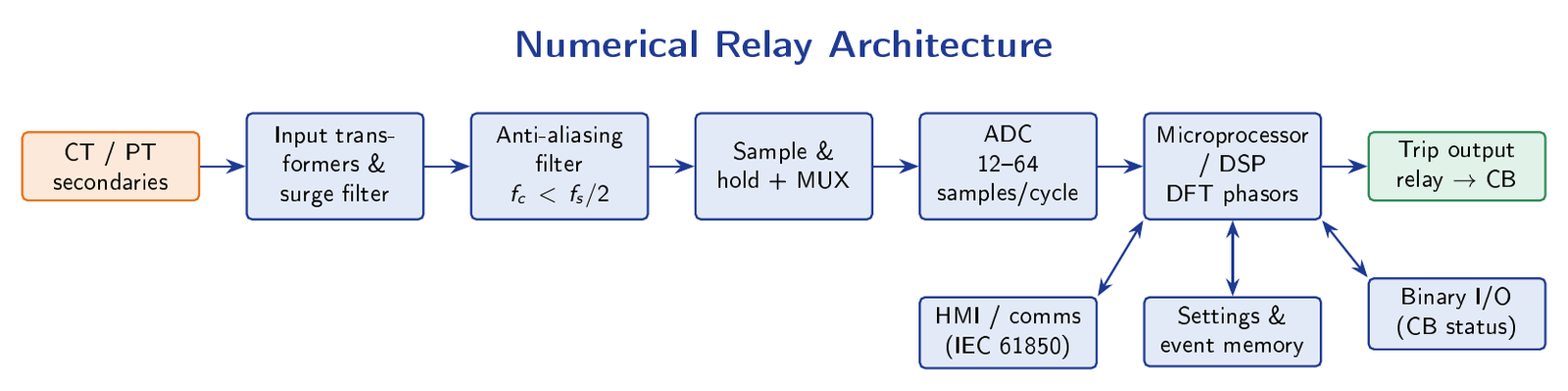
Static (solid-state) relays using op-amps and comparators were superseded from the 1990s by numerical relays based on microprocessors. The signal chain is:
Full-Cycle DFT for Phasor Extraction
Numerical relay algorithms use the extracted phasors for distance protection (\(Z = V/I\) → zone check), differential protection (compare phasors at all terminals), disturbance recording (oscillography, SOE with 1 ms time-stamps), and communication via IEC 61850 (Ethernet GOOSE messaging, <4 ms).
Advantages of Numerical Relays
- Multi-function and programmable — one IED replaces many electromechanical units
- Adaptive settings: cold-load pickup blocking, dynamic Zone-3 reach during load encroachment
- Event records, fault location, RTU functions built in
- Reduced wiring via process bus (IEC 61850-9-2 Sampled Values)
Cybersecurity is now a critical part of digital substation design. IEC 62351 specifies: authenticated GOOSE and Sampled Values (R-GOOSE / R-SV), role-based access control, network segmentation, and end-to-end encryption of inter-substation communication.
Gas-Insulated Substation (GIS)
In a GIS, all HV equipment — CB, isolator, busbar, CT, VT, surge arrester — is enclosed in grounded metal enclosures filled with SF₆ at ~5–7 bar. GIS footprint is ~10% of equivalent AIS; reliability is very high because the equipment is sealed; maintenance intervals are extended. Cost is 2–3× AIS, justified in urban, offshore, or harsh environments.
Disconnector switching in GIS generates Very Fast Transient Overvoltages at frequencies of tens of MHz, with peaks up to 2.5 pu. These can stress windings of transformers connected to the GIS and must be managed by surge arresters or ferrite rings at the GIS-to-transformer junction.
Adaptive and Wide-Area Protection
Adaptive protection changes relay settings with changing operating conditions — cold-load pickup blocking, dynamic Zone-3 reach during load encroachment, out-of-step blocking and tripping. The Wide-Area Measurement System (WAMS) uses Phasor Measurement Units (PMUs) providing GPS-time-tagged synchrophasors at 10/25/50 fps (50 Hz systems) or higher, aggregated by Phasor Data Concentrators (PDCs).
PMU performance: IEEE C37.118.1. Digital substation communications: IEC 61850. Wide-area protection using IEC 61850: IEC 61850-90-5. Substation grounding: IEEE 80. HV switchgear: IEC 62271 series. Short-circuit calculations: IEC 60909.
HVDC Protection — A Modern Frontier
HVDC links (LCC, VSC, MMC) transport bulk power across long distances and between asynchronous grids but demand fundamentally different protection:
- No natural current zero — arc interruption is harder than in AC systems
- Fault transients propagate as travelling waves in ≤1 ms
- Converter semiconductors tolerate ~2×In for only a few milliseconds
DC-Side Fault Types
- Pole-to-ground and pole-to-pole faults
- Line travelling-wave protection (du/dt, di/dt, wavelet)
- Converter blocking ~1 ms; restart via control action
DC Circuit Breaker Technologies
- Mechanical: inexpensive, slow (>30 ms)
- Solid-state: fast (<1 ms), high conduction losses
- Hybrid (ABB 2012): <5 ms; MOV absorbs \(\tfrac{1}{2}LI^2\)
On interruption of \(I_{dc}\) in line inductance \(L_{dc}\): \(W = \tfrac{1}{2}L_{dc}I_{dc}^2\). For 500 kV, 3 kA, \(L_{dc} = 100\,\text{mH}\): \(W \approx 450\,\text{kJ}\) — absorbed entirely by the DC-CB arrester stack. The energy class of ZnO modules is the binding design constraint. Standards: CIGRÉ B4 WG reports; IEC 62501, IEC 62747; IEEE 1158, IEEE 2745 (in development).
Key Takeaways
Course Summary
Eight Pillars of Switchgear and Protection
From fundamentals to HVDC — what every protection engineer must know.
- Faults are inevitable. Protection is the heart of a reliable power system — its design is as important as the power plant itself.
- Symmetrical components (Fortescue, 1918) reduce unsymmetrical fault analysis to scalar sequence networks, enabling the derivation of fault currents for LG, LL, and LLG conditions analytically.
- Instrument transformers (CTs, VTs, CCVTs) translate kV/kA into relay-friendly signals; accuracy class, knee-point voltage, and transient response fundamentally bound what protection can achieve.
- Circuit-breaker performance is the race between dielectric recovery and RRRV; isolators and earth switches complete the isolation chain and must be correctly sequenced to ensure personnel safety.
- Protective relays embody the universal torque equation; numerical relays realise it digitally with extraordinary multi-function flexibility, event recording, and self-monitoring.
- Coordination — selectivity in time, current, distance, direction, and communication — is the central design challenge. A correctly graded system limits fault damage to the minimum required circuit section.
- Insulation coordination couples surge-arrester behaviour to equipment BIL; substation earthing design bounds touch and step voltages to within IEEE 80 permissible limits.
- Modern grids demand adaptive, wide-area, communication-assisted, and cyber-secure protection. HVDC adds entirely new constraints on fault clearance speed and DC circuit breaker technology.
"Protection is invisible when it works, indispensable when it must."
Recommended References
Primary Textbooks
- Y. G. Paithankar & S. R. Bhide, Fundamentals of Power System Protection, PHI Learning.
- C. L. Wadhwa, Electrical Power Systems, New Age International.
- Sunil S. Rao, Switchgear Protection and Power Systems, Khanna Publishers.
- S. H. Horowitz & A. G. Phadke, Power System Relaying, Wiley–IEEE Press.
- J. L. Blackburn & T. J. Domin, Protective Relaying: Principles and Applications, CRC Press.
- G. Ziegler, Numerical Distance Protection: Principles and Applications, Wiley/Siemens.
Key Standards
IEEE Standards
- C37.2 — Device function numbers
- C37.04–C37.09 — HV circuit breakers
- C37.113 — Line protection
- C37.118.1 — PMU synchrophasors
- IEEE 80 — Substation grounding
IEC Standards
- IEC 60255 — Measuring relays
- IEC 61869 — Instrument transformers
- IEC 60071 — Insulation coordination
- IEC 60909 — Short-circuit currents
- IEC 61850 — Digital substation
- IEC 62271 — HV switchgear
- IEC 62351 — Cybersecurity