Signals and Systems
A Comprehensive Course — From Foundations to Competitive Examinations
Introduction to Signals & Systems
What is a Signal?
A signal is any physical quantity that conveys information and varies with respect to one or more independent variables (time, space, etc.).
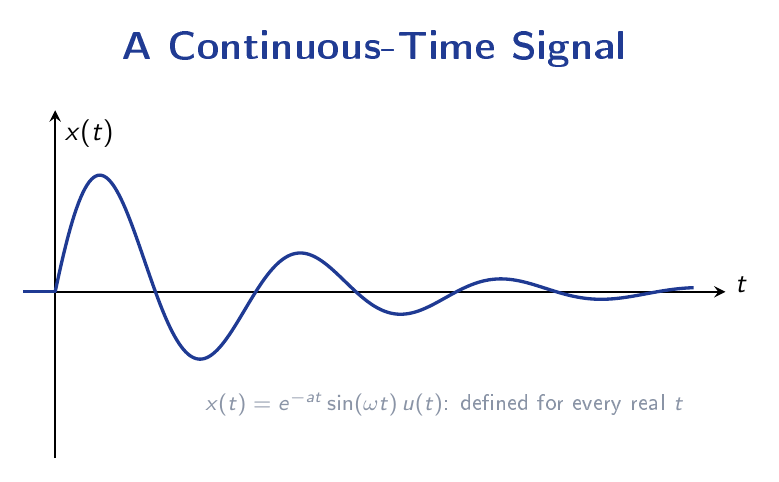
Signals are represented mathematically as \(x(t)\) for continuous-time (CT) and \(x[n]\) for discrete-time (DT), where \(t\) is real time and \(n\) is an integer sample index. The independent variable can also be position \((x,y)\), frequency \(\omega\), or any other dimension.
Practical examples include speech and audio signals \(x(t)\), images \(x(m,n)\), video \(x(m,n,t)\), bio-signals (ECG, EEG, EMG), radar echoes, stock indices, and sensor data from industrial systems.
What is a System?
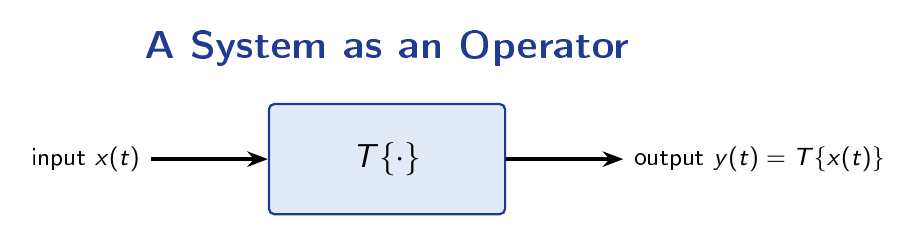
A system is a physical device, algorithm, or process that performs an operation \(T\{\cdot\}\) on an input signal \(x(t)\) to produce an output signal \(y(t) = T\{x(t)\}\).
Systems are depicted as a black box with an input port and an output port. The operator \(T\{\cdot\}\) encodes the relationship between the two. Physical examples include RC/RLC circuits, digital filters, communication channels, and mechanical vibration absorbers.
Course Roadmap
- Introduction to Signals & Systems
- Classification of Signals
- Standard Signals
- Signal Operations
- Classification of Systems
- LTI Systems and Convolution
- Differential & Difference Equations
- Realization Structures
- Fourier Series
- Continuous-Time Fourier Transform
- Laplace Transform
- Sampling Theorem
- Discrete-Time Fourier Transform
- Z-Transform
- Frequency Response & Filters
- Correlation & Spectral Density
- Discrete Fourier Transform & FFT
- State-Space Representation
- Competitive Exam Quick Reference
- Summary & Big Picture
Classification of Signals
Signals can be classified along several orthogonal axes. The most important classifications for engineering analysis are listed below.
Continuous-Time vs. Discrete-Time
A continuous-time (CT) signal \(x(t)\) is defined for every real value of \(t\). A discrete-time (DT) signal \(x[n]\) is defined only at integer values of \(n\), and may arise naturally (e.g., daily stock prices) or by sampling a CT signal.
Analog vs. Digital
An analog signal has a continuum of amplitude values. A digital signal is both discrete in time and quantized in amplitude. Most physical signals are analog; digital systems process quantized versions of them.
Periodic vs. Aperiodic
A CT signal is periodic with period \(T_0\) if \(x(t + T_0) = x(t)\) for all \(t\). The fundamental period is the smallest positive \(T_0\) satisfying this. For DT, \(x[n]\) is periodic with period \(N\) if \(x[n+N] = x[n]\). A key distinction: \(x[n] = \cos(\Omega_0 n)\) is periodic only when \(\Omega_0 / 2\pi\) is a rational number.
Energy vs. Power Signals
For a CT signal:
A signal is an energy signal if \(E < \infty\) (and then \(P = 0\)). It is a power signal if \(0 < P < \infty\) (and then \(E = \infty\)). Periodic signals are power signals; finite-duration signals are typically energy signals.
Even and Odd Decomposition
Any signal can be uniquely decomposed as \(x(t) = x_e(t) + x_o(t)\), where:
Causal, Anti-causal, and Non-causal Signals
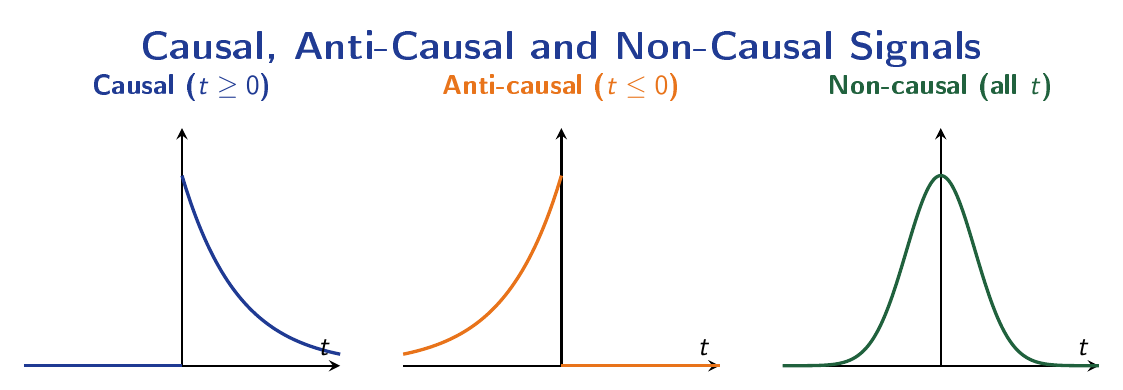
A causal signal satisfies \(x(t) = 0\) for all \(t < 0\). An anti-causal signal is zero for \(t > 0\). A signal that is neither is non-causal
Standard Signals
Unit Step Function
\[ u(t) = \begin{cases} 1, & t \geq 0 \\ 0, & t < 0 \end{cases} \]
\[ u[n] = \begin{cases} 1, & n \geq 0 \\ 0, & n < 0 \end{cases} \]
The step function acts as a "switch-on" operator: \(x(t)u(t)\) is the causal version of \(x(t)\). Any signal multiplied by \(u(t)\) is set to zero for negative time.
Unit Impulse (Dirac Delta) Function
\[ \delta(t) = 0 \; \forall \, t \neq 0, \qquad \int_{-\infty}^{\infty} \delta(t) \, \mathrm{d}t = 1 \]
Key Properties of \(\delta(t)\)
- Sifting: \(\displaystyle\int_{-\infty}^{\infty} x(t)\,\delta(t - t_0)\,\mathrm{d}t = x(t_0)\)
- Scaling: \(\delta(at) = \dfrac{1}{|a|}\delta(t)\)
- Even symmetry: \(\delta(-t) = \delta(t)\)
- Product: \(x(t)\,\delta(t - t_0) = x(t_0)\,\delta(t - t_0)\)
- Step relation: \(\dfrac{\mathrm{d}u(t)}{\mathrm{d}t} = \delta(t)\), and \(u(t) = \displaystyle\int_{-\infty}^{t} \delta(\tau)\,\mathrm{d}\tau\)
For the discrete-time impulse: \(\delta[n] = 1\) at \(n=0\), zero elsewhere, and \(\delta[n] = u[n] - u[n-1]\).
Unit Ramp and Parabolic Signals
\[ r(t) = t\,u(t) = \int_{-\infty}^{t} u(\tau)\,\mathrm{d}\tau \]
\[ p(t) = \frac{t^2}{2}\,u(t) = \int_{-\infty}^{t} r(\tau)\,\mathrm{d}\tau \]
Exponential Signals
Real exponentials take the form \(x(t) = A\,\mathrm{e}^{at}\): growing for \(a > 0\), decaying for \(a < 0\), and constant for \(a = 0\). Complex exponentials generalize this to \(x(t) = A\mathrm{e}^{st}\) with \(s = \sigma + j\omega\), yielding:
\[ \mathrm{e}^{j\omega t} = \cos(\omega t) + j\sin(\omega t) \]
\[ \cos\omega t = \frac{\mathrm{e}^{j\omega t} + \mathrm{e}^{-j\omega t}}{2}, \qquad \sin\omega t = \frac{\mathrm{e}^{j\omega t} - \mathrm{e}^{-j\omega t}}{2j} \]
Sinusoidal Signals
where \(A\) is the amplitude, \(\omega_0 = 2\pi f_0 = 2\pi/T\) is the angular frequency in rad/s, \(f_0\) is the frequency in Hz, \(T\) is the period, and \(\phi\) is the phase in radians.
For the discrete-time sinusoid \(x[n] = A\cos(\Omega_0 n + \phi)\), there are key distinctions: periodicity requires \(\Omega_0/2\pi\) to be rational; digital frequencies \(\Omega_0\) and \(\Omega_0 + 2\pi k\) produce identical sequences (unique frequencies lie in \([-\pi, \pi]\)); and maximum oscillation occurs at \(\Omega_0 = \pi\).
Rectangular, Triangular, and Sinc Pulses
| Signal | Mathematical Form | Key Property |
|---|---|---|
| Rectangular \(\rect(t/T)\) | \(1\) for \(|t| \leq T/2\), else \(0\) | Fourier transform is a sinc |
| Triangular \(\tri(t/T)\) | \(1 - |t|/T\) for \(|t| \leq T\), else \(0\) | Convolution of two rect pulses |
| Sinc \(\sinc(t)\) | \(\sin(\pi t)/(\pi t)\), with \(\sinc(0) = 1\) | Zero crossings at all non-zero integers |
Signum and Comb Functions
The signum function is defined as \(\operatorname{sgn}(t) = +1\) for \(t > 0\), \(0\) at \(t = 0\), and \(-1\) for \(t < 0\). Its step relation is \(\operatorname{sgn}(t) = 2u(t) - 1\).
The Dirac comb (impulse train) is \(\mathrm{III}_T(t) = \sum_{n=-\infty}^{\infty} \delta(t - nT)\). It is periodic and fundamental in sampling theory, where multiplication by a comb creates a sampled signal.
Signal Operations
Time Operations
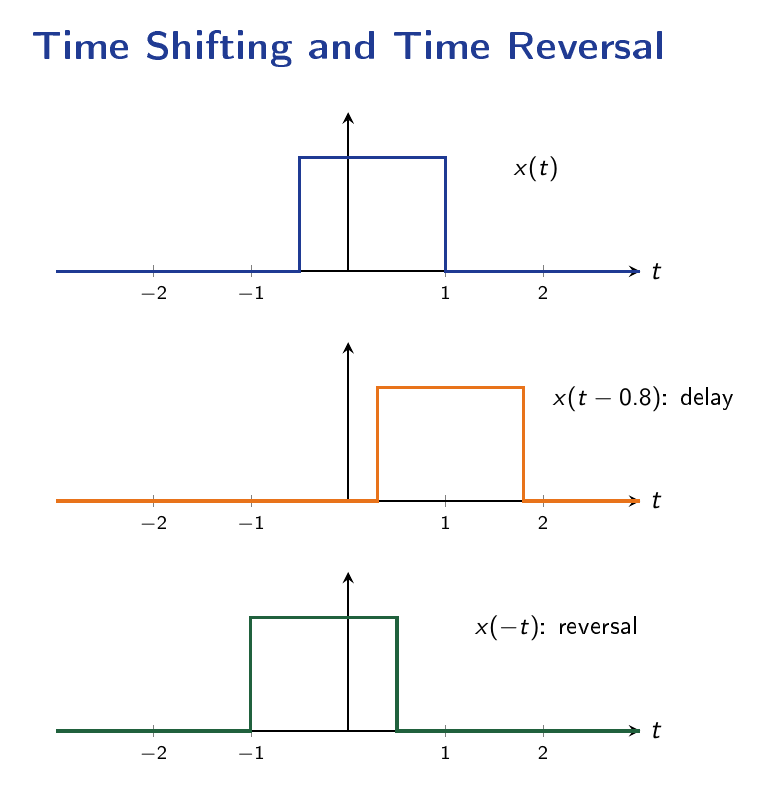
\(y(t) = x(t - t_0)\): positive \(t_0\) shifts the signal to the right (delay); negative \(t_0\) shifts it to the left (advance).
\(y(t) = x(-t)\): reflection about the vertical axis.
\(y(t) = x(at)\): \(|a| > 1\) compresses (speeds up); \(|a| < 1\) expands (slows down); \(a < 0\) includes reversal.
Combined Transformations
For \(y(t) = x(at + b)\), the correct order of operations is: (1) time shift by \(-b/a\), then (2) time scale by \(1/|a|\) (plus reverse if \(a < 0\)). Equivalently: (1) time scale by \(1/|a|\), then (2) shift by \(-b\). The order matters — always resolve systematically.
Classification of Systems
| Property | Definition | Test |
|---|---|---|
| Linearity | Satisfies superposition: additivity + homogeneity | \(T\{\alpha x_1 + \beta x_2\} = \alpha T\{x_1\} + \beta T\{x_2\}\) |
| Time-Invariance | A time shift in input produces identical shift in output | \(T\{x(t-t_0)\} = y(t-t_0)\) |
| Causality | Output at \(t_0\) depends only on input for \(t \leq t_0\) | \(h(t) = 0\) for \(t < 0\) |
| BIBO Stability | Bounded input always produces bounded output | \(\int_{-\infty}^{\infty}|h(t)|\,\mathrm{d}t < \infty\) |
| Memoryless | Output depends only on current input value | \(y(t) = f(x(t))\) only |
| Invertibility | Input can be uniquely recovered from output | Distinct inputs produce distinct outputs |
A system that is both linear and time-invariant (LTI) is completely characterized by its impulse response \(h(t)\). Every LTI system obeys the convolution principle.
LTI Systems and Convolution
Convolution Integral (CT)
The output of an LTI system is the convolution of the input with the impulse response. Convolution is commutative (\(x \ast h = h \ast x\)), associative, and distributive over addition.
Convolution Sum (DT)
If \(x[n]\) has length \(L_x\) and \(h[n]\) has length \(L_h\), the output length is \(L_y = L_x + L_h - 1\).
Graphical Convolution
The four-step graphical method proceeds as: (1) Express \(x(\tau)\) and \(h(\tau)\); (2) flip \(h\) to get \(h(-\tau)\); (3) slide \(h(t - \tau)\) across and identify overlap regions; (4) compute the integral of the product for each region of \(t\).
For \(x(t) = \rect(t - 0.5)\) and \(h(t) = \rect(t - 0.5)\) (both unit pulses on \([0,1]\)): \[ y(t) = \rect \ast \rect = \tri(t-1) \] The convolution of two identical rectangular pulses of width \(T\) produces a triangular pulse of width \(2T\).
Step Response and Eigenfunctions
\[ s(t) = u(t) \ast h(t) = \int_{-\infty}^{t} h(\tau)\,\mathrm{d}\tau \qquad \Longleftrightarrow \qquad h(t) = \frac{\mathrm{d}s(t)}{\mathrm{d}t} \]
Complex exponentials are eigenfunctions of LTI systems: \[ \mathrm{e}^{st} \;\to\; \boxed{\text{LTI}} \;\to\; H(s)\,\mathrm{e}^{st} \] The eigenvalue \(H(s) = \int_{-\infty}^{\infty} h(t)\,\mathrm{e}^{-st}\,\mathrm{d}t\) is the transfer function. Sinusoidal and exponential inputs pass through an LTI system with only amplitude and phase changes — which is why frequency-domain analysis is so powerful.
Differential & Difference Equations
Linear Constant-Coefficient Differential Equation (CT)
\(N\) is the system order. The total response can be decomposed in three equivalent ways:
The characteristic equation \(\sum_{k=0}^{N} a_k s^k = 0\) gives the natural modes (poles) of the system.
Solving via Laplace Transform
For \(\ddot{y} + 3\dot{y} + 2y = x(t)\) with \(y(0^-) = 1\), \(\dot{y}(0^-) = 0\), \(x(t) = u(t)\):
\[(s^2 + 3s + 2)Y(s) = \frac{1}{s} + s + 3 \implies Y(s) = \underbrace{\frac{1}{s(s+1)(s+2)}}_{\text{zero-state}} + \underbrace{\frac{s+3}{(s+1)(s+2)}}_{\text{zero-input}}\]
Inverse Laplace via partial fractions yields \(y(t)\).
For \(X(s) = \dfrac{N(s)}{(s+p_1)\cdots(s+p_N)}\) with distinct poles: \(X(s) = \sum_k \dfrac{A_k}{s+p_k}\), where \(A_k = (s+p_k)X(s)\big|_{s=-p_k}\).
For a repeated pole \((s+p)^r\), expand as \(\dfrac{A_1}{s+p} + \dfrac{A_2}{(s+p)^2} + \cdots + \dfrac{A_r}{(s+p)^r}\).
Linear Constant-Coefficient Difference Equation (DT)
Recursive form: \(y[n] = \sum_{k=0}^{M} b_k x[n-k] - \sum_{k=1}^{N} a_k y[n-k]\).
\(N = 0\), non-recursive. Always BIBO-stable. \(h[n]\) has finite length.
\(N \geq 1\), recursive. \(h[n]\) has infinite length. Stability must be analyzed separately.
Realization Structures
For a 2nd-order DT transfer function \(H(z) = \dfrac{b_0 + b_1 z^{-1} + b_2 z^{-2}}{1 + a_1 z^{-1} + a_2 z^{-2}}\), there are several canonical realizations.
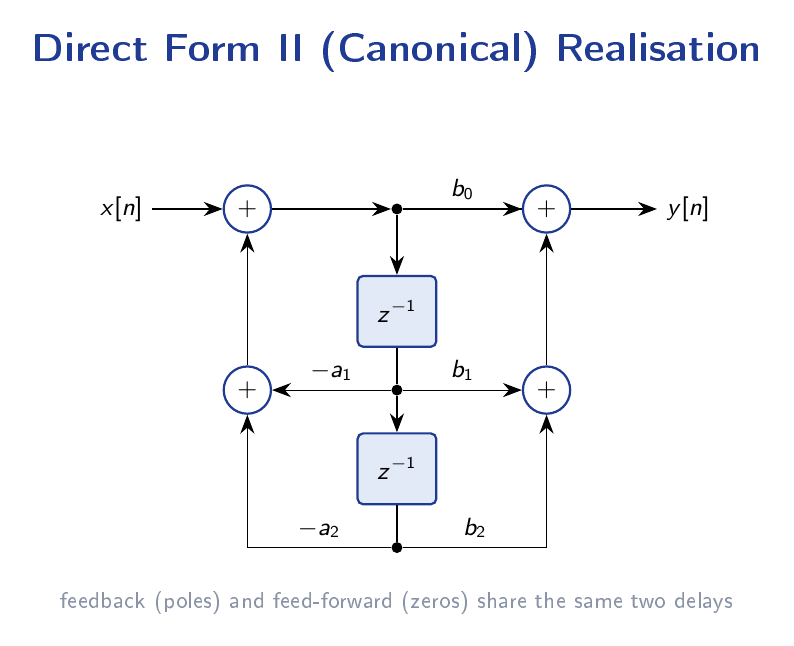
Direct Form II is canonical — it uses the minimum number of delay elements (\(\max(M,N)\)). Direct Form I requires \(M + N\) delays (not minimal).
Other Structures
Transposed Direct Form II: Reverse all signal-flow directions and swap input/output. Yields the same \(H(z)\) but often has better numerical properties under finite-precision arithmetic.
Cascade (SOS) Form: Factor \(H(z) = K\prod_k H_k(z)\) into second-order biquad sections. Low sensitivity to coefficient quantization — the preferred structure for fixed-point implementations.
Parallel Form: Partial-fraction expansion \(H(z) = \sum_k H_k(z)\). Modes are implemented in parallel, which is well-suited for high-throughput hardware.
Signal Flow Graphs & Mason's Gain Formula
A Signal Flow Graph (SFG) is a directed graph where nodes are signals and branches carry gains (transmittances). Mason's gain formula gives the overall system gain from input to output:
where \(P_k\) is the gain of the \(k^\text{th}\) forward path, \(\Delta = 1 - \sum L_i + \sum L_i L_j - \cdots\) is the graph determinant (with \(L_i\) denoting loop gains of non-touching loops), and \(\Delta_k\) is \(\Delta\) after removing all loops touching \(P_k\).
Fourier Series
Any reasonable periodic signal can be written as a sum of sinusoids (or complex exponentials) — the foundation of all spectral analysis.
Three Equivalent Forms (CT, Period \(T_0\))
Let \(\omega_0 = 2\pi/T_0\). Then:
- Trigonometric: \(x(t) = a_0 + \sum_{n=1}^{\infty} \big[a_n \cos n\omega_0 t + b_n \sin n\omega_0 t\big]\)
- Cosine-phase: \(x(t) = A_0 + \sum_{n=1}^{\infty} A_n \cos(n\omega_0 t - \phi_n)\)
- Exponential: \(x(t) = \sum_{n=-\infty}^{\infty} c_n\,\mathrm{e}^{jn\omega_0 t}\), where \(c_n = \dfrac{1}{T_0}\int_{T_0} x(t)\,\mathrm{e}^{-jn\omega_0 t}\,\mathrm{d}t\)
Dirichlet Conditions & Gibbs Phenomenon
- Absolutely integrable over one period: \(\int_{T_0}|x(t)|\,\mathrm{d}t < \infty\)
- Finite number of maxima and minima per period
- Finite number of finite discontinuities per period
At a discontinuity, the Fourier series converges to the midpoint of the jump.
At a jump discontinuity, the partial-sum Fourier series overshoots by approximately 9% of the jump height. The overshoot does not vanish as \(N \to \infty\) — only its width narrows. This is intrinsic to the truncated series and unavoidable without windowing.
Properties of CT Fourier Series
| Property | Time Domain | FS Coefficients |
|---|---|---|
| Linearity | \(\alpha x(t) + \beta y(t)\) | \(\alpha c_n^{(x)} + \beta c_n^{(y)}\) |
| Time shift | \(x(t - t_0)\) | \(\mathrm{e}^{-jn\omega_0 t_0}\,c_n\) |
| Frequency shift | \(\mathrm{e}^{jM\omega_0 t}x(t)\) | \(c_{n-M}\) |
| Time reversal | \(x(-t)\) | \(c_{-n}\) |
| Conjugation | \(x^*(t)\) | \(c_{-n}^*\) |
| Differentiation | \(\mathrm{d}x/\mathrm{d}t\) | \(jn\omega_0\,c_n\) |
| Multiplication | \(x(t)\,y(t)\) | \(\sum_k c_k^{(x)}c_{n-k}^{(y)}\) |
| Parseval | \(\dfrac{1}{T_0}\int_{T_0}|x(t)|^2\,\mathrm{d}t\) | \(\sum_{n=-\infty}^{\infty}|c_n|^2\) |
Symmetry and Vanishing Coefficients
| Symmetry | Effect on FS |
|---|---|
| Even: \(x(-t) = x(t)\) | Only cosine terms (\(a_n\)); \(c_n\) real and even |
| Odd: \(x(-t) = -x(t)\) | Only sine terms (\(b_n\)); \(c_n\) imaginary and odd |
| Half-wave odd: \(x(t \pm T_0/2) = -x(t)\) | Only odd harmonics; \(c_n = 0\) for even \(n\) |
| Quarter-wave even | Odd harmonics, cosines only |
| Quarter-wave odd | Odd harmonics, sines only |
Discrete-Time Fourier Series (DTFS)
For a DT periodic signal \(x[n]\) with period \(N\):
Key differences from the CT case: the sum has exactly \(N\) terms (not infinite); \(c_k\) is itself \(N\)-periodic (\(c_{k+N} = c_k\)); convergence is exact; and there is no Gibbs phenomenon for DT signals. The DTFS coefficients satisfy \(c_k = \frac{1}{N}X[k]\), where \(X[k]\) is the \(N\)-point DFT of one period of \(x[n]\).
Continuous-Time Fourier Transform (CTFT)
\[ X(j\omega) = \int_{-\infty}^{\infty} x(t)\,\mathrm{e}^{-j\omega t}\,\mathrm{d}t, \qquad x(t) = \frac{1}{2\pi}\int_{-\infty}^{\infty} X(j\omega)\,\mathrm{e}^{j\omega t}\,\mathrm{d}\omega \]
Existence Conditions
- Absolute integrability \(\int|x(t)|\,\mathrm{d}t < \infty\) \(\Rightarrow\) classical FT exists, \(X(j\omega)\) continuous and bounded.
- Finite energy \(\int|x(t)|^2\,\mathrm{d}t < \infty\) \(\Rightarrow\) FT exists in mean-square sense.
- Pulse, impulse, step, and sinusoid require generalized (distributional) Fourier transforms.
Standard CTFT Pairs
| \(x(t)\) | \(X(j\omega)\) |
|---|---|
| \(\delta(t)\) | \(1\) |
| \(1\) | \(2\pi\delta(\omega)\) |
| \(u(t)\) | \(\pi\delta(\omega) + \dfrac{1}{j\omega}\) |
| \(\mathrm{e}^{-at}u(t),\ a>0\) | \(\dfrac{1}{a + j\omega}\) |
| \(t\,\mathrm{e}^{-at}u(t),\ a>0\) | \(\dfrac{1}{(a+j\omega)^2}\) |
| \(\rect(t/T)\) | \(T\,\sinc(\omega T/2\pi)\) |
| \(\sinc(Wt/\pi)\) | \(\dfrac{1}{W}\rect(\omega/2W)\) |
| \(\cos(\omega_0 t)\) | \(\pi[\delta(\omega - \omega_0) + \delta(\omega + \omega_0)]\) |
| \(\sin(\omega_0 t)\) | \(\dfrac{\pi}{j}[\delta(\omega - \omega_0) - \delta(\omega + \omega_0)]\) |
| \(\mathrm{e}^{j\omega_0 t}\) | \(2\pi\delta(\omega - \omega_0)\) |
| \(\mathrm{III}_T(t)\) (impulse train) | \(\dfrac{2\pi}{T}\mathrm{III}_{2\pi/T}(\omega)\) |
Properties of the CTFT
| Property | Pair |
|---|---|
| Linearity | \(\alpha x_1 + \beta x_2 \leftrightarrow \alpha X_1 + \beta X_2\) |
| Time shift | \(x(t-t_0) \leftrightarrow \mathrm{e}^{-j\omega t_0}X(j\omega)\) |
| Frequency shift | \(\mathrm{e}^{j\omega_0 t}x(t) \leftrightarrow X(j(\omega-\omega_0))\) |
| Time scaling | \(x(at) \leftrightarrow \dfrac{1}{|a|}X(j\omega/a)\) |
| Time reversal | \(x(-t) \leftrightarrow X(-j\omega) = X^*(j\omega)\) (if \(x\) real) |
| Differentiation | \(\dfrac{\mathrm{d}^n x}{\mathrm{d}t^n} \leftrightarrow (j\omega)^n X(j\omega)\) |
| Integration | \(\int_{-\infty}^{t}x(\tau)\,\mathrm{d}\tau \leftrightarrow \dfrac{X(j\omega)}{j\omega} + \pi X(0)\delta(\omega)\) |
| Convolution | \(x \ast h \leftrightarrow X \cdot H\) |
| Multiplication | \(x(t)\,y(t) \leftrightarrow \dfrac{1}{2\pi}X \ast Y\) |
| Modulation | \(x(t)\cos\omega_0 t \leftrightarrow \tfrac{1}{2}[X(j(\omega-\omega_0)) + X(j(\omega+\omega_0))]\) |
| Parseval | \(\int|x|^2\,\mathrm{d}t = \dfrac{1}{2\pi}\int|X(j\omega)|^2\,\mathrm{d}\omega\) |
| Duality | \(X(jt) \leftrightarrow 2\pi x(-\omega)\) |
Laplace Transform
\[ X(s) = \int_{-\infty}^{\infty} x(t)\,\mathrm{e}^{-st}\,\mathrm{d}t, \qquad s = \sigma + j\omega \]
The unilateral (one-sided) Laplace transform integrates from \(0^-\) to \(\infty\), making it the tool of choice for solving systems with initial conditions.
Region of Convergence (ROC)
The ROC is the set of values of \(s\) for which the Laplace integral converges. It is always a vertical strip in the \(s\)-plane and never contains a pole. For a right-sided signal, the ROC is a right half-plane; for a left-sided signal, a left half-plane. A system is BIBO-stable if and only if the ROC includes the \(j\omega\)-axis.
Standard Laplace Transform Pairs
| \(x(t)\) | \(X(s)\) | ROC |
|---|---|---|
| \(\delta(t)\) | \(1\) | All \(s\) |
| \(u(t)\) | \(\dfrac{1}{s}\) | \(\text{Re}(s) > 0\) |
| \(t^n u(t)\) | \(\dfrac{n!}{s^{n+1}}\) | \(\text{Re}(s) > 0\) |
| \(\mathrm{e}^{-at}u(t)\) | \(\dfrac{1}{s+a}\) | \(\text{Re}(s) > -a\) |
| \(t\,\mathrm{e}^{-at}u(t)\) | \(\dfrac{1}{(s+a)^2}\) | \(\text{Re}(s) > -a\) |
| \(\cos(\omega_0 t)u(t)\) | \(\dfrac{s}{s^2+\omega_0^2}\) | \(\text{Re}(s) > 0\) |
| \(\sin(\omega_0 t)u(t)\) | \(\dfrac{\omega_0}{s^2+\omega_0^2}\) | \(\text{Re}(s) > 0\) |
| \(\mathrm{e}^{-at}\cos(\omega_0 t)u(t)\) | \(\dfrac{s+a}{(s+a)^2+\omega_0^2}\) | \(\text{Re}(s) > -a\) |
Key Laplace Transform Properties
| Property | Formula |
|---|---|
| Time shift | \(x(t-t_0)u(t-t_0) \leftrightarrow \mathrm{e}^{-st_0}X(s)\) |
| Frequency shift | \(\mathrm{e}^{-at}x(t) \leftrightarrow X(s+a)\) |
| Differentiation | \(x'(t) \leftrightarrow sX(s) - x(0^-)\) |
| Integration | \(\int_0^t x \leftrightarrow X(s)/s\) |
| Convolution | \(x \ast h \leftrightarrow X(s)H(s)\) |
| Initial value | \(x(0^+) = \lim_{s\to\infty} sX(s)\) |
| Final value | \(\lim_{t\to\infty} x(t) = \lim_{s\to 0} sX(s)\) (if poles of \(sX(s)\) in LHP) |
Stability via Pole Locations
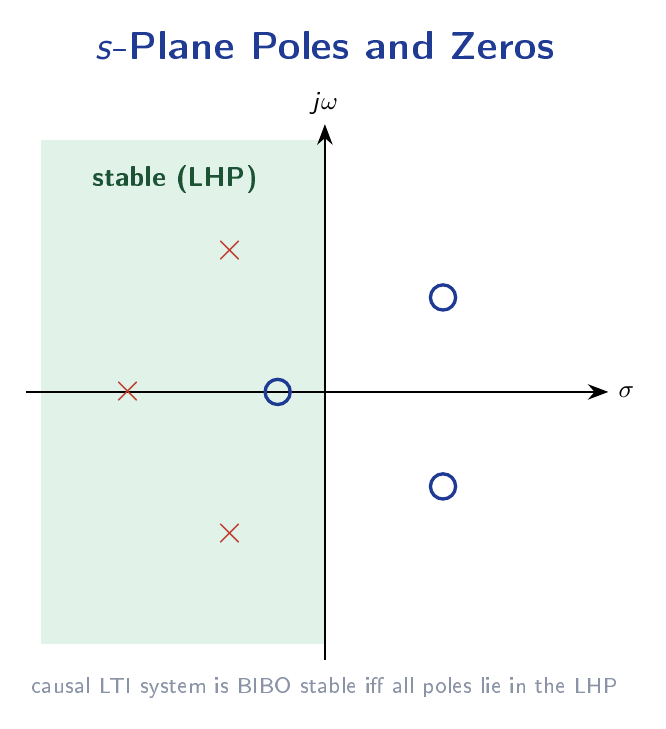
A causal CT LTI system is BIBO-stable if and only if all poles of \(H(s)\) lie in the open left half-plane (\(\text{Re}(s) < 0\)). Poles on the \(j\omega\)-axis give marginal stability; poles in the RHP give instability.
Sampling Theorem
A bandlimited signal with maximum frequency \(f_{\max}\) can be exactly reconstructed from its samples if the sampling frequency satisfies \(f_s \geq 2f_{\max}\). The minimum rate \(f_s = 2f_{\max}\) is the Nyquist rate.
Sampling in the Frequency Domain
Sampling \(x(t)\) at rate \(f_s = 1/T_s\) with an impulse train produces a spectrum that is periodic with period \(\omega_s = 2\pi f_s\):
When \(f_s < 2f_{\max}\), the spectral replicas overlap — this is aliasing. Once aliased, the original signal cannot be recovered. The solution is to apply an anti-aliasing low-pass filter before sampling to enforce bandlimiting.
Ideal Reconstruction (Whittaker–Shannon)
Each sample is interpolated by a sinc kernel. The reconstruction filter is an ideal LPF with bandwidth \(\omega_s/2\) and gain \(T_s\). Practical issues include: ideal sinc is non-causal (use FIR/IIR approximations); real DACs use zero-order hold (staircase), introducing \(\sinc\)-shaped spectral distortion requiring post-equalization; bandpass sampling for a signal of bandwidth \(B\) requires \(f_s \geq 2B\) (not the highest frequency).
Discrete-Time Fourier Transform (DTFT)
\[ X(\mathrm{e}^{j\omega}) = \sum_{n=-\infty}^{\infty} x[n]\,\mathrm{e}^{-j\omega n}, \qquad x[n] = \frac{1}{2\pi}\int_{-\pi}^{\pi} X(\mathrm{e}^{j\omega})\,\mathrm{e}^{j\omega n}\,\mathrm{d}\omega \]
\(X(\mathrm{e}^{j(\omega+2\pi)}) = X(\mathrm{e}^{j\omega})\) — the DTFT is automatically periodic in \(\omega\). Only one period (typically \([-\pi,\pi]\) or \([0,2\pi]\)) needs to be specified.
Convergence requires absolute summability \(\sum|x[n]| < \infty\) for uniform convergence, or finite energy \(\sum|x[n]|^2 < \infty\) for mean-square convergence.
Standard DTFT Pairs
| \(x[n]\) | \(X(\mathrm{e}^{j\omega})\) |
|---|---|
| \(\delta[n]\) | \(1\) |
| \(1\) (all \(n\)) | \(2\pi\sum_k \delta(\omega - 2\pi k)\) |
| \(u[n]\) | \(\dfrac{1}{1-\mathrm{e}^{-j\omega}} + \pi\sum_k \delta(\omega - 2\pi k)\) |
| \(a^n u[n],\ |a|<1\) | \(\dfrac{1}{1 - a\mathrm{e}^{-j\omega}}\) |
| \((n+1)a^n u[n],\ |a|<1\) | \(\dfrac{1}{(1-a\mathrm{e}^{-j\omega})^2}\) |
| \(\dfrac{\sin(\omega_c n)}{\pi n}\) (ideal LPF) | \(\rect(\omega/2\omega_c),\ |\omega| \leq \pi\) |
| \(\cos(\omega_0 n)\) | \(\pi\sum_k[\delta(\omega-\omega_0-2\pi k)+\delta(\omega+\omega_0-2\pi k)]\) |
Properties of the DTFT
| Property | Pair |
|---|---|
| Linearity | \(\alpha x_1 + \beta x_2 \leftrightarrow \alpha X_1 + \beta X_2\) |
| Time shift | \(x[n-n_0] \leftrightarrow \mathrm{e}^{-j\omega n_0}X(\mathrm{e}^{j\omega})\) |
| Frequency shift | \(\mathrm{e}^{j\omega_0 n}x[n] \leftrightarrow X(\mathrm{e}^{j(\omega-\omega_0)})\) |
| Time reversal | \(x[-n] \leftrightarrow X(\mathrm{e}^{-j\omega})\) |
| Convolution | \(x \ast y \leftrightarrow XY\) |
| Multiplication | \(x[n]y[n] \leftrightarrow \dfrac{1}{2\pi}X \circledast Y\) (periodic convolution) |
| Differentiation in \(\omega\) | \(-jn\,x[n] \leftrightarrow \mathrm{d}X/\mathrm{d}\omega\) |
| Parseval | \(\sum_n |x[n]|^2 = \dfrac{1}{2\pi}\int_{2\pi}|X|^2\,\mathrm{d}\omega\) |
Z-Transform
Bilateral: \(X(z) = \sum_{n=-\infty}^{\infty} x[n]\,z^{-n}\)
Unilateral: \(X(z) = \sum_{n=0}^{\infty} x[n]\,z^{-n}\)
Relation to DTFT: If the unit circle \(|z|=1\) lies in the ROC, then \(X(\mathrm{e}^{j\omega}) = X(z)\big|_{z=\mathrm{e}^{j\omega}}\).
ROC Properties
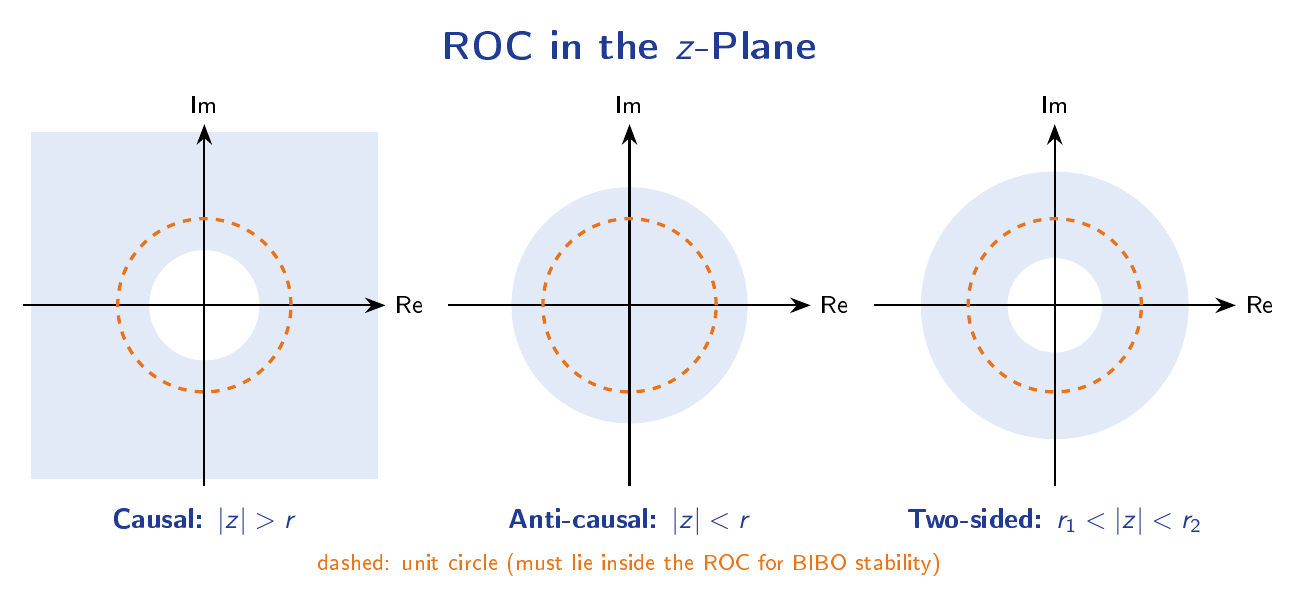
- ROC is an annular ring centred at the origin (or a disk interior/exterior).
- ROC contains no poles.
- Right-sided \(x[n]\): ROC is the exterior of a disk.
- Left-sided \(x[n]\): ROC is the interior of a disk.
- Finite-duration \(x[n]\): entire \(z\)-plane (except possibly \(z=0\) or \(\infty\)).
BIBO Stability: A DT LTI system is BIBO-stable if and only if the ROC includes the unit circle \(|z|=1\).
Standard Z-Transform Pairs
| \(x[n]\) | \(X(z)\) | ROC |
|---|---|---|
| \(\delta[n]\) | \(1\) | All \(z\) |
| \(\delta[n-k]\) | \(z^{-k}\) | \(z \neq 0\) |
| \(u[n]\) | \(\dfrac{z}{z-1} = \dfrac{1}{1-z^{-1}}\) | \(|z|>1\) |
| \(a^n u[n]\) | \(\dfrac{z}{z-a} = \dfrac{1}{1-az^{-1}}\) | \(|z|>|a|\) |
| \(na^n u[n]\) | \(\dfrac{az}{(z-a)^2}\) | \(|z|>|a|\) |
| \(-a^n u[-n-1]\) | \(\dfrac{z}{z-a}\) | \(|z|<|a|\) |
| \(\cos(\omega_0 n)u[n]\) | \(\dfrac{z(z-\cos\omega_0)}{z^2-2z\cos\omega_0+1}\) | \(|z|>1\) |
| \(\sin(\omega_0 n)u[n]\) | \(\dfrac{z\sin\omega_0}{z^2-2z\cos\omega_0+1}\) | \(|z|>1\) |
Properties of the Z-Transform
| Property | Pair |
|---|---|
| Linearity | \(\alpha x_1 + \beta x_2 \leftrightarrow \alpha X_1 + \beta X_2\) |
| Time shift | \(x[n-k] \leftrightarrow z^{-k}X(z)\) |
| Scaling by \(a^n\) | \(a^n x[n] \leftrightarrow X(z/a)\) |
| Time reversal | \(x[-n] \leftrightarrow X(1/z)\) |
| Convolution | \(x \ast y \leftrightarrow X(z)Y(z)\) |
| Differentiation in \(z\) | \(n\,x[n] \leftrightarrow -z\,\mathrm{d}X/\mathrm{d}z\) |
| Accumulation | \(\sum_{k=-\infty}^{n} x[k] \leftrightarrow \dfrac{z}{z-1}X(z)\) |
| Initial value | \(x[0] = \lim_{z\to\infty}X(z)\) (causal) |
| Final value* | \(\lim_{n\to\infty}x[n] = \lim_{z\to 1}(z-1)X(z)\) |
* Valid only if poles of \((z-1)X(z)\) lie inside the unit circle.
Solving Difference Equations via Z-Transform
For \(y[n] - \tfrac{3}{4}y[n-1] + \tfrac{1}{8}y[n-2] = x[n]\), with \(x[n] = u[n]\), zero initial conditions:
\[ Y(z) = \frac{1}{(1-\frac{1}{2}z^{-1})(1-\frac{1}{4}z^{-1})(1-z^{-1})} \]
Partial fractions yield: \(y[n] = \left[\tfrac{8}{3} - 4\left(\tfrac{1}{2}\right)^n + \tfrac{1}{3}\left(\tfrac{1}{4}\right)^n\right]u[n]\).
Inverse Z-transform methods: inspection (recognize standard pairs); partial fractions; power-series expansion (long division); or contour integral \(\dfrac{1}{2\pi j}\oint X(z)z^{n-1}\,\mathrm{d}z\).
s-Plane to z-Plane Mapping
The standard mapping when sampling a CT system is \(z = \mathrm{e}^{sT_s}\):
| \(s\)-plane region | \(z\)-plane image | Interpretation |
|---|---|---|
| \(j\omega\)-axis (\(\text{Re}(s)=0\)) | Unit circle \(|z|=1\) | Sustained oscillations |
| LHP (\(\text{Re}(s)<0\)) | Inside unit circle (\(|z|<1\)) | Decaying; stable |
| RHP (\(\text{Re}(s)>0\)) | Outside unit circle (\(|z|>1\)) | Growing; unstable |
| \(s=0\) | \(z=1\) | DC component |
| \(s = \pm j\omega_s/2\) | \(z=-1\) | Nyquist frequency |
\(s = \dfrac{2}{T_s}\dfrac{z-1}{z+1}\) maps the entire LHP onto the interior of the unit circle without aliasing, but introduces frequency warping: \(\Omega = \dfrac{2}{T_s}\tan(\omega/2)\). Pre-warping of critical frequencies is necessary in filter design.
Multirate Signal Processing
Decimation (downsampling by \(M\)): \(y[n] = x[Mn]\). The spectrum is compressed by \(M\) with \(M\) replicas; an anti-aliasing LPF of cutoff \(\pi/M\) must precede downsampling.
Interpolation (upsampling by \(L\)): Insert \(L-1\) zeros between samples; spectrum expands by \(L\) (creating images); an image-rejection LPF of cutoff \(\pi/L\) with gain \(L\) must follow.
Rational rate conversion \(L/M\): upsample by \(L\), then downsample by \(M\). Used in audio conversion between 44.1 kHz and 48 kHz.
Frequency Response & Filter Design
Frequency Response of an LTI System
For \(x(t) = \mathrm{e}^{j\omega t}\): \(y(t) = H(j\omega)\,\mathrm{e}^{j\omega t}\) (CT)
For \(x[n] = \mathrm{e}^{j\omega n}\): \(y[n] = H(\mathrm{e}^{j\omega})\,\mathrm{e}^{j\omega n}\) (DT)
The magnitude response \(|H(j\omega)|\) specifies amplification or attenuation; the phase response \(\angle H(j\omega)\) specifies frequency-dependent delay. For a real system, \(H^*(j\omega) = H(-j\omega)\), so only \(\omega \geq 0\) needs to be plotted.
Steady-state response to a sinusoid \(x(t) = A\cos(\omega_0 t + \phi)\):
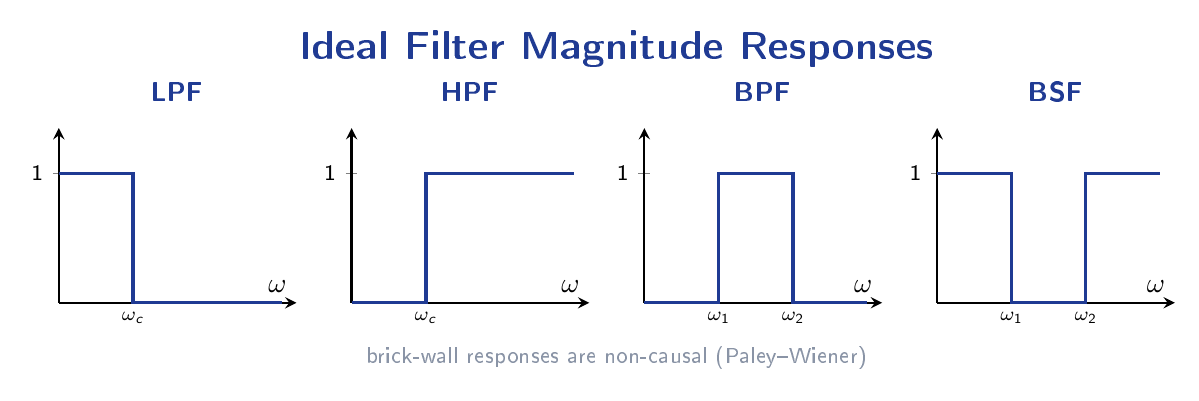
Ideal Filter Shapes
Practical Filter Specifications
A practical LPF is specified by: passband cutoff \(\omega_p\) with maximum ripple \(\delta_p\); stopband edge \(\omega_s\) with attenuation \(\delta_s\) (in dB: \(-20\log_{10}\delta_s\)); and transition band \([\omega_p, \omega_s]\). Classical designs include Butterworth (maximally flat), Chebyshev I/II (equiripple), and Elliptic (equiripple in both bands, minimum order).
Group Delay
Group delay is defined as \(\tau_g(\omega) = -\dfrac{\mathrm{d}\theta(\omega)}{\mathrm{d}\omega}\), where \(\theta(\omega) = \angle H(j\omega)\). Constant group delay (linear phase) implies that all frequency components are delayed by the same amount — important for distortion-free transmission.
Correlation and Spectral Density
The cross-correlation of \(x(t)\) and \(y(t)\) is \(R_{xy}(\tau) = \int x(t)y(t+\tau)\,\mathrm{d}t\). The autocorrelation is \(R_{xx}(\tau) = \int x(t)x(t+\tau)\,\mathrm{d}t\). The power spectral density (PSD) is the Fourier transform of the autocorrelation: \(S_x(\omega) = \mathcal{F}\{R_{xx}(\tau)\}\). For an LTI system: \(S_y(\omega) = |H(j\omega)|^2 S_x(\omega)\).
Discrete Fourier Transform (DFT) & FFT
\[ X[k] = \sum_{n=0}^{N-1} x[n]\,\mathrm{e}^{-j2\pi kn/N} = \sum_{n=0}^{N-1} x[n]\,W_N^{kn}, \qquad k = 0, 1, \ldots, N-1 \]
\[ x[n] = \frac{1}{N}\sum_{k=0}^{N-1} X[k]\,W_N^{-kn}, \qquad W_N = \mathrm{e}^{-j2\pi/N} \]
Properties of the DFT
| Property | Formula |
|---|---|
| Periodicity | \(X[k+N] = X[k]\) and \(x[n+N] = x[n]\) |
| Linearity | \(\alpha x_1 + \beta x_2 \leftrightarrow \alpha X_1 + \beta X_2\) |
| Circular shift | \(x[n-m \mod N] \leftrightarrow W_N^{mk} X[k]\) |
| Circular convolution | \(x \circledast y \leftrightarrow X[k]\,Y[k]\) |
| Symmetry (real \(x\)) | \(X[N-k] = X^*[k]\) |
| Parseval | \(\sum_{n=0}^{N-1}|x[n]|^2 = \dfrac{1}{N}\sum_{k=0}^{N-1}|X[k]|^2\) |
Fast Fourier Transform (FFT)
Direct DFT computation requires \(\mathcal{O}(N^2)\) complex multiplications. The Cooley–Tukey radix-2 FFT exploits the periodicity and symmetry of \(W_N\) to reduce this to \(\mathcal{O}(N\log_2 N)\), using the divide-and-conquer recursion:
For \(N = 2^r\), this produces \(\log_2 N\) stages each with \(N/2\) butterfly operations. Complexity comparison: direct DFT needs \(N^2 = 64\) complex multiplications for \(N=8\); radix-2 FFT needs only \(\tfrac{N}{2}\log_2 N = 12\).
Variants include Decimation-in-Time (DIT, bit-reverse input), Decimation-in-Frequency (DIF, natural input), radix-4, mixed-radix, and Bluestein's algorithm for arbitrary \(N\).
State-Space Representation
Continuous-Time State-Space
\[ \dot{\mathbf{x}}(t) = \mathbf{A}\,\mathbf{x}(t) + \mathbf{B}\,\mathbf{u}(t), \qquad \mathbf{y}(t) = \mathbf{C}\,\mathbf{x}(t) + \mathbf{D}\,\mathbf{u}(t) \]
Here \(\mathbf{x} \in \mathbb{R}^n\) is the state vector, \(\mathbf{u} \in \mathbb{R}^m\) the input, \(\mathbf{y} \in \mathbb{R}^p\) the output. Matrices: \(\mathbf{A}\) (state/system), \(\mathbf{B}\) (input), \(\mathbf{C}\) (output), \(\mathbf{D}\) (feedthrough).
Transfer function: \(\mathbf{H}(s) = \mathbf{C}(s\mathbf{I} - \mathbf{A})^{-1}\mathbf{B} + \mathbf{D}\).
Stability: The system is asymptotically stable if and only if all eigenvalues of \(\mathbf{A}\) lie in the open left half-plane.
Solution:
where \(\mathrm{e}^{\mathbf{A}t}\) is the state transition matrix \(\Phi(t) = \mathcal{L}^{-1}\{(s\mathbf{I}-\mathbf{A})^{-1}\}\).
Discrete-Time State-Space
\[ \mathbf{x}[n+1] = \mathbf{A}\,\mathbf{x}[n] + \mathbf{B}\,\mathbf{u}[n], \qquad \mathbf{y}[n] = \mathbf{C}\,\mathbf{x}[n] + \mathbf{D}\,\mathbf{u}[n] \]
Transfer function: \(\mathbf{H}(z) = \mathbf{C}(z\mathbf{I}-\mathbf{A})^{-1}\mathbf{B} + \mathbf{D}\). Stability (DT): all eigenvalues of \(\mathbf{A}\) inside the unit circle.
Controllability & Observability
- Controllable: The controllability matrix \([\mathbf{B}\;\mathbf{AB}\;\mathbf{A}^2\mathbf{B}\;\cdots\;\mathbf{A}^{n-1}\mathbf{B}]\) has full row rank \(n\).
- Observable: The observability matrix \([\mathbf{C}^\top\;(\mathbf{CA})^\top\;\cdots\;(\mathbf{CA}^{n-1})^\top]^\top\) has full column rank \(n\).
Canonical realizations include: controllable canonical form, observable canonical form, modal (diagonal) form, and Jordan form. All realize the same \(H(s)\) with different state representations.
Competitive Exam Quick Reference
Must-Know Formulas
| Concept | Formula |
|---|---|
| Energy of CT signal | \(E = \int_{-\infty}^{\infty}|x(t)|^2\,\mathrm{d}t\) |
| Power of CT signal | \(P = \lim_{T\to\infty}\tfrac{1}{2T}\int_{-T}^{T}|x(t)|^2\,\mathrm{d}t\) |
| Energy of DT signal | \(E = \sum_{n=-\infty}^{\infty}|x[n]|^2\) |
| Convolution (CT) | \(y(t) = \int x(\tau)h(t-\tau)\,\mathrm{d}\tau\) |
| Convolution length (DT) | \(L_y = L_x + L_h - 1\) |
| DT periodicity condition | \(\Omega_0 / 2\pi\) must be rational |
| Nyquist rate | \(f_s \geq 2f_{\max}\) |
| Final value (Laplace) | \(\lim_{t\to\infty}x(t) = \lim_{s\to 0}sX(s)\) |
| Initial value (Laplace) | \(x(0^+) = \lim_{s\to\infty}sX(s)\) |
| DC gain (CT) | \(H(s)\big|_{s=0} = H(0)\) |
| DC gain (DT) | \(H(z)\big|_{z=1} = H(1)\) |
| Stability (CT) | All poles in the open left half-plane |
| Stability (DT) | All poles inside \(|z|=1\) |
| Parseval (CTFT) | \(\int|x|^2\,\mathrm{d}t = \tfrac{1}{2\pi}\int|X(j\omega)|^2\,\mathrm{d}\omega\) |
| Parseval (DTFT) | \(\sum|x[n]|^2 = \tfrac{1}{2\pi}\int_{2\pi}|X(\mathrm{e}^{j\omega})|^2\,\mathrm{d}\omega\) |
| Parseval (DFT) | \(\sum|x[n]|^2 = \tfrac{1}{N}\sum|X[k]|^2\) |
| Modulation (CTFT) | \(x(t)\cos\omega_0 t \leftrightarrow \tfrac12[X(j(\omega-\omega_0)) + X(j(\omega+\omega_0))]\) |
| Output PSD (LTI) | \(S_y(\omega) = |H(j\omega)|^2 S_x(\omega)\) |
| FFT complexity | \(\mathcal{O}(N\log_2 N)\) for \(N = 2^r\) |
| 3-dB bandwidth (1st-order) | \(\omega_c\) where \(|H| = 1/\sqrt{2}\) |
Practice Problems
The signal \(x(t) = \cos(3\pi t) + \sin(5\pi t)\) has fundamental period…
Solution: Periods \(T_1 = 2/3\), \(T_2 = 2/5\). LCM \(\Rightarrow T_0 = 2\) s.
Is \(x[n] = \cos(n)\) periodic in \(n\)?
Solution: Need \(\Omega_0/2\pi = 1/(2\pi)\) rational — but \(\pi\) is irrational. Therefore, not periodic.
Energy of \(x(t) = \mathrm{e}^{-2t}u(t)\):
Solution: \(E = \int_0^\infty \mathrm{e}^{-4t}\,\mathrm{d}t = \dfrac{1}{4}\). So \(E = 0.25\) J.
For \(x(t) = \rect(t)\), find \(X(j\omega)\).
Solution: \(X(j\omega) = \dfrac{\sin(\omega/2)}{\omega/2}\).
\(y(t) = x(t-2) + 3\): linear? time-invariant? causal?
Solution: Not linear (additive constant breaks additivity); time-invariant ✓; causal ✓.
Convolve \(x(t) = u(t)\) with \(h(t) = \mathrm{e}^{-t}u(t)\).
Solution: \(y(t) = \int_0^t \mathrm{e}^{-(t-\tau)}\,\mathrm{d}\tau = 1 - \mathrm{e}^{-t}\) for \(t \geq 0\).
Find \(h[n]\) if \(H(z) = \dfrac{z}{z-0.5}\), ROC \(|z|>0.5\).
Solution: \(h[n] = (0.5)^n u[n]\).
DC gain of \(H(s) = \dfrac{2s+4}{s^2+3s+4}\):
Solution: \(H(0) = 4/4 = 1\).
Minimum sampling rate for \(x(t) = \cos(200\pi t) + \sin(300\pi t)\) to avoid aliasing.
Solution: \(f_{\max} = 150\) Hz \(\Rightarrow f_s \geq 300\) Hz.
Group delay of \(H(j\omega) = \mathrm{e}^{-j\omega \tau_0}\).
Solution: Phase \(\theta(\omega) = -\omega\tau_0 \Rightarrow \tau_g = -\mathrm{d}\theta/\mathrm{d}\omega = \tau_0\). Constant group delay — linear phase system.
Is \(H(z) = \dfrac{z}{z-2}\), \(|z|>2\), BIBO-stable?
Solution: Pole at \(z=2\) outside unit circle. Not stable.
\(x[n] = \{1,2,3,4\}\), \(h[n] = \{1,1\}\). Find \(y[n]\).
Solution: \(y[n] = x \ast h = \{1, 3, 5, 7, 4\}\).
Complex multiplications: 8-point DFT vs. 8-point FFT.
Solution: DFT: \(N^2 = 64\); radix-2 FFT: \(\tfrac{N}{2}\log_2 N = 12\).
\(x(t) = 10\cos(100\pi t - \pi/4)\) sampled at \(f_s = 200\) Hz. Resulting DT signal?
Solution: \(x[n] = 10\cos(\pi n/2 - \pi/4)\), period \(N = 4\).
Causal LTI: \(H(s) = \dfrac{1}{s^2+3s+2}\). Find impulse response.
Solution: \(H = \dfrac{1}{s+1} - \dfrac{1}{s+2} \Rightarrow h(t) = (\mathrm{e}^{-t} - \mathrm{e}^{-2t})u(t)\).
Inverse \(\mathcal{Z}\) of \(X(z) = \dfrac{z}{(z-0.5)(z-0.25)}\), causal.
Solution: \(x[n] = 4(0.5)^n u[n] - 4(0.25)^n u[n]\).
LTI system with \(h(t) = \mathrm{e}^{-2t}u(t)\). Steady-state output to \(x(t) = \cos(t)\).
Solution: \(H(j1) = \dfrac{1}{2+j}\), \(|H| = 1/\sqrt{5}\), \(\angle H = -\arctan(1/2) \Rightarrow y_{ss}(t) = \dfrac{1}{\sqrt{5}}\cos\!\big(t - \arctan\tfrac{1}{2}\big)\).
Average power of \(x(t) = 2 + 3\cos(\pi t) + 5\sin(2\pi t)\).
Solution (Parseval): \(P = 2^2 + \dfrac{3^2}{2} + \dfrac{5^2}{2} = 4 + 4.5 + 12.5 = 21\) W.
Summary & Big Picture
The Four Transforms at a Glance
| Transform | Domain | Signal Type | Spectrum | Spectrum Periodic? |
|---|---|---|---|---|
| CTFS | CT | Periodic | Discrete | — |
| CTFT | CT | Aperiodic | Continuous | No |
| DTFS / DFT | DT | Periodic | Discrete | Yes (in \(k\)) |
| DTFT | DT | Aperiodic | Continuous | Yes (\(2\pi\) in \(\omega\)) |
| Laplace | CT | Aperiodic | Continuous (\(s\)) | — |
| Z-Transform | DT | Aperiodic | Continuous (\(z\)) | — |
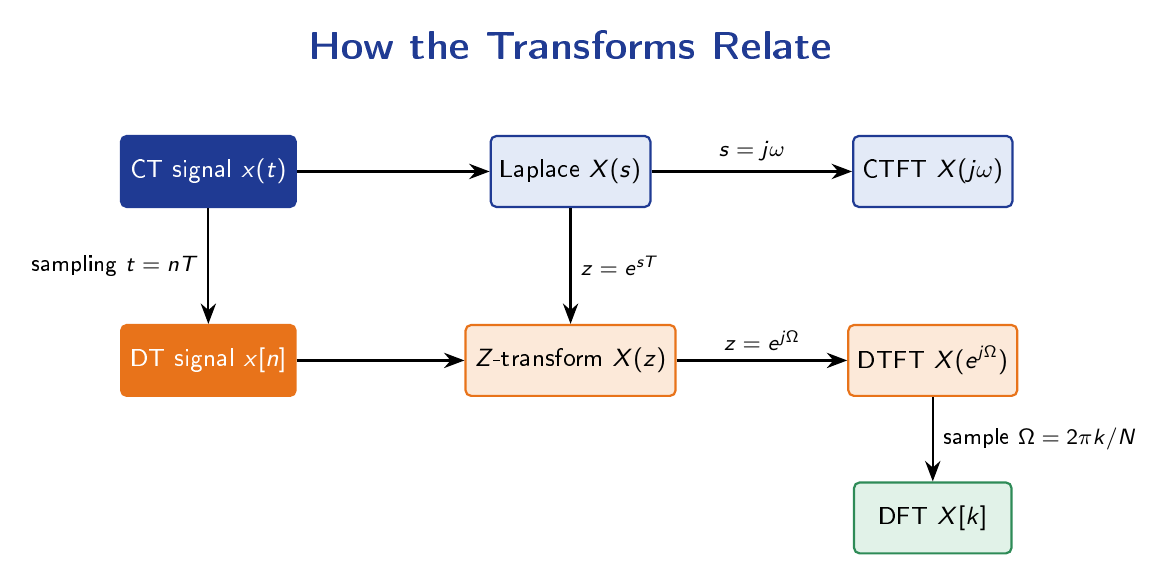
Key Interrelationships
- CTFT = Laplace evaluated on the \(j\omega\)-axis (when ROC includes it)
- DTFT = Z-transform evaluated on the unit circle \(|z|=1\)
- DFT = samples of the DTFT at \(\omega_k = 2\pi k/N\)
- DTFS coefficients \(= \tfrac{1}{N} \times\) DFT of one period
Further Reading
Classic Textbooks
- Oppenheim, Willsky, Nawab — Signals and Systems, 2nd ed. (Pearson)
- Haykin, Van Veen — Signals and Systems, 2nd ed. (Wiley)
- Proakis, Manolakis — Digital Signal Processing (Pearson)
- Lathi — Linear Systems and Signals (OUP)
Competitive Exam Preparation (GATE / IES / DRDO)
- Schaum's Outline of Signals and Systems — Hsu
- Made Easy / Ace Academy postal study material
- Solved GATE papers (last 15 years), focused on transforms, convolution, sampling, and stability
Online Resources
- MIT OpenCourseWare 6.003 — Signals and Systems
- NPTEL — Signals and Systems by Prof. Kushal Shah (IISER Bhopal)