Renewable Energy: A Comprehensive Study Guide
Introduction to Energy
Energy is the capacity of a physical system to perform work. It is a conserved scalar quantity governed by the first law of thermodynamics:
\[ \Delta U = Q - W, \qquad \text{SI unit: joule (J)} \]Forms of Energy
- Mechanical — kinetic and potential energy
- Thermal — internal molecular motion
- Electrical and electromagnetic
- Chemical — bond energy
- Nuclear — mass–energy equivalence, \(E = mc^2\)
- Radiant — solar radiation
Energy Units, Prefixes, and Scales
Practical unit conversions essential for energy engineering calculations:
- \(1\,\text{kWh} = 3.6\,\text{MJ}\)
- \(1\,\text{toe} \approx 41.87\,\text{GJ} \approx 11{,}630\,\text{kWh}\)
- \(1\,\text{tce} \approx 29.3\,\text{GJ}\)
- \(1\,\text{BTU} \approx 1{,}055\,\text{J}\)
- \(1\,\text{calorie} = 4.184\,\text{J}\)
- \(1\,\text{kg TNT} \approx 4.184\,\text{MJ}\)
SI prefixes: kilo (\(10^3\)), mega (\(10^6\)), giga (\(10^9\)), tera (\(10^{12}\)), peta (\(10^{15}\)), exa (\(10^{18}\)).
- Human food intake: \(\sim 10\,\text{MJ/day}\)
- Indian per-capita primary energy: \(\approx 27\,\text{GJ/yr}\)
- Global primary energy: \(\approx 600\,\text{EJ/yr}\)
- Solar radiation incident on Earth: \(\approx 3.85\times10^{24}\,\text{J/yr}\)
Key distinction: Power vs. Energy — \(\text{Energy} = \text{Power} \times \text{Time}\). Confusing kW with kWh is the most common mistake in energy reports.
Global Energy Demand
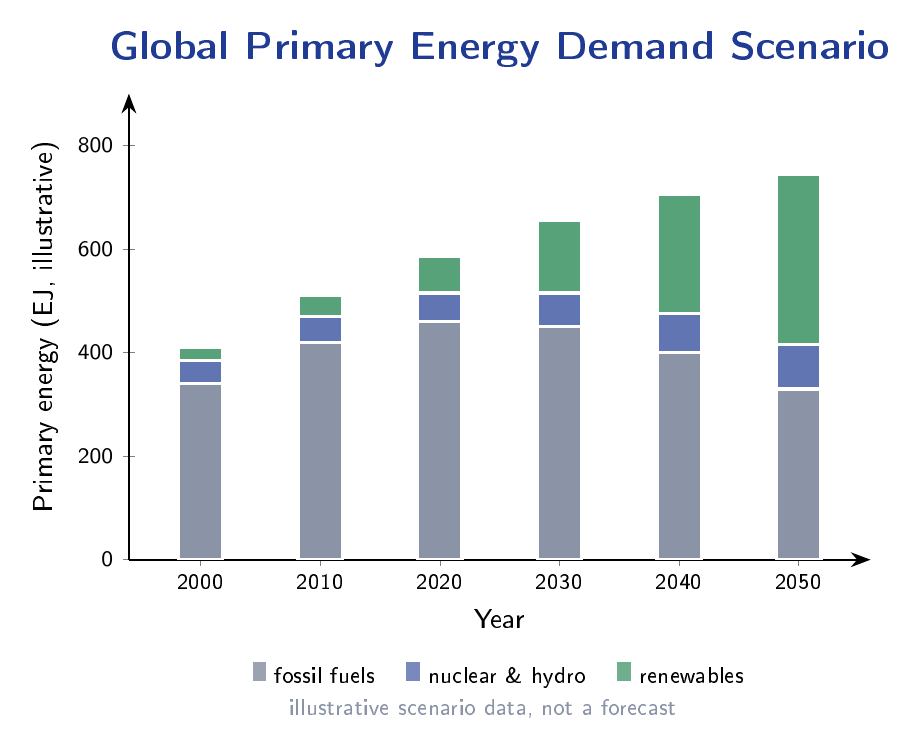
Drivers of rising global demand include population growth (approximately 8 billion in 2024), industrialisation and urbanisation, rising per-capita consumption, and accelerating electrification of transport and heating. World primary energy demand exceeds 600 EJ/yr and is projected to grow 30–40% by 2050 under business-as-usual scenarios.
Energy Crisis and Environmental Impact
Conventional energy use presents a triple challenge: depletion of finite fossil reserves, geopolitical insecurity of supply, and accelerating climate change driven by CO₂ emissions. Key pollutants from fossil combustion include CO₂, CH₄, N₂O (greenhouse gases), SOx and NOx (acid rain precursors), fine particulate matter (PM₂.₅, PM₁₀), and heavy metals.
Anthropogenic CO₂ concentration has risen from 280 ppm (pre-industrial) to over 420 ppm today, driving approximately 1.1 °C of warming above the 1850–1900 baseline.
Greenhouse Effect and Carbon Footprint
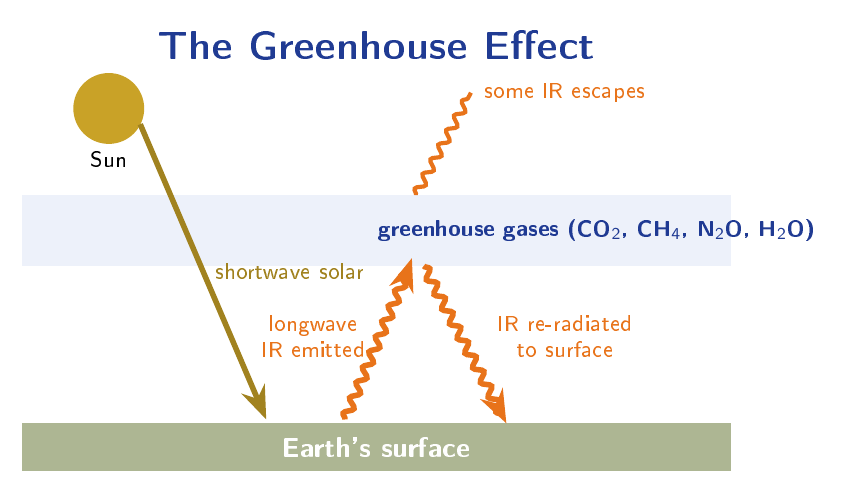
Total GHG emissions caused directly or indirectly by an entity, expressed as kg CO₂-equivalent.
A coal plant emitting 920 g/kWh supplying 5,000 homes at 300 kWh/month:
\[ 0.92 \times 5000 \times 300 \times 12 \approx 1.66 \times 10^7\;\text{kg CO}_2\text{/yr} \]Sustainability and Sustainable Development
"Development that meets the needs of the present without compromising the ability of future generations to meet their own needs."
The three pillars of sustainability are Environmental (ecosystem integrity), Social (equity, health, energy access), and Economic (viability and employment). Energy-relevant UN SDGs are SDG 7 (Affordable & Clean Energy), SDG 9 (Industry & Innovation), SDG 11 (Sustainable Cities), and SDG 13 (Climate Action).
- Energy is conserved but degrades in quality (entropy, second law).
- Demand is rising; fossil-fuel use is environmentally unsustainable.
- Climate change is an unequivocal scientific consensus.
- Renewables are the cornerstone of a sustainable energy transition.
- State the first and second laws of thermodynamics.
- Define carbon footprint with appropriate units.
- Distinguish between weather and climate.
- What are the three pillars of sustainability?
Fundamentals of Renewable Energy
Energy obtained from natural processes that are replenished on a human time-scale — continuously or cyclically — without significant net depletion of the source.
Major renewable sources are Solar, Wind, Hydro, Biomass, Geothermal, and Ocean energy. Each is covered in dedicated sections below.
Renewable versus Non-Renewable Energy
| Attribute | Renewable | Non-Renewable |
|---|---|---|
| Source | Natural flows (sun, wind, water) | Finite stocks (coal, oil, gas, uranium) |
| Replenishment | Hours to years | Millions of years |
| GHG at point of use | Near-zero | High |
| Energy density | Low / diffuse | High and concentrated |
| Cost trajectory | Falling (learning curves) | Volatile / generally rising |
| Examples | PV, wind, hydro, biomass | Coal, oil, natural gas, nuclear* |
*Nuclear is low-carbon but uses finite fissile material.
Energy Conversion Principles
First law (conservation):
\[ \frac{dE}{dt} = \dot{Q} - \dot{W} \]Second law (quality):
\[ \frac{dS_{\text{univ}}}{dt} \geq 0 \]Carnot efficiency (upper bound for heat engines):
\[ \eta_{\text{Carnot}} = 1 - \frac{T_C}{T_H} \]A solar-thermal plant operates between \(T_H = 823\,\text{K}\) and \(T_C = 313\,\text{K}\): \[ \eta_{\text{Carnot}} = 1 - \frac{313}{823} = 0.620 \] Real plants achieve approximately 0.35–0.40 due to irreversibilities.
Efficiency Definitions
Typical EROI values: oil ≈ 10, coal ≈ 30, hydro > 80, wind ≈ 20, PV ≈ 8–15.
Energy Storage and Smart Grids — Overview
Renewables are intermittent and non-dispatchable. Storage decouples generation from consumption and provides ancillary services (frequency regulation, voltage support). The principal storage categories are:
- Mechanical — pumped hydro storage (PHS), compressed air (CAES), flywheel
- Electrochemical — Li-ion, vanadium redox flow, sodium-sulfur
- Thermal — molten salt, phase-change materials (PCM)
- Chemical — green hydrogen, ammonia
Solar Energy
Solar Radiation Fundamentals
\(G_{\text{sc}} = 1361\,\text{W/m}^2\) at the top of the atmosphere at mean Sun–Earth distance.
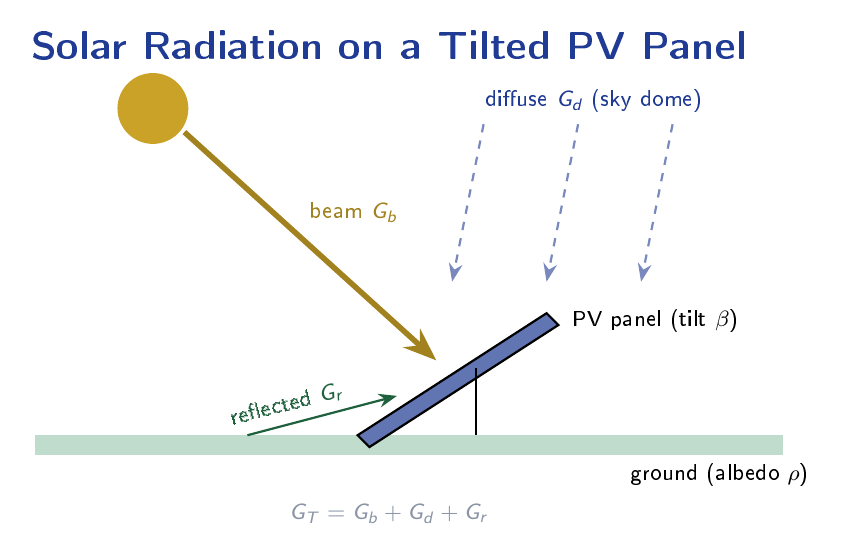
Solar radiation arriving at the Earth's surface comprises three components:
- Beam (direct) irradiance \(G_b\)
- Diffuse irradiance \(G_d\) (scattered by atmosphere)
- Reflected irradiance \(G_r\) (ground albedo)
Global horizontal irradiance: \( G = G_b \cos\theta_z + G_d \). Air mass is approximated as \(\text{AM} \approx 1/\cos\theta_z\) for zenith angles \(\theta_z \lesssim 70°\); AM 1.5 is the standard test spectrum for PV ratings.
Solar Geometry
where \(\delta\) = declination, \(\phi\) = latitude, \(\omega\) = hour angle, \(\beta\) = tilt, \(\gamma\) = surface azimuth, \(n\) = day number of year.
Measurement of Solar Radiation
| Instrument | Measures | Principle |
|---|---|---|
| Pyranometer | Global horizontal irradiance | Thermopile / Si photodiode |
| Pyrheliometer | Direct beam (normal incidence) | Tracker + collimated tube |
| Pyranometer + shadow ring | Diffuse component | Subtracts beam contribution |
| Sunshine recorder | Bright sunshine hours | Campbell–Stokes glass sphere |
| Net radiometer | Net radiation (4 components) | Two-faced thermopile |
Solar Thermal Systems
Solar thermal systems convert solar radiation into useful heat for space heating, water heating, industrial process heat, or driving thermodynamic cycles for electricity generation.
where \(F_R\) = heat-removal factor, \(\tau\alpha\) = transmittance–absorptance product, \(U_L\) = overall loss coefficient.
Collector Types
- Flat-plate collector (FPC) — \(T < 100°\text{C}\)
- Evacuated tube collector (ETC) — \(T < 200°\text{C}\)
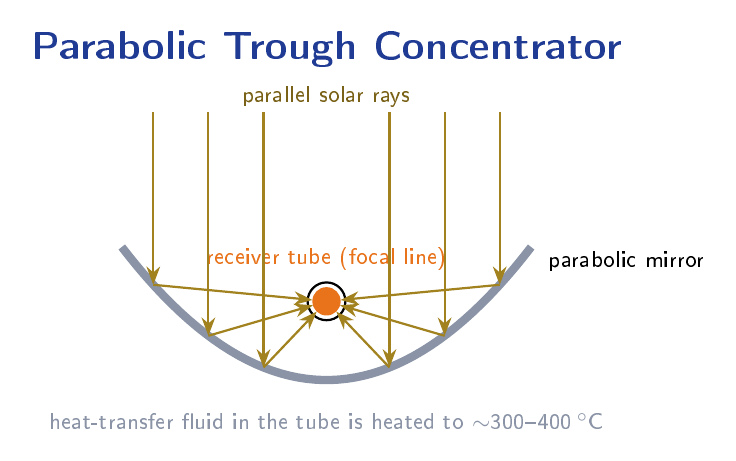
- Parabolic trough collector (PTC) — \(T \sim 400°\text{C}\)
- Linear Fresnel reflector
- Parabolic dish (Stirling engine)
- Central receiver / solar tower
Concentrating Solar Power (CSP)
The concentration ratio \(C = A_{\text{aperture}} / A_{\text{receiver}}\) determines operating temperature. Typical values: trough/Fresnel 30–80; dish 1000–3000; tower 300–1500. Power-block cycles include Rankine, Brayton, hybrid combined cycle, and Stirling.
Solar Water Heating Systems
Solar water heaters circulate a working fluid (water or glycol) through an absorber and deliver heat to a storage tank. Two circulation modes are used:
- Thermosiphon (natural circulation) — tank above collector; flow driven by density difference \(\rho_{\text{cold}} > \rho_{\text{hot}}\)
- Forced circulation — pump-driven with differential controller; required for large systems
Stagnation temperature (no flow): \(T_{\max} = T_a + G_T(\tau\alpha)/U_L\). Indian standards: BIS IS 12933 (FPC), IS 16368 (ETC).
Solar Cookers, Dryers, and Stills
A box-type solar cooker uses an insulated box with a blackened tray, glass cover, and side reflector, reaching stagnation temperatures around 120 °C. Concentrating (parabolic) types reach ~200 °C. Solar dryers are classified as direct (cabinet), indirect (collector + separate drying chamber), or mixed-mode. A solar still (distillation) yields approximately 3 L/m²/day:
where \(p_w\), \(p_g\) are vapour pressures of water and glass cover; \(h_c\) is convective coefficient.
Solar Pond and Passive Solar Heating
A salt-gradient solar pond has three zones: Upper Convective Zone (UCZ, ~30 °C), Non-Convective Zone (NCZ — salinity gradient suppresses convection), and Lower Convective Zone (LCZ, brine at ~85 °C). Heat stored in the LCZ powers a low-temperature ORC or supplies industrial process heat.
Passive solar heating (no fans or pumps) exploits direct gain (south-facing glazing), indirect gain (Trombe wall), or isolated gain (sunspace). The key performance metric is the solar fraction \(f = Q_{\text{solar}} / Q_{\text{load}}\).
Solar Photovoltaics — Semiconductor Basics
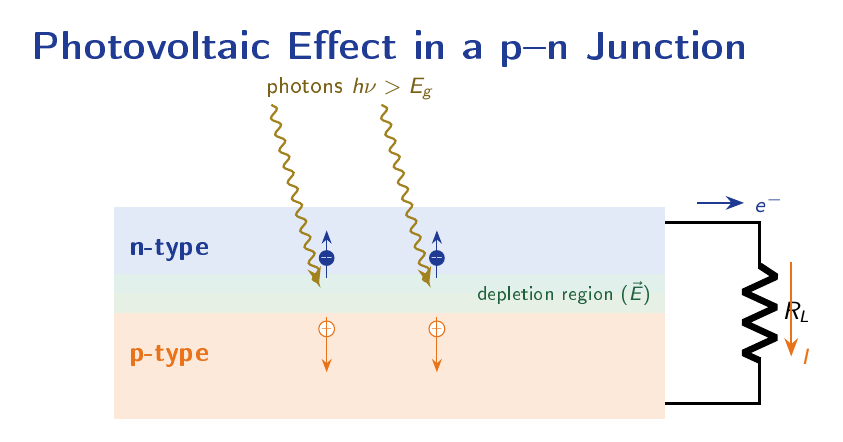
The photovoltaic effect (Becquerel, 1839): a photon with energy \(h\nu \geq E_g\) excites a valence-band electron into the conduction band. The built-in electric field of the p–n junction separates charge carriers, and the external circuit collects the photo-generated current. Key bandgap values:
- Si: \(E_g = 1.12\,\text{eV}\)
- GaAs: \(E_g = 1.42\,\text{eV}\)
- CdTe: \(E_g = 1.45\,\text{eV}\)
- Perovskite (MAPbI₃): \(\sim 1.55\,\text{eV}\)
Solar Cell Technologies — Comparison
| Technology | η (commercial) | Cost | Key Features |
|---|---|---|---|
| Mono-Si (c-Si) | 20–23% | Moderate | High efficiency, single crystal |
| Poly/Multi-Si | 17–20% | Lower | Multiple grains; cheaper manufacture |
| Amorphous Si (a-Si) | 6–10% | Low | Thin film, flexible, poor stability |
| CdTe | 18–22% | Low | Thin film, low embodied energy |
| CIGS | 14–20% | Moderate | Thin film, tunable bandgap |
| PERC | 22–24% | Moderate | Passivated rear; dominant since 2020 |
| HJT (heterojunction) | 24–26% | High | a-Si/c-Si stack; low temperature coefficient |
| TOPCon | 24–26% | High | Tunnel-oxide passivation |
| IBC | 24–27% | High | Interdigitated back contact |
The Shockley–Queisser limit for a single-junction cell is \(\eta_{\max} \approx 33.7\%\) at \(E_g \approx 1.34\,\text{eV}\) under AM 1.5G illumination.
PV Module Degradation Mechanisms
Cell- and Module-Level
- LID (Light-Induced Degradation) — B–O complex in p-type Cz-Si; ~1–3% loss in first hours of exposure
- LeTID — light- and elevated-temperature-induced degradation; affects PERC modules
- PID (Potential-Induced Degradation) — sodium ion migration from glass under high system voltage; can exceed 10% power loss
- Hot-spots — reverse-biased shaded cells dissipate power; bypass diodes mitigate
Field-Induced
- Snail trails — silver paste reacting with moisture producing dark discolouration
- Delamination and EVA browning — UV and moisture ingress
- Cell cracks — from hail, transport, or snow load
- Soiling — dust and bird droppings; up to 30% loss at arid sites
- Backsheet failure, junction-box arcing, and corrosion
Typical degradation rate: 0.5–0.8%/yr for c-Si; manufacturer warranties typically guarantee 80% power output at 25 years. Relevant standards: IEC 61215, IEC 61730, IEC 62804 (PID).
PV Cell Equivalent Circuit and I–V Equation
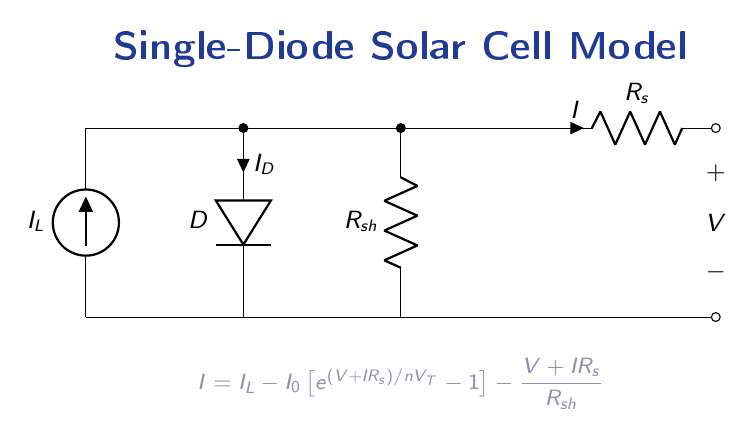
Fill Factor and Maximum Power
\[ FF = \frac{P_{mp}}{I_{sc}\,V_{oc}} = \frac{I_{mp}\,V_{mp}}{I_{sc}\,V_{oc}}, \qquad \eta = \frac{P_{mp}}{G_T\,A_c} = \frac{I_{sc}\,V_{oc}\,FF}{G_T\,A_c} \]Typical commercial module fill factors: 0.70–0.83.
MPPT Algorithms
| Algorithm | Principle | Remarks |
|---|---|---|
| Perturb & Observe (P&O) | Perturbs operating point; observes power change | Simple; oscillates near MPP; slow under fast irradiance change |
| Incremental Conductance (IncCond) | Tracks \(dP/dV = 0\) via \(\Delta I/\Delta V = -I/V\) | Better dynamic response; higher computational load |
| Fractional open-circuit \(V_{oc}\) | \(V_{mp} \approx k\,V_{oc}\); \(k \approx 0.76\) | Very simple; not true MPPT; periodic measurement needed |
PV System Design
Monitoring standards: IEC 61724. The Levelised Cost of Energy (LCOE) is the key economic metric, typically below USD 30–50/MWh for utility-scale PV in high-irradiance markets (2024).
- Solar PV is now the cheapest new electricity source in most markets.
- The Shockley–Queisser limit caps single-junction efficiency at ~33.7%.
- MPPT, module degradation control, and system design are core engineering tasks.
Wind Energy
Wind Power Fundamentals
The cubic dependence on velocity is the most critical relation in wind engineering: a 10% increase in wind speed yields 33% more power.
Wind speed at hub height follows the power-law (Hellman) profile:
\[ \frac{v(z)}{v(z_r)} = \left(\frac{z}{z_r}\right)^{\!\alpha} \]where \(\alpha\) is the Hellman exponent, ranging 0.10–0.40 depending on terrain roughness.
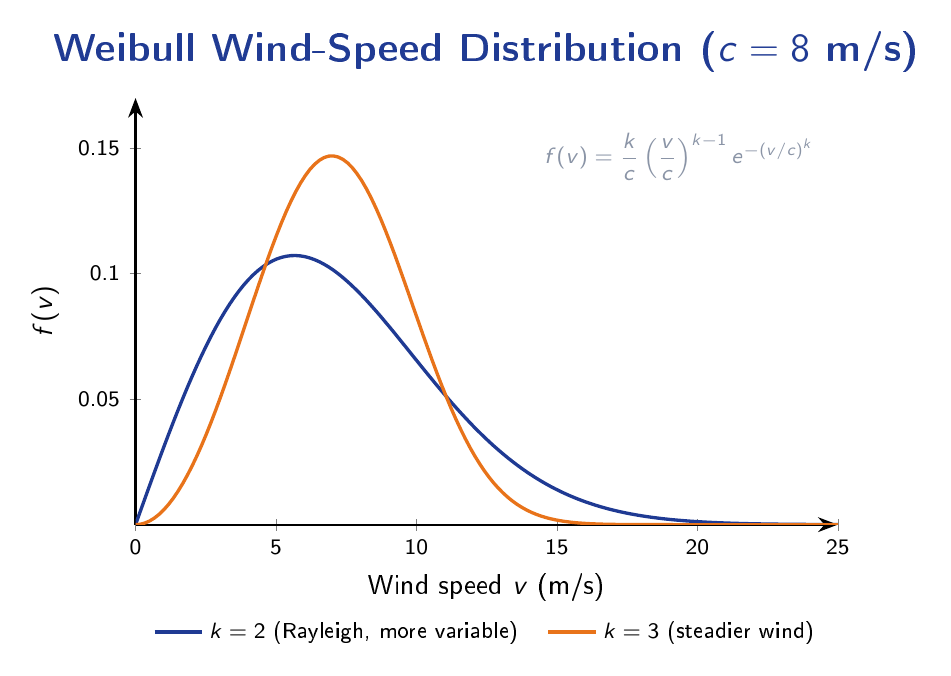
Wind Speed Statistics — Weibull Distribution
\(k\) = shape parameter; \(c\) = scale parameter \(\approx \bar{v}/\Gamma(1+1/k)\). Rayleigh distribution is the special case \(k = 2\).
Wind Resource Assessment and IEC Wind Classes
A site measurement campaign (per IEC 61400-12-1) typically employs a met-mast at the proposed hub height with cup and sonic anemometers, wind vane, temperature, pressure, and relative humidity sensors. Remote sensing tools include SoDAR and LiDAR for wind shear and veer profiles. The campaign should last at least one year, with Measure–Correlate–Predict (MCP) correction to a long-term reference dataset.
\[ \text{AEP} = 8760\int_0^\infty P(v)\,f(v)\,dv \cdot \eta_{\text{avail}}\,\eta_{\text{wake}} \]| IEC Class | Mean Wind Speed | Reference Speed (50-yr) |
|---|---|---|
| I | 10 m/s | 50 m/s |
| II | 8.5 m/s | 42.5 m/s |
| III | 7.5 m/s | 37.5 m/s |
| IV | 6 m/s | 30 m/s |
Turbulence sub-classes: A (high, TI = 0.16), B (medium, 0.14), C (low, 0.12).
Aerodynamics — Betz Limit Derivation
The actuator-disc model assumes incompressible, steady, one-dimensional flow with axial induction factor \(a = (v_1 - v_2)/v_1\). With \(v_2 = v_1(1-a)\) and downstream velocity \(v_3 = v_1(1-2a)\), the extracted power is:
\[ P = 2\rho A v_1^3\,a(1-a)^2 \]Maximising over \(a\): \(dP/da = 0 \Rightarrow a = 1/3\).
No open-flow turbine can extract more than 59.3% of the wind's kinetic energy.
Blade Element Momentum (BEM) Theory
BEM discretises the blade into independent radial elements and equates momentum loss in each streamtube with the lift and drag forces on the local aerofoil section. The local velocity triangle gives:
\[ \tan\phi = \frac{(1-a)\,v_\infty}{(1+a')\,\omega r}, \quad W = \sqrt{(1-a)^2 v_\infty^2 + (1+a')^2(\omega r)^2} \]Element forces per unit span:
\[ dL = \frac{1}{2}\rho W^2 c\,C_L\,dr, \quad dD = \frac{1}{2}\rho W^2 c\,C_D\,dr \]Iterative solution for axial induction \(a\) and tangential induction \(a'\) at each radial station yields the \(C_p(\lambda, \beta)\) map. Standard corrections include Prandtl tip- and hub-loss factors and Glauert's correction for \(a > 0.4\).
Turbine Types: HAWT versus VAWT
| Attribute | HAWT | VAWT |
|---|---|---|
| Axis | Horizontal (parallel to wind) | Vertical (perpendicular) |
| Examples | Upwind / downwind 3-blade | Darrieus, Savonius, H-rotor |
| Typical \(C_p\) | 0.40–0.50 | 0.20–0.40 |
| Yaw mechanism | Required | Not required |
| Tower height | High (>80 m) | Moderate |
| Best suited for | Utility-scale, smooth wind | Urban, turbulent, small-scale |
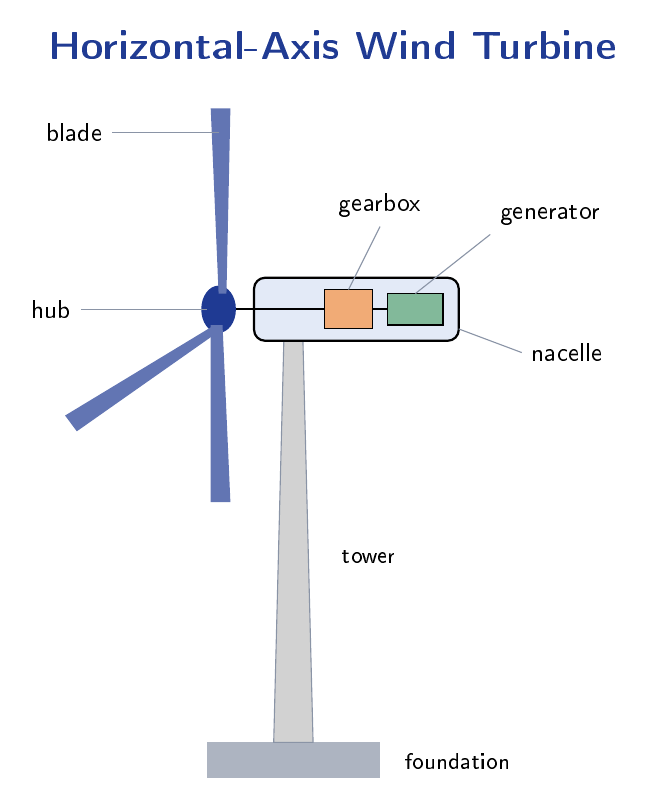
Wind Turbine Components (HAWT)
The main subsystems of a modern HAWT are the rotor assembly (blades of aerofoil section in GFRP/CFRP, hub, pitch system), nacelle (low-speed shaft, gearbox or direct-drive, mechanical brake, generator, yaw drive), and the support structure (tubular steel tower and foundation).
Wind Turbine Electrical Topologies (Types I–IV)
| Type | Generator | Power Electronics | Speed Range | Reactive Power |
|---|---|---|---|---|
| I | SCIG (fixed speed) | Soft-starter + capacitor bank | ±1% | Consumes Q |
| II | WRIG + variable rotor resistance | Soft-starter + chopper | ±10% | Consumes Q |
| III | DFIG (most installed) | Partial-scale converter (~30%) | ±30% | 4-quadrant Q control |
| IV | PMSG / EESG / SCIG | Full-scale back-to-back converter | 0–100% | Full Q control |
DFIG (Type III): stator connects directly to grid; rotor connects via AC/DC/AC converter rated at ~25–30% of stator power. Slip power \(s \cdot P_{\text{stator}}\) flows through the converter. Crowbar protection on grid faults. Slip: \(s = (\omega_s - \omega_r)/\omega_s\); \(P_{\text{rotor}} \approx -s\,P_{\text{stator}}\).
PMSG (Type IV): permanent-magnet field; no slip rings; often direct-drive (no gearbox). Back-to-back VSC decouples machine and grid. Excellent LVRT capability and full reactive support; preferred for offshore applications.
Tip-Speed Ratio and Power Coefficient
Optimum TSR values: Savonius (drag) ≈ 1; HAWT 3-blade (lift) ≈ 6–8; Darrieus ≈ 4–6.
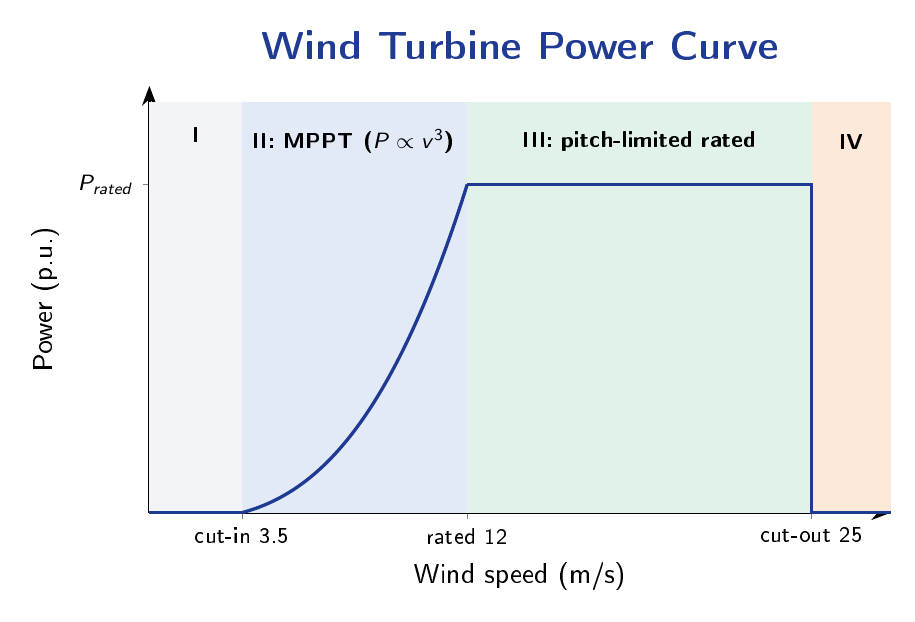
Control regions: Region I (\(v < v_{\text{cut-in}}\)): parked; Region II: MPPT tracking \(\lambda_{\text{opt}}\); Region III (\(v_{\text{rated}} < v < v_{\text{cut-out}}\)): pitch/stall control limits output to rated power.
Wind Farm Layout and Wake Losses
Downwind turbines experience reduced and more turbulent flow due to the wake from upstream machines, causing array losses of 5–20%. Typical spacing rules of thumb: 8–12 rotor diameters along the prevailing wind direction, 3–5 diameters crosswind. Park efficiency:
\[ \eta_{\text{park}} = \frac{\sum P_i}{N \cdot P_{\text{single}}} \]Offshore Wind Energy
Offshore sites offer higher and steadier wind speeds and allow larger turbines (>15 MW), with reduced visual and noise impact. Foundation selection is governed by water depth: monopile (<30 m), jacket (30–60 m), floating (>60 m). Key challenges include foundation cost, subsea cable routing, marine corrosion, and offshore O&M logistics.
Wind Economics — Worked Example
A 2 MW turbine at a site with mean wind speed \(\bar{v} = 8\,\text{m/s}\) and capacity factor \(CF = 0.32\):
\[ \text{AEP} = 2000 \times 0.32 \times 8760 = 5{,}606\,\text{MWh/yr} \]With CapEx = $3M, OpEx = $50 k/yr, \(r = 8\%\), \(N = 20\) yr:
\[ \text{LCOE} \approx \frac{3\times10^6 \cdot CRF + 50{,}000}{5.61\times10^6} \approx \$63\,\text{/MWh} \]Wind power scales with \(v^3\); the Betz limit caps energy capture at 59.3%. Modern HAWTs approach \(C_p \approx 0.50\). Site assessment (Weibull), wake modelling, and grid integration are the core engineering tasks.
Hydropower
Hydrological Cycle and Hydropower Principle
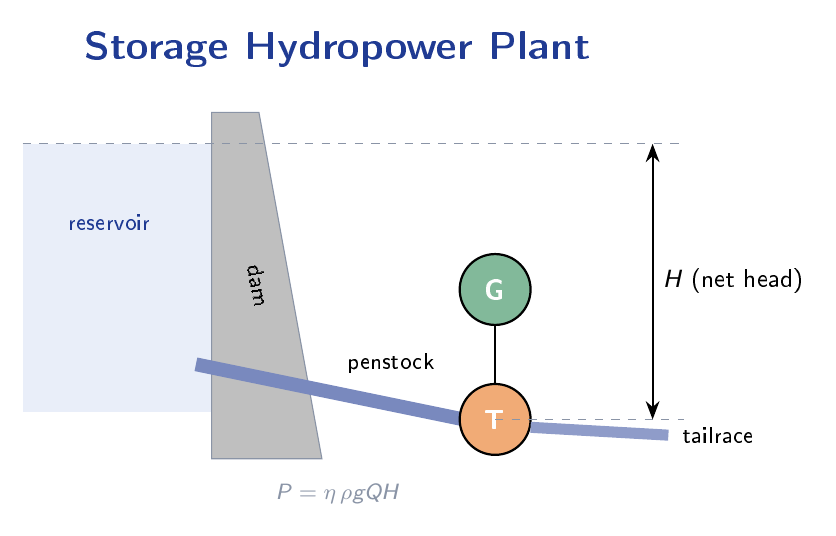
\(H\) = net head, \(Q\) = volumetric flow rate, \(\eta\) = overall efficiency (0.85–0.92). Specific speed \(N_s = N\sqrt{P}/H^{5/4}\) selects the turbine type for a given head and flow.
Types of Hydropower Plants
| Type | Description | Application / Example |
|---|---|---|
| Storage | Reservoir + dam | Three Gorges (China), Bhakra (India) |
| Run-of-river | Minimal storage | Karnali (Nepal), small Himalayan units |
| Pumped storage | Pump water up at off-peak times | Bath County (USA), Tehri PSP (India) |
| Mini/Micro | <100 kW to 10 MW | Off-grid rural electrification |
Turbine Selection
| Turbine | Head Range | Type | Notes |
|---|---|---|---|
| Pelton | >300 m | Impulse | Multi-jet; high head, low flow |
| Francis | 40–600 m | Reaction | Most common; mixed flow |
| Kaplan | <40 m | Reaction | Axial; adjustable blades; low head |
| Turgo / Crossflow | 30–300 m | Impulse | Small-hydro applications |
Pumped Hydro Storage and Small Hydro
Pumped hydro storage (PHS) acts as a giant electrochemical-free battery: round-trip efficiency 70–80%, response time seconds to minutes, and a globally installed capacity exceeding 160 GW — by far the dominant grid-scale storage technology.
Small hydro classification (MNRE, India): Micro (<100 kW), Mini (100 kW–2 MW), Small (2 MW–25 MW).
Environmental and social considerations include reservoir methane emissions, fish migration barrier effects, sedimentation, and potential displacement of communities.
Biomass Energy
Organic matter of biological origin available on a renewable basis, including plants, agricultural residues, animal waste, and municipal solid waste (MSW).
Categories include woody biomass (forest residues, energy crops such as Miscanthus), agricultural residues (rice husk, bagasse, straw), animal manure and slurries, MSW and sewage sludge, and aquatic biomass (algae, water hyacinth). Approximate energy content: dry wood 18–20 MJ/kg; biogas ~20 MJ/Nm³; bioethanol ~29.7 MJ/kg.
Biomass Conversion Pathways
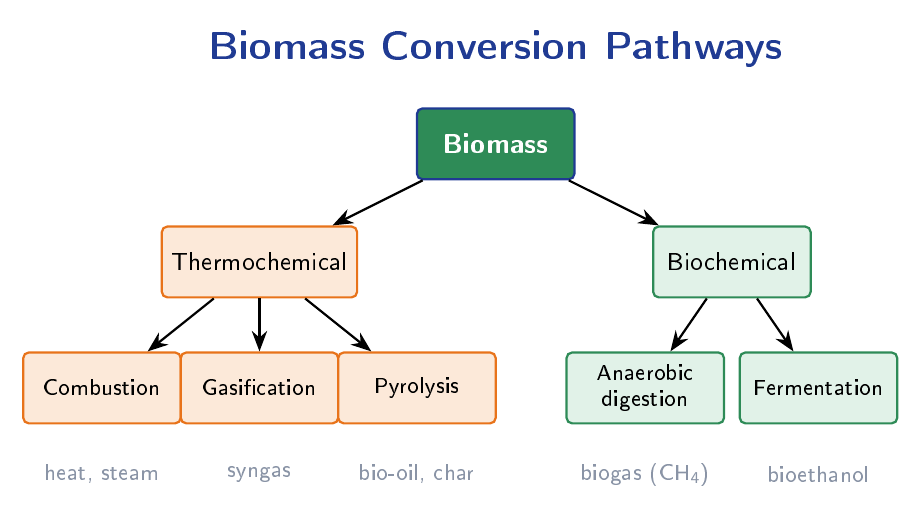
Conversion routes split into thermochemical (combustion, gasification, pyrolysis) and biochemical (anaerobic digestion, fermentation) pathways.
Biomass Gasification
Gasification involves partial oxidation at 700–1200 °C with sub-stoichiometric air, oxygen, or steam to produce producer gas (CO, H₂, CH₄, CO₂, N₂) with a lower heating value of approximately 4–6 MJ/Nm³ for air-blown systems.
| Gasifier Type | Operating Principle | Features |
|---|---|---|
| Updraft (counter-current) | Gas flows up against descending fuel; tar-rich exit gas | Simple; high thermal η; high tar limits engine use |
| Downdraft (co-current) | Gas drawn down through hot oxidation/reduction zone | Low-tar gas suitable for engines; size-limited (~1 MW) |
| Cross-draft | Air injected sideways through narrow hearth | Compact; sensitive to fuel quality; charcoal feed |
| Fluidised-bed (BFB/CFB) | Sand bed at ~800 °C; uniform temperature | Fuel-flexible; large scale (>10 MW); higher PM output |
| Entrained-flow | Fine powder co-current with O₂/steam at >1300 °C | Very low tar; used in IGCC; high CapEx |
Biogas and Anaerobic Digestion
Anaerobic digestion proceeds through four stages: hydrolysis → acidogenesis → acetogenesis → methanogenesis. Typical biogas composition: 50–70% CH₄, 30–50% CO₂, trace H₂S.
Common Indian biogas plant designs: fixed-dome (Janata, Deenbandhu models), floating-drum (KVIC model), and tubular polyethylene (bag digesters).
Biofuels — Biodiesel and Bioethanol
Biodiesel (FAME) is produced by transesterification of triglycerides:
\[ \text{TG} + 3\,\text{CH}_3\text{OH} \xrightarrow{\text{cat.}} 3\,\text{FAME} + \text{glycerol} \]Typical feedstocks: jatropha, soybean, used cooking oil. Cetane number ~50; LHV ~37 MJ/kg.
Bioethanol via yeast fermentation of sugars:
\[ \ce{C_6H_{12}O_6 ->[\text{yeast}] 2\,C_2H_5OH + 2\,CO_2} \]Generations: 1G (sugar/starch — corn, sugarcane), 2G (lignocellulosic), 3G (algal). Waste-to-energy pathways include incineration with energy recovery, refuse-derived fuel (RDF), and gasification of MSW (LHV ~8 MJ/kg).
Geothermal Energy
Heat stored within the Earth, originating from primordial accretional heat and radioactive decay of ⁴⁰K, ²³²Th, and ²³⁸U in the crust.
The average geothermal gradient is ~25 °C/km, rising above 80 °C/km in volcanically active zones. Resource categories include hydrothermal (steam/hot-water reservoirs), hot dry rock / Enhanced Geothermal Systems (EGS), geopressured, and magmatic (research stage).
Geothermal Power Plant Types
| Type | Working Fluid | Notes |
|---|---|---|
| Dry-steam | Vapour-dominated reservoir | Oldest technology (Larderello, 1904) |
| Flash steam | Liquid flashed to steam | Most common; requires >180 °C |
| Binary (ORC) | Low-boiling organic fluid (R245fa, isobutane) | Medium temperatures 85–170 °C |
| Hybrid / EGS | Engineered fractures | Future high-potential technology |
Direct-use applications include space heating (Iceland), greenhouse farming, aquaculture, balneology, and ground-source heat pumps.
Ground-Source Heat Pumps (GSHP)
The shallow ground (<200 m) maintains a near-constant temperature of 10–20 °C year-round. A vapour-compression heat pump exploits this as a heat source (winter) or heat sink (summer).
Typical COP = 3–5, substantially higher than air-source heat pumps in cold climates.
Loop configurations: horizontal closed loop (shallow trench, large land area), vertical closed loop (borehole 50–200 m), pond/lake loop, and open loop (direct groundwater). Low-GWP refrigerants (R32, R290, R744) are increasingly preferred.
Ocean Energy
Ocean energy resources arise from tidal gravitational forces, wind-driven surface waves, ocean thermal gradients, salinity gradients, and marine (thermohaline) currents.
Tidal range potential energy per tidal cycle:
\[ E = \rho g A h^2 \]Wave power per unit crest length (deep water, linear theory):
\[ P = \frac{\rho g^2}{64\pi} H_s^2 T_e \quad [\text{W/m}] \]Wave Energy Converter (WEC) Types
| Class | Working Principle | Examples |
|---|---|---|
| Oscillating Water Column (OWC) | Air chamber above sea surface; rise/fall drives bidirectional Wells turbine | LIMPET (UK), Mutriku (Spain) |
| Point absorber | Buoy heaves on surface; PTO between buoy and reaction body | PowerBuoy, CETO |
| Attenuator | Long floating structure; relative motion at hinges drives PTO | Pelamis (decommissioned) |
| Overtopping | Waves spill into elevated reservoir; low-head turbine | Wave Dragon, TAPCHAN |
| Oscillating wave surge | Hinged seabed flap sways with wave surge | Oyster (Aquamarine Power) |
OTEC and Salinity Gradient
Ocean Thermal Energy Conversion (OTEC) exploits the temperature difference between warm surface water (~25 °C) and deep cold water (~5 °C).
Practical conversion efficiency is ~3%. Cycles: open (Claude cycle), closed (Anderson cycle), hybrid.
Salinity gradient: pressure-retarded osmosis (PRO) and reverse electrodialysis (RED) can theoretically exploit ~2.6 TW of global osmotic potential.
Tidal Barrage versus Tidal Stream
| Aspect | Tidal Barrage (potential) | Tidal Stream (kinetic) |
|---|---|---|
| Principle | Damming an estuary; head difference drives turbines | Underwater turbines harness flowing currents |
| Resource threshold | Tidal range >5 m | Current speed >2 m/s |
| Examples | La Rance 240 MW (France, 1966); Sihwa 254 MW (Korea) | MeyGen (Scotland), SeaGen (UK) |
| Environmental impact | Estuarine ecosystem disruption; sediment trapping | Lower impact; fish-friendly designs possible |
| Power formula | \(P = \frac{1}{2}\rho g A h^2 / T_{\text{tide}}\) | \(P = \frac{1}{2}\rho A v^3 C_p\) (Betz-like) |
Hydrogen and Fuel Cells
Hydrogen Production — the Colour Code
| Colour | Process | Carbon Intensity |
|---|---|---|
| Grey | Steam methane reforming (SMR) of natural gas | ~10 kg CO₂/kg H₂ |
| Blue | SMR + carbon capture and storage (CCS) | ~1–3 kg CO₂/kg H₂ |
| Turquoise | Methane pyrolysis | Solid carbon by-product |
| Green | Electrolysis powered by renewables | ~0 |
| Pink | Electrolysis powered by nuclear | ~0 |
Electrolysis
Electrolyser technologies: alkaline (mature, low cost), PEM (fast dynamic response, suited to variable renewables), solid-oxide (high temperature, highest efficiency), and AEM (emerging). System efficiency: 60–80% LHV basis.
Fuel Cell Principles
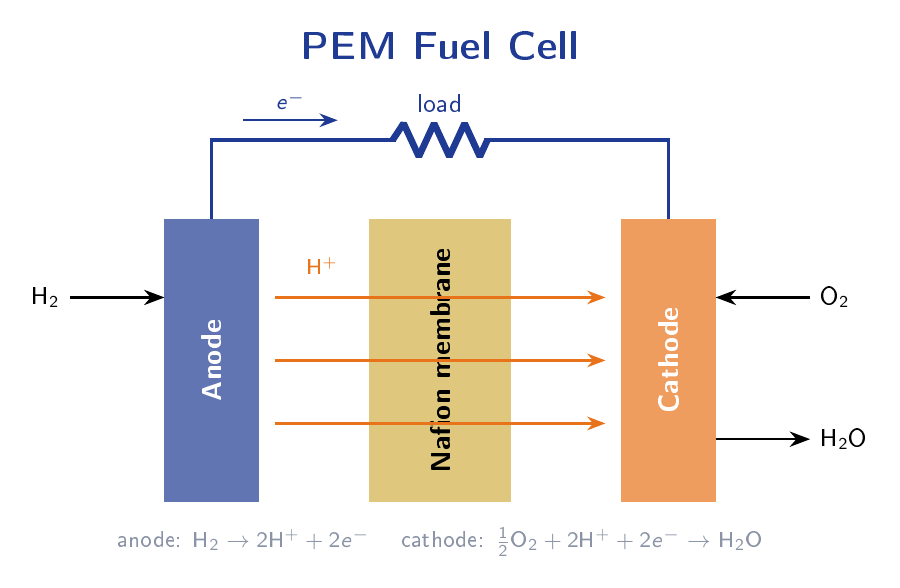
A fuel cell is the electrochemical reverse of electrolysis — an electrochemical engine that converts chemical energy directly into electrical energy without combustion.
Real cell voltage: 0.6–0.8 V due to activation, ohmic, and mass-transport losses.
Types of Fuel Cells
| Type | Electrolyte | Temperature (°C) | Applications |
|---|---|---|---|
| PEMFC | Polymer membrane (Nafion) | 60–80 | Transport, portable power |
| AFC | KOH solution | 60–90 | Space (Apollo programme) |
| PAFC | H₃PO₄ | 150–200 | CHP applications |
| MCFC | Molten carbonate | 600–700 | Utility-scale CHP |
| SOFC | Y₂O₃–ZrO₂ (YSZ) | 600–1000 | Stationary power, APU |
| DMFC | Polymer + methanol | 60–130 | Portable electronics |
Energy Storage Systems
Storage Technologies — Comparative Overview
| Technology | Energy Density | Power | Cycle Life | Application |
|---|---|---|---|---|
| Lead-acid | 30–50 Wh/kg | Low | 500–1,000 | Backup, SLI |
| Li-ion (NMC) | 150–250 Wh/kg | High | 2,000–5,000 | EV, grid BESS |
| LiFePO₄ (LFP) | 90–160 Wh/kg | High | 4,000–8,000 | Stationary storage |
| Flow (VRFB) | 15–30 Wh/kg | Moderate | >10,000 | Long-duration grid |
| NaS | 100–250 Wh/kg | High | 2,500–5,000 | Utility-scale |
| Supercapacitor | 5–10 Wh/kg | Very high | >10⁶ | Pulse power, regen. braking |
| Flywheel | 5–100 Wh/kg | Very high | >10⁷ | UPS, frequency regulation |
| PHS | 0.5–1.5 Wh/kg | GW-scale | >50 yr | Bulk grid storage |
Battery Modelling and BMS
Battery Management System (BMS) functions: cell balancing (active / passive), SoC / SoH / SoP estimation (Kalman filters, observers), thermal management, protection (OVP, UVP, OCP, SCP), and communication via CAN bus (ISO 26262).
Thermal and Chemical Storage
Sensible heat: \(Q = mc_p \Delta T\). Molten salt (NaNO₃/KNO₃) at 290–565 °C in CSP plants is the leading commercial technology. Latent heat: \(Q = mL_f\). Phase-change materials (PCMs) include paraffins, fatty acids, and salt hydrates. Thermochemical: systems such as CaO/Ca(OH)₂ can store ~1.4 GJ/m³.
Hydrogen storage options: compressed gas (350–700 bar), liquid at 20 K, metal hydrides, and ammonia/methanol carriers. DOE gravimetric density target: 6.5 wt% H₂.
Grid Integration and Smart Energy Systems
Power Electronics in Renewables — Overview
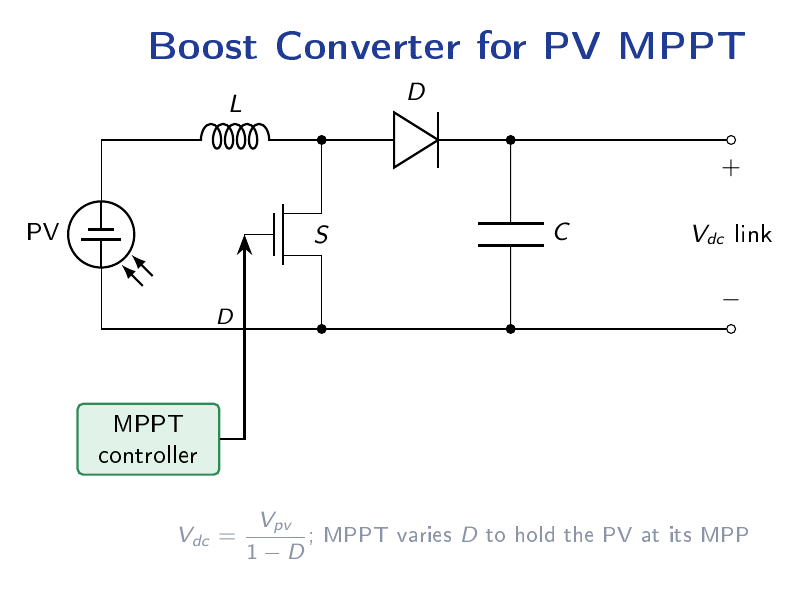
The typical power conversion chain for a grid-connected renewable source is: PV/Wind → Rectifier (AC/DC) → DC link → Inverter (DC/AC) → Grid. A battery or other storage system interfaces bidirectionally at the DC link. Key roles of power electronics: MPPT, voltage matching, AC–DC–AC conversion, reactive power support, fault ride-through, harmonic filtering, and galvanic isolation.
Device technologies: Si IGBT (mature; <6.5 kV), SiC MOSFET (higher switching frequency, temperature, and voltage), GaN HEMT (low-power, high-frequency). Trade-off: higher switching frequency \(f_s\) reduces passive component size but increases switching losses. Typical \(f_s\): PV string inverters ~16 kHz; MV wind converters ~2–4 kHz.
DC–DC Boost Converter for PV MPPT
Multilevel Inverters
Multilevel inverters reduce harmonic distortion, lower device voltage stress, and allow medium-voltage operation without series-connected devices. The number of output levels \(N\) gives \(2N-1\) steps in the line-to-line waveform, with THD approximately proportional to \(1/(N-1)\).
HVDC Transmission for Offshore Wind and Long Distances
AC subsea cables become uneconomic beyond approximately 80 km due to charging current \(I_c = \omega C V\). HVDC eliminates reactive losses and can interconnect asynchronous AC networks.
| Technology | Converter | Renewable Use |
|---|---|---|
| LCC-HVDC (classic) | Thyristor; requires strong AC at both ends | Bulk onshore; not used offshore |
| VSC-HVDC (2/3-level) | IGBT VSC; independent P/Q control | Earlier offshore wind; black-start capable |
| VSC-HVDC (MMC) | Modular multilevel submodules | Modern offshore wind; ±525 kV |
| MTDC / DC grids | Multi-terminal VSC + DC breakers | Future European supergrid |
LCL Filter for Grid-Connected Inverters
Design rule: \(10f_n < f_{\text{res}} < f_s/2\). LCL provides –60 dB/decade attenuation above resonance, allowing smaller inductors than a simple L filter. Damping strategies: passive resistor in series with \(C_f\) (simple but lossy) or active virtual resistor in software (lossless, preferred).
Harmonic limits: IEEE 519 (\(\text{THD}_i \leq 5\%\)); IEC 61000 individual-harmonic limits.
Grid Codes and Fault Ride-Through (FRT)
Modern grid codes require renewable generators to stay connected during voltage and frequency disturbances (LVRT/HVRT), inject reactive current during voltage sags, provide frequency response (droop, fast frequency response), limit harmonics, and increasingly support black-start capability.
Active power–frequency droop:
\[ \Delta P = -\frac{1}{R}\Delta f \]PLL, dq-Frame Control, and Grid-Forming Inverters
The Synchronous Reference Frame PLL (SRF-PLL) performs Clarke (\(abc \to \alpha\beta\)) then Park (\(\alpha\beta \to dq\)) transforms, with a PI controller on \(v_q\) driving the estimated frequency to grid frequency. Variants include DSOGI-PLL and MAF-PLL for better performance under distorted grid conditions.
In dq-frame current control: \(i_d\) controls active power \(P\); \(i_q\) controls reactive power \(Q\):
\[ v_{d,q} = R\,i_{d,q} + L\,\frac{di_{d,q}}{dt} \mp \omega L\,i_{q,d} + e_{d,q} \]Grid-following (GFL) inverters operate as current sources requiring a stiff grid and PLL. They dominate today but face stability issues in weak-grid conditions. Grid-forming (GFM) inverters (emerging) act as voltage sources, set their own V and f, enable islanding, and provide virtual inertia. Strategies include droop, virtual synchronous machine (VSM), matching, and dispatchable virtual oscillator control (dVOC).
FACTS and Reactive Power Support
| Device | Type | Compensates | Role in Renewables |
|---|---|---|---|
| SVC | Shunt (TCR + TSC) | Reactive power | Voltage support at PV/wind farm POI |
| STATCOM | Shunt (VSC) | Reactive power | Faster, wider range; LVRT support |
| TCSC | Series (TCR + C) | Line impedance | Power-flow control; damping |
| UPFC | Combined | V, P, Q together | Multi-objective control |
| Sync. condenser | Rotating machine | Q + inertia | Replaces lost inertia in low-inertia grids |
Grid Synchronisation and Anti-Islanding
Conditions for paralleling a generator with the grid: equal voltage magnitude, equal frequency, equal phase sequence, and zero phase angle difference at the instant of connection. A PLL extracts the grid phase angle in real time for dq-frame control loops. Anti-islanding methods: passive (over/under frequency and voltage relays), active (impedance injection, frequency drift), per IEEE 1547 / IEC 62116.
Smart Grids, Microgrids, and Demand Response
An electricity network that uses digital sensing, two-way communication, and intelligent control to integrate generation, storage, and demand efficiently, reliably, and securely.
A microgrid is a localised group of sources and loads that can operate either grid-connected or in islanded mode. Demand response (DR) programmes include price-based mechanisms (Time-of-Use, Real-Time Pricing, Critical Peak Pricing) and incentive-based mechanisms (direct load control, interruptible tariffs, OpenADR 2.0).
Hybrid Renewable Energy Systems (HRES)
HRES combines complementary resource profiles (PV + wind + biomass + diesel backup) with storage and smart control to achieve high reliability and low LCOE. Key optimisation tools: HOMER Pro, RETScreen, iHOGA, GAMS/MATLAB.
Renewable Forecasting and Vehicle-to-Grid (V2G)
Forecasting horizons span very short-term (seconds to minutes — persistence models, sky imagers for ramp control), short-term (hours — ARIMA, LSTM, XGBoost for unit commitment), medium-term (days — NWP + post-processing for markets), and long-term (months — climatology for planning). Error metrics: MAE, RMSE, normalised RMSE, skill score versus persistence.
EV integration: V1G (smart/scheduled charging to absorb surplus PV/wind); V2G (bidirectional — EV as dispatchable grid storage). Standards: ISO 15118 (Plug & Charge), OCPP, IEC 61851. Battery degradation from V2G cycling must be priced into any ancillary service contract.
Environmental and Economic Analysis
Life-Cycle Assessment (LCA)
The ISO 14040 framework comprises four phases: (1) goal and scope definition, (2) life-cycle inventory (LCI), (3) life-cycle impact assessment (LCIA), and (4) interpretation. Typical impact categories: GWP, acidification potential (AP), eutrophication potential (EP), ozone depletion potential (ODP), photochemical ozone creation potential (POCP), water use, and land use.
Typical values: crystalline-Si PV 1–3 years; wind turbines 3–7 months.
Techno-Economic Analysis
Internal Rate of Return (IRR) is the discount rate that sets NPV = 0. Sensitivity and uncertainty are analysed via tornado plots and Monte Carlo simulation.
Energy Efficiency and Demand-Side Management
Energy efficiency = same output with less input (better motors, LEDs, insulation). Energy conservation = consciously using less (behaviour change, set-point adjustments).
The efficiency pyramid: (1) reduce demand (building envelope, behaviour), (2) improve end-use efficiency (BEE star ratings, ISO 50001), (3) supply-side efficiency (CHP, waste-heat recovery), (4) renewable supply for residual demand. India's PAT (Perform, Achieve, Trade) scheme sets specific-energy-consumption targets for designated consumers, with ESCerts traded on power exchanges.
Cogeneration / CHP and Trigeneration
Sequential production of two or more useful energy forms (typically electricity + heat) from a single fuel input.
Typical \(\eta_{\text{CHP}} = 75\text{–}90\%\) versus ~50% for separate generation. Trigeneration (CCHP) adds cooling via an absorption chiller — optimal for hospitals, data centres, and hotels.
Policy Instruments and Carbon Markets
| Instrument | Mechanism |
|---|---|
| Feed-in tariff (FiT) | Guaranteed long-term price for renewable generation |
| Renewable Portfolio Standard | Obligated share of renewables for utilities |
| Net metering | Self-consumption + export at retail price |
| Production tax credit | Per-kWh credit (USA wind, PV) |
| Carbon tax | Price on CO₂ emissions (Sweden, Canada) |
| Cap-and-trade (ETS) | Tradeable emission permits (EU ETS) |
| REC / Green certificate | Tradeable proof of green electricity generation |
Indian Renewable Energy Scenario
Institutional framework: MNRE (Ministry of New & Renewable Energy, nodal agency), SECI (Solar Energy Corporation of India, conducts auctions), IREDA (financing), CEA, CERC, and SERCs (planning and tariff regulation), NIWE and NISE (wind and solar testing and resource mapping).
Key national targets: 500 GW of non-fossil capacity by 2030; net-zero by 2070; 50% non-fossil electricity by 2030 (NDC commitment).
Flagship missions and schemes: Jawaharlal Nehru National Solar Mission (JNNSM), National Wind–Solar Hybrid Policy (2018), PM-KUSUM (solar pumps and agri-PV), Rooftop Solar Phase-II, PLI scheme for high-efficiency PV modules, National Green Hydrogen Mission (2023), and the PAT scheme with state-level RPOs.
Assessed resource potential (MNRE): solar ~750 GW, wind ~695 GW (at 120 m hub height), small hydro ~21 GW, biomass ~28 GW.
Standards, Codes, and Grid Integration in India
| Standard / Code | Scope |
|---|---|
| CEA Technical Standards (2019, 2023) | Grid connectivity for solar/wind; harmonics; ride-through |
| IEC 61215 / 61730 | PV module qualification and safety testing |
| IEC 61724 | PV system performance monitoring |
| IS / IEC 62116, IEEE 1547 | Anti-islanding and DER interconnection |
| IEC 61400 series | Wind turbine design and certification |
| CERC Deviation Settlement Mechanism | Forecasting, scheduling, and imbalance penalties |
| RPO / REC framework | State-level renewable obligations and certificate trading |
The Green Energy Open Access Rules (2022) enable corporate renewable energy procurement at capacities ≥100 kW and reduce banking and wheeling charges for green power consumers.
Emerging Technologies and Future Trends
Next-Generation PV: Perovskites and Tandems
Perovskite solar cells (PSC) have the ABX₃ crystal structure (e.g. CH₃NH₃PbI₃) with a tunable bandgap of 1.2–2.3 eV. Record single-junction cell efficiencies exceed 26%; monolithic perovskite/Si tandem cells have demonstrated over 33% efficiency. Primary research challenges are long-term stability and lead (Pb) toxicity. Other emerging technologies include organic PV, dye-sensitised cells (DSSC), quantum-dot cells, and multi-junction III–V concentrator cells for space.
Floating Solar and Advanced Offshore Wind
Floating PV (FPV) saves scarce land, reduces reservoir evaporation, and benefits from surface cooling (improving module η). Notable Indian projects: Omkareshwar (Madhya Pradesh). Floating offshore wind (spar-buoy, semi-submersible, TLP platforms) opens up deep-water sites (>60 m); Hywind Tampen (Norway) is the world's largest floating offshore wind farm at 88 MW. AI/IoT applications include predictive maintenance, digital twins, probabilistic forecasting, smart inverters, and blockchain-based peer-to-peer energy trading.
Green Hydrogen and Net-Zero
Green hydrogen is targeted at hard-to-abate sectors: green steel, Haber–Bosch ammonia, refining, long-haul shipping, and aviation e-fuels. Major net-zero pledges: EU 2050, UK 2050, USA 2050, China 2060, India 2070. Common features of IEA NZE, IRENA 1.5 °C, and DNV energy-transition scenarios: massive electrification, three-to-four times renewable capacity by 2030, deep energy efficiency, and demand-side flexibility.
The world must triple installed renewables by 2030 and reach near-net-zero emissions by mid-century to limit warming to 1.5 °C. Solar PV and wind are now the cheapest forms of new electricity in most markets; hydropower remains the largest renewable source. Biomass, geothermal, ocean, and hydrogen fill complementary roles. Storage, smart grids, and sector coupling are the integration backbone.
Negative-Emission Technologies (NETs)
IPCC AR6 1.5 °C-compatible scenarios all require some carbon dioxide removal (CDR) alongside deep mitigation.
| Pathway | Mechanism | Notes |
|---|---|---|
| Afforestation / Reforestation | Biological photosynthesis → standing carbon stock | Low cost; saturates; reversal risk |
| BECCS | Biomass combustion + CCS | Net-negative; competes with food/land |
| Soil carbon (biochar, no-till) | Cover crops, biochar, no-till agriculture | Co-benefits; difficult to verify |
| DAC + geological storage | Amine/solid sorbent captures CO₂ directly from air | ~$100–600/t CO₂; ~2 MWh/t energy needed |
| Enhanced weathering | Crushed olivine/basalt absorbs atmospheric CO₂ | Slow; high mining/transport footprint |
Geological storage options include depleted oil and gas reservoirs, deep saline aquifers, and basaltic mineralisation (CarbFix project, Iceland). Cost target: <$100/t CO₂.
Future Research Directions
- Tandem perovskite/Si and III–V terrestrial PV
- Floating offshore wind and 20 MW+ turbines
- Green-hydrogen value chains and e-fuels
- Long-duration storage (iron-air, flow batteries, thermochemical)
- AI-driven grid forecasting and autonomous control
- Closed-loop, fully recyclable component design and circular economy
Glossary, Abbreviations, and References
Glossary of Key Terms
| Betz limit | Maximum fraction (16/27 ≈ 59.3%) of wind kinetic energy recoverable by an open-flow turbine. |
| Capacity factor | Ratio of actual energy output to maximum possible energy output over a given period. |
| Carbon footprint | Total CO₂-equivalent GHG emissions attributable to an activity, product, or entity. |
| COP | Coefficient of Performance of a heat pump or refrigerator; ratio of useful heat delivered (or removed) to work input. |
| Solar constant | Mean solar irradiance at the top of the atmosphere: \(\approx 1361\,\text{W/m}^2\). |
| Smart grid | Electricity network with two-way digital communication between producers, storage, and consumers enabling intelligent control. |
| Tip-speed ratio (TSR) | Ratio of blade-tip linear speed to free-stream wind speed \(\lambda = \omega R / v_\infty\); key dimensionless aerodynamic parameter for wind turbines. |
| LCOE | Levelised Cost of Energy: total life-cycle cost divided by total energy produced, expressed in $/MWh or ₹/kWh. |
| Fill factor (FF) | Ratio of maximum power to the product of open-circuit voltage and short-circuit current; measure of PV cell quality. |
| SoC / SoH | State of Charge (remaining capacity) / State of Health (capacity relative to nominal) of a battery. |
Abbreviations
Selected References
- J. Twidell, T. Weir, Renewable Energy Resources, 4th ed., Routledge, 2021.
- G. Boyle, Renewable Energy: Power for a Sustainable Future, 3rd ed., Oxford University Press, 2012.
- J. A. Duffie, W. A. Beckman, Solar Engineering of Thermal Processes, 4th ed., Wiley, 2013.
- J. F. Manwell, J. G. McGowan, A. L. Rogers, Wind Energy Explained, 2nd ed., Wiley, 2010.
- T. Burton et al., Wind Energy Handbook, 3rd ed., Wiley, 2021.
- G. M. Masters, Renewable and Efficient Electric Power Systems, 2nd ed., Wiley, 2013.
- G. D. Rai, Non-Conventional Energy Sources, 6th ed., Khanna Publishers, 2018.
- B. H. Khan, Non-Conventional Energy Resources, 3rd ed., McGraw-Hill, 2017.
- R. A. Messenger, A. Abtahi, Photovoltaic Systems Engineering, 4th ed., CRC Press, 2017.
- J. Larminie, A. Dicks, Fuel Cell Systems Explained, 2nd ed., Wiley, 2003.
- IEA, World Energy Outlook, 2024.
- IRENA, World Energy Transitions Outlook, 2024.
- IPCC, AR6 Synthesis Report: Climate Change 2023, 2023.
"The stone age did not end for lack of stone, and the oil age will end long before the world runs out of oil."