Quantitative Aptitude
A Concept & Formula Compendium for GATE · CAT · XAT · GMAT · SNAP · Banking · SSC
Prof. Mithun Mondal · Department of EEE, BITS Pilani · Revision Notes
Introduction & Strategy
Why Quantitative Aptitude?
Purpose
Quantitative Aptitude (QA) measures numerical reasoning, problem-solving speed, and logical thinking under time pressure. It is a core section in nearly every competitive examination — GATE (≈15% of marks), CAT / XAT / IIFT / SNAP / NMAT, GMAT / GRE Quant reasoning, and Banking, SSC, RRB, and UPSC CSAT.
Skills Tested
Speed & accuracy · mental arithmetic · pattern recognition · approximation & estimation · logical structuring.
Recommended Study Sequence
Number Systems → Arithmetic → Algebra → Geometry / Mensuration → Modern Math → Data Interpretation
Test-Taking Strategy
Before the Exam
- Memorise the formula sheet (final section of these notes).
- Drill mental math — squares to 30, cubes to 15, square roots to 25.
- Memorise fraction-to-percentage conversions.
- Solve ≥ 10 full mock papers under timed conditions.
During the Exam
- Skim once, mark easy problems first.
- Allocate ≈ 1.5–2 min per QA question.
- Approximate before exact computation.
- Use answer choices — back-substitute, eliminate.
- Revisit skipped questions only if time permits.
Common Pitfalls
Reading errors · unit confusion (km vs m, hr vs min) · off-by-one in counting · misapplied percentages on shifting bases · over-investing time in one tough problem.
Number Systems
Classification of Numbers
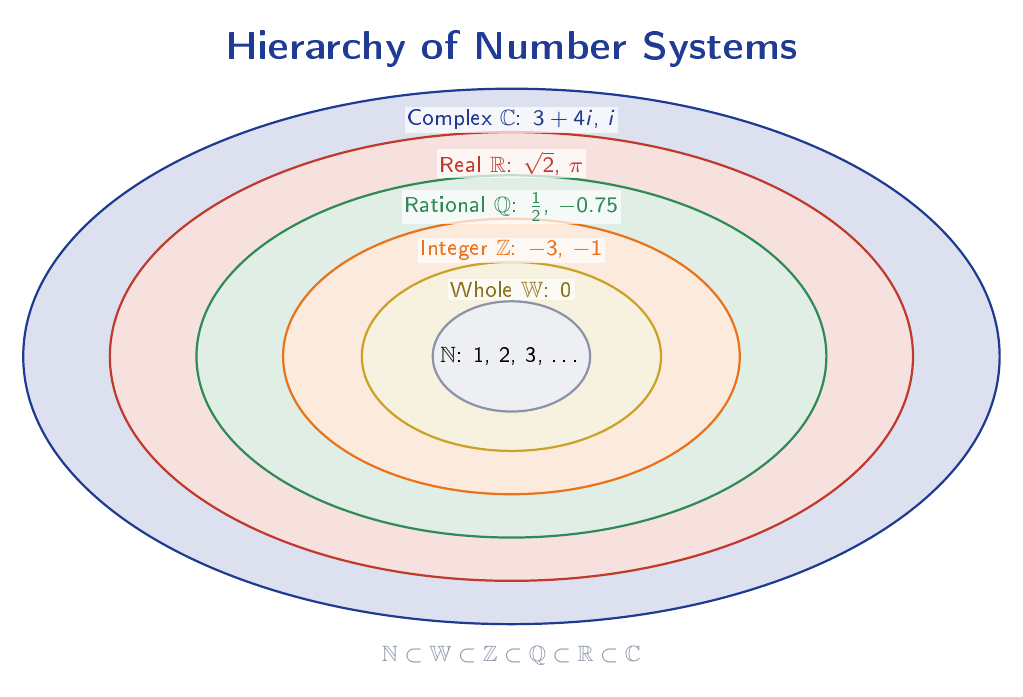
Hierarchy
\(\mathbb{N} \subset \mathbb{W} \subset \mathbb{Z} \subset \mathbb{Q} \subset \mathbb{R} \subset \mathbb{C}\)
- \(\mathbb{N}\): Naturals \(\{1,2,3,\dots\}\)
- \(\mathbb{W}\): Whole \(\{0,1,2,\dots\}\)
- \(\mathbb{Z}\): Integers \(\{\dots,-2,-1,0,1,\dots\}\)
- \(\mathbb{Q}\): Rationals \(p/q\), \(q\neq 0\)
- Irrationals: \(\sqrt{2},\pi,e\) (non-repeating, non-terminating)
- \(\mathbb{R}\): Reals \(= \mathbb{Q}\cup\text{Irrationals}\)
- \(\mathbb{C}\): Complex \(a+bi\), \(i^2=-1\)
Divisibility Rules
| Divisor | Rule |
|---|---|
| 2 | Last digit even |
| 3 | Sum of digits divisible by 3 |
| 4 | Last two digits divisible by 4 |
| 5 | Last digit 0 or 5 |
| 6 | Divisible by both 2 and 3 |
| 7 | Double the last digit, subtract from rest; repeat until result divisible by 7 |
| 8 | Last three digits divisible by 8 |
| 9 | Sum of digits divisible by 9 |
| 10 | Last digit 0 |
| 11 | Alternating sum of digits divisible by 11 |
| 13 | Multiply last digit by 4, add to rest; repeat |
Example — Divisibility by 9
Is 4,725 divisible by 9? Digit sum \(= 4+7+2+5 = 18\), and \(18/9 = 2\). Yes.
Example — Divisibility by 11
Test 73,953 for divisibility by 11: alternating sum \(= 3-5+9-3+7 = 11\). Divisible by 11. ✓
Shortcut
For divisibility by \(2^k\), only the last \(k\) digits matter. For divisibility by 3 or 9, only the digit sum matters.
HCF and LCM
Definitions
HCF (GCD): largest integer dividing all given numbers. LCM: smallest positive integer divisible by all given numbers.
\[\text{HCF}(a,b)\times \text{LCM}(a,b) \;=\; a\times b\]
Methods
Prime factorisation: HCF = product of common primes (lowest power); LCM = all primes (highest power).Euclidean algorithm: \(\gcd(a,b)=\gcd(b,\, a\bmod b)\).
Example — HCF and LCM of 36 and 60
\(36=2^2\cdot 3^2,\quad 60=2^2\cdot 3\cdot 5\).HCF \(=2^2\cdot 3=12\); LCM \(=2^2\cdot 3^2\cdot 5=180\). Check: \(12\times 180=2160=36\times 60\). ✓
Remainders & Modular Arithmetic
Key Identities
If \(a\equiv r_1\pmod{n}\) and \(b\equiv r_2\pmod{n}\):
\[(a+b)\equiv(r_1+r_2),\quad (a\cdot b)\equiv(r_1\cdot r_2),\quad a^k\equiv r_1^k \pmod{n}\]
Fermat's little theorem: \(a^{p-1}\equiv 1 \pmod{p}\), where \(p\) is prime and \(\gcd(a,p)=1\).
Example — Remainder of \(7^{100}\) divided by 5
\(7\equiv 2\pmod{5}\), so \(7^{100}\equiv 2^{100}\pmod{5}\). Since \(2^4=16\equiv 1\), we get \(2^{100}=(2^4)^{25}\equiv 1\pmod{5}\). Remainder \(=\) 1.
Unit Digit (Cyclicity)
| \(a\bmod 10\) | Cycle Length | Cycle of Last Digit (powers 1, 2, 3, …) |
|---|---|---|
| 0, 1, 5, 6 | 1 | \(\{0\},\ \{1\},\ \{5\},\ \{6\}\) |
| 4, 9 | 2 | \(\{4,6\},\ \{9,1\}\) |
| 2, 3, 7, 8 | 4 | \(\{2,4,8,6\},\ \{3,9,7,1\},\ \{7,9,3,1\},\ \{8,4,2,6\}\) |
Example — Unit digit of \(7^{83}\)
Cycle of 7 has length 4: \(\{7,9,3,1\}\). Compute \(83\bmod 4 = 3\). The 3rd entry is 3.
Number of Factors & Sum of Factors
If \(N=p_1^{a_1}p_2^{a_2}\cdots p_k^{a_k}\) is the prime factorisation:
\[\tau(N) = \prod_{i=1}^k (a_i+1) \qquad \sigma(N)=\prod_{i=1}^{k}\frac{p_i^{a_i+1}-1}{p_i-1}\]
Example — \(N = 72 = 2^3\cdot 3^2\)
\(\tau(N)=(3+1)(2+1)=12\); \(\sigma(N)=\dfrac{2^{4}-1}{2-1}\cdot\dfrac{3^{3}-1}{3-1}=15\cdot 13=\)195.
Highest Power of a Prime in \(n!\) — Legendre's Formula
\[\nu_p(n!) \;=\; \sum_{k=1}^{\infty}\left\lfloor \frac{n}{p^k}\right\rfloor\]
Example — Trailing zeros in 100!
Trailing zeros = power of 5 in 100! (since 2's are more abundant).\(\left\lfloor \tfrac{100}{5}\right\rfloor+\left\lfloor \tfrac{100}{25}\right\rfloor+\left\lfloor \tfrac{100}{125}\right\rfloor=20+4+0=\)24.
Sum Formulas
\[\sum_{k=1}^{n} k = \frac{n(n+1)}{2}\qquad \sum_{k=1}^{n} k^2 = \frac{n(n+1)(2n+1)}{6}\qquad \sum_{k=1}^{n} k^3 = \left[\frac{n(n+1)}{2}\right]^2\]
Useful Corollaries
- Sum of first \(n\) odd numbers \(= n^2\).
- Sum of first \(n\) even numbers \(= n(n+1)\).
- \(\displaystyle \sum_{k=1}^{n}(2k-1)^2 = \frac{n(2n-1)(2n+1)}{3}\).
Surds, Indices & Rationalisation
Laws of Indices
\(a^m\!\cdot a^n = a^{m+n};\quad \dfrac{a^m}{a^n}=a^{m-n};\quad (a^m)^n=a^{mn};\quad a^0=1;\quad a^{-n}=\dfrac{1}{a^n}\)
Surds
\(\sqrt[n]{a}=a^{1/n};\quad \sqrt{a}\sqrt{b}=\sqrt{ab};\quad \dfrac{\sqrt{a}}{\sqrt{b}}=\sqrt{\tfrac{a}{b}}\)
Rationalising the Denominator
\[\frac{1}{\sqrt{3}-\sqrt{2}}\cdot\frac{\sqrt{3}+\sqrt{2}}{\sqrt{3}+\sqrt{2}}=\]\(\sqrt{3}+\sqrt{2}\).
Arithmetic
Percentages
\[x\%\text{ of }y \;=\; \frac{x}{100}\cdot y \qquad \text{\% change} = \frac{\text{Final}-\text{Initial}}{\text{Initial}}\times 100\%\]
Successive Percentage Change
A change of \(a\%\) followed by \(b\%\) yields a net change of \(\left(a + b + \dfrac{ab}{100}\right)\%\).
Example — Salary up 10%, then down 10%
Net \(= 10 + (-10) + \dfrac{(10)(-10)}{100} = -1\%\), i.e. a 1% loss, not zero!
Standard Fraction-to-Percentage Conversions
| Fraction | % | Fraction | % | Fraction | % |
|---|---|---|---|---|---|
| \(1/2\) | 50 | \(1/3\) | 33.33 | \(1/4\) | 25 |
| \(1/5\) | 20 | \(1/6\) | 16.67 | \(1/7\) | 14.29 |
| \(1/8\) | 12.5 | \(1/9\) | 11.11 | \(1/10\) | 10 |
| \(1/11\) | 9.09 | \(1/12\) | 8.33 | \(1/16\) | 6.25 |
Profit and Loss
\[\text{Profit\%}=\frac{\text{SP}-\text{CP}}{\text{CP}}\times 100\qquad \text{Loss\%}=\frac{\text{CP}-\text{SP}}{\text{CP}}\times 100\]
\[\text{SP}=\text{CP}\!\left(1\pm\frac{P\%}{100}\right);\qquad \text{Discount}=\text{MP}-\text{SP}\]
Example — Marked 25% above CP, Discount 10%
Let CP \(=100\). Then MP \(=125\), SP \(=125\times 0.9=112.5\). Profit \(=\)12.5%.
Special Cases
- False weight: Gain% \(= \dfrac{W-w}{w}\times 100\) where \(w\) is weight used, \(W\) true weight.
- Same SP, equal %: If one item sold at gain \(x\%\) and another at loss \(x\%\) with same SP, Net loss \(= \dfrac{x^2}{100}\%\).
Watch Out
Always compute profit% on CP, never on SP. "Discount" is on MP; "profit" is on CP.
Simple Interest & Compound Interest
\[\text{SI} \;=\; \frac{P\cdot R\cdot T}{100};\qquad A = P + \text{SI}\]
\[A \;=\; P\!\left(1+\frac{R}{100}\right)^{\!T};\qquad \text{CI}=A-P\]
With compounding frequency \(n\) per year: \(A = P\!\left(1+\dfrac{R}{100\,n}\right)^{\!nT}\).
CI − SI Shortcuts
For 2 years: \(\text{CI}-\text{SI} = P\!\left(\dfrac{R}{100}\right)^{\!2}\)For 3 years: \(\text{CI}-\text{SI} = P\!\left(\dfrac{R}{100}\right)^{\!2}\!\left(3+\dfrac{R}{100}\right)\)
Example — P = 10,000, R = 10%, 2 yr
CI \(-\) SI \(=10000\times 0.01=\)\$100. (CI \(=\$2100\), SI \(=\$2000\).)
Ratio, Proportion & Variation
Key Properties
- Componendo: \(\dfrac{a}{b}=\dfrac{c}{d}\Rightarrow \dfrac{a+b}{b}=\dfrac{c+d}{d}\)
- Dividendo: \(\dfrac{a-b}{b}=\dfrac{c-d}{d}\)
- Componendo & Dividendo: \(\dfrac{a+b}{a-b}=\dfrac{c+d}{c-d}\)
- Mean Proportional of \(a,b\): \(x=\sqrt{ab}\)
- Direct variation: \(y=kx\); Inverse: \(xy=k\)
Partnership
Profit Sharing
Equal time: ratio of capitals. Unequal time: ratio of \(C_i\cdot t_i\) products.
Example
A invests \$5,000 for 12 mo; B invests \$8,000 for 6 mo.Ratio \(=5000\cdot 12 : 8000\cdot 6 = 60000:48000=\)5:4.
Mixtures & Alligation
\[\frac{\text{Quantity of cheaper}}{\text{Quantity of dearer}} = \frac{\text{Dearer price}-\text{Mean price}}{\text{Mean price}-\text{Cheaper price}}\]
Repeated Dilution
After \(n\) replacements of \(r\) litres from \(V\) litres of pure liquid:
\[\text{Pure left} = V\!\left(1-\frac{r}{V}\right)^{\!n}\]
Averages & Ages
\[\bar{x} = \frac{1}{n}\sum_{i=1}^{n} x_i \qquad \bar{x}_w = \frac{\sum w_i x_i}{\sum w_i}\ (\text{weighted})\]
Effect of New Entry
If average of \(n\) items is \(A\), and a new item \(x\) joins: New avg \(= \dfrac{nA+x}{n+1}\).
Example — Father and Son Ages
Five years ago the ratio of father's age to son's was 7:2; ten years hence it will be 2:1.Let current ages be \(F\) and \(S\): \(\dfrac{F-5}{S-5}=\dfrac{7}{2}\) and \(\dfrac{F+10}{S+10}=2\).
Solving: Father 40, Son 15.
Algebra
Algebraic Identities
Standard Identities
\[\begin{align}
(a+b)^2 &= a^2+2ab+b^2 & (a-b)^2 &= a^2-2ab+b^2\\
a^2-b^2 &= (a+b)(a-b) & (a+b)^3 &= a^3+3a^2b+3ab^2+b^3\\
a^3+b^3 &= (a+b)(a^2-ab+b^2) & a^3-b^3 &= (a-b)(a^2+ab+b^2)
\end{align}\]
\[a^3+b^3+c^3-3abc = (a+b+c)(a^2+b^2+c^2-ab-bc-ca)\]
Useful Corollary
If \(a+b+c=0\), then \(a^3+b^3+c^3=3abc\).
Binomial Theorem
\[(a+b)^n = \sum_{k=0}^{n}\binom{n}{k}a^{\,n-k}b^{\,k}\]
General term: \(T_{k+1}=\dbinom{n}{k}a^{\,n-k}b^{\,k}\) (the \((k+1)\)-th term, \(k=0,1,\dots,n\)).
Example — Coefficient of \(x^4\) in \((2x+3)^7\)
For \(x^4\): \(7-k=4\Rightarrow k=3\). Coefficient \(=\binom{7}{3}\cdot 2^{4}\cdot 3^{3}=35\cdot 16\cdot 27=\)15120.
Linear & Quadratic Equations
Two-Variable System
For \(a_1x+b_1y=c_1,\ a_2x+b_2y=c_2\):
- Unique solution: \(\dfrac{a_1}{a_2}\ne\dfrac{b_1}{b_2}\)
- Infinitely many: \(\dfrac{a_1}{a_2}=\dfrac{b_1}{b_2}=\dfrac{c_1}{c_2}\)
- No solution: \(\dfrac{a_1}{a_2}=\dfrac{b_1}{b_2}\ne \dfrac{c_1}{c_2}\)
Quadratic formula for \(ax^2+bx+c=0\):
\[x = \frac{-b\pm\sqrt{b^2-4ac}}{2a}\] Vieta's: \(\alpha+\beta=-\dfrac{b}{a},\quad \alpha\beta=\dfrac{c}{a}\)
\[x = \frac{-b\pm\sqrt{b^2-4ac}}{2a}\] Vieta's: \(\alpha+\beta=-\dfrac{b}{a},\quad \alpha\beta=\dfrac{c}{a}\)
Discriminant \(\Delta = b^2-4ac\)
\(\Delta>0\): two distinct real roots. \(\quad\Delta=0\): equal real roots. \(\quad\Delta<0\): complex-conjugate roots.
Quadratic Roots — Common Transformations
| Required Roots | Sum, Product | New Equation |
|---|---|---|
| Reciprocals \((1/\alpha,\ 1/\beta)\) | \(\tfrac{\alpha+\beta}{\alpha\beta},\ \tfrac{1}{\alpha\beta}\) | \(cx^2+bx+a=0\) |
| Negatives \((-\alpha,\ -\beta)\) | \(-(\alpha+\beta),\ \alpha\beta\) | \(ax^2-bx+c=0\) |
| Squares \((\alpha^2,\ \beta^2)\) | \((\alpha+\beta)^2-2\alpha\beta,\ (\alpha\beta)^2\) | \(a^2x^2-(b^2-2ac)x+c^2=0\) |
| Roots shifted by \(h\) | — | Substitute \(x\to x-h\) |
Polynomials — Remainder & Factor Theorems
Key Theorems
- Remainder theorem: When \(p(x)\) is divided by \((x-a)\), the remainder is \(p(a)\).
- Factor theorem: \((x-a)\) is a factor of \(p(x)\) iff \(p(a)=0\).
Inequalities
AM–GM–HM Inequality (Non-negative Reals)
\[\text{AM}\geq \text{GM}\geq \text{HM}:\qquad\frac{a+b}{2}\geq \sqrt{ab}\geq \frac{2ab}{a+b}\]
Equality if and only if \(a=b\).
Sequences & Series
Arithmetic Progression (AP)
\[T_n = a+(n-1)d \qquad S_n = \frac{n}{2}\bigl(2a+(n-1)d\bigr) = \frac{n}{2}(a+\ell)\]
Geometric Progression (GP)
\[T_n=ar^{\,n-1} \qquad S_n=\frac{a(r^n-1)}{r-1},\ r\ne 1;\qquad S_\infty=\frac{a}{1-r},\ |r|<1\]
Harmonic Progression (HP) & Means
Means Relationship
\(\text{HM}=\dfrac{2ab}{a+b}\); \(\text{GM}^2=\text{AM}\cdot \text{HM}\).
Logarithms
Laws of Logarithms
\[\begin{align}
\log_b(xy) &= \log_b x + \log_b y & \log_b(x/y) &= \log_b x - \log_b y\\
\log_b(x^k) &= k\log_b x & \log_b x &= \frac{\log_a x}{\log_a b}\ (\text{change of base})
\end{align}\]
\[\log_b 1 = 0,\qquad \log_b b = 1,\qquad b^{\log_b x}=x\]
Memorise
\(\log_{10} 2\approx 0.3010,\quad \log_{10} 3\approx 0.4771,\quad \log_{10} 7\approx 0.8451\).
Example — Number of Digits in \(2^{50}\)
\(\log_{10}(2^{50})=50\log_{10}2 \approx 50(0.3010)=15.05\). Digits \(=\lfloor 15.05\rfloor+1=\)16.
Geometry
Lines, Angles & Polygons
Key Facts
- Sum of angles on a straight line \(=180^\circ\).
- Vertically opposite angles are equal.
- Parallel lines cut by a transversal: corresponding and alternate angles equal; co-interior angles sum to \(180^\circ\).
Regular polygon with \(n\) sides: Interior angle \(= \dfrac{(n-2)\cdot 180^\circ}{n}\); Exterior \(=\dfrac{360^\circ}{n}\).
Triangle Properties
\[\text{Area} = \tfrac{1}{2}\cdot b\cdot h = \tfrac{1}{2}ab\sin C\]
Heron's formula: \(\text{Area}=\sqrt{s(s-a)(s-b)(s-c)},\ \ s=\dfrac{a+b+c}{2}\)
Special Triangles
- Equilateral (side \(a\)): Area \(=\tfrac{\sqrt{3}}{4}a^2\); \(r=\tfrac{a}{2\sqrt{3}}\); \(R=\tfrac{a}{\sqrt{3}}\)
- Right triangle: \(a^2+b^2=c^2\); triples: (3,4,5), (5,12,13), (8,15,17), (7,24,25)
- Isosceles: two equal sides, base angles equal
Classical Centres
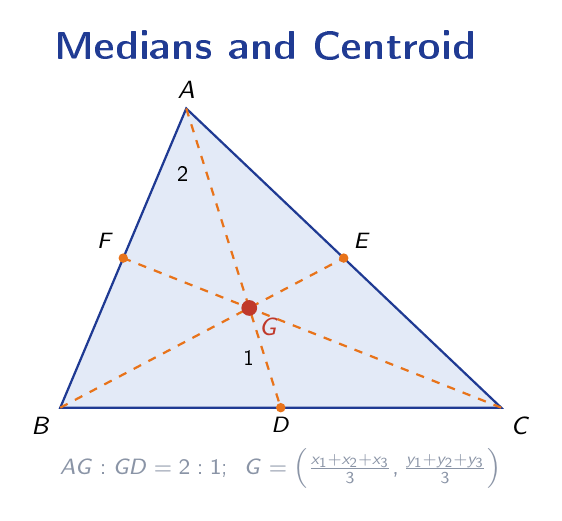
- Centroid \(G\): medians; divides each 2:1 from vertex
- Incenter \(I\): angle bisectors; inscribed circle radius \(r\)
- Circumcenter \(O\): perpendicular bisectors; circumscribed radius \(R\)
- Orthocenter \(H\): altitudes; \(O\), \(G\), \(H\) collinear (\(OG:GH=1:2\))
Similarity & Congruence
Key Results
- Congruence (SSS, SAS, ASA, RHS): identical shape and size.
- Similarity (AA, SSS, SAS): same shape; corresponding sides in ratio \(k\). Area ratio \(=k^2\); volume ratio \(=k^3\).
- Thales' theorem: A line parallel to one side of a triangle cuts the other two sides proportionally.
Circles
Key Theorems
- Circumference \(=2\pi r\); Area \(=\pi r^2\).
- Angle at centre \(=2\times\) angle at circumference (same arc).
- Angle in a semicircle \(=90^\circ\).
- Tangent \(\perp\) radius at point of contact.
- Two tangents from an external point are equal in length.
Power of a point: \(PA\cdot PB = PC\cdot PD = PT^2\)
Sectors and Segments
In radians (\(\theta\)): Arc \(= r\theta\); Area \(= \tfrac{1}{2}r^2\theta\)
In degrees: Arc \(= \dfrac{\theta}{360}(2\pi r)\); Area \(= \dfrac{\theta}{360}\,\pi r^2\)
Segment area \(= \tfrac{1}{2}r^2(\theta-\sin\theta)\) (\(\theta\) in radians)
In degrees: Arc \(= \dfrac{\theta}{360}(2\pi r)\); Area \(= \dfrac{\theta}{360}\,\pi r^2\)
Segment area \(= \tfrac{1}{2}r^2(\theta-\sin\theta)\) (\(\theta\) in radians)
Coordinate Geometry
Distance: \(d=\sqrt{(x_2-x_1)^2+(y_2-y_1)^2}\);
Section formula: \(P=\!\left(\dfrac{mx_2+nx_1}{m+n},\ \dfrac{my_2+ny_1}{m+n}\right)\)
Area of triangle: \(\tfrac{1}{2}\bigl|\,x_1(y_2-y_3)+x_2(y_3-y_1)+x_3(y_1-y_2)\,\bigr|\)
Straight Line Forms
| Form | Equation |
|---|---|
| Slope-intercept | \(y=mx+c\) |
| Point-slope | \(y-y_1 = m(x-x_1)\) |
| Two-point | \(\dfrac{y-y_1}{y_2-y_1}=\dfrac{x-x_1}{x_2-x_1}\) |
| Intercept | \(\dfrac{x}{a}+\dfrac{y}{b}=1\) |
| Perpendicular lines | \(m_1 m_2 = -1\) |
| Distance from point to line | \(\dfrac{|Ax_0+By_0+C|}{\sqrt{A^2+B^2}}\) |
Conic Sections
Equations and Properties
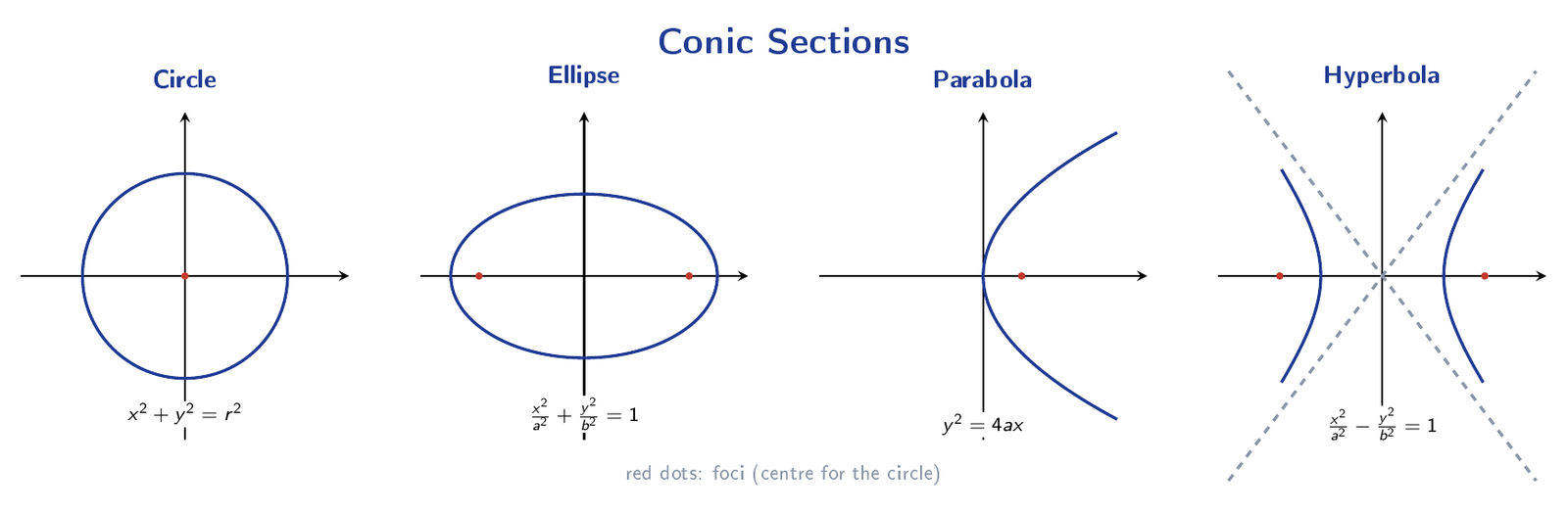
- Circle: \((x-h)^2+(y-k)^2=r^2\)
- Parabola: \(y^2=4ax\); focus \((a,0)\); directrix \(x=-a\)
- Ellipse: \(\dfrac{x^2}{a^2}+\dfrac{y^2}{b^2}=1\); \(e=\sqrt{1-b^2/a^2}\)
- Hyperbola: \(\dfrac{x^2}{a^2}-\dfrac{y^2}{b^2}=1\); \(e=\sqrt{1+b^2/a^2}\); asymptotes \(y=\pm \tfrac{b}{a}x\)
Mensuration
2D Mensuration
| Shape | Area | Perimeter |
|---|---|---|
| Square (side \(a\)) | \(a^2\) | \(4a\) |
| Rectangle (\(l, b\)) | \(lb\) | \(2(l+b)\) |
| Triangle | \(\tfrac{1}{2}bh\) | \(a+b+c\) |
| Equilateral (side \(a\)) | \(\tfrac{\sqrt{3}}{4}a^2\) | \(3a\) |
| Circle (radius \(r\)) | \(\pi r^2\) | \(2\pi r\) |
| Semicircle | \(\tfrac{1}{2}\pi r^2\) | \(\pi r+2r\) |
| Trapezium (\(a\parallel b\), ht \(h\)) | \(\tfrac{1}{2}(a+b)h\) | sum of sides |
| Regular hexagon (side \(a\)) | \(\tfrac{3\sqrt{3}}{2}a^2\) | \(6a\) |
3D Mensuration
| Solid | Volume | TSA | LSA / CSA |
|---|---|---|---|
| Cube (side \(a\)) | \(a^3\) | \(6a^2\) | \(4a^2\) |
| Cuboid (\(l,b,h\)) | \(lbh\) | \(2(lb+bh+lh)\) | \(2h(l+b)\) |
| Cylinder (\(r,h\)) | \(\pi r^2 h\) | \(2\pi r(r+h)\) | \(2\pi r h\) |
| Cone (\(r,h,\ell\)) | \(\tfrac{1}{3}\pi r^2 h\) | \(\pi r(r+\ell)\) | \(\pi r \ell\) |
| Sphere (\(r\)) | \(\tfrac{4}{3}\pi r^3\) | \(4\pi r^2\) | — |
| Hemisphere (\(r\)) | \(\tfrac{2}{3}\pi r^3\) | \(3\pi r^2\) | \(2\pi r^2\) |
Frustum, Prism & Pyramid
- Frustum (radii \(r_1, r_2\), ht \(h\)): \(V = \tfrac{1}{3}\pi h(r_1^2 + r_2^2 + r_1 r_2)\); Slant ht \(\ell = \sqrt{h^2+(r_1-r_2)^2}\)
- Prism: \(V = \text{Base area}\times \text{Height}\)
- Pyramid: \(V = \tfrac{1}{3}\cdot \text{Base area}\cdot \text{Height}\)
Diagonals
Square: \(a\sqrt{2}\); Rectangle: \(\sqrt{l^2+b^2}\); Cube: \(a\sqrt{3}\); Cuboid: \(\sqrt{l^2+b^2+h^2}\)
Trigonometry
Trigonometric Ratios & Standard Values
\[\sin\theta=\frac{\text{Opp}}{\text{Hyp}},\quad \cos\theta=\frac{\text{Adj}}{\text{Hyp}},\quad \tan\theta=\frac{\text{Opp}}{\text{Adj}}\]
\[\csc\theta=\frac{1}{\sin\theta},\quad \sec\theta=\frac{1}{\cos\theta},\quad \cot\theta=\frac{1}{\tan\theta}\]
| \(\theta\) | \(0^\circ\) | \(30^\circ\) | \(45^\circ\) | \(60^\circ\) | \(90^\circ\) |
|---|---|---|---|---|---|
| \(\sin\) | 0 | \(\tfrac{1}{2}\) | \(\tfrac{1}{\sqrt{2}}\) | \(\tfrac{\sqrt{3}}{2}\) | 1 |
| \(\cos\) | 1 | \(\tfrac{\sqrt{3}}{2}\) | \(\tfrac{1}{\sqrt{2}}\) | \(\tfrac{1}{2}\) | 0 |
| \(\tan\) | 0 | \(\tfrac{1}{\sqrt{3}}\) | 1 | \(\sqrt{3}\) | undefined |
Trigonometric Identities
Pythagorean Identities
\[\sin^2\theta+\cos^2\theta = 1\qquad 1+\tan^2\theta=\sec^2\theta\qquad 1+\cot^2\theta=\csc^2\theta\]
Sum / Difference Formulas
\[\begin{align}
\sin(A\pm B) &= \sin A\cos B \pm \cos A \sin B\\
\cos(A\pm B) &= \cos A \cos B \mp \sin A \sin B\\
\tan(A\pm B) &= \frac{\tan A\pm \tan B}{1\mp \tan A\tan B}
\end{align}\]
\[\sin 2A=2\sin A\cos A;\quad \cos 2A=\cos^2 A-\sin^2 A=1-2\sin^2 A=2\cos^2A-1\]
Sine & Cosine Rules
Sine rule: \(\dfrac{a}{\sin A}=\dfrac{b}{\sin B}=\dfrac{c}{\sin C}=2R\);
Cosine rule: \(c^2 = a^2+b^2 -2ab\cos C\)
Heights and Distances
Tower Problem
A pole casts a shadow of 30 m when the sun's elevation is \(30^\circ\).Height \(=30\tan 30^\circ = 30/\sqrt{3}=10\sqrt{3}\approx\)17.3 m.
Two-angle setup (angles \(\alpha <\beta\) from points \(a\) apart on same side):\quad \(h = \dfrac{a\,\tan\alpha\,\tan\beta}{\tan\beta-\tan\alpha}\)
Permutations & Combinations
\[n! = n\cdot(n-1)\cdots 2\cdot 1;\qquad 0!=1\]
\[\nPr{n}{r} = \frac{n!}{(n-r)!}\qquad \nCr{n}{r} = \binom{n}{r} = \frac{n!}{r!\,(n-r)!}\]
Permutation Variants
- Repetitions allowed: \(n^r\)
- Circular (distinct items): \((n-1)!\)
- Necklace/bracelet: \((n-1)!/2\)
- Indistinguishable items (\(p\) of one kind, \(q\) of another): \(\dfrac{n!}{p!\,q!}\)
Combination Properties
- \(\nCr{n}{r}=\nCr{n}{n-r}\)
- \(\nCr{n}{0}=\nCr{n}{n}=1\)
- Pascal's rule: \(\nCr{n}{r} = \nCr{n-1}{r-1}+\nCr{n-1}{r}\)
- Sum: \(\displaystyle\sum_{r=0}^n \nCr{n}{r} = 2^n\)
Example — Letters of MISSISSIPPI
11 letters: M×1, I×4, S×4, P×2.\(\dfrac{11!}{4!\,4!\,2!\,1!}=\)34,650.
Distributing \(n\) identical balls into \(r\) distinct boxes (no restriction): \(\nCr{n+r-1}{r-1}\) (stars-and-bars).
Derangements: \(D_n = n!\sum_{k=0}^{n}\dfrac{(-1)^k}{k!}\approx \dfrac{n!}{e}\)
Derangements: \(D_n = n!\sum_{k=0}^{n}\dfrac{(-1)^k}{k!}\approx \dfrac{n!}{e}\)
Probability
\[P(A) = \frac{\text{favourable outcomes}}{\text{total equally-likely outcomes}}\qquad 0\leq P(A)\leq 1;\quad P(\bar{A})=1-P(A)\]
\[P(A\cup B) = P(A) + P(B) - P(A\cap B)\]
\[P(A\mid B) = \frac{P(A\cap B)}{P(B)},\qquad P(A\cap B) = P(A\mid B)\cdot P(B)\]
Bayes' theorem: \(\displaystyle P(A\mid B) = \frac{P(B\mid A)\,P(A)}{P(B)}\)
Standard Distributions
Binomial Distribution
\(n\) independent Bernoulli trials; probability of exactly \(k\) successes:
\[P(X=k) = \binom{n}{k}p^k (1-p)^{n-k}\qquad \mu=np;\quad \sigma^2=np(1-p)\]
Geometric Distribution
Number of trials until first success:\quad \(P(X=k)=(1-p)^{k-1}p,\quad E[X]=\tfrac{1}{p}\)
Poisson Distribution (Rare Events)
\(P(X=k)=\dfrac{\lambda^k e^{-\lambda}}{k!},\quad E[X]=\mathrm{Var}(X)=\lambda\)
Expectation: \(E[X]=\displaystyle\sum_i x_i\,P(X=x_i);\qquad \mathrm{Var}(X)=E[X^2]-\bigl(E[X]\bigr)^2\)
Set Theory
\[|A\cup B| = |A|+|B|-|A\cap B|\]
\[|A\cup B\cup C| = |A|+|B|+|C|-|A\cap B|-|B\cap C|-|A\cap C|+|A\cap B\cap C|\]
De Morgan's Laws & Other Properties
\((A\cup B)^c = A^c\cap B^c\); \((A\cap B)^c = A^c\cup B^c\); \(|\mathcal{P}(A)| = 2^{|A|}\); \(|A\times B| = |A|\cdot|B|\)
Example — Tea / Coffee Preferences
In 100 students: 60 like tea, 50 like coffee, 30 like both.\(|T\cup C|=60+50-30=80\). 20 like neither.
Statistics
Measures of Central Tendency
Mean: \(\bar{x} = \dfrac{\sum x_i}{n}\) (raw); \(\bar{x}=\dfrac{\sum f_i x_i}{\sum f_i}\) (grouped).Median (grouped data): \[\text{Median}=L+\frac{\tfrac{n}{2}-F}{f}\cdot h\] where \(L\) = lower limit of median class, \(F\) = cumulative frequency before, \(f\) = class frequency, \(h\) = class width.
Empirical relation (Karl Pearson): \(\text{Mode}\approx 3\,\text{Median} - 2\,\text{Mean}\).
Measures of Dispersion
\[\sigma^2 = \frac{1}{n}\sum_{i=1}^{n} (x_i-\bar{x})^2;\qquad \sigma=\sqrt{\sigma^2}\]
Sample variance: \(s^2 = \dfrac{1}{n-1}\sum (x_i-\bar{x})^2\); CV \(= \dfrac{\sigma}{\bar{x}}\times 100\%\)
Pearson correlation: \(r = \dfrac{\sum (x_i-\bar{x})(y_i-\bar{y})}{\sqrt{\sum(x_i-\bar{x})^2}\,\sqrt{\sum(y_i-\bar{y})^2}}\); \(-1\leq r\leq 1\)
Linear Regression \(y = a + bx\)
\[b = \frac{\sum(x_i-\bar{x})(y_i-\bar{y})}{\sum (x_i-\bar{x})^2};\qquad a=\bar{y} - b\bar{x}\]
Time, Speed & Distance
\[D = S\times T\qquad 1\,\text{km/h}=\tfrac{5}{18}\,\text{m/s};\qquad 1\,\text{m/s}=\tfrac{18}{5}\,\text{km/h}\]
Average speed (equal distances at speeds \(u, v\)): \(\bar{v} = \dfrac{2uv}{u+v}\) (harmonic mean)
Trains
Passing Distances
- Pole / standing person: distance = length of train
- Platform / another train: distance = sum of lengths
Relative Speed
Same direction: \(|v_1-v_2|\); Opposite direction: \(v_1+v_2\)
Boats and Streams
Downstream speed \(= b+s\); Upstream speed \(= b-s\)
\(b = \tfrac{1}{2}(\text{down}+\text{up});\qquad s=\tfrac{1}{2}(\text{down}-\text{up})\)
\(b = \tfrac{1}{2}(\text{down}+\text{up});\qquad s=\tfrac{1}{2}(\text{down}-\text{up})\)
Round trip time: \(\dfrac{d}{b-s}+\dfrac{d}{b+s}=\dfrac{2bd}{b^2-s^2}\)
Races and Clocks
Clock Angle Formula
Hour hand: \(30^\circ\)/hr \(= 0.5^\circ\)/min. Minute hand: \(6^\circ\)/min.Angle between hands at \(H:M\): \(\bigl|30H - 5.5M\bigr|\pmod{360^\circ}\).
Hands coincide every \(\dfrac{720}{11}\,\text{min} \approx 65\,\text{min}\,27\,\text{s}\), i.e. 11 times in 12 hours.
Time and Work
Combined rate \(=\dfrac{1}{a}+\dfrac{1}{b}\); Time together \(=\dfrac{ab}{a+b}\)
Work conservation: \(\dfrac{M_1 D_1 H_1}{W_1} = \dfrac{M_2 D_2 H_2}{W_2}\)
Work conservation: \(\dfrac{M_1 D_1 H_1}{W_1} = \dfrac{M_2 D_2 H_2}{W_2}\)
Example — Two Workers
A finishes in 12 days, B in 18 days. Together: \(\dfrac{12\cdot 18}{12+18}=\dfrac{216}{30}=\)7.2 days.
Example — Pipes and Cisterns
Pipe A fills in 6 h; pipe B empties in 8 h. Net rate \(= \tfrac{1}{6}-\tfrac{1}{8}=\tfrac{1}{24}\). Tank fills in 24 hours.
Watch the Sign
Always check whether each pipe fills or empties before adding rates. An overlooked outlet flips the answer.
Data Interpretation
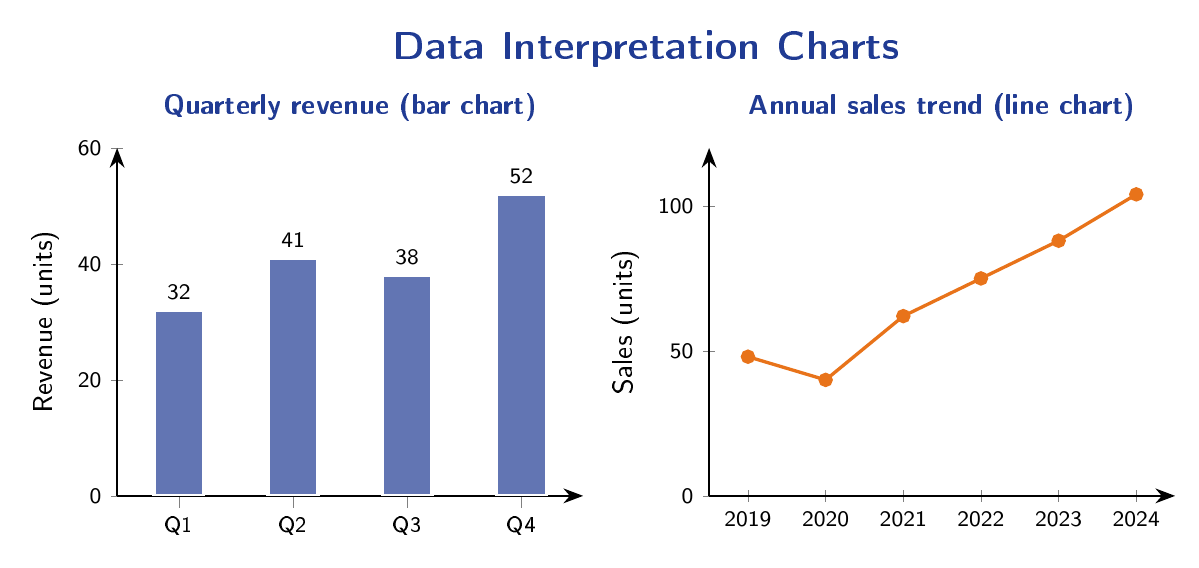
Common Chart Types
- Tables: rows/columns of values.
- Bar graphs: categorical comparison; vertical or horizontal.
- Line graphs: trends over time.
- Pie charts: proportions of a whole; total \(=100\%\) or \(360^\circ\).
- Stacked/grouped bars: composition with comparison.
- Caselets: paragraph-form data.
Compound Annual Growth Rate (CAGR)
\[\text{CAGR} = \left(\frac{V_T}{V_0}\right)^{\!1/T} - 1\qquad \text{Simple YoY growth: }g = \frac{V_T - V_{T-1}}{V_{T-1}}\times 100\%\]
Approximation & Estimation
Common Shortcuts
- Round to nearest 10 / 100 before multiplying.
- Convert % to fractions: \(33\%=1/3\), \(25\%=1/4\).
- Newton step for square root: \(\sqrt{n}\approx\tfrac{1}{2}(g+\tfrac{n}{g})\).
- Difference of squares: \(a^2-b^2=(a-b)(a+b)\).
DI Rule of Thumb
Identify the question type first: ratio, growth, total, or relative comparison. Then select only the data point you need — don't read everything. Only approximate when answer choices are well-separated; if two options differ by less than 2%, compute exactly.
Summary & Universal Cheat Sheet
Exam Mantra
Score ∝ Accuracy × Speed × Pattern Recognition
Master fundamentals first, not shortcuts. Build a personal formula sheet. Practice with a timer from week one. Review mistakes more than new problems.
Arithmetic Formulas
- \(\text{SI}=\dfrac{PRT}{100}\); \(\text{CI}=P\!\left(1+\tfrac{R}{100}\right)^{T}\!-P\)
- Profit% \(=\dfrac{\text{SP}-\text{CP}}{\text{CP}}\times 100\)
- Successive %: \(a+b+\dfrac{ab}{100}\)
- Avg speed (equal dist.): \(\dfrac{2xy}{x+y}\)
- Alligation: \(\dfrac{Q_{\text{cheap}}}{Q_{\text{dear}}}=\dfrac{D-M}{M-C}\)
Algebra Formulas
- \((a\pm b)^2=a^2\pm 2ab+b^2\)
- \(a^3\pm b^3=(a\pm b)(a^2\mp ab+b^2)\)
- Quadratic: \(x=\dfrac{-b\pm\sqrt{b^2-4ac}}{2a}\)
- AP: \(S_n=\tfrac{n}{2}(2a+(n-1)d)\)
- GP: \(S_n=\dfrac{a(r^n-1)}{r-1}\)
- Binomial: \(T_{k+1}=\binom{n}{k}a^{n-k}b^k\)
Geometry / Mensuration
- Triangle area \(=\tfrac{1}{2}bh\); Heron's \(\sqrt{s(s-a)(s-b)(s-c)}\)
- Circle: \(A=\pi r^2\), \(C=2\pi r\)
- Sphere: \(V=\tfrac{4}{3}\pi r^3\), \(S=4\pi r^2\)
- Cone: \(V=\tfrac{1}{3}\pi r^2 h\), \(S=\pi r(r+\ell)\)
- Cylinder: \(V=\pi r^2 h\), \(S=2\pi r(r+h)\)
Trigonometry
- \(\sin^2\theta+\cos^2\theta=1\)
- \(1+\tan^2\theta=\sec^2\theta\)
- \(\sin(A\pm B)=\sin A\cos B\pm \cos A\sin B\)
- Sine rule: \(\dfrac{a}{\sin A}=\dfrac{b}{\sin B}=\dfrac{c}{\sin C}=2R\)
- Cosine rule: \(c^2=a^2+b^2-2ab\cos C\)
Counting & Probability
- \({}^nP_r=\dfrac{n!}{(n-r)!}\); \({}^nC_r=\dfrac{n!}{r!(n-r)!}\)
- \(P(A\cup B)=P(A)+P(B)-P(A\cap B)\)
- Bayes: \(P(A\mid B)=\dfrac{P(B\mid A)P(A)}{P(B)}\)
- Binomial: \(E[X]=np\), \(\mathrm{Var}=np(1-p)\)
Statistics & TSD & Work
- Mean: \(\bar{x}=\dfrac{\sum x_i}{n}\); Var: \(\sigma^2=\dfrac{\sum(x_i-\bar{x})^2}{n}\)
- Empirical: Mode \(\approx 3\,\text{Median} - 2\,\text{Mean}\)
- \(D=ST\); km/h → m/s: \(\times\tfrac{5}{18}\)
- Combined work: \(\tfrac{1}{T}=\tfrac{1}{a}+\tfrac{1}{b}\)
- Logs: \(\log(ab)=\log a+\log b\); \(\log_b a=\dfrac{\log a}{\log b}\)
- Sets: \(|A\cup B|=|A|+|B|-|A\cap B|\)
Common Pitfalls — Don't Lose Easy Marks
Calculation Traps
- Confusing % change with % point change.
- Forgetting base year in CAGR / growth.
- Mixing units (km vs m, hr vs s, % vs decimal).
- Squaring negatives: \((-3)^2=9\), not \(-9\).
- Treating \(\sqrt{a^2+b^2}\) as \(a+b\).
Algebra Traps
- Cancelling a variable that may be zero.
- Squaring an inequality with a negative side.
- Forgetting domain restrictions in logs (\(x>0\)).
Geometry Traps
- Assuming a figure is to scale.
- Confusing radius with diameter in surface area.
- Forgetting Pythagoras condition (\(c\) = hypotenuse).
- Sector vs segment area.
Probability & DI Traps
- Assuming independence without proof.
- Reading a pie chart in degrees vs %.
- Comparing absolute vs relative values.
- Trusting visual proportions over actual numbers.
Further Reading & References
Books — Conceptual Depth
- Arun Sharma — Quantitative Aptitude for CAT, McGraw-Hill
- Sarvesh Verma — Quantum CAT, Arihant Publications
- Nishit K. Sinha — Quantitative Aptitude, Pearson
- R. S. Aggarwal — Quantitative Aptitude for Competitive Exams, S. Chand
- Trishna Knowledge Systems — Quantitative Aptitude, Pearson
- NCERT Mathematics Textbooks, Classes IX–XII
- K. H. Rosen — Discrete Mathematics and Its Applications, McGraw-Hill, 8th ed.
- M. R. Spiegel & L. J. Stephens — Schaum's Outline of Statistics, McGraw-Hill, 6th ed.
Online & Exam Material
- NPTEL — discrete math and probability courses
- GATE past papers (gate.iitk.ac.in) — 10+ years
- CAT past papers (iimcat.ac.in)
- Art of Problem Solving (aops.com)
- Khan Academy — algebra and geometry refresher
- Project Euler — numerical reasoning practice
Practice Strategy
Pick one primary book. Solve every problem. Use others only for additional drills on weak topics. Take a full timed mock every weekend and spend two hours analysing it — every wrong answer becomes a flashcard.