Electric Power Systems
A Comprehensive Revision Guide for Competitive Examinations
Introduction to Electric Power Systems
What is an Electric Power System?
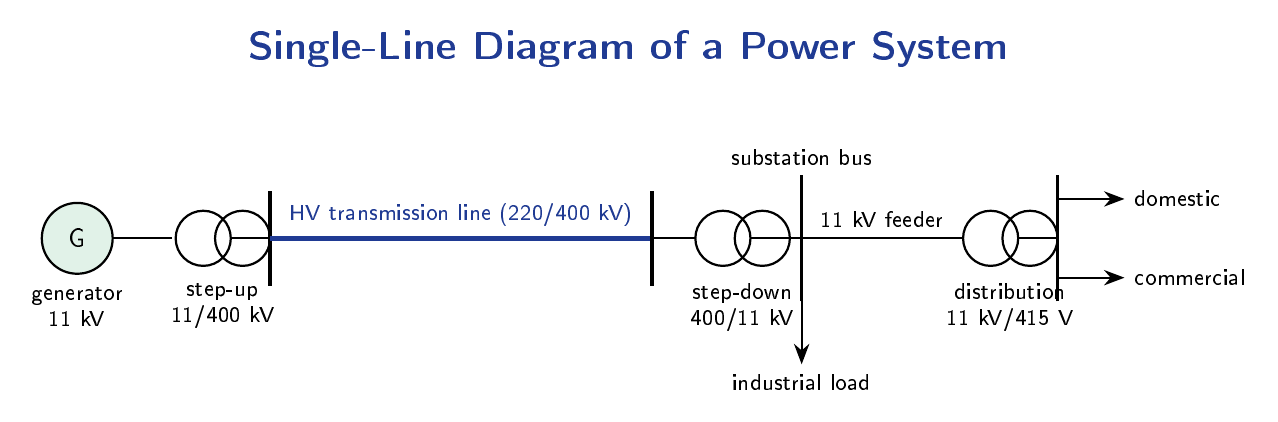
An electric power system is a network of components that generate, transmit, distribute, and consume electrical energy to meet load demand reliably and economically.
- Generation — Convert primary energy to electricity
- Transmission — Bulk power transfer at high voltage
- Distribution — Deliver power to end-users
- Reliability and continuity
- Regulation of voltage and frequency
- Reduced losses
- Resilience to disturbances
- Reasonable cost (economy)
- Safety and environmental compliance
Structure of a Modern Power System
Why High-Voltage Transmission?
For a given power \(P\) and power factor \(\cos\phi\), the line current is
A higher transmission voltage reduces the current, which reduces \(I^2R\) losses. Doubling the voltage halves the current, cutting losses to one-quarter and allowing a smaller conductor cross-section.
Higher voltage increases insulation cost, corona loss, and radio interference. Engineers select the optimum voltage level based on the distance and power to be transmitted.
AC versus DC Transmission
| Aspect | AC Transmission | HVDC Transmission |
|---|---|---|
| Conductors | 3 (three-phase) | 2 (bipolar) or 1 (monopolar) |
| Skin effect | Present | Absent |
| Reactive power | Generated and absorbed by line | No reactive power issue |
| Stability limit | Limited by synchronism | No synchronous stability limit |
| Corona losses | Higher | Lower |
| Converter stations | Not required | Required (high capital cost) |
| Best application | Short/medium distances | Long distance (>600 km), submarine cables |
The Power Triangle and Power Factor
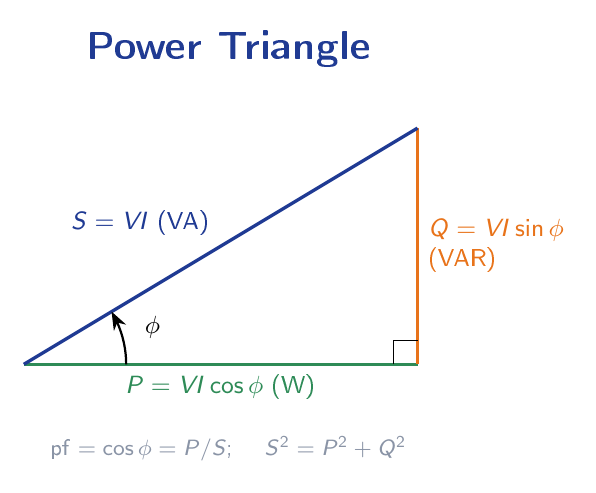
- \(P = VI\cos\phi\) — Real power; performs useful work
- \(Q = VI\sin\phi\) — Reactive power; sustains magnetic and electric fields
- \(S = VI\) — Apparent power; governs equipment ratings
A low power factor means higher current for the same real power, leading to increased losses, larger equipment, and utility penalties.
Sources of Electrical Generation
| Type | Fuel / Source | Advantages | Limitations |
|---|---|---|---|
| Thermal | Coal, gas, oil | Proven, base-load capacity | Emissions, ash handling |
| Hydro | Water head | Clean, fast ramping, peaking | Site-dependent, ecological concerns |
| Nuclear | U-235, Th-232 | High energy density, low emissions | Waste disposal, safety, long lead time |
| Gas Turbine | Natural gas | Fast start, lower emissions | Volatile fuel cost |
| Solar PV | Sunlight | No fuel cost, modular | Intermittent, land-intensive |
| Wind | Kinetic energy | No fuel, mature technology | Intermittent, low inertia contribution |
Base-load plants have high capital cost and low operating cost; they run continuously (nuclear, large thermal, run-of-river hydro). Peak-load plants have low capital cost but high operating cost; they start only during peak demand (gas turbines, pumped hydro, diesel).
Solar PV Cell Characteristics and MPPT
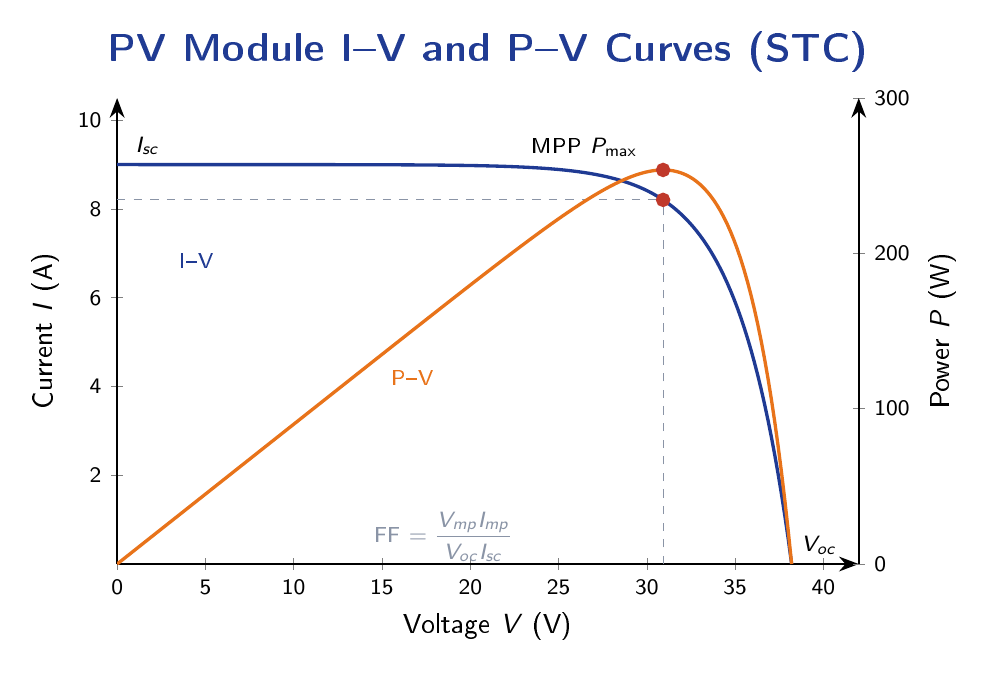
Key PV parameters: short-circuit current \(I_{sc}\), open-circuit voltage \(V_{oc}\), and the fill factor
- Perturb and Observe (P&O) — simple, widely used, slight oscillation at MPP
- Incremental Conductance — more accurate, faster convergence
- Fuzzy / ML-based — modern, handles rapid irradiance changes
Wind Turbine Generator Types
| Type | Generator | Speed Range | Key Features |
|---|---|---|---|
| Type 1 | SCIG, fixed speed | ~1% slip | Direct grid connection; reactive Q drawn from grid; flicker issues |
| Type 2 | WRIG with variable rotor resistance | ±10% | Limited speed range via rotor resistance control |
| Type 3 | DFIG (partial converter ~30%) | ±30% | Most popular; partial power converter; FRT challenges |
| Type 4 | PMSG / SCIG, full converter | 0–100% | Full decoupling from grid; best grid support; modern standard |
Energy Storage Technologies
| Technology | Power | Duration | Efficiency | Best For |
|---|---|---|---|---|
| Pumped Hydro (PHS) | MW–GW | hours–days | 70–85% | Bulk storage, peak-shifting (largest installed base) |
| Compressed Air (CAES) | 10–300 MW | hours | 50–70% | Bulk, slow response |
| Li-ion BESS | kW–100 MW | min–4 h | 90–95% | Frequency regulation, peak shaving, EV |
| Lead-acid | kW–MW | min–hours | 70–85% | Backup, economical UPS |
| Flow Battery (V/Zn-Br) | kW–MW | 4–10 h | 65–80% | Long-duration, cycling-heavy applications |
| Flywheel | 0.1–20 MW | seconds | 85–95% | Frequency regulation, UPS ride-through |
| Supercapacitor | kW–MW | ms–s | 90–98% | Power quality, transient support |
| Hydrogen / Fuel Cell | kW–MW | hours–days | 30–45% | Seasonal storage, decarbonisation |
Power rating (kW/MW) • Energy duration (kWh/MWh) • Round-trip efficiency • Cycle life • Response time • Capital cost ($/kWh)
Load Curves and Key Factors
- Load factor ≤ 1 (higher is better — indicates better utilisation)
- Diversity factor ≥ 1 (higher is better — reduces required installed capacity)
- Demand factor ≤ 1
- \(\text{LF} \leq \text{Capacity Factor}\)
The daily load curve plots power demand versus time over 24 hours; the area under it equals energy consumed. The load duration curve rearranges loads in descending order, enabling economic assessment of generation mix.
Electricity Tariffs
- Flat-rate: fixed rate per kWh
- Block-rate: multiple slabs with different rates
- Two-part: fixed capacity charge + variable energy charge
- Three-part: fixed + energy + maximum demand charge
- Time-of-Use (ToU): peak / off-peak pricing
- Power factor tariff: financial penalty for low PF
\(A\) = demand charge (INR/kW) | \(B\) = energy charge (INR/kWh) | \(C\) = fixed charge
Key Components of Power Systems
Synchronous Generators (Alternators)
\(P\) = poles, \(N_s\) = synchronous speed (rpm), \(\phi\) = flux per pole, \(T\) = turns per phase, \(k_w\) = winding factor.
- Salient pole: low speed, \(P \geq 4\), used in hydroelectric generators
- Cylindrical (round) rotor: high speed, \(P = 2\) or 4, used in steam and gas turbine generators
- Unity PF: Cross-magnetising — distorts flux distribution
- Lagging PF (inductive load): Demagnetising — reduces terminal voltage
- Leading PF (capacitive load): Magnetising — increases terminal voltage
Synchronous Generator Phasor Diagrams
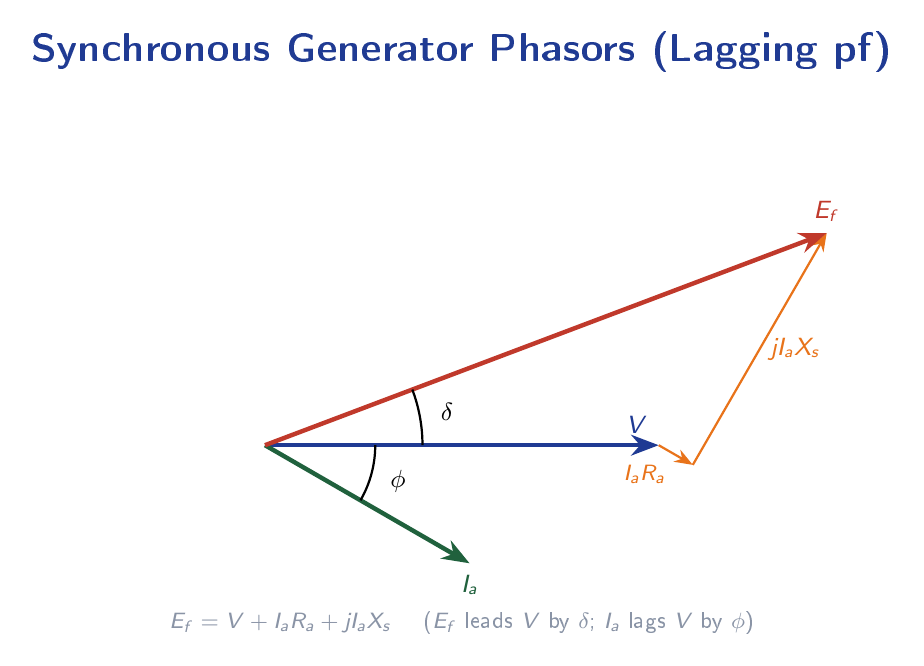
Single synchronous reactance \(X_s\) applies uniformly in all axes.
\(X_d > X_q\) due to the non-uniform air-gap. \(I_d\) and \(I_q\) are the direct-axis and quadrature-axis components of \(I_a\).
Transformers
"+" for lagging PF, "−" for leading PF.
Transformer losses: core (iron) losses are constant and depend on flux; copper losses are variable and proportional to the square of the load current. Maximum efficiency occurs when copper losses equal core losses:
where \(x_{full}\) is the per-unit loading at maximum efficiency.
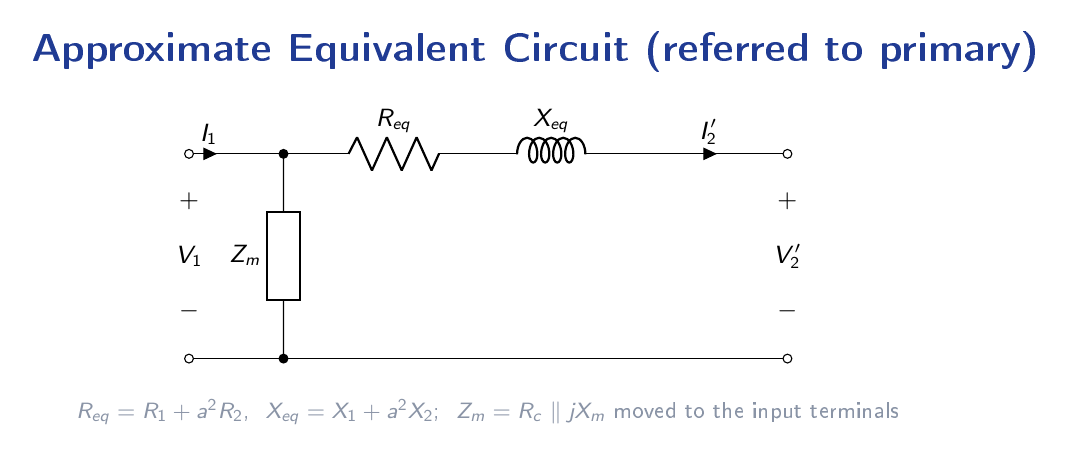
- Open-Circuit (OC) Test: determines core losses, magnetising reactance \(X_m\), and core-loss resistance \(R_c\)
- Short-Circuit (SC) Test: determines copper losses and equivalent impedance \(Z_{eq}\)
- Sumpner's (Back-to-back) Test: full-load heat run with minimal supply power
Transformer Equivalent Circuit
Three-Phase Transformer Connections
| Connection | Phase Shift | Advantages | Drawbacks |
|---|---|---|---|
| Y–Y (Yy0) | 0° | Neutral available; low insulation cost | Third-harmonic problems unless tertiary delta is provided |
| Δ–Δ (Dd0) | 0° | Open-delta operation possible | No neutral; high insulation requirement |
| Y–Δ (Yd1/Yd11) | 30° | Step-down; delta side blocks zero-sequence | Phase-shift care needed for parallel operation |
| Δ–Y (Dy1/Dy11) | 30° | Step-up; secondary neutral available | Phase shift complicates paralleling |
| Zig-zag | 0°/30° | Earthing transformer; harmonic suppression | More expensive to manufacture |
Transmission Line Classification
| Type | Length | Parameters Considered | Model Used |
|---|---|---|---|
| Short line | < 80 km | R, L (lumped) | Series impedance only |
| Medium line | 80–250 km | R, L, C (lumped) | Nominal π or nominal T |
| Long line | > 250 km | R, L, C, G (distributed) | ABCD parameters / hyperbolic functions |
ABCD Parameters (Two-Port Network)
For a symmetric passive line: \(AD - BC = 1\) and \(A = D\). The percentage voltage regulation using ABCD parameters is
| Line Model | A | B | C | D |
|---|---|---|---|---|
| Short (< 80 km) | \(1\) | \(Z\) | \(0\) | \(1\) |
| Medium nominal-T | \(1+\dfrac{YZ}{2}\) | \(Z\!\left(1+\dfrac{YZ}{4}\right)\) | \(Y\) | \(1+\dfrac{YZ}{2}\) |
| Medium nominal-π | \(1+\dfrac{YZ}{2}\) | \(Z\) | \(Y\!\left(1+\dfrac{YZ}{4}\right)\) | \(1+\dfrac{YZ}{2}\) |
| Long line (exact) | \(\cosh\gamma\ell\) | \(Z_c\sinh\gamma\ell\) | \(\dfrac{\sinh\gamma\ell}{Z_c}\) | \(\cosh\gamma\ell\) |
Transmission Line Parameters
\(D_m\) = GMD (geometric mean distance between phases); \(D_s\) = GMR (geometric mean radius of conductor).
The SIL is the load at which the line delivers exactly as much reactive power as it absorbs — the line neither generates nor consumes net reactive power, and voltage profile is flat.
On a long, lightly-loaded (or no-load) transmission line, the receiving-end voltage exceeds the sending-end voltage. This is caused by the leading current drawn by the line's distributed capacitance flowing through the line inductance, which produces a voltage rise. Shunt reactors at the receiving end are used to absorb this excess reactive power.
Skin Effect, Proximity Effect, and Corona
At power frequency, AC current tends to flow near the conductor surface. Effective resistance increases approximately as \(\sqrt{f}\). Mitigation: stranded or hollow conductors, ACSR (Aluminium Conductor Steel Reinforced).
Non-uniform current distribution caused by the magnetic field of neighbouring current-carrying conductors. Also raises effective AC resistance beyond the skin-effect value alone.
Ionisation of air around a conductor when the electric field exceeds the dielectric strength of air (~30 kV/cm). Causes power loss, radio interference, and characteristic hissing noise. Bundled conductors reduce surface gradient and suppress corona on EHV lines.
Protection System: Relays and Zones
- Overcurrent (IDMT): inverse-time characteristic; used for feeders and distribution
- Differential: compares current in versus current out; used for transformers, generators, and busbars
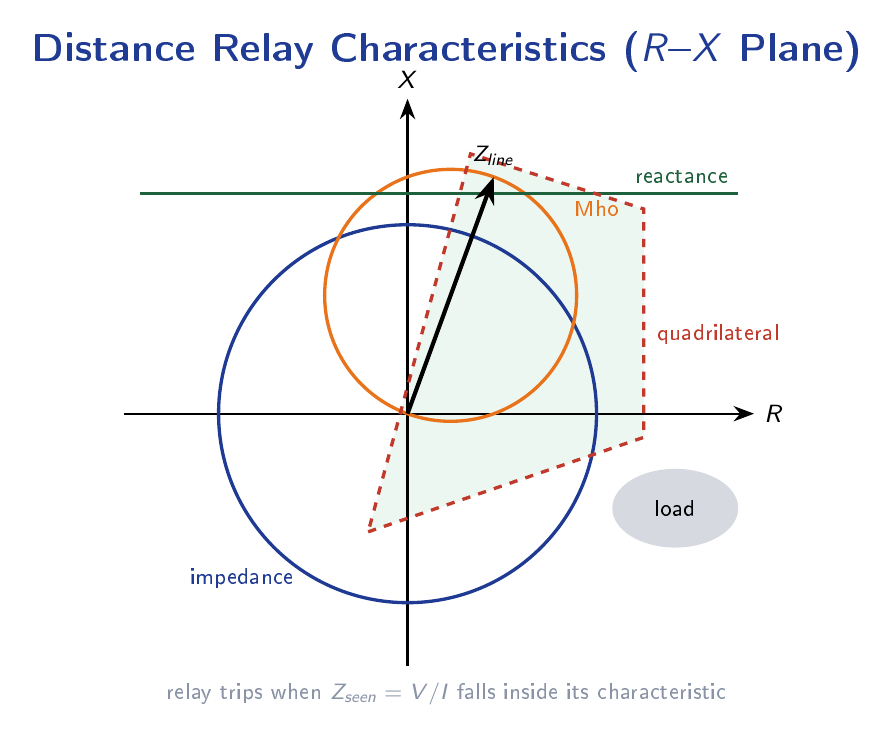
- Distance (impedance): measures \(V/I\) seen at relay; primary protection for transmission lines
- Directional: discriminates fault direction; used in ring or mesh systems
- Buchholz: detects gas accumulation in oil-filled transformers
- Zone 1: 80% of protected line — instantaneous trip
- Zone 2: 120% of line — ~0.3 s time delay (remote-end backup)
- Zone 3: reaches into next line — ~1 s time delay (remote backup)
Instrument Transformers: CT and PT
- Primary winding: in series with the line
- Secondary: connects to ammeter or relay (standard rating: 5 A or 1 A)
- Never open-circuit the secondary — a dangerously high voltage appears across the open terminals
- Ratio: \(I_p / I_s = n\); burden specified in VA
- Primary winding: connected in parallel with the line
- Secondary: standard 110 V line-to-line
- Never short-circuit the secondary — this creates an overcurrent fault
- Used for voltmeters, wattmeters, and protective relays
Neutral Grounding Methods
| Method | Description | Characteristics |
|---|---|---|
| Ungrounded | Isolated neutral | High transient overvoltages; ferro-resonance risk |
| Solid grounding | Direct neutral-earth connection | High fault current; low overvoltages; used at LV and EHV levels |
| Resistance grounding | Resistor in neutral | Limits fault current; controls transient overvoltage |
| Reactance grounding | Reactor in neutral | Must satisfy \(X_n \leq X_0/3\) to avoid transient overvoltages |
| Peterson coil | Tuned arc-suppression reactor | Self-extinguishing arcs; used in medium-voltage systems; \(L = 1/(3\omega^2 C)\) |
Circuit Breaker Ratings
The RRRV (V/μs) is a critical parameter for successful arc interruption. If the RRRV exceeds the dielectric recovery rate of the arc gap, a restrike occurs: \(\text{RRRV}_{max} = \omega V_m\). The restriking voltage is the high-frequency transient voltage immediately after interruption; the recovery voltage is the power-frequency steady-state voltage after transients decay.
Per-Unit (p.u.) System
The per-unit system eliminates transformer turns ratios from calculations, keeps all quantities in a similar numerical range, and simplifies multi-voltage-level network analysis.
Power System Analysis
Load Flow (Power Flow) Analysis
The objective of load flow is to determine steady-state bus voltages, line flows, and system losses under a specified generation and load condition. Buses are classified by which quantities are known and which are solved:
| Bus Type | Known (1) | Known (2) | Unknown (1) | Unknown (2) |
|---|---|---|---|---|
| Slack (Swing) | \(|V|\) | \(\delta\) | \(P\) | \(Q\) |
| PV (Generator) | \(|V|\) | \(P\) | \(\delta\) | \(Q\) |
| PQ (Load) | \(P\) | \(Q\) | \(|V|\) | \(\delta\) |
The nonlinear power flow equations (for bus \(i\) in an \(n\)-bus system) are:
Load Flow Solution Methods
| Method | Convergence | Memory | Typical Usage |
|---|---|---|---|
| Gauss–Seidel | Slow (linear) | Low | Small systems, educational |
| Newton–Raphson | Fast (quadratic) | High | Large industrial systems |
| Fast Decoupled | Fast | Moderate | Online EMS applications |
| DC Load Flow | Instant (linear) | Very low | Planning studies, approximation |
The number of N-R iterations is practically independent of system size; each iteration involves forming and solving the Jacobian, which is computationally heavier than a Gauss–Seidel iteration.
Ybus and Zbus Matrix Formulation
- Diagonal \(Y_{ii}\): sum of all admittances connected to bus \(i\)
- Off-diagonal \(Y_{ij} = -y_{ij}\) (negative of mutual admittance)
- Sparse; efficient for large networks; used in load flow
- Full (dense) matrix; diagonal element \(Z_{ii}\) is the Thevenin impedance at bus \(i\)
- Fault current at bus \(k\): \(I_f^{(k)} = V_k^{pre-fault}/(Z_{kk} + Z_f)\)
- Used in fault analysis and short-circuit calculations
Three buses connected by lines with impedances \(z_{12} = j0.2\), \(z_{13} = j0.4\), \(z_{23} = j0.5\) p.u.
Admittances: \(y_{12} = -j5\), \(y_{13} = -j2.5\), \(y_{23} = -j2\) p.u.
Quick checks: \(Y_{bus}\) is symmetric for passive networks; each row sums to zero when there are no shunt elements to ground; \(Z_{bus} = Y_{bus}^{-1}\) is a full matrix.
Fault Analysis — Types of Faults
- LLL (three-phase balanced) and LLLG (three-phase to ground)
- Most severe but least frequent
- Analysed using the positive-sequence network alone
- LG (line-to-ground) — ~70% of faults
- LL (line-to-line) — ~15%
- LLG (double line-to-ground) — ~10%
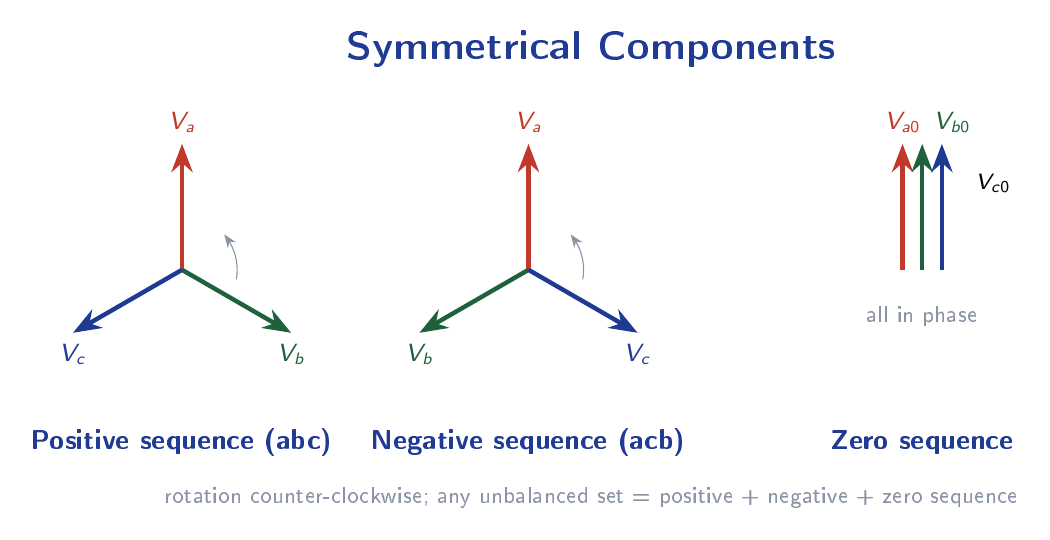
Require symmetrical components (Fortescue's theorem) for analysis.
Symmetrical Components
| Fault | Network Connection | Boundary Conditions |
|---|---|---|
| 3-φ (LLL) | Positive sequence only | \(V_a = V_b = V_c = 0\) at fault point |
| LL (b–c) | Positive and negative in parallel | \(I_a = 0\), \(I_b = -I_c\) |
| LG (a–g) | All three (1, 2, 0) in series | \(I_b = I_c = 0\), \(V_a = Z_f I_a\) |
| LLG (b–c–g) | Positive in series with (2 ∥ 0) | \(I_a = 0\), \(V_b = V_c = Z_f(I_b + I_c)\) |
Problem: A 50 MVA, 11 kV generator with \(X_d'' = 0.20\) p.u. feeds a 50 MVA, 11/132 kV transformer (\(X = 0.10\) p.u.). A line with \(X = 20\,\Omega\) connects to a fault on the 132 kV bus. Find the three-phase fault current on a system base of 100 MVA, 132 kV.
Step 1 — Convert to new base:
Step 2 — Total reactance and fault current:
Load Frequency Control (LFC) and Automatic Generation Control (AGC)
Typical droop \(R = 4\)–\(5\%\) of rated speed. A lower droop means a stiffer frequency response.
- Primary (droop): automatic, acts in seconds — arrests frequency deviation
- Secondary (AGC): restores frequency to nominal, acts in minutes
- Tertiary (economic dispatch): optimises generation cost, acts in minutes to hours
The AGC drives ACE to zero, simultaneously restoring frequency and scheduled tie-line power exchange.
Reactive Power and Voltage Control
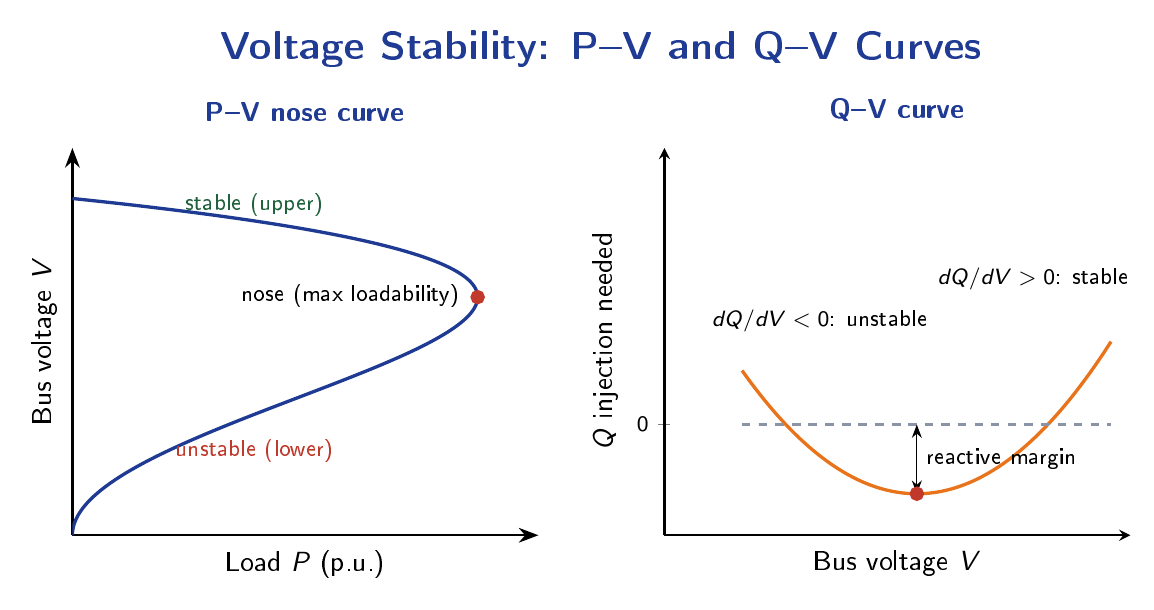
Reactive power and voltage magnitude are tightly coupled: \(Q\) must be supplied locally because long-distance reactive power transfer is highly inefficient. The key \(P\)–\(f\) and \(Q\)–\(V\) decoupling underpins the Fast Decoupled Load Flow method.
- Shunt capacitor: supplies \(Q\), boosts voltage
- Shunt reactor: absorbs \(Q\), reduces voltage (counters Ferranti effect)
- Series capacitor: reduces effective reactance, increases active power transfer limit
- Synchronous condenser: provides variable \(Q\) continuously
- SVC / STATCOM: fast dynamic voltage and \(Q\) control
- On-load tap-changing (OLTC) transformer: voltage regulation at substations
FACTS Devices: Shunt versus Series Compensation
| Device | Type | Connection | Function | Speed |
|---|---|---|---|---|
| SVC (TCR/TSC) | Shunt | Thyristor-switched | Variable Q (capacitor + reactor) for voltage control | Cycle (ms) |
| STATCOM | Shunt | VSC + DC capacitor | Q injection independent of voltage; superior at low voltage | Sub-cycle |
| TCSC | Series | Thyristor-switched capacitor | Variable \(X_C\); damps SSR; raises power transfer limit | ms |
| SSSC | Series | VSC injects \(V_q\) | Series voltage injection; virtual reactance control | Sub-cycle |
| UPFC | Combined | Two VSCs (shunt + series) | Independent control of \(P\), \(Q\), and \(V\) | Sub-cycle |
Turbine-generator torsional modes can interact with series-compensated lines, potentially causing shaft fatigue or failure. The TCSC mitigates SSR by detuning the resonant frequency dynamically.
Power System Stability
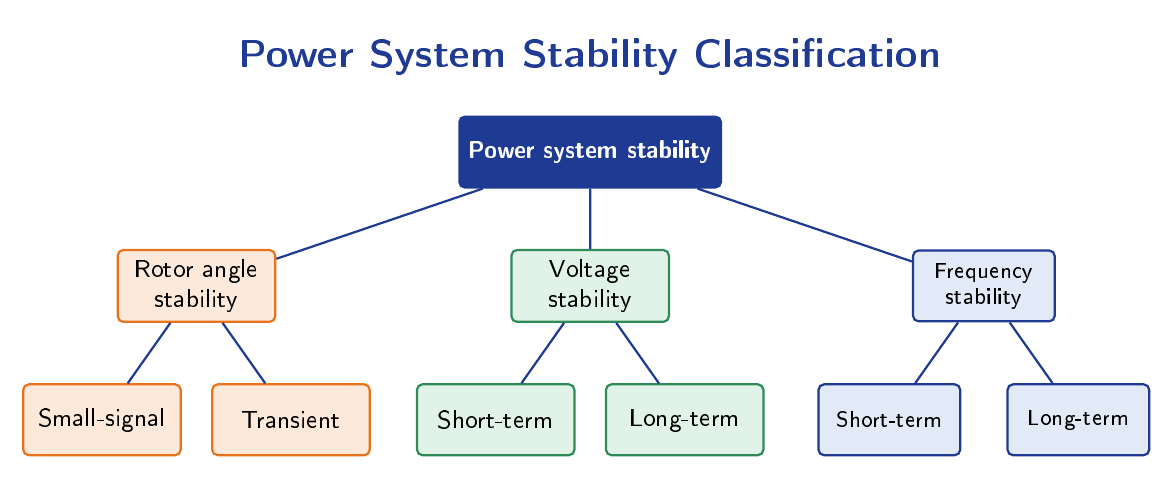
The ability of a power system to regain a state of operating equilibrium after being subjected to a physical disturbance, with most system variables bounded so that the system as a whole remains intact.
Swing Equation and Equal Area Criterion
\(H\) is the inertia constant (MJ/MVA), \(M = H/\pi f\), \(P_m\) is mechanical input power, \(P_e\) is electrical output power, and \(P_a\) is the accelerating power. The power-angle relationship is:
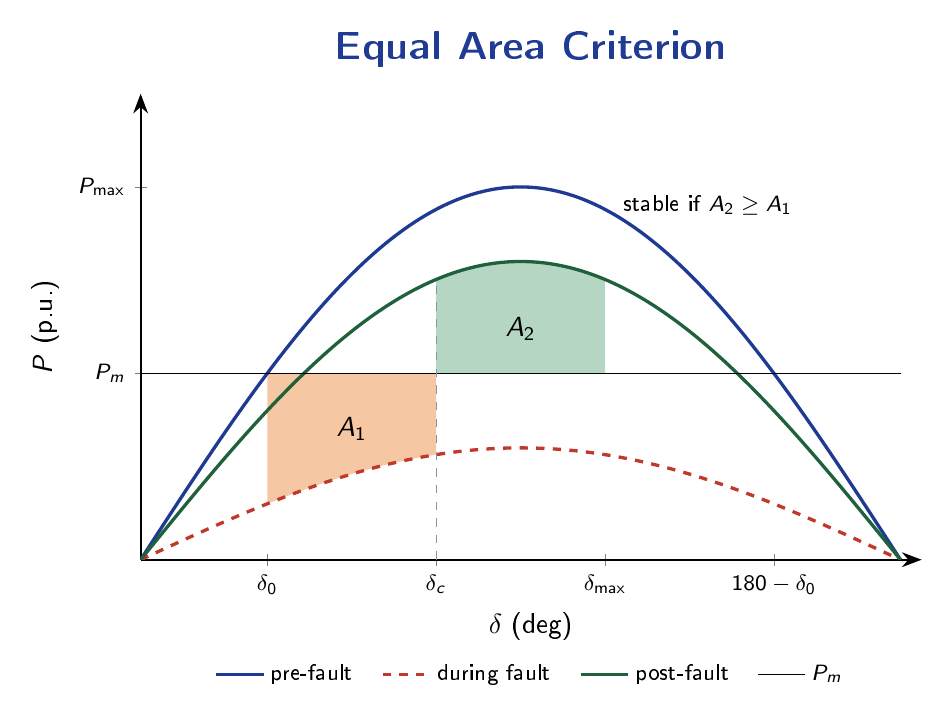
\[\int_{\delta_0}^{\delta_c}(P_m - P_e)\,d\delta \leq \int_{\delta_c}^{\delta_{max}}(P_e - P_m)\,d\delta\]
The critical clearing angle \(\delta_c\) is the maximum angle at which the fault can be cleared to maintain stability. Maximum power transfer occurs at \(\delta = 90°\); operation beyond 90° is unstable.
Voltage Stability — P–V and Q–V Curves
Modern Challenges in Power Systems
Renewable Energy Integration
- Climate change mitigation and net-zero commitments
- Rapidly declining cost of solar PV and wind
- Energy security and national energy independence
- India's Target: 500 GW non-fossil capacity by 2030 (~50% of installed capacity)
- Intermittency — clouds and wind lulls cause rapid generation swings
- Low inertia — inverter-based resources contribute no synchronous inertia
- Forecasting uncertainty — stochastic output complicates dispatch
- Reactive power support — inverters must be programmed to provide Q
- Grid code compliance — fault ride-through and frequency response requirements
- Battery Energy Storage Systems (BESS) and pumped hydro
- Demand response and flexible loads
- Grid-forming inverters providing synthetic inertia
- HVDC interconnections for long-distance renewable export
- ML-based forecasting and advanced energy management systems
Smart Grids
A smart grid is an electricity network that uses digital communication, automation, and advanced analytics to intelligently manage generation, transmission, distribution, and consumption in real time.
- AMI — Advanced Metering Infrastructure
- SCADA — Supervisory Control and Data Acquisition
- PMU — Phasor Measurement Units (synchrophasors)
- WAMS — Wide Area Monitoring Systems
- DER — Distributed Energy Resources
- IoT and AI — predictive maintenance and dynamic optimisation
- Two-way power flow enabling prosumer participation
- Self-healing networks (FLISR: Fault Location, Isolation, and Service Restoration)
- Real-time system monitoring and control
- Seamless integration of EVs and DERs
- Dynamic pricing and demand response
Microgrids and Distributed Generation
A microgrid is a localized group of distributed sources and loads that can operate in grid-connected mode or in islanded (autonomous) mode. Typical components include solar PV, wind, small gas turbines, battery storage, smart inverters, and a central Energy Management System (EMS).
- Voltage and frequency regulation without a stiff grid reference
- Seamless and stable grid–island transitions
- Protection coordination when fault levels change between modes
Electric Vehicles and Grid Impact
- Level 1: 120 V AC, 1.4–1.9 kW (slow, overnight residential)
- Level 2: 240 V AC, 3–19 kW (home and public charging)
- DC Fast Charging: 50–350 kW (highway and depot charging)
Bidirectional EV chargers allow EVs to act as distributed storage, providing peak shaving, frequency regulation, renewable firming, and emergency backup power.
HVDC Transmission: Converter Basics
- \(\alpha < 90°\): rectifier mode (AC to DC)
- \(\alpha > 90°\): inverter mode (DC to AC)
- Thyristor-based; 6-pulse or 12-pulse bridge; consumes reactive power
- IGBT-based; modern HVDC (Modular Multilevel Converter, MMC)
- Independent control of active and reactive power
- Can supply passive or weak AC grids; no commutation failure
- Compact footprint; used for offshore wind connections
Power Quality
- Harmonics: integer multiples of fundamental from non-linear loads (VFDs, rectifiers)
- Voltage sag: 10–90% of nominal for 0.5 cycle to 1 minute
- Voltage swell: above 110% of nominal
- Flicker: low-frequency voltage fluctuation from arc furnaces, etc.
- Transients: impulsive (lightning) or oscillatory (capacitor switching)
IEEE 519 limits THD to <5% at the point of common coupling (PCC). Mitigation: passive LC filters, active power filters (APF), Dynamic Voltage Restorer (DVR).
Grid Codes and Connection Requirements
- Voltage and frequency operating ranges and tolerances
- Power factor / reactive capability curves
- Fault Ride-Through (FRT) / Low Voltage Ride-Through (LVRT)
- Harmonic and flicker emission limits
- Communication and telemetry standards
India: CEA Grid Connectivity Standards and the Indian Electricity Grid Code (IEGC) govern grid connection.
- Continuous operation: 49.5–50.5 Hz
- Short-time permissible: 47.5–52 Hz
- Mandatory primary frequency response from all large synchronous generators
Distribution Reliability Indices
| Index | Full Name | Formula |
|---|---|---|
| SAIFI | System Average Interruption Frequency Index | \(\displaystyle\frac{\sum N_i}{N_T}\) (interruptions/customer-year) |
| SAIDI | System Average Interruption Duration Index | \(\displaystyle\frac{\sum r_i N_i}{N_T}\) (hours/customer-year) |
| CAIDI | Customer Average Interruption Duration Index | \(\displaystyle\frac{\text{SAIDI}}{\text{SAIFI}}\) (hours/interruption) |
| ASAI | Average Service Availability Index | \(1 - \text{SAIDI}/8760\) |
| ENS | Energy Not Supplied | \(\sum L_a r_i\) (kWh/year) |
\(N_i\) = customers affected by event \(i\); \(r_i\) = outage duration of event \(i\); \(N_T\) = total customers served; \(L_a\) = average load disconnected.
Formulas and Key Theorems
Three-Phase Power Formulas
Three-Phase Power
\[ P = \sqrt{3}\,V_L I_L \cos\phi, \quad Q = \sqrt{3}\,V_L I_L \sin\phi, \quad S = \sqrt{3}\,V_L I_L \]Star vs Delta Relationships
Star (Y): \(V_L = \sqrt{3}\,V_{ph}\), \(I_L = I_{ph}\)
Delta (Δ): \(V_L = V_{ph}\), \(I_L = \sqrt{3}\,I_{ph}\)
Power Factor Correction
\[ Q_c = P(\tan\phi_1 - \tan\phi_2) \]Capacitor bank required to improve PF from \(\cos\phi_1\) to \(\cos\phi_2\).
Transmission Line Formulas
| Parameter / Relation | Formula |
|---|---|
| Propagation constant | \(\gamma = \sqrt{zy} = \alpha + j\beta\) |
| Characteristic impedance | \(Z_c = \sqrt{z/y}\) |
| Surge impedance loading | \(\text{SIL} = V_L^2 / Z_c\) |
| Maximum power transfer (lossless) | \(P_{max} = |V_S||V_R| / X\) |
| Real power flow | \(P = (|V_S||V_R|/X)\sin\delta\) |
| Reactive power flow | \(Q = |V_R|(|V_S|\cos\delta - |V_R|)/X\) |
| Voltage regulation | \(\text{VR} = (|V_{NL}| - |V_{FL}|)/|V_{FL}| \times 100\%\) |
| Transmission efficiency | \(\eta = P_R/P_S \times 100\%\) |
Generator and Transformer Formulas
Synchronous Generator
\[ f = \frac{PN_s}{120}, \quad E_{ph} = 4.44\,f\,\phi\,T\,k_w \] \[ k_w = k_p \cdot k_d, \quad P = \frac{E_f V_t}{X_s}\sin\delta \]Transformer
\[ E = 4.44\,f\,N\,\phi_m, \quad \eta = \frac{\text{Output}}{\text{Output} + P_{cu} + P_i} \] \[ \eta_{max} \Leftrightarrow P_{cu} = P_i, \quad x_{full} = \sqrt{P_i / P_{cu,FL}} \]Economic Operation Formulas
Minimise \(\sum C_i(P_i)\) subject to \(\sum P_i = P_D\). The optimality condition (without losses):
With a quadratic cost function \(C_i(P_i) = a_i + b_i P_i + c_i P_i^2\), the incremental cost is \(dC_i/dP_i = b_i + 2c_i P_i\).
The B-coefficient matrix gives \(P_L = \sum_i \sum_j P_i B_{ij} P_j\). The penalty factor \(L_i = 1/(1-\text{ITL}_i)\) adjusts the incremental cost of each unit.
Problem: Two units supply 200 MW.
\(C_1 = 0.05P_1^2 + 20P_1 + 100\) → \(dC_1/dP_1 = 0.10P_1 + 20\)
\(C_2 = 0.04P_2^2 + 30P_2 + 200\) → \(dC_2/dP_2 = 0.08P_2 + 30\)
Equal incremental cost and power balance:
Check: \(P_1 + P_2 = 200\text{ MW}\) ✓
Unit Commitment
Unit commitment (UC) determines which generating units to bring online or shut down over a dispatch horizon (typically 24 hours) to minimise total operating cost while meeting demand and reserve requirements. Costs include fuel costs, start-up costs (cold/warm/hot), shutdown costs, and no-load costs. Constraints include power balance, minimum up/down times, ramp rates, and spinning reserve. Solution methods range from priority lists and dynamic programming to Lagrangian relaxation and modern Mixed-Integer Linear Programming (MILP).
Key Theorems
Maximum power is transferred to a load when the load impedance equals the complex conjugate of the source (Thevenin) impedance: \(Z_L = Z_S^*\).
Any unbalanced set of \(n\) phasors can be resolved into \(n\) balanced sets of phasors (the symmetrical components). For three-phase systems: positive, negative, and zero sequence.
A synchronous machine is transiently stable if the accelerating area equals or is less than the maximum available decelerating area on the \(P\)–\(\delta\) power-angle curve.
For any network satisfying KVL and KCL, the total power delivered by all sources equals the total power absorbed by all elements. Useful in load flow verification.
KCL (nodal analysis) and KVL (mesh analysis) form the mathematical foundation for \(Y_{bus}\) and \(Z_{bus}\) formulation in power system analysis.
Any linear network viewed from a port reduces to a voltage source \(V_{th}\) in series with \(Z_{th}\) (or its Norton dual). This is the basis for fault current calculation using \(Z_{bus}\): \(I_f = V_{th}/Z_{th}\).
Exam Preparation Strategy
High-Yield Topics for GATE EE
| Topic | Weightage | Focus Areas |
|---|---|---|
| Transmission Line Parameters | High | ABCD parameters, SIL, Ferranti effect |
| Load Flow | Medium | Bus classification, Newton–Raphson method, convergence |
| Fault Analysis | High | Symmetrical components, \(Z_{bus}\), fault current formulas |
| Stability | Medium | Swing equation, Equal Area Criterion, Critical Clearing Angle |
| Per-Unit System | High | Base change, short-circuit MVA calculations |
| Economic Dispatch | Low–Medium | Lambda iteration, penalty factors, B-coefficients |
| Protection | Medium | Relay types, CT/PT, distance protection zones |
| Power Electronics and Grid | Growing | FACTS, HVDC converters, grid-forming inverters |
Recent GATE papers increasingly emphasise numerical problems on per-unit calculations, symmetrical fault currents, and ABCD parameters. Power Systems typically contributes 8–12 marks in the GATE EE paper.
Smart Study Strategy
- Read standard textbooks once through; understand the big picture
- Make short notes per chapter as you read
- Understand derivations, not just the final formulas
- Visualise circuits, phasor diagrams, and power flow paths
- Solve previous 10-year GATE questions — this is non-negotiable
- Work topic-wise problem sets before mixed tests
- Focus on numerical accuracy and unit consistency
- Time yourself to build exam-day speed
- Review short notes and formula sheets daily in the final weeks
- Attempt full-length mock tests under exam conditions
- Analyse mistakes and identify recurring weak areas
- Avoid starting new topics in the last two weeks
Recommended Books
- Modern Power System Analysis — Nagrath and Kothari (the standard Indian textbook)
- Power System Analysis — Grainger and Stevenson (rigorous and comprehensive)
- Electric Machinery — Fitzgerald, Kingsley, and Umans (machines and generators)
- GATE Previous Year Question Papers — 10 years is essential; 15+ years is ideal
Common Mistakes to Avoid
- Confusing line versus phase quantities (the \(\sqrt{3}\) factor)
- Using the wrong base when converting per-unit values
- Forgetting the \(\sqrt{3}\) factor in three-phase power calculations
- Mixing RMS and peak values in the same calculation
- Incorrect sign conventions for real and reactive power flow
- Not reading the question completely before starting to solve
- Ignoring or mis-converting units (kV to V, MVA to kVA, etc.)
- Spending too long on a single difficult question
- Skipping MCQs blindly when negative marking applies
- Poor time allocation between sections
Always practice under timed, exam-like conditions. A correct answer found in three minutes is worth far more than a perfect solution found in fifteen.
Quick Formula Checklist Before the Exam
Must-Know Formulas
- \(P_{3\phi} = \sqrt{3}\,V_L I_L\cos\phi\)
- \(E = 4.44\,f\,N\,\phi_m\) (transformer / generator)
- \(N_s = 120f/P\)
- \(Z_{base} = V^2/S\)
- \(P = (EV/X)\sin\delta\)
- Swing: \(M\ddot{\delta} = P_m - P_e\)
- LG fault: \(I_f = 3E/(Z_1 + Z_2 + Z_0)\)
- \(\text{SIL} = V_L^2/Z_c\)
Must-Know Concepts
- Ferranti effect — long, lightly-loaded lines
- Why delta windings block zero-sequence current
- When is transformer efficiency maximum?
- Why is 3-φ fault most severe but rarest?
- Slack vs PV vs PQ bus roles
- Salient vs cylindrical rotor — application choice
- Skin and proximity effects — root causes
- Bundled conductors — purpose and benefit
Focus only on formula sheets, short notes, and previous-year questions. Avoid attempting new topics. Get adequate sleep the night before — cognitive performance degrades significantly with sleep deprivation. Arrive early and carry all required documents.
Build concepts first, then master formulas. A formula memorised without conceptual understanding fails under exam pressure. Practice is non-negotiable for numerical problems — there is no shortcut. Stay updated with modern topics (renewables, smart grids, HVDC, BESS) as their GATE weightage is growing steadily. Revise regularly using short notes and formula sheets throughout your preparation, not only in the final week.