Power Electronics: A Complete Course
Power electronics is the art of shaping electrical energy using solid-state switches. Every converter discussed here is built around the same insight: an ideal switch in the ON state has zero voltage across it; in the OFF state it carries zero current. Either way, the instantaneous power dissipation \( P = vi \approx 0 \). Losses arise only during the brief transitions between states. Understanding this single principle – and the three canonical equations of volt-second balance, charge balance, and energy conservation – is sufficient to derive the behaviour of any converter topology.
1. Introduction and Power Semiconductor Devices
What is Power Electronics?
Power electronics is the conversion, control, and conditioning of electric power using solid-state switches driven by low-power control signals. A power converter sits between an electrical source and an electrical load; a control and sensing subsystem closes the loop around the converter to regulate output.
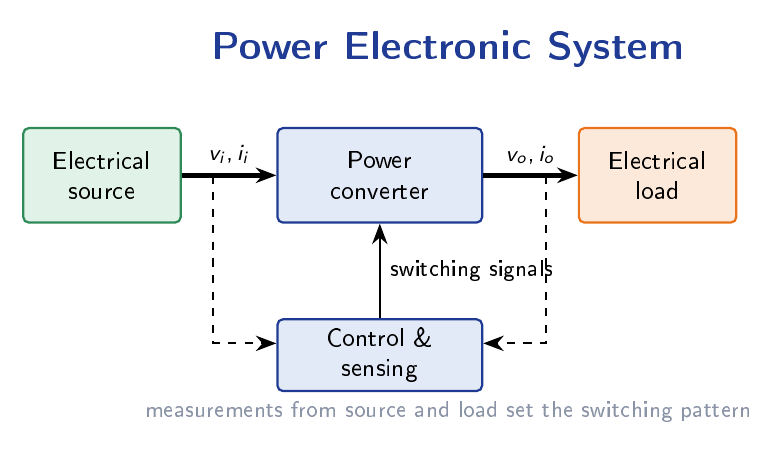
The four fundamental converter classes are:
- AC → DC: Rectifiers — used in SMPS, battery chargers, HVDC.
- DC → DC: Choppers / Switched-mode converters — used in VRMs, MPPT stages, LED drivers.
- DC → AC: Inverters — used in motor drives, UPS, solar grid-tie.
- AC → AC: Cycloconverters / AC voltage controllers — used in soft-starters, heating control, cement-mill drives.
Why Switch? The Efficiency Argument
Consider regulating a 12 V supply down to 5 V at 1 A load. A linear (series-pass) regulator must dissipate \( (V_s - V_o) I_o = 7 \) W as heat, giving an efficiency of only \( 5/12 \approx 42\% \). A switching regulator achieves the same conversion with losses well below 0.5 W, yielding efficiencies above 90 %. The gain comes entirely from the switching principle: the switch is never simultaneously stressed by both high voltage and high current.
Classification of Power Semiconductor Devices
Power semiconductor devices are classified by the degree of external gate (control) authority over both turn-on and turn-off:
- Uncontrolled: Power Diode — conducts whenever forward-biased; no gate.
- Semi-controlled: SCR / Thyristor — gate triggers turn-on, but turn-off requires external commutation.
- Fully controlled: BJT, MOSFET, IGBT, GTO, IGCT — gate controls both turn-on and turn-off.
Device Comparison
| Device | Control | Voltage | Current | Max Frequency | Drive Type | On-state Drop |
|---|---|---|---|---|---|---|
| Diode | None | Up to 10 kV | Up to 5 kA | Low | — | Low |
| SCR | Latching (gate ON) | Up to 6 kV | Up to 5 kA | < 1 kHz | Pulse current | Low |
| GTO | Gate ON/OFF | Up to 6 kV | Up to 4 kA | < 2 kHz | Large current | Medium |
| BJT | Current controlled | Up to 1 kV | Up to 500 A | 5 kHz | Current | Low |
| MOSFET | Voltage controlled | Up to 500 V | Up to 100 A | 1 MHz+ | Voltage | \(\propto V\) |
| IGBT | Voltage controlled | Up to 6.5 kV | Up to 2 kA | 50 kHz | Voltage | Medium |
| SiC MOSFET | Voltage controlled | Up to 15 kV | 100 A | 100 kHz+ | Voltage | Low |
| GaN HEMT | Voltage controlled | Up to 900 V | 100 A | MHz range | Voltage | Very low |
A useful heuristic for device selection: \( V < 200 \) V and \( f > 100 \) kHz → MOSFET; \( V > 600 \) V and \( f < 20 \) kHz → IGBT; ultra-high power → GTO/IGCT/thyristor.
Power Diode: V–I Characteristics and Reverse Recovery
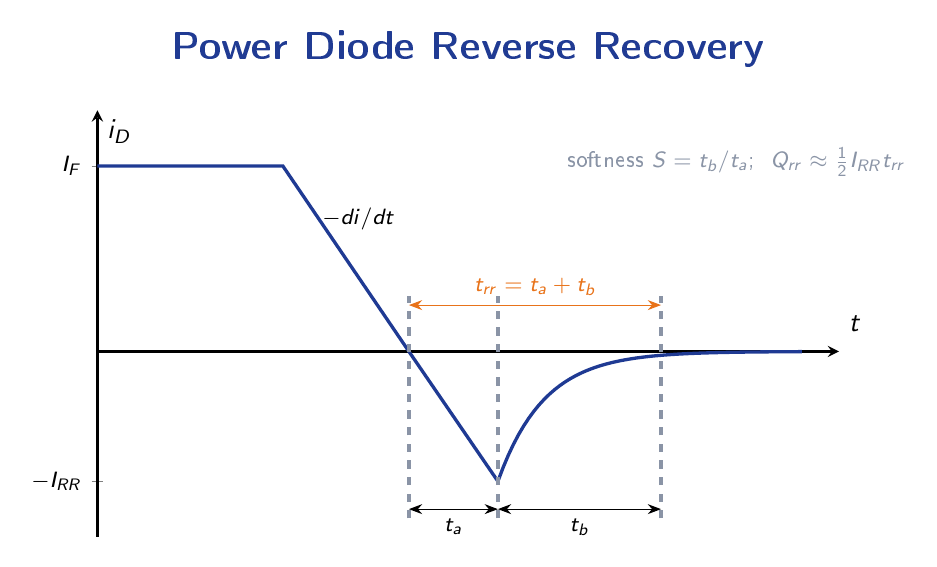
The power diode has three regions of operation: forward conduction (above the knee voltage \( V_\gamma \approx 0.7 \) V for silicon), reverse blocking (small leakage current), and reverse breakdown at \( V_{BR} \). The most important dynamic parameter is the reverse-recovery charge \( Q_{RR} \), which represents stored minority carriers that must be swept out after the diode switches from conducting to blocking.
Diode Types and Selection
| Type | \(V_F\) | \(t_{rr}\) | Max \(V_R\) | Application |
|---|---|---|---|---|
| General-purpose (Si) | 0.7–1.5 V | 25 µs | 5 kV | Line-frequency rectifiers |
| Fast-recovery (FRD) | 0.8–1.5 V | 0.1–5 µs | 3 kV | SMPS, choppers, inverters |
| Schottky (Si) | 0.3–0.5 V | < 10 ns | 100 V | Low-voltage SMPS output stage |
| SiC Schottky | ~1.5 V | Zero (majority carrier) | 1.7 kV | PFC, EV chargers |
| GaN (lateral) | — | Negligible | 650 V | High-frequency converters |
Thyristor (SCR): Structure, Operation and Characteristics
The silicon-controlled rectifier is a four-layer PNPN device with three terminals: Anode (A), Cathode (K) and Gate (G). It operates through positive feedback between two internally coupled BJTs (PNP and NPN). When a gate current pulse drives the NPN transistor into conduction, both transistors reinforce each other until the combined current gains satisfy \( \alpha_1 + \alpha_2 \to 1 \), at which point the device latches ON and the gate loses control.
Key threshold currents are the latching current \( I_L \) (minimum anode current needed to latch after the gate pulse ends) and the holding current \( I_H \) (minimum anode current to remain ON). Typically, \( I_L \approx 2\text{–}3 \times I_H \).
Methods to turn an SCR ON: gate current pulse (standard); forward breakover voltage \( V_{BO} \) (destructive); excessive \( dv/dt \) (unwanted); light (LASCR). To turn it OFF, the anode current must be reduced below \( I_H \) — this process is called commutation.
SCR Protection: di/dt and dv/dt Limits
Excessive rate of rise of anode current causes localised heating near the gate–cathode junction. A series inductor \( L_s \) limits this:
Excessive \( dv/dt \) across the junction capacitance \( C_j \) generates a displacement current \( i = C_j\, dv/dt \) that can trigger the device falsely. An RC snubber across the SCR suppresses this:
SCR Commutation Techniques
Natural (line) commutation occurs in AC circuits where the supply voltage naturally reverses polarity, reducing the anode current to zero. It requires no auxiliary circuitry and is used in phase-controlled rectifiers, AC voltage controllers, and cycloconverters.
Forced commutation is required in DC circuits where no natural voltage reversal is available. Six classes (A through F) exist based on the commutation mechanism (resonant pulse, complementary SCR, auxiliary SCR, external source, etc.). The circuit turn-off time \( t_c \) must exceed the device turn-off time \( t_q \); otherwise commutation fails.
SCR Gate Triggering and UJT Oscillator
A reliable gate signal must have amplitude exceeding \( I_{GT} \) (typically 10–500 mA), pulse width exceeding the latching time, and galvanic isolation from the power circuit. The classical gate driver uses a UJT relaxation oscillator:
Modern implementations use dedicated gate-drive ICs such as the IR2110 or HCPL-3120 with built-in desaturation protection. The cosine firing scheme linearises the control characteristic: \( \alpha = \cos^{-1}(V_c / V_m) \), making output \( V_{dc} \propto V_c \).
Series and Parallel Operation of SCRs
When the required voltage or current exceeds a single device rating, SCRs are connected in series (for voltage sharing) or parallel (for current sharing). Unequal leakage currents cause unequal voltage distribution in series strings; a shunt resistor \( R \) across each device provides static balancing. An RC snubber provides dynamic balancing during transitions.
String derating factor: \( \text{DF} = 1 - \dfrac{V_s}{n\,V_{BO}} \)
BJT, MOSFET, and IGBT
The three dominant fully-controlled devices differ fundamentally in their conduction and switching mechanisms:
- Power BJT: current-controlled (\( I_C = \beta I_B \)). Susceptible to second breakdown; relatively slow; largely obsolete.
- Power MOSFET: voltage-controlled (\( I_D \propto (V_{GS} - V_T)^2 \)); majority-carrier device; very fast (no minority-carrier storage); on-resistance \( R_{DS(on)} \) increases with voltage rating, limiting use below ~500 V for Si.
- IGBT: MOS-controlled input with BJT-style conductivity modulation in the output — combines the best of both. Low \( V_{CE(sat)} \) even at high voltages; a tail current at turn-off due to minority-carrier recombination limits maximum switching frequency.
Switching Losses
During turn-on and turn-off, both voltage and current are simultaneously non-zero for durations \( t_{\text{on}} \) and \( t_{\text{off}} \). The overlap of these waveforms creates a power dissipation pulse in the switch. For linear ramp approximations:
Gate Drive Circuits
A gate driver converts low-power logic signals into high-current pulses needed to charge the gate capacitance rapidly. Key requirements include sufficient peak current \( I_G = Q_G f_s / V_{\text{drive}} \) (typically 1–10 A peak), propagation delay below 100 ns matched between high-side and low-side, and galvanic isolation for high-side switches (via pulse transformer, optocoupler, or digital isolator).
DESAT protection monitors \( V_{CE} \) after turn-on; if it remains high beyond 2–5 µs, a short-circuit is detected and the device is shut down softly. Dead-time (typically 500 ns–2 µs for IGBT, 50–200 ns for MOSFET/SiC/GaN) is inserted between complementary switch signals to prevent shoot-through.
Wide-Bandgap Devices: SiC and GaN
Silicon has reached practical limits imposed by its bandgap (1.12 eV). Wide-bandgap semiconductors offer dramatically higher breakdown fields, enabling thinner drift regions and lower on-resistance for the same voltage rating.
| Parameter | Si | SiC (4H) | GaN |
|---|---|---|---|
| Bandgap \(E_g\) (eV) | 1.12 | 3.26 | 3.39 |
| Breakdown field (MV/cm) | 0.3 | 3.0 | 3.3 |
| Electron mobility (cm²/V·s) | 1400 | 900 | 2000 (2DEG) |
| Thermal conductivity (W/cm·K) | 1.5 | 4.9 | 1.3 |
| Max junction temperature (°C) | 150 | 200+ | 150 |
| Commercial voltage rating | ≤ 6.5 kV | ≤ 15 kV | ≤ 900 V |
Baliga's Figure of Merit: \( \text{BFOM} = \varepsilon\, \mu\, E_g^3 \), which gives SiC roughly 400× and GaN roughly 900× the performance potential of silicon. In practice: 10× faster switching, ~50% lower losses, and higher permissible junction temperature.
Thermal Design and Heat Sinking
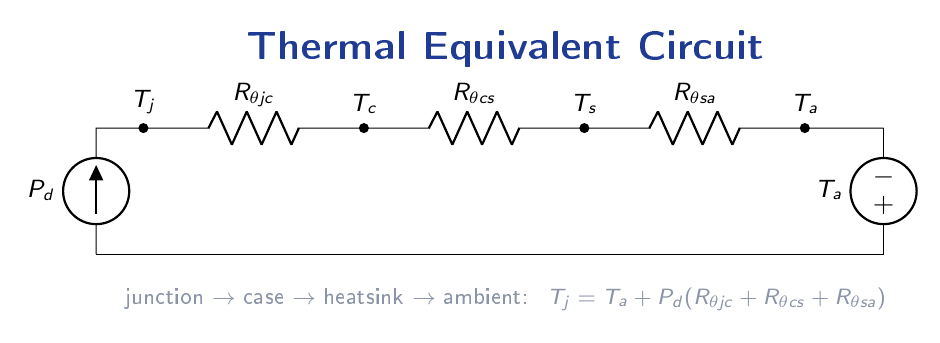
The thermal equivalent circuit treats temperature as voltage and power dissipation as current. Junction temperature must remain below the device rating (\( T_{j,\max} = 150 \) °C for Si, 200+ °C for SiC):
2. AC–DC Converters: Rectifiers
Rectifiers convert AC power to DC. Uncontrolled (diode) rectifiers provide a fixed DC output voltage. Controlled (thyristor) rectifiers provide a variable DC output through firing angle \( \alpha \) and can even operate as inverters when \( \alpha > 90^\circ \) into an active back-EMF load. Higher pulse number reduces ripple.
Performance Parameters
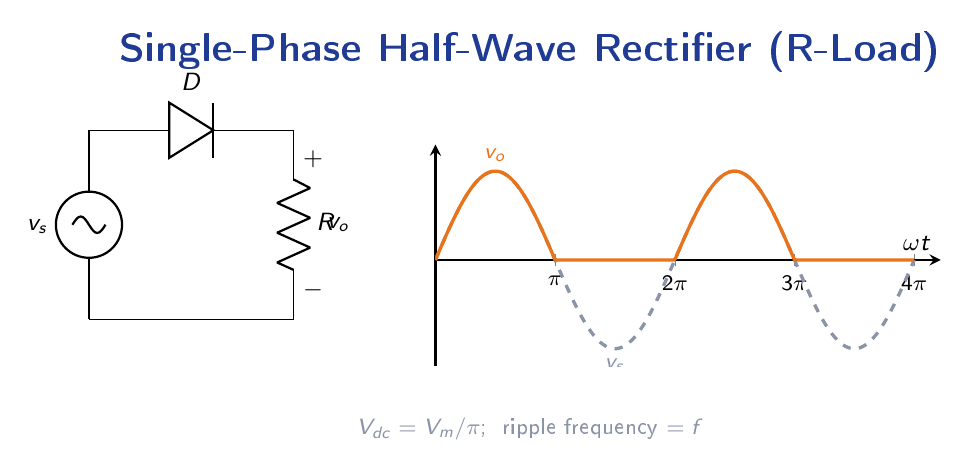
Single-Phase Half-Wave Rectifier (R-Load)
The diode conducts only during positive half-cycles. This is the simplest rectifier but has poor performance: low DC output, high ripple, and a DC component in the source current that can saturate transformers.
Half-Wave Controlled Rectifier with RL Load
An SCR replaces the diode, firing at angle \( \alpha \). The inductor stores energy, causing conduction to extend beyond \( \pi \) to an extinction angle \( \beta > \pi \). The governing equation during conduction is:
A freewheeling diode placed across the load clamps \( v_o \ge 0 \), forces \( \beta = \pi \), improves \( V_{dc} \), and reduces input current distortion.
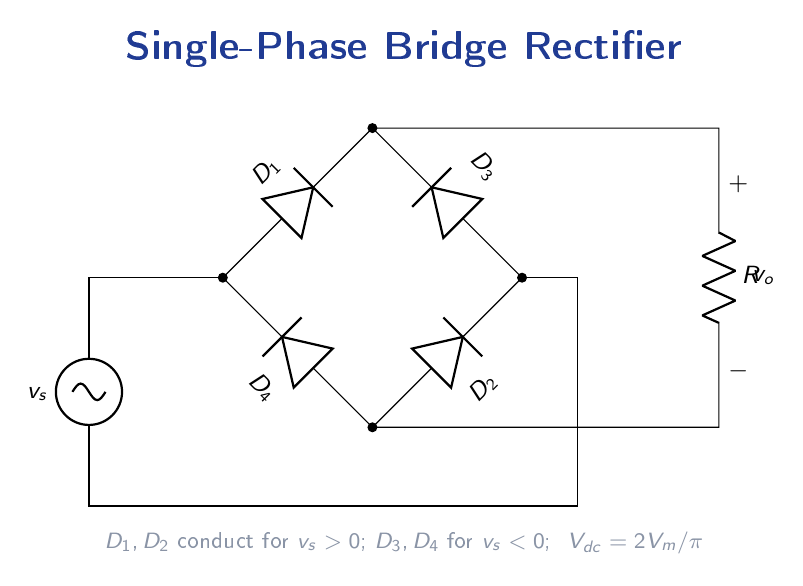
Single-Phase Full-Wave Bridge Rectifier
The Graetz bridge uses four diodes and requires no centre-tap transformer. Both half-cycles of the AC supply are rectified, doubling the ripple frequency to \( 2f \) and dramatically improving performance.
Three-Phase Rectifiers
Three-phase rectifiers achieve far higher pulse numbers, dramatically reducing ripple:
The ripple frequency of a \( p \)-pulse rectifier is \( p \cdot f \). A 6-pulse rectifier on a 50 Hz supply produces 300 Hz ripple — far easier to filter than 50 Hz ripple. Twelve-pulse rectifiers (two bridges fed through Y–Y and Y–Δ transformers) are used in HVDC applications.
Single-Phase Full-Controlled Bridge (SCR Bridge)
Replacing all four diodes with SCRs fired at angle \( \alpha \) gives a fully controllable DC output. With a highly inductive (continuous current) load:
For \( 0 \le \alpha < 90^\circ \), the converter operates in rectification mode (\( V_{dc} > 0 \)). For \( 90^\circ < \alpha \le 180^\circ \), \( V_{dc} < 0 \) and the converter operates as a line-commutated inverter (requires a back-EMF load such as a DC motor in regenerative braking).
Semi-Controlled Bridge and Discontinuous Conduction
The half-controlled bridge uses 2 SCRs and 2 diodes. Output is always non-negative (no inversion capability), with inherent freewheeling action:
Discontinuous conduction mode (DCM) occurs at low inductance or high firing angle, when the current reaches zero within each half-cycle. The extinction angle \( \beta \) must be determined numerically, and \( V_{dc} \) becomes dependent on \( R \), \( L \) and \( \alpha \).
Source Inductance and Overlap Angle
Real AC sources have stray inductance \( L_s \). During commutation, current cannot switch instantaneously between outgoing and incoming devices, producing an overlap angle \( \mu \) during which both devices conduct simultaneously. This reduces the effective DC output and creates voltage notches in the source waveform:
Dual Converter: Four-Quadrant DC Drive
Two fully-controlled bridges connected in anti-parallel across a DC motor load provide four-quadrant operation. The ideal coordination condition is \( \alpha_P + \alpha_N = 180^\circ \), ensuring equal and opposite DC outputs. Two operating modes exist: non-circulating current (only one bridge active at a time) and circulating current (both bridges active with a reactor to limit ripple current between them).
3. DC–DC Converters: Choppers
DC–DC converters produce a regulated or variable DC output from a DC input by switching a power device at duty cycle \( D = T_{\text{on}} / T = T_{\text{on}} f_s \). The volt-second balance principle applied to the inductor (\( \langle v_L \rangle = 0 \) in steady state) yields the conversion ratio in closed form for any topology.
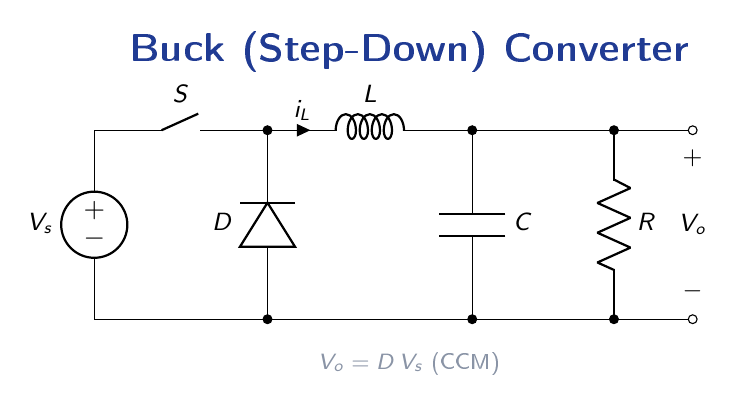
Buck Converter (Step-Down)
The buck converter produces \( V_o < V_s \). Switch ON: the inductor charges from \( V_s - V_o \). Switch OFF: the diode freewheels and the inductor discharges into the load. In CCM:
Boost Converter (Step-Up)
Switch ON: \( V_s \) drives inductor current up; diode is reverse-biased; capacitor supplies the load. Switch OFF: inductor releases energy through the diode into the load and capacitor. The boost input current is continuous (good for PFC front-ends). As \( D \to 1 \), the ideal gain approaches infinity; parasitic resistance causes a practical maximum near \( D \approx 0.75 \).
Buck-Boost, Ćuk, SEPIC, and Zeta Converters
The buck-boost inverts the output polarity with a gain of magnitude \( D/(1-D) \):
Ćuk: \( V_o/V_s = -D/(1-D) \) \quad (inverted, but both input and output currents are continuous)
SEPIC: \( V_o/V_s = +D/(1-D) \) \quad (non-inverting)
Converter Comparison Table
| Converter | \(V_o/V_s\) | Polarity | Input Current | Output Current |
|---|---|---|---|---|
| Buck | \(D\) | + | Pulsed | Continuous |
| Boost | \(\frac{1}{1-D}\) | + | Continuous | Pulsed |
| Buck-Boost | \(-\frac{D}{1-D}\) | − | Pulsed | Pulsed |
| Ćuk | \(-\frac{D}{1-D}\) | − | Continuous | Continuous |
| SEPIC | \(\frac{D}{1-D}\) | + | Continuous | Pulsed |
| Zeta | \(\frac{D}{1-D}\) | + | Pulsed | Continuous |
Isolated DC–DC Converters
Isolated topologies incorporate a high-frequency transformer for galvanic isolation:
- Flyback: buck-boost derived; \( V_o = (N_2/N_1) \cdot D/(1-D) \cdot V_s \); low cost; below ~150 W.
- Forward: buck-derived; needs a reset winding or active clamp; up to ~1 kW.
- Push-pull, Half-bridge, Full-bridge: higher power; up to tens of kW.
Chopper Quadrant Classification
| Class | Quadrant(s) | \(V_o\) | \(I_o\) | Typical Application |
|---|---|---|---|---|
| A | Q1 | + | + | Simple buck, motoring |
| B | Q2 | + | − | Regenerative braking |
| C | Q1+Q2 | + | ± | Two-quadrant motor drive |
| D | Q1+Q4 | ± | + | Field control |
| E | Q1–Q4 | ± | ± | Full reversible drive (H-bridge) |
4. DC–AC Converters: Inverters
Inverters convert DC to AC. Classification axes include the DC source type (VSI: voltage-source inverter; CSI: current-source inverter), number of phases, and the modulation strategy (square-wave, PWM, multilevel).
Performance Metrics
Single-Phase Inverter Configurations
The half-bridge uses two switches and two DC-link capacitors providing \( V_s/2 \) each; the output peak is \( V_s/2 \). The full-bridge (H-bridge) uses four switches and can apply \( \pm V_s \) to the load; the output peak is \( V_s \).
Full-bridge square-wave: \( V_{o1,rms} = \dfrac{2\sqrt{2} V_s}{\pi} \approx 0.9\, V_s \), \( V_{rms} = V_s \)
Harmonic spectrum: \( V_{on} = \dfrac{4V_s}{n\pi} \), \( n = 1, 3, 5, \ldots \)
Square-wave THD \( \approx 48.43\% \)
Three-Phase Six-Step (180° Conduction) Inverter
Six switches operate with each device ON for 180°, always three switches conducting simultaneously. The line-to-line voltage is a six-step quasi-square waveform. Triplen harmonics (multiples of 3) are absent in the line-to-line voltage (but present in phase-to-neutral voltage) due to the 120° symmetry of the three-phase system.
Line-to-line THD \( \approx 31\% \)
Voltage Control Methods
Three main strategies control the output voltage amplitude of an inverter:
- Single-pulse modulation: \( V_{o,rms} = V_s\sqrt{d/\pi} \). Simple but large low-order harmonics.
- Multiple-pulse modulation (MPM): \( p \) equal-width pulses per half-cycle; shifts harmonics to higher orders proportional to \( p \).
- Sinusoidal PWM (SPWM): lowest THD; fundamental linearly controllable via modulation index \( m_a \).
Sinusoidal PWM (SPWM)
A sinusoidal reference waveform (frequency \( f_m \)) is compared to a triangular carrier (frequency \( f_c \)). The output switches whenever the reference crosses the carrier.
Frequency modulation index: \( m_f = f_c / f_m \)
Linear region (\( m_a \le 1 \)): \( \hat{V}_{o1} = m_a\, V_s/2 \) (leg voltage, half-bridge)
Overmodulation (\( 1 < m_a < 3.24 \)): non-linear; low-order harmonics re-emerge
Square-wave limit (\( m_a \to \infty \)): \( \hat{V}_{o1} = \tfrac{4}{\pi} \cdot \tfrac{V_s}{2} \)
PWM Variants
- Third-harmonic injection PWM (THIPWM): adding a \( \frac{1}{6} \)-amplitude third harmonic to the reference gives 15.5% higher fundamental without overmodulation.
- Space Vector PWM (SVPWM): selects from 8 inverter states (6 active + 2 zero) to form the reference vector optimally. Produces ~15.5% more fundamental than SPWM. Maximum linear line-to-line RMS output: \( V_{LL,1} = V_s/\sqrt{2} \).
- Selective Harmonic Elimination (SHE-PWM): solves transcendental equations to eliminate specific harmonics; used in high-power, low-switching-frequency inverters.
- Hysteresis-band current control: tracks a reference current within a band; simple and fast but variable switching frequency.
Current Source Inverter (CSI)
The CSI is fed from a stiff DC current source (large series inductor). Output is a quasi-square current waveform; output voltage is determined by the load. Switches require reverse voltage blocking, and commutating capacitors are needed for SCR-based CSIs. CSIs are inherently short-circuit proof.
Multilevel Inverters (MLI)
MLIs generate output with more than two voltage levels, improving waveform quality, reducing \( dv/dt \) stress, and enabling higher voltage ratings without series-connected devices. The three standard topologies are:
- Diode-clamped (NPC): neutral-point capacitors and clamping diodes; voltage balance challenging at levels above 3.
- Flying-capacitor: floating capacitors hold intermediate voltages; needs pre-charging.
- Cascaded H-bridge (CHB): series-connected H-bridge cells each with an isolated DC source; most modular.
Switches per phase (NPC or FC): \( 2(m-1) \)
5. AC–AC Converters
AC Voltage Controller (Single-Phase)
An AC voltage controller (using a triac or two anti-parallel SCRs) controls AC power by delaying the firing angle \( \alpha \) within each half-cycle (phase control) or by switching full cycles on and off (integral-cycle control).
Applications include lamp dimmers, fan speed control, resistance heater control, induction heating, and motor soft-starters. Integral-cycle control is suited to thermal loads with long time constants; phase control generates more EMI but works for any load type.
Three-Phase AC Voltage Controller
Three pairs of anti-parallel SCRs control the per-phase voltages. The number of SCRs conducting simultaneously changes with firing angle \( \alpha \): three SCRs conduct for \( \alpha < 60° \); two or three alternate for \( 60° \le \alpha < 90° \); exactly two conduct for \( 90° \le \alpha < 150° \); and output drops to zero for \( \alpha \ge 150° \).
Cycloconverters and Matrix Converters
A cycloconverter directly converts AC of one frequency to a lower AC frequency without a DC intermediate stage. Each output half-cycle is synthesised from segments of the input supply waveform using phase-controlled bridges. The maximum output frequency is limited to approximately one-third of the input frequency.
Matrix converters generalise cycloconverters using bidirectional IGBT switches to achieve full AC-to-AC conversion with no DC link. The maximum output voltage is limited to 0.866 times the input voltage due to modulation constraints.
6. Electric Drives and Applications
Any electric drive system comprises four elements: a power converter, a motor, sensors, and a controller. Differences between drive systems lie in the converter topology, motor type, control strategy, and sensor requirements.
DC Motor Drives
The separately excited DC motor obeys:
Speed control below base speed uses armature voltage control (constant-torque region). Speed control above base speed uses field weakening (constant-power region). Four-quadrant operation requires either a dual converter or a class-E (H-bridge) chopper.
Induction Motor Drives
Speed-control methods in order of performance sophistication:
- Stator voltage control (AC controller): \( T \propto V^2 \); only for fan-type loads with inherent torque-speed characteristic.
- V/f control (open-loop scalar): maintains constant flux below base speed; adequate for many pump and fan applications.
- Rotor resistance control (slip-ring only): simple but lossy.
- Slip-power recovery (Kramer/Scherbius): recovers rotor slip power back to the supply; efficient for large slip-ring machines.
- Field-oriented control (FOC): decouples torque and flux; provides DC-motor-like dynamic performance.
BLDC, PMSM, and SRM Drives
| Parameter | BLDC | PMSM | SRM |
|---|---|---|---|
| Back-EMF waveform | Trapezoidal | Sinusoidal | — |
| Control strategy | Six-step | Vector (FOC) | Hysteresis/PWM |
| Torque ripple | Medium | Low | High |
| Cost | Medium | High | Low |
| Position sensor | Hall sensor | Encoder/Resolver | Position or sensorless |
7. Power Quality and Special Topics
Harmonics and Power Factor
For non-sinusoidal load current with sinusoidal supply voltage, only the fundamental current component contributes real power. True power factor is the product of displacement power factor (DPF) and distortion factor (DF):
Power Factor Correction (PFC)
Passive PFC places an inductor in series with the diode-bridge input, partially smoothing the current waveform. It is simple but bulky and only partially effective.
Active boost PFC forces the input current to track the input voltage waveform, emulating a resistor at the AC input. This achieves PF > 0.99 and THD < 5%.
DC-link ripple: \( \Delta v_o = \dfrac{P}{2\pi f C V_o} \) (at frequency \( 2f \))
EMI, Filters, and Design Practice
Switching converters generate wideband noise in two modes: differential-mode (DM) propagates through input lines; common-mode (CM) propagates through parasitic capacitances to earth. Standards (CISPR 11/22, FCC) set limits for conducted EMI from 150 kHz to 30 MHz and radiated EMI from 30 MHz to 1 GHz.
Place \( f_c \) one decade below the fundamental switching harmonic.
Attenuation: 40 dB/decade above \( f_c \) (second-order LC filter).
Renewable Energy and EV Power Electronics
A solar PV grid-tie system consists of a PV array followed by an MPPT boost stage, a grid inverter, an LCL filter, and the utility grid. An EV charging and drivetrain system passes through a PFC stage, an isolated LLC or DAB converter, a high-voltage battery pack, a traction inverter, and finally the PMSM motor.
Key specialised converters in these applications include: the Dual Active Bridge (DAB) for bidirectional isolated DC–DC conversion in EV onboard chargers; the LLC resonant converter for high-efficiency isolated conversion in server power supplies and DC fast chargers; the Modular Multilevel Converter (MMC) for HVDC and STATCOM; and the DFIG back-to-back converter for variable-speed wind generation.
Resonant and Soft-Switching Converters
Resonant converters exploit LC resonance to create natural zero-voltage or zero-current crossing instants, eliminating switching losses at high frequency:
FACTS and Custom Power Devices
Grid-scale power electronics is divided into FACTS (Flexible AC Transmission Systems) at transmission level and Custom Power devices at distribution level:
FACTS devices: SVC (static VAR compensator = TCR + TSC); STATCOM (VSC-based shunt reactive power); TCSC (thyristor-controlled series capacitor); UPFC (unified power flow controller = STATCOM + SSSC).
Custom Power devices: DVR (dynamic voltage restorer, series voltage injection); D-STATCOM (distribution STATCOM, shunt reactive and harmonic compensation); UPQC (unified power quality conditioner = series + shunt combined).
8. GATE Strategy, Formula Sheets, and Worked Examples
Complete Formula Sheet: Rectifiers and Performance Indices
1-phase FW bridge (R, \(\alpha=0\)): \(FF=1.11\), \(RF=0.482\), \(\eta=81.2\%\), TUF\(=0.812\)
3-phase FW bridge (R, \(\alpha=0\)): \(FF=1.0009\), \(RF=0.042\), \(\eta=99.8\%\), TUF\(=0.954\)
1-phase FW (RL, cont.): \(PF = \dfrac{2\sqrt{2}}{\pi}\cos\alpha \approx 0.9\cos\alpha\)
Complete Formula Sheet: Choppers and Inverters
Three-phase six-step VSI: \[ V_{LL,1,rms} = \frac{\sqrt{6}}{\pi}V_s \approx 0.7797\, V_s \] \[ V_{LL,rms} = \sqrt{\tfrac{2}{3}}\, V_s \approx 0.8165\, V_s \] \[ \text{THD}_{LL} \approx 31\% \] \[ \text{SPWM max linear } V_{LL,1} = \frac{\sqrt{3}}{2\sqrt{2}}V_s \approx 0.612\, V_s \] \[ \text{SVPWM max linear } V_{LL,1} = \frac{V_s}{\sqrt{2}} \approx 0.707\, V_s \;(\approx 15\% \text{ more than SPWM}) \]
GATE Problem-Solving Roadmap
- Identify the topology: 1-phase/3-phase, half-wave/full-wave, controlled/uncontrolled, semi/full.
- Identify the load: R / RL (continuous or discontinuous) / RLE (motor) / battery.
- Determine the conduction mode: CCM vs DCM for choppers; continuous vs discontinuous for rectifiers.
- Pick the correct formula for \( V_{dc} \), \( I_o \), or ripple.
- Compute the fundamental of source current for PF/DPF calculations.
- Cross-check units and limiting cases (\( \alpha = 0 \), \( D = 0 \), \( D = 1 \)).
- Using \(V_{rms}\) where \(V_{dc}\) is asked (or vice versa).
- Forgetting \(\sqrt{2}\) when converting \(V_s \to V_m\).
- Confusing 3-phase HW (3-pulse, \(\frac{3\sqrt{3}}{2\pi}\)) and 3-phase FW (6-pulse, \(\frac{3}{\pi}\)) constants.
- Treating \(PF = \cos\alpha\) for non-sinusoidal source current (omitting distortion factor).
- Applying the buck output-ripple formula to a boost converter.
- Using SPWM peak (\( m_a V_s/2 \)) and forgetting it is per-phase, not line-to-line.
- Forgetting that a freewheeling diode changes rectifier formulae entirely.
- For semi-converter: range \( 0 \le \alpha \le \pi \); output is never negative.
- Six-step VSI: triplen harmonics absent in line-to-line but present in phase voltage.
Worked Example 1 — Single-Phase Full-Bridge Rectifier
Problem: A single-phase fully-controlled bridge feeds a highly inductive load from a 230 V (rms), 50 Hz source. Firing angle \( \alpha = 45° \), load current \( I_o = 10 \) A (approximately constant). Find: (a) \( V_{dc} \), (b) input PF, (c) fundamental RMS source current, (d) DPF.
Solution:
- \( V_m = \sqrt{2} \times 230 = 325.27 \) V.
- \( V_{dc} = \dfrac{2V_m}{\pi}\cos\alpha = \dfrac{2 \times 325.27}{\pi} \times \cos 45° = 207.07 \times 0.7071 = \mathbf{146.42 \text{ V}} \).
-
Source current is a quasi-square wave of \(\pm I_o\):
\( I_s = I_o = 10 \) A (RMS).
Fundamental: \( I_{s1} = \dfrac{2\sqrt{2}\, I_o}{\pi} = \mathbf{9.003 \text{ A}} \). - DPF \( = \cos\alpha = \cos 45° = \mathbf{0.7071} \) (lagging).
- Distortion factor: \( DF = I_{s1}/I_s = 0.9003 \).
- \( PF = DF \times DPF = 0.9003 \times 0.7071 = \mathbf{0.6366} \) lagging.
Worked Example 2 — Boost Converter (CCM)
Problem: Boost converter: \( V_s = 12 \) V, \( V_o = 36 \) V, \( R = 30 \, \Omega \), \( L = 100 \, \mu\text{H} \), \( C = 100 \, \mu\text{F} \), \( f_s = 40 \) kHz, CCM operation. Find: (a) duty cycle \( D \), (b) inductor current ripple \( \Delta i_L \), (c) output voltage ripple \( \Delta v_o \).
Solution:
- \( V_o/V_s = 1/(1-D) \Rightarrow 3 = 1/(1-D) \Rightarrow D = \mathbf{0.6667} \).
- \( P_o = V_o^2/R = 36^2/30 = 43.2 \) W; \( I_L = P_o/V_s = 43.2/12 = 3.6 \) A.
-
\( \Delta i_L = \dfrac{V_s D}{L f_s} = \dfrac{12 \times 0.6667}{100 \times 10^{-6} \times 40 \times 10^3}
= \mathbf{2 \text{ A}} \) (peak-to-peak).
CCM check: \( I_L = 3.6 > \Delta i_L/2 = 1 \) A ✓ -
\( \dfrac{\Delta v_o}{V_o} = \dfrac{D}{RCf_s} = \dfrac{0.6667}{30 \times 100 \times 10^{-6} \times 40 \times 10^3}
= 5.556 \times 10^{-3} \).
\( \Delta v_o = 5.556 \times 10^{-3} \times 36 = \mathbf{0.2 \text{ V}} \) (peak-to-peak).
Worked Example 3 — Three-Phase Six-Step VSI
Problem: A three-phase six-step (180° conduction) VSI is fed from \( V_s = 600 \) V DC. Find: (a) RMS fundamental line-to-line voltage, (b) total RMS line-to-line voltage, (c) line-to-line THD.
Solution:
- Fundamental (RMS): \( V_{LL,1} = \dfrac{\sqrt{6}}{\pi} \times 600 = \mathbf{467.83 \text{ V}} \).
- Total RMS (quasi-square 120° waveform): \( V_{LL,rms} = \sqrt{2/3} \times 600 = 0.8165 \times 600 = \mathbf{489.90 \text{ V}} \).
- \( \text{THD} = \sqrt{(V_{LL,rms}/V_{LL,1})^2 - 1} = \sqrt{(489.90/467.83)^2 - 1} = \sqrt{0.0966} = \mathbf{31.08\%} \).
- Phase fundamental: \( V_{ph,1} = V_{LL,1}/\sqrt{3} = 270.1 \) V.
Worked Example 4 — SCR Protection (Snubber + di/dt)
Problem: An SCR has \( (dv/dt)_{\max} = 200 \) V/µs and \( (di/dt)_{\max} = 100 \) A/µs. Supply \( V_s = 400 \) V. Design (a) series inductor \( L_s \) for \( di/dt \) limiting, (b) RC snubber for \( dv/dt \) with damping ratio \( \xi = 0.65 \). Find \( C_s \) so the initial \( dv/dt \) on re-application of forward voltage equals the limit, then find \( R_s \).
Solution:
- \( di/dt \) limiting: \( L_s \ge \dfrac{V_s}{(di/dt)_{\max}} = \dfrac{400}{100 \times 10^6} = \mathbf{4 \, \mu\text{H}} \).
- The initial \( dv/dt \) on reapplication: \( (dv/dt)|_{0^+} = V_s / (2\xi\sqrt{L_s C_s}) \). Setting this equal to \( (dv/dt)_{\max} \): \[ C_s = \frac{V_s^2}{4\xi^2 L_s (dv/dt)_{\max}^2} = \frac{(400)^2}{4(0.65)^2(4 \times 10^{-6})(2 \times 10^8)^2} \approx \mathbf{0.59 \, \mu\text{F}} \]
- Damping resistor: \( R_s = 2\xi\sqrt{L_s/C_s} = 2(0.65)\sqrt{4\,\mu\text{H}/0.6\,\mu\text{F}} = 1.3\sqrt{6.667} \approx \mathbf{3.36 \, \Omega} \).
9. The Power-Electronics Worldview: Eight Core Insights
- Switches are ideal; losses come from transitions. Conduction loss \(\propto V_{\text{on}} I\); switching loss \(\propto V_{\text{off}} I_{\text{on}} (t_r + t_f) f_s\). Trade-off: higher \(f_s\) → smaller filter, more switching loss.
- Inductors enforce current continuity; capacitors enforce voltage continuity. Every converter is built on this: \(L\) sees pulsed voltage and smooth current; \(C\) sees pulsed current and smooth voltage.
- Volt-second balance and charge balance determine steady state. \(\langle v_L \rangle_{T_s} = 0\), \(\langle i_C \rangle_{T_s} = 0\). Apply these and the conversion ratio of any topology falls out in two lines.
- Energy is conserved switch by switch. Boost: \(V_s I_s = V_o I_o \Rightarrow I_s / I_o = 1/(1-D)\). Step-up voltage means step-down current.
- Fourier determines the harmonics; topology determines which survive. Six-step VSI kills triplens in LL voltage; 12-pulse rectifier cancels 5th and 7th harmonics; multilevel inverters reduce \(dv/dt\) and harmonics together.
- Power factor has two independent components. \( PF = \underbrace{\cos\phi_1}_{DPF} \cdot \underbrace{I_{s1}/I_s}_{DF} \). Capacitor PFC corrects only DPF; active boost PFC corrects both DPF and DF.
- Control loops are cascaded with the fastest loop innermost. In drives: torque (current) loop → speed loop → position loop. Bandwidth ratio ~5–10× between successive loops.
- WBG devices (SiC, GaN) change the limits, not the laws. The same volt-second balance applies; smaller \(t_{\text{on}} + t_{\text{off}}\) enables MHz-frequency designs. Thermal management and EMI become the new limiting constraints.
References and Further Reading
Core Textbooks
- Rashid, M. H., Power Electronics: Circuits, Devices, and Applications, 4th ed., Pearson.
- Mohan, Undeland, and Robbins, Power Electronics: Converters, Applications and Design, 3rd ed., Wiley.
- Bimbhra, P. S., Power Electronics, Khanna Publishers.
- Erickson, R. W. and Maksimović, D., Fundamentals of Power Electronics, 3rd ed., Springer.
Specialised References
- Bose, B. K., Modern Power Electronics and AC Drives, Prentice Hall.
- Krishnan, R., Electric Motor Drives: Modelling, Analysis and Control, Prentice Hall.
- Hingorani and Gyugyi, Understanding FACTS, IEEE Press.
GATE Preparation
- Solve all GATE EE Power Electronics Previous Year Questions (2000–2025), topic-wise.
- NPTEL: Power Electronics by L. Umanand (IISc); Switched-Mode Power Conversion by V. Ramanarayanan.
- Made-Easy / ACE GATE Engineering booklets on Power Electronics.
Simulation and Hands-On Practice
- LTspice, PLECS (free demo) — circuit-level simulation.
- MATLAB/Simulink with Simscape Electrical — system-level simulation.
- PSIM, Typhoon HIL — hardware-in-the-loop testing.
"Power electronics is the art of processing electrical energy with switches that are off
most of the time — and on at exactly the right instant."
— Prof. Mithun Mondal, BITS Pilani – Hyderabad