Foundations of the Operational Amplifier
What Is an Operational Amplifier?
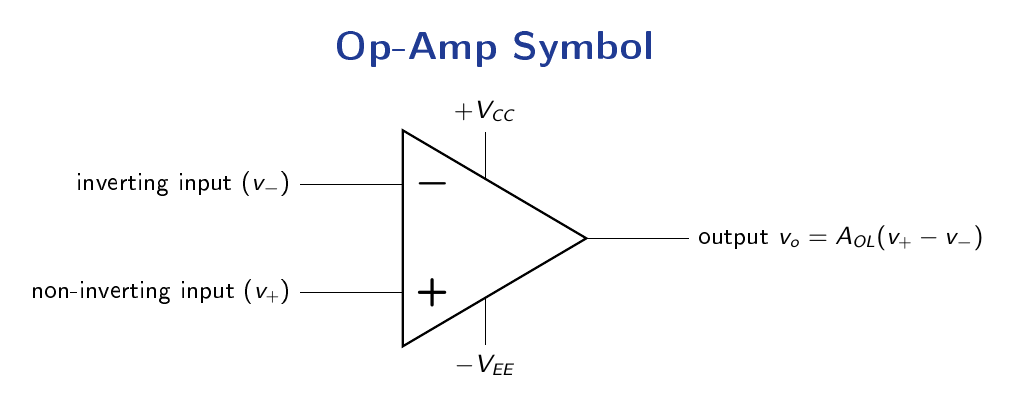
An operational amplifier is a high-gain, direct-coupled, differential-input voltage amplifier. Originally designed in the 1940s to perform mathematical operations — addition, subtraction, integration, differentiation — in analog computers, today a single IC (μA741, LM358, TL081…) costs a few rupees and forms the heart of almost every analog signal-processing block.
A Short History of the Op-Amp
| Year | Milestone |
|---|---|
| 1941 | Karl D. Swartzel (Bell Labs) designs the first patented vacuum-tube op-amp for the M9 gun director. |
| 1947 | John Ragazzini (Columbia University) coins the term operational amplifier. |
| 1953 | First commercial op-amp, the GAP/R K2-W (vacuum tube). |
| 1963 | Bob Widlar designs the first monolithic IC op-amp — the μA702 at Fairchild Semiconductor. |
| 1965 | The legendary μA709 (Widlar) sets the template for IC op-amps. |
| 1968 | David Fullagar releases the μA741 — internally compensated, easy to use, still in production. |
| 1970s+ | FET-input (μA740, LF356), CMOS, rail-to-rail, low-noise, chopper-stabilised, and high-speed (GHz) variants emerge. |
Internal Block Diagram of an Op-Amp
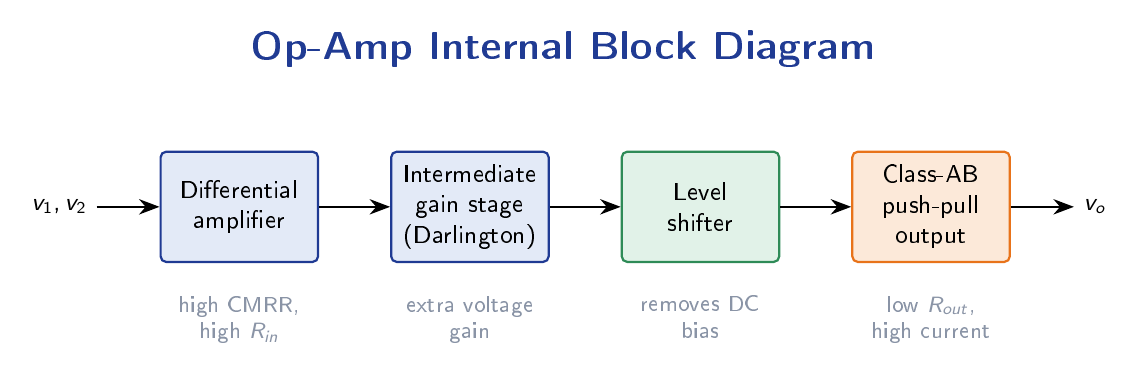
Intermediate gain stage: Provides additional gain (~500×) and impedance buffering (Darlington pair).
Output stage: Low output impedance, high current drive, wide voltage swing.
Pin Diagram of the μA741 (8-Pin DIP)
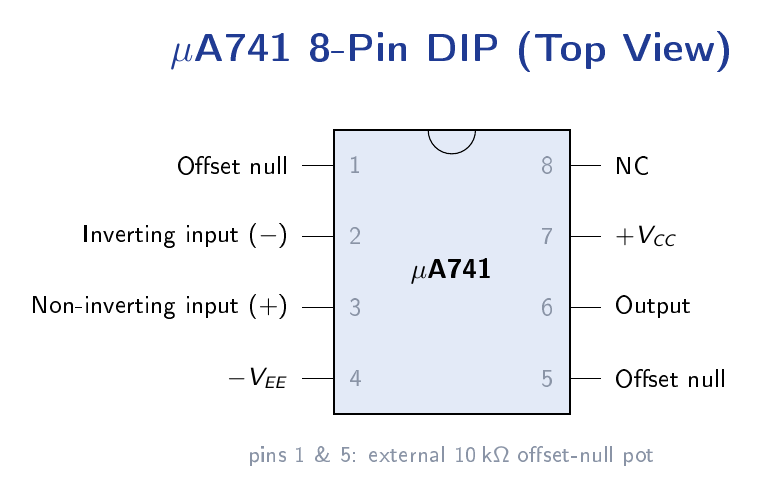
| Pin(s) | Name | Purpose |
|---|---|---|
| 1, 5 | Offset null | External potentiometer to null the input offset voltage |
| 2 | \(v_-\) (Inverting input) | Negative differential input |
| 3 | \(v_+\) (Non-inverting input) | Positive differential input |
| 4 | \(-V_{EE}\) | Negative supply (−15 V typical) |
| 6 | Output | \(v_o\) |
| 7 | \(+V_{CC}\) | Positive supply (+15 V typical) |
| 8 | N.C. | Not connected |
The Ideal Op-Amp — A Useful Fiction
| Parameter | Ideal Value | Practical (741 typical) |
|---|---|---|
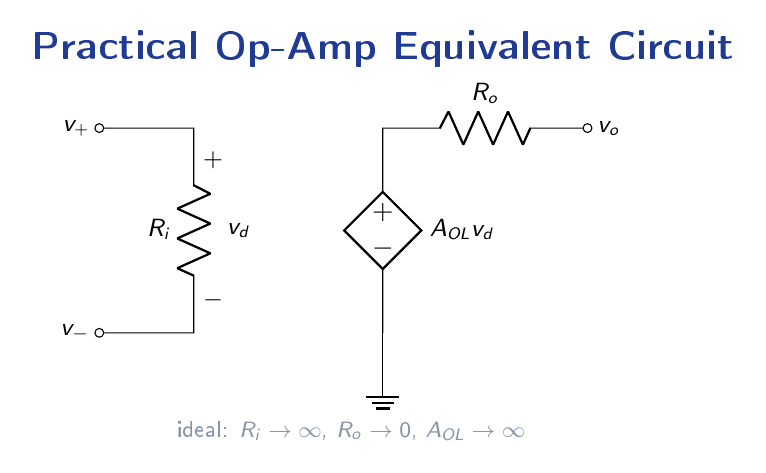
| Open-loop gain \(A_{OL}\) | \(\infty\) | \(2 \times 10^5\) |
| Input impedance \(R_i\) | \(\infty\) | 2 MΩ |
| Output impedance \(R_o\) | 0 | 75 Ω |
| Bandwidth (BW) | \(\infty\) | \(f_T = 1\) MHz |
| CMRR | \(\infty\) | 90 dB |
| Slew rate (SR) | \(\infty\) | 0.5 V/μs |
| Input offset \(V_{io}\) | 0 | 2 mV |
| Input bias current \(I_B\) | 0 | 80 nA |
| PSRR | \(\infty\) | 90 dB |
| Noise | 0 | ~20 nV/√Hz |
Equivalent Circuit of a Practical Op-Amp
Pedagogical Approach
Every topic in these notes follows a consistent flow: Why we need it → What the circuit looks like → How to derive its behaviour → Where it is applied → Worked numerical example. Three pillars underpin op-amp mastery:
- Intuition first — always ask: what is the op-amp trying to keep equal?
- Two golden rules — \(V^+ = V^-\) and \(I^+ = I^- = 0\) explain 90 % of all circuits.
- Practice by derivation — never memorise a formula you cannot re-derive in 60 seconds.
Ideal vs. Practical Op-Amp Parameters
Rule 2: \(I^+ = I^- = 0\) (no input current).
Both apply only when negative feedback is present and the op-amp is in its linear region.
DC Imperfections
Input Offset Voltage \(V_{io}\)
The small differential input voltage required to null the output. For the 741: \(V_{io} \approx 2\) mV typical. Referred to the output of a closed-loop circuit with gain \(A_{CL}\):
\[ V_{oo} = A_{CL} \cdot V_{io} \]Input Bias Current \(I_B\) and Offset Current \(I_{io}\)
Each input draws a small base/gate current. The average is \(I_B = (I_B^+ + I_B^-)/2\) and the mismatch is \(I_{io} = |I_B^+ - I_B^-|\). For the 741: \(I_B \approx 80\) nA, \(I_{io} \approx 20\) nA.
Compensating for Bias Current
Insert a compensating resistor \(R_c\) in series with the non-inverting input so that the voltage drops produced by \(I_B\) at the two inputs cancel:
\[ R_c = R_1 \,\Vert\, R_f = \dfrac{R_1 R_f}{R_1 + R_f} \]The residual output offset is then governed by the much smaller offset current:
\[ V_{oo} \approx I_{io}\,R_f \ll I_B\,R_f \]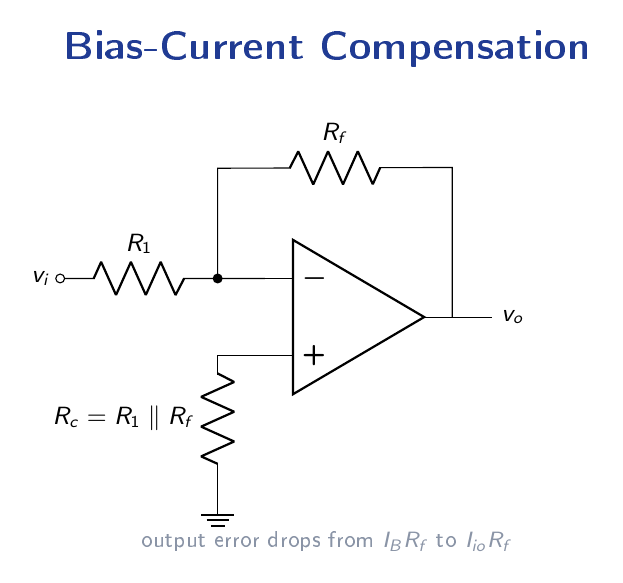
Thermal Drift
Offsets and bias currents change with temperature. For instrumentation work, this drift is the real design challenge, not the nominal offset value.
\[ \Delta V_{io} = \left.\frac{\partial V_{io}}{\partial T}\right|_T \cdot \Delta T \quad [\text{V}/^\circ\text{C}] \]- Typical 741: \(dV_{io}/dT \approx 6\,\mu\text{V}/^\circ\text{C}\), \(dI_{io}/dT \approx 0.2\,\text{nA}/^\circ\text{C}\).
- Premium precision op-amps (OP07, AD8551): \(<1\,\mu\text{V}/^\circ\text{C}\).
- Chopper-stabilized parts: \(<0.05\,\mu\text{V}/^\circ\text{C}\).
AC Characteristics
Frequency Response and Gain–Bandwidth Product
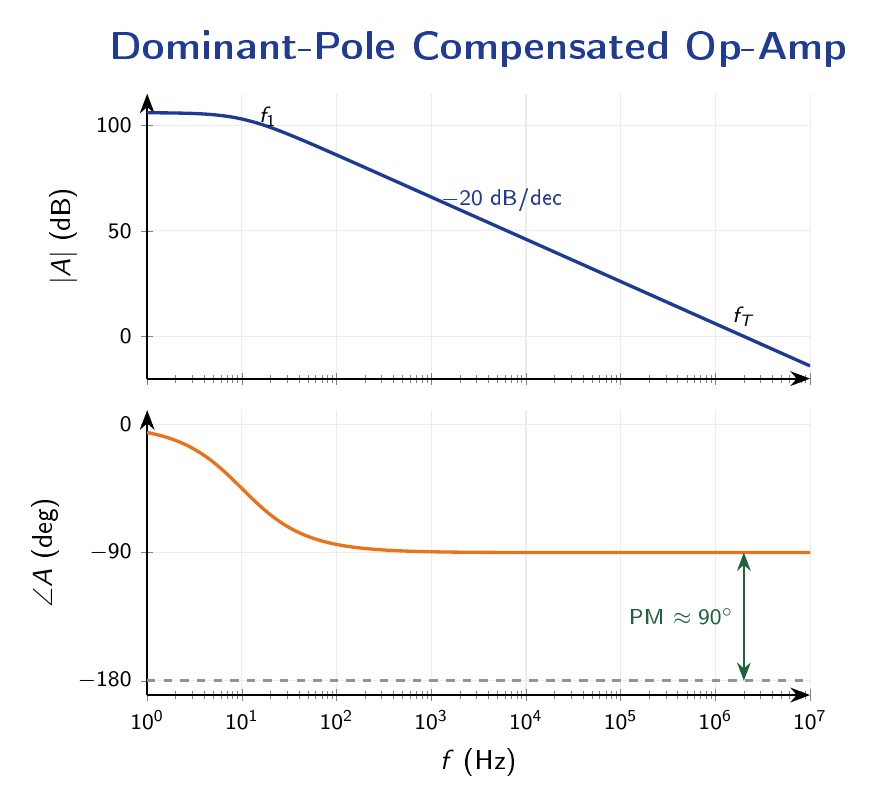
The open-loop gain rolls off at 20 dB/decade above the dominant pole \(f_1\). A single-pole model gives:
\[ A_{OL}(f) = \dfrac{A_0}{1 + j\,f/f_1}, \qquad |A_{OL}(f)| \approx \dfrac{f_T}{f} \quad (f \gg f_1) \]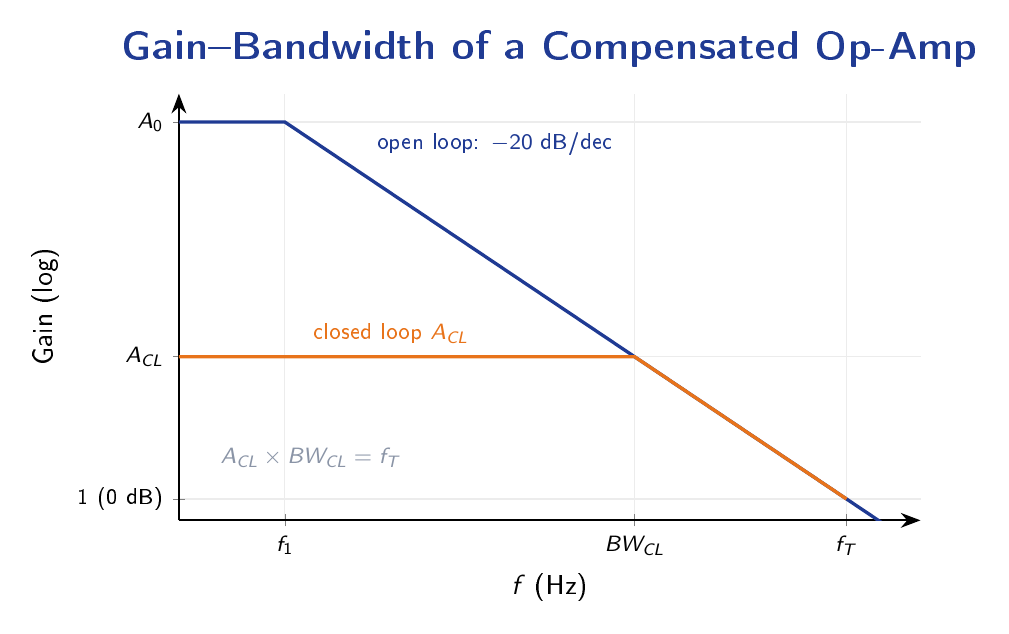
Slew Rate
Common-Mode Rejection Ratio (CMRR)
For inputs \(v_1, v_2\): \(v_d = v_1 - v_2\), \(v_c = \tfrac{1}{2}(v_1+v_2)\), \(v_o = A_d v_d + A_c v_c\).
\[ \mathrm{CMRR} = \left|\dfrac{A_d}{A_c}\right|, \qquad \mathrm{CMRR_{dB}} = 20\log_{10}\!\left|\dfrac{A_d}{A_c}\right| \]Typical 741: 90 dB. Instrumentation-grade INA126: \(>110\) dB. High CMRR is critical for thermocouples, ECG, and strain-gauge circuits that ride on common-mode noise.
Power-Supply Rejection Ratio (PSRR)
\[ \mathrm{PSRR} = \dfrac{\Delta V_{CC}}{\Delta V_{io}}, \qquad \mathrm{PSRR_{dB}} = 20\log_{10}\!\left|\dfrac{\Delta V_{CC}}{\Delta V_{io}}\right| \]Typical 741: ~90 dB. PSRR decreases at high frequencies, so 0.1 μF ceramic decoupling capacitors at supply pins are mandatory in any PCB layout.
Noise in Op-Amps
Referred to the input, every op-amp produces input voltage noise \(e_n\) [nV/√Hz] and input current noise \(i_n\) [pA/√Hz]. Each spectrum has a \(1/f\) region below corner frequency \(f_c\) and white noise above it.
\[ E_{no} = G_n\sqrt{e_n^2\Delta f + (i_n R_{eq})^2\Delta f + 4kT R_{eq}\Delta f} \]where \(G_n = 1+R_f/R_1\) is the noise gain, \(R_{eq}\) is the equivalent source resistance, and \(\Delta f\) is the bandwidth.
High source impedance (photodiode, electrometer): JFET/CMOS-input, low-\(i_n\) part (e.g. LF356, LMC6064) — otherwise the \(i_n R_s\) term dominates.
Summary: Typical 741 Parameters
| Parameter | Typical Value | Significance |
|---|---|---|
| \(A_{OL}\) (open-loop gain) | \(2\times10^5\) | Sets accuracy of closed-loop gain |
| \(R_i\) (input resistance) | 2 MΩ | Loading on source |
| \(R_o\) (output resistance) | 75 Ω | Ability to drive loads |
| \(V_{io}\) (input offset voltage) | 2 mV | DC error at output |
| \(I_B\) (input bias current) | 80 nA | Voltage drop across resistors |
| \(I_{io}\) (input offset current) | 20 nA | Residual after compensation |
| CMRR | 90 dB | Common-mode rejection |
| PSRR | 30 μV/V | Supply noise rejection |
| SR (slew rate) | 0.5 V/μs | Large-signal speed |
| \(f_T\) (unity-gain BW) | 1 MHz | Small-signal speed |
| \(e_n\) (input voltage noise) | ~20 nV/√Hz | Noise floor |
| \(V_{sat}\) (output swing) | ±13 V (with ±15 V supply) | Output headroom |
The Differential Amplifier Stage
Four Input/Output Configurations
- Dual-Input, Balanced-Output (DIBO) — two signals in, output taken between two collectors.
- Dual-Input, Unbalanced-Output (DIUO) — two signals in, output taken w.r.t. ground.
- Single-Input, Balanced-Output (SIBO) — one signal, two-ended output.
- Single-Input, Unbalanced-Output (SIUO) — the typical single-ended configuration.
In all cases two signal modes are analysed: differential mode (\(v_d\)) — the useful signal — and common mode (\(v_c\)) — the noise or interference to be rejected.
DIBO: Dual-Input, Balanced-Output
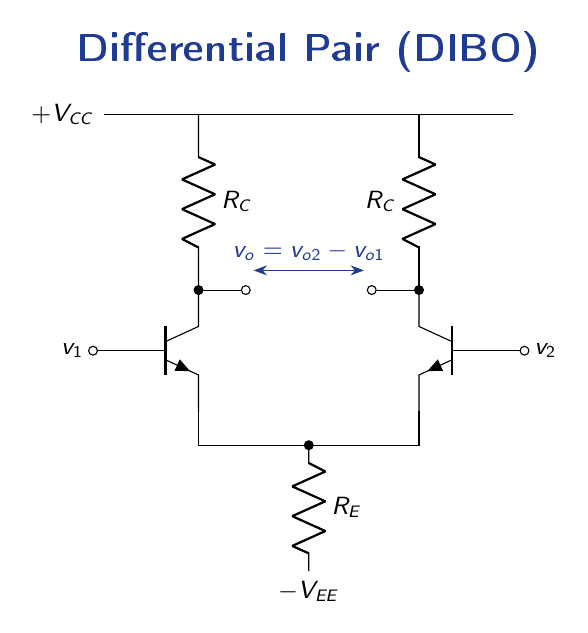
where \(r_e = V_T/I_E\) is the small-signal emitter resistance.
Improving CMRR — Active Tail Current Source
Configuration Summary
| Configuration | Differential Gain | Common-Mode Gain | Notes |
|---|---|---|---|
| DIBO | \(R_C/r_e\) | \(\approx R_C/2R_E\) | High gain; two ends to use |
| DIUO | \(R_C/(2r_e)\) | \(\approx R_C/2R_E\) | Most common at op-amp inputs |
| SIBO | \(R_C/r_e\) | Same as DIBO | One input grounded |
| SIUO | \(R_C/(2r_e)\) | Same as DIUO | Single-ended in and out |
Unbalanced output → half the gain (you read only one collector).
Feedback Theory in Op-Amps
The General Feedback Topology
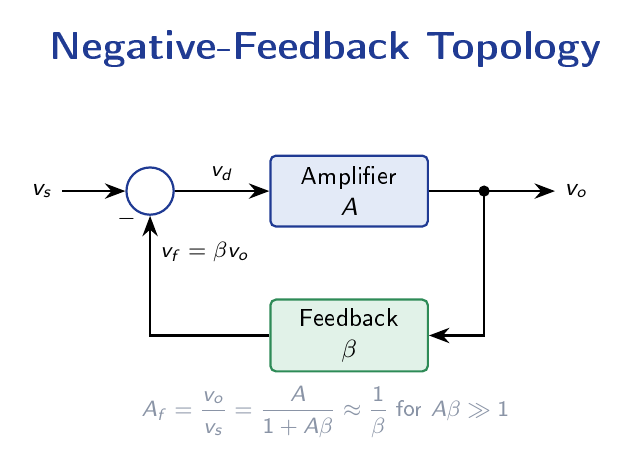
Benefits of Negative Feedback
| Property | Effect (desensitivity factor \(D = 1+A\beta\)) |
|---|---|
| Gain | Reduced by \(D\): \(A_f = A/D\) |
| Gain stability | \(\dfrac{dA_f/A_f}{dA/A} = \dfrac{1}{D}\) |
| Input impedance | \(R_{if} = R_i \cdot D\) (series-mixed) or \(R_i/D\) (shunt-mixed) |
| Output impedance | \(R_{of} = R_o/D\) (voltage-sampled) or \(R_o \cdot D\) (current-sampled) |
| Bandwidth | Increased by \(D\): \(f_{Hf} = f_H \cdot D\) |
| Distortion | Reduced by \(D\) |
| Intrinsic noise | Unchanged |
The Four Feedback Topologies
| Topology | Sampled at Output | Mixed at Input | Op-Amp Example |
|---|---|---|---|
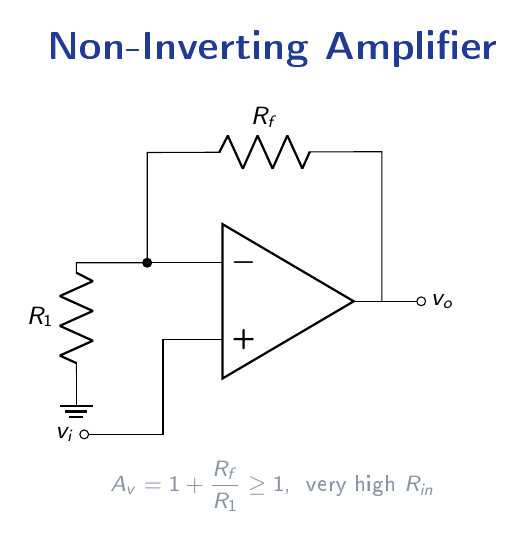
| Voltage-series | Voltage | Voltage (series) | Non-inverting amplifier |
| Voltage-shunt | Voltage | Current (shunt) | Inverting amplifier |
| Current-series | Current | Voltage (series) | V-to-I converter |
| Current-shunt | Current | Current (shunt) | Current amplifier |
Step 2: If feedback samples the load voltage (parallel to output) → voltage sampling; if it samples a series current → current sampling.
The Two Golden Rules — Revisited
With \(A_{OL} \to \infty\) and a small finite \(v_o\):
\[ v_d = v_+ - v_- = v_o/A_{OL} \to 0 \quad\Rightarrow\quad v_+ = v_-\ \text{(virtual short)} \]With \(R_i \to \infty\), no current flows into the input terminals: \(i_+ = i_- = 0\).
Closed-Loop Configurations
The Inverting Amplifier
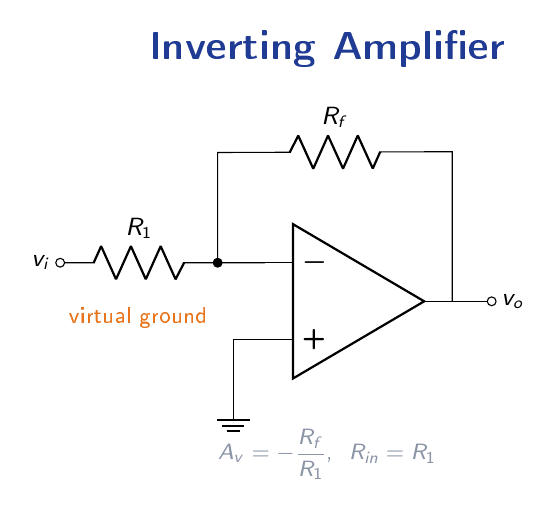
KCL at virtual ground (inverting node held at 0 V):
\[ \dfrac{v_i - 0}{R_1} = \dfrac{0 - v_o}{R_f} \]The Non-Inverting Amplifier
The Voltage Follower (Unity-Gain Buffer)
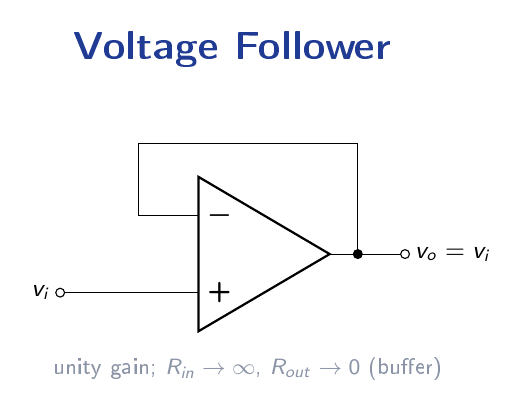
Uses: Impedance buffer for high-Z sources (pH sensor, electrometer), inter-stage isolation, power buffering without voltage change.
Linear Applications
Summing (Adder) Amplifier
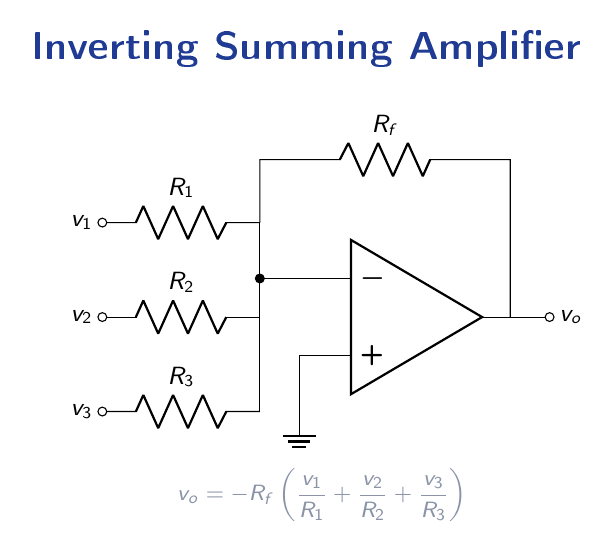
KCL at virtual ground:
\[ \dfrac{v_1}{R_1} + \dfrac{v_2}{R_2} + \dfrac{v_3}{R_3} = -\dfrac{v_o}{R_f} \]Worked Example — Designing a Summing Amplifier
Design a circuit to compute \(v_o = -(2v_1 + 5v_2 + 0.5v_3)\) using a 741 op-amp with \(R_f = 100\) kΩ.
Solution: For each input, \(R_f/R_i\) equals the desired weight:
- Coefficient 2 for \(v_1\): \(R_1 = R_f/2 = 50\) kΩ
- Coefficient 5 for \(v_2\): \(R_2 = R_f/5 = 20\) kΩ
- Coefficient 0.5 for \(v_3\): \(R_3 = R_f/0.5 = 200\) kΩ
Bias compensation: \(R_c = R_1 \Vert R_2 \Vert R_3 \Vert R_f \approx 11.4\) kΩ placed at the non-inverting input.
Headroom check: With each input at ±1 V, \(|v_o|_{\max} = 7.5\) V — well within the ±13 V swing of the 741.
Difference (Subtractor) Amplifier
With both inputs applied through matched resistors to the inverting and non-inverting inputs, superposition gives:
\[ v_o = v_2 \cdot \dfrac{R_g}{R_2+R_g} \cdot \!\left(1+\dfrac{R_f}{R_1}\right) - \dfrac{R_f}{R_1}v_1 \]Instrumentation Amplifier (3-Op-Amp)
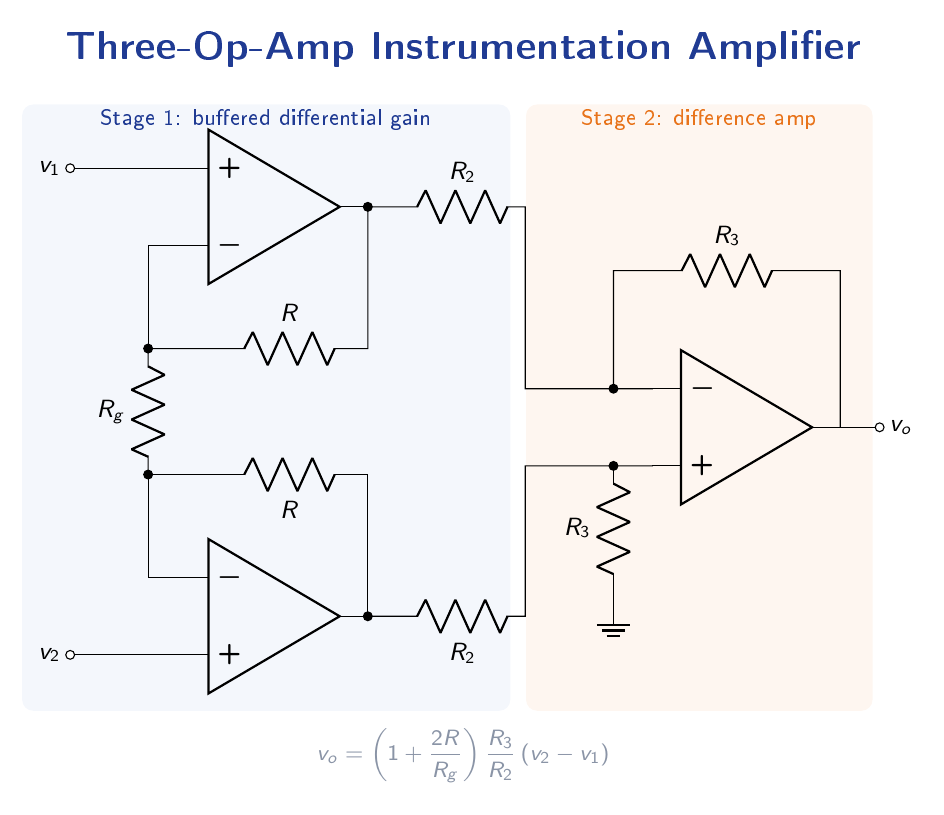
Advantages: Very high \(Z_{in}\); gain set by one resistor \(R_g\); CMRR determined only by Stage 2 resistor matching. Widely used in medical instrumentation and strain-gauge bridges.
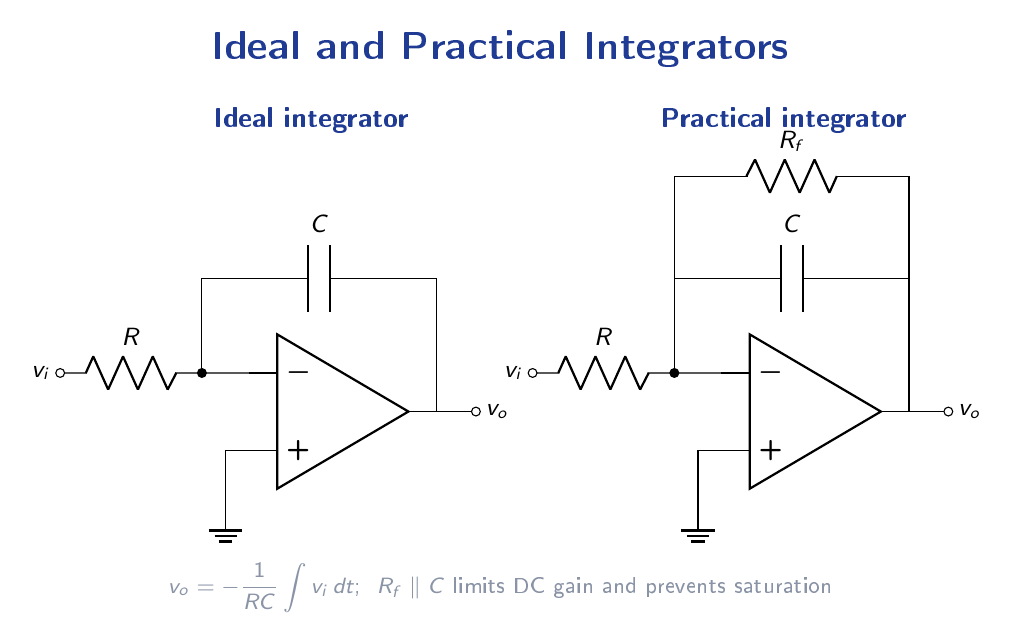
Ideal and Practical Integrators
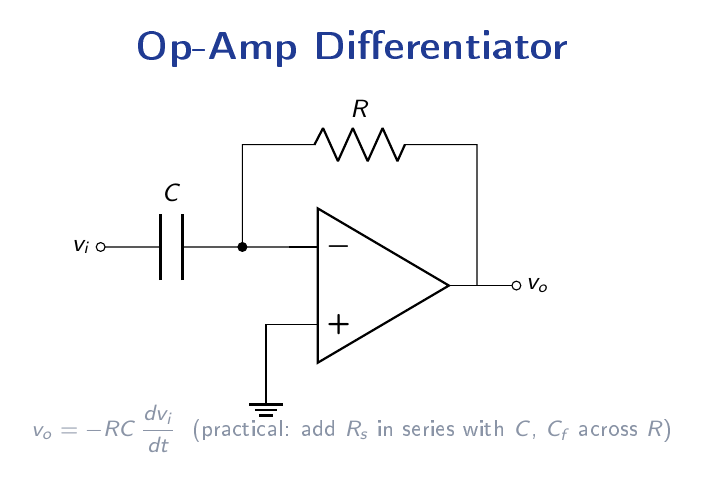
Differentiator
V-to-I and I-to-V Converters
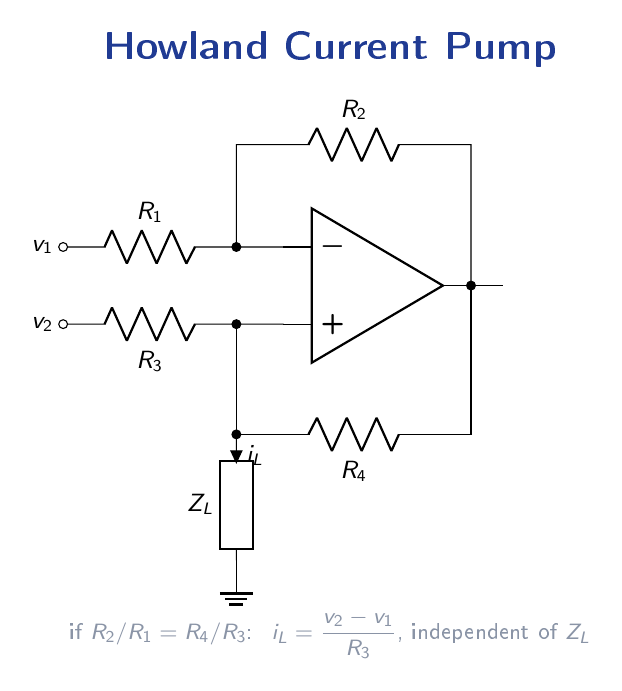
Howland Current Pump (Grounded-Load V-to-I)
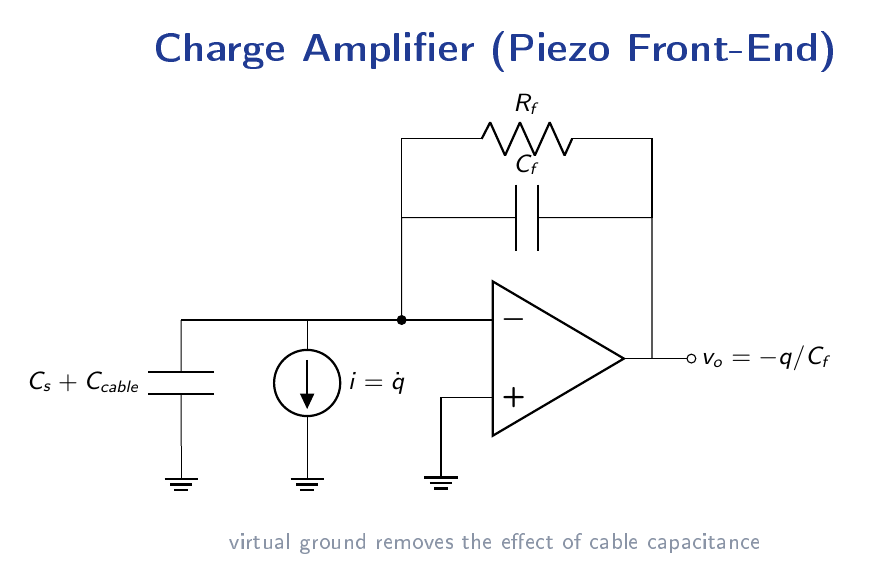
Charge Amplifier (Piezoelectric Front-End)
Non-Linear Applications
The Comparator
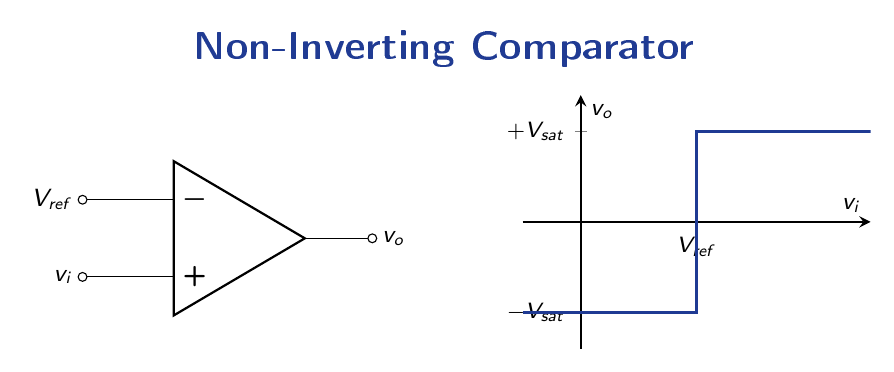
Applications: threshold detection, zero-crossing detection, window detectors, ADC stages. The zero-crossing detector (\(V_{ref} = 0\)) converts a sine wave to a square wave. A window detector uses two comparators with outputs OR-ed to indicate when the input lies within \([V_L, V_H]\).
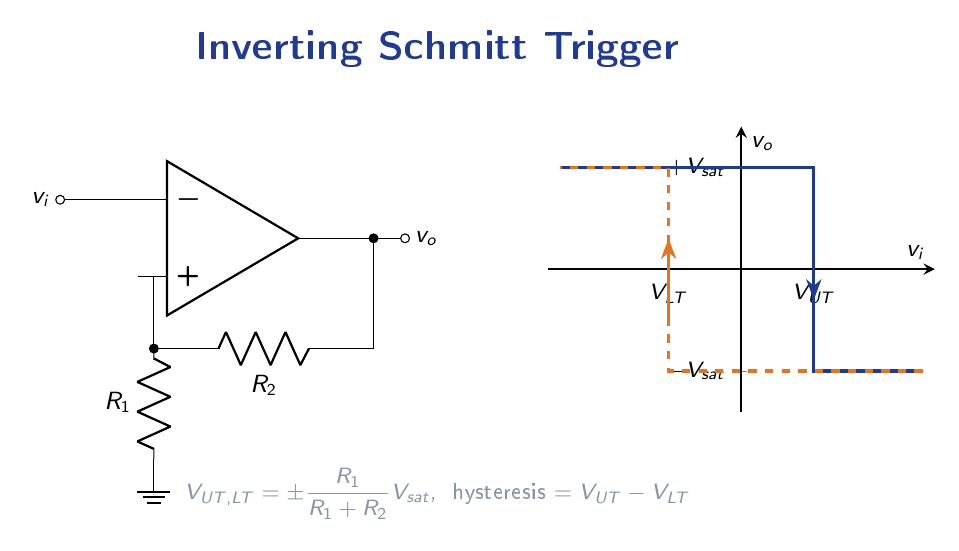
Schmitt Trigger — Comparator with Hysteresis
Multivibrators and Waveform Generators
Astable Multivibrator (Square-Wave Generator)
The op-amp is used open-loop with positive feedback (Schmitt configuration) and a timing RC network on the inverting input. The capacitor charges through \(R\) toward the threshold, flipping the output, then charges in the other direction — producing a continuous square wave.
Monostable Multivibrator (One-Shot)
Has one stable state; a trigger drives the output to an unstable state for a fixed time \(T\), then it returns. Used for pulse generation, debouncing, and missing-pulse detection.
\[ T = RC\,\ln\!\left(\dfrac{1+V_D/V_{sat}}{1-\beta}\right), \quad \beta = \dfrac{R_1}{R_1+R_2} \]Triangular-Wave Generator
A Schmitt trigger drives an integrator; the Schmitt output is a square wave and the integrator converts it to a triangle wave via feedback.
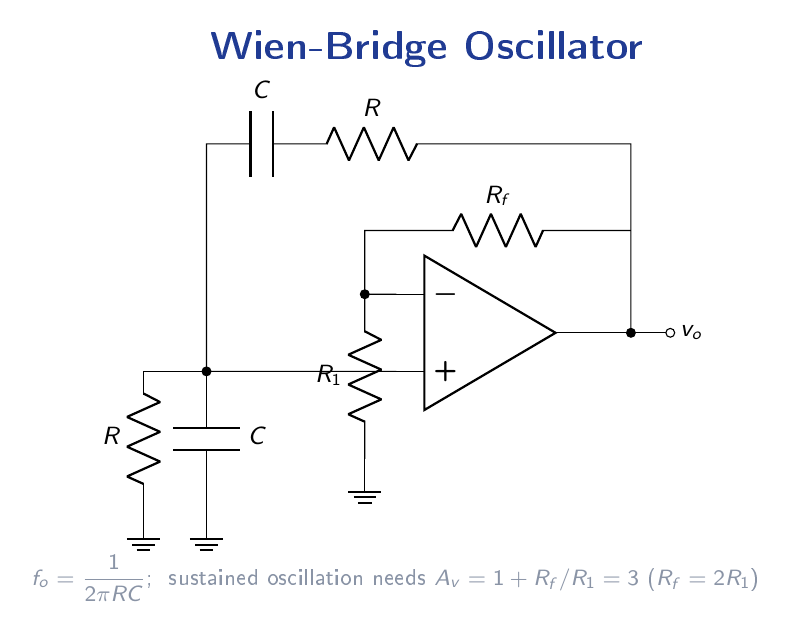
Wien-Bridge Oscillator
RC Phase-Shift Oscillator
Three cascaded RC sections each provide 60° of phase shift for a total of 180° at one specific frequency; the inverting op-amp adds another 180°, satisfying the Barkhausen criterion.
Precision Rectifiers
Precision Half-Wave Rectifier (Superdiode)
A passive diode has a forward voltage drop of ~0.7 V that ruins precision for small signals. The op-amp drives whatever voltage is needed at its output to overcome \(V_D\), so the effective threshold at the node becomes \(V_D/A_{OL} \approx 0\).
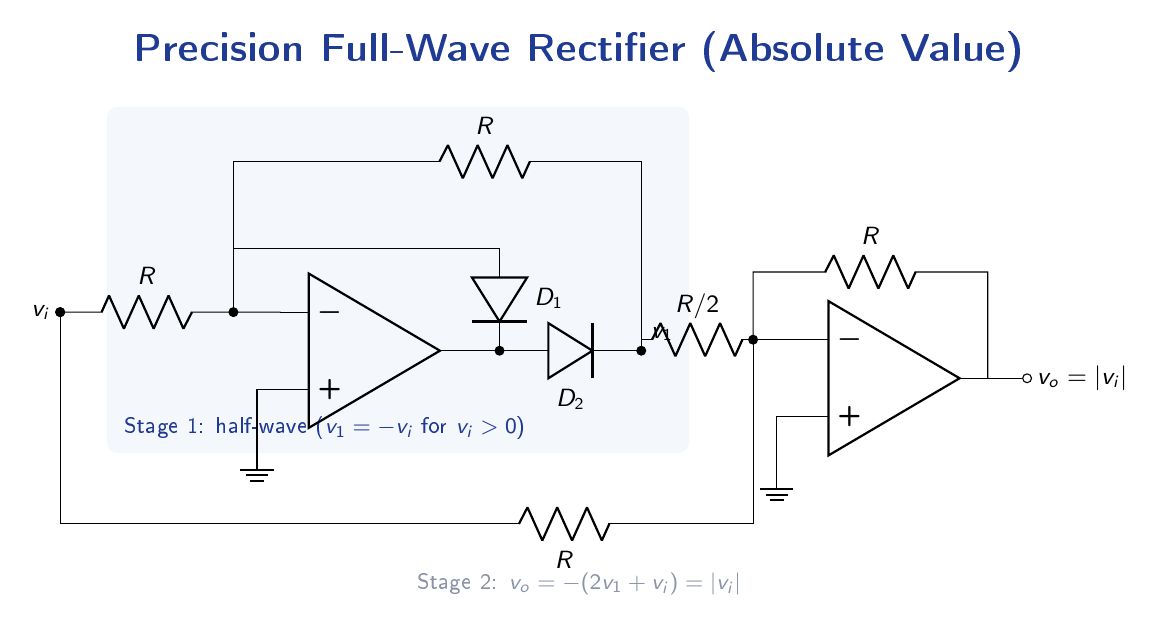
Precision Full-Wave Rectifier (Absolute-Value Circuit)
Stage 1 is a precision half-wave rectifier producing \(v_1\). Stage 2 is an inverting summer combining \(v_1\) with weight 2 (through \(R/2\)) and the original \(v_i\) with weight 1 (through \(R\)), yielding \(v_o = |v_i|\).
Log and Antilog Amplifiers
Applications: analog multiply/divide, dB meters, audio compressors. Temperature drift is the main limitation — use a matched transistor pair or a compensated IC (AD538, LOG112).
Sample-and-Hold Circuit
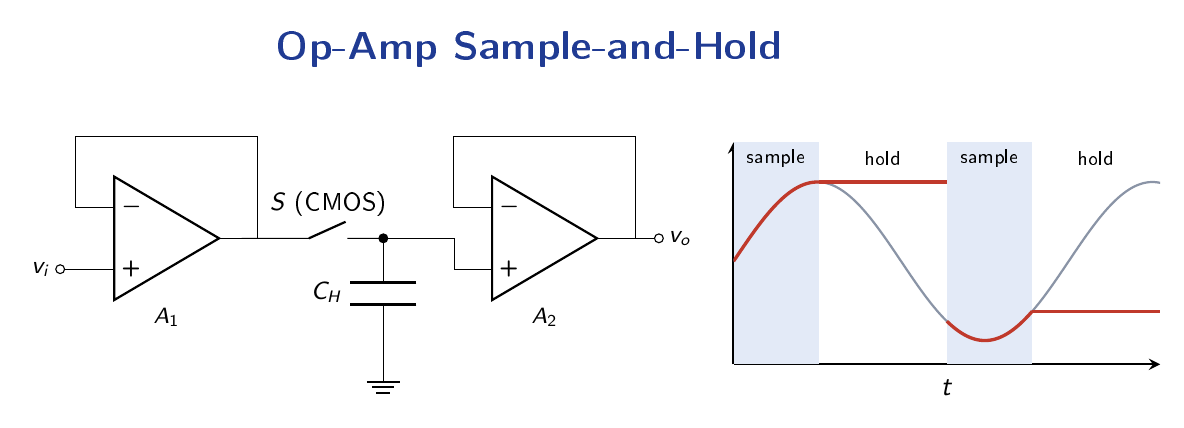
Droop rate: \(dv_o/dt = I_{leak}/C_H\)
Aperture time: switch turn-off uncertainty → amplitude jitter
Peak Detector
A precision diode (op-amp A₁ + diode \(D\)) charges a hold capacitor \(C_H\) only when \(v_i\) rises above the previously stored peak. When \(v_i\) falls, \(D\) reverse-biases and \(C_H\) retains the peak voltage.
\[ v_o(t) = \max_{0\le \tau \le t} v_i(\tau) \]A reset switch discharges \(C_H\) between measurements. Used in envelope detection, AM demodulation, and AGC systems.
Active Filters
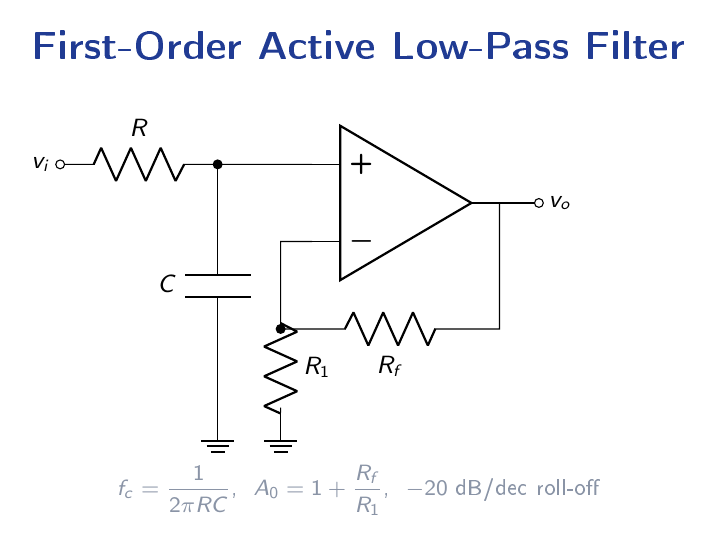
First-Order Low-Pass Filter
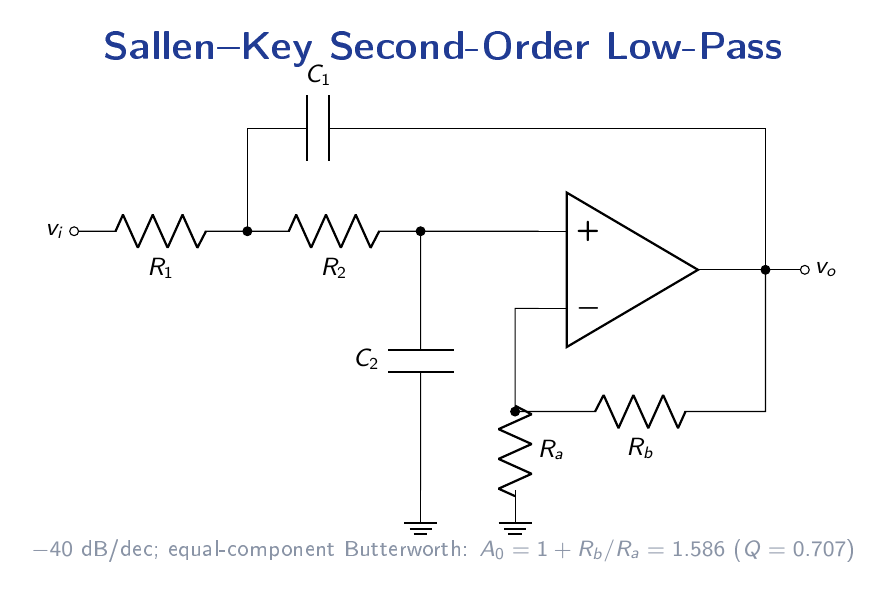
Second-Order Low-Pass Filter (Sallen-Key)
High-Pass Filters
A first-order HPF is obtained by interchanging \(R\) and \(C\) in the LPF circuit:
\[ H(s) = \dfrac{A_0\,s/\omega_c}{1 + s/\omega_c}, \quad f_c = \dfrac{1}{2\pi RC}, \quad A_0 = 1+\dfrac{R_f}{R_1} \]The second-order HPF (Sallen-Key) is obtained by swapping \(R\) and \(C\) in the 2nd-order LPF:
\[ H(s) = \dfrac{A_0\,s^2}{s^2 + (\omega_o/Q)s + \omega_o^2} \]Band-Pass Filters
A wideband BPF is formed by cascading an HPF (cutoff \(f_L\)) and an LPF (cutoff \(f_H\)) with \(f_L < f_H\).
Multiple-Feedback Band-Pass Filter
For \(C_1 = C_2 = C\):
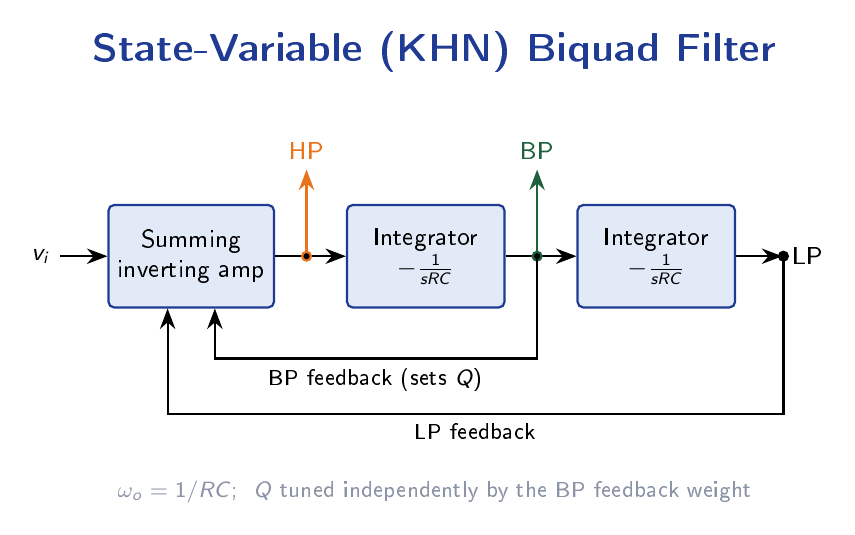
\[ f_o = \dfrac{1}{2\pi C}\sqrt{\dfrac{R_1+R_2}{R_1 R_2 R_3}}, \quad Q = \pi f_o R_3 C, \quad A_o = -\dfrac{R_3}{2R_1} \]State-Variable Filter (KHN Biquad)
Band-Stop (Notch) Filter
Eliminates a single interfering frequency, such as 50/60 Hz mains hum from ECG signals. Two common designs:
- Twin-T notch: Highest selectivity, requires precise component matching. \(f_n = 1/(2\pi RC)\).
- Wide-band BSF: Cascade LPF and HPF in parallel via a summing amplifier.
All-Pass Filter (Phase Equalizer)
Passes all frequencies with constant unity amplitude but variable phase — used to correct phase distortion in cables and communication channels.
Special-Purpose ICs
The 555 Timer
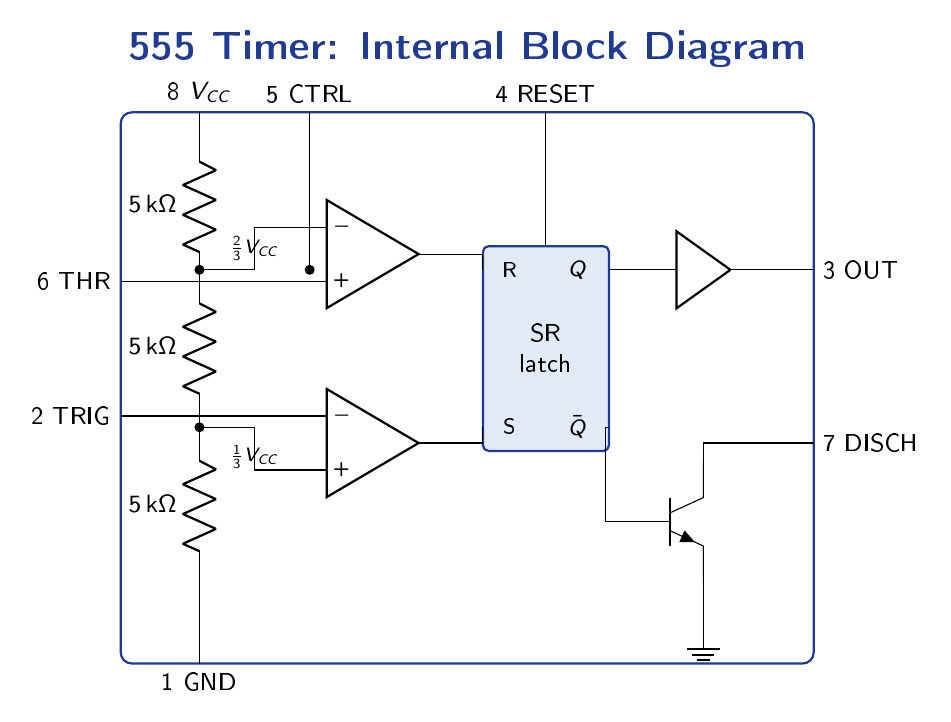
Introduced in 1972 by Hans Camenzind (Signetics), the 555 timer is one of the most-sold integrated circuits in history. Internal blocks include a three-resistor voltage divider setting thresholds at \(V_{CC}/3\) and \(2V_{CC}/3\), two comparators, an SR flip-flop, a 200 mA output buffer, and a discharge transistor.
Voltage-Controlled Oscillator (VCO)
An oscillator whose output frequency varies linearly with a control voltage \(V_c\):
\[ f_o = f_c + K_{VCO}\,V_c \quad [\text{Hz/V}] \]NE566 design equation: \(f_o = 2(V_{CC}-V_c)/(R_1 C_1 V_{CC})\), with \(R_1\) in 2–20 kΩ and \(f_{\max} \approx 1\) MHz. Applications: FM modulators, PLL building blocks, function generators.
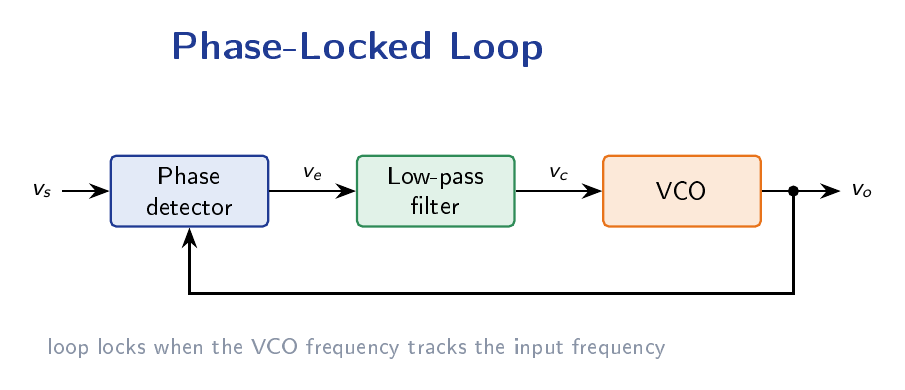
Phase-Locked Loop (PLL)
Digital-to-Analog Converters (DAC)
Weighted-Resistor DAC
Each digital bit drives an input through a binary-weighted resistor. Problems: requires a wide range of resistor values (1× to \(2^n\times\)) which is difficult to maintain accurately for high-bit-count converters.
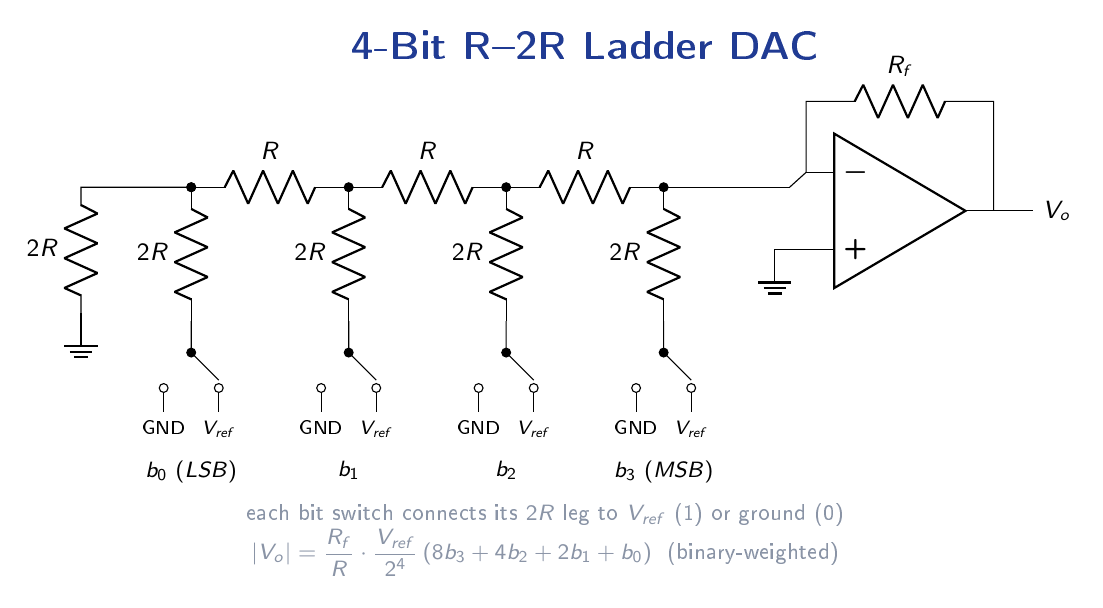
\[ v_o = -V_{ref}\dfrac{R_f}{R}\!\left(b_3\cdot\tfrac{1}{1}+b_2\cdot\tfrac{1}{2}+b_1\cdot\tfrac{1}{4}+b_0\cdot\tfrac{1}{8}\right) \]R-2R Ladder DAC
Analog-to-Digital Converters (ADC)
| Type | Principle | Speed | Resolution |
|---|---|---|---|
| Flash | \(2^n-1\) comparators vs. resistor ladder | Very fast (GS/s) | Low (8-bit) |
| Successive Approx. (SAR) | Binary search via DAC + comparator | Medium (MS/s) | Medium (12–18-bit) |
| Dual-slope (integrating) | Integrates input then reference; counts time | Slow (S/s–kS/s) | Very high (22-bit) |
| Sigma-Delta (ΣΔ) | Oversampling + noise-shaping + decimation | Slow–medium | Very high (24-bit audio) |
| Counter (ramp) | Compares input to counter-driven DAC ramp | Slow | Medium |
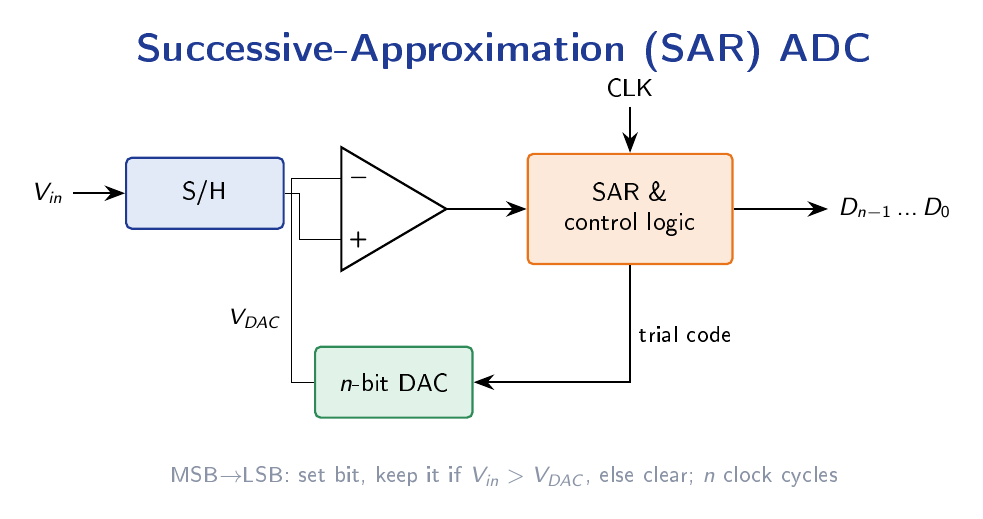
Successive-Approximation Register (SAR) ADC
For an \(n\)-bit converter, \(n\) comparison clocks are needed. The algorithm: (1) try MSB = 1 — if DAC output \(> v_i\), reset it to 0, else keep 1; (2) move to the next bit and repeat; (3) after \(n\) steps the SAR holds the digital code closest to \(v_i\). Conversion time: \(n\) clocks. Example ICs: ADS7886, ADC0808, MCP3008.
Frequency Response and Stability
Compensation and Stability
Each pole of \(A_{OL}(s)\) adds 90° of phase lag. If the total phase lag reaches 180° at the frequency where \(|A_{OL}\beta| = 1\), negative feedback becomes positive feedback — leading to oscillation.
Phase Margin (PM): \(180^\circ - |\angle A_{OL}\beta|\) at the unity-gain frequency.
Rule of thumb: PM ≥ 45°, GM ≥ 6 dB.
Compensation Techniques
- Dominant-pole: Add a large internal capacitor \(C_C\) to push the first pole to very low frequency so that by the unity-gain frequency the phase lag is still only ~90°. Done internally in the 741.
- Pole-zero: Cancel an unwanted pole with a zero in the compensation network.
- Feed-forward: Bypass a slow internal stage for high-frequency signals.
- External compensation: Non-internally-compensated op-amps (e.g. 301A) let the designer tailor compensation for each application.
Voltage-Feedback (VFA) vs. Current-Feedback (CFA) Op-Amps
| Property | Voltage-Feedback (VFA) | Current-Feedback (CFA) |
|---|---|---|
| Internal topology | High-Z differential inputs; output ∝ differential voltage | Low-Z inverting input (transimpedance node); buffer between + and − |
| Open-loop quantity | Gain \(A_{OL}\) (V/V) | Transimpedance \(Z_T\) (Ω) |
| GBW behaviour | GBW = const; \(f_T\) trades linearly with gain | BW set by \(R_f\) alone; independent of closed-loop gain |
| Slew rate | Limited by tail current of input pair | Very high — internal node charges from a low-Z buffer |
| Stable feedback | Any resistor ratio; capacitor allowed in feedback | \(R_f\) must lie in a recommended range (~500 Ω–1.5 kΩ); no capacitor across \(R_f\) |
| Examples | 741, OP07, OPA227 | AD844, LT1223, OPA683 |
Course Summary
- Built from ideal to practical: golden rules → real DC/AC limitations
- Mastered the differential pair and negative feedback core
- Closed-loop topologies: inverting, non-inverting, follower
- Linear blocks: summer, difference, instrumentation, integrator, differentiator, V–I/I–V, Howland, charge amplifier
- Non-linear blocks: comparators, Schmitt trigger, oscillators, precision rectifiers, log/antilog, sample-and-hold, peak detector
- Active filters: LPF, HPF, BPF, BSF, all-pass, state-variable (KHN biquad)
- Special ICs: 555 timer, VCO, PLL, DAC (weighted and R-2R), ADC (Flash, SAR, Dual-slope, Sigma-Delta)
- Noise, frequency response, stability margins, VFA vs. CFA