From Fundamentals to GATE Excellence — Complete Revision Notes
By Dr. Mithun Mondal | Department of Electrical & Electronics Engineering, BITS Pilani Hyderabad Campus | Category: EEE
"In God we trust. All others must bring data."
— W. Edwards Deming
1. Fundamentals & Terminology
What is Measurement?
Definition
Measurement is the process of comparing an unknown physical quantity with a predefined standard of the same kind to obtain a numerical value expressing its magnitude.
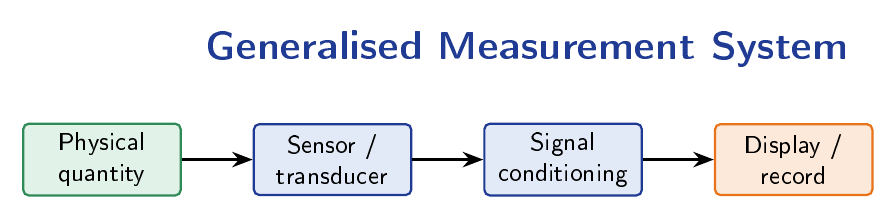
A complete measurement system consists of four stages in sequence: the physical quantity is first sensed by a sensor or transducer, the signal then undergoes signal conditioning, is subsequently processed by electronic circuitry, and finally displayed or recorded.
Block diagram of a generalised measurement system: Physical Quantity → Sensor/Transducer → Signal Conditioning → Display/Record, representing the four essential stages from input to output.
Methods of Measurement
Direct: meter stick, voltmeter
Indirect: \(P = VI\)
Comparison: bridges, potentiometers
Null method: balance point indicates zero deviation
Deflection method: pointer reads proportional to the measurand
Performance Parameters
Accuracy, Precision
Sensitivity, Resolution
Linearity, Hysteresis
Dynamic response (bandwidth, settling time)
Accuracy vs Precision
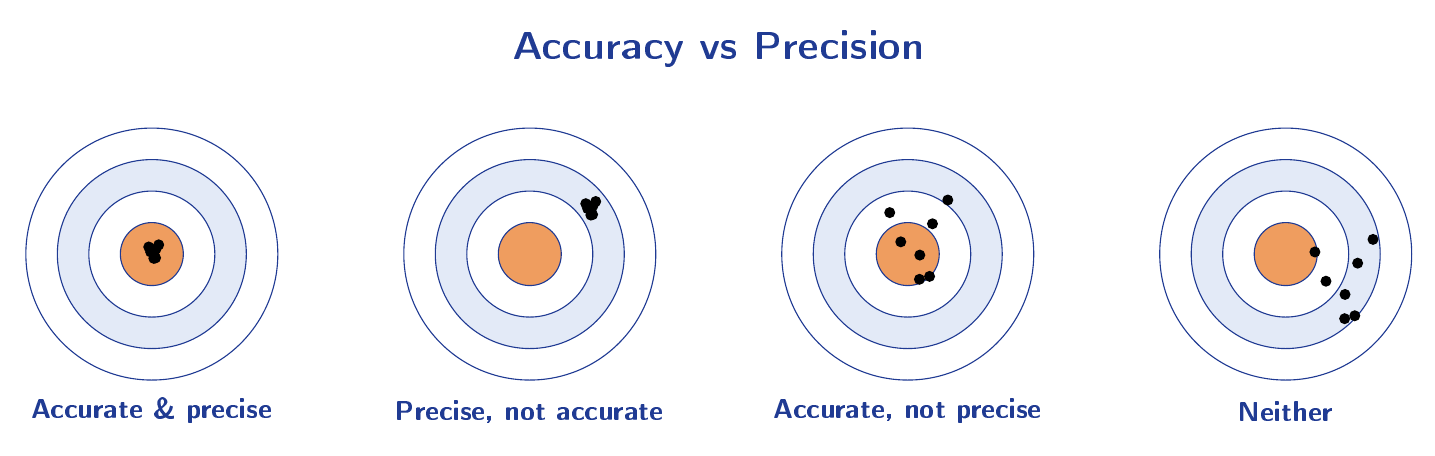
Key DistinctionAccuracy is the closeness of a measurement to the true value. Precision is the reproducibility of repeated readings under the same conditions. An instrument can be precise without being accurate (systematic bias), and it can be accurate on average without being precise (large scatter).
Accuracy Expressions
\[ \%\,\text{Accuracy} = \left(1 - \frac{|X_m - X_t|}{X_t}\right) \times 100 \qquad \%\,\text{Error} = \frac{X_m - X_t}{X_t} \times 100 \]
where \(X_m\) is the measured value and \(X_t\) is the true value.
Target diagrams illustrating the four combinations of accuracy and precision. Clustered hits near the centre indicate both accuracy and precision; clustered hits away from the centre show precision without accuracy; scattered hits near the centre demonstrate accuracy without precision.
Static Characteristics of Instruments
Core Static Parameters
Sensitivity: \(S = \dfrac{dq_o}{dq_i}\) Resolution: \(\dfrac{\text{Full Scale}}{\text{Number of divisions}}\)
Threshold: minimum input from zero for a detectable output change.
Dead Zone: range of input producing no change in output.
Hysteresis: output difference between ascending and descending input traversals.
Drift: gradual output shift over time — zero drift, span drift, thermal drift.
GATE Insight: Sensitivity Trap
A 0–10 A ammeter with 100 divisions has sensitivity = 0.1 A/div. Higher sensitivity implies a smaller resolvable quantity — an instrument with a smaller current per division is more sensitive, not less.
Dynamic Characteristics
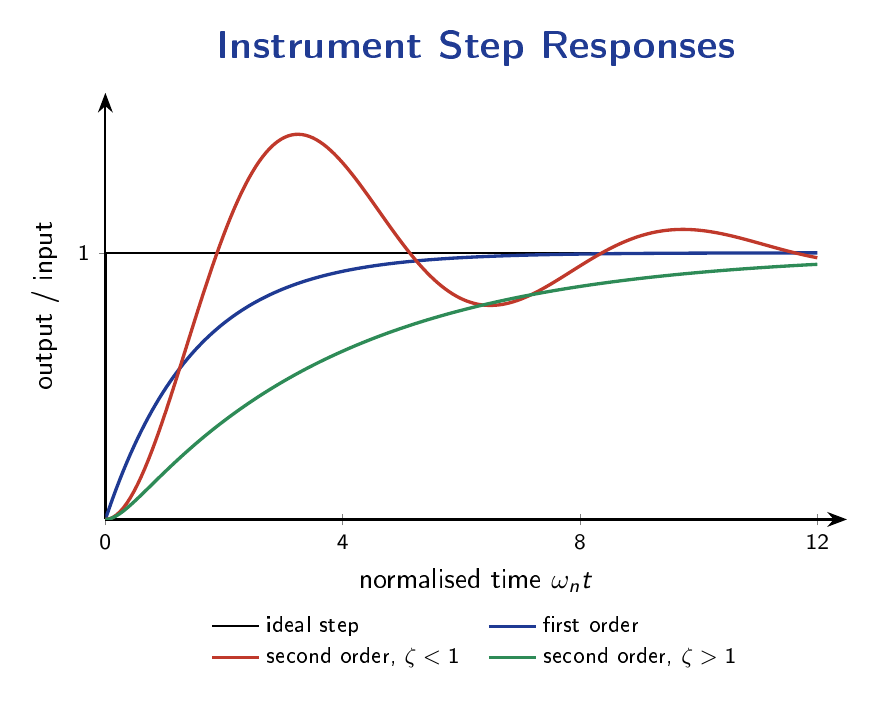
Real signals vary with time, and the instrument must reproduce changes faithfully. Instruments are classified by their order of dynamic response:
Zero-order: \(\;q_o(t) = K\,q_i(t)\) — instantaneous response, no lag.
First-order: \(\;\tau\dfrac{dq_o}{dt} + q_o = K\,q_i\) — exponential approach to steady state with time constant \(\tau\).
Limiting (Guaranteed) Error
Manufacturer-guaranteed maximum error expressed as ±% of full-scale deflection (FSD):
\[ \delta A = \pm\frac{\%\epsilon \times \text{FSD}}{100} \]
Note that the percentage error in reading increases as the reading falls below FSD — always read instruments near full scale.
Propagation of Errors
For \(Y = f(x_1, x_2, \ldots, x_n)\):
Power \(Y = x^n\): \(\dfrac{\delta Y}{Y} = n\,\dfrac{\delta x}{x}\)
GATE Insight: Power in a Resistor
For \(P = I^2 R\): \(\dfrac{\delta P}{P} = 2\dfrac{\delta I}{I} + \dfrac{\delta R}{R}\)
Statistical Analysis of Random Errors
Mean and Deviation
\[ \bar{x} = \frac{1}{n}\sum_{i=1}^{n} x_i \qquad d_i = x_i - \bar{x} \qquad \sum d_i = 0 \]
Standard Deviation and Variance
\[ \sigma = \sqrt{\frac{\sum_{i=1}^{n}(x_i - \bar{x})^2}{n-1}} \qquad V = \sigma^2 \]
Use \(n-1\) (Bessel's correction) for \(n \le 20\); use \(n\) for large samples.
Normal (Gaussian) Distribution
\[ p(x) = \frac{1}{\sigma\sqrt{2\pi}}\exp\!\left[-\frac{(x-\bar{x})^2}{2\sigma^2}\right] \]
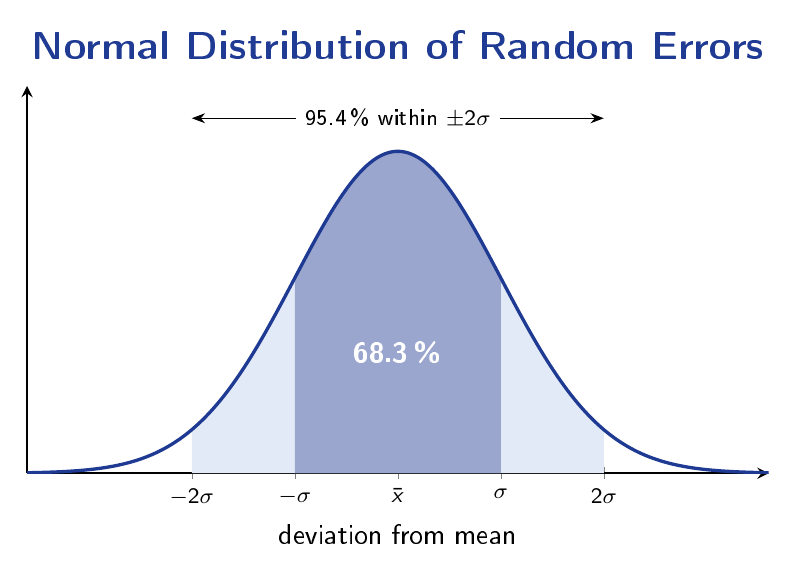
Normal distribution of random measurement errors, showing the 68.3% (±1σ) and 95.4% (±2σ) confidence intervals. The symmetric bell-shaped curve is characteristic of purely random errors.
Confidence Intervals
Range
Probability
Description
\(\bar{x} \pm 0.6745\sigma\)
50.0%
Probable error
\(\bar{x} \pm \sigma\)
68.3%
1-sigma range
\(\bar{x} \pm 2\sigma\)
95.4%
2-sigma range
\(\bar{x} \pm 3\sigma\)
99.7%
3-sigma range
Loading Error
Example: Voltmeter Loading
A voltmeter with internal resistance \(R_v\) placed across circuit resistance \(R\) creates a parallel combination \(R_{eq} = R \parallel R_v\). With Thévenin source \((V_{th}, R_{th})\):
\[ V_m = V_{th} \cdot \frac{R_{eq}}{R_{eq} + R_{th}} \]
With \(R = 50\,\text{k}\Omega\) and \(R_v = 10\,\text{k}\Omega\): \(R_{eq} = 8.33\,\text{k}\Omega\) — a severe drop, so \(V_m\) falls well below the true voltage. Moral: keep \(R_v \gg R_{circuit}\).
GUM: Measurement Uncertainty (ISO/IEC Guide 98-3)
Type A and Type B Uncertainty
Type A — statistical (from repeated readings): \(\;u_A(\bar{x}) = s/\sqrt{n}\)
Type B — non-statistical (from datasheets, calibration certificates): \(\;u_B = a/k\), where \(a\) is the half-range and \(k\) is the coverage factor (\(\sqrt{3}\) for rectangular, \(\sqrt{6}\) for triangular distribution).
Combined and Expanded Uncertainty
\[ u_c = \sqrt{\sum_i \left(\frac{\partial f}{\partial x_i}\right)^{\!2} u^2(x_i)} \qquad U = k\,u_c \quad (k=2 \to 95\%) \]
Results are reported as \(X = \bar{x} \pm U\) at coverage factor \(k=2\).
3. Standards of Measurement
Hierarchy of Standards
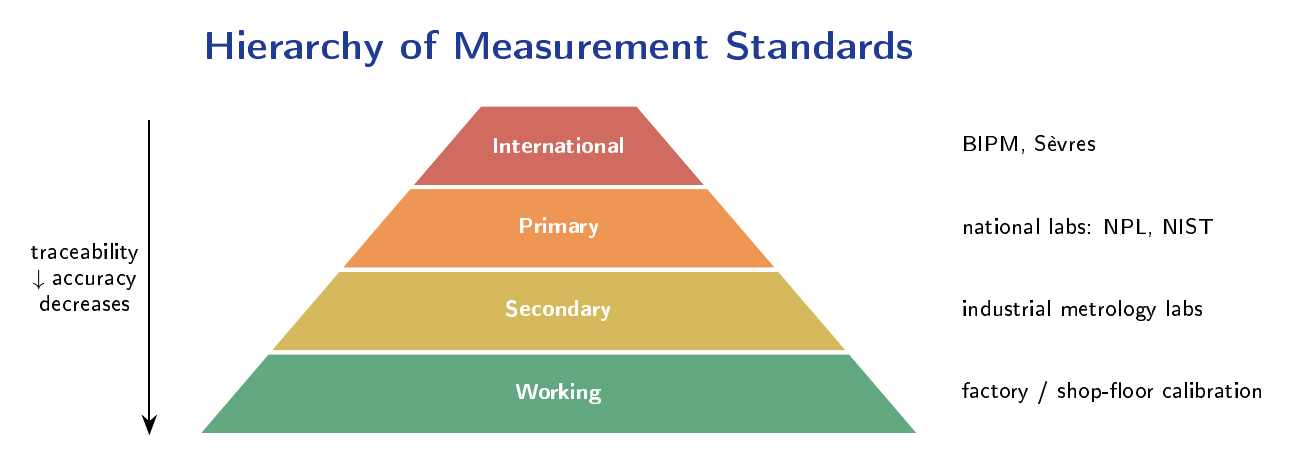
Hierarchy of measurement standards. Accuracy decreases from International Standards (BIPM, Sèvres, France) down through Primary, Secondary, and Working Standards, with each level traceable to the one above.
SI Base Units
Quantity
Unit
Quantity
Unit
Length
metre (m)
Electric Current
ampere (A)
Mass
kilogram (kg)
Thermodynamic Temperature
kelvin (K)
Time
second (s)
Amount of Substance
mole (mol)
Luminous Intensity
candela (cd)
—
—
Quantum Electrical Standards
Quantum Realisations
Voltage: Josephson effect — \(V = nhf/2e\)
Resistance: Quantum Hall effect — \(R_K = h/e^2 \approx 25.8\,\text{k}\Omega\)
Current: derived from \(V/R\) or single-electron pump
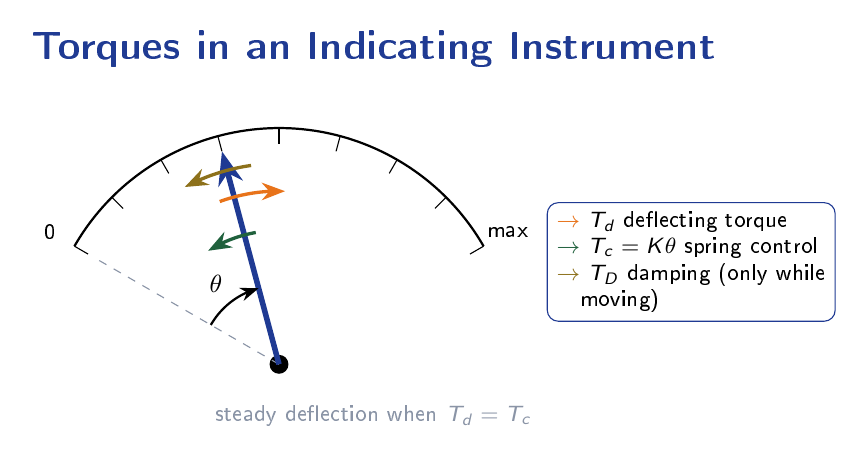
Schematic representation of the three torques in an analog indicating instrument: deflecting torque \(T_d\) causing pointer rotation, spring control torque \(T_c\) opposing deflection, and damping torque \(T_D\) acting only during pointer movement.
PMMC Instrument
Permanent Magnet Moving Coil — Principle
Current through a coil in the radial field of a permanent magnet experiences a force producing deflecting torque. Eddy-current damping occurs in the aluminium former. The radial pole-piece geometry keeps flux density \(B\) constant, ensuring \(T_d \propto I\).
Torque Balance and Deflection
Deflecting: \(T_d = NBILD = GI\) Controlling (spring): \(T_c = K\theta\)
\[ \theta = \frac{G}{K}\,I \propto I \quad \text{(linear, uniform scale)} \]
\(G = NBLd\) is the displacement constant.
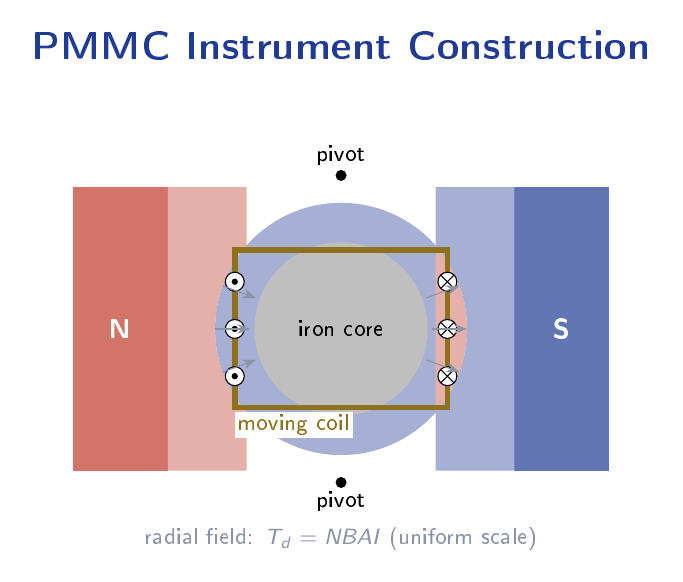
Construction of a PMMC instrument: the aluminium former carrying the coil rotates within a radial magnetic field established between the pole shoes and the central iron core, producing a torque proportional to current.
Extending the Range of PMMC
Ammeter: Shunt Resistance
\[ R_{sh} = \frac{I_m R_m}{I - I_m} = \frac{R_m}{m-1} \]
where the multiplying factor \(m = I/I_m\).
Voltmeter: Series Multiplier
\[ R_s = \frac{V}{I_m} - R_m = R_m(m-1) \]
where \(m = V/V_m\) and \(V_m = I_m R_m\).
GATE Insight: Voltmeter Sensitivity
Sensitivity \(= 1/I_{fsd}\) in \(\Omega/\text{V}\). Higher sensitivity means lower loading error. A typical \(20\,\text{k}\Omega/\text{V}\) meter has \(I_{fsd} = 50\,\mu\text{A}\).
Moving Iron (MI) Instruments
Principle
A current-carrying coil produces a magnetic field that attracts or repels soft iron pieces. Works on the RMS value of current, making it suitable for both AC and DC.
The scale is non-uniform (square-law), crowded near zero. Types include attraction and repulsion forms. An MI instrument calibrated on DC reads RMS on AC — for sinusoidal current \(I_{rms} = I_m/\sqrt{2}\).
As a wattmeter, the fixed coil carries load current and the moving coil is connected across the voltage: \(\theta \propto VI\cos\phi = P\). The wattmeter scale is uniform; as an ammeter or voltmeter, the scale is square-law.
Comparison of Analog Instruments
Feature
PMMC
MI
EDM
Induction
Use
DC only
AC & DC
AC & DC
AC only
Torque ∝
\(I\)
\(I^2\)
\(I_1 I_2 \cos\phi\)
\(\phi_1\phi_2\sin\alpha\)
Scale
Uniform
Square-law
Uniform (W) / Sq
Uniform
Accuracy
±0.1%
±1–2%
±0.25%
±2%
Frequency effect
—
Yes
Small
Yes
Power consumed
Very low
Moderate
Moderate
High
Cost
Moderate
Low
High
Moderate
GATE Insight: True RMS
PMMC + rectifier reads average current, scaled to display sinusoidal RMS — this is incorrect for non-sinusoidal waveforms. MI and EDM instruments always read true RMS regardless of waveform shape.
5. Power & Energy Measurement
Electrodynamometer Wattmeter
Construction and Reading
Current Coil (CC): fixed, low resistance, carries load current.
Pressure Coil (PC): moving, high resistance plus multiplier, connected across the load.
\[ P = VI\cos\phi \qquad \theta = \frac{VI\cos\phi}{K}\cdot\frac{dM}{d\theta} \]
Two Connection Modes
PC across load: reads \(P + V^2/r_p\) — includes PC copper loss. Preferred for low-voltage loads.
PC across supply: reads \(P + I^2 r_{cc}\) — includes CC copper loss. Preferred for low-current loads.
Choose the connection in which the known error is smaller.
PC Inductance Error
\[ \%\,\text{Error} = \tan\beta \cdot \tan\phi \times 100 \qquad \tan\beta = \frac{\omega L_p}{R_p} \]
This error is severe at low power factor. An LPF (low power factor) wattmeter uses a compensating coil and a light spring to give accurate readings at low \(\cos\phi\).
Three-Phase Power: Two-Wattmeter Method
Blondel's Theorem
For any 3-phase 3-wire system (balanced or unbalanced, star or delta): \(\;P_{total} = W_1 + W_2\)
GATE Tip
If one wattmeter reads negative, reverse its PC connections and treat the reading as negative when summing.
Induction-Type Energy Meter
Single-Phase Energy Meter — Principle
Two electromagnets (shunt voltage coil and series current coil) produce fluxes that interact with an aluminium disc to produce a driving torque. A braking permanent magnet provides a retarding torque proportional to disc speed. At steady state:
\[ T_d = T_b \implies N \propto P \implies \text{Revolutions} \propto \text{Energy} \]
Meter Constant and Energy
\[ K = \frac{\text{Revolutions}}{\text{kWh}} \qquad E = \frac{\text{Number of revolutions}}{K}\;\text{kWh} \]
\[ P = \frac{3600 \times n}{K \times t} \]
where \(n\) is the number of revolutions in time \(t\) seconds.
Energy Meter Errors and Corrections
Phase error: shunt flux not exactly in quadrature with voltage. Corrected by lag adjustment (shading coil).
Friction error: pronounced at light loads. Corrected by light-load (friction) compensation.
Creep: disc rotates at no load. Corrected by drilling small holes in the disc opposite each other.
Overload error and temperature error also exist.
6. DC & AC Bridges
Wheatstone Bridge
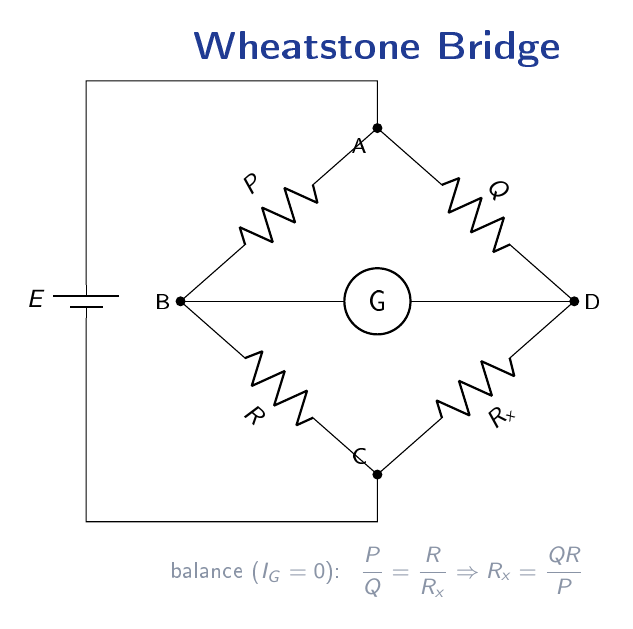
Wheatstone bridge circuit for measuring unknown resistance \(R_x\). At balance, no current flows through the galvanometer G, and the ratio of opposite arm resistances gives the unknown value.
Balance Condition
At balance (\(I_g = 0\)):
\[ \frac{P}{Q} = \frac{R}{R_x} \implies \boxed{R_x = \frac{Q}{P}\cdot R} \]
Products of opposite arms are equal. Measures \(1\,\Omega\) to \(1\,\text{M}\Omega\) accurately.
Used for measurement of very low resistances (below \(1\,\Omega\), down to \(\mu\Omega\)). Eliminates the effect of contact and lead resistance using an extra set of ratio arms.
Balance Equation
If outer ratio \(P/Q\) equals inner ratio \(p/q\), the yoke resistance term vanishes:
\[ \boxed{R_x = \frac{P}{Q}\,S} \]
Used for shunts, bus bars, armature windings, and contacts. Range: \(10\,\mu\Omega\) to \(1\,\Omega\).
AC Bridges: General Balance Condition
General AC Bridge Balance
For four impedance arms \(Z_1, Z_2, Z_3, Z_4\):
\[ Z_1 Z_4 = Z_2 Z_3 \]
In polar form, this requires two simultaneous conditions:
\[ |Z_1||Z_4| = |Z_2||Z_3| \quad \text{(magnitude)} \qquad \phi_1 + \phi_4 = \phi_2 + \phi_3 \quad \text{(phase)} \]
AC bridge detectors include the vibration galvanometer (low frequency), headphones, tuned amplifier, and CRO.
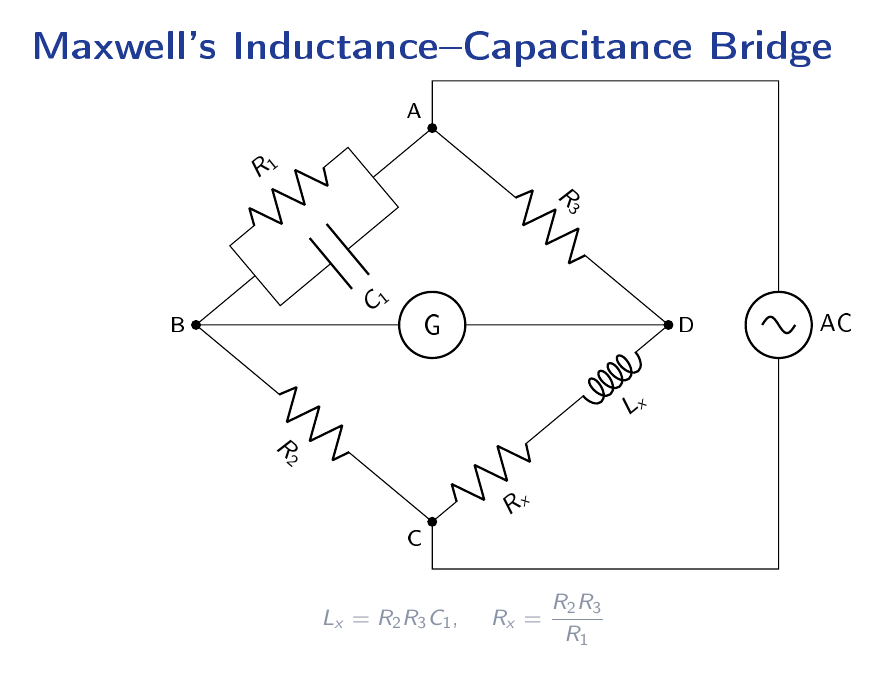
Maxwell's inductance–capacitance bridge for measuring inductors with medium Q-factor. The parallel R1–C1 combination in arm AB is balanced against the series R2 in arm BC and R3 in arm AD.
Hay's, Anderson's, and Owen's Bridges
Hay's Bridge — High Q (>10)
Uses series \(R_1\)–\(C_1\) instead of parallel:
\[ L_x = \frac{R_2 R_3 C_1}{1+(\omega R_1 C_1)^2} \qquad Q = \frac{1}{\omega R_1 C_1} \]
Frequency-dependent (small effect for high Q).
Anderson's Bridge — Low Q (<1)
Modified Maxwell with extra resistance arm \(r\); uses a fixed standard capacitor. Very accurate for low-Q coils.
\[ L_x = \frac{C\,r\,[R_3(R_1+R_2)+R_1 R_2]}{R_2} \qquad R_x = \frac{R_1 R_3}{R_2} \]
Owen's Bridge
Uses two capacitors; covers a wide inductance range and allows incremental inductance measurement:
\(L_x = R_2 R_3 C_4\), \(R_x = R_3 C_4 / C_2\).
Bridge Selection Mnemonic: M-A-HMaxwell → Medium Q | Anderson → low Q | Hay's → High Q
Capacitance Bridges: De Sauty and Schering
De Sauty's Bridge
Simplest bridge for lossless capacitors:
\[ C_x = \frac{R_2 C_s}{R_1} \]
Cannot measure dissipation factor D.
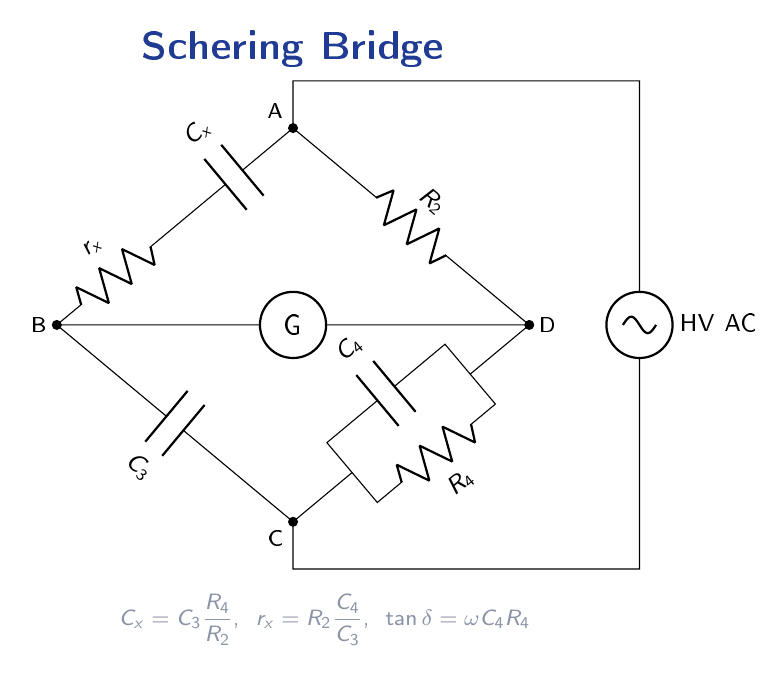
Schering bridge for measuring capacitance and dissipation factor of practical capacitors. Arm DC contains \(R_4 \parallel C_4\), which provides the phase adjustment necessary to balance both magnitude and phase simultaneously.
GATE Insight: Dissipation Factor
\(D = \tan\delta\) quantifies insulation quality. An ideal capacitor has \(D = 0\); practical values range from \(10^{-4}\) to \(10^{-2}\).
Wien's Bridge and Frequency Measurement
Balance Equations
Arm 1: \(R_1\) series \(C_1\); Arm 2: \(R_2\) parallel \(C_2\); Arms 3, 4: pure resistances.
\[ \frac{R_4}{R_3} = \frac{R_1}{R_2} + \frac{C_2}{C_1} \qquad \boxed{\omega^2 = \frac{1}{R_1 R_2 C_1 C_2}} \]
If \(R_1 = R_2\) and \(C_1 = C_2\): \(f = 1/(2\pi RC)\). Also used in Wien-bridge oscillators.
GATE Insight: Wagner Earth
AC bridges use the Wagner Earth auxiliary balance to null stray ground capacitances and improve null detection accuracy.
7. Potentiometers
DC Potentiometer
Principle
At null condition, the unknown EMF is compared with a known IR drop across the slide wire. No current is drawn from the test source — the instrument gives the true EMF, not the terminal voltage.
Crompton's Potentiometer
Standardise with Weston standard cell: \(\text{EMF}_{std} = I \cdot R_{std}\)
Then measure unknown: \(E_x = I \cdot R_x\)
Key Advantage
Since no current flows through the cell at balance, the internal resistance of the source does not affect the measurement. This is the fundamental advantage over voltmeters.
AC Potentiometers
Drysdale–Tinsley (Polar Type)
Measures magnitude and phase separately.
Gall–Tinsley (Coordinate Type)
Measures in-phase and quadrature components directly.
8. Transducers & Sensors
Transducer Classification
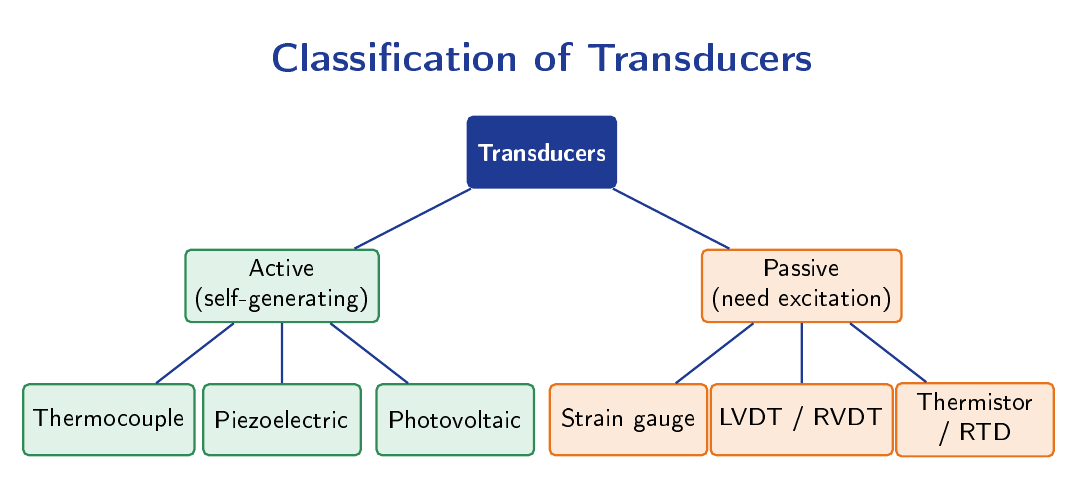
Classification of transducers by energy conversion: Active transducers generate their own output signal (thermocouple, piezoelectric, photovoltaic), while Passive transducers require external excitation (strain gauge, LVDT, thermistor, RTD).
Additional classification axes: Resistive/Inductive/Capacitive; Analog/Digital; Primary/Secondary; and Inverse transducers (input applied to output terminal).
Strain Gauge
Gauge Factor
\[ G_f = \frac{\Delta R / R}{\Delta L / L} = \frac{\Delta R / R}{\varepsilon} = 1 + 2\nu + \frac{\Delta\rho/\rho}{\varepsilon} \]
where \(\nu\) is Poisson's ratio. Typical values: \(G_f \approx 2\) for metal, 50–200 for semiconductor types.
Bridge configurations: quarter-bridge (one active gauge), half-bridge (two gauges, doubles output), full bridge (four gauges, quadruples output and provides temperature compensation).
LVDT (Linear Variable Differential Transformer)
Principle
Primary winding plus two secondary windings in opposition, with a movable soft-iron core. Differential output \(E_o = E_{s1} - E_{s2}\) is linear with core displacement around the null position, with phase reversal for \(\pm x\).
Specifications
Range: \(\pm 1\,\text{mm}\) to \(\pm 25\,\text{cm}\); Excitation: 50 Hz to 20 kHz, 3–15 V; Linearity: \(\pm 0.25\%\) typical. Theoretical infinite resolution (no contact).
RVDT
Similar principle for angular (rotational) measurement up to ±40°.
Thermal Transducers
Thermocouple (Active)
Seebeck effect: junction of two dissimilar metals develops an EMF proportional to temperature difference. \(E = a\Delta T + b(\Delta T)^2 + \ldots\). Types: J (Fe–Con), K (Cr–Al), T (Cu–Con), R, S, B. Range: −200°C to +1700°C. Requires cold-junction compensation.
RTD — Platinum Resistance Thermometer (Passive)
Metallic resistance increases with temperature: \(R_t = R_0[1 + \alpha(t-t_0) + \beta(t-t_0)^2]\). For platinum: \(\alpha = 3.85 \times 10^{-3}/°\text{C}\); Pt-100 has \(R_0 = 100\,\Omega\) at 0°C. Very accurate, stable, and linear.
Thermistor (NTC)
\[ R_T = R_0\,\exp\!\left[\beta\!\left(\frac{1}{T} - \frac{1}{T_0}\right)\right] \]
High sensitivity but non-linear. NTC type resistance decreases with increasing temperature.
Other Important Transducers
Piezoelectric
Mechanical stress → charge: \(Q = d \cdot F\). Materials: quartz, PZT. Used for dynamic force, acceleration, ultrasound. Not suitable for static measurements.
Hall Effect
\(V_H = \dfrac{I\,B}{n\,e\,t}\). Used for magnetic flux density, current, and position sensing.
Transducer Selection Criteria
Match accuracy, range, environment, dynamic response, cost, and ease of signal conditioning to the application.
9. CRO & DSO
Cathode Ray Oscilloscope (CRO)
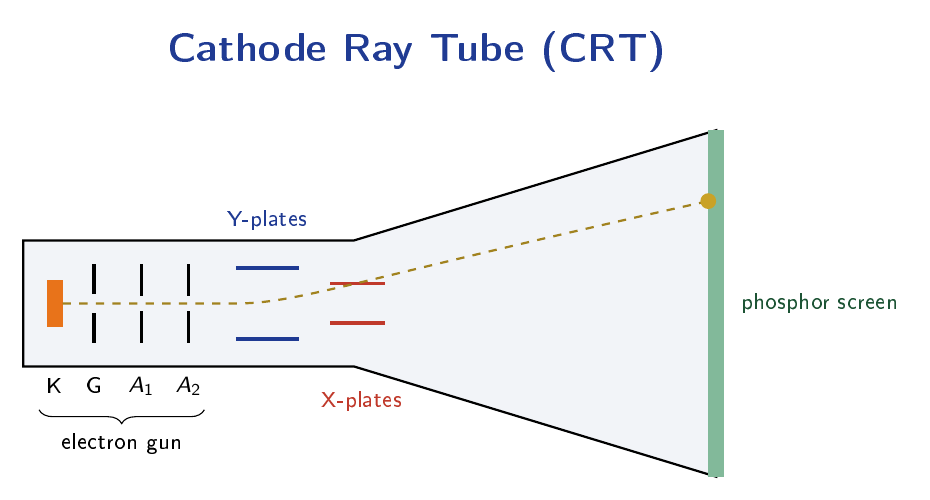
A CRO consists of six main sub-systems: the electron gun (cathode, grid, anodes), Y-deflection plates, X-deflection plates (driven by the time base), a fluorescent screen, vertical and horizontal amplifiers, and the trigger circuit.
Internal structure of a cathode ray tube (CRT): the electron beam from the gun is deflected by the Y-plates (vertical) and X-plates (horizontal, driven by the sawtooth time base) before striking the phosphor screen to produce the trace.
Measurements: Voltage = (div) × (V/div); Time = (div) × (time/div); \(f = 1/T\); Phase via Lissajous figures.
Lissajous Figures
Frequency Ratio and Phase
\[ \frac{f_y}{f_x} = \frac{\text{tangencies on X-axis}}{\text{tangencies on Y-axis}} \]
For \(f_x = f_y\): \(\sin\phi = y_1/y_2 = x_1/x_2\), where \(y_1\) is the Y-intercept and \(y_2\) is the maximum Y amplitude.
Special Phase Angles
\(\phi = 0°\): straight line (slope +1); \(\phi = 90°\): circle; \(\phi = 180°\): straight line (slope −1); otherwise: ellipse.
Digital Storage Oscilloscope (DSO)
Advantages over Analog CRO
Infinite persistence, pre-trigger viewing, waveform math (FFT, \(V_{rms}\)), automatic measurements, storage and USB output, and multi-channel synchronisation.
Nyquist Criterion
\(f_s \geq 2f_{max}\). Real oscilloscopes use 5–10× oversampling for good waveform reconstruction.
Dual-Slope DVM — Most Important
Integrate unknown for fixed time \(T_1\), then deintegrate with reference until zero (time \(T_2\)):
\[ V_x = V_{ref} \cdot \frac{T_2}{T_1} \]
Advantages: very high noise immunity; rejects line-frequency pickup if \(T_1 = n/f_{line}\); component drift cancels.
DVM Resolution
A \(3\tfrac{1}{2}\)-digit DVM has a maximum count of 1999 and a resolution of \(1/2000 = 0.05\%\). A \(4\tfrac{1}{2}\)-digit DVM has 19999 counts, giving 0.005% resolution.
Digital Frequency Meter
Gate-Time Method and Error
\[ f = N / T_g \quad (N = \text{count},\; T_g = \text{gate time}) \]
Quantization error: \(\pm 1\) count \(\Rightarrow \%\,\text{error} = \pm 100/N\). Longer gate gives lower error but slower update.
Period Mode (for Low Frequencies)
Measure period by counting internal clock pulses: \(T = N \cdot T_{clk}\), then \(f = 1/T\). This gives much better accuracy than gate-time mode for low-frequency signals.
11. Q-Meter & Instrument Transformers
Q-Meter
Principle and Quality Factor
Based on series resonance. At resonance, \(V_C = Q \cdot V_{in}\). Direct reading Q from the capacitor voltage ratio.
\[ Q = \frac{\omega L}{R} = \frac{1}{\omega C R} = \frac{1}{R}\sqrt{\frac{L}{C}} \qquad \omega_0 = \frac{1}{\sqrt{LC}} \]
Insertion Error (Effective Q)
\[ Q_e = \frac{\omega L}{R + R_{sh}} \]
The insertion resistor \(R_{sh} \approx 0.02\,\Omega\) makes the indicated Q slightly lower than the true Q. Correction: \(Q = Q_e(1 + R_{sh}/R)\).
Current Transformer (CT)
Ratios and Error
Nominal ratio \(K_n = I_{p,\text{rated}}/I_{s,\text{rated}}\); Actual ratio \(R = I_p/I_s\); Turns ratio \(n = N_s/N_p\).
\[ \text{Ratio error} = \frac{K_n - R}{R} \times 100\,\% \]
CRITICAL Safety WarningNEVER open-circuit a CT secondary — the huge induced voltage will destroy insulation. Always short-circuit the secondary before disconnecting an ammeter.
Potential Transformer (PT)
Errors
Ratio error: \(\epsilon = (K_n V_s - V_p)/V_p \times 100\)
Phase-angle error \(\theta\): angle between reversed secondary phasor and primary phasor.
Burden
Burden = secondary impedance expressed in VA. Accuracy classes (0.1, 0.2, 0.5, 1.0, 3.0) are guaranteed only at rated burden.
Rogowski Coil and Hall-Effect Current Sensor
Rogowski Coil
Air-cored toroidal helix encircling the conductor. No magnetic core → no saturation, fully linear, very wide bandwidth (Hz to MHz).
\[ v_{out}(t) = -M\,\frac{di(t)}{dt} \qquad i(t) = -\frac{1}{M}\int v_{out}\,dt \]
Applications: power-quality monitors, switchgear transient capture, lightning current measurement.
Hall-Effect Current Sensor
\(V_H = I_{bias}\,B/(n\,e\,t)\); in a magnetic concentrator, \(B \propto I_{primary}\). Closed-loop versions null the core flux via a secondary winding, giving 0.1% accuracy and DC capability.
12. Signal Conditioning & Data Acquisition
Signal Conditioning Functions
Amplification and level shifting
Filtering (low-pass, high-pass, band-pass, notch)
Linearisation and isolation
Excitation for passive sensors
Impedance matching
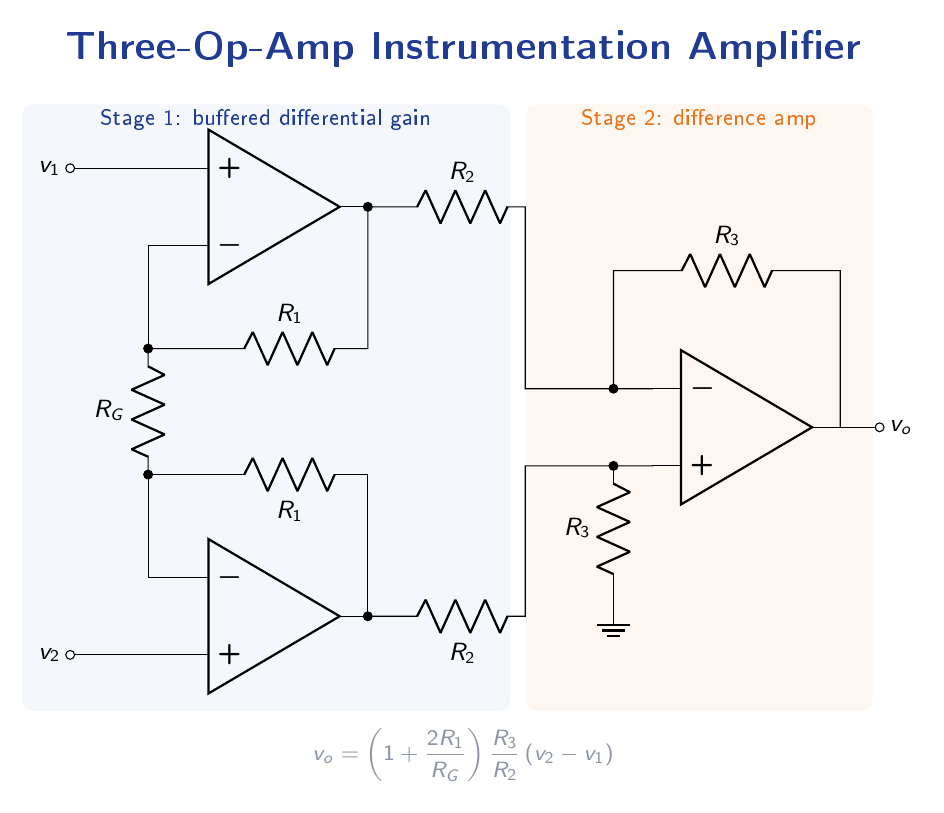
Three-Op-Amp Instrumentation Amplifier
\[ G = \left(1 + \frac{2R_1}{R_G}\right)\frac{R_3}{R_2} \]
\(R_G\) alone sets the gain; \(R_1\), \(R_2\), \(R_3\) are matched. Ideal for strain gauges and thermocouples.
Classic three-op-amp instrumentation amplifier. The gain-setting resistor \(R_G\) between the two input op-amps determines the first-stage gain, while the matched \(R_2\) and \(R_3\) resistors in the output difference stage provide high CMRR.
Butterworth Active Low-Pass Filter
\[ |H(j\omega)| = \frac{1}{\sqrt{1+(\omega/\omega_c)^{2n}}} \]
Maximally flat passband of order \(n\).
Anti-Aliasing
A pre-ADC low-pass filter with cut-off below \(f_s/2\) is mandatory to prevent spectrum overlap (aliasing).
Data Acquisition System (DAS)
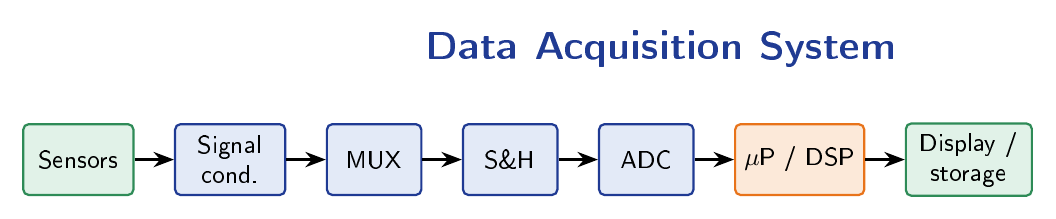
Block diagram of a complete data acquisition system (DAS): analogue signals from multiple sensors are conditioned, time-multiplexed, sampled, held, converted to digital by the ADC, processed, and stored or displayed.
ADC Quantisation
For an \(n\)-bit ADC with full-scale range \(V_{FS}\):
\[ Q = \frac{V_{FS}}{2^n} \qquad \text{SQNR} = 6.02n + 1.76\;\text{dB} \]
Nyquist Sampling
Sampling frequency \(f_s \geq 2f_{max}\) (Nyquist theorem). The aperture time of the sample-and-hold circuit limits the effective bandwidth.
13. Resistance Measurement — Full Spectrum
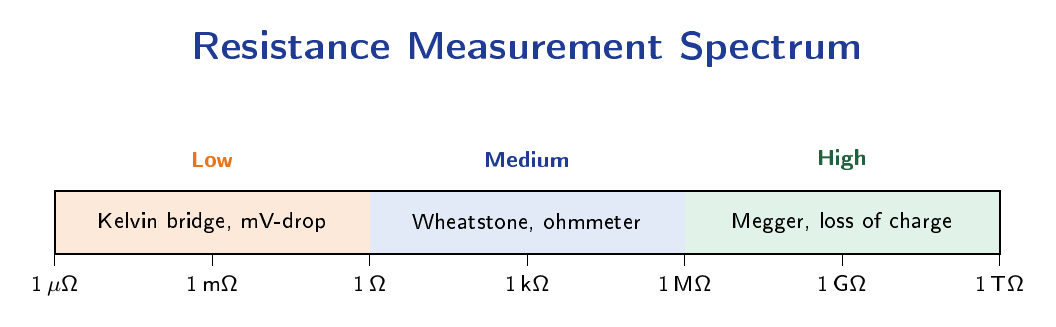
Resistance measurement spectrum showing the appropriate method for each decade of resistance: Kelvin-type methods for low resistance, Wheatstone bridge for medium range, and Megger or loss-of-charge for high resistance.
Ammeter–Voltmeter Method (Medium Resistance)
Two Connection Modes
Case A (Voltmeter across R only): \(R_{meas} = R \cdot R_V/(R+R_V)\) — suitable for low R.
Case B (Voltmeter across R + ammeter): \(R_{meas} = R + R_A\) — suitable for high R.
Transition: \(R_{trans} = \sqrt{R_A \cdot R_V}\). Use Case A below and Case B above this value.
Four-Terminal (Kelvin) Method for Low Resistance
Separate current terminals (outer) and potential terminals (inner) eliminate contact and lead resistance from the measurement. Fundamental for bus bars, shunts, and armature windings.
Megger — High Resistance and Insulation Testing
Principle
Hand-cranked or electronic generator produces 500/1000/2500 V. A crossed-coil moving system gives a direct M\(\Omega\) reading independent of generator speed.
\[ R_{ins} = f(I_p/I_c) \]
where pressure coil current \(I_p \propto V\) and current coil \(I_c \propto V/R\) — the ratio is voltage-independent.
Loss-of-Charge Method (Very High Resistance)
Formula
Capacitor \(C\) charged to \(V_0\) discharges through unknown \(R\):
\[ V(t) = V_0\,e^{-t/RC} \implies \boxed{R = \frac{t}{C\,\ln(V_0/V)}} \]
Correction for voltmeter resistance \(R_v\): \(R_{true} = R R_v / (R_v - R)\).
Earth Resistance: Fall-of-Potential Method
61.8% Rule
\[ R_E = V_{EP}/I_{EC} \]
Potential probe P placed at 62% of the distance from earth electrode E to current electrode C avoids overlap of the resistance areas.
The unknown \(R_x\) is replaced by a calibrated variable standard \(R_s\) in the same circuit. \(R_s\) is adjusted until the meter reads identically. Result: \(R_x = R_s\). Instrument calibration and supply variation errors cancel out.
14. Magnetic Measurements
Ballistic Galvanometer and Flux Meter
Charge and Flux Measurement
\[ Q = \int i\,dt = K_b\,\theta_1 \qquad \Delta\phi = \frac{N\,\Delta\phi}{R} \implies \boxed{\Delta\phi = \frac{Q R}{N}} \]
\(\theta_1\) = first (ballistic) throw, \(K_b\) = ballistic constant (C/rad). The search coil has \(N\) turns in a circuit of total resistance \(R\).
Method of Reversals and Iron Loss Separation
\[ B = \phi/A \qquad H = N_1 I/\ell \]
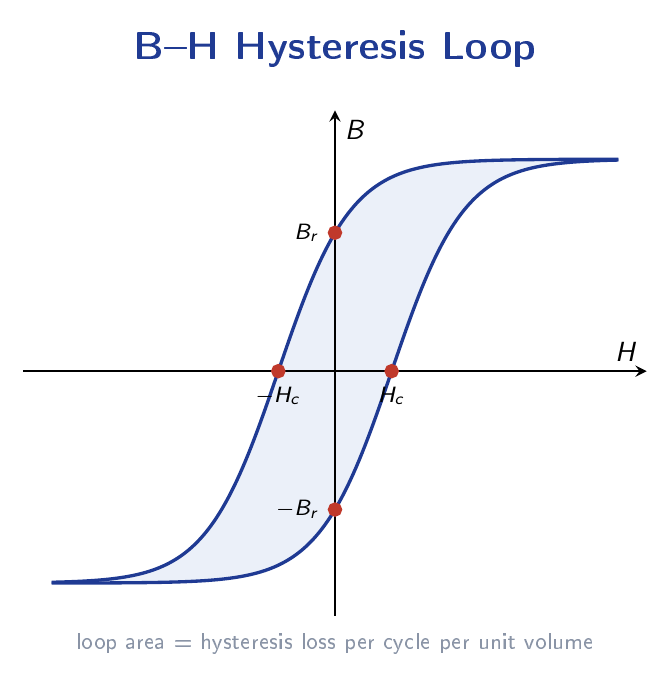
Hysteresis loss (Steinmetz): \(W_h = \eta\,B_{max}^{1.6}\,f\,V\)
Eddy-current loss: \(W_e = K_e\,B_{max}^2\,f^2\,t^2\,V\)
Separation (two-frequency method): at fixed \(B_{max}\), \(P/f = A + Bf\).
B-H hysteresis loop for a ferromagnetic material. The remanence \(B_r\) is the flux density at zero field and the coercive force \(H_c\) is the reverse field required to demagnetise the material. The enclosed area represents hysteresis loss per unit volume per cycle.
Iron Loss StandardsEpstein square (IS/IEC): 25 or 50 cm strips tested at 1.5 T, 50 Hz. Lloyd–Fisher: alternating laminations at 90°.
Hall Gaussmeter and Modern Magnetic Sensors
\[ V_H = \frac{I\,B}{n\,e\,t} \]
Modern sensors for weak fields: Fluxgate magnetometer, GMR/TMR sensors, and SQUIDs (sensitivity to \(10^{-15}\,\text{T}\)).
15. Frequency, Phase & Power Factor Meters
Analog Frequency Meters
Vibrating Reed (Mechanical)
Array of thin steel reeds with staggered natural frequencies. The reed whose resonant frequency matches the supply vibrates with maximum amplitude. Range: 45–55 Hz typical.
Weston Frequency Meter (Electrical)
Ratio-type meter with two moving coils. Deflection depends only on frequency, not on supply voltage:
\[ \theta = f(I_1/I_2) = f(\omega) \]
Phase Meter and Power Factor Meter
Single-Phase Dynamometer PF Meter
Fixed coil (current) + two moving coils at 90° (one in phase, one in quadrature with voltage). No control spring — pointer rests where torques balance:
\[ \tan\theta = \tan\phi \implies \theta = \phi \]
Direct reading of power factor angle.
Digital Phase Meter (XOR Method)
Both signals converted to square waves → XOR gate → pulse width proportional to phase difference:
\[ \phi = \frac{T_{pulse}}{T_{period}} \times 360° \]
Synchroscope
Indicates phase and frequency difference between an incoming generator and the bus bar for paralleling alternators.
Pointer stationary → frequencies equal
Rotating clockwise (fast): incoming frequency > bus
Rotating anticlockwise (slow): incoming frequency < bus
Close the breaker at the 12 o'clock position (in phase)
16. Wave & Spectrum Analysis
Total Harmonic Distortion (THD)
THD Definition
\[ \text{THD} = \frac{\sqrt{V_2^2 + V_3^2 + V_4^2 + \ldots}}{V_1} \times 100\% \]
where \(V_n\) is the RMS amplitude of the \(n^{th}\) harmonic.
GATE Insight: THD Convention
IEEE THD-F uses fundamental \(V_1\) in denominator; THD-R uses total \(V_{rms}\). Always check the convention used in the problem.
Spectrum Analyser
Swept Heterodyne (Analog)
Sweep oscillator → mixer → IF filter → detector → display. Resolution bandwidth (RBW) sets the minimum spacing of resolvable signals. Sweep time \(\propto 1/\text{RBW}^2\).
FFT Analyser (Digital)
Sample at \(f_s\), take \(N\)-point FFT → frequency bins of width \(\Delta f = f_s/N\). Window functions (Hanning, Hamming, Blackman) reduce spectral leakage.
17. ADC & DAC Architectures
DAC Types
Weighted-Resistor DAC
Each bit drives a binary-weighted resistor: \(R, 2R, 4R, \ldots\) summed via op-amp.
\[ V_o = -V_{ref}\sum_{k=0}^{n-1}\frac{b_k}{2^{n-k}} \]
Large resistor spread for many bits limits accuracy.
R-2R Ladder DAC
Only two resistor values (\(R\) and \(2R\)) regardless of bit count. Most popular for discrete DAC design.
ADC Architectures
Type
Resolution
Speed
Latency
Power
Application
Flash
4–8 bit
GSps
1 clock
High
Scopes, comms
Pipelined
8–16 bit
100 MSps
few clocks
Medium
Imaging, video
SAR
8–18 bit
MSps
\(N\) clocks
Low
DAS, industrial
Dual-slope
12–22 bit
10 Sps
long
Very low
DMM, panel meters
\(\Sigma\Delta\)
16–24 bit
kSps
long
Low
Audio, precision
Flash ADC
\(2^n - 1\) comparators in parallel against a resistor reference ladder. Fastest but high die area and power.
Successive Approximation (SAR)
Binary search using one comparator + DAC. Conversion time \(= n \cdot T_{clk}\). Best balance of speed, resolution, and power — most popular for industrial DAS.
Dual-Slope (Integrating)
\[ V_x = V_{ref} \cdot T_2/T_1 \]
Strengths: very high noise rejection, component drift cancels (ratio measurement), line-frequency rejection if \(T_1 = n/f_{line}\). Weakness: slow (~10 conv/s).
Sigma-Delta (\(\Sigma\Delta\))
1-bit quantizer in feedback loop with integrator. Heavy oversampling (≥64×) + decimation filter → effectively 16–24 bit. SNR improves by 9 dB per octave for first-order \(\Sigma\Delta\).
ENOB and Aperture Jitter
\[ \text{ENOB} = \frac{\text{SNR}_{measured} - 1.76}{6.02} \qquad \sigma_v = 2\pi f\,V_{FS}\,\sigma_t \]
For high-frequency, high-resolution ADCs, clock jitter is often the dominant noise source.
18. Special Signal Conditioning Circuits
V/F, F/V, and True-RMS Converters
Voltage-to-Frequency (V/F) Converter
\(f_{out} = K_{vf} \cdot V_{in}\). Linearity 0.05%, range 1 Hz–1 MHz. Used for isolated transmission over a single optocoupler or fibre.
True RMS-to-DC Converter
Computes \(V_{rms} = \sqrt{\overline{v^2(t)}}\) for arbitrary waveforms. Three methods: thermal (heating element + thermocouple), computational (AD536/AD637 IC), or direct digital (DSP).
Crest Factor
\(\text{CF} = V_{peak}/V_{rms}\). Rectifier-type DMMs assume CF = \(\sqrt{2}\) — incorrect for spiky or distorted signals. True-RMS chips handle CF up to 5–10.
Shielding
Electric field: conductive enclosure (copper, aluminium) at fixed potential. Magnetic field: high-μ material (mu-metal) at LF; good conductor at HF.
Guarding
Driven shield held at the same potential as the signal node — no current flows through stray capacitance or leakage resistance. Used in electrometers, triaxial cables, and in-amps.
Twisted Pair
Twisting cancels induced EMF (loop area reverses each twist), rejecting magnetic pickup.
19. Additional Sensors & Modern Instrumentation
Proximity and Level Sensors
Inductive Proximity
Tank-circuit oscillator; metallic target absorbs energy via eddy currents → amplitude drops → output triggers. Range: 1–40 mm, metal targets only.
Capacitive Proximity
Target alters fringe capacitance. Detects metallic and non-metallic objects. Range: 1–60 mm.
Flow Measurement
Differential Pressure Flow (Orifice/Venturi)
\[ Q = C_d A_2\sqrt{\frac{2\Delta P}{\rho(1-\beta^4)}} \]
where \(\beta = d_2/d_1\) is the diameter ratio.
Electromagnetic Flow Meter
Faraday's law: \(E = BLv\). Output proportional to volumetric flow. No moving parts, no pressure drop. Conductive fluids only.
Coriolis Flow Meter
Direct mass flow plus density measurement. Highest accuracy (±0.1%), used in custody transfer. Independent of fluid properties.
Smart Sensors and Virtual Instrumentation
Smart Sensor Features
Sensing element + signal conditioning + ADC + microcontroller + digital interface (I²C, SPI, RS-485, IO-Link, HART) integrated in one package. Provides self-calibration, self-diagnostics, linearisation, and plug-and-play via IEEE 1451 TEDS.
Industry 4.0
Smart sensors → edge computing → cloud analytics → predictive maintenance and digital twins.
Campbell's Bridge
Compares unknown \(M_x\) with standard \(M_s\): \(M_x = M_s\) at null. Used for calibration of mutual inductors.
Carey-Foster Bridge
For the accurate measurement of the difference of two nearly equal resistances. Contact resistance eliminated by reversal:
\[ R_x - R_s = (\ell_2 - \ell_1)\rho_{wire} \]
Resonance Bridge
Series LC + parallel resistive arm. At balance: \(\omega_r^2 = 1/(LC)\). Measures audio frequency or unknown \(L\) or \(C\).
Complete Bridge Selection Guide
Small Q → Anderson; Medium Q → Maxwell; High Q → Hay's; Mutual inductance → Heaviside/Campbell; Resistance difference → Carey-Foster; Frequency → Wien's; Capacitor loss → Schering.
21. CRO Advanced Topics
Dual-Trace, Delayed Sweep, and X-Y Mode
Dual Trace
Two waveforms displayed simultaneously. Alternate mode: one full sweep per channel (for high frequency). Chopped mode: rapid switching (~500 kHz) within a sweep (for low frequency).
Delayed Sweep
A second time base triggers \(t_d\) after the main one, stretching a small portion of the waveform across the full screen. Essential for jitter, glitch, and fine timing analysis.
Trigger Modes
Auto: sweeps even without a valid trigger. Normal: sweeps only on a valid trigger. Single: one-shot capture. HF/LF reject, noise reject, and holdoff for stable triggering on complex signals.
CRO Probes
10× Passive Probe Compensation
A 9 MΩ series resistor plus scope input (1 MΩ ∥ C_in) gives 10:1 attenuation. Compensation capacitor keeps the RC product matched for a flat frequency response. Under-compensation: rounded leading edge. Over-compensation: spike. Correct: clean rising edge.
Oscilloscope Rise-Time Rule
\[ t_r \approx \frac{0.35}{\text{BW}} \]
Oscilloscope bandwidth should be ≥ 5× the signal frequency for accurate amplitude measurement.
22. 3-Phase Energy Measurement
Two-Element Meter (3-wire)
Two stator elements drive a common spindle (analogous to two-wattmeter method):
\[ E_{tot} = E_1 + E_2 \]
Three-Element Meter (4-wire)
Three stator elements measure each phase independently:
\[ E_{tot} = E_R + E_Y + E_B \]
Average PF from Meter Readings
\[ \cos\phi_{avg} = \frac{\text{kWh}}{\sqrt{\text{kWh}^2 + \text{kVArh}^2}} \]
Modern Static Energy Meters
Hall sensors/CTs + ADC + DSP. Class 0.5 or better, no moving parts, immune to magnetic tampering. Supports TOD (time-of-day) billing, AMR/AMI, and bidirectional metering.
23. GATE-Focused Solved Problems
P1: Wattmeter Connection Error
Problem
Wattmeter with PC across load. Supply: 230 V, 1 A, \(\cos\phi = 0.9\), \(R_p = 2000\,\Omega\). Find true power and % error.
Problem
2 V output at 4 mm displacement. Sensitivity and output at 1.5 mm?
Sensitivity \(S = 2/4 = 0.5\,\text{V/mm}\). Output at 1.5 mm \(= 0.5 \times 1.5 = 0.75\,\text{V}\).
P8: Voltmeter Loading Comparison
Problem
Two 0–150 V meters: \(V_1 = 1\,\text{k}\Omega/\text{V}\), \(V_2 = 10\,\text{k}\Omega/\text{V}\). 100-V point, source \(50\,\text{k}\Omega\). Which loads less?
Problem
PMMC: \(I_{fsd} = 1\,\text{mA}\), \(R_m = 100\,\Omega\). Universal shunt for 10 mA, 100 mA, 1 A.
\(m_{max} = 1000\), total shunt \(R_{sh} \approx 0.1\,\Omega\). Tap points scaled by \(1/m\) for each range. Aryton shunt avoids open-circuit during range switching.
P12: Wattmeter Connection Error (Full)
Problem
230 V, 10 A, \(\cos\phi = 0.6\). \(R_{cc} = 0.05\,\Omega\), \(R_{pc} = 2\,\text{k}\Omega\). Find error in each connection.
PC across load: reads \(P + V^2/R_{pc} = P + 26.45\,\text{W}\).
PC across supply: reads \(P + I^2 R_{cc} = P + 5\,\text{W}\). Use the second (supply) connection here.
P13: CT Burden
Problem
CT 100/5 A. Secondary: ammeter (0.05 Ω) and relay (0.5 Ω) in series. Burden at rated secondary?
Total \(R = 0.55\,\Omega\). Burden \(= I_s^2 R = 5^2 \times 0.55 = 13.75\,\text{VA}\). Compare to CT rating — if exceeded, accuracy degrades.
P14: Schering Bridge
Problem
\(C_3 = 100\,\text{pF}\), \(R_4 = 160\,\Omega\), \(R_2 = 130\,\Omega\), \(C_4 = 0.1\,\mu\text{F}\) at 50 Hz. Find \(C_x\), \(r_x\), \(D\).
Disc makes 2 revolutions in 5 min at no load. Creep present — disc should not exceed 1 revolution. Inspect for shorted lag coil or excessive friction-compensation adjustment.
Bridge Selection: "M-A-H"Maxwell → Medium Q (1 < Q < 10) Anderson → Low Q (Q < 1) Hay's → High Q (Q > 10)
For C loss factor → Schering; For frequency → Wien's.
Instrument → Use CasePMMC → Pure DC MI → Mains AC & DC EDM → Exacting wattmeter Induction → Industrial AC energy
Wattmeter Connection Rule
"PC across the Place where loss is Small"
High current load → PC across supply (CC loss is small)
High voltage load → PC across load (PC loss is small)
GATE Mnemonic: "LASRP"Limiting, Absolute, Statistical, Random, Propagation — the five error topics every GATE problem will touch.
26. References & Further Reading
Textbooks
A. K. Sawhney, Electrical & Electronic Measurements and Instrumentation, Dhanpat Rai
Helfrick & Cooper, Modern Electronic Instrumentation & Measurement Techniques, PHI
E. O. Doebelin, Measurement Systems: Application & Design, McGraw-Hill
J. P. Bentley, Principles of Measurement Systems, Pearson
For GATE Preparation
Previous year GATE EE/EC papers (2000–present)
Made Easy / ACE Engineering question banks
NPTEL: Industrial Instrumentation (IIT Kharagpur)
Standards and Bodies
BIPM (Bureau International des Poids et Mesures), NPL India, NIST USA
ISO/IEC 17025 (Testing and calibration laboratories)
GUM: ISO/IEC Guide 98-3 (Expression of measurement uncertainty)
Simulation and Lab Tools
LTspice, Multisim, Proteus, MATLAB Simulink/Simscape, LabVIEW, NI Multisim. Supplement simulation with hands-on work at a real measurement bench whenever possible.
27. Summary & Key Takeaways
The Three Pillars of Metrology
Standards & Traceability: every measurement is meaningful only when traceable to a primary standard through an unbroken chain of comparisons.
Statistics & Uncertainty: always report results as \(\bar{x} \pm U\) at stated confidence level (GUM approach).
Loading & Bandwidth: every instrument loads its source. Match instrument impedance and bandwidth to the signal being measured.
Choosing the Right Instrument
Match range, accuracy, frequency response, environment, and cost to the application. No single instrument is best for all tasks.
GATE Strategy
Master the formula card — 70% of problems are direct formula applications
Learn the M-A-H bridge selection rule
Practise wattmeter connection error problems
The two-wattmeter sign convention is a frequent trap
Memorise the dual-slope DVM derivation
"Not everything that can be counted counts, and not everything that counts can be counted."
— attributed to Albert Einstein
"You cannot improve what you cannot measure."
— Lord Kelvin