High Voltage Engineering
A Comprehensive Lecture Series
Course Outline
High Voltage Engineering is a core subject for power-systems engineers covering the generation, measurement, and withstand of voltages far beyond normal operating levels. It is indispensable for designing insulation in transformers, cables, switchgear, transmission lines, and modern HVDC links. The subject is organised into six thematic parts.
Part I – Fundamentals
- Electric stress estimation & control
- Breakdown in gases, liquids, solids, vacuum
Part II – Generation
- HV DC and AC generation
- Impulse voltage and current generation
Part III – Measurement
- Sphere gaps, ESV, generating voltmeter
- Voltage dividers, Chubb–Fortescue method
Part IV – Testing & Diagnostics
- HV testing of cables, transformers, breakers
- Schering bridge, partial discharge, NDT
Part V – System Aspects
- Transients, travelling waves, lightning
- Insulation coordination & protection
Part VI – Modern Applications
- Pulsed power, PEF, electroporation
- HVDC, GIS, smart-grid monitoring
Power transmission economics demand higher voltages: \(P\propto V^2/Z\) while line losses scale as \(1/V^2\) for fixed power. Modern UHV-AC systems operate at 765 kV and 1100 kV; HVDC links reach \(\pm 800\) kV and \(\pm 1100\) kV. Insulation, not the conductors, sets the design ceiling. HV phenomena are governed by stochastic ionisation processes, making statistical design margins essential.
Electric Stress Estimation and Control
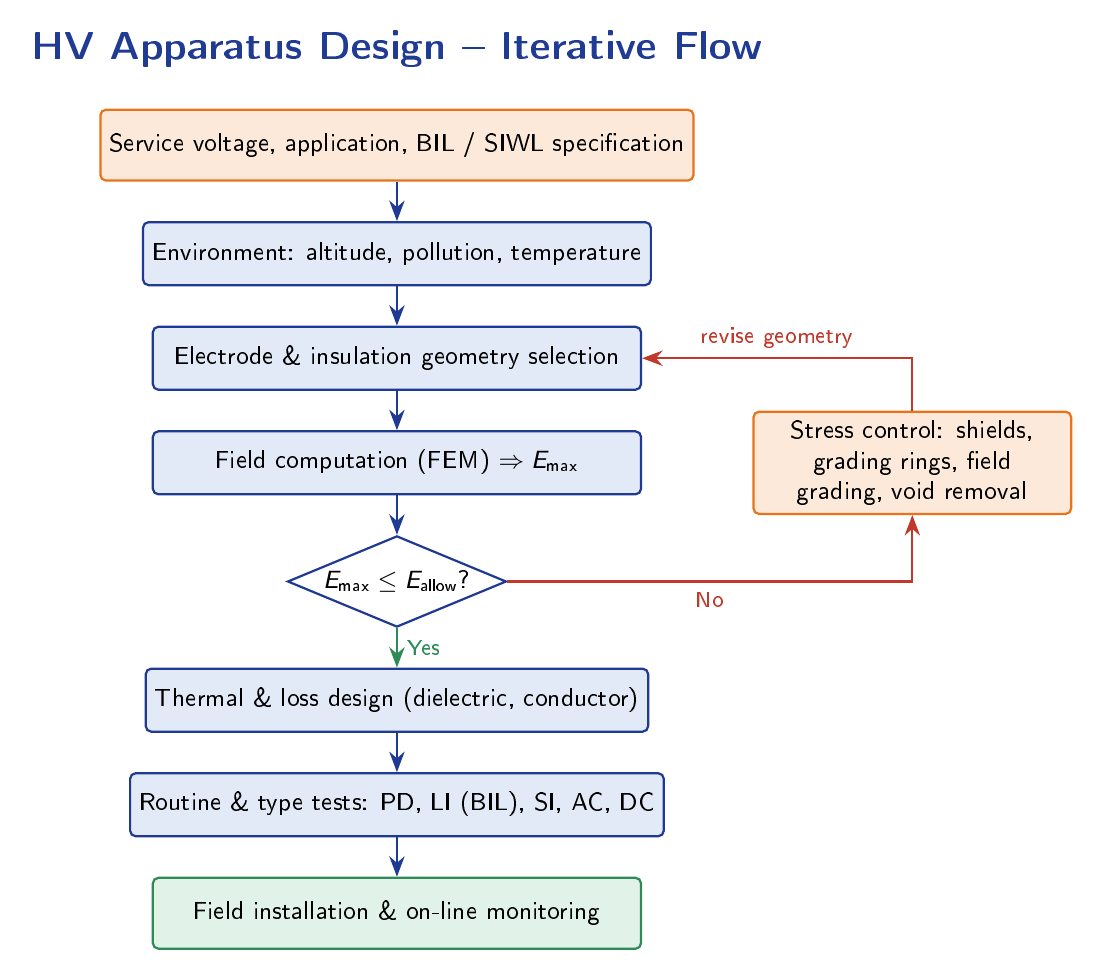
Insulation breakdown is governed by the local electric field \(\mathbf{E}(\mathbf{r})\), not the applied voltage alone. Designers must determine \(E_\text{max}\) at every electrode triple junction, sharp edge, and void. Closed-form solutions exist only for a handful of geometries (parallel plate, coaxial, sphere–sphere). Real apparatus such as bushings, GIS spacers, and cable terminations requires numerical field computation.
- Finite Difference Method (FDM) – regular mesh, simple implementation
- Finite Element Method (FEM) – general geometry, multi-dielectric
- Charge Simulation Method (CSM) – efficient for smooth electrodes
- Surface Charge Simulation / BEM (SCSM)
- Experimental analogues – electrolytic tank, conducting-paper
Governing Field Equations
For a linear, isotropic, source-free dielectric region:
\[\nabla\cdot\mathbf{D}=\rho_v,\qquad \mathbf{D}=\varepsilon\mathbf{E},\qquad \mathbf{E}=-\nabla\varphi\]Combining these gives the Poisson equation and, for the source-free case, the Laplace equation:
\[\nabla^{2}\varphi=-\frac{\rho_v}{\varepsilon}\qquad\xrightarrow{\rho_v=0}\qquad\boxed{\nabla^{2}\varphi=0}\]- Dirichlet: \(\varphi=V_0\) on conductor surfaces.
- Neumann: \(\partial\varphi/\partial n=0\) on planes of symmetry.
- Interface: \(\varepsilon_1 E_{1n}=\varepsilon_2 E_{2n}\) and \(E_{1t}=E_{2t}\).
Finite Difference Method
Derivatives are replaced by finite differences on a regular mesh of step \(h\). The five-point Liebmann formula for a 2-D Laplace problem reads:
\[\varphi_{i,j}=\tfrac{1}{4}\!\left(\varphi_{i+1,j}+\varphi_{i-1,j}+\varphi_{i,j+1}+\varphi_{i,j-1}\right)\]Iteration proceeds with successive over-relaxation (SOR) until \(\max|\Delta\varphi|<\varepsilon\); then \(\mathbf{E}=-\nabla\varphi\) is evaluated by central differences. FDM works best on rectangular domains but struggles with curved boundaries.
Charge Simulation Method
Fictitious line, point, or ring charges inside the electrodes replace the actual surface charge distribution. The potential at any field point is the superposition:
\[\varphi(\mathbf{r})=\sum_{j=1}^{n}q_j\,p_{ij}\]where \(p_{ij}\) is the analytically known potential coefficient. Charge magnitudes are found by satisfying boundary conditions at \(n\) contour points. CSM is highly accurate for smooth electrodes with no mesh discretisation error.
Stress Control Techniques
Stress concentration is managed by: toroidal or hemispherical stress shields at conductor ends; grading electrodes in capacitor bushings and cable terminations; elimination of voids and delaminations in solid insulation; and application of field-grading materials (resistive or non-linear) at compound interfaces. The utilisation factor \(\eta=E_\text{avg}/E_\text{max}\) characterises how uniformly the insulation is stressed. For a coaxial geometry the optimal inner-conductor radius \(r_i=r_o/e\) maximises \(\eta\).
Breakdown in Gaseous Dielectrics
Townsend Primary Ionisation Coefficient
Townsend's first ionisation coefficient \(\alpha\) (ions produced per electron per unit length) governs avalanche growth. The current after a path \(d\) is:
\[I=I_0\,e^{\alpha d}\]The coefficient is expressed as \(\alpha/p=A\,e^{-Bp/E}\). For air: \(A\approx15\;\text{cm}^{-1}\text{Torr}^{-1}\), \(B\approx365\;\text{V/(cm\cdot Torr)}\).
Secondary Processes and Townsend's \(\gamma\)
Electrons are liberated from the cathode by positive-ion impact (\(\gamma_i\)), photons (\(\gamma_p\)), and metastables (\(\gamma_m\)), with \(\gamma=\gamma_i+\gamma_p+\gamma_m\). Including secondary emission:
\[\boxed{I=\frac{I_0\,e^{\alpha d}}{1-\gamma\!\left(e^{\alpha d}-1\right)}}\]The Townsend breakdown criterion (denominator to zero) is:
\[\gamma\!\left(e^{\alpha d}-1\right)=1\qquad\Longleftrightarrow\qquad\boxed{\alpha d=\ln\!\left(1+\frac{1}{\gamma}\right)}\]Streamer (Kanal) Mechanism
For atmospheric pressure with \(pd>200\;\text{Torr\cdot cm}\), breakdown occurs in \(\sim10^{-8}\;\text{s}\) – too fast for ion feedback. Raether–Meek streamer theory: a single avalanche of \(\sim10^8\) electrons generates a space-charge field \(E_r\) comparable to the applied field \(E_0\). Photons from the avalanche head trigger secondary avalanches that are sucked into the positive-ion trail, forming a cathode-directed streamer. The weakly conducting plasma channel (kanal) bridges the gap. The Meek criterion (air, 1 atm) is:
\[\alpha\,x_c=17.7+\ln x_c+\ln(E_r/E_0)\approx 20\]Paschen's Law
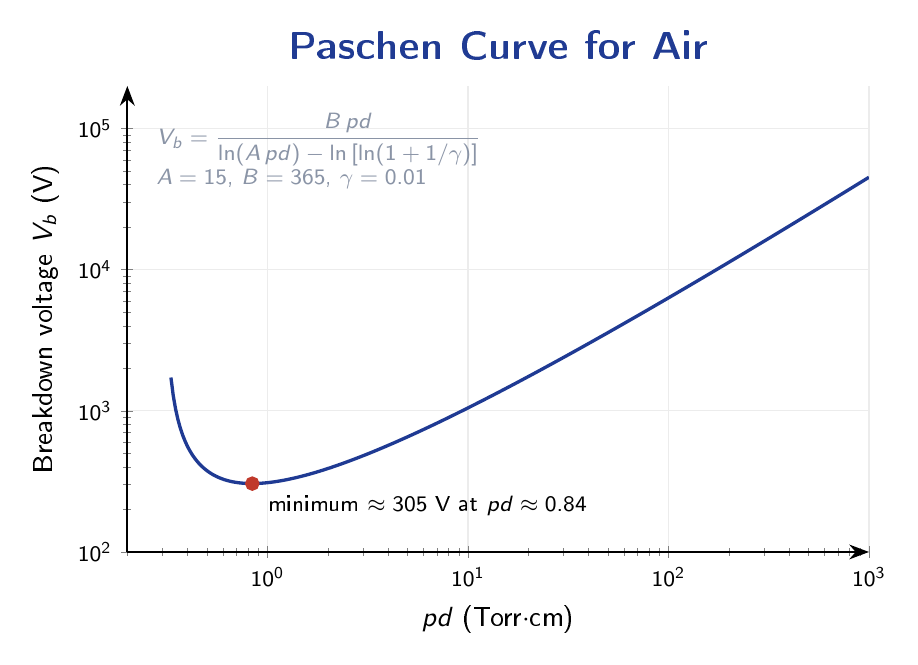
Setting \(E=V/d\) in the Townsend criterion and using \(\alpha/p=A\,e^{-Bp/E}\) gives \(V_s=f(pd)\):
\[\boxed{V_s=\frac{B\,(pd)}{\ln\!\left[\dfrac{A\,(pd)}{\ln(1+1/\gamma)}\right]}}\]The Paschen curve has a minimum at \((pd)_\text{min}\). For air (\(\gamma=0.01\)): \(V_{s,\text{min}}\approx305\;\text{V}\) at \((pd)_\text{min}\approx0.84\;\text{Torr\cdot cm}\). Below the minimum: too few collisions; above: too many collisions for adequate energy gain.
Penning Effect, Corona, and Time-Lag
Penning effect: Small admixtures of a low-ionisation-potential gas (e.g., Ar in Ne) drastically reduce breakdown voltage via collisional ionisation of the impurity by host metastables. This effect is exploited in gas-filled surge protectors.
Corona discharges occur where the local field exceeds the critical ionisation field in non-uniform geometries. Peek's formula for the disruptive critical field on a cylindrical conductor is:
\[E_v=30\,m\,\delta\!\left(1+\frac{0.301}{\sqrt{\delta r}}\right)\;\text{kV/cm (peak)}\]where \(\delta\) is the relative air density, \(m\) is a surface roughness factor, and \(r\) is the conductor radius in cm. Power loss follows the Peterson formula: \(P_c\propto(f+25)\,(V-V_c)^2\).
Time-lag: \(t_l=t_s+t_f\), where \(t_s\) is the statistical time-lag (waiting for an initiatory electron) and \(t_f\) is the formative time-lag (\(\sim10\;\mu\text{s}\) for a streamer).
Breakdown in SF₆ and Vacuum
SF₆ is strongly electronegative: \(e^-+\text{SF}_6\to\text{SF}_6^-\). Effective ionisation coefficient \(\bar\alpha=\alpha-\eta\). Critical field: \((E/p)_\text{cr}\approx89\;\text{kV/(cm\cdot bar)}\). Dielectric strength \(\approx2.5\times\) air at 1 bar and \(\approx5\times\) at 3 bar. GWP \(\approx23{,}500\); toxic decomposition products (SOF₂, SO₂F₂). Modern alternatives: g³, C5/C4 fluoronitriles.
Vacuum breakdown (<\(10^{-4}\;\text{Pa}\)) is governed by Cranberg's clump hypothesis and field emission from microprotrusions (Fowler–Nordheim: \(J=AE^2\exp(-B/E)\)). Empirically \(V_b=K\,d^n\), \(n\approx0.5\text{–}0.7\).
Breakdown in Liquid and Solid Dielectrics
Liquid Dielectrics
Pure liquids can withstand \(E_b\approx1\;\text{MV/cm}\) in highly purified, degassed form. Commercial transformer oil is dominated by impurities through two principal mechanisms:
A particle of permittivity \(\varepsilon_2\) in a liquid of \(\varepsilon_1\) experiences a dielectrophoretic force toward the high-field region: \[F=\tfrac{1}{2}V_p(\varepsilon_2-\varepsilon_1)\nabla|\mathbf{E}|^2\] Particles chain into a low-impedance bridge, triggering breakdown.
Dissolved gas comes out of solution under stress. The cavity field is amplified by \(\varepsilon_l/\varepsilon_g\). The cavity ionises first and initiates a streamer into the liquid.
Treatment and Testing of Transformer Oil
Treatment steps: filtration through fuller's earth or molecular sieves (removes particles and polar compounds); centrifuging (removes free water and sludge); vacuum dehydration and degassing (target <10 ppm H₂O). Standard tests include the BDV test (two brass spheres, 2.5 mm gap, 2 kV/s ramp; minimum 30 kV new, 40 kV treated), tan-δ at 50 Hz and 90°C, Karl Fischer moisture titration, dissolved-gas analysis (DGA), and interfacial tension.
Solid Dielectric Breakdown – Five Mechanisms
1. Intrinsic Breakdown
Pure solids, \(\sim10^{-8}\;\text{s}\). Electrons gain enough energy to ionise the lattice: \(E_{b,\text{intr}}=10^6\text{–}10^7\;\text{V/cm}\).
2. Electromechanical Breakdown
Compressive Maxwell stress \(\sigma=\tfrac{1}{2}\varepsilon E^2\) thins the dielectric until the local field reaches \(E_b\). The Stark–Garton criterion for the critical applied field is:
\[E_a=0.6\,\sqrt{\frac{Y}{\varepsilon}}\;\;\text{[V/m]}\]where \(Y\) is the elastic modulus. This mechanism is relevant for soft polymer insulators.
3. Electrical and Water Treeing
Surface contamination combined with moisture creates conductive paths. Partial discharges erode the polymer, producing branching tree structures that propagate through XLPE cable insulation and ultimately cause breakdown.
4. Thermal Breakdown
When dielectric loss power \(\sigma E^2\) exceeds heat removed, a thermal runaway occurs. The energy balance is \(C\,dT/dt+\nabla\cdot\mathbf{q}=\sigma E^2\), yielding a critical voltage \(V_\text{th}\) above which temperature rises without bound.
5. Electrochemical Breakdown
Long-term ionic migration and electrolysis under DC stress cause progressive chemical degradation. Most relevant for paper-insulated cables under prolonged DC service.
Solid-dielectric breakdown in service is rarely an instantaneous intrinsic event. Ageing, void formation, and treeing dominate field life. Design life is determined by accumulated degradation, not a single-shot withstand value.
Solid Dielectrics in Power Apparatus
| Material | Apparatus | Key Properties |
|---|---|---|
| Porcelain | Overhead/post insulators | High mechanical strength; susceptible to surface leakage |
| Toughened glass | Disc insulators | Visible failure mode (shatters on puncture) |
| Mica / mica-paper | Rotating-machine slot insulation | Very high \(E_b\); stable at elevated temperature |
| Kraft paper, pressboard | Oil-impregnated transformers, cables | Cellulose base; low tan-δ when dry |
| PVC, PE | Low-voltage cables | Inexpensive; thermal limit 70°C |
| XLPE | MV/HV cables up to 500 kV | Cross-linked; \(T_\text{max}=90\)°C; PD-sensitive |
| EPDM, silicone rubber | Composite insulators, terminations | Hydrophobic; UV-stable; flexible |
| Epoxy resin | Bushings, GIS spacers, CT/PT | Castable; mechanically strong; low tan-δ |
| PTFE, polyimide | Spacecraft, high-temperature apparatus | Extreme thermal stability; low dielectric loss |
Generation of High DC, AC, and Impulse Voltages
High DC Voltage Generation
Half-Wave Rectifier and Ripple Analysis
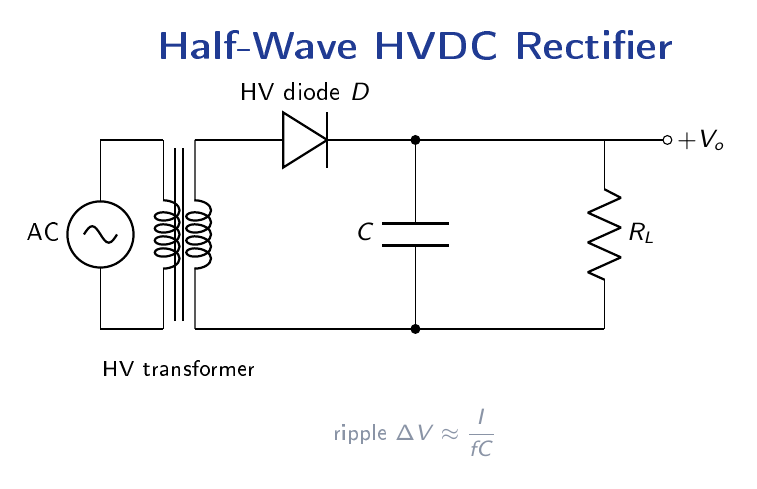
The basic arrangement (HV diode + HV transformer + smoothing capacitor) delivers ripple and voltage drop for a load \(R\) with capacitor \(C\) at frequency \(f\):
\[\Delta V\approx\frac{I}{fC}=\frac{V}{fRC},\qquad\delta V=\frac{\Delta V}{2}\]Voltage regulation \(\eta_v=(V_\text{nl}-V_\text{fl})/V_\text{nl}\). Diode PIV must be \(\ge2V_\text{max}\). The output is limited by the transformer rating, which motivates voltage multipliers.
Cockcroft–Walton Voltage Multiplier
An \(n\)-stage CW multiplier cascades diode–capacitor stages to multiply the transformer peak. Ideal no-load output: \(V_0=2n\,V_\text{ac,peak}\). With load current \(I\):
\[\Delta V_{nl}=\frac{I}{fC}\!\left(\frac{2n^3}{3}+\frac{n^2}{2}-\frac{n}{6}\right),\qquad n_\text{opt}\approx\sqrt{\frac{V_\text{max}\,fC}{I}}\]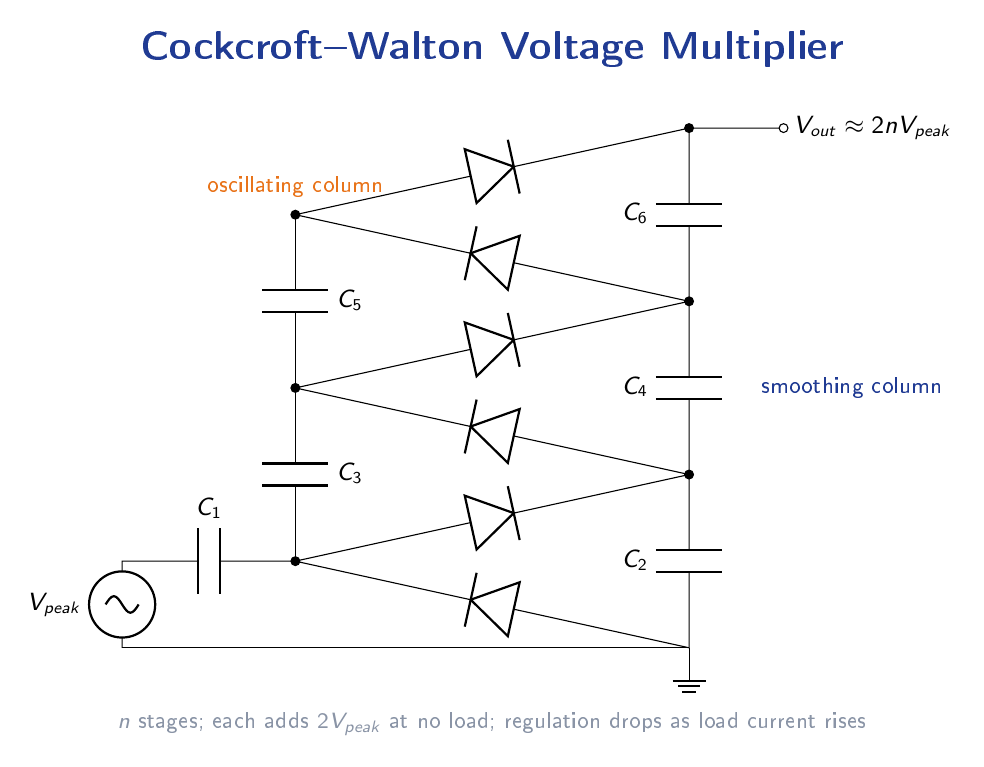
High AC Voltage Generation
Cascaded (series-stacked) transformers allow individual units to have moderate ratings while the series stack delivers the full test voltage. Series-resonant test sets (variable-frequency or variable-inductance) tune the test object capacitance into resonance, dramatically reducing the required source apparent power since the reactive energy is supplied by the resonant circuit.
Impulse Voltage Generation
Standard Impulse Waveforms
The standard full lightning impulse is \(1.2/50\;\mu\text{s}\) (\(T_1=1.2\;\mu\text{s}\) front, \(T_2=50\;\mu\text{s}\) tail, tolerances \(\pm30\%/\pm20\%\)). The switching impulse is \(250/2500\;\mu\text{s}\). A chopped impulse is truncated at 2–5 µs by a rod gap. The double-exponential form is:
\[v(t)=K\!\left(e^{-\alpha t}-e^{-\beta t}\right)\]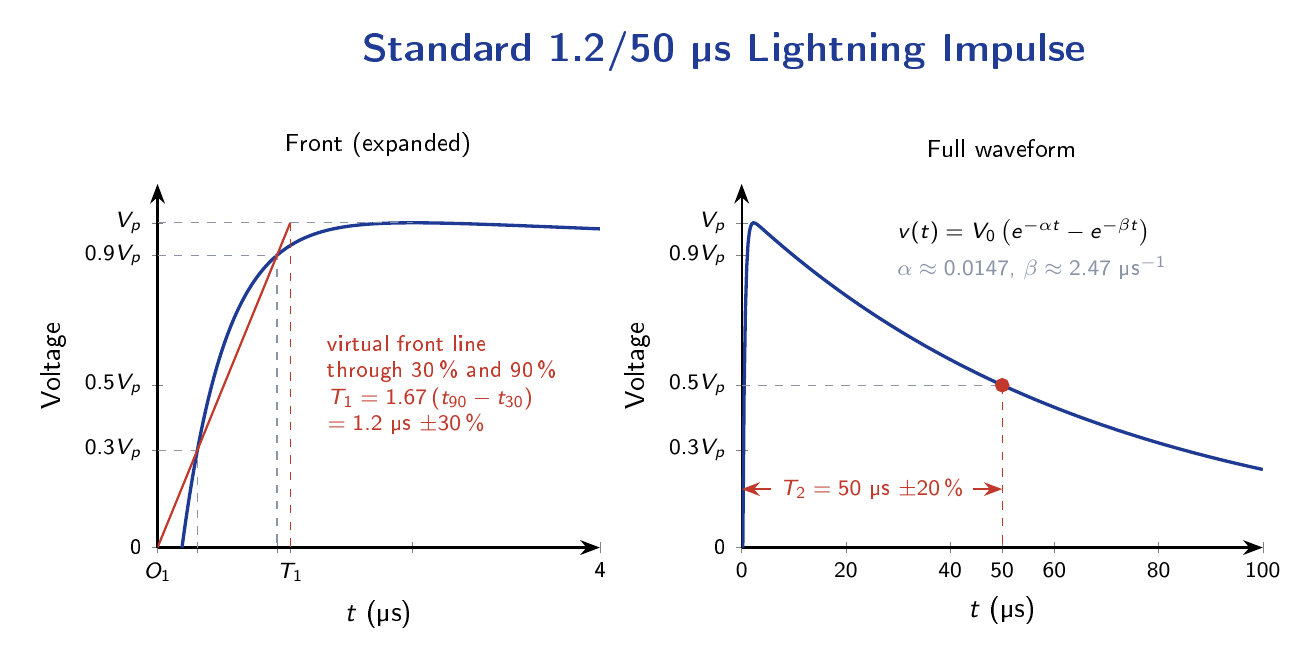
Single-Stage Impulse Generator
Circuit (a): tail resistor \(R_2\) across load capacitance \(C_2\); front resistor \(R_1\) between \(C_1\) and \(C_2\). S-domain analysis gives a double-exponential output. Efficiency \(\approx95\%\) for practical \(1.2/50\;\mu\text{s}\) generators.
Circuit (b): \(R_1\) in series, \(R_2\) across \(C_1\). Approximate decoupled design (\(C_1\gg C_2\)): \(\tau_\text{tail}\approx R_2 C_1\), \(\tau_\text{front}\approx R_1 C_2\). For a 1.2/50 generator with a 1 nF load and \(C_1=1\;\mu\text{F}\):
\[R_1\approx\frac{T_1}{3C_2}\approx400\;\Omega,\qquad R_2\approx\frac{T_2}{0.7\,C_1}\approx70\;\Omega\]Circuit (a) gives higher efficiency; Circuit (b) is preferred for multistage Marx generators due to smoother fronts on capacitive loads.
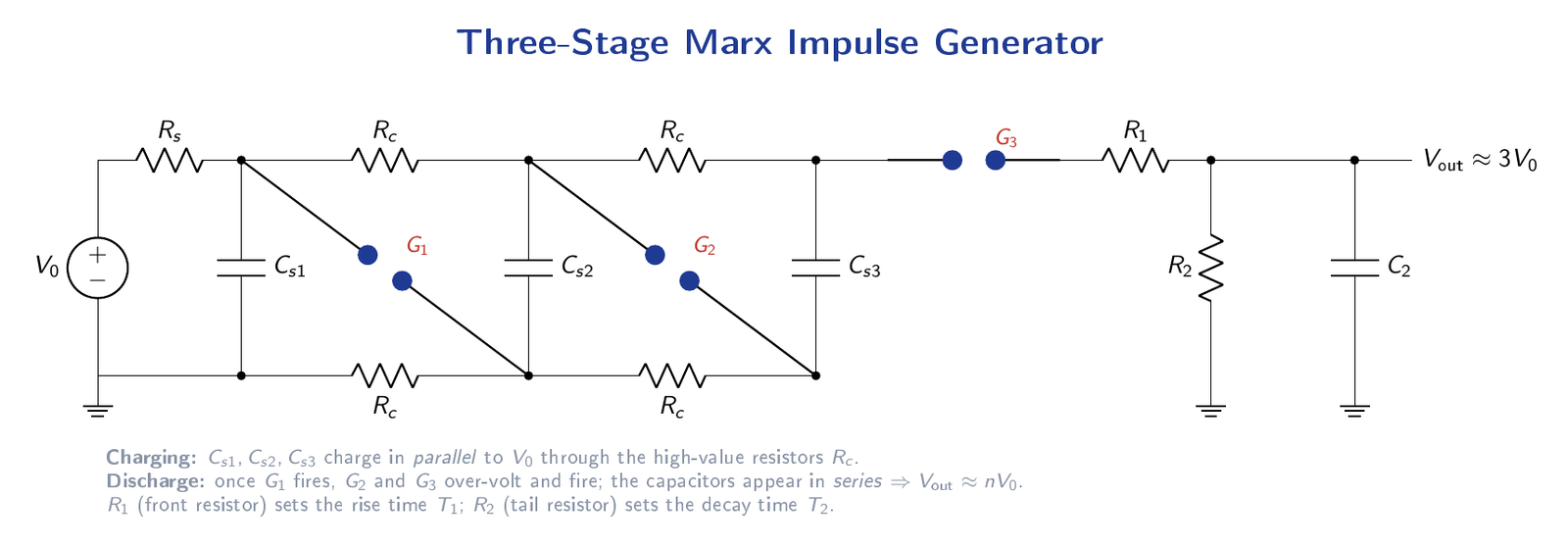
Multistage Marx Generator
\(n\) stage capacitors \(C_g\) are charged in parallel via \(R_c\), then discharged in series via spark gaps:
\[C_\text{eq}=\frac{C_g}{n},\qquad V_\text{out}\approx n\,V_0\,\eta,\qquad W=\tfrac{1}{2}\,n\,C_g\,V_0^2\]The first gap is triggered (trigatron or laser-triggered gap); the cascade completes in \(\sim100\;\text{ns}\). Practical ratings: 200 kV/stage, 4–12 stages, 200 kJ to several MJ.
Impulse Current Generation
Standard waveforms: \(8/20\;\mu\text{s}\) (lightning arrester testing) and \(4/10\;\mu\text{s}\). An RLC circuit produces:
\[i(t)=\frac{V_0}{\omega L}\,e^{-\alpha t}\sin(\omega t),\quad\alpha=\frac{R}{2L},\quad\omega=\sqrt{\frac{1}{LC}-\alpha^2}\]For \(8/20\;\mu\text{s}\): \(L\sim\text{few}\;\mu\text{H}\), \(C\sim100\;\mu\text{F}\) at 100 kV, giving \(\sim100\;\text{kA}\) peak. A crowbar switch suppresses the oscillating tail. Long rectangular pulses use a pulse-forming network (PFN) matched to the load: \(Z_0=\sqrt{L/C}\).
Measurement of High Voltages and Currents
| Method | Quantity Measured | Range / Typical Use |
|---|---|---|
| Sphere gap | Peak (DC, AC, impulse) | Up to 2.5 MV; reference standard |
| Uniform-field gap (Bruce) | Peak | Laboratory standard, ±1–2% |
| Rod gap | Peak | Up to 1 MV; ±8%; less accurate |
| Electrostatic voltmeter (ESV) | RMS / DC | Up to 1 MV; <10 mA loading |
| Generating voltmeter | DC only | 0–±500 kV; no source loading |
| Chubb–Fortescue | AC peak | 50 Hz, accurate and simple |
| Resistive divider | DC, AC, low-freq. impulse | Loading \(V^2/R\) sets limit |
| Capacitive divider | AC, impulse | Low loss; frequency-dependent |
| Damped capacitive (mixed) divider | Impulse front | Best impulse-front fidelity |
Sphere Gap
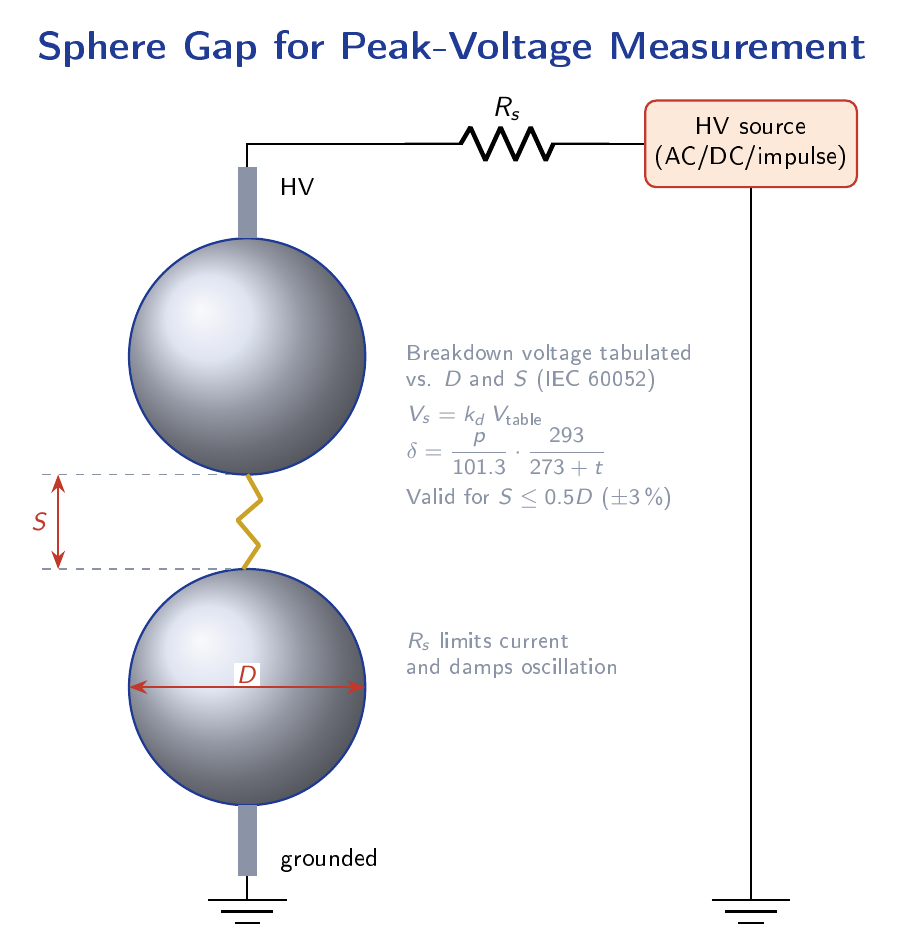
Two equal-diameter metallic spheres separated by gap \(S\). The breakdown voltage \(V_b(D,S)\) is tabulated at standard conditions (\(p_0=101.3\;\text{kPa}\), \(T_0=20°\text{C}\), \(h_0=11\;\text{g/m}^3\)). Air-density correction:
\[V_b=V_{b,0}\,\delta,\qquad\delta=\frac{p}{p_0}\cdot\frac{273+T_0}{273+T}\]Humidity correction \(k_h\) applies for AC/DC; not for impulse. Rules: use \(S/D\le0.5\) for accuracy \(\pm3\%\); keep surrounding objects \(\ge5D\) away; apply UV illumination for AC below 50 kV.
Electrostatic Voltmeter (ESV)
Two parallel discs, area \(A\), separation \(d\). Attractive force:
\[F=\frac{\varepsilon_0 A\,V^2}{2d^2}\]An attracted-disc ESV measures \(V\) (DC or RMS AC) via suspension torque against a counter-spring. Advantages: negligible loading, reads true RMS of any waveform, range up to ~1 MV. Limitations: dust sensitivity, mechanical damping requirement, calibration drift.
Generating Voltmeter
A grounded rotor disc periodically exposes and screens an electrode at HV potential, creating \(C(t)=C_0+C_m\cos\omega t\). The induced current is:
\[i(t)=V_\text{dc}\,\frac{dC}{dt}=-V_\text{dc}\,C_m\,\omega\,\sin\omega t\]Peak current is proportional to \(V_\text{dc}\). The generating voltmeter reads only DC or very slowly changing voltages – it does not respond to AC peak, unlike the Chubb–Fortescue method.
Chubb–Fortescue Method
A series capacitor \(C\) is connected to the HV; the AC current through it is half-wave rectified. The average rectified current equals \(2fCV_\text{pk}\), giving:
\[V_\text{pk}=\frac{I_\text{avg}}{2fC}\]This is the standard method for measuring AC peak voltage at power frequency. Sphere-gap calibration depends on the peak value, not the RMS.
Voltage Dividers
Resistive dividers serve DC and slow impulse fronts. Capacitive dividers suit AC and switching impulses. Mixed (damped capacitive) dividers optimally capture both the front and tail of lightning impulses. The step-response settling time of the divider–cable system must be well within the impulse front time.
HV Testing of Power Apparatus
Insulators
Routine tests: power-frequency dry and wet withstand (1 min) and visible-discharge tests. Type tests: impulse withstand and 50% flashover (positive and negative polarity), pollution tests (salt-fog and solid-layer methods), corona extinction voltage, and radio-influence voltage (RIV). Composite silicone-rubber insulators are increasingly preferred over porcelain and glass for superior hydrophobicity and pollution performance.
Cables
PILC cables: DC pressure test at \(V_\text{dc}=2.4\,V_0\) for 15 min. Modern XLPE cables: AC at 0.1 Hz (VLF) – capacitive kVA is dramatically reduced at this frequency. Type tests add bending, thermal cycling with PD monitoring, lightning impulse (\(\pm10\) shots), and long-duration AC. Site tests use TDR-based PD mapping for defect location.
DC testing of aged XLPE cables generates space charges that can cause failure under subsequent AC service voltage. DC testing of XLPE is therefore avoided in modern practice; VLF AC is the standard alternative.
Bushings, Capacitors, and Transformers
Bushing tests: power-frequency withstand (dry/wet), lightning impulse (full and chopped), switching impulse (≥300 kV), PD (\(\le10\;\text{pC}\) at \(1.5U_m/\sqrt3\)), and tan-δ. Power transformer type tests: separate-source AC withstand; induced overvoltage withstand with simultaneous PD; lightning impulse (full and chopped) on each line terminal; switching impulse for \(U_m\ge245\;\text{kV}\).
Circuit Breakers
Asymmetrical fault tests apply short-circuit currents including a DC offset; the breaker is rated for making, breaking, short-time, and short-circuit duty. Synthetic test circuits (current-injection and voltage-injection methods, Weil–Dobke circuit) are used when laboratory short-circuit power is insufficient. The transient recovery voltage (TRV) is specified by its rate of rise (RRRV) and peak factor; the breaker must withstand the TRV without re-strike.
Non-Destructive Insulation Testing
Dielectric Loss and tan-δ
For a sinusoidal field, complex permittivity is \(\varepsilon^*=\varepsilon'-j\varepsilon''\) and:
\[\boxed{\tan\delta=\frac{\varepsilon''}{\varepsilon'}=\frac{1}{\omega R_p C_p}}\]Power dissipated per unit volume: \(p=\omega\varepsilon_0\varepsilon'' E^2\). Loss mechanisms: conduction (low frequency), dipolar Debye relaxation (peak at \(\omega\tau=1\)), interfacial Maxwell–Wagner (composites), and resonance (IR, UV). Tan-δ is the most sensitive bulk indicator of insulation health – it rises with moisture, contamination, and void formation long before breakdown. Routinely measured on cables, bushings, transformers, and capacitors.
Schering Bridge
The unknown specimen \(C_x\) (with loss \(R_x\)) is compared against a loss-free standard \(C_N\). Balance condition \(\mathbf{Z}_1\mathbf{Z}_4=\mathbf{Z}_2\mathbf{Z}_3\) gives:
\[\boxed{C_x=\frac{R_4}{R_3}\,C_N,\qquad\tan\delta=\omega R_4 C_4}\]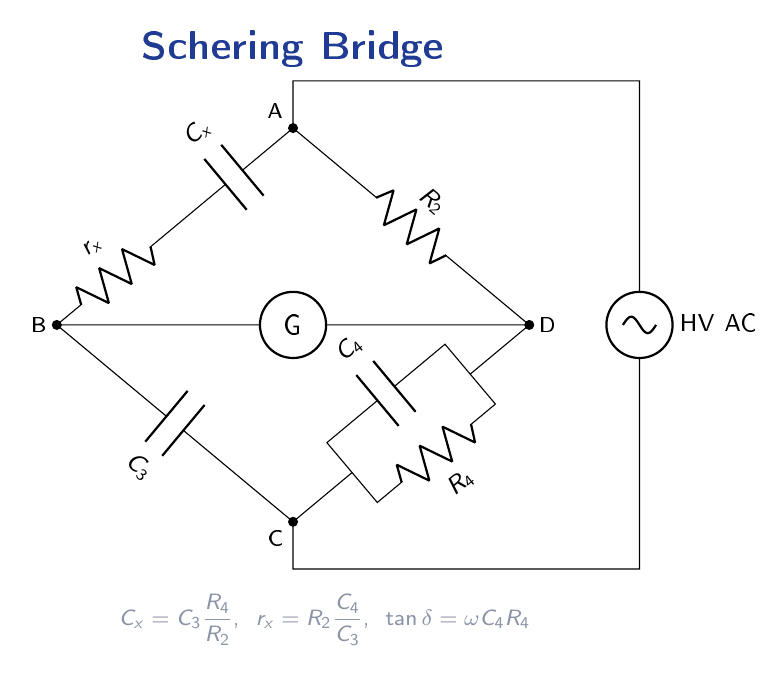
Variants: inverted bridge for grounded specimens; high-loss bridge with \(C_4\) across \(C_N\) for \(\tan\delta>0.1\); Wagner earth to eliminate stray capacitance currents; transformer ratio-arm bridge (TRAB) with inductively coupled ratio arms for superior stability and immunity to strays.
Partial Discharge Measurement
A partial discharge is a localised discharge that only partially bridges the insulation between conductors. Types: internal PD (voids in solid/liquid insulation), surface PD (solid–gas interface), corona (HV conductors in gas).
The Gemant–Philippoff a-b-c circuit models a void of capacitance \(C_c\) in series with \(C_b\) and in parallel with sound dielectric \(C_a\). The apparent charge transferred at the terminals when a void discharge \(\Delta V_c\) occurs is:
\[q=\Delta V_c\cdot\frac{C_b C_c}{C_b+C_c}\approx C_b\,\Delta V_c\]Inception voltage \(V_i\) is the lowest voltage at which PD just starts; extinction voltage \(V_e<V_i\) due to space-charge remnants. Detection: coupling capacitor \(C_k\) in parallel with the test object and detection impedance \(Z_d\); calibrator injects known charge \(q_0\). Phase-resolved PD (PRPD) pattern recognition identifies discharge type. On-line detection uses UHF sensors (300–3000 MHz) in GIS, HFCT/TEV on cables, and acoustic emission in transformers.
Other Diagnostic Techniques
Frequency-response analysis (FRA) detects winding deformations in transformers by comparing transfer-function fingerprints over time. Dissolved-gas analysis (DGA) identifies thermal and electrical faults via oil chromatography, interpreted through Rogers/Doernenburg ratios or the Duval triangle. Polarisation/depolarisation current (PDC) and recovery voltage measurement (RVM) infer moisture in cellulose insulation via low-frequency dielectric response. Thermography, on-line UHF PD, and distributed temperature sensing (DTS) via optical fibre are modern asset-management staples.
Transients and Insulation Coordination
Even in a 50 Hz network the insulation is sized by transient overvoltages: lightning (µs scale, peaks several MV); switching (100 µs–ms, 2–3 p.u.); temporary overvoltages (TOV) (s–min, from load rejection or ferroresonance). Per-unit base: \(V_\text{base}=U_m\sqrt2/\sqrt3\) (peak phase voltage).
RLC Transients
For a series RLC step input \(V_0\):
\[\zeta=\frac{R}{2}\sqrt{\frac{C}{L}},\qquad\omega_n=\frac{1}{\sqrt{LC}}\]Underdamped (\(\zeta<1\)): oscillatory overshoot peaking at \(V_{C,\text{max}}=V_0(1+e^{-\pi\zeta/\sqrt{1-\zeta^2}})\). Critically damped and overdamped cases have exponential decays without oscillation.
Travelling Waves on Transmission Lines
Wave propagation velocity and surge impedance of a lossless line:
\[v=\frac{1}{\sqrt{LC}}=c\;\text{(air)},\qquad Z_0=\sqrt{\frac{L}{C}}\]At a junction between lines of surge impedances \(Z_1\) and \(Z_2\):
\[\Gamma=\frac{Z_2-Z_1}{Z_2+Z_1},\qquad\tau=\frac{2Z_2}{Z_2+Z_1}\]Open circuit (\(Z_2\to\infty\)): \(\Gamma=+1\), voltage doubles. Short circuit (\(Z_2=0\)): \(\Gamma=-1\), voltage collapses. Matched (\(Z_2=Z_1\)): \(\Gamma=0\), no reflection.
Switching Surge and Gallet Equation
The 50% flashover voltage of an air gap under switching impulse (Gallet equation):
\[V_{50,\text{SI}}=\frac{3400}{1+8/d}\;\text{kV (peak)},\quad d\text{ in m}\]Statistical spread: \(\sigma_p\approx6\%\) (LI), 8% (SI). Withstand voltage:
\[V_w=V_{50}(1-Z_\alpha\,\sigma_p),\qquad Z_\alpha=1.282\;\text{(10% risk)}\]Insulation Coordination – Conventional Method
The design goal:
\[V_\text{withstand}(\text{equipment})>V_\text{protective}(\text{arrester})\times\text{margin}\]Deterministic procedure: determine maximum surge \(V_s\); choose \(\text{BIL}\ge V_s\times1.2\text{–}1.4\); verify V–t coordination (arrester V–t curve must lie below equipment's V–t curve over the full time-to-flashover range). For Range I (\(U_m\le245\;\text{kV}\)): primary criterion is BIL. For Range II (\(U_m\ge300\;\text{kV}\)): SIWL takes precedence.
Insulation Coordination – Statistical Method
Both stress and strength are random variables. Risk of failure:
\[R=\int_{-\infty}^{\infty}f_s(V)\,P(V)\,dV\]Statistical safety factor \(\gamma_s=V_{w,\text{stat}}/V_{s,\text{stat}}\) uses the 10% withstand voltage and 2% stress voltage. Field/EMTP simulations establish the overvoltage distribution. If \(R\) exceeds the acceptable level (\(10^{-3}\)/yr typical), insulation is strengthened or protection improved.
Surge Arresters
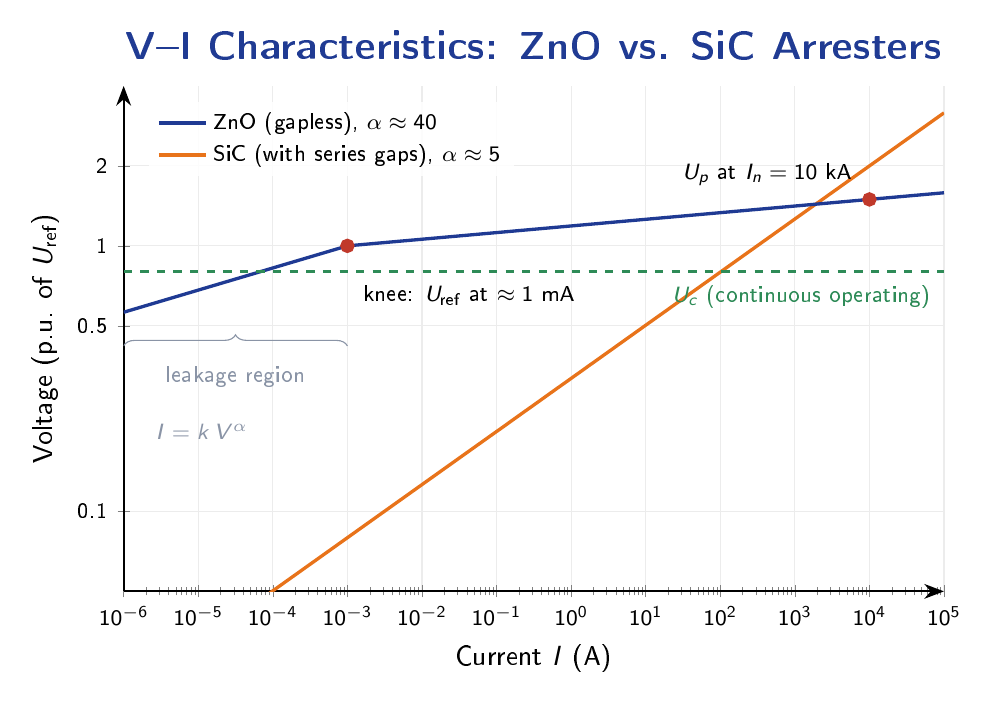
Modern metal-oxide (ZnO) gapless arresters have a highly non-linear V–I characteristic \(I=kV^\alpha\), \(\alpha\approx25\text{–}60\). Negligible leakage (\(\sim\)mA) at operating voltage; clamping to protective level \(U_p\) at nominal discharge current \(I_n\) (5, 10, or 20 kA). Coordination: \(\text{BIL}\ge U_p\times1.2\) (LI); \(\text{SIWL}\ge U_{p,\text{SI}}\times1.15\).
Ground Wires and Rotating Machine Protection
Shield wires intercept lightning before it reaches phase conductors. Effective shielding angle: ≤30° for ≤230 kV; ≤15° for ≥400 kV. Tower-footing resistance target <10 Ω. Rotating machines have low inter-turn BIL; steep-front surges produce uneven winding voltage distribution. Protection: surge arrester (limits magnitude) plus surge capacitor (~0.25 µF at motor terminals) reduces front time from µs to ~10 µs, equalising winding voltage distribution.
Modern Applications of High Voltage Engineering
Pulsed Power Systems
Pulsed power converts long-timescale electrical energy into short, intense bursts (kV–MV at ns–µs). The energy compression chain: prime power (seconds) → capacitor charging (milliseconds) → pulse forming (microseconds) → switching/output (nanoseconds). Key components include capacitor banks, PFNs, Blumlein lines (SMES), triggered spark gaps, thyratrons, and IGBTs. Topologies include the Marx generator, transformer-based modulator, solid-state Marx, and linear transformer driver (LTD).
Applications: Pulsed Electric Field (PEF) food pasteurisation and electroporation for drug/gene delivery; X-ray flash radiography; ozone generation and pollution control; EUV light sources for semiconductor lithography; medical defibrillators, lithotripsy, and irreversible electroporation for tumour ablation.
Pulsed Electric Field (PEF)
Microsecond pulses of \(E\sim10\text{–}80\;\text{kV/cm}\) induce a transmembrane potential of ~1 V across cell membranes. Above the electroporation threshold, the lipid bilayer becomes permeable – reversibly (drug delivery) or irreversibly (sterilisation) depending on pulse energy. Pulse parameters: 10–60 kV, 1–100 µs width, 1 Hz to kHz repetition, 10–300 kJ/L specific energy. Mushroom-shaped electrodes provide uniform field with low erosion.
HVDC Transmission
Thyristor-based 12-pulse bridge; needs strong AC system; consumes 50–60% reactive power. Current direction fixed; power reversal by voltage polarity reversal. Voltages up to ±1100 kV (Changji–Guquan UHVDC).
IGBT-based modular multilevel converter (MMC); independent P and Q control; black-start capable; suited for offshore wind, weak grids, multi-terminal HVDC. Voltages up to ±525 kV with extruded XLPE cable.
Key HV challenges: DC field stress is conductivity-dominated (not permittivity-dominated), with steep dependence on temperature and contamination; polarity reversal in LCC causes severe transient stress; converter valve insulation must be redesigned for PWM-induced high-frequency overvoltages; DC circuit breakers remain an active research frontier.
Gas Insulated Switchgear (GIS) and Substations
GIS integrates circuit breakers, disconnectors, earthing switches, busbars, and instrument transformers in a metal-enclosed SF₆-pressurised assembly (66 kV to 1100 kV). Footprint is 10–25% of equivalent AIS; maintenance intervals reach 20–25 years. Specific HV phenomena include very fast transient overvoltages (VFTO) – nanosecond steep fronts (>kV/ns) from disconnector pre-strikes – and particle-induced flashover from metallic debris. The sustainability shift away from SF₆ (GWP ≈ 23 500) is driving adoption of g³ (Novec 4710 + CO₂), clean-air mixtures, and CO₂ blends.
Smart-Grid HV Monitoring and Digital Substations
Condition-based maintenance is enabled by on-line diagnostics: UHF PD sensors in GIS (300–3000 MHz); HFCT/TEV on cables and rotating machines; on-line DGA sensors with IoT telemetry interpreted via Duval triangle/pentagon; bushing tan-δ monitoring via leakage-current analysis; distributed temperature sensing (DTS) along cables; acoustic emission localisation in transformers. The digital substation (IEC 61850) uses a process bus carrying Sampled Values from optical CT/VT to merging units, with PTP time synchronisation (IEEE 1588, µs accuracy) and GOOSE messaging replacing hard-wired protection. AI/ML is increasingly applied to PD pattern recognition, DGA trending, and digital-twin calibration.
Key Formulas and Comparison Tables
Formula Quick Reference
| Phenomenon / Device | Formula |
|---|---|
| Townsend avalanche (1st coeff.) | \(I=I_0\,e^{\alpha d}\) |
| Townsend with secondary emission | \(I=\dfrac{I_0\,e^{\alpha d}}{1-\gamma(e^{\alpha d}-1)}\) |
| Townsend breakdown criterion | \(\gamma(e^{\alpha d}-1)=1\) |
| Streamer criterion | \(\alpha d\approx18\text{–}20\) |
| Paschen's law | \(V_b=f(pd)\), minimum at \((pd)_\text{min}\) |
| Peek's corona onset field | \(E_v=m\delta E_0\!\left(1+\frac{0.301}{\sqrt{\delta r}}\right)\) kV/cm |
| HVDC ripple (half-wave) | \(\delta V\approx I/(fC)\) |
| Cockcroft–Walton voltage drop | \(\Delta V=\frac{I}{fC}\!\left(\frac{2n^3}{3}+\frac{n^2}{2}-\frac{n}{6}\right)\) |
| CW optimum stages | \(n_\text{opt}\approx\sqrt{V_\text{max}fC/I}\) |
| Generating voltmeter current | \(i(t)=V_\text{dc}\,dC/dt\) |
| Chubb–Fortescue (AC peak) | \(V_\text{pk}=I_\text{avg}/(2fC)\) |
| ESV plate force | \(F=\varepsilon A V^2/(2d^2)\) |
| Standard lightning impulse | \(1.2/50\;\mu\text{s}\) |
| Marx output (no-load) | \(V_\text{out}=nV_\text{ch}\); with stray \(C_s\): \(\eta=C_g/(C_g+C_s)\) |
| Schering bridge balance | \(C_x=(R_4/R_3)C_N\), \(\tan\delta=\omega R_4 C_4\) |
| PD apparent charge | \(q=C_b\Delta V\) [pC scale] |
| Travelling wave velocity | \(v=1/\sqrt{LC}=c\) in air |
| Surge impedance | \(Z_0=\sqrt{L/C}\) |
| Reflection / refraction coefficients | \(\Gamma=(Z_2-Z_1)/(Z_2+Z_1)\), \(\tau=2Z_2/(Z_2+Z_1)\) |
| Striking distance (lightning) | \(r_s=10\,I^{0.65}\) m (\(I\) in kA) |
| Risk of failure | \(R=\int f(V)\,P(V)\,dV\) |
| ZnO arrester V–I | \(I=kV^\alpha\), \(\alpha\approx25\text{–}60\) |
Comparison of HV Measurement Methods
| Method | Quantity | Range & Accuracy | Best Use |
|---|---|---|---|
| Sphere gap | Peak (DC, AC, LI) | Up to 2.5 MV; ±3% | Lab calibration of any HV |
| Uniform-field gap | Peak | Up to 600 kV; ±1–2% | Reference for AC peak |
| Rod gap | Peak | Up to MV; ±8% | Field overvoltage estimate |
| ESV / absolute voltmeter | RMS / DC | 10 kV–MV; ±0.5% | DC reference standard |
| Generating voltmeter | DC | MV class; ±1% | Continuous DC HV monitoring |
| Chubb–Fortescue | AC peak | MV class; ±0.5% | AC calibration |
| Resistive divider | DC & impulse | MV; ±1% | DC and impulse fronts |
| Capacitive divider | AC & impulse | MV; ±1% | AC and switching impulse |
| Mixed / damped divider | Impulse | MV; ±1% | LI + SI accurately |
| PT/CT (instrument transformer) | AC RMS | Up to 800 kV | Switchyard metering |
| Optical (Pockels / Faraday) | AC, DC, impulse | Up to MV | GIS, HVDC, UHV |
Comparison of Breakdown Mechanisms
| Medium | Mechanism | Governing Relation | Typical \(E_b\) |
|---|---|---|---|
| Gas (low \(pd\)) | Townsend | \(\gamma(e^{\alpha d}-1)=1\) | 30 kV/cm (air, STP) |
| Gas (high \(pd\)) | Streamer (Meek) | \(\alpha d\approx18\text{–}20\) | 30 kV/cm (air, STP) |
| Gas (uniform field) | Paschen | \(V_b=f(pd)\) | – |
| SF₆ | Streamer + attachment | \((E/p)_\text{cr}\approx89\;\text{kV/(cm·bar)}\) | 89 kV/cm (STP) |
| Vacuum | Field emission / clump | Fowler–Nordheim; micro-particle | 100–500 kV/cm |
| Liquid (pure) | Electronic, bubble | Avalanche, cavitation | 1 MV/cm |
| Liquid (commercial) | Suspended particle | Bridging by contamination chain | 50–200 kV/cm |
| Solid (intrinsic) | Electronic avalanche | High-field, FN-like | ≥5 MV/cm |
| Solid (thermal) | Joule heat balance | \(\sigma(T)E^2=\) cooling losses | 1–3 MV/cm |
| Solid (electromechanical) | Maxwell stress | \(\varepsilon E^2/2>Y\) | Polymer, rubber |
| Solid (treeing / PD) | Tree growth from voids | PD inception, ageing | Long-term failure |
| Solid (surface) | Tracking, contamination | Dry-band arcing | 5–30 kV/cm |
HV Apparatus Design – Quick-Reference Flow
HV Laboratory Safety and Exam Essentials
HV Laboratory Best Practices
Layout and Earthing
- Single-point grounding; low-impedance mat (<0.5 Ω).
- Faraday cage / shielded lab to suppress EMI for PD measurement.
- Clearances: ≥1 m/100 kV (peak AC); ≥3 m/MV (impulse).
Procedural Safety
- Discharge stick and earth rod after every test; never rely on bleeders alone.
- Interlocked perimeter; key-issue and dead-man systems.
- Two-person rule for live operations; HV PPE (gloves, mat, face shield).
- Capacitor bank dump resistors sized for stored energy in kJ.
Measurement Hygiene
- Calibrate dividers periodically; verify against a sphere gap.
- Use coaxial damping and matched terminations (50 Ω) to prevent travelling-wave reflections.
- Shield instrumentation cabinets; use common-mode chokes on signal cables.
- Document atmospheric correction factors for every test: \(V_\text{std}=K_d\,V_\text{meas}/K_h\).
Always reproduce, with derivation if asked:
- Townsend criterion \(\gamma(e^{\alpha d}-1)=1\) and how Paschen's law follows from \(\alpha=f(E/p)\).
- Streamer (Raether–Meek) condition and contrast with Townsend (low-\(pd\) versus high-\(pd\) regimes).
- Cockcroft–Walton ripple and voltage-drop expression; derivation of optimum \(n\).
- Standard impulse \(1.2/50\;\mu\text{s}\) and Marx voltage-multiplication principle (charge in parallel, discharge in series).
- Schering bridge balance and tan-δ derivation.
- Travelling-wave reflection and refraction coefficients at open, short, and matched terminations.
- Insulation coordination: conventional vs. statistical; meaning of \(V_{50}\), \(\sigma\), BIL, and \(V_{p,\text{SA}}\).
- DC stress in cables is conductivity-graded, not permittivity-graded. Temperature inversion can reverse the field distribution in HVDC cables, potentially over-stressing inner insulation.
- In SF₆, breakdown is dominated by electron attachment. A small metallic protrusion dramatically lowers \(V_b\) by locally exceeding the critical \(E/p\).
- The generating voltmeter reads only DC (or very slow change), not AC peak – contrast with Chubb–Fortescue.
- Sphere-gap calibration depends on peak voltage, not RMS. Never substitute RMS into sphere-gap tables.
- Tan-δ alone is a bulk diagnostic. Partial discharge measurement localises individual defects that are invisible to tan-δ.
References and Further Reading
Standard Textbooks
- E. Kuffel, W. S. Zaengl, J. Kuffel, High Voltage Engineering: Fundamentals, 2nd ed., Newnes, 2000.
- M. S. Naidu, V. Kamaraju, High Voltage Engineering, 6th ed., McGraw-Hill, 2022.
- C. L. Wadhwa, High Voltage Engineering, 3rd ed., New Age International, 2012.
- D. Kind, K. Feser, High-Voltage Test Techniques, 2nd ed., Newnes, 2001.
- L. L. Alston (ed.), High-Voltage Technology, Oxford University Press, 1968.
Pulsed Power and Modern Applications
- H. Bluhm, Pulsed Power Systems: Principles and Applications, Springer, 2006.
- P. W. Smith, Transient Electronics: Pulsed Circuit Technology, Wiley, 2002.
Standards
- IEC 60060-1/-2/-3: HV test techniques – general, measuring systems, on-site tests.
- IEC 60071-1/-2: Insulation coordination – definitions, principles, and application guide.
- IEC 60270: Partial discharge measurement.
- IEEE Std 4: Standard for HV testing techniques.
- IEC 61850: Communication networks and systems for power utility automation.