Engineering Physics
A Comprehensive Course for First-Year B.Tech Students — Aligned with AICTE / GTU / AKTU / VTU / JNTU Model Curriculum
1. Units, Dimensions, and Errors
Physical Quantities and SI Units
| Quantity | Unit | Symbol |
|---|---|---|
| Length | metre | m |
| Mass | kilogram | kg |
| Time | second | s |
| Electric current | ampere | A |
| Thermodynamic temperature | kelvin | K |
| Amount of substance | mole | mol |
| Luminous intensity | candela | cd |
Dimensional Analysis
Examples: \([\text{Velocity}]=[LT^{-1}]\), \([\text{Force}]=[MLT^{-2}]\), \([\text{Energy}]=[ML^2T^{-2}]\), \([\text{Pressure}]=[ML^{-1}T^{-2}]\), \([\text{Charge}]=[IT]\).
Dimensional analysis is used to check equation homogeneity, derive relations between quantities, and convert units. The principle of homogeneity requires every term in a valid equation to share the same dimensions.
Limitations: it cannot determine dimensionless constants (e.g., the \(\tfrac{1}{2}\) in \(\tfrac{1}{2}mv^2\)), fails for transcendental functions, and cannot distinguish quantities with identical dimensions such as work and torque.
Errors in Measurement
For \(n\) repeated measurements \(a_1, a_2, \ldots, a_n\):
\[\bar{a} = \frac{1}{n}\sum_{i=1}^n a_i, \qquad \overline{\Delta a} = \frac{1}{n}\sum_i |a_i - \bar{a}|, \qquad \delta_r = \frac{\overline{\Delta a}}{\bar{a}}.\]Propagation of Errors
For a function \(Z = f(A, B, \ldots)\): \[\text{Sum/difference:}\quad \Delta Z = \Delta A + \Delta B\] \[\text{Product/quotient:}\quad \frac{\Delta Z}{Z} = \frac{\Delta A}{A} + \frac{\Delta B}{B}\] \[\text{Power }Z = A^p B^q C^r:\quad \frac{\Delta Z}{Z} = |p|\frac{\Delta A}{A} + |q|\frac{\Delta B}{B} + |r|\frac{\Delta C}{C}\]- State and explain the principle of homogeneity of dimensions. Verify \(s = ut + \tfrac{1}{2}at^2\).
- Differentiate between systematic and random errors with examples.
- Derive the percentage error in \(g\) measured by a simple pendulum.
- Discuss the limitations of dimensional analysis.
- Convert 1 newton into the CGS system using dimensional analysis.
2. Waves and Oscillations
Simple Harmonic Motion (SHM)
Newton's second law gives \(m\ddot{x} = -kx\), i.e., \(\ddot{x} + \omega_0^2 x = 0\) with \(\omega_0 = \sqrt{k/m}\). The general solution is
\[x(t) = A\cos(\omega_0 t + \phi),\] where \(A\) is the amplitude, \(\omega_0\) is the angular frequency, period \(T = 2\pi/\omega_0\), frequency \(f = 1/T\), and \(\phi\) is the initial phase.Energy in SHM
\[\text{KE} = \tfrac{1}{2}mv^2 = \tfrac{1}{2}m\omega_0^2(A^2 - x^2), \qquad \text{PE} = \tfrac{1}{2}kx^2\] \[E = \text{KE} + \text{PE} = \tfrac{1}{2}m\omega_0^2 A^2 = \tfrac{1}{2}kA^2 = \text{const.}\]Damped Harmonic Oscillator
With a velocity-dependent damping force \(-b\dot{x}\):
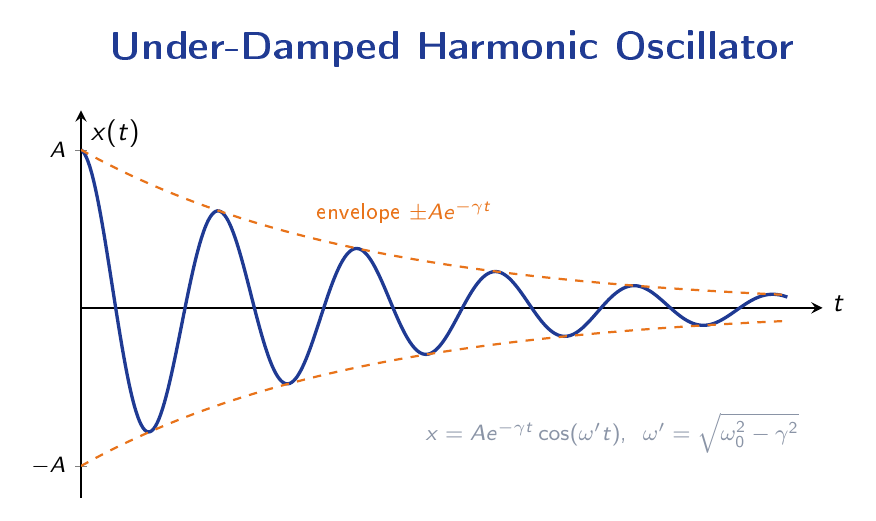
\[m\ddot{x} + b\dot{x} + kx = 0 \quad\Longrightarrow\quad \ddot{x} + 2\gamma\dot{x} + \omega_0^2 x = 0, \qquad \gamma = \frac{b}{2m}.\]Three regimes determined by the trial solution \(x \propto e^{\alpha t}\):
- Under-damped (\(\gamma < \omega_0\)): oscillatory decay, \(x(t) = A_0 e^{-\gamma t}\cos(\omega' t + \phi)\), \(\omega' = \sqrt{\omega_0^2 - \gamma^2}\).
- Critically damped (\(\gamma = \omega_0\)): fastest non-oscillatory return to equilibrium.
- Over-damped (\(\gamma > \omega_0\)): slow exponential return.
Quality Factor and Logarithmic Decrement
\[Q = \frac{\omega_0}{2\gamma}, \qquad \delta = \ln\frac{x_n}{x_{n+1}} = \gamma T'.\]High \(Q\) implies low damping and a sharp resonance peak; \(\delta\) measures the decay per cycle.
Forced Oscillations and Resonance
With a driving force \(F_0\cos\omega t\), the steady-state amplitude is
\[A(\omega) = \frac{F_0/m}{\sqrt{(\omega_0^2 - \omega^2)^2 + 4\gamma^2\omega^2}}.\]Resonance occurs at \(\omega_r = \sqrt{\omega_0^2 - 2\gamma^2} \approx \omega_0\) for small damping.
Travelling Waves
A harmonic transverse wave on a string: \(y = A\sin(kx - \omega t)\), satisfying
\[\frac{\partial^2 y}{\partial t^2} = v^2 \frac{\partial^2 y}{\partial x^2}, \qquad v = \sqrt{T/\mu},\] where \(T\) is the tension and \(\mu\) is the linear mass density. The dispersion relation is \(\omega = vk\), wavelength \(\lambda = 2\pi/k\). A travelling wave carries energy proportional to \(A^2\omega^2\) per unit length.Standing Waves
Superposition of two counter-propagating waves gives
\[y = 2A\sin(kx)\cos(\omega t).\]Nodes at \(kx = n\pi\); antinodes at \(kx = (n + \tfrac{1}{2})\pi\). Normal modes of a string of length \(L\) fixed at both ends:
\[\lambda_n = \frac{2L}{n}, \qquad f_n = \frac{nv}{2L}, \qquad n = 1, 2, 3, \ldots\]Sound Waves and Doppler Effect
Sound in air consists of longitudinal pressure waves with speed \(v = \sqrt{B/\rho}\) (\(B\) = bulk modulus). Intensity \(I = \tfrac{1}{2}\rho v\omega^2 A^2\). Sound level in decibels:
\[\beta = 10\log_{10}\!\left(\frac{I}{I_0}\right)\ \text{dB}, \qquad I_0 = 10^{-12}\ \text{W m}^{-2}.\]For a source moving at velocity \(v_s\) and observer at \(v_o\) along the same line:
\[f' = f_0\,\frac{v \pm v_o}{v \mp v_s}.\]Applications include radar speed guns, Doppler ultrasound, and astronomical redshift.
Phase Velocity and Group Velocity
A monochromatic wave travels at the phase velocity \(v_p = \omega/k\). A wave packet (real signal) has its envelope moving at the group velocity
\[v_g = \frac{d\omega}{dk}.\]- Derive the differential equation of a damped harmonic oscillator and discuss the three regimes.
- Define quality factor and logarithmic decrement; relate them.
- Derive the resonance amplitude formula for a driven oscillator.
- Obtain the speed of a transverse wave on a stretched string.
- State and prove the relations for nodes and antinodes in a standing wave on a fixed string.
- Derive the Doppler formula when source and observer both move.
3. Interference of Light
Wave Theory and Coherence
Light is a transverse electromagnetic wave with visible wavelengths from 400 to 700 nm. Two beams from coherent sources combine by linear superposition, producing intensity variations called interference.
Intensity Distribution
For fields \(E_1 = E_0\cos\omega t\) and \(E_2 = E_0\cos(\omega t + \delta)\), the resultant time-averaged intensity is
\[I = 4I_0\cos^2(\delta/2).\]Maxima when \(\delta = 2n\pi\); minima when \(\delta = (2n+1)\pi\).
Young's Double-Slit Experiment (YDSE)
For slit separation \(d\) and screen distance \(D\), the path difference for a point at height \(y\) is \(\Delta = yd/D\). Bright fringes at \(\Delta = n\lambda\), dark at \(\Delta = (n + \tfrac{1}{2})\lambda\). The fringe width (spacing between successive bright or dark fringes) is
\[\beta = \frac{\lambda D}{d}.\]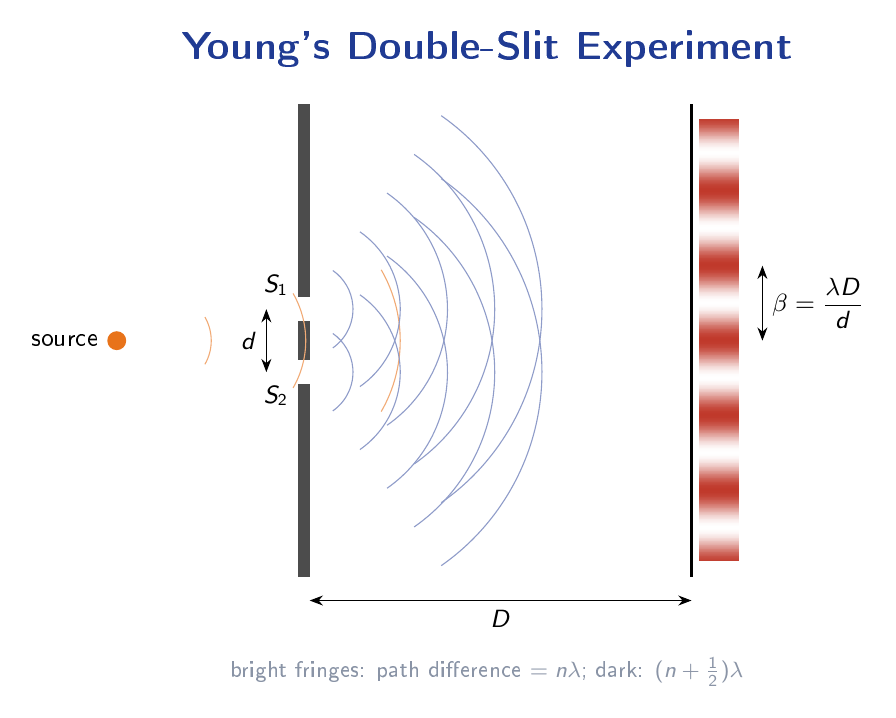
Thin-Film Interference
For a film of refractive index \(\mu\) and thickness \(t\), with light incident at angle \(i\) refracting at \(r\):
\[\Delta = 2\mu t\cos r \pm \frac{\lambda}{2}.\]The \(\lambda/2\) term arises from the phase reversal on reflection at the denser medium. For reflected light: maxima when \(2\mu t\cos r = (n + \tfrac{1}{2})\lambda\); minima when \(2\mu t\cos r = n\lambda\).
Newton's Rings
A plano-convex lens of radius \(R\) resting on a flat glass plate creates an air wedge. In reflected monochromatic light the radii of dark and bright rings are
\[r_n^{\text{dark}} = \sqrt{n\lambda R}, \qquad r_n^{\text{bright}} = \sqrt{(n + \tfrac{1}{2})\lambda R}.\]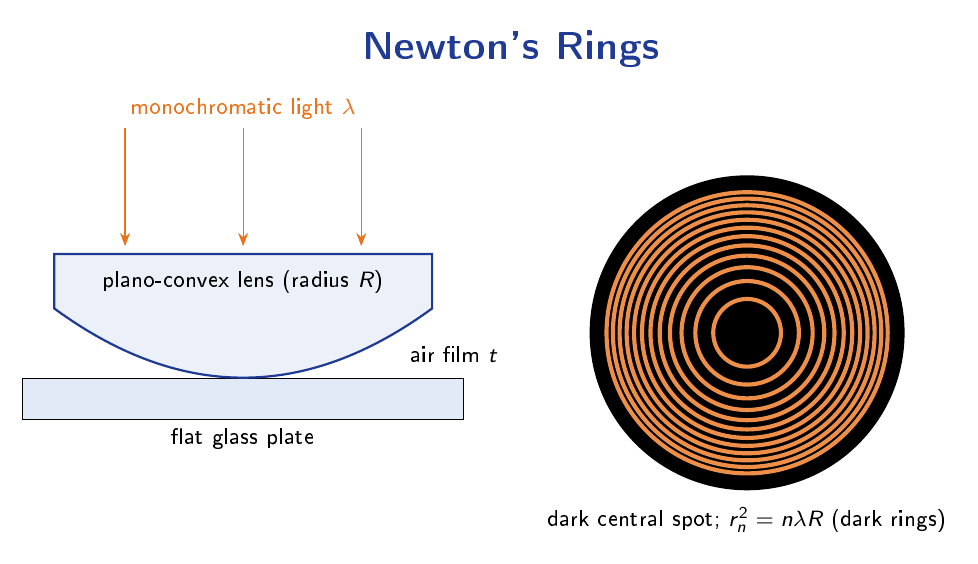
Wavelength determination using two ring orders \(n\) and \(n+p\):
\[\lambda = \frac{D_{n+p}^2 - D_n^2}{4pR}, \qquad D = 2r.\]- Define coherence. State the conditions for sustained interference.
- Derive the expression for fringe width in YDSE.
- Explain colours observed in thin films and derive the path-difference condition.
- Describe Newton's rings experiment and derive the formula for \(\lambda\).
4. Diffraction
Definition and Types
Single-Slit Fraunhofer Diffraction
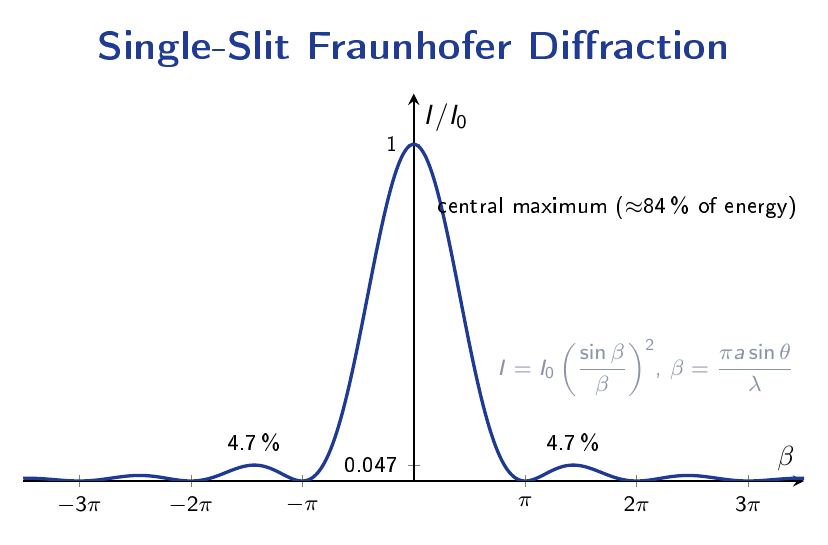
For slit width \(a\) and wavelength \(\lambda\), the intensity at angle \(\theta\) is
\[I(\theta) = I_0\left(\frac{\sin\beta}{\beta}\right)^2, \qquad \beta = \frac{\pi a\sin\theta}{\lambda}.\]Minima (nodes) occur when \(a\sin\theta = m\lambda\), \(m = \pm 1, \pm 2, \ldots\) The width of the central maximum on a screen at focal length \(f\) is \(w_0 = 2\lambda f/a\).
Double-Slit Diffraction
The pattern combines the single-slit envelope with two-source interference:
\[I(\theta) = I_0\left(\frac{\sin\beta}{\beta}\right)^2\cos^2\gamma, \qquad \beta = \frac{\pi a\sin\theta}{\lambda},\quad \gamma = \frac{\pi d\sin\theta}{\lambda}.\]Missing orders occur when \(d/a\) is an integer, causing an interference maximum to coincide with a diffraction minimum.
Diffraction Grating
For \(N\) slits with grating element \(d = a + b\), the principal maxima satisfy the grating equation \(d\sin\theta = n\lambda\). The resolving and dispersive powers are
\[R = \frac{\lambda}{\Delta\lambda} = nN, \qquad \frac{d\theta}{d\lambda} = \frac{n}{d\cos\theta}.\]Applications include spectrometers, wavelength-division multiplexing (WDM) in optical fiber systems, and astronomical spectroscopy.
Resolving Power of Optical Instruments
For a telescope with circular aperture \(D\): \(\theta_{\min} = 1.22\lambda/D\). For a microscope with numerical aperture \(NA\): \(d_{\min} = 0.61\lambda/NA\).
- Distinguish between Fresnel and Fraunhofer diffraction.
- Derive the intensity formula for single-slit Fraunhofer diffraction.
- Discuss missing orders in the double-slit pattern.
- Define dispersive power and resolving power of a grating.
- State and derive the Rayleigh criterion.
5. Polarization
Methods of producing polarized light: reflection (Brewster's law), refraction in birefringent crystals, selective absorption (Polaroid films), and Rayleigh scattering.
Brewster's Law
At the polarizing angle \(\theta_p\), the reflected beam is completely plane-polarized:
\[\tan\theta_p = \mu.\]For glass (\(\mu = 1.5\)), \(\theta_p \approx 56.3°\). The reflected and refracted rays are perpendicular. Applications: polarizing sunglasses, laser Brewster windows.
Malus's Law
Linearly polarized light of intensity \(I_0\) transmitted through an analyzer at angle \(\theta\):
\[I = I_0\cos^2\theta.\]Double Refraction and Wave Plates
Calcite and quartz are birefringent: the incident ray splits into an ordinary ray (obeys Snell's law) and an extraordinary ray (direction-dependent index \(n_e\)). The optic axis is the direction along which \(n_o = n_e\). A quarter-wave plate has thickness such that \((n_o - n_e)t = \lambda/4\), converting linear to circular polarization; a half-wave plate satisfies \((n_o - n_e)t = \lambda/2\) and rotates the plane of polarization by 90°.
- State and prove Brewster's law.
- Derive Malus's law from electric-field projection.
- Explain double refraction and define optic axis.
- Differentiate quarter-wave and half-wave plates.
6. Lasers
Principle of Laser Action
LASER stands for Light Amplification by Stimulated Emission of Radiation. Three processes operate between atomic levels \(E_1\) and \(E_2\) (\(E_2 > E_1\)): stimulated absorption (\(E_1 \to E_2\)), spontaneous emission (\(E_2 \to E_1\), random phase), and stimulated emission (incident photon induces an identical coherent photon).
Einstein Coefficients
In thermal equilibrium with radiation density \(\rho(\nu)\):
\[\frac{A_{21}}{B_{21}} = \frac{8\pi h\nu^3}{c^3}, \qquad B_{12}g_1 = B_{21}g_2.\]Population Inversion and Pumping
Three- and Four-Level Laser Schemes
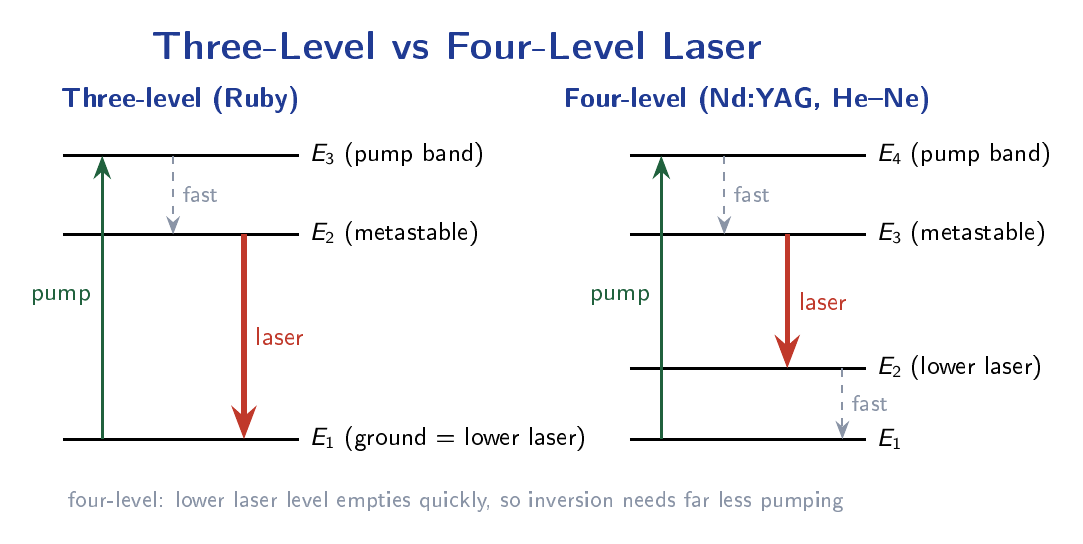
An optical resonator (high-reflectance mirror + output coupler) provides feedback to sustain and amplify the stimulated emission.
Properties of Laser Light
- Monochromaticity: extreme spectral purity, \(\Delta\lambda/\lambda \sim 10^{-8}\).
- Coherence: high spatial and temporal coherence.
- Directionality: divergence \(\theta \sim \lambda/D\).
- High intensity/brightness.
Specific Laser Types
Ruby Laser
Active medium: Cr³⁺-doped Al₂O₃. Pump: xenon flash lamp. Wavelength: 694.3 nm (red). Pulsed 3-level operation. Efficiency ~1%. Applications: holography, ranging, tattoo removal.
He–Ne Laser
Active medium: He–Ne gas (10:1) at low pressure. Pump: DC discharge. Principal wavelength: 632.8 nm (red). Continuous wave, 4-level operation. Applications: interferometry, alignment, barcode readers.
Semiconductor (Diode) Laser
Stimulated emission across the band gap in a heavily doped p–n junction. Wavelength: \(\lambda = hc/E_g\) (e.g., GaAs at ~840 nm, InGaAsP at 1.55 μm). Electrically pumped, compact, efficiency >50%. Applications: optical communication, DVD/Blu-ray, LiDAR.
Holography
Recording intensity: \(I(\vec{r}) = |E_R + E_O|^2 = |E_R|^2 + |E_O|^2 + 2\,\text{Re}(E_R^* E_O)\). The cross term carries the object phase. Reconstruction with \(E_R\) produces the term \(\propto E_O\). Applications: security holograms, holographic data storage, head-up displays, vibration analysis.
- Derive the relations among Einstein's \(A\) and \(B\) coefficients.
- Explain population inversion and pumping mechanisms.
- Describe the construction and working of the Ruby, He–Ne, or semiconductor laser.
- List four properties of laser light with engineering examples.
7. Fiber Optics
Basic Principle
An optical fiber is a glass or plastic cylinder guiding light by repeated total internal reflection (TIR) at the core–cladding interface. The core has refractive index \(n_1\), the cladding \(n_2 < n_1\).
Acceptance Angle and Numerical Aperture
TIR condition at the core–cladding interface: \(\sin\theta_c = n_2/n_1\). The acceptance (half-)cone angle in air:
\[\text{NA} = \sin\theta_a = \sqrt{n_1^2 - n_2^2} \approx n_1\sqrt{2\Delta}, \qquad \Delta = \frac{n_1 - n_2}{n_1}.\]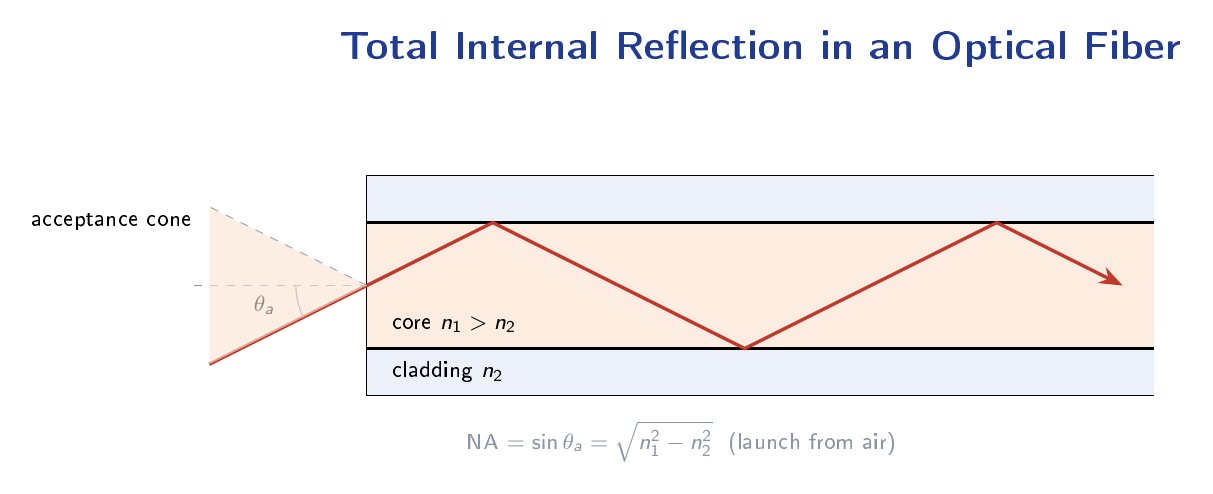
Classification of Optical Fibers
| Type | Refractive index profile | Use |
|---|---|---|
| Step-index single-mode (SMF) | Step, \(V < 2.405\) | Long-haul telecom |
| Step-index multi-mode (MMF) | Step, \(V > 2.405\) | Short links, sensors |
| Graded-index multi-mode | Parabolic profile | Medium distance, low dispersion |
The V-number \(V = (2\pi a/\lambda)\,\text{NA}\) determines how many modes propagate. Single-mode operation requires \(V < 2.405\).
Attenuation and Dispersion
Attenuation: \(\alpha = \frac{10}{L}\log_{10}(P_{\text{in}}/P_{\text{out}})\) [dB/km]. Typical silica fiber: ~0.2 dB/km at 1.55 μm. Sources of loss: absorption (OH ions, IR lattice), Rayleigh scattering (\(\propto 1/\lambda^4\)), and bending losses. Dispersion (modal, material, waveguide) broadens pulses and limits data rate.
- Derive expressions for acceptance angle and numerical aperture.
- Classify optical fibers based on RI profile and mode count.
- Discuss losses and dispersion in optical fibers.
- Explain the block diagram of an optical-fiber communication system.
8. Origins of Quantum Mechanics
Failure of Classical Physics
By 1900, several experimental results could not be explained by classical theory: the blackbody radiation spectrum (UV catastrophe), photoelectric effect, Compton scattering, atomic emission line spectra, and the specific heats of solids at low temperature. These resolutions gave birth to quantum mechanics.
Planck's Radiation Law (1900)
Energy of a harmonic oscillator is quantized: \(E_n = nh\nu\). Planck's radiation law:
\[u(\nu, T)\,d\nu = \frac{8\pi h\nu^3}{c^3}\frac{1}{e^{h\nu/k_BT} - 1}\,d\nu.\]Low-frequency limit recovers the Rayleigh–Jeans law; high-frequency limit gives Wien's law. The Stefan–Boltzmann result \(E = \sigma T^4\) with \(\sigma = 5.67 \times 10^{-8}\ \text{W m}^{-2} \text{K}^{-4}\) follows by integration.
Photoelectric Effect (Einstein, 1905)
Einstein's equation:
\[h\nu = \phi + \tfrac{1}{2}mv_{\max}^2,\] where \(\phi\) is the work function, threshold frequency \(\nu_0 = \phi/h\), and stopping potential \(eV_s = h\nu - \phi\). Photocurrent is proportional to intensity (one electron per photon).Compton Scattering (1923)
An X-ray photon of wavelength \(\lambda\) scattered through angle \(\theta\) by a free electron shifts to
\[\Delta\lambda = \lambda' - \lambda = \frac{h}{m_e c}(1 - \cos\theta), \qquad \frac{h}{m_e c} = 2.43 \times 10^{-12}\ \text{m.}\]This establishes the photon as a relativistic particle with energy \(h\nu\) and momentum \(h\nu/c\).
de Broglie Hypothesis (1924)
Every particle has an associated matter wave:
\[\lambda = \frac{h}{p} = \frac{h}{mv}.\]For an electron accelerated through potential \(V\): \(\lambda = 12.27/\sqrt{V}\ \text{Å}\). The Davisson–Germer experiment (1927) confirmed this via electron diffraction from a nickel crystal (\(\lambda_{\text{de Broglie}} \approx 1.67\ \text{Å}\), \(\lambda_{\text{exp}} \approx 1.65\ \text{Å}\) from Bragg's law on Ni (110) planes).
Heisenberg Uncertainty Principle
For conjugate variables:
\[\Delta x\,\Delta p \ge \frac{\hbar}{2}, \qquad \Delta E\,\Delta t \ge \frac{\hbar}{2}.\]Wave Function — Born Interpretation
A particle is described by a complex wave function \(\psi(\vec{r}, t)\) such that \(|\psi(\vec{r}, t)|^2\,dV\) is the probability of finding the particle in volume \(dV\). Normalization: \(\int|\psi|^2\,dV = 1\). The wave function must be single-valued, finite, continuous, with continuous first derivative wherever the potential is finite.
- Derive Planck's radiation law and discuss its classical limits.
- Explain Einstein's interpretation of the photoelectric effect.
- Derive the de Broglie wavelength of an electron accelerated through potential \(V\).
- Derive the time-independent Schrödinger equation by separation of variables.
9. Schrödinger Equation
Time-Dependent Schrödinger Equation
For a non-relativistic particle of mass \(m\) in potential \(V(\vec{r}, t)\):
\[i\hbar\frac{\partial\psi}{\partial t} = -\frac{\hbar^2}{2m}\nabla^2\psi + V(\vec{r}, t)\psi.\]For a free particle (\(V = 0\)), the plane wave \(\psi = e^{i(\vec{k}\cdot\vec{r} - \omega t)}\) requires \(\hbar\omega = \hbar^2 k^2/2m\), recovering the de Broglie relation.
Time-Independent Schrödinger Equation (TISE)
If \(V = V(\vec{r})\), writing \(\psi = u(\vec{r})e^{-iEt/\hbar}\) leads to the eigenvalue equation:
\[-\frac{\hbar^2}{2m}\nabla^2 u + Vu = Eu.\]For a stationary state, \(|\psi|^2\) is independent of time.
Probability Current
\(\vec{J} = \frac{\hbar}{2mi}\left[\psi^*\nabla\psi - \psi\nabla\psi^*\right]\) satisfies the continuity equation \(\partial|\psi|^2/\partial t + \nabla\cdot\vec{J} = 0\). Probability is conserved. This describes tunneling currents in scanning tunneling microscopes.
Postulates of Quantum Mechanics
- Physical state described by \(\psi\), a vector in Hilbert space.
- Every observable is represented by a Hermitian operator.
- The only possible measurement results are eigenvalues of that operator.
- Probability of obtaining eigenvalue \(a_i\) is \(|\langle\phi_i|\psi\rangle|^2\).
- After measurement of \(a_i\), \(\psi\) collapses to \(\phi_i\).
- Time evolution between measurements governed by the Schrödinger equation.
- Derive Planck's radiation law and its classical limits.
- Explain the photoelectric effect — Einstein's interpretation.
- Derive the de Broglie wavelength; describe the Davisson–Germer experiment.
- Derive the TISE by separation of variables from the TDSE.
10. Particle in a Box
One-Dimensional Infinite Well
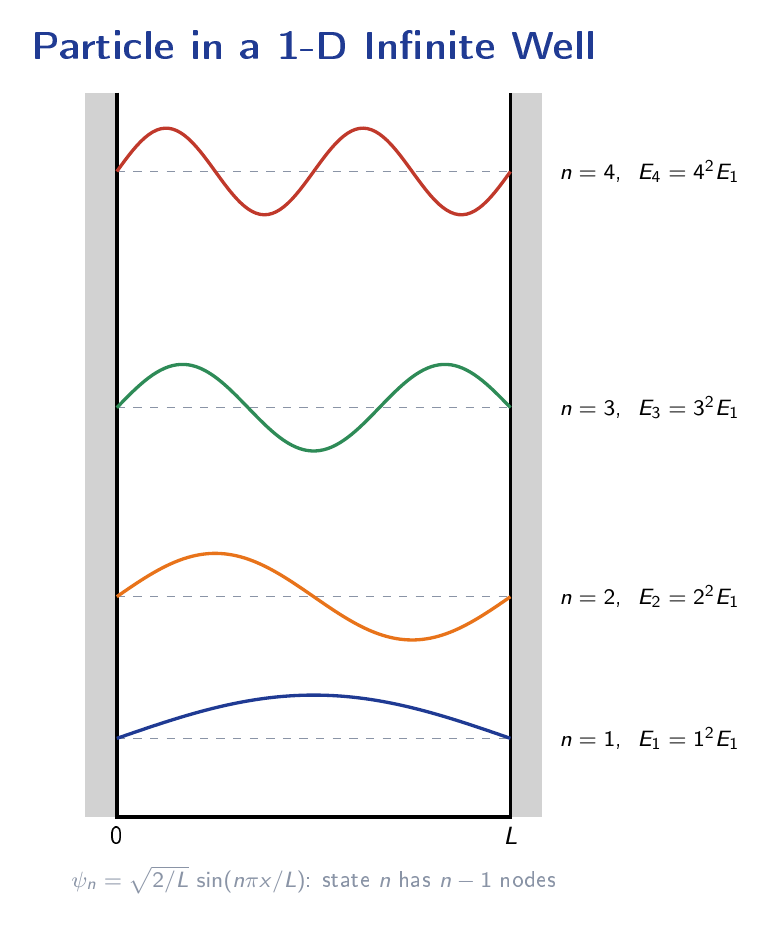
Potential: \(V(x) = 0\) for \(0 < x < L\), \(V = \infty\) elsewhere. Inside the box TISE gives \(u'' + k^2 u = 0\) with \(k = \sqrt{2mE}/\hbar\). Boundary conditions \(u(0) = u(L) = 0\) quantize \(k\) to \(k_n = n\pi/L\):
\[u_n(x) = \sqrt{\frac{2}{L}}\sin\!\left(\frac{n\pi x}{L}\right), \qquad E_n = \frac{n^2\pi^2\hbar^2}{2mL^2}, \quad n = 1, 2, 3, \ldots\]Key features: energies scale as \(n^2\); there is a non-zero zero-point energy \(E_1\); nodes increase with \(n\); spacing widens as \(L\) shrinks — the basis of quantum confinement.
Three-Dimensional Infinite Box
Inside a cube of side \(L\):
\[E_{n_x n_y n_z} = \frac{\pi^2\hbar^2}{2mL^2}(n_x^2 + n_y^2 + n_z^2).\]Different triples \((n_x, n_y, n_z)\) with the same sum of squares are degenerate.
- Solve the 1-D infinite well and obtain \(E_n\) and \(\psi_n\).
- Discuss zero-point energy and degeneracy in a 3-D box.
- Determine the most probable position of a particle in the \(n = 2\) state.
11. Free Electron Theory and Band Theory
Classical (Drude) Free Electron Theory
Valence electrons are treated as a classical ideal gas colliding with positive ions (relaxation time \(\tau\)). Electrical conductivity: \(\sigma = ne^2\tau/m\). Wiedemann–Franz law: \(\kappa/\sigma = LT\) with \(L \approx 2.45 \times 10^{-8}\ \text{W}\Omega\,\text{K}^{-2}\). The model fails to predict the correct electronic specific heat and has no explanation for insulators.
Sommerfeld Quantum Free-Electron Theory
Electrons are non-interacting fermions filling states up to the Fermi energy \(E_F\):
\[g(E) = \frac{1}{2\pi^2}\left(\frac{2m}{\hbar^2}\right)^{3/2}E^{1/2}, \qquad E_F = \frac{\hbar^2}{2m}(3\pi^2 n)^{2/3}.\]At \(T > 0\), electrons obey the Fermi–Dirac distribution:
\[f(E) = \frac{1}{e^{(E-\mu)/k_BT} + 1}.\]This gives the correct \(T\)-linear electronic specific heat \(C_v^{\text{el}} = \frac{\pi^2}{2}nk_B(T/T_F)\) and recovers the Wiedemann–Franz law.
Bloch's Theorem and Band Formation
A periodic potential \(V(\vec{r}) = V(\vec{r} + \vec{R})\) leads to Bloch eigenfunctions:
\[\psi_{\vec{k}}(\vec{r}) = e^{i\vec{k}\cdot\vec{r}}u_{\vec{k}}(\vec{r}), \qquad u_{\vec{k}}(\vec{r}) = u_{\vec{k}}(\vec{r} + \vec{R}).\]Allowed energies form continuous bands separated by forbidden gaps.
Kronig–Penney Model
A 1-D periodic square-well potential (barrier strength \(P\)) gives the condition
\[\cos(ka) = \cos(\alpha a) + P\frac{\sin(\alpha a)}{\alpha a}, \qquad \alpha = \frac{\sqrt{2mE}}{\hbar}.\]Forbidden gaps appear at Brillouin-zone boundaries \(k = n\pi/a\). As \(P \to 0\) the free-electron parabola is recovered; as \(P \to \infty\) discrete atomic levels emerge.
Effective Mass
The curvature of the dispersion relation \(E(k)\) defines the effective mass:
\[\frac{1}{m^*} = \frac{1}{\hbar^2}\frac{d^2E}{dk^2}.\]Near band minima \(m^* > 0\) (electron-like); near band maxima \(m^* < 0\) leading to hole behavior. The effective mass controls carrier mobility and density of states.
Classification by Band Filling
Conductors have overlapping valence and conduction bands. Semiconductors have a small gap (~1 eV); insulators have a large gap (>5 eV).
- Compare classical, Sommerfeld, and band theories of metals.
- Derive the Fermi energy of a 3-D free-electron gas.
- State and discuss Bloch's theorem.
- Discuss the Kronig–Penney model qualitatively.
- Define effective mass and explain its physical significance.
12. Semiconductor Physics
Intrinsic Semiconductors
In a pure semiconductor, thermal generation across the band gap governs carrier concentration:
\[n_i = \sqrt{N_c N_v}\,e^{-E_g/2k_BT},\] where \(N_c\) and \(N_v\) are the effective densities of states in the conduction and valence bands. The Fermi level lies near the mid-gap: \[E_F = \frac{E_c + E_v}{2} + \frac{k_BT}{2}\ln\frac{N_v}{N_c}.\]Typical band gaps: Si (1.12 eV), Ge (0.67 eV), GaAs (1.43 eV).
Extrinsic Semiconductors — Doping
n-type: pentavalent donors (P, As, Sb) donate electrons; donor level \(E_d\) just below \(E_c\). For fully ionized donors: \(n \approx N_D\), \(p = n_i^2/N_D\). p-type: trivalent acceptors (B, Al) create holes; acceptor level \(E_a\) just above \(E_v\). Law of mass action: \(np = n_i^2\).
Carrier Transport: Drift and Diffusion
Drift: \(J_n^{\text{drift}} = en\mu_n E\), \(J_p^{\text{drift}} = ep\mu_p E\). Diffusion: \(J_n^{\text{diff}} = eD_n(dn/dx)\), \(J_p^{\text{diff}} = -eD_p(dp/dx)\). Einstein relation: \(D/\mu = k_BT/e\).
Hall Effect
A current-carrying conductor in a transverse magnetic field develops a transverse Hall voltage \(V_H = IB/(net)\). Hall coefficient \(R_H = 1/(nq)\); its sign identifies the carrier type and its magnitude gives carrier density.
p–n Junction
Diffusion of carriers creates a depletion region with a built-in potential:
\[V_{\text{bi}} = \frac{k_BT}{e}\ln\!\left(\frac{N_A N_D}{n_i^2}\right).\]Shockley ideal diode equation: \(I = I_S(e^{eV/k_BT} - 1)\). Reverse breakdown: Zener (tunneling, narrow depletion layer, \(|V_z| \lesssim 5\) V, negative temperature coefficient) and avalanche (impact ionization, positive \(T\)-coefficient).
- Derive expressions for \(n_i\) and \(E_F\) in intrinsic semiconductors.
- Derive the law of mass action and the Einstein relation.
- Describe the Hall effect and its applications.
- Derive the diode equation; explain Zener and avalanche breakdown.
13. Diodes and Transistors
Diode Types
Rectifier diodes (power conversion), Zener diodes (voltage regulation), LEDs (electroluminescence), photodiodes (optical detection), solar cells (photovoltaics), Schottky diodes (fast switching), tunnel diodes (negative resistance), and varactors (voltage-controlled capacitance).
Rectifier Circuits
Half-wave rectifier: \(V_{\text{dc}} = V_m/\pi\), efficiency \(\eta = 40.6\%\), ripple \(\gamma = 1.21\). Full-wave bridge rectifier: \(V_{\text{dc}} = 2V_m/\pi\), \(\eta = 81.2\%\), \(\gamma = 0.48\). LC or capacitor filters reduce ripple.
Bipolar Junction Transistor (BJT)
Two back-to-back p–n junctions (NPN or PNP). In active mode (EB forward, CB reverse): \(I_E = I_B + I_C\), \(\alpha = I_C/I_E < 1\), \(\beta = I_C/I_B = \alpha/(1-\alpha) \gg 1\).
| Parameter | CB | CE | CC |
|---|---|---|---|
| Input impedance | Low | Medium | High |
| Output impedance | High | Medium | Low |
| Voltage gain | High | High | <1 |
| Current gain | \(\alpha < 1\) | \(\beta\) high | High |
| Phase shift | 0° | 180° | 0° |
| Use | RF amp | General amp | Buffer/follower |
Field-Effect Transistors (FETs)
JFET: current controlled by reverse-biased gate; very high input impedance (>10⁹ Ω). MOSFET: oxide-isolated gate; enhancement or depletion mode. Saturation drain current (enhancement MOSFET):
\[I_D = \frac{1}{2}\mu_n C_{ox}\frac{W}{L}(V_{GS} - V_{TH})^2.\]CMOS (complementary MOSFET) is the foundation of modern digital electronics.
- Derive the efficiency and ripple factor of half- and full-wave rectifiers.
- Compare CE, CB, CC configurations of a BJT.
- Derive the drain-current expression for a saturated MOSFET.
- Explain LED operation and its difference from a normal diode.
14. Superconductivity
Critical Parameters
The superconducting state is bounded by three quantities: critical temperature \(T_c\), critical field \(H_c(T) = H_0[1-(T/T_c)^2]\), and critical current density \(J_c\). The Meissner effect (\(\vec{B} = 0\) inside the bulk below \(T_c\)) distinguishes a superconductor from a perfect conductor.
Type-I vs Type-II Superconductors
| Type-I | Type-II | |
|---|---|---|
| Critical field(s) | Single \(H_c\) | \(H_{c1}\) and \(H_{c2}\) |
| Mixed state | None | Flux vortices between \(H_{c1}\) and \(H_{c2}\) |
| Examples | Hg, Pb, Sn | Nb-Ti, Nb₃Sn, YBCO (HTS, \(T_c \sim 92\) K) |
| Use | Lab curiosities | MRI, accelerators, motors |
BCS Theory
Bardeen–Cooper–Schrieffer (1957): phonon-mediated attraction causes pairs of electrons with opposite momenta and spins (Cooper pairs) to condense into a coherent macroscopic quantum state below \(T_c\). An energy gap \(2\Delta\) forms; excitation requires breaking pairs, hence zero resistance. BCS prediction: \(2\Delta(0) \approx 3.52\,k_BT_c\).
London Equations and Penetration Depth
\[\nabla^2\vec{B} = \frac{\vec{B}}{\lambda_L^2}, \qquad \lambda_L = \sqrt{\frac{m}{\mu_0 n_s e^2}}.\]\(\lambda_L\) is the London penetration depth, the skin depth for magnetic flux.
Josephson Effects
DC Josephson: Cooper-pair tunneling through a thin insulating barrier gives \(I = I_c\sin\phi\) at zero voltage. AC Josephson: a constant voltage \(V\) produces oscillating current at \(\omega = 2eV/\hbar\). Applications: SQUIDs (world's most sensitive magnetometers), voltage standards, superconducting qubits.
- State the properties of superconductors. Distinguish Type-I and Type-II.
- Explain the Meissner effect and its significance.
- Briefly describe BCS theory and the energy gap.
- Describe DC and AC Josephson effects and give one application.
15. Nanotechnology
At the nanoscale: quantum confinement modifies electronic properties, the surface-to-volume ratio is enormously enhanced, mean-free-path effects govern transport, and optical resonances (plasmons) appear at characteristic sizes.
Dimensional Classification of Nanostructures
| Dimensionality | Confined directions | Examples |
|---|---|---|
| 3-D bulk | 0 | Bulk metal, semiconductor |
| 2-D thin films / quantum wells | 1 | GaAs/AlGaAs heterostructure |
| 1-D nanowires / quantum wires | 2 | Si nanowire, CNT, ZnO |
| 0-D quantum dots | 3 | CdSe, PbS QD, colloidal QD |
Synthesis Methods
Top-down (start large, carve to nanoscale): lithography (photo, e-beam, EUV), etching (RIE, wet), ball milling. Bottom-up (atom-by-atom assembly): CVD/PVD, MBE, ALD, sol-gel, self-assembly, colloidal chemistry.
Characterization Techniques
| Tool | Information |
|---|---|
| SEM, TEM | Morphology, crystallography |
| AFM, STM | Surface topography, atomic imaging |
| XRD | Crystal structure, phase |
| Raman, FTIR | Vibrational fingerprint, bonds |
| UV-vis, PL | Optical band gap, excitons |
| XPS, EDX | Elemental and chemical state |
| BET | Specific surface area |
Special Nanomaterials
Carbon nanotubes (CNTs): rolled graphene, ballistic transport, Young's modulus ~TPa. Graphene: monolayer carbon, massless Dirac fermions, extremely high conductivity. Quantum dots: size-tunable photoluminescence. Nano-Ag, Nano-Au: plasmonic absorption, sensing, antibacterial. TiO₂, ZnO nanoparticles: photocatalysis, UV protection.
- Define nanomaterials and classify them by dimensionality.
- Compare top-down and bottom-up approaches with examples.
- Discuss synthesis and applications of carbon nanotubes.
- Mention three applications of nanotechnology in energy.
16. Electromagnetism
Vector Calculus Toolkit
Gradient \(\nabla\phi\) (steepest rise), divergence \(\nabla\cdot\vec{F}\) (source density), curl \(\nabla\times\vec{F}\) (rotation), Laplacian \(\nabla^2\phi = \nabla\cdot(\nabla\phi)\). Gauss's theorem: \(\oint_S \vec{F}\cdot d\vec{A} = \int_V (\nabla\cdot\vec{F})\,dV\). Stokes' theorem: \(\oint_C \vec{F}\cdot d\vec{\ell} = \int_S (\nabla\times\vec{F})\cdot d\vec{A}\).
Electrostatics
Coulomb force: \(\vec{F}_{12} = \frac{1}{4\pi\varepsilon_0}\frac{q_1 q_2}{r_{12}^2}\hat{r}_{12}\). Gauss's law: \(\oint\vec{E}\cdot d\vec{A} = Q_{\text{enc}}/\varepsilon_0\), equivalently \(\nabla\cdot\vec{E} = \rho/\varepsilon_0\). Potential: \(\vec{E} = -\nabla V\). Energy stored in a field: \(U = \frac{\varepsilon_0}{2}\int E^2\,dV\). Parallel-plate capacitance: \(C = \varepsilon_0\varepsilon_r A/d\).
Magnetostatics
Biot–Savart law: \(d\vec{B} = \frac{\mu_0}{4\pi}\frac{I\,d\vec{\ell}\times\hat{r}}{r^2}\). Ampère's law: \(\oint\vec{B}\cdot d\vec{\ell} = \mu_0 I_{\text{enc}}\), \(\nabla\times\vec{B} = \mu_0\vec{J}\). Lorentz force: \(\vec{F} = q(\vec{E} + \vec{v}\times\vec{B})\).
Electromagnetic Induction
Faraday's law: \(\varepsilon = -d\Phi_B/dt\), \(\nabla\times\vec{E} = -\partial\vec{B}/\partial t\). Lenz's law: induced current opposes change. Self-inductance: \(\varepsilon = -L\,dI/dt\), energy \(U = \tfrac{1}{2}LI^2\). Mutual inductance: \(M = \Phi_{21}/I_1\) — basis of transformers.
Series LCR Circuit and Resonance
For a series LCR driven at angular frequency \(\omega\):
\[Z = \sqrt{R^2 + (X_L - X_C)^2}, \qquad \tan\phi = \frac{X_L - X_C}{R}.\]Quality factor and bandwidth: \(Q = \omega_0 L/R = (1/R)\sqrt{L/C}\), \(\Delta\omega = \omega_0/Q\). Engineering uses: radio/TV tuning, band-pass filters, power-factor correction, MRI coils, wireless charging.
- State and prove Gauss's law in electrostatics.
- Derive the magnetic field of a long straight current using Ampère's law.
- Define self- and mutual-inductance with examples.
- Express electric and magnetic energy density in terms of the fields.
17. Maxwell's Equations and EM Waves
Displacement Current
Ampère's law fails for a charging capacitor. Maxwell introduced the displacement current density \(\vec{J}_d = \varepsilon_0\,\partial\vec{E}/\partial t\), modifying Ampère's law to
\[\nabla\times\vec{B} = \mu_0\!\left(\vec{J} + \varepsilon_0\frac{\partial\vec{E}}{\partial t}\right).\]Maxwell's Equations in Vacuum
\[\nabla\cdot\vec{E} = \rho/\varepsilon_0, \qquad \nabla\cdot\vec{B} = 0,\] \[\nabla\times\vec{E} = -\frac{\partial\vec{B}}{\partial t}, \qquad \nabla\times\vec{B} = \mu_0\vec{J} + \mu_0\varepsilon_0\frac{\partial\vec{E}}{\partial t}.\]EM Wave Equation
In free space (\(\rho = 0\), \(\vec{J} = 0\)), taking the curl of Faraday's law:
\[\nabla^2\vec{E} = \mu_0\varepsilon_0\frac{\partial^2\vec{E}}{\partial t^2}, \qquad c = \frac{1}{\sqrt{\mu_0\varepsilon_0}} \approx 3 \times 10^8\ \text{m s}^{-1}.\]The same equation holds for \(\vec{B}\). EM waves are transverse (\(\vec{E} \perp \vec{B} \perp \hat{k}\)), in phase, with \(E = cB\).
Energy and Poynting Vector
Energy density: \(u = \varepsilon_0 E^2\). Poynting vector: \(\vec{S} = (1/\mu_0)\vec{E}\times\vec{B}\). Time-averaged intensity: \(\langle S\rangle = \frac{1}{2}c\varepsilon_0 E_0^2\).
Electromagnetic Spectrum
| Band | Wavelength | Engineering Use |
|---|---|---|
| Radio | >1 m | Broadcasting, mobile communication |
| Microwave | 1 mm – 1 m | Radar, microwave heating |
| Infrared | 700 nm – 1 mm | Remote sensing, thermal imaging |
| Visible | 400 – 700 nm | Vision, photonics |
| Ultraviolet | 10 – 400 nm | Sterilization, lithography |
| X-ray | 0.01 – 10 nm | Medical imaging, crystallography |
| Gamma | <0.01 nm | Nuclear medicine |
- State Maxwell's equations and explain the physical meaning of each.
- Derive the EM wave equation in vacuum from Maxwell's equations.
- Define the Poynting vector and derive average intensity of a plane wave.
- Discuss the EM spectrum and engineering applications of any three bands.
18. Special Theory of Relativity
Postulates
- The laws of physics are identical in every inertial frame.
- The speed of light in vacuum, \(c\), is the same in all inertial frames, independent of source motion.
Lorentz Transformations
For frame \(S'\) moving at velocity \(v\) along \(x\):
\[x' = \gamma(x - vt), \qquad t' = \gamma\!\left(t - \frac{vx}{c^2}\right), \qquad \gamma = \frac{1}{\sqrt{1 - v^2/c^2}}.\]Maxwell's equations are invariant under Lorentz transformations (unlike Galilean ones).
Time Dilation and Length Contraction
Moving clocks run slow: \(\Delta t = \gamma\,\Delta t_0\). Moving lengths contract: \(L = L_0/\gamma\). Example: muons at \(0.99c\) (\(\gamma \approx 7.09\)) survive to reach detectors on Earth — confirming time dilation.
Relativistic Velocity Addition
\[u = \frac{u' + v}{1 + u'v/c^2}.\]Two photons approaching each other still give a relative speed \(c\), never \(2c\).
Relativistic Energy and Momentum
\[m = \gamma m_0, \qquad E = \gamma m_0 c^2 = m_0 c^2 + K, \qquad E^2 = (pc)^2 + (m_0 c^2)^2.\]Rest energy \(E_0 = m_0 c^2\). Kinetic energy \(K = (\gamma - 1)m_0 c^2\).
- State the postulates of SR and derive the Lorentz transformations.
- Derive expressions for time dilation and length contraction.
- Derive \(E = mc^2\) and discuss its physical meaning.
- Discuss three experimental verifications of SR.
19. Crystal Structure and X-Ray Diffraction
Crystalline vs Amorphous Solids
Crystalline solids have long-range periodic order, a sharp melting point, and are anisotropic (e.g., NaCl, metals). Amorphous solids have short-range order only, soften gradually, and are isotropic (e.g., glass, polymers). Most metals and ceramics are polycrystalline.
Fourteen Bravais Lattices and Seven Crystal Systems
| System | Relations | Bravais lattices |
|---|---|---|
| Cubic | \(a=b=c\), \(\alpha=\beta=\gamma=90°\) | P, I, F |
| Tetragonal | \(a=b\ne c\) | P, I |
| Orthorhombic | \(a\ne b\ne c\) | P, I, F, C |
| Hexagonal | \(a=b\ne c\), \(\gamma=120°\) | P |
| Rhombohedral | \(a=b=c\), \(\alpha=\beta=\gamma\) | P |
| Monoclinic | \(a\ne b\ne c\), \(\beta\ne 90°\) | P, C |
| Triclinic | All distinct | P |
Common Cubic Structures
| Property | SC | BCC | FCC | Diamond |
|---|---|---|---|---|
| Atoms/cell | 1 | 2 | 4 | 8 |
| Coordination number | 6 | 8 | 12 | 4 |
| Packing fraction | 0.52 | 0.68 | 0.74 | 0.34 |
| Examples | Po | Fe, Cr | Cu, Al, Ni | C, Si, Ge |
Miller Indices
To find the \((hkl)\) indices: (1) find intercepts on axes in units of lattice constants, (2) take reciprocals, (3) reduce to smallest integers. Interplanar spacing in cubic: \(d_{hkl} = a/\sqrt{h^2 + k^2 + l^2}\).
Bragg's Law of X-Ray Diffraction
XRD Methods
Laue method (white X-rays, single crystal, spot pattern — orientation determination). Powder (Debye-Scherrer) method (monochromatic X-rays, powder sample, rings — phase identification, lattice constant). Rotating-crystal method (3-D structure information).
Crystal Defects
Point defects (vacancies, interstitials — Schottky, Frenkel), line defects (edge and screw dislocations → plastic deformation), planar defects (grain boundaries, stacking faults), and volume defects (voids, precipitates). Defects often govern mechanical, electrical, and optical properties of real materials.
- Define lattice, basis, and unit cell. State the seven crystal systems.
- Derive the packing fraction of BCC and FCC structures.
- Define Miller indices and derive \(d_{hkl}\) for cubic crystals.
- State and derive Bragg's law; describe the Debye-Scherrer method.
- Classify and describe common defects in solids.
20. Acoustics and Ultrasonics
Sound and Frequency Ranges
Audible: 20 Hz – 20 kHz. Infrasonic: <20 Hz (earthquakes, large animals). Ultrasonic: >20 kHz (medical, NDT). Speed of sound: \(v = \sqrt{B/\rho}\) (fluids), \(v = \sqrt{E/\rho}\) (solids, longitudinal).
Architectural Acoustics
Reverberation time \(T_{60}\) is the time for the sound level to drop 60 dB. Sabine's formula:
\[T_{60} = \frac{0.161\,V}{A}, \qquad A = \sum_i S_i\alpha_i,\] where \(V\) is the room volume (m³) and \(\alpha_i\) is the absorption coefficient of the \(i\)-th surface. Optimum values: concert hall ~1.8 s; lecture hall ~0.6 s.Common acoustic defects and remedies: echo (use absorbers), excessive reverberation (acoustic panels), focusing from concave surfaces (use diffusers), dead spots (diffusers), outside noise (soundproofing).
Production of Ultrasonic Waves
Magnetostriction oscillator: ferromagnetic rod (Ni) elongates and contracts under alternating magnetic field; works up to ~100 kHz. Piezoelectric oscillator: quartz or PZT crystal in a tank circuit; high frequencies up to MHz, high power.
- Define reverberation time. Derive Sabine's formula.
- Discuss acoustic defects in halls and their remedies.
- Describe piezoelectric and magnetostriction ultrasonic generators.
- Discuss four engineering applications of ultrasonics.
21. Dielectrics and Magnetic Materials
Dielectric Materials
Polarization Mechanisms
- Electronic: distortion of electron cloud relative to nucleus.
- Ionic: relative displacement of positive and negative ions.
- Orientational (dipolar): alignment of permanent dipoles.
- Space-charge: at interfaces between media of different conductivity (Maxwell–Wagner).
Total: \(\alpha_{\text{tot}} = \alpha_e + \alpha_i + \alpha_o + \alpha_s\). As frequency increases, polarization mechanisms drop out successively.
Clausius–Mossotti relation:
\[\frac{\varepsilon_r - 1}{\varepsilon_r + 2} = \frac{N\alpha}{3\varepsilon_0}.\]Dielectric loss is quantified by the loss tangent \(\tan\delta = \varepsilon''/\varepsilon'\). Dielectric strength is the maximum field before breakdown.
Magnetic Materials
| Type | \(\chi_m\) | Examples |
|---|---|---|
| Diamagnetic | Small, <0 | Cu, Ag, Bi, water |
| Paramagnetic | Small, >0 | Al, Mn, Pt, O₂ |
| Ferromagnetic | Large, >0, nonlinear | Fe, Co, Ni |
| Antiferromagnetic | Small, >0 | MnO, NiO |
| Ferrimagnetic | Large, >0 | Fe₃O₄, ferrites |
\(\vec{B} = \mu_0(\vec{H} + \vec{M})\), \(\vec{M} = \chi_m\vec{H}\), \(\mu_r = 1 + \chi_m\).
Ferromagnetism and Weiss Domains
Below the Curie temperature \(T_C\), exchange interaction aligns spins into magnetic domains. Above \(T_C\), the Curie–Weiss law governs: \(\chi_m = C/(T - T_C)\). The hysteresis loop is characterized by retentivity \(B_r\) (residual flux density) and coercivity \(H_c\) (field needed to demagnetize); its area equals energy lost per cycle per unit volume.
Soft vs Hard Magnetic Materials
| Soft | Hard | |
|---|---|---|
| Coercivity \(H_c\) | Low | High |
| Hysteresis area | Small | Large |
| Examples | Si–Fe, ferrites | Alnico, NdFeB |
| Use | Transformer cores, inductors | Permanent magnets, motors |
- Discuss types of polarization and their frequency dependence.
- Derive the Clausius–Mossotti equation.
- Classify magnetic materials with examples.
- Explain hysteresis and define \(B_r\) and \(H_c\).
- Compare soft and hard magnetic materials; mention applications.
22. Modern Physics — Atom and Hydrogen Spectra
Hydrogen Atomic Spectrum
Empirical Rydberg formula: \(1/\lambda = R(1/n_1^2 - 1/n_2^2)\), \(R = 1.097 \times 10^7\ \text{m}^{-1}\). Spectral series: Lyman (\(n_1 = 1\), UV), Balmer (\(n_1 = 2\), visible), Paschen/Brackett/Pfund (IR).
Bohr Model
Postulates: (1) angular momentum is quantized \(L = n\hbar\); (2) radiation emitted or absorbed when transitioning between orbits \(h\nu = E_i - E_f\). For hydrogen-like atoms:
\[r_n = \frac{n^2 a_0}{Z}, \qquad E_n = -\frac{Z^2}{n^2} \times 13.6\ \text{eV}, \qquad a_0 = 0.529\ \text{Å}.\]Quantum Numbers and Pauli Exclusion Principle
The quantum-mechanical hydrogen atom is described by \(\psi_{nlm} = R_{nl}(r)Y_l^m(\theta,\phi)\) with: principal \(n = 1, 2, \ldots\); orbital \(\ell = 0, \ldots, n-1\) (s, p, d, f); magnetic \(m = -\ell, \ldots, +\ell\); spin \(s = \pm\tfrac{1}{2}\). The Pauli exclusion principle (no two fermions can share all four quantum numbers) determines the structure of the periodic table. Selection rules: \(\Delta\ell = \pm 1\), \(\Delta m = 0, \pm 1\), \(\Delta s = 0\).
- Derive expressions for Bohr radius and energy levels.
- Calculate the wavelength of the H-α (Balmer-α) line.
- State Pauli's exclusion principle and discuss its implications.
23. Nuclear Physics
Nuclear Properties
Nucleus contains \(Z\) protons and \(N\) neutrons (\(A = Z + N\)). Nuclear radius: \(R = R_0 A^{1/3}\), \(R_0 \approx 1.2\ \text{fm}\). Nuclear density is nearly constant, ~\(2.3 \times 10^{17}\ \text{kg m}^{-3}\).
Binding Energy and the Semi-Empirical Mass Formula
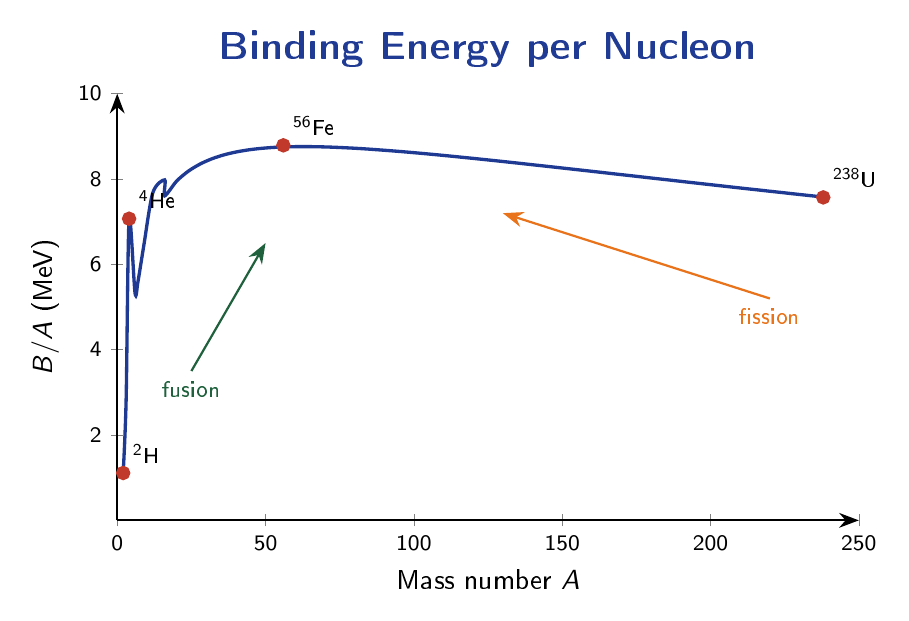
Mass defect: \(\Delta m = Zm_p + Nm_n - M_{\text{nucleus}}\). Binding energy: \(B = (\Delta m)c^2\). Binding energy per nucleon \(B/A\) peaks near \(A \approx 56\) (iron). Weizsäcker's formula:
\[B = a_v A - a_s A^{2/3} - a_c\frac{Z(Z-1)}{A^{1/3}} - a_a\frac{(A-2Z)^2}{A} + \delta.\]Terms: volume, surface, Coulomb, asymmetry, pairing.
Radioactive Decay
\[N(t) = N_0 e^{-\lambda t}, \qquad T_{1/2} = \frac{\ln 2}{\lambda}, \qquad \bar{\tau} = \frac{1}{\lambda}.\]Activity \(A(t) = \lambda N(t)\), measured in becquerels (1 Bq = 1 decay/s). Decay modes: alpha (emission of \({}^4_2\text{He}\)), beta-minus (\(n \to p + e^- + \bar{\nu}_e\)), beta-plus, electron capture, and gamma (nuclear de-excitation).
Nuclear Fission and Fusion
Fission: \(n + {}^{235}\text{U} \to {}^{141}\text{Ba} + {}^{92}\text{Kr} + 3n + 200\ \text{MeV}\). Fusion: \({}^{2}\text{H} + {}^{3}\text{H} \to {}^{4}\text{He} + n + 17.6\ \text{MeV}\). Fusion powers stars and is pursued in ITER and NIF.
- Derive \(R = R_0 A^{1/3}\) and estimate nuclear density.
- State the semi-empirical mass formula and explain each term.
- Derive the law of radioactive decay; define half-life and mean life.
- Distinguish nuclear fission and fusion with energy calculations.
24. Renewable Energy Physics
Solar Photovoltaics
A p–n junction absorbs photons with \(h\nu > E_g\), generating electron–hole pairs separated by the built-in field. The equivalent circuit gives the solar cell I-V equation:
\[I = I_L - I_0\!\left[\exp\!\left(\frac{e(V+IR_s)}{nk_BT}\right)-1\right] - \frac{V+IR_s}{R_{\text{sh}}}.\]Key parameters: short-circuit current \(I_{sc}\), open-circuit voltage \(V_{oc}\), fill factor \(\text{FF} = V_{mp}I_{mp}/(V_{oc}I_{sc})\), efficiency \(\eta = V_{oc}I_{sc}\cdot\text{FF}/P_{\text{in}}\). The Shockley–Queisser limit for a single junction is ~33%.
| Technology | Lab Efficiency | Comment |
|---|---|---|
| Mono-crystalline Si | ~26% | Most installed globally |
| Multi-crystalline Si | ~23% | Lower cost |
| Thin-film (a-Si) | 13% | Flexible substrates |
| CIGS, CdTe | 22–23% | Cost-effective thin films |
| GaAs single-junction | 29.1% | High efficiency |
| Perovskite/Si tandem | >33% | Emerging technology |
| Multi-junction III-V | >47% | Space and concentrators |
Wind Energy
Power available in wind crossing area \(A\) at speed \(v\): \(P = \tfrac{1}{2}\rho Av^3\). The Betz limit: only \(C_{P,\max} = 16/27 \approx 59.3\%\) of wind power can be extracted by an ideal turbine. Practical wind turbines achieve \(C_P \sim 0.4\text{–}0.5\).
Hydro, Tidal, and Wave Energy
Hydropower: \(P = \rho g Q H \eta\) (world's largest renewable contribution). Tidal range potential: \(E = \tfrac{1}{2}\rho Agh^2\). Wave energy flux proportional to \(H^2 T\).
Geothermal, Biomass, and Hydrogen
Geothermal uses Earth's internal heat (capacity factor often >90%). Biomass is carbon-neutral if sustainably sourced. Green hydrogen, produced by electrolysis from surplus renewables, is a promising energy carrier for fuel cells.
Energy Storage Technologies
Batteries (Li-ion, flow, Na-ion), pumped hydro (95% of global grid storage), compressed air (CAES), flywheels, supercapacitors, thermal storage (molten salts in CSP), and hydrogen as a chemical carrier. Key engineering challenges: round-trip efficiency, lifecycle, and cost.
- Derive the V–I equation of a solar cell.
- Define and explain fill factor and efficiency of a solar cell.
- Derive the Betz limit for a wind turbine.
- Discuss any two energy-storage technologies and their physics.
25. Engineering Applications of Physics
Engineering physics bridges fundamental principles and practical hardware across every engineering domain.
MEMS and NEMS
Micro/Nano-Electro-Mechanical Systems are miniaturized machines fabricated by IC-compatible processes, exploiting SHM, beam mechanics, and capacitive/piezoelectric transduction. Applications: accelerometers (airbag deployment, gaming), gyroscopes (drones), pressure sensors, microphones, lab-on-a-chip biosensors, RF MEMS filters and switches.
Display Technologies
- LCD: birefringence and polarizers, requires backlight.
- LED/mini-LED: direct emission from semiconductor junctions.
- OLED: organic semiconductors, self-emissive, flexible.
- Micro-LED: inorganic LED arrays <50 μm.
- Quantum-dot LED (QLED): size-tunable color via quantum confinement.
Medical Imaging and Sensing
X-ray CT (absorption tomography), MRI (nuclear spin precession in \(\vec{B}\)), ultrasound (piezoelectric transduction), OCT (low-coherence interferometry), PET (positron annihilation), and hyperspectral imaging.
Communications and Computing
Optical fiber networks (EDFAs, DWDM), 5G mm-wave and MIMO antennas, quantum communication and QKD (BB84), photonic integrated circuits, spintronics (GMR/TMR in hard-disk read heads), and quantum computing (superconducting and trapped-ion qubits).
- Discuss MEMS technology and applications.
- Compare LCD, LED, and OLED display technologies.
- Briefly describe the physical principles of MRI.
- Explain spintronics and one of its applications.
Appendix A: Fundamental Physical Constants (CODATA)
| Quantity | Symbol | Value (SI) |
|---|---|---|
| Speed of light in vacuum | \(c\) | \(2.998 \times 10^8\ \text{m s}^{-1}\) |
| Planck constant | \(h\) | \(6.626 \times 10^{-34}\ \text{J s}\) |
| Reduced Planck constant | \(\hbar\) | \(1.055 \times 10^{-34}\ \text{J s}\) |
| Elementary charge | \(e\) | \(1.602 \times 10^{-19}\ \text{C}\) |
| Electron rest mass | \(m_e\) | \(9.109 \times 10^{-31}\ \text{kg}\) |
| Proton rest mass | \(m_p\) | \(1.673 \times 10^{-27}\ \text{kg}\) |
| Neutron rest mass | \(m_n\) | \(1.675 \times 10^{-27}\ \text{kg}\) |
| Boltzmann constant | \(k_B\) | \(1.381 \times 10^{-23}\ \text{J K}^{-1}\) |
| Avogadro number | \(N_A\) | \(6.022 \times 10^{23}\ \text{mol}^{-1}\) |
| Gas constant | \(R\) | \(8.314\ \text{J mol}^{-1}\ \text{K}^{-1}\) |
| Permittivity of free space | \(\varepsilon_0\) | \(8.854 \times 10^{-12}\ \text{F m}^{-1}\) |
| Permeability of free space | \(\mu_0\) | \(1.257 \times 10^{-6}\ \text{H m}^{-1}\) |
| Gravitational constant | \(G\) | \(6.674 \times 10^{-11}\ \text{m}^3\ \text{kg}^{-1}\ \text{s}^{-2}\) |
| Stefan–Boltzmann constant | \(\sigma\) | \(5.670 \times 10^{-8}\ \text{W m}^{-2}\ \text{K}^{-4}\) |
| Rydberg constant | \(R_\infty\) | \(1.097 \times 10^7\ \text{m}^{-1}\) |
| Bohr radius | \(a_0\) | \(5.292 \times 10^{-11}\ \text{m}\) |
| Bohr magneton | \(\mu_B\) | \(9.274 \times 10^{-24}\ \text{J T}^{-1}\) |
| Fine-structure constant | \(\alpha\) | \(1/137.036\) |
| Atomic mass unit | \(u\) | \(1.661 \times 10^{-27}\ \text{kg}\) |
| Compton wavelength | \(h/m_e c\) | \(2.426 \times 10^{-12}\ \text{m}\) |
Useful Conversion Factors
| Quantity | Value |
|---|---|
| 1 electronvolt | \(1.602 \times 10^{-19}\ \text{J}\) |
| 1 calorie (thermochemical) | 4.184 J |
| 1 u (in energy, \(\times c^2\)) | 931.494 MeV |
| 1 Ångström | \(10^{-10}\ \text{m}\) |
| 1 femtometre (fermi) | \(10^{-15}\ \text{m}\) |
| 1 barn | \(10^{-28}\ \text{m}^2\) |
| 1 atmosphere | \(1.013 \times 10^5\ \text{Pa}\) |
| 1 horsepower | 745.7 W |
| \(k_BT\) at 300 K | 25.85 meV |
| \(\hbar c\) | 197.3 MeV fm |
Appendix B: Formula Cheat Sheet
Mechanics and Oscillations
- SHM: \(x(t) = A\cos(\omega t + \phi)\), \(\omega = \sqrt{k/m}\)
- Energy: \(E = \tfrac{1}{2}kA^2 = \tfrac{1}{2}m\omega^2 A^2\)
- Damped: \(\ddot{x} + 2\gamma\dot{x} + \omega_0^2 x = 0\); quality factor \(Q = \omega_0/2\gamma\)
- Wave equation: \(\partial^2 y/\partial t^2 = v^2\,\partial^2 y/\partial x^2\)
- Group / phase velocity: \(v_g = d\omega/dk\), \(v_p = \omega/k\)
Optics
- YDSE fringe width: \(\beta = \lambda D/d\)
- Thin film (constructive, reflected): \(2\mu t\cos r = (n + \tfrac{1}{2})\lambda\)
- Newton's rings (dark, reflected): \(r_n^2 = n\lambda R\)
- Single-slit minima: \(a\sin\theta = m\lambda\)
- Grating principal maxima: \((a + b)\sin\theta = m\lambda\)
- Rayleigh criterion: \(\sin\theta_{\min} = 1.22\lambda/D\)
- Brewster: \(\tan\theta_p = n_2/n_1\); Malus: \(I = I_0\cos^2\theta\)
- Fiber NA: \(\text{NA} = \sqrt{n_1^2 - n_2^2} = n_0\sin\theta_a\)
- V-number: \(V = (2\pi a/\lambda)\,\text{NA}\); single mode if \(V < 2.405\)
Quantum and Atomic
- de Broglie: \(\lambda = h/p\)
- Uncertainty: \(\Delta x\,\Delta p \ge \hbar/2\)
- TISE: \(-(\hbar^2/2m)\nabla^2\psi + V\psi = E\psi\)
- Particle in 1-D box: \(E_n = n^2\pi^2\hbar^2/(2mL^2)\), \(\psi_n = \sqrt{2/L}\sin(n\pi x/L)\)
- Hydrogen: \(E_n = -13.6/n^2\ \text{eV}\); \(1/\lambda = R_H(1/n_1^2 - 1/n_2^2)\)
- Bohr radius: \(a_0 = 4\pi\varepsilon_0\hbar^2/(m_e e^2)\)
- Compton shift: \(\Delta\lambda = (h/m_e c)(1 - \cos\theta)\)
- Planck radiation: \(u(\nu, T) = \frac{8\pi h\nu^3}{c^3}\frac{1}{e^{h\nu/k_BT}-1}\)
Solid State, Semiconductors, Superconductivity
- Bragg: \(2d\sin\theta = n\lambda\); interplanar: \(d = a/\sqrt{h^2+k^2+l^2}\) (cubic)
- Fermi–Dirac: \(f(E) = 1/[1 + \exp((E - E_F)/k_BT)]\)
- Intrinsic carriers: \(n_i = \sqrt{N_cN_v}\exp(-E_g/2k_BT)\)
- Mass action: \(np = n_i^2\)
- Hall coefficient: \(R_H = 1/(nq)\)
- Shockley diode: \(I = I_0(e^{qV/k_BT} - 1)\)
- BCS gap (\(T=0\)): \(2\Delta(0) \approx 3.52\,k_BT_c\)
- London penetration: \(\lambda_L = \sqrt{m/(\mu_0 n_s e^2)}\)
- Flux quantum: \(\Phi_0 = h/(2e) = 2.07 \times 10^{-15}\ \text{Wb}\)
Electromagnetism and Relativity
Maxwell's equations (vacuum, differential form):
\[\nabla\cdot\vec{E} = \rho/\varepsilon_0, \quad \nabla\cdot\vec{B} = 0, \quad \nabla\times\vec{E} = -\partial\vec{B}/\partial t, \quad \nabla\times\vec{B} = \mu_0\vec{J} + \mu_0\varepsilon_0\,\partial\vec{E}/\partial t.\]EM waves: \(c = 1/\sqrt{\mu_0\varepsilon_0}\); intensity \(I = \tfrac{1}{2}\varepsilon_0 c E_0^2\).
Special relativity: \(\gamma = 1/\sqrt{1-v^2/c^2}\); time dilation \(\Delta t = \gamma\,\Delta t_0\); length contraction \(L = L_0/\gamma\); energy-momentum \(E^2 = (pc)^2 + (m_0c^2)^2\); velocity addition \(u = (u'+v)/(1+u'v/c^2)\).
Appendix C: Greek Letters and Mathematical Operators in Physics
| Symbol | Name | Typical use | Symbol | Name | Typical use |
|---|---|---|---|---|---|
| \(\alpha\) | alpha | Fine-structure, absorption coeff. | \(\nu\) | nu | Frequency |
| \(\beta\) | beta | \(v/c\), transistor current gain | \(\xi, \Xi\) | xi | Damping ratio, position |
| \(\gamma, \Gamma\) | gamma | Lorentz factor, photon | \(\pi, \Pi\) | pi | 3.14159…, products |
| \(\delta, \Delta\) | delta | Change/increment, skin depth | \(\rho\) | rho | Density, resistivity, charge density |
| \(\varepsilon\) | epsilon | Permittivity, strain | \(\sigma, \Sigma\) | sigma | Conductivity, cross-section |
| \(\zeta\) | zeta | Damping ratio | \(\tau\) | tau | Time constant, torque |
| \(\eta\) | eta | Efficiency, viscosity | \(\phi, \varphi, \Phi\) | phi | Phase, magnetic flux, work function |
| \(\theta, \Theta\) | theta | Angle, temperature | \(\chi\) | chi | Susceptibility |
| \(\kappa\) | kappa | Thermal conductivity, curvature | \(\psi, \Psi\) | psi | Wavefunction |
| \(\lambda, \Lambda\) | lambda | Wavelength, decay constant | \(\omega, \Omega\) | omega | Angular frequency, ohm |
| \(\mu\) | mu | Permeability, mobility, \(10^{-6}\) |
Common Mathematical Operators
- Gradient: \(\nabla f = (\partial_x f, \partial_y f, \partial_z f)\)
- Divergence: \(\nabla\cdot\vec{A} = \partial_x A_x + \partial_y A_y + \partial_z A_z\)
- Curl: \(\nabla\times\vec{A}\)
- Laplacian: \(\nabla^2 f = \nabla\cdot\nabla f\)
- D'Alembertian: \(\Box = \nabla^2 - (1/c^2)\partial_t^2\)
- Commutator: \([\hat{A}, \hat{B}] = \hat{A}\hat{B} - \hat{B}\hat{A}\)
- Expectation value: \(\langle\hat{O}\rangle = \int\psi^*\hat{O}\psi\,d\tau\)
- Inner product: \(\langle\phi|\psi\rangle = \int\phi^*\psi\,d\tau\)
- Dirac delta: \(\int\delta(x-a)f(x)\,dx = f(a)\)
References and Bibliography
- D. Halliday, R. Resnick, J. Walker, Fundamentals of Physics, 10th ed., Wiley, 2014.
- A. Beiser, Concepts of Modern Physics, 6th ed., McGraw-Hill, 2003.
- D. J. Griffiths, Introduction to Electrodynamics, 4th ed., Pearson, 2013.
- D. J. Griffiths, Introduction to Quantum Mechanics, 3rd ed., Cambridge, 2018.
- A. Ghatak, Optics, 6th ed., McGraw-Hill, 2017.
- C. Kittel, Introduction to Solid State Physics, 8th ed., Wiley, 2005.
- N. W. Ashcroft, N. D. Mermin, Solid State Physics, Cengage, 1976.
- S. O. Pillai, Solid State Physics, 8th ed., New Age International, 2018.
- B. K. Pandey, S. Chaturvedi, Engineering Physics, Cengage, 2012.
- H. K. Malik, A. K. Singh, Engineering Physics, McGraw-Hill, 2010.
- P. A. Tipler, R. Llewellyn, Modern Physics, 6th ed., W. H. Freeman, 2012.
- S. M. Sze, K. K. Ng, Physics of Semiconductor Devices, 3rd ed., Wiley, 2007.
- B. G. Streetman, S. K. Banerjee, Solid State Electronic Devices, 7th ed., Pearson, 2016.
- K. S. Krane, Introductory Nuclear Physics, Wiley, 1987.
- M. Tinkham, Introduction to Superconductivity, 2nd ed., Dover, 2004.
- C. P. Poole et al., Introduction to Nanotechnology, Wiley, 2003.
- J. D. Jackson, Classical Electrodynamics, 3rd ed., Wiley, 1998.
- A. P. French, Vibrations and Waves, Nelson Thornes, 1971.
- B. D. Cullity, Elements of X-Ray Diffraction, 3rd ed., Prentice Hall, 2001.
- B. E. A. Saleh, M. C. Teich, Fundamentals of Photonics, 2nd ed., Wiley, 2007.