Engineering Mathematics — A Comprehensive Overview
Engineering mathematics is the common language underlying all branches of engineering — from electrical networks and control systems to structural analysis, signal processing, machine learning, and beyond. Every applied engineering problem reduces, at its core, to a problem in calculus, algebra, transforms, statistics, discrete mathematics, or optimization. This comprehensive set of revision notes covers all major topics at the depth required for GATE and university examinations.
1. Linear Algebra
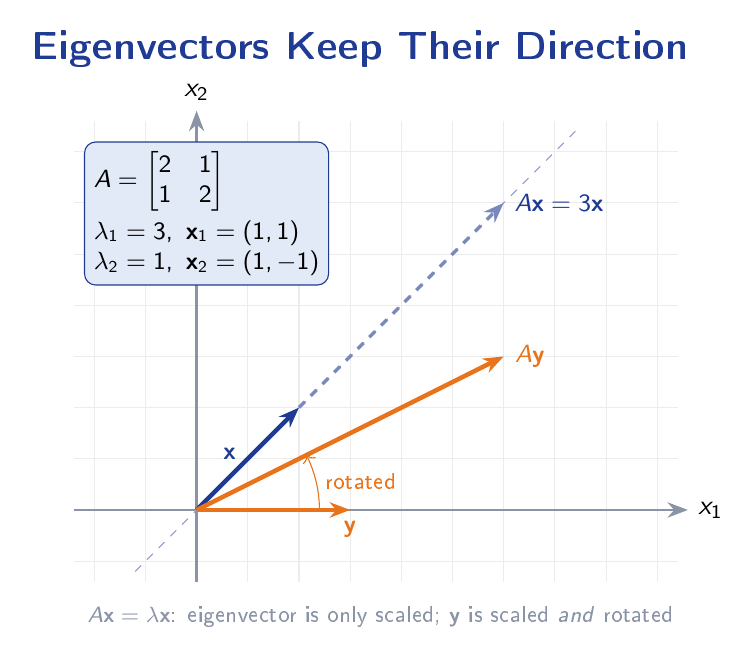
Linear algebra is the language of systems. Electrical networks, structural analysis, control systems, signal processing, computer graphics, and machine learning all reduce to matrix problems \(A\mathbf{x} = \mathbf{b}\) or eigenvalue problems \(A\mathbf{x} = \lambda\mathbf{x}\). Matrices encode linear transformations, determinants measure volume distortion, and eigenvalues describe principal modes and stability.
Matrices and Basic Operations
A matrix \(A = [a_{ij}]_{m \times n}\) has \(m\) rows and \(n\) columns. The fundamental operations are addition \((A + B)_{ij} = a_{ij} + b_{ij}\) (for matrices of the same size), scalar multiplication \((\alpha A)_{ij} = \alpha a_{ij}\), matrix product \((AB)_{ij} = \sum_{k=1}^{n} a_{ik} b_{kj}\), and transpose \((A^T)_{ij} = a_{ji}\).
Determinants
For a \(2 \times 2\) matrix: \(\det\begin{bmatrix}a & b \\ c & d\end{bmatrix} = ad - bc\). For \(n \times n\) matrices, cofactor expansion along row \(i\) gives:
\[\det A = \sum_{j=1}^{n} (-1)^{i+j} a_{ij} M_{ij}\]- \(\det(AB) = \det A \, \det B\)
- \(\det(A^T) = \det A\)
- \(\det(\alpha A) = \alpha^n \det A\) for \(A \in \mathbb{R}^{n \times n}\)
- \(A\) is invertible \(\Leftrightarrow \det A \neq 0\)
- \(A^{-1} = \dfrac{1}{\det A} \operatorname{adj}(A)\)
Rank, Solvability, and Gaussian Elimination
The rank of \(A\) is the number of linearly independent rows, which equals the number of linearly independent columns.
Gauss elimination applies elementary row operations to reduce \([A \mid \mathbf{b}]\) to row-echelon form, followed by back-substitution. Cramer's rule gives \(x_i = \det A_i / \det A\), where \(A_i\) replaces column \(i\) of \(A\) with \(\mathbf{b}\).
Eigenvalues and Eigenvectors
The equation \(A\mathbf{x} = \lambda\mathbf{x},\; \mathbf{x} \neq \mathbf{0}\) defines eigenvalues \(\lambda\) and eigenvectors \(\mathbf{x}\). To find them: (1) solve the characteristic equation \(\det(A - \lambda I) = 0\) for \(\lambda\), then (2) solve \((A - \lambda I)\mathbf{x} = \mathbf{0}\) for each \(\lambda\).
- \(\sum \lambda_i = \operatorname{tr}(A)\), \(\quad \prod \lambda_i = \det A\).
- Eigenvalues of \(A^k\) are \(\lambda^k\); of \(A^{-1}\) are \(1/\lambda\).
- Symmetric (Hermitian) matrices have real eigenvalues and orthogonal eigenvectors.
Diagonalization and Quadratic Forms
If \(A\) has \(n\) linearly independent eigenvectors, then \(A = PDP^{-1}\), where \(D = \operatorname{diag}(\lambda_1, \dots, \lambda_n)\) and \(P = [\mathbf{x}_1 \cdots \mathbf{x}_n]\). This yields \(A^k = PD^k P^{-1}\) and \(e^{At} = Pe^{Dt}P^{-1}\).
The Spectral Theorem states that every real symmetric matrix is orthogonally diagonalizable: \(A = Q\Lambda Q^T\) with \(Q^T Q = I\).
Vector Spaces and Subspaces
A vector space \(V\) over a field \(F\) is a set closed under addition and scalar multiplication, satisfying eight axioms. A subset \(W \subseteq V\) is a subspace if and only if \(\mathbf{0} \in W\) and \(\alpha\mathbf{u} + \beta\mathbf{v} \in W\) for all \(\mathbf{u}, \mathbf{v} \in W\). The span of a set \(S\) is the smallest subspace containing \(S\).
Linear Independence, Basis and Dimension
Vectors \(\mathbf{v}_1, \dots, \mathbf{v}_k\) are linearly independent if \(\sum c_i \mathbf{v}_i = \mathbf{0}\) implies all \(c_i = 0\). A basis of \(V\) is a linearly independent spanning set; every basis has the same number of elements, called \(\dim V\). The change of basis formula is \([\mathbf{v}]_{B'} = P^{-1}[\mathbf{v}]_B\).
The Four Fundamental Subspaces
For \(A \in \mathbb{R}^{m \times n}\) with rank \(r\):
| Subspace | Lives in | Dimension |
|---|---|---|
| Column space \(C(A)\) | \(\mathbb{R}^m\) | \(r\) |
| Null space \(N(A)\) | \(\mathbb{R}^n\) | \(n - r\) |
| Row space \(C(A^T)\) | \(\mathbb{R}^n\) | \(r\) |
| Left null space \(N(A^T)\) | \(\mathbb{R}^m\) | \(m - r\) |
Inner Products, Orthogonality, and Gram–Schmidt
On \(\mathbb{R}^n\): \(\langle \mathbf{u}, \mathbf{v} \rangle = \mathbf{u}^T \mathbf{v}\) and \(\|\mathbf{u}\| = \sqrt{\langle \mathbf{u}, \mathbf{u} \rangle}\). The Cauchy–Schwarz inequality states \(|\langle \mathbf{u}, \mathbf{v} \rangle| \le \|\mathbf{u}\| \, \|\mathbf{v}\|\).
The projection of \(\mathbf{b}\) onto \(C(A)\) is \(\mathbf{p} = A(A^T A)^{-1} A^T \mathbf{b}\) — the foundation of least-squares estimation.
Matrix Decompositions
2. Differential Calculus
Limits and Continuity
\[\lim_{x \to a} f(x) = L \;\Longleftrightarrow\; \forall\varepsilon > 0,\;\exists\delta > 0 \text{ s.t. } 0 < |x - a| < \delta \Rightarrow |f(x) - L| < \varepsilon.\]L'Hôpital's rule handles \(\frac{0}{0}\) or \(\frac{\infty}{\infty}\) indeterminate forms: \(\lim f/g = \lim f'/g'\) when the latter exists. A function is continuous at \(a\) if \(\lim_{x \to a} f(x) = f(a)\).
Differentiation
\[f'(a) = \lim_{h \to 0} \frac{f(a + h) - f(a)}{h}.\]| Function | Derivative | Function | Derivative |
|---|---|---|---|
| \(x^n\) | \(nx^{n-1}\) | \(\sin x\) | \(\cos x\) |
| \(\cos x\) | \(-\sin x\) | \(\tan x\) | \(\sec^2 x\) |
| \(e^x\) | \(e^x\) | \(\ln x\) | \(1/x\) |
| \(\arcsin x\) | \(1/\sqrt{1 - x^2}\) | \(\arctan x\) | \(1/(1 + x^2)\) |
Product rule: \((fg)' = f'g + fg'\). Quotient rule: \((f/g)' = (f'g - fg')/g^2\). Chain rule: \((f \circ g)' = f'(g)\,g'\).
Mean Value Theorems and Taylor Series
Standard Maclaurin expansions: \(e^x = \sum \frac{x^n}{n!}\), \(\sin x = \sum \frac{(-1)^n x^{2n+1}}{(2n+1)!}\), \(\cos x = \sum \frac{(-1)^n x^{2n}}{(2n)!}\), \(\ln(1 + x) = \sum \frac{(-1)^{n+1} x^n}{n}\).
Hyperbolic Functions
\[\sinh x = \frac{e^x - e^{-x}}{2}, \qquad \cosh x = \frac{e^x + e^{-x}}{2}, \qquad \tanh x = \frac{\sinh x}{\cosh x}.\]Key identities: \(\cosh^2 x - \sinh^2 x = 1\); derivatives: \(\frac{d}{dx}\sinh x = \cosh x\), \(\frac{d}{dx}\cosh x = \sinh x\), \(\frac{d}{dx}\tanh x = \operatorname{sech}^2 x\). Inverse forms: \(\sinh^{-1} x = \ln(x + \sqrt{x^2 + 1})\). Engineering relevance includes catenary cables, lossless transmission lines, and beam deflection.
Partial Derivatives and Total Differential
For \(z = f(x, y)\): \(\partial f / \partial x = \lim_{h \to 0} [f(x + h, y) - f(x, y)]/h\). The total differential is \(dz = (\partial f/\partial x)\,dx + (\partial f/\partial y)\,dy\). By the chain rule: if \(x = x(t), y = y(t)\), then \(dz/dt = (\partial f/\partial x)(dx/dt) + (\partial f/\partial y)(dy/dt)\).
Clairaut–Schwarz theorem: if second partials are continuous, mixed partials commute: \(\partial^2 f / \partial x \partial y = \partial^2 f / \partial y \partial x\).
The Jacobian of a transformation \((u, v)\) from \((x, y)\) is \(J = \det\begin{bmatrix}u_x & u_y \\ v_x & v_y\end{bmatrix}\).
Maxima, Minima, and Lagrange Multipliers
For \(f(x, y)\), let \(D = f_{xx}f_{yy} - f_{xy}^2\) at a critical point: \(D > 0, f_{xx} > 0\) gives a local minimum; \(D > 0, f_{xx} < 0\) a local maximum; \(D < 0\) a saddle; \(D = 0\) is inconclusive.
3. Sequences and Series
A sequence \(\{a_n\}\) converges to \(L\) if for every \(\varepsilon > 0\) there is \(N\) such that \(|a_n - L| < \varepsilon\) for \(n > N\). The monotone convergence theorem guarantees convergence of every bounded monotone sequence. The Cauchy criterion and the squeeze theorem are standard tools.
Convergence Tests for Series
- Comparison: if \(0 \le a_n \le b_n\) and \(\sum b_n\) converges, so does \(\sum a_n\).
- Ratio (D'Alembert): \(L = \lim |a_{n+1}/a_n|\). Converges if \(L < 1\), diverges if \(L > 1\), inconclusive if \(L = 1\).
- Root (Cauchy): \(L = \lim \sqrt[n]{|a_n|}\). Same rules as ratio test.
- Integral test: \(\sum_{n \ge 1} f(n)\) and \(\int_1^\infty f\) share the same convergence fate for \(f\) positive and decreasing.
- \(p\)-series: \(\sum 1/n^p\) converges if and only if \(p > 1\).
The Leibniz alternating series test states that \(\sum (-1)^n b_n\) with \(b_n \downarrow 0\) converges. Absolute convergence (\(\sum|a_n|\) converges) implies conditional convergence (\(\sum a_n\) converges), but not vice versa.
Power Series and Radius of Convergence
A power series \(\sum_{n=0}^\infty c_n(x - a)^n\) has radius of convergence \(R\) given by the Cauchy–Hadamard formula:
\[\frac{1}{R} = \limsup_{n \to \infty} \sqrt[n]{|c_n|}, \qquad R = \lim\left|\frac{c_n}{c_{n+1}}\right| \text{ when this limit exists.}\]The series converges absolutely on \(|x - a| < R\) and diverges for \(|x - a| > R\). Within \(R\), term-by-term differentiation and integration are valid, and the sum equals its Taylor series.
4. Integral Calculus
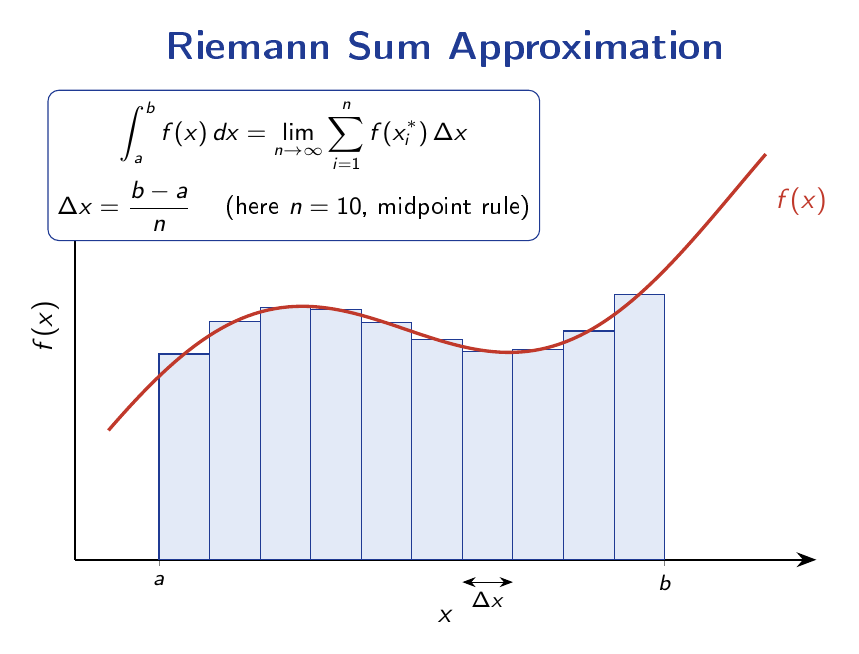
The definite integral is defined as the limit of Riemann sums: \(\int_a^b f(x)\,dx = \lim_{n \to \infty} \sum_{i=1}^n f(x_i^*)\,\Delta x\). The Fundamental Theorem of Calculus states: \(\frac{d}{dx}\int_a^x f(t)\,dt = f(x)\) and \(\int_a^b f'(x)\,dx = f(b) - f(a)\).
Integration Techniques
- Substitution: \(\int f(g(x))g'(x)\,dx = \int f(u)\,du\).
- Integration by parts: \(\int u\,dv = uv - \int v\,du\).
- Partial fractions for rational integrands.
- Trigonometric substitution for expressions involving \(\sqrt{a^2 \pm x^2}\).
Improper integrals are defined via limits: \(\int_a^\infty f(x)\,dx = \lim_{b \to \infty} \int_a^b f(x)\,dx\), provided the limit exists.
Beta and Gamma Functions
\[\Gamma(n) = \int_0^\infty x^{n-1}e^{-x}\,dx, \qquad B(m, n) = \int_0^1 x^{m-1}(1 - x)^{n-1}\,dx.\]Key properties: \(\Gamma(n+1) = n\,\Gamma(n)\); \(\Gamma(n+1) = n!\) for \(n \in \mathbb{N}\); \(\Gamma(1/2) = \sqrt{\pi}\); \(B(m, n) = \Gamma(m)\Gamma(n)/\Gamma(m+n)\). These functions are especially useful for evaluating \(\int_0^{\pi/2} \sin^m\theta\cos^n\theta\,d\theta\).
Multiple Integrals
\[\iint_R f(x, y)\,dA = \int_a^b \int_{g_1(x)}^{g_2(x)} f(x, y)\,dy\,dx.\]Change of variables uses the Jacobian: \(\iint_R f(x, y)\,dx\,dy = \iint_{R'} f(x(u,v), y(u,v))\,|\partial(x,y)/\partial(u,v)|\,du\,dv\). Common substitutions are polar (\(|J| = r\)), cylindrical (\(|J| = r\)), and spherical (\(|J| = \rho^2\sin\phi\)).
5. Vector Calculus
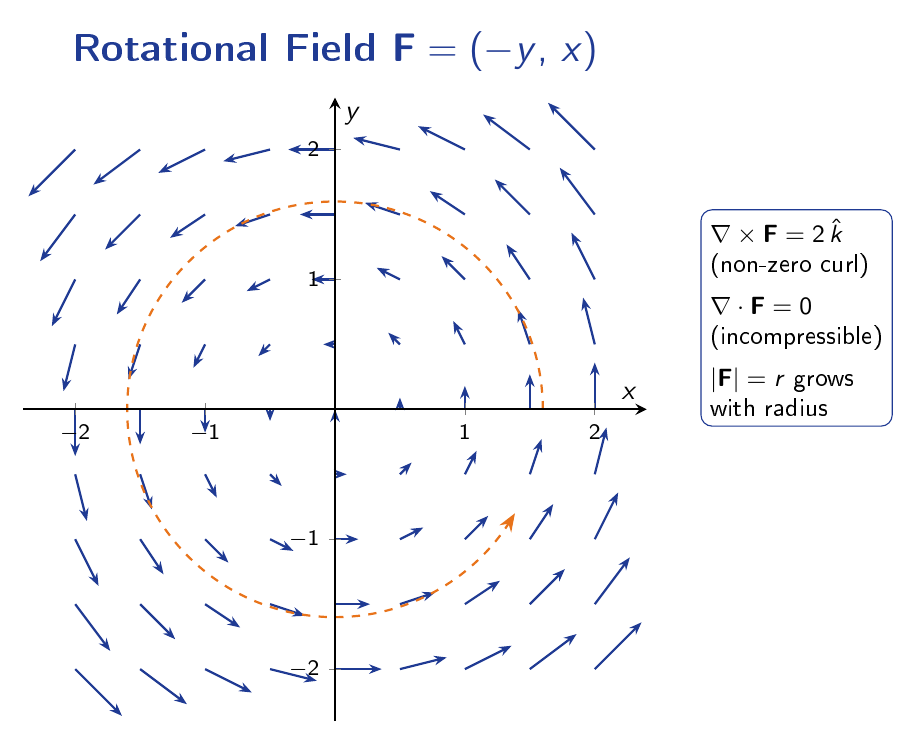
A scalar field \(\phi: \mathbb{R}^3 \to \mathbb{R}\) assigns a number (e.g., temperature) to each point. A vector field \(\mathbf{F}: \mathbb{R}^3 \to \mathbb{R}^3\) assigns a vector (e.g., electric field, velocity) to each point.
Differential Operators
With \(\nabla = \hat{\imath}\partial_x + \hat{\jmath}\partial_y + \hat{k}\partial_z\):
\[\nabla\phi = \left(\frac{\partial\phi}{\partial x}, \frac{\partial\phi}{\partial y}, \frac{\partial\phi}{\partial z}\right), \qquad \nabla\cdot\mathbf{F} = \frac{\partial F_1}{\partial x} + \frac{\partial F_2}{\partial y} + \frac{\partial F_3}{\partial z},\] \[\nabla\times\mathbf{F} = \det\begin{bmatrix}\hat{\imath} & \hat{\jmath} & \hat{k} \\ \partial_x & \partial_y & \partial_z \\ F_1 & F_2 & F_3\end{bmatrix}.\]The gradient points in the direction of steepest ascent and is normal to level surfaces. Divergence measures net outflow per unit volume; curl measures rotation per unit area. Fundamental identities: \(\nabla\times(\nabla\phi) = \mathbf{0}\); \(\nabla\cdot(\nabla\times\mathbf{F}) = 0\); \(\nabla\cdot(\nabla\phi) = \nabla^2\phi\).
Directional Derivative and Tangent Planes
\[D_{\hat{\mathbf{u}}}\phi = \nabla\phi \cdot \hat{\mathbf{u}} = \|\nabla\phi\|\cos\theta.\]The tangent plane to \(\phi(x, y, z) = c\) at point \(\mathbf{p}\) is \(\nabla\phi(\mathbf{p}) \cdot (\mathbf{r} - \mathbf{p}) = 0\). The normal line is \(\mathbf{r}(t) = \mathbf{p} + t\,\nabla\phi(\mathbf{p})\).
Line and Surface Integrals
The line integral of a vector field along curve \(C\) is \(\int_C \mathbf{F}\cdot d\mathbf{r} = \int_a^b \mathbf{F}(\mathbf{r}(t))\cdot\mathbf{r}'(t)\,dt\), representing work done by \(\mathbf{F}\). The surface flux integral is \(\iint_S \mathbf{F}\cdot d\mathbf{S} = \iint_D \mathbf{F}\cdot(\mathbf{r}_u \times \mathbf{r}_v)\,du\,dv\). A conservative field satisfies \(\mathbf{F} = \nabla\phi\), making the line integral path-independent, and \(\nabla\times\mathbf{F} = \mathbf{0}\).
The Three Integral Theorems
All three are special cases of the generalized Stokes theorem \(\int_{\partial M} \omega = \int_M d\omega\).
6. Ordinary Differential Equations
First-Order ODEs
- Separable: \(dy/dx = f(x)g(y) \Rightarrow \int dy/g(y) = \int f(x)\,dx\).
- Linear: \(y' + P(x)y = Q(x)\). Integrating factor \(\mu(x) = e^{\int P\,dx}\); solution \(y = \frac{1}{\mu}\int\mu Q\,dx + C/\mu\).
- Exact: \(M\,dx + N\,dy = 0\) with \(M_y = N_x\); find \(\psi\) with \(\psi_x = M, \psi_y = N\).
- Bernoulli: \(y' + Py = Qy^n\); substitute \(v = y^{1-n}\).
- Homogeneous: \(y' = f(y/x)\); substitute \(v = y/x\).
Second-Order Linear ODEs with Constant Coefficients
For \(ay'' + by' + cy = g(x)\), find the complementary solution from the characteristic equation \(ar^2 + br + c = 0\):
- Distinct real roots \(r_1, r_2\): \(y_c = C_1 e^{r_1 x} + C_2 e^{r_2 x}\).
- Repeated root \(r\): \(y_c = (C_1 + C_2 x)e^{rx}\).
- Complex roots \(\alpha \pm i\beta\): \(y_c = e^{\alpha x}(C_1\cos\beta x + C_2\sin\beta x)\).
For the particular solution \(y_p\): use undetermined coefficients (guess matching \(g(x)\)) or variation of parameters. The general solution is \(y = y_c + y_p\).
Cauchy–Euler and Series Methods
For series solutions about an ordinary point \(x_0\), assume \(y = \sum_{n=0}^\infty a_n(x - x_0)^n\), substitute, and derive a recurrence for \(a_n\). The Frobenius method extends this to regular singular points, yielding solutions of the form \(x^r\) times a power series — relevant to Bessel and Legendre equations.
Special Functions
7. Partial Differential Equations
Classification of Second-Order PDEs
For \(Au_{xx} + 2Bu_{xy} + Cu_{yy} + \cdots = 0\): if \(B^2 - AC < 0\) the equation is elliptic (Laplace's equation); if \(B^2 - AC = 0\) it is parabolic (heat/diffusion); if \(B^2 - AC > 0\) it is hyperbolic (wave equation).
Method of Separation of Variables
Seek \(u(x, t) = X(x)T(t)\). Substituting into the PDE separates it into two ODEs joined by a separation constant.
D'Alembert's solution for the 1D wave equation:
\[u(x, t) = \frac{1}{2}[f(x - ct) + f(x + ct)] + \frac{1}{2c}\int_{x-ct}^{x+ct} g(s)\,ds.\]8. Complex Analysis
Complex Numbers
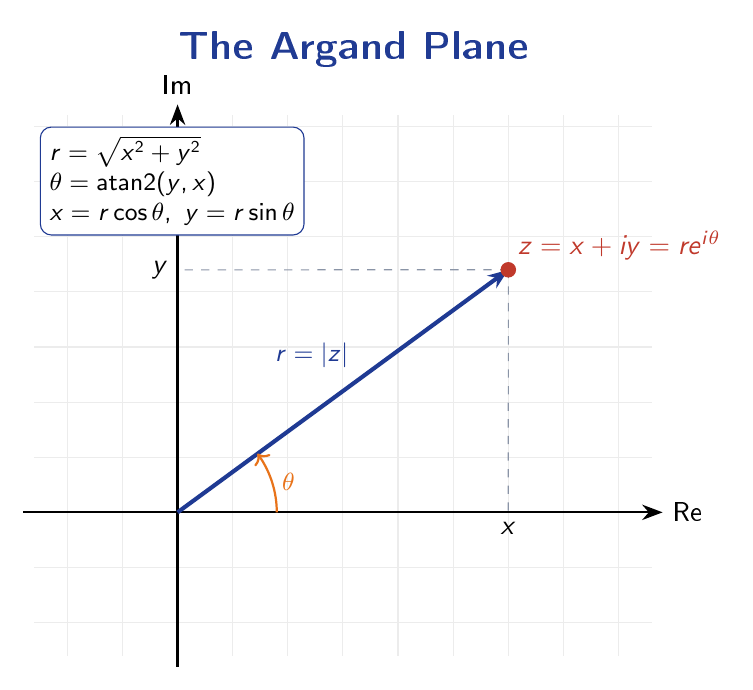
\(z = x + iy = re^{i\theta}\) with \(r = |z| = \sqrt{x^2 + y^2}\) and \(\theta = \arg z\).
- Euler: \(e^{i\theta} = \cos\theta + i\sin\theta\).
- De Moivre: \((\cos\theta + i\sin\theta)^n = \cos n\theta + i\sin n\theta\).
- \(n\)-th roots of \(z\): \(z^{1/n} = r^{1/n} e^{i(\theta + 2k\pi)/n}\), \(k = 0, \dots, n-1\).
Analytic Functions and Cauchy–Riemann Equations
A function \(f(z) = u(x, y) + iv(x, y)\) is analytic at \(z_0\) if differentiable in a neighbourhood of \(z_0\).
Contour Integration and Cauchy's Theorems
The Laurent series about an isolated singularity \(z_0\) is \(f(z) = \sum_{n=-\infty}^{\infty} a_n(z - z_0)^n\), where \(a_{-1} = \operatorname{Res}_{z=z_0} f\).
Liouville's Theorem and the Maximum Modulus Principle
Singularities and the Residue Theorem
Isolated singularities are classified as removable, poles of order \(m\), or essential. The residue at a simple pole is \(\operatorname{Res}_{z=z_0} f = \lim_{z \to z_0}(z - z_0)f(z)\). At a pole of order \(m\):
\[\operatorname{Res}_{z=z_0} f = \frac{1}{(m-1)!}\lim_{z \to z_0} \frac{d^{m-1}}{dz^{m-1}}\bigl[(z - z_0)^m f(z)\bigr].\]Real Integrals via Residues and Conformal Mapping
For trigonometric integrals \(\int_0^{2\pi} R(\cos\theta, \sin\theta)\,d\theta\), substitute \(z = e^{i\theta}\) and integrate over the unit circle. For improper integrals \(\int_{-\infty}^\infty R(x)\,dx\) with rational \(R\) and no real poles, the result equals \(2\pi i\) times the sum of residues in the upper half-plane.
A conformal map \(w = f(z)\) with \(f'(z_0) \neq 0\) preserves angles. The Möbius (bilinear) transformation \(w = (az + b)/(cz + d)\) maps circles and lines to circles and lines and is uniquely determined by three points. Engineering applications include solving Laplace's equation in complex domains by mapping to simpler geometries.
9. Laplace Transforms
\[\mathcal{L}\{f(t)\} = F(s) = \int_0^\infty e^{-st} f(t)\,dt, \quad s > \sigma_0.\]- Linearity: \(\mathcal{L}\{af + bg\} = aF + bG\).
- First shift: \(\mathcal{L}\{e^{at}f(t)\} = F(s - a)\).
- Second shift: \(\mathcal{L}\{u(t-a)f(t-a)\} = e^{-as}F(s)\).
- Scaling: \(\mathcal{L}\{f(at)\} = \frac{1}{a}F(s/a)\).
- Derivative: \(\mathcal{L}\{f'(t)\} = sF(s) - f(0)\); \(\mathcal{L}\{f''(t)\} = s^2 F(s) - sf(0) - f'(0)\).
- Integral: \(\mathcal{L}\left\{\int_0^t f\,d\tau\right\} = F(s)/s\).
- Convolution: \(\mathcal{L}\{f * g\} = F(s)G(s)\).
Standard Laplace Transform Pairs
| \(f(t)\) | \(F(s)\) |
|---|---|
| \(1\) | \(1/s\) |
| \(t^n\) | \(n!/s^{n+1}\) |
| \(e^{at}\) | \(1/(s-a)\) |
| \(\sin\omega t\) | \(\omega/(s^2+\omega^2)\) |
| \(\cos\omega t\) | \(s/(s^2+\omega^2)\) |
| \(\sinh at\) | \(a/(s^2-a^2)\) |
| \(\cosh at\) | \(s/(s^2-a^2)\) |
| \(t\sin\omega t\) | \(2\omega s/(s^2+\omega^2)^2\) |
| \(\delta(t)\) | \(1\) |
| \(u(t-a)\) | \(e^{-as}/s\) |
Initial and Final Value Theorems
Inverse Laplace is computed via partial fractions, shift theorems, table lookup, or the Bromwich integral \(f(t) = \frac{1}{2\pi i}\int_{\gamma - i\infty}^{\gamma + i\infty} e^{st}F(s)\,ds\).
10. Fourier Series and Transforms
Fourier Series
A periodic function \(f\) of period \(2L\) can be represented as:
\[f(x) = \frac{a_0}{2} + \sum_{n=1}^{\infty}\left[a_n\cos\frac{n\pi x}{L} + b_n\sin\frac{n\pi x}{L}\right],\] \[a_n = \frac{1}{L}\int_{-L}^{L} f(x)\cos\frac{n\pi x}{L}\,dx, \qquad b_n = \frac{1}{L}\int_{-L}^{L} f(x)\sin\frac{n\pi x}{L}\,dx.\]Symmetry shortcuts: even \(f \Rightarrow b_n = 0\) (cosine series); odd \(f \Rightarrow a_n = 0\) (sine series). Parseval's identity: \(\frac{1}{L}\int_{-L}^L |f|^2\,dx = a_0^2/2 + \sum(a_n^2 + b_n^2)\).
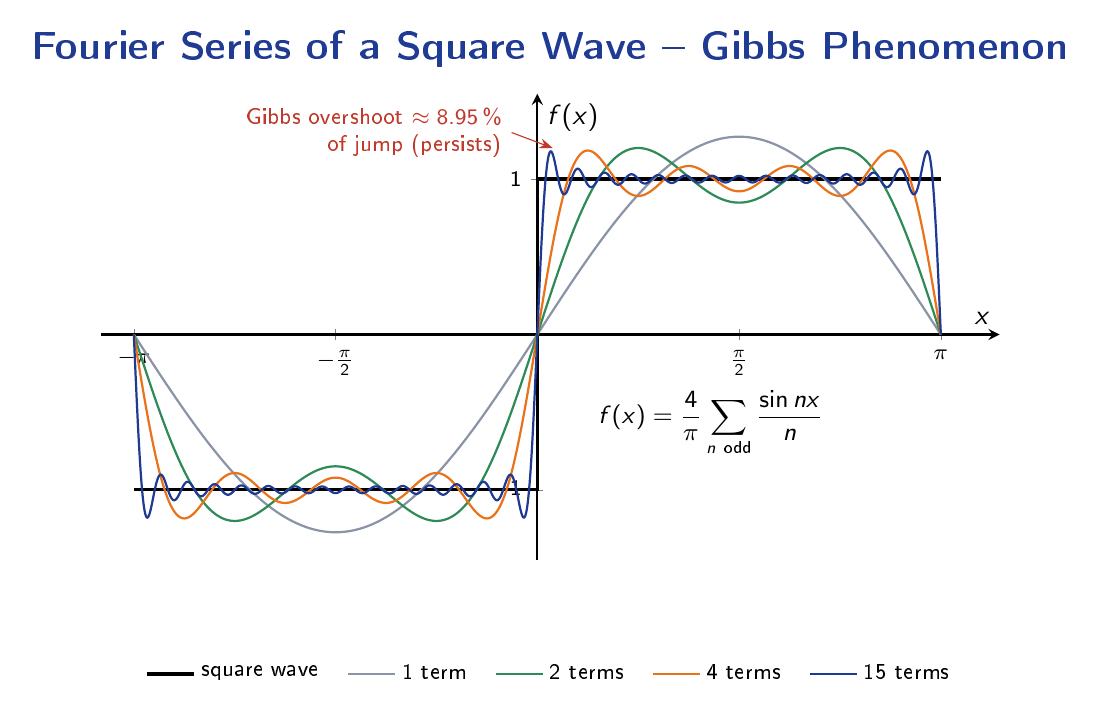
The Fourier series of the square wave is \(f(x) = \dfrac{4}{\pi}\sum_{k=0}^{\infty}\dfrac{\sin((2k+1)x)}{2k+1}\), exhibiting the Gibbs phenomenon — approximately 8.95% overshoot near jump discontinuities, which narrows but never vanishes as more terms are added.
Dirichlet Convergence Conditions
The Fourier series of \(f\) converges pointwise if \(f\) is bounded, absolutely integrable, has finitely many maxima and minima, and has finitely many finite discontinuities on \([-L, L]\). At a jump discontinuity \(x_0\), the series converges to the average of the one-sided limits: \([f(x_0^+) + f(x_0^-)]/2\).
Fourier Transform
\[\mathcal{F}\{f(t)\} = F(\omega) = \int_{-\infty}^{\infty} f(t)\,e^{-i\omega t}\,dt, \qquad f(t) = \frac{1}{2\pi}\int_{-\infty}^{\infty} F(\omega)\,e^{i\omega t}\,d\omega.\]Key properties: linearity; differentiation gives \(\mathcal{F}\{f'(t)\} = i\omega F(\omega)\); convolution gives \(\mathcal{F}\{f * g\} = F(\omega)G(\omega)\); Parseval's theorem: \(\int|f|^2\,dt = \frac{1}{2\pi}\int|F|^2\,d\omega\). Engineering applications include signal spectra, filter design, and solving PDEs on infinite domains.
11. Z-Transform
The unilateral Z-transform of a discrete sequence \(\{x[n]\}\) is:
\[\mathcal{Z}\{x[n]\} = X(z) = \sum_{n=0}^{\infty} x[n]\,z^{-n}.\]The Region of Convergence (ROC) is the set of \(z\) for which \(X(z)\) converges — typically an annulus \(r_1 < |z| < r_2\). The ROC is essential because different sequences can share the same algebraic \(X(z)\) with different ROCs. The connection to the Laplace transform: \(X(z)\big|_{z = e^{sT}} \approx X_a(s)\), mapping the \(j\omega\)-axis to the unit circle.
Properties and Standard Z-Transform Pairs
- Time-shift: \(\mathcal{Z}\{x[n-k]\} = z^{-k}X(z)\).
- Scaling: \(\mathcal{Z}\{a^n x[n]\} = X(z/a)\).
- Differentiation: \(\mathcal{Z}\{n\,x[n]\} = -z\,dX/dz\).
- Convolution: \(\mathcal{Z}\{x * h\} = X(z)H(z)\).
- Initial value: \(x[0] = \lim_{z \to \infty} X(z)\).
- Final value: if poles of \((z-1)X(z)\) are inside \(|z| < 1\): \(\lim_{n \to \infty} x[n] = \lim_{z \to 1}(z-1)X(z)\).
| \(x[n]\) | \(X(z)\) | ROC |
|---|---|---|
| \(\delta[n]\) | \(1\) | all \(z\) |
| \(u[n]\) | \(z/(z-1)\) | \(|z|>1\) |
| \(a^n u[n]\) | \(z/(z-a)\) | \(|z|>|a|\) |
| \(na^n u[n]\) | \(az/(z-a)^2\) | \(|z|>|a|\) |
| \(\cos(\omega_0 n)u[n]\) | \(z(z - \cos\omega_0)/(z^2 - 2z\cos\omega_0 + 1)\) | \(|z|>1\) |
Inverse Z-Transform and Difference Equations
The inverse Z-transform is computed via partial-fraction expansion of \(X(z)/z\) followed by table lookup, long division for power-series form, or contour integration. For linear difference equations, take the Z-transform (including initial conditions), solve algebraically for \(Y(z)\), then invert. The system function is \(H(z) = Y(z)/X(z)\). An LTI system is BIBO-stable if and only if all poles of \(H(z)\) lie strictly inside the unit circle.
12. Numerical Methods
Root Finding
Interpolation
The Lagrange interpolation polynomial through \((x_i, y_i)\) is \(P(x) = \sum_{i=0}^n y_i L_i(x)\), where \(L_i(x) = \prod_{j \neq i}(x - x_j)/(x_i - x_j)\). Newton's divided differences provide a computationally efficient alternative, and for equally spaced data, forward/backward difference formulas apply.
Numerical Integration
ODE Solvers
Euler's method: \(y_{n+1} = y_n + h\,f(x_n, y_n)\). Global error \(O(h)\). Cheap, first-order only.
Modified Euler/Heun: predictor-corrector with global error \(O(h^2)\).
For stiff systems, explicit methods become unstable unless \(h\) is impractically small; use implicit methods (Backward Euler, BDF).
Numerical Linear Systems
Direct methods include Gauss elimination with partial pivoting (\(O(n^3)\)), LU factorization (efficient for multiple right-hand sides), and Cholesky decomposition for symmetric positive-definite systems. Iterative methods (Jacobi, Gauss–Seidel) are preferred for large sparse systems; convergence is guaranteed when \(A\) is strictly diagonally dominant. The condition number \(\kappa(A) = \|A\|\,\|A^{-1}\|\) measures error amplification.
Curve Fitting and Least Squares
Minimizing \(\sum(y_i - \sum c_j \phi_j(x_i))^2\) leads to the normal equations \(A^T A\,\mathbf{c} = A^T\mathbf{y}\). For linear regression \(y = mx + c\):
\[m = \frac{n\sum x_i y_i - \sum x_i \sum y_i}{n\sum x_i^2 - (\sum x_i)^2}, \qquad c = \bar{y} - m\bar{x}.\]Goodness of fit: \(R^2 = 1 - \dfrac{\sum(y_i - \hat{y}_i)^2}{\sum(y_i - \bar{y})^2}\). Non-linear models are linearized via logarithms and then fitted by the same approach.
13. Probability and Statistics
Probability Essentials
The probability axioms are: \(0 \le P(A) \le 1\); \(P(\Omega) = 1\); \(P(\bigcup A_i) = \sum P(A_i)\) for disjoint events. Conditional probability: \(P(A \mid B) = P(A \cap B)/P(B)\). Bayes' theorem: \(P(A \mid B) = P(B \mid A)P(A)/P(B)\). Total probability: \(P(B) = \sum_i P(B \mid A_i)P(A_i)\) for a partition \(\{A_i\}\).
Random Variables and Distributions
For a random variable \(X\): \(E[X] = \int x\,f_X(x)\,dx\) and \(\operatorname{Var}(X) = E[X^2] - (E[X])^2\).
| Distribution | Mean | Variance |
|---|---|---|
| Bernoulli\((p)\) | \(p\) | \(p(1-p)\) |
| Binomial\((n,p)\) | \(np\) | \(np(1-p)\) |
| Geometric\((p)\) | \(1/p\) | \((1-p)/p^2\) |
| Poisson\((\lambda)\) | \(\lambda\) | \(\lambda\) |
| Uniform\((a,b)\) | \((a+b)/2\) | \((b-a)^2/12\) |
| Exponential\((\lambda)\) | \(1/\lambda\) | \(1/\lambda^2\) |
| Normal\((\mu,\sigma^2)\) | \(\mu\) | \(\sigma^2\) |
Markov inequality: \(P(X \ge a) \le E[X]/a\) for \(X \ge 0\). Chebyshev inequality: \(P(|X - \mu| \ge k\sigma) \le 1/k^2\).
Joint, Marginal, and Conditional Distributions
For joint pdf \(f_{XY}(x,y)\): marginals \(f_X(x) = \int f_{XY}(x,y)\,dy\), conditional \(f_{Y|X}(y|x) = f_{XY}(x,y)/f_X(x)\). Independence: \(f_{XY} = f_X f_Y\). Covariance: \(\operatorname{Cov}(X,Y) = E[XY] - E[X]E[Y]\). Correlation: \(\rho_{XY} = \operatorname{Cov}(X,Y)/(\sigma_X \sigma_Y) \in [-1, 1]\).
Moment Generating Functions
\(M_X(t) = E[e^{tX}]\). Moments are \(E[X^k] = M_X^{(k)}(0)\). For independent \(X, Y\): \(M_{X+Y}(t) = M_X(t)M_Y(t)\). MGFs uniquely determine distributions.
Sampling Distributions
For a normal random sample \(X_1, \dots, X_n \overset{\text{iid}}{\sim} \mathcal{N}(\mu, \sigma^2)\): \((n-1)S^2/\sigma^2 \sim \chi^2_{n-1}\); \((\bar{X} - \mu)/(S/\sqrt{n}) \sim t_{n-1}\); the \(F\) distribution arises as a ratio of scaled chi-squared variables (used in ANOVA).
Limit Theorems and Statistical Inference
Confidence interval for \(\mu\) (\(\sigma\) unknown, large \(n\)): \(\bar{x} \pm z_{\alpha/2}\,s/\sqrt{n}\). Hypothesis testing: state \(H_0\) vs \(H_1\), compute a test statistic, compare against the critical value or \(p\)-value.
14. Discrete Mathematics
Sets, Relations, and Functions
Set operations: \(A \cup B\), \(A \cap B\), \(A \setminus B\), \(A^c\), \(A \times B\). De Morgan's laws: \((A \cup B)^c = A^c \cap B^c\). Inclusion–exclusion: \(|A \cup B| = |A| + |B| - |A \cap B|\).
A relation \(R \subseteq A \times A\) is an equivalence relation if reflexive, symmetric, and transitive; a partial order if reflexive, antisymmetric, and transitive. A function \(f: A \to B\) is bijective (invertible) if and only if it is both injective and surjective.
Propositional and Predicate Logic
- Implication: \(p \to q \equiv \neg p \vee q\).
- Contrapositive: \(p \to q \equiv \neg q \to \neg p\).
- De Morgan: \(\neg(p \wedge q) \equiv \neg p \vee \neg q\).
- Quantifier negation: \(\neg(\forall x\,P(x)) \equiv \exists x\,\neg P(x)\).
Combinatorics and Counting
\[P(n, r) = \frac{n!}{(n-r)!}, \qquad \binom{n}{r} = \frac{n!}{r!(n-r)!}.\]Pascal's identity: \(\binom{n}{r} = \binom{n-1}{r-1} + \binom{n-1}{r}\). Binomial theorem: \((x+y)^n = \sum\binom{n}{k}x^k y^{n-k}\). Stars and bars: \(\binom{n+r-1}{r}\) ways to choose \(r\) items from \(n\) types with repetition.
Recurrence Relations and Generating Functions
For linear homogeneous recurrences with constant coefficients, try \(a_n = r^n\) to obtain the characteristic equation. Distinct roots \(r_i\) give \(a_n = \sum \alpha_i r_i^n\); a root of multiplicity \(m\) contributes \((\alpha_0 + \alpha_1 n + \cdots + \alpha_{m-1}n^{m-1})r^n\). The Fibonacci sequence has the closed form \(F_n = (\varphi^n - \hat{\varphi}^n)/\sqrt{5}\), where \(\varphi = (1 + \sqrt{5})/2\).
Graph Theory
A graph \(G = (V, E)\). The handshake lemma: \(\sum_v \deg(v) = 2|E|\). A tree is a connected acyclic graph with \(|V| - 1\) edges. An Euler circuit exists if and only if the graph is connected with every vertex of even degree. Euler's formula for connected planar graphs: \(V - E + F = 2\). The chromatic number \(\chi(G) \le 4\) for planar graphs (four-colour theorem).
Algebraic Structures
A group \((G, \cdot)\) is a set with an associative binary operation having an identity and inverses. Lagrange's theorem: the order of every subgroup divides \(|G|\). A ring adds a second distributive operation. A field is a commutative ring where every non-zero element is invertible (e.g., \(\mathbb{Q}, \mathbb{R}, \mathbb{C}, \mathbb{Z}_p\) for prime \(p\)). Boolean algebra underlies digital logic, simplified using Karnaugh maps or the Quine–McCluskey method.
15. Optimization and Linear Programming
Unconstrained Optimization
For \(f: \mathbb{R}^n \to \mathbb{R}\) smooth, critical points satisfy \(\nabla f = \mathbf{0}\). At a critical point, the Hessian \(H\) determines the nature: positive definite \(\Rightarrow\) local minimum; negative definite \(\Rightarrow\) local maximum; indefinite \(\Rightarrow\) saddle. For convex \(f\), every local minimum is global. Steepest descent iterates \(\mathbf{x}_{k+1} = \mathbf{x}_k - \alpha_k \nabla f(\mathbf{x}_k)\); Newton's method converges quadratically near a minimum.
Linear Programming — Standard Form
Maximize \(\mathbf{c}^T\mathbf{x}\) subject to \(A\mathbf{x} \le \mathbf{b}\), \(\mathbf{x} \ge \mathbf{0}\). The feasible region is a convex polytope; the optimum occurs at a vertex. The simplex method (Dantzig) moves from vertex to vertex along improving edges until no improvement is possible. Equality and \(\ge\) constraints are handled via the Big-M or two-phase method. Degeneracy and cycling are addressed with Bland's rule.
Duality and Special LPs
| Primal | Dual |
|---|---|
| \(\max\; \mathbf{c}^T\mathbf{x}\) | \(\min\; \mathbf{b}^T\mathbf{y}\) |
| \(A\mathbf{x} \le \mathbf{b}\) | \(A^T\mathbf{y} \ge \mathbf{c}\) |
| \(\mathbf{x} \ge \mathbf{0}\) | \(\mathbf{y} \ge \mathbf{0}\) |
Special LPs include the transportation problem (minimizing shipping costs, solved by NW-corner/Vogel + MODI) and the assignment problem (solved in \(O(n^3)\) by the Hungarian algorithm).
16. GATE Practice — Worked Examples
Linear Algebra and Calculus
Solution: For a triangular matrix, eigenvalues lie on the diagonal: \(\lambda = 2, 3, 5\). Therefore \(\sum\lambda_i = \operatorname{tr}(A) = 10\) and \(\prod\lambda_i = \det A = 30\).
Solution: By the Rank–Nullity theorem, \(\dim N(A) = n - r = 6 - 3 = \mathbf{3}\).
Solution: Using the Maclaurin expansion, \(e^x - 1 - x = \frac{x^2}{2} + O(x^3)\). Dividing by \(x^2\): limit \(= \dfrac{1}{2}\).
ODE and Vector Calculus
Solution: Integrating factor \(\mu = e^{\int dx/x} = x\). Then \(\frac{d}{dx}(xy) = x^3 \Rightarrow xy = x^4/4 + C\). Applying \(y(1) = 0\) gives \(C = -1/4\). Therefore \(\boxed{y = \frac{1}{4}\left(x^3 - x^{-1}\right)}\).
Solution: \(\nabla\phi = (2xy,\, x^2 + z^2,\, 2yz) = (4, 2, -4)\). The unit vector \(\hat{\mathbf{a}} = (2, -1, 2)/3\). Therefore \(D_{\hat{\mathbf{a}}}\phi = (4\cdot2 + 2\cdot(-1) + (-4)\cdot2)/3 = -2/3\).
Solution: By Green's theorem, \(\partial Q/\partial x - \partial P/\partial y = 1 - (-1) = 2\). Therefore \(\iint_D 2\,dA = 2\pi\).
Transforms and Complex Analysis
Solution: Complete the square: \(s^2 + 2s + 5 = (s+1)^2 + 4\). Rewrite: \(\dfrac{(s+1)+2}{(s+1)^2+4}\). By the first shift theorem: \(e^{-t}(\cos 2t + \sin 2t)\).
Solution: \(Y(s) = H(s)/s\). Poles of \(sY(s)\) are at \(-1, -2\) (both in the LHP, so FVT applies). Steady-state output \(= \lim_{s \to 0} sY(s) = H(0) = 1\).
Solution: Pole of order 2 at \(z = i\): \(\operatorname{Res} = \dfrac{d}{dz}\!\left[\dfrac{z}{(z+i)^2}\right]_{z=i} = -\dfrac{i}{4}\).
Probability and Numerical Methods
Solution: \(\dfrac{0.5 \times 0.8}{0.5 \times 0.5 + 0.5 \times 0.8} = \dfrac{0.40}{0.65} \approx 0.615\).
Solution: \(x_1 = 3 - (9 - 10)/6 = 3.1\overline{6}\); \(x_2 = 3.1623\ldots\). Quadratic convergence is evident.
Solution: \(\dfrac{0.25}{2}\,[1 + 2(0.9394 + 0.7788 + 0.5698) + 0.3679] \approx 0.7430\) (true value \(\approx 0.7468\)).
17. GATE Strategy and Quick Tips
- Linear algebra (eigenvalues, rank, systems) — high yield.
- Calculus and differential equations (first/second-order ODE, basic PDE).
- Probability and statistics (distributions, Bayes, CLT).
- Numerical methods (Newton–Raphson, trapezoidal/Simpson, Euler/RK).
- Transforms and complex variables (residues, Laplace, Fourier, Z).
- Discrete mathematics — CS/IT branches only (sets, logic, graphs, counting).
- Memorize standard transform pairs and Taylor/Maclaurin expansions.
- For triangular or diagonal matrices, eigenvalues sit on the diagonal; cross-check using \(\operatorname{tr}(A)\) and \(\det A\).
- For a \(2 \times 2\) inverse: swap diagonal entries, negate off-diagonal entries, divide by \(\det A\).
- Before applying the FVT, verify that all poles of \(sF(s)\) lie strictly in the left half-plane.
- Use Parseval's identity to convert integral computations into discrete sum problems in Fourier contexts.
- In graph problems, always verify Euler's formula \(V - E + F = 2\) for planarity.
18. Suggested References
- E. Kreyszig — Advanced Engineering Mathematics, Wiley.
- B. S. Grewal — Higher Engineering Mathematics, Khanna Publishers.
- M. D. Greenberg — Advanced Engineering Mathematics, Pearson.
- G. Strang — Introduction to Linear Algebra, Wellesley-Cambridge Press.
- S. S. Sastry — Introductory Methods of Numerical Analysis, PHI Learning.
- S. Ross — A First Course in Probability, Pearson.
- K. H. Rosen — Discrete Mathematics and Its Applications, McGraw-Hill.
- C. L. Liu — Elements of Discrete Mathematics, McGraw-Hill.
- H. A. Taha — Operations Research: An Introduction, Pearson.
- A. V. Oppenheim & R. W. Schafer — Discrete-Time Signal Processing, Pearson (for Z-transform applications).
"Mathematics is the language with which God has written the universe."