Vector Analysis
Electric and magnetic fields are vector fields defined in three-dimensional space and time. Vector calculus provides the compact language of Maxwell's equations. The coordinate system is selected according to the symmetry of the problem, and differential operators encode local behaviour while integral theorems relate them to global flux and circulation.
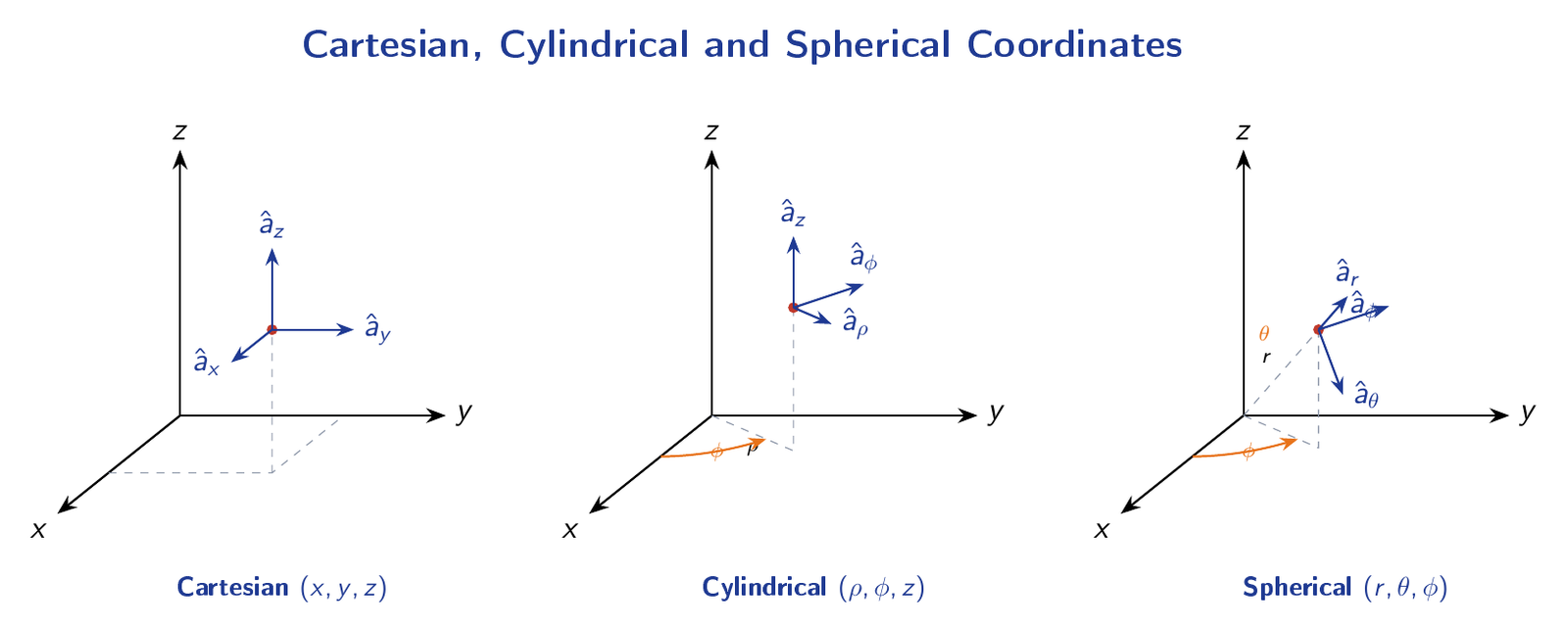
Coordinate Systems — Choose by Symmetry
Unit vectors \(\hat{\mathbf{x}},\hat{\mathbf{y}},\hat{\mathbf{z}}\) are constant everywhere.
\(dV = dx\,dy\,dz\)
\(dr^2 = dx^2+dy^2+dz^2\)
Unit vectors \(\hat{\boldsymbol{\rho}},\hat{\boldsymbol{\phi}},\hat{\mathbf{z}}\).
\(x=\rho\cos\phi,\;y=\rho\sin\phi\)
\(dV=\rho\,d\rho\,d\phi\,dz\)
\(dr^2=d\rho^2+\rho^2 d\phi^2+dz^2\)
Unit vectors \(\hat{\mathbf{r}},\hat{\boldsymbol{\theta}},\hat{\boldsymbol{\phi}}\).
\(z=r\cos\theta\)
\(dV=r^2\sin\theta\,dr\,d\theta\,d\phi\)
Gradient, Divergence, Curl, and Laplacian
Points in the direction of maximum rate of increase of \(\phi\). The electric field is \(\mathbf{E}=-\nabla V\).
Cartesian: \(\nabla\!\cdot\!\mathbf{A}=\partial_x A_x+\partial_y A_y+\partial_z A_z\)
Cylindrical: \(\nabla\!\cdot\!\mathbf{A}=\tfrac{1}{\rho}\partial_\rho(\rho A_\rho)+\tfrac{1}{\rho}\partial_\phi A_\phi+\partial_z A_z\)
Spherical: \(\nabla\!\cdot\!\mathbf{A}=\tfrac{1}{r^2}\partial_r(r^2 A_r)+\tfrac{1}{r\sin\theta}\partial_\theta(\sin\theta A_\theta)+\tfrac{1}{r\sin\theta}\partial_\phi A_\phi\)
Spherical divergence carries \(1/r^2\) and \(r^2 A_r\), plus \(\sin\theta\) factors for the \(\theta\)-component. These factors are exactly the Jacobian of the volume element — a tell-tale sign to check when computing grad/div/curl in spherical coordinates.
Key Vector Identities
- \(\nabla\!\times\!\nabla\phi=\mathbf{0}\) confirms the electrostatic field \(\mathbf{E}=-\nabla V\) is conservative.
- \(\nabla\!\cdot\!\nabla\!\times\!\mathbf{A}=0\) confirms the magnetic field is solenoidal, so \(\mathbf{B}=\nabla\!\times\!\mathbf{A}\).
- The BAC-CAB identity \(\nabla\!\times\!\nabla\!\times\!\mathbf{A}=\nabla\nabla\!\cdot\!\mathbf{A}-\nabla^2\mathbf{A}\) is the engine of the wave equation.
- A GATE favourite: "Which field can represent an electrostatic field?" — Test: \(\nabla\!\times\!\mathbf{F}\stackrel{?}{=}\mathbf{0}\).
Integral Theorems — The Bridge
Flux through a closed surface equals the divergence integrated over the enclosed volume.
Circulation of a vector around a closed loop equals the curl integrated through the enclosed surface.
These two theorems are the bridges between the differential and integral forms of Maxwell's equations. Every integral form of Maxwell's equations is obtained by applying one of these theorems to the corresponding differential form.
The Dirac Delta Function
A point charge \(Q\) at \(\mathbf{r}_0\) expressed as a volume charge density: \(\rho_v(\mathbf{r})=Q\,\delta^3(\mathbf{r}-\mathbf{r}_0)\). Sanity check: \(\int\rho_v\,dV=Q\). Gauss's law then yields \(E=Q/(4\pi\varepsilon_0 r^2)\).
This identity is the foundation of the integral solution of Poisson's equation.
Electrostatics
Electrostatics deals with charges at rest and the fields they produce. The fundamental law is Coulomb's (1785), from which Gauss's law, potential theory, and energy relations all follow.
Coulomb's Law and Electric Field
\(\varepsilon_0 = 8.854\times 10^{-12}\) F/m \(\approx\tfrac{1}{36\pi}\times 10^{-9}\). Force is inverse-square, central, and satisfies Newton's third law.
Superposition: \(\mathbf{E}=\sum_i \mathbf{E}_i\). Continuous: \(\mathbf{E}=\int\dfrac{dQ}{4\pi\varepsilon_0 R^2}\hat{\mathbf{R}}\) where \(dQ=\rho_v dV,\;\rho_s dS,\;\rho_l dl\).
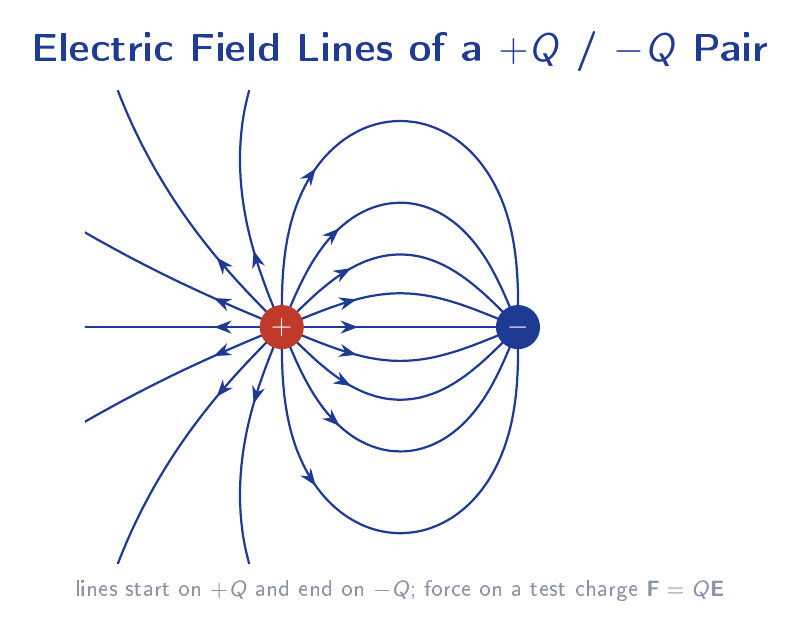
Gauss's Law — The Power of Symmetry
\(\mathbf{D}=\varepsilon\mathbf{E}\) is the electric flux density (C/m²). Gauss's law is always true, but only useful when symmetry allows \(|\mathbf{D}|\) to be constant on a Gaussian surface.
- Spherical symmetry → Gaussian sphere
- Cylindrical symmetry (infinite line/coax) → Gaussian cylinder
- Planar symmetry (infinite sheet) → Gaussian pillbox
Standard Electric Field Results
| Configuration | \(\mathbf{E}\) | Falloff |
|---|---|---|
| Point charge \(Q\) | \(\dfrac{Q}{4\pi\varepsilon_0 r^2}\hat{\mathbf{r}}\) | \(\sim 1/r^2\) |
| Infinite line \(\rho_l\) | \(\dfrac{\rho_l}{2\pi\varepsilon_0\rho}\hat{\boldsymbol{\rho}}\) | \(\sim 1/\rho\) |
| Infinite sheet \(\rho_s\) | \(\dfrac{\rho_s}{2\varepsilon_0}\hat{\mathbf{n}}\) | Uniform |
| Inside uniform sphere (\(r<a\)) | \(\dfrac{\rho_v r}{3\varepsilon_0}\hat{\mathbf{r}}\) | \(\propto r\) |
| Outside uniform sphere (\(r>a\)) | \(\dfrac{Q}{4\pi\varepsilon_0 r^2}\hat{\mathbf{r}}\) | \(\sim 1/r^2\) |
| Between parallel-plate capacitor | \(\dfrac{\rho_s}{\varepsilon_0}\hat{\mathbf{n}}\) | Uniform |
| Inside coaxial cable (between \(a,b\)) | \(\dfrac{\rho_l}{2\pi\varepsilon_0\rho}\hat{\boldsymbol{\rho}}\) | \(\sim 1/\rho\) |
The field inside a uniformly charged sphere grows linearly with \(r\), not as \(1/r^2\). A common GATE favourite: "Field at the centre of a charged sphere?" — Answer: zero.
Electric Potential and Dipole
Point charge: \(V=\dfrac{Q}{4\pi\varepsilon_0 R}\). Work to move charge \(q\): \(W=q(V_B-V_A)\). Conservative: \(\oint\mathbf{E}\cdot d\mathbf{l}=0\).
The dipole field falls as \(E\sim 1/r^3\) — faster than a point charge's \(1/r^2\).
Energy in the Electrostatic Field
The third form shows that energy resides in the field itself, not on the charges. Energy density: \(w_E=\tfrac{1}{2}\varepsilon E^2\) (J/m³).
- Battery disconnected: \(Q\) fixed, \(V\) drops, \(W\) decreases (work done by the dielectric).
- Battery connected: \(V\) fixed, \(Q\) rises, \(W\) increases (battery supplies extra energy).
Method of Images
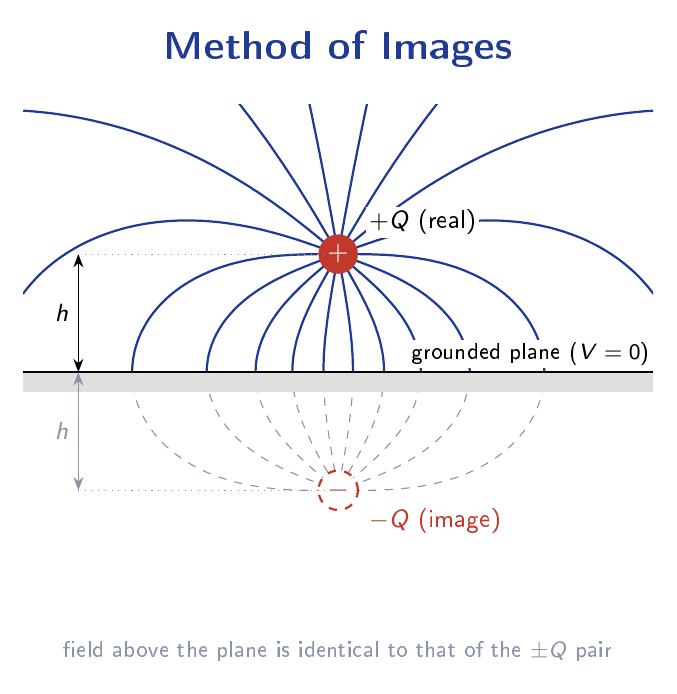
Replace a conductor (or dielectric interface) with a fictitious image charge that satisfies the boundary condition on the conductor surface. The uniqueness theorem guarantees correctness.
Charge \(+Q\) at height \(h\) above an infinite grounded plane. Image: \(-Q\) at \(-h\).
Poisson's and Laplace's Equations
Derived from \(\mathbf{E}=-\nabla V\) and \(\nabla\!\cdot\!\mathbf{D}=\rho_v\).
A solution of Laplace's (or Poisson's) equation satisfying all prescribed boundary conditions is unique. Therefore, any method — separation of variables, method of images, or numerical — that yields such a solution is correct.
Solution recipe: (1) Identify symmetry and choose coordinate system. (2) Write \(\nabla^2 V=0\) (or Poisson) in that system. (3) Integrate and apply boundary conditions to fix integration constants. (4) Obtain \(\mathbf{E}=-\nabla V\), then \(\rho_s\), \(Q\), and \(C\).
Conductors, Dielectrics, and Capacitance
Current Density and the Continuity Equation
Convection: \(\mathbf{J}=\rho_v\mathbf{u}\). Conduction (point-form of Ohm's law): \(\mathbf{J}=\sigma\mathbf{E}\). Total current: \(I=\int_S\mathbf{J}\cdot d\mathbf{S}\).
Charge is conserved everywhere in space.
Charge Relaxation: In a conducting medium, \(\rho_v(t)=\rho_v(0)\,e^{-t/T_r}\) where \(T_r=\varepsilon/\sigma\). For copper \(T_r\sim 10^{-19}\) s (essentially instantaneous); for mica \(T_r\) is several hours.
Resistance and the RC Duality
For any geometry, replace \(\varepsilon\to\sigma\) in the capacitance formula to get \(R\) of its leaky version. Example: coaxial capacitor \(C=2\pi\varepsilon L/\ln(b/a)\) → leakage resistance \(R=\ln(b/a)/(2\pi\sigma L)\).
Conductors and Dielectric Polarisation
\(\mathbf{E}=0\) and \(\rho_v=0\) inside. All free charge resides on the surface. \(\mathbf{E}\) just outside is purely normal; the conductor is an equipotential.
\(\varepsilon_r=1+\chi_e\). Bound charges: \(\rho_{pb}=-\nabla\!\cdot\!\mathbf{P}\), \(\rho_{sb}=\mathbf{P}\!\cdot\!\hat{\mathbf{n}}\).
Boundary Conditions — Electrostatics
If no free surface charge: \(D_{1n}=D_{2n}\). Field refraction law: \(\tan\theta_1/\tan\theta_2=\varepsilon_1/\varepsilon_2\).
At a conductor–dielectric surface: \(E_t=0\) and \(D_n=\rho_s\). These conditions follow from applying Maxwell's equations in integral form to a pillbox or loop straddling the interface.
Capacitance — Standard Results
| Geometry | Capacitance |
|---|---|
| Parallel plate (area \(A\), gap \(d\)) | \(C=\varepsilon A/d\) |
| Coaxial (inner \(a\), outer \(b\), length \(L\)) | \(C=2\pi\varepsilon L/\ln(b/a)\) |
| Concentric spheres (inner \(a\), outer \(b\)) | \(C=4\pi\varepsilon/\bigl(1/a-1/b\bigr)\) |
| Isolated sphere (radius \(a\)) | \(C=4\pi\varepsilon a\) |
| Two dielectrics in series (plate cap.) | \(1/C=d_1/(\varepsilon_1 A)+d_2/(\varepsilon_2 A)\) |
Series: \(1/C_{\text{eq}}=\sum 1/C_i\). Parallel: \(C_{\text{eq}}=\sum C_i\). Stacked dielectrics between plates are capacitors in series.
Magnetostatics
Magnetostatics deals with the fields produced by steady (DC) currents. The fundamental law is the Biot–Savart law, and Ampère's circuital law provides a powerful tool when symmetry permits.
Biot–Savart Law
- Infinite wire: \(H=I/(2\pi\rho)\)
- Circular loop centre (radius \(a\)): \(H=I/(2a)\)
- On-axis at distance \(z\) from loop: \(H=Ia^2/[2(a^2+z^2)^{3/2}]\)
- Infinite solenoid (\(n\) turns/m): \(H=nI\)
- Toroid: \(H=NI/(2\pi\rho)\)
Ampère's Circuital Law and Magnetic Flux
No magnetic monopoles — all field lines form closed loops.
Only when symmetry allows \(H\) to be constant along an Amperian loop: infinite wire, infinite solenoid, toroid, coaxial cable.
Magnetic Potentials
Since \(\nabla\!\cdot\!\mathbf{B}=0\): \(\mathbf{B}=\nabla\!\times\!\mathbf{A}\).
In Coulomb gauge (\(\nabla\!\cdot\!\mathbf{A}=0\)): \(\nabla^2\mathbf{A}=-\mu\mathbf{J}\).
Magnetic flux: \(\Psi=\oint_C\mathbf{A}\cdot d\mathbf{l}\).
Valid only in current-free regions (\(\mathbf{J}=0\)):
Useful for magnetic circuits and permanent-magnet analysis.
Forces, Torques, and the Hall Effect
Wire: \(\mathbf{F}=\int I\,d\mathbf{l}\times\mathbf{B}\)
Parallel wires: \(F/L=\mu_0 I_1 I_2/(2\pi d)\)
Magnetic moment: \(\mathbf{m}=I\mathbf{S}\). Torque: \(\mathbf{T}=\mathbf{m}\times\mathbf{B}\). Potential energy: \(U=-\mathbf{m}\cdot\mathbf{B}\).
\(n\) = carrier density, \(t\) = thickness. The sign of \(V_H\) distinguishes \(n\)-type from \(p\)-type. Parallel currents attract; anti-parallel repel.
Magnetic Materials
| Type | \(\chi_m\) | Examples |
|---|---|---|
| Diamagnetic | \(<0\), small (\(\sim10^{-5}\)) | Cu, Bi, Ag, water |
| Paramagnetic | \(>0\), small (\(\sim10^{-3}\)) | Al, Pt, Mn |
| Ferromagnetic | \(\gg 1\), nonlinear, hysteresis | Fe, Ni, Co |
Field refraction: \(\tan\theta_1/\tan\theta_2=\mu_1/\mu_2\). At a perfect conductor surface: \(B_n=0,\;H_t=K\).
Magnetic Circuits and the Electrical Analogy
| Electric Quantity | Magnetic Analogue |
|---|---|
| EMF \(V\) | MMF \(NI\) |
| Current \(I\) | Flux \(\Psi\) |
| Resistance \(R=\ell/\sigma A\) | Reluctance \(\mathscr{R}=\ell/\mu A\) |
| Conductivity \(\sigma\) | Permeability \(\mu\) |
| KVL | Hopkinson's law (loop) |
| KCL | Flux continuity (node) |
Inductance and Magnetic Energy
Self-inductance: \(L=N\Psi/I=\lambda/I\). Mutual inductance: \(M_{12}=N_2\Psi_{12}/I_1\), and \(M_{12}=M_{21}\). Coupling coefficient: \(k=M/\sqrt{L_1 L_2}\), with \(0\le k\le 1\).
| Geometry | Inductance |
|---|---|
| Solenoid (\(N\) turns, length \(\ell\), area \(A\)) | \(L=\mu N^2 A/\ell\) |
| Toroid (\(N\) turns, mean radius \(\rho_0\)) | \(L\approx\mu N^2 A/(2\pi\rho_0)\) |
| Coaxial (per unit length) | \(L'=\dfrac{\mu}{2\pi}\ln(b/a)\) |
| Two parallel wires (per unit length) | \(L'=\dfrac{\mu}{\pi}\cosh^{-1}(d/2a)\) |
Energy density: \(w_m=B^2/(2\mu)=\tfrac{1}{2}\mu H^2\).
Time-Varying Fields and Maxwell's Equations
Faraday's Law of Induction
Transformer EMF: loop fixed, \(\mathbf{B}\) time-varying.
Motional EMF: loop moves, \(\mathbf{B}\) static: \(\mathcal{E}_m=\oint(\mathbf{u}\times\mathbf{B})\cdot d\mathbf{l}\).
In the general case, both contribute.
The induced EMF opposes the change in flux that caused it. This is energy conservation in disguise — the negative sign in Faraday's law is its mathematical statement.
Displacement Current — Maxwell's Insight
Static Ampère: \(\nabla\!\times\!\mathbf{H}=\mathbf{J}\) implies \(\nabla\!\cdot\!\mathbf{J}=0\). But the continuity equation requires \(\nabla\!\cdot\!\mathbf{J}=-\partial_t\rho_v\ne 0\) for time-varying charge distributions.
Adding the displacement current \(\mathbf{J}_d=\partial_t\mathbf{D}\) resolves the inconsistency:
This single insight predicted electromagnetic waves and unified optics with electromagnetism. In a capacitor gap, \(\mathbf{J}=0\) but \(\partial_t\mathbf{D}\ne 0\), so the Amperian loop closes through the gap: \(I_d=\varepsilon A\,\partial_t E=I_{\text{wire}}\).
Maxwell's Equations — The Grand Summary
| Law | Differential Form | Integral Form |
|---|---|---|
| Gauss (Electric) | \(\nabla\!\cdot\!\mathbf{D}=\rho_v\) | \(\oint\mathbf{D}\cdot d\mathbf{S}=Q_{\text{enc}}\) |
| Gauss (Magnetic) | \(\nabla\!\cdot\!\mathbf{B}=0\) | \(\oint\mathbf{B}\cdot d\mathbf{S}=0\) |
| Faraday | \(\nabla\!\times\!\mathbf{E}=-\dfrac{\partial\mathbf{B}}{\partial t}\) | \(\oint\mathbf{E}\cdot d\mathbf{l}=-\dfrac{d}{dt}\int\mathbf{B}\cdot d\mathbf{S}\) |
| Ampère–Maxwell | \(\nabla\!\times\!\mathbf{H}=\mathbf{J}+\dfrac{\partial\mathbf{D}}{\partial t}\) | \(\oint\mathbf{H}\cdot d\mathbf{l}=I_{\text{enc}}+\dfrac{d}{dt}\int\mathbf{D}\cdot d\mathbf{S}\) |
For static fields \(\partial/\partial t=0\), so \(\mathbf{E}\) and \(\mathbf{B}\) decouple. Maxwell's equations plus the Lorentz force law constitute complete classical electrodynamics.
Retarded Potentials
Gauge condition: \(\nabla\!\cdot\!\mathbf{A}+\mu\varepsilon\,\partial_t V=0\). Under this gauge, \(V\) and \(\mathbf{A}\) each satisfy uncoupled wave equations:
Solutions are the retarded potentials: \(t_r=t-|\mathbf{r}-\mathbf{r}'|/c\) is the retarded time, confirming that information propagates at \(c\).
General Boundary Conditions
At a perfect conductor (\(\sigma\to\infty\)): \(\mathbf{E}=\mathbf{B}=0\) inside; just outside \(E_t=0\), \(D_n=\rho_s\), \(B_n=0\), \(H_t=K\).
Electromagnetic Wave Propagation
The Wave Equation
In a source-free, linear, homogeneous, isotropic medium (\(\rho_v=0\), \(\mathbf{J}=0\)), taking the curl of Faraday's law and substituting Ampère–Maxwell:
The same equation holds for \(\mathbf{H}\). This is the 3-D vector wave equation.
The fact that \(c\) falls out from purely electrical and magnetic constants convinced Maxwell that light is an electromagnetic wave.
Plane Waves in Lossless Media
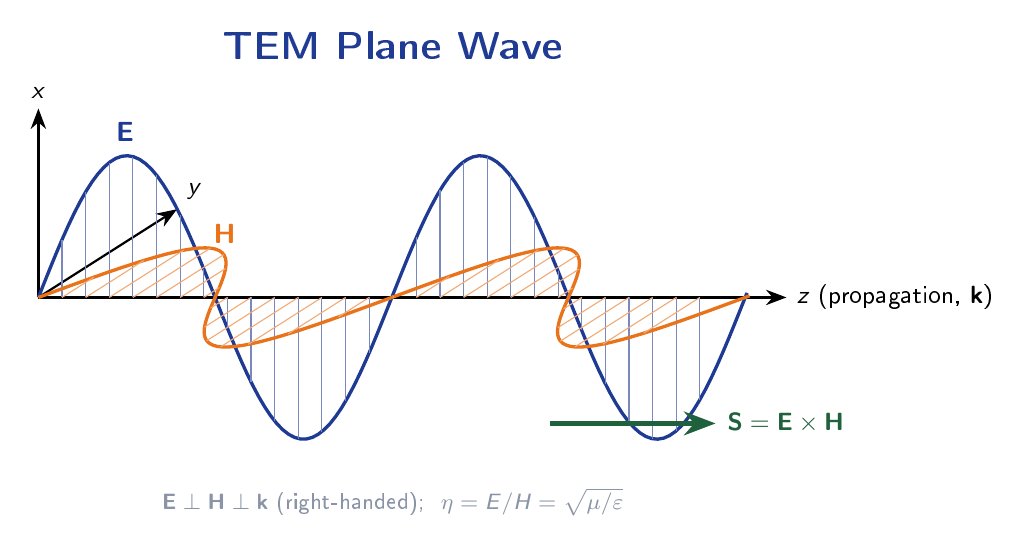
\(\mathbf{E}\perp\mathbf{H}\perp\) direction of propagation ⟹ TEM wave.
Plane Waves in Lossy Media
Loss tangent: \(\tan\delta=\sigma/(\omega\varepsilon)\). \(\ll 1\): good dielectric; \(\gg 1\): good conductor.
Behaves nearly like a lossless medium.
Strong attenuation; \(\mathbf{H}\) lags \(\mathbf{E}\) by \(45^\circ\).
Copper: \(\delta\approx 8.5\) mm at 60 Hz; \(\approx 2\;\mu\)m at 1 GHz. Hence thin silver plating suffices at RF.
Poynting Vector and Power Flow
Energy flowing in = rate of increase of stored energy + Ohmic dissipation.
Time-average: \(\mathbf{S}_{\text{avg}}=\tfrac{1}{2}\,\text{Re}\{\mathbf{E}\times\mathbf{H}^*\}\). For a plane wave in lossless medium: \(S_{\text{avg}}=|E_0|^2/(2\eta)\).
Polarisation of Plane Waves
- Linear: \(x\)- and \(y\)-components in phase (or \(180^\circ\) out). Axial ratio AR→∞.
- Circular: equal amplitudes, phase difference \(\pm90^\circ\). AR=1. RHCP or LHCP by sense of rotation.
- Elliptical: general case (unequal amplitudes or non-quadrature phase). AR between 1 and ∞.
Reflection and Transmission
Power conservation: \(|\Gamma|^2+(\eta_1/\eta_2)|\tau|^2=1\). At a perfect conductor (\(\eta_2=0\)): \(\Gamma=-1\), total reflection, SWR=\(\infty\).
Brewster's angle (no reflection for parallel/TM polarisation): \(\tan\theta_B=\sqrt{\varepsilon_2/\varepsilon_1}=n_2/n_1\).
Critical angle (total internal reflection when \(n_1>n_2\)): \(\sin\theta_c=n_2/n_1\).
Polarised sunglasses use Brewster's angle to eliminate glare. Optical fibres use total internal reflection beyond \(\theta_c\).
Transmission Lines
Distributed Parameters and Telegrapher's Equations
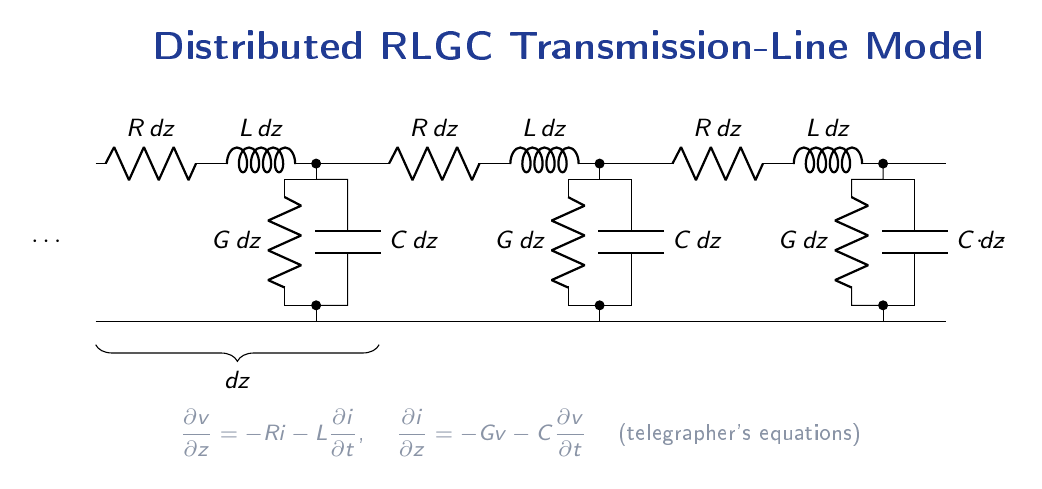
Lossless line (\(R=G=0\)): \(Z_0=\sqrt{L/C}\in\mathbb{R}\), \(\beta=\omega\sqrt{LC}\), \(v_p=1/\sqrt{LC}\).
Distortionless and Lossless Lines
\(\gamma=j\beta\), \(\alpha=0\). No attenuation and no distortion — all frequencies travel at \(v_p=1/\sqrt{LC}\).
Then \(\alpha\) is frequency-independent and \(\beta\propto\omega\) — pulses retain their shape as they attenuate uniformly. Loading coils (Pupin coils) were historically added to telephone lines to approach this condition.
Reflection and Input Impedance
| Special Case | \(Z_{\text{in}}\) |
|---|---|
| Short-circuit (\(Z_L=0\)) | \(jZ_0\tan\beta l\) |
| Open-circuit (\(Z_L=\infty\)) | \(-jZ_0\cot\beta l\) |
| Matched (\(Z_L=Z_0\)) | \(Z_0\) |
| Quarter-wave (\(l=\lambda/4\)) | \(Z_0^2/Z_L\) |
| Half-wave (\(l=\lambda/2\)) | \(Z_L\) |
VSWR, Smith Chart, and Matching
Matched line: \(|\Gamma|=0\), VSWR=1, RL→∞.
- Quarter-wave transformer: \(Z_{0T}=\sqrt{Z_0 Z_L}\) — works for real loads.
- Single stub: short-circuited stub at distance \(d\) cancels susceptance.
- Double stub: fixed spacing (often \(\lambda/8\)).
- Lumped L-section: series and shunt reactance.
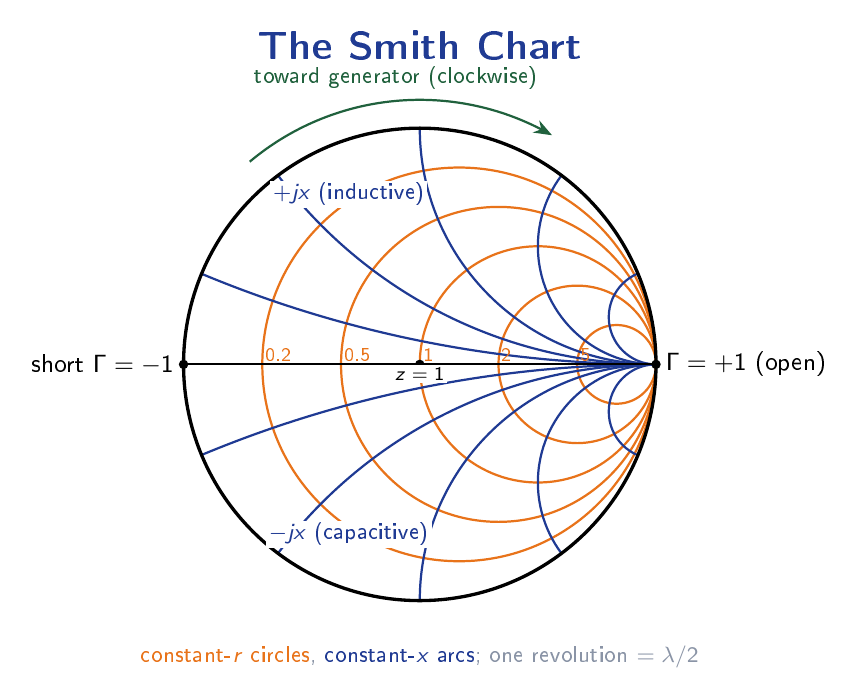
One full turn = \(\lambda/2\). Moving toward the source is clockwise; toward the load is counter-clockwise. The centre (\(\Gamma=0\)) corresponds to the matched condition \(Z_L=Z_0\).
Special Transmission Line Geometries
| Type | \(L'\) (H/m) | \(C'\) (F/m) |
|---|---|---|
| Coaxial (\(a,b\)) | \(\dfrac{\mu}{2\pi}\ln(b/a)\) | \(\dfrac{2\pi\varepsilon}{\ln(b/a)}\) |
| Two-wire (\(a,d\)) | \(\dfrac{\mu}{\pi}\cosh^{-1}(d/2a)\) | \(\dfrac{\pi\varepsilon}{\cosh^{-1}(d/2a)}\) |
| Parallel-plate (\(w,d\)) | \(\dfrac{\mu d}{w}\) | \(\dfrac{\varepsilon w}{d}\) |
Coaxial characteristic impedance: \(Z_0=\dfrac{60}{\sqrt{\varepsilon_r}}\ln(b/a)\;\Omega\).
Waveguides and Cavity Resonators
Rectangular Waveguide — TE and TM Modes
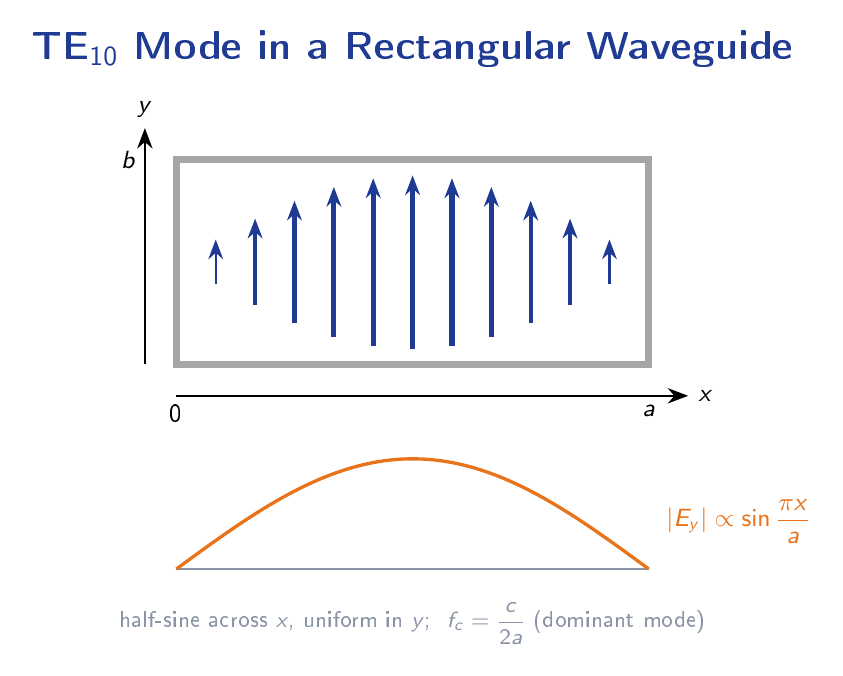
- Dominant mode: \(TE_{10}\), \(f_c=c/2a\) (assuming \(a>b\)).
- \(TM_{m0}\) and \(TM_{0n}\) modes are forbidden (\(E_z=0\) trivially).
- \(TE_{00}\) mode is forbidden (\(H_z=0\)).
Waveguide Parameters
\(v_p>c\) is the speed of phase, not energy or information. The group velocity \(v_g<c\) is the actual signal speed. The product \(v_p v_g=c^2\) links the two.
Below cutoff (\(f<f_c\)): \(\beta\) becomes imaginary → evanescent wave with exponential amplitude decay — no power is transported.
Circular Waveguide and Cavity Resonators
Modes are \(TE_{np}\) and \(TM_{np}\), involving Bessel functions \(J_n\).
Dominant mode: \(TE_{11}\), \(k_c a=1.8412\) (first root of \(J'_1\)).
\(TM_{01}\) has \(k_c a=2.4048\) (first root of \(J_0\)).
For \(a>d>b\), dominant mode is \(TE_{101}\).
Typical metallic cavity: \(Q\sim 10^4\) — far higher than any lumped LC circuit.
Microwave ovens use the \(TE_{10}\) mode at 2.45 GHz in standard waveguide WR-340. For single-mode operation the band is chosen so that only the dominant mode propagates; higher-order modes are deliberately suppressed.
Antennas and Radiation
Hertzian Dipole Radiation
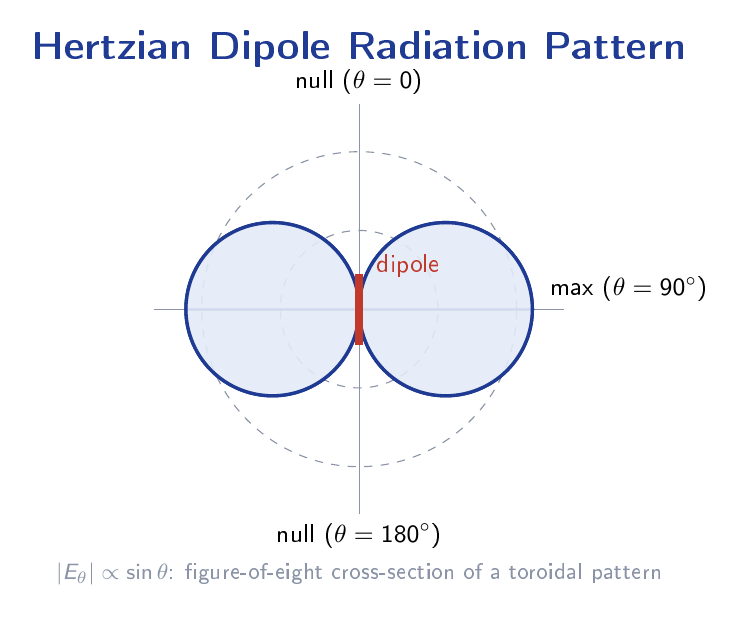
Pattern: \(\sin\theta\) — nothing radiated along the axis (\(\theta=0,\pi\)); maximum at \(\theta=\pi/2\) (broadside).
Half-wave dipole: \(R_{\text{rad}}\approx 73\;\Omega\), directivity \(D\approx 1.64\) (2.15 dBi).
Antenna Parameters and Friis Equation
\(U\): radiation intensity (W/sr); \(D\): directivity; \(G\): gain; \(A_e\): effective aperture; \(e_r\): radiation efficiency.
Free-space spreading gives \(1/R^2\) dependence; gains multiply. This is the foundation of every link budget.
Round-trip propagation gives \(1/R^4\); \(\sigma_{\text{rcs}}\) is the radar cross-section of the target.
Antenna Arrays
Pattern multiplication: \(E_{\text{total}}=E_{\text{element}}\times\text{AF}\).
Broadside: \(\alpha=0\), maximum at \(\theta=90^\circ\). End-fire: \(\alpha=-\beta d\), maximum along the array axis.
The Electromagnetic Spectrum
| Band | Frequency Range | Typical Applications |
|---|---|---|
| Radio | \(10^3\)–\(10^9\) Hz | AM/FM, TV, cellular |
| Microwave | \(10^9\)–\(10^{12}\) Hz | Radar, satellite, WiFi, 5G |
| Infrared | \(10^{12}\)–\(10^{14}\) Hz | Thermal imaging, IR remote control |
| Visible | \(\sim 4\)–\(7\times10^{14}\) Hz (400–700 nm) | Human vision |
| Ultraviolet | \(10^{15}\)–\(10^{16}\) Hz | Sterilisation, fluorescence |
| X-ray | \(10^{16}\)–\(10^{19}\) Hz | Medical imaging |
| Gamma ray | >\(10^{19}\) Hz | Nuclear decay |
L (1–2 GHz), S (2–4), C (4–8), X (8–12), Ku (12–18), K, Ka. 2.4 GHz: WiFi / microwave ovens; 5 GHz: WiFi; 28 & 39 GHz: 5G mmWave.
Worked Examples (GATE Style)
Example 1 — Electrostatics Superposition
Charges \(Q_1=+4\) nC at \((0,0,0)\) m and \(Q_2=-2\) nC at \((3,0,0)\) m. Find \(\mathbf{E}\) at \(P=(0,4,0)\) m.
From \(Q_1\): \(R_1=4\) m, \(\hat{\mathbf{R}}_1=\hat{\mathbf{y}}\).
From \(Q_2\): \(\mathbf{R}_2=(-3,4,0)\), \(R_2=5\) m, \(\hat{\mathbf{R}}_2=(-0.6,0.8,0)\). Since \(Q_2\) is negative, field points toward \(Q_2\):
Total: \(\mathbf{E}_P=(0.432,\;1.674,\;0)\) V/m, \(|\mathbf{E}_P|\approx 1.73\) V/m.
Example 2 — Reflection Coefficient and VSWR
Lossless line: \(Z_0=50\;\Omega\), \(Z_L=100+j50\;\Omega\). Find \(\Gamma_L\) and VSWR.
Return loss: \(RL=-20\log_{10}(0.447)\approx 7.0\) dB.
Example 3 — Plane Wave Parameters
A 1 GHz plane wave in lossless medium with \(\varepsilon_r=4\), \(\mu_r=1\). Find \(\beta\), \(v_p\), \(\lambda\), \(\eta\).
- \(v_p=c/\sqrt{\mu_r\varepsilon_r}=3\times 10^8/2=1.5\times 10^8\) m/s.
- \(\beta=\omega/v_p=2\pi\times 10^9/(1.5\times 10^8)\approx 41.89\) rad/m.
- \(\lambda=v_p/f=0.15\) m = 15 cm.
- \(\eta=\eta_0/\sqrt{\varepsilon_r}=120\pi/2\approx 188.5\;\Omega\).
Sanity check: \(\lambda f=0.15\times 10^9=1.5\times 10^8=v_p\) ✓
Example 4 — Waveguide Analysis
Air-filled rectangular waveguide, \(a=2.5\) cm, \(b=1.0\) cm. Find \(f_c\) of the dominant mode and \(\lambda_g\) at 10 GHz.
Dominant mode \(TE_{10}\): \(f_c=c/(2a)=3\times 10^8/(2\times 0.025)=6\) GHz.
At \(f=10\) GHz: \((f_c/f)^2=0.36\), \(\sqrt{1-0.36}=0.8\).
Verify: \(v_p v_g=(3.75)(2.4)\times 10^{16}=9\times 10^{16}=c^2\) ✓
Example 5 — Skin Depth in Copper
Skin depth in copper (\(\sigma=5.8\times 10^7\) S/m, \(\mu=\mu_0\)) at 1 MHz and at 1 GHz.
At \(f=10^6\) Hz: \(\delta\approx 66\;\mu\)m.
Since \(\delta\propto 1/\sqrt{f}\), scaling by \(\sqrt{1000}\approx 31.6\): \(\delta_{1\,\text{GHz}}\approx 2.1\;\mu\)m.
Interpretation: at GHz frequencies only the outermost few micrometres of copper conduct. Thin silver plating on RF cables is therefore sufficient.
Summary, Formula Recap, and GATE Aids
Constants and Free-Space Values
| Constant | Value |
|---|---|
| \(\varepsilon_0\) (vacuum permittivity) | \(8.854\times 10^{-12}\) F/m \(=\tfrac{1}{36\pi}\times 10^{-9}\) |
| \(\mu_0\) (vacuum permeability) | \(4\pi\times 10^{-7}\) H/m |
| \(c\) (speed of light) | \(3\times 10^8\) m/s |
| \(\eta_0\) (free-space impedance) | \(120\pi\approx 377\;\Omega\) |
| \(e\) (elementary charge) | \(1.602\times 10^{-19}\) C |
Quick Formula Recap — Statics
| Quantity | Formula |
|---|---|
| Coulomb force | \(F=Q_1 Q_2/(4\pi\varepsilon R^2)\) |
| \(E\)-field of point charge | \(E=Q/(4\pi\varepsilon r^2)\) |
| \(E\)-field of line charge | \(E=\rho_l/(2\pi\varepsilon\rho)\) |
| \(E\)-field of sheet | \(E=\rho_s/(2\varepsilon)\) |
| Potential of point charge | \(V=Q/(4\pi\varepsilon r)\) |
| Dipole potential | \(V=p\cos\theta/(4\pi\varepsilon r^2)\) |
| Energy density (E) | \(w_E=\tfrac{1}{2}\varepsilon E^2\) |
| Parallel-plate capacitor | \(C=\varepsilon A/d\) |
| Coaxial capacitor | \(C=2\pi\varepsilon L/\ln(b/a)\) |
| Resistance | \(R=\ell/(\sigma A)\) |
| RC duality | \(RC=\varepsilon/\sigma\) |
| Ohm's law (point form) | \(\mathbf{J}=\sigma\mathbf{E}\) |
| Biot–Savart | \(d\mathbf{H}=I\,d\mathbf{l}\times\hat{\mathbf{R}}/(4\pi R^2)\) |
| Field of long wire | \(H=I/(2\pi\rho)\) |
| Field at loop centre | \(H=I/(2a)\) |
| Field, infinite solenoid | \(H=nI\) |
| Force on current-carrying wire | \(\mathbf{F}=\int I\,d\mathbf{l}\times\mathbf{B}\) |
| Energy density (B) | \(w_m=B^2/(2\mu)\) |
| Solenoid inductance | \(L=\mu N^2 A/\ell\) |
| Reluctance | \(\mathscr{R}=\ell/(\mu A)\) |
Quick Formula Recap — Waves and Lines
| Quantity | Formula |
|---|---|
| Wave speed | \(v=1/\sqrt{\mu\varepsilon}\) |
| Intrinsic impedance | \(\eta=\sqrt{\mu/\varepsilon}\) |
| Poynting vector | \(\mathbf{S}=\mathbf{E}\times\mathbf{H}\) |
| Average power (plane wave) | \(|E_0|^2/(2\eta)\) |
| Skin depth | \(\delta=1/\sqrt{\pi f\mu\sigma}\) |
| Loss tangent | \(\tan\delta=\sigma/(\omega\varepsilon)\) |
| Reflection coefficient | \(\Gamma=(\eta_2-\eta_1)/(\eta_2+\eta_1)\) |
| Brewster's angle | \(\tan\theta_B=\sqrt{\varepsilon_2/\varepsilon_1}\) |
| Critical angle | \(\sin\theta_c=n_2/n_1\) |
| Char. impedance (lossless) | \(Z_0=\sqrt{L/C}\) |
| Input impedance | \(Z_0(Z_L+jZ_0\tan\beta l)/(Z_0+jZ_L\tan\beta l)\) |
| Quarter-wave transformer | \(Z_{0T}=\sqrt{Z_0 Z_L}\) |
| VSWR | \((1+|\Gamma|)/(1-|\Gamma|)\) |
| Distortionless condition | \(R/L=G/C\) |
| Waveguide cutoff | \(f_c=\tfrac{1}{2\sqrt{\mu\varepsilon}}\sqrt{(m/a)^2+(n/b)^2}\) |
| Guide wavelength | \(\lambda_g=\lambda/\sqrt{1-(f_c/f)^2}\) |
| \(v_p v_g\) (air waveguide) | \(=c^2\) |
| Friis equation | \(P_r/P_t=G_t G_r(\lambda/4\pi R)^2\) |
| Half-wave dipole \(R_{\text{rad}}\) | \(\approx 73\;\Omega\) |
GATE Pitfalls and Tips
\(\mathbf{E}\): V/m \(\mathbf{D}\): C/m² \(\mathbf{H}\): A/m \(\mathbf{B}\): T = Wb/m² \(\mathbf{P}\): C/m² \(\mathbf{M}\): A/m \(\mathbf{J}\): A/m² \(\mathbf{S}\): W/m²
Point: \(\sim 1/r^2\). Line: \(\sim 1/\rho\). Sheet: constant (distance-independent). Inside a uniformly charged sphere: \(\mathbf{E}\propto r\) (linear, not zero, not \(1/r^2\)).
Tangential \(\mathbf{E}\) always continuous. Normal \(\mathbf{B}\) always continuous. \(D_n\) jumps by \(\rho_s\). \(H_t\) jumps by \(K\).
\(\delta=1/\sqrt{\pi f\mu\sigma}\). In good conductors \(\alpha=\beta=1/\delta\). \(\delta\propto 1/\sqrt{f}\).
Dominant mode in rectangular: \(TE_{10}\), \(f_c=c/2a\). Modes \(TM_{m0}\), \(TM_{0n}\), \(TE_{00}\) are all forbidden. \(v_p v_g=c^2\) (air-filled).
Quarter-wave transformer for real loads: \(Z_{0T}=\sqrt{Z_0 Z_L}\). Smith chart: one full turn = \(\lambda/2\); moving toward source is clockwise. Distortionless: \(R/L=G/C\). Lossless: \(R=G=0\).
Circular polarisation: equal amplitudes, \(\pm 90^\circ\) phase difference. Brewster angle: only for parallel (TM) polarisation. Friis: received power falls as \(1/R^2\); radar as \(1/R^4\).
Study Strategy for GATE
- Master vector calculus first — every EMFT problem reduces to grad, div, or curl.
- Memorise standard field formulas for point, line, sheet, sphere, and coaxial geometries.
- Understand boundary conditions thoroughly — they are a consistent high-weightage topic.
- Practice Maxwell's equations in both integral and differential forms.
- Drill transmission-line problems on the Smith chart.
- Know waveguide cutoff and mode-existence rules cold.
- Derive, don't memorise blindly. A derivation protects you when question wording shifts.
- Solve previous-year papers — patterns recur: skin depth, \(\Gamma\), \(f_c\), Friis, polarisation.
Statics: 30% | Time-varying + Maxwell: 15% | EM Waves: 20% | Lines & Guides: 25% | Antennas: 10%.
Conceptual Map — How Topics Connect
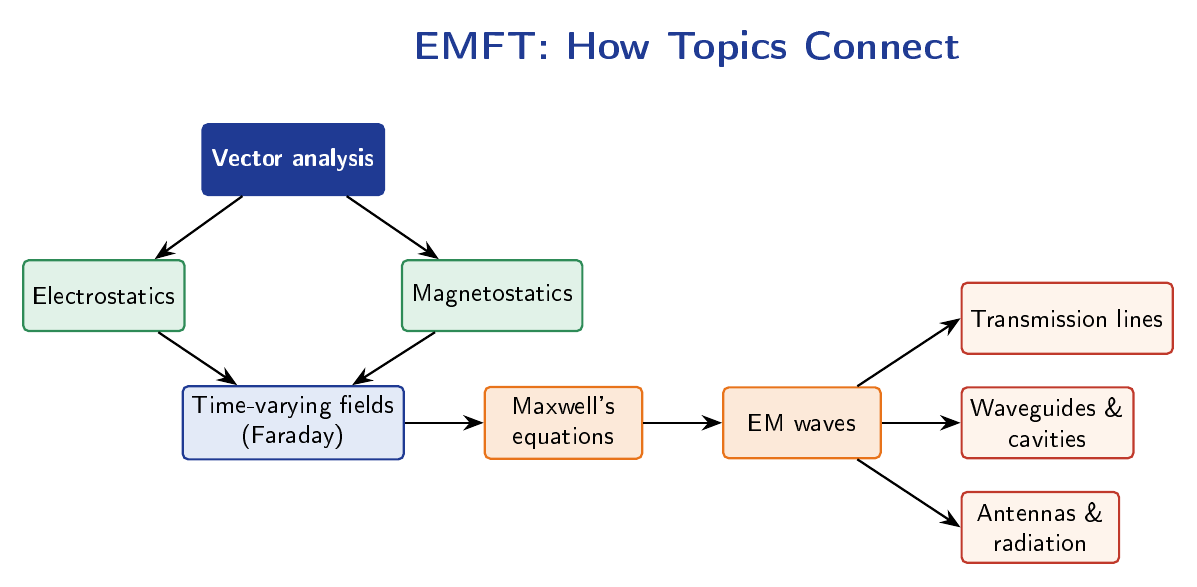
Every topic downstream depends on Maxwell's equations. Master them first — they unify everything learned in statics into a single framework supporting wave propagation, guidance, and radiation.
Recommended References
- M. N. O. Sadiku, Elements of Electromagnetics — Oxford University Press. (Primary text)
- W. H. Hayt & J. A. Buck, Engineering Electromagnetics — McGraw-Hill.
- D. K. Cheng, Field and Wave Electromagnetics — Pearson.
- J. D. Kraus, Electromagnetics — McGraw-Hill.
- D. J. Griffiths, Introduction to Electrodynamics — Pearson.
- D. M. Pozar, Microwave Engineering — for transmission lines, waveguides, and the Smith chart.
- C. A. Balanis, Antenna Theory: Analysis and Design — for antennas and arrays.
- GATE previous-year papers (EE and EC streams).
- NPTEL lectures on Electromagnetic Theory — Prof. Pradeep Kumar K, IIT Madras.
- MIT OpenCourseWare 8.03 — Physics III: Vibrations and Waves.
- NPTEL courses on Transmission Lines and Waveguides — excellent for Smith chart practice.