Electrical Machines
From Fundamentals to GATE-Level Mastery — A Comprehensive Study Note
- Explain the principles of electromagnetic induction and magnetic circuits, and apply them to electrical machines.
- Analyse the steady-state performance of DC machines, transformers, induction motors, and synchronous machines.
- Derive the EMF, torque, power-flow, and equivalent-circuit equations for each machine class.
- Compute efficiency, voltage regulation, slip, power factor, and starting performance using standard tests.
- Select appropriate starting, speed-control, and braking techniques for a given application.
- Solve GATE/ESE/PSU-level numerical problems with clear physical interpretation.
- Appreciate modern developments — BLDC, PMSM, SRM, stepper, linear motors — and their role in EVs and automation.
Pre-requisites: Basic Circuit Theory · Electromagnetic Field Theory · Fundamentals of Electrical Engineering.
1. Fundamentals of Electromagnetism
- Magnetic-field production by current.
- Force on current-carrying conductors in a field.
- EMF induction by changing flux.
- Energy conservation between electrical, magnetic, and mechanical domains.
Faraday's and Lenz's Laws
The induced EMF in a coil of \(N\) turns is given by Faraday's law: \[ e \;=\; -N\,\frac{d\Phi}{dt}. \] Lenz's law states that the induced EMF always opposes the change that caused it, ensuring energy conservation.
Ampere's Law and MMF
For a magnetic circuit with a mean path length \(\ell\), cross-sectional area \(A\), and permeability \(\mu\): \[ \mathcal{F} \;=\; NI \;=\; H\ell \;=\; \Phi\,\mathcal{R}, \qquad \mathcal{R} = \frac{\ell}{\mu A}. \] Reluctances in series add; reluctances in parallel combine as conductances (the dual of Kirchhoff's laws for electric circuits).
Hysteresis and Eddy-Current Losses
Ferromagnetic cores suffer two types of core loss. The B–H hysteresis loop shows residual flux density \(B_r\) retained when \(H \to 0\) and coercive force \(H_c\) required to reduce \(B\) back to zero. The area enclosed by the loop represents energy dissipated per cycle per unit volume.
To reduce eddy-current loss, cores are made of thin silicon-steel laminations of thickness \(t\). To reduce hysteresis loss, materials with a narrow loop (CRGO, amorphous alloys) are used.
2. Electromechanical Energy Conversion
Field Energy and Co-energy (Linear, Singly-Excited)
For a linear magnetic system: \[ W_{\text{fld}} \;=\; \int_0^{\lambda} i\,d\lambda \;=\; \frac{\lambda^2}{2L} \;=\; \frac{1}{2}LI^2, \qquad W'_{\text{fld}} \;=\; \int_0^{i}\lambda\,di \;=\; \frac{1}{2}LI^2. \] The force at constant current (mechanical variable \(x\)) is: \[ F \;=\; \left.\frac{\partial W'_{\text{fld}}}{\partial x}\right|_i. \]
Singly-Excited vs Doubly-Excited Systems
In a singly-excited system (e.g., variable-reluctance stepper, switched-reluctance motor), only one winding carries current and torque arises purely from reluctance: \(T = \tfrac{1}{2}I^2\,dL/d\theta\). Non-zero torque requires rotor saliency (\(dL/d\theta \neq 0\)).
In a doubly-excited system (e.g., synchronous machine, DC machine, wound-rotor induction motor), both windings carry current. For a cylindrical rotor the self-inductance derivatives vanish, leaving only the mutual term; for a salient-pole rotor both reluctance and mutual torques contribute.
3. DC Machines
Construction
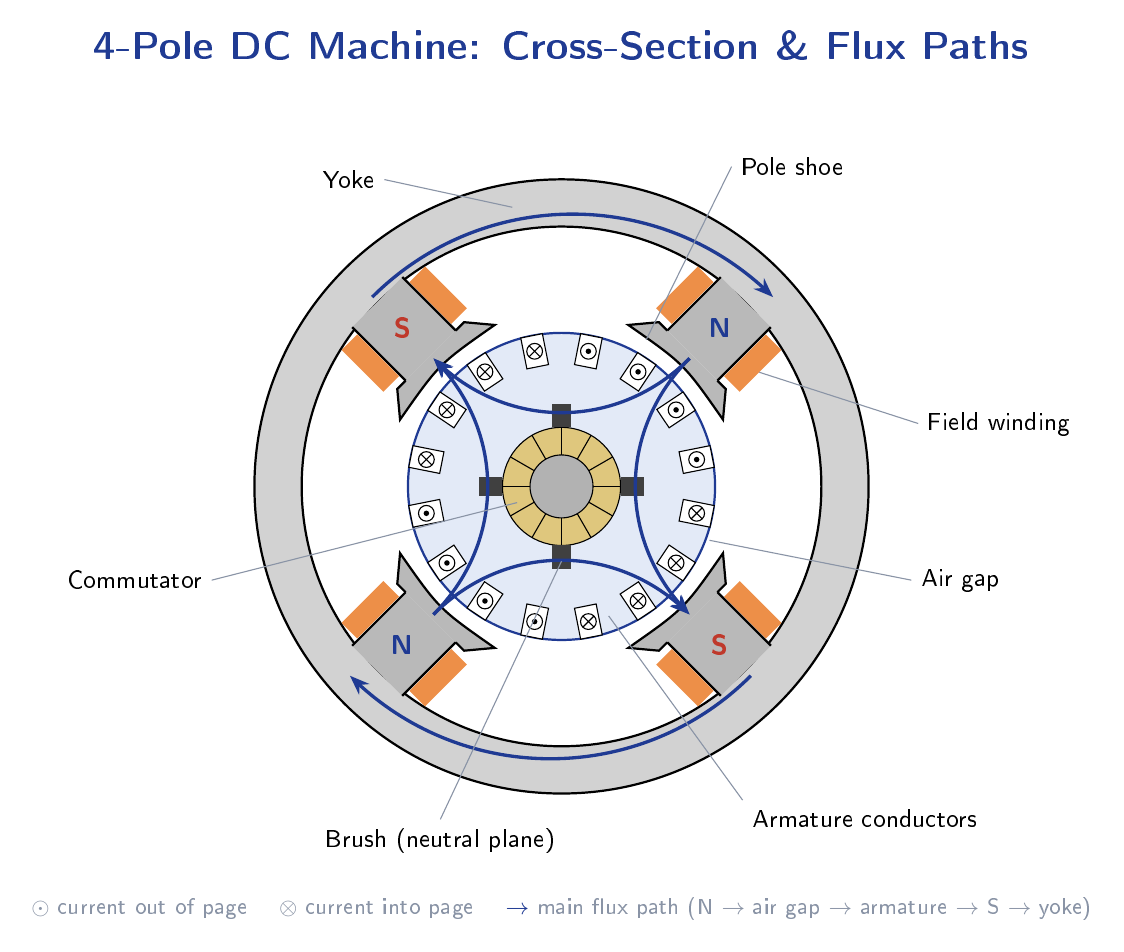
A DC machine consists of a yoke (outer flux path and mechanical support), pole cores and shoes carrying the field winding, a laminated armature core, an armature winding (lap or wave), a commutator (mechanical AC-to-DC rectifier), brushes, and optionally interpoles and a compensating winding for commutation improvement.
| Property | Lap | Wave |
|---|---|---|
| Parallel paths \(A\) | \(P\) | \(2\) |
| Best for | High current, low voltage | Low current, high voltage |
| Equalizers | Yes | No |
| Number of brushes | \(P\) | \(2\) |
| Coil span | ≈ pole pitch | ≈ 2 × pole pitch |
EMF and Torque Equations
The EMF in one conductor is \(e = B L v\). Summing over all series conductors per parallel path:
Motor and Generator Conventions
Motor (back-EMF \(E_b\)): \(V = E_b + I_a R_a\), so \(E_b = V - I_a R_a\).
Generator (generated EMF \(E_g\)): \(E_g = V + I_a R_a\).
Mechanical power developed: \(P_m = E_b I_a = T\omega\). Shaft output: \(P_{\text{out}} = P_m - P_{\text{rot}}\).
Armature Reaction and Commutation
Armature reaction is the effect of the armature MMF on the main field. It has two components: a cross-magnetising component that distorts the field along the q-axis, and a demagnetising component when brushes are shifted forward.
Commutation involves reversing the current in a coil passing under the brush. The reactance voltage \(e_L = L(2I_c/T_c)\) opposes reversal, causing delayed commutation and sparking. Remedies include interpoles (commutating poles), a compensating winding in the pole face for large machines, and high-resistance carbon brushes.
DC Generator: Types and Self-Excitation
DC generators are classified as separately excited (field from external source) or self-excited. Self-excited types include shunt (\(R_{sh}\) in parallel), series (\(R_{se}\) in series), and compound (both, cumulative or differential).
Series: \(\;I_a = I_{se} = I_L,\;\; E_g = V + I_a(R_a + R_{se})\)
DC Motor: Types and Speed–Torque Characteristics
| Property | Shunt | Series | Cum. Compound | Diff. Compound |
|---|---|---|---|---|
| Speed regulation | Good | Poor (highly variable) | Moderate | Very flat |
| Starting torque | Moderate | Very high | High | Low |
| No-load behaviour | Safe | Runaway | Safe | Safe |
| \(T\)–\(I_a\) shape | Linear | Parabolic (\(\propto I_a^2\)) | Mixed | Mixed |
| Typical applications | Lathes, fans | Traction, cranes | Rolling mills, lifts | Rare |
For a shunt motor, flux is constant, so \(T \propto I_a\) and speed is approximately constant. For a series motor, pre-saturation gives \(\Phi \propto I_a\), hence \(T \propto I_a^2\) and \(N \propto 1/\sqrt{T}\).
Speed Control and Braking of DC Motors
Shunt motor methods: (a) Flux control via variable field resistance — gives speeds above base, constant power; (b) Armature-resistance control — below base speed, constant torque, lossy; (c) Voltage control (Ward–Leonard) — smooth, four-quadrant operation.
- Regenerative: \(E_b > V\) — power returned to mains.
- Dynamic (rheostatic): disconnect supply, dissipate \(E_b\) in a resistor.
- Plugging: reverse supply polarity — fastest stop, very lossy.
Modern alternatives include chopper (DC–DC) drives for buck/boost/four-quadrant control, and fully-controlled rectifier drives where \(V_a = V_{dm}\cos\alpha\) for a full converter under continuous conduction.
DC Machine Losses, Efficiency, and Tests
Losses are classified as: copper losses (\(I_a^2 R_a\), \(I_f^2 R_f\), brush contact) — variable with load; iron losses (hysteresis and eddy current) — approximately constant; mechanical losses (friction, windage) — approximately constant; and stray losses (~1% of output).
Swinburne's test is a no-load test on a shunt motor that determines constant losses, enabling efficiency prediction at any load (not applicable to series motors). Hopkinson's (back-to-back) test uses two identical machines to find full-load losses without supplying full-load power.
4. Transformers
The factor 4.44 arises from \(\sqrt{2}\pi \approx 4.44\), which appears when integrating \(V_m\sin\omega t\) over a half-cycle and converting to RMS.
Core-Type vs Shell-Type Construction
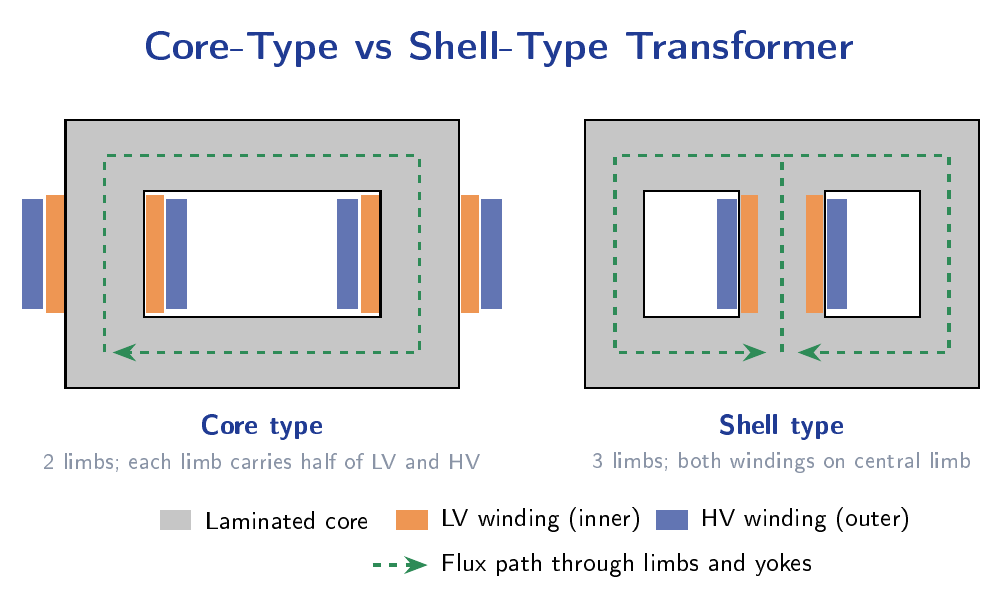
In the core-type, each limb carries half the LV and half the HV winding, providing good leakage reactance control. In the shell-type, both windings sit concentrically on the central limb with the core enclosing them, providing better mechanical protection and lower leakage flux.
Equivalent Circuit and Phasor Diagram
Voltage Regulation
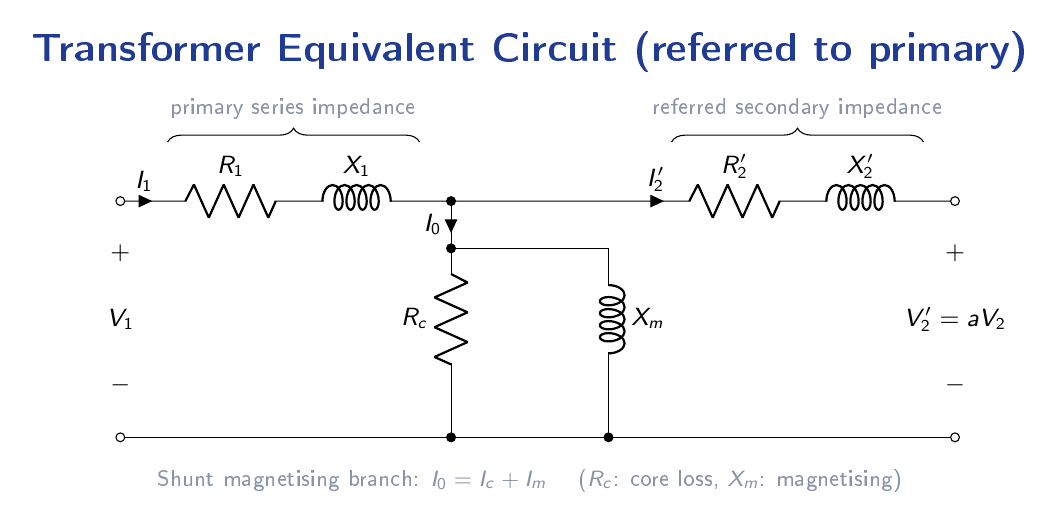
Zero regulation occurs at \(\tan\phi = R_{02}/X_{02}\) (leading load). Maximum regulation occurs at \(\tan\phi = X_{02}/R_{02}\) (lagging load): \(\text{Reg}_{\max} = \sqrt{v_r^2 + v_x^2}\).
Efficiency and All-Day Efficiency
\[ \eta \;=\; \frac{V_2 I_2\cos\phi}{V_2 I_2\cos\phi + P_i + P_{cu}} \]Open-Circuit and Short-Circuit Tests
Three-Phase Transformer Connections
| Connection | Line Voltage Ratio | Phase Shift | Application |
|---|---|---|---|
| Y–Y | \(N_1/N_2\) | \(0°\) | Rarely used (3rd-harmonic issues) |
| \(\Delta\)–\(\Delta\) | \(N_1/N_2\) | \(0°\) | Large LV; fault-tolerant (open-\(\Delta\) possible) |
| Y–\(\Delta\) | \(\sqrt{3}\,N_1/N_2\) | \(30°\) lag | Generator step-down |
| \(\Delta\)–Y | \(N_1/(\sqrt{3}\,N_2)\) | \(30°\) lead | Distribution step-up; LV neutral available |
Special Transformers
PT: steps down voltage to 110 V — never short-circuit the secondary.
Magnetising Inrush Current and Harmonics
Excitation-current harmonics arise from B–H non-linearity, predominantly the 3rd, plus 5th, 7th, etc. In a Y–Y connection without neutral, 3rd-harmonic flux has no path, causing peaked phase EMF and insulation stress. A tertiary delta winding provides a circulating path for 3rd-harmonic currents.
Tap Changers and Three-Winding Transformers
Taps on the HV side adjust the turns ratio to control voltage. An off-load tap changer (DETC) requires de-energisation; an on-load tap changer (OLTC) switches seamlessly using a diverter switch with resistor or reactor transition. Typical range: ±10% in steps of 1.25% or 2.5%.
A three-winding transformer adds a tertiary (usually delta) winding that suppresses 3rd-harmonic distortion, supplies auxiliary loads, or connects reactive compensators. An open-delta (V–V) connection delivers \(\sqrt{3}\) times the single-unit rating, i.e., 57.7% of the closed-delta capacity — used for emergency or small loads.
5. Three-Phase Induction Motors
The squirrel-cage rotor uses short-circuited aluminium or copper bars — rugged and simple but with relatively low starting torque. The slip-ring (wound-rotor) type brings out the 3-phase rotor winding via slip rings, allowing external resistance for high starting torque and speed control.
Rotating Magnetic Field (Ferraris Principle)
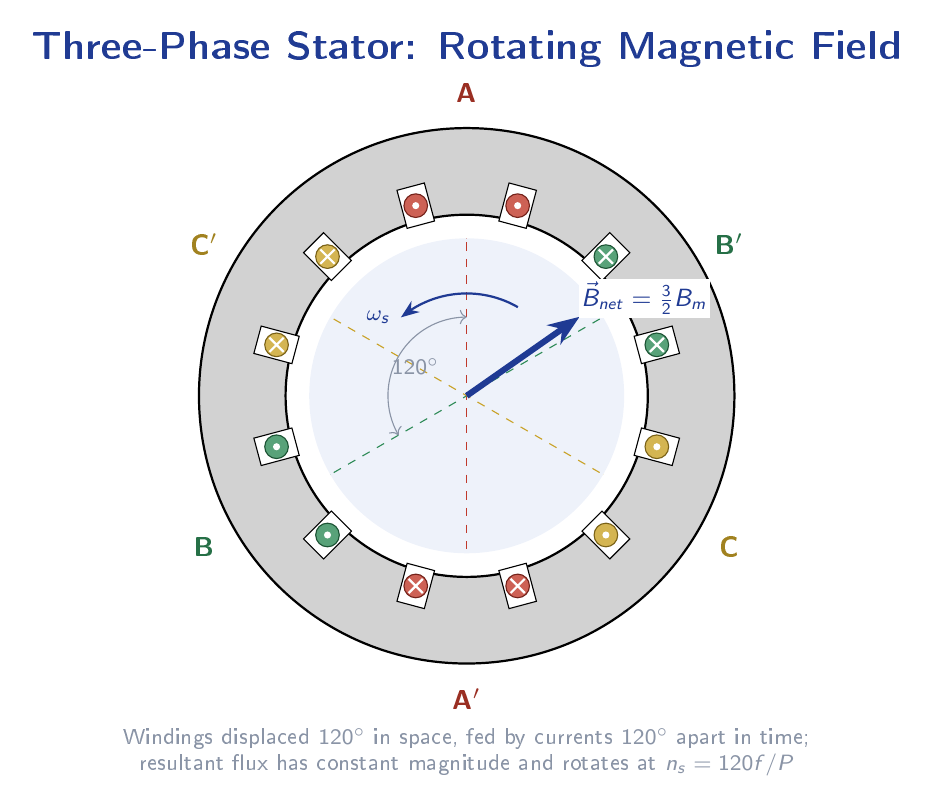
Three windings displaced 120° in space, fed by three-phase currents displaced 120° in time, produce: \[ \vec{B}_{\text{net}}(t) \;=\; B_A + B_B + B_C \;=\; \tfrac{3}{2}\,B_m \angle\omega t. \] The amplitude is constant at \(\tfrac{3}{2}B_m\) and the direction rotates at \(\omega_s = 2\pi f/(P/2)\). Swapping any two supply phases reverses the direction of rotation.
Torque Equation
Torque–Slip Characteristic
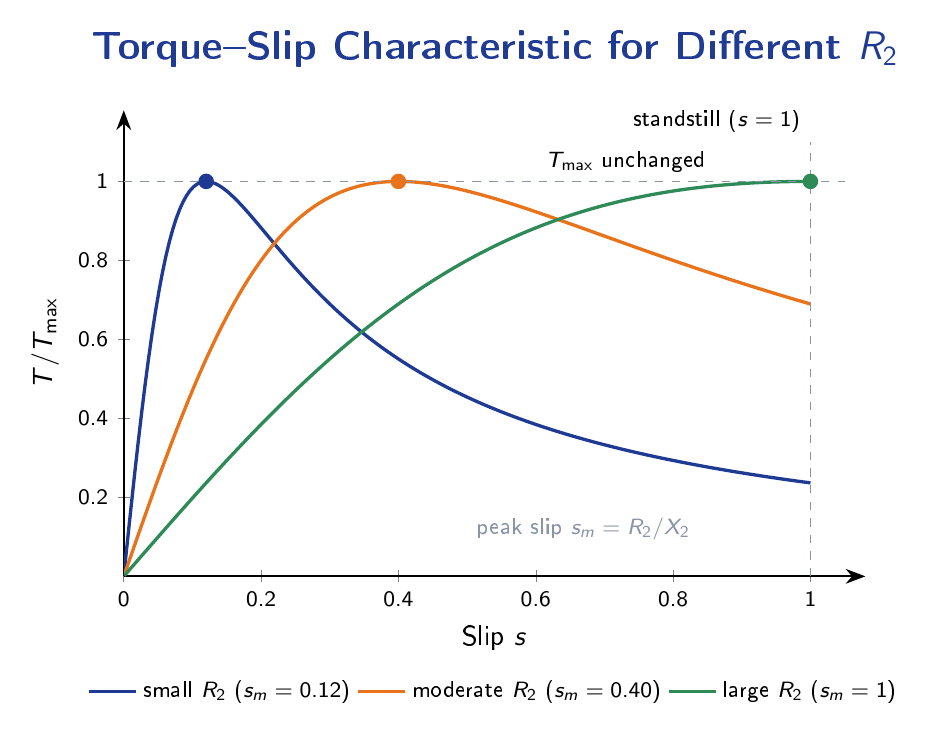
Three operating regions exist: the stable motoring region (\(0 < s < s_m\), where \(T \propto s\)); the unstable region (\(s_m < s < 1\), transited only during starting); and the plugging region (\(s > 1\), used for braking).
Power Flow
Equivalent Circuit and Tests
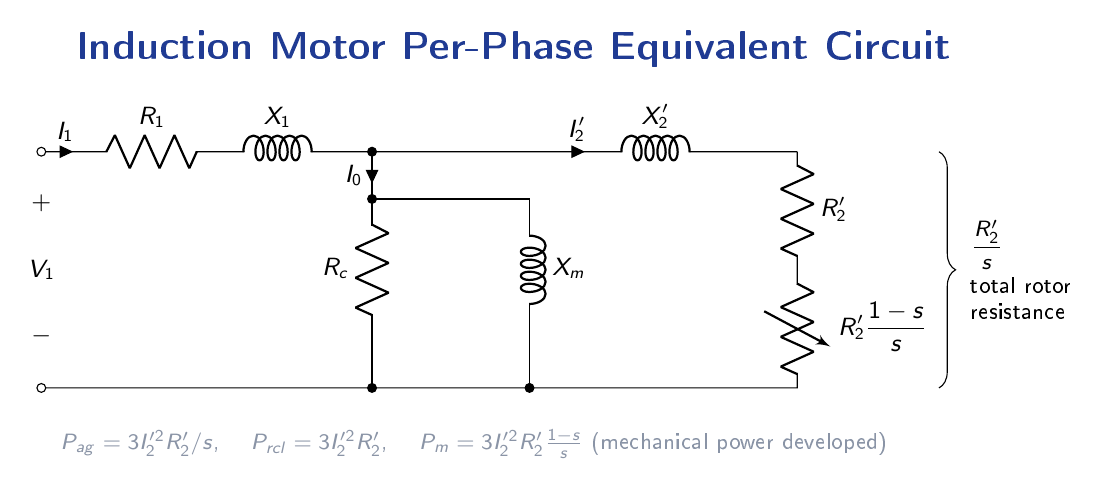
The no-load test (rated voltage, no mechanical load) separates core loss and friction/windage loss and yields the shunt branch parameters \(R_c\) and \(X_m\). The blocked-rotor test (reduced voltage, rotor locked) gives the series branch parameters \(R_{eq}\) and \(X_{eq}\).
Starting Methods
| Starter | Line Starting Current | \(T_{st}/T_{FL}\) |
|---|---|---|
| Direct-on-line (DOL) | \(I_{sc}\) | \((I_{sc}/I_{FL})^2\,s_{FL}\) |
| Stator resistor / reactor | \(x\,I_{sc}\) | \(x^2(I_{sc}/I_{FL})^2\,s_{FL}\) |
| Auto-transformer (\(K\) tap) | \(K^2 I_{sc}\) | \(K^2(I_{sc}/I_{FL})^2\,s_{FL}\) |
| Star–Delta | \(I_{sc}/3\) | \(\tfrac{1}{3}(I_{sc}/I_{FL})^2\,s_{FL}\) |
| Rotor-resistance (slip-ring) | As designed | Up to \(T_{\max}\) |
| Soft starter (TRIAC/IGBT) | Smoothly ramped | Adjustable |
| VFD | \(\leq I_{FL}\) | \(T_{\max}\) at start |
Star–Delta starting requires the motor to be rated for delta-running; both line current and starting torque reduce to one-third of DOL values.
Speed Control
Stator-side methods: V/f control (most common — keeps \(\Phi\) constant, \(V/f = \text{const}\)); voltage control (lossy, \(T \propto V^2\)); pole-changing for discrete speed steps; variable-frequency drive (VFD).
Rotor-side methods (slip-ring only): external rotor resistance (simple but lossy); cascade connection; slip-power recovery via Kramer or Scherbius drives (efficient for large machines).
Crawling: stable running at approximately \(N_s/7\) — caused by 7th-harmonic torque from the slotted stator.
Braking and Double-Cage Rotor
Braking methods include plugging (reverse two phases, slip becomes \(2-s\), high rotor heating), dynamic braking (disconnect AC, apply DC to stator), and regenerative braking (drive \(N_r > N_s\), slip becomes negative, power returned to mains).
Induction Generator
6. Single-Phase Induction Motors
| Type | Starting Torque | Typical Application |
|---|---|---|
| Split-phase | \(1.5–2\,T_{FL}\) | Fans, small pumps |
| Capacitor-start | \(3–4.5\,T_{FL}\) | Compressors, refrigerators |
| Capacitor-start & -run | \(3–4.5\,T_{FL}\) | Better pf, quieter operation |
| Permanent capacitor (PSC) | \(\sim 0.5\,T_{FL}\) | Fans, blowers, indoor AC |
| Shaded-pole | Very low | Small fans, toys |
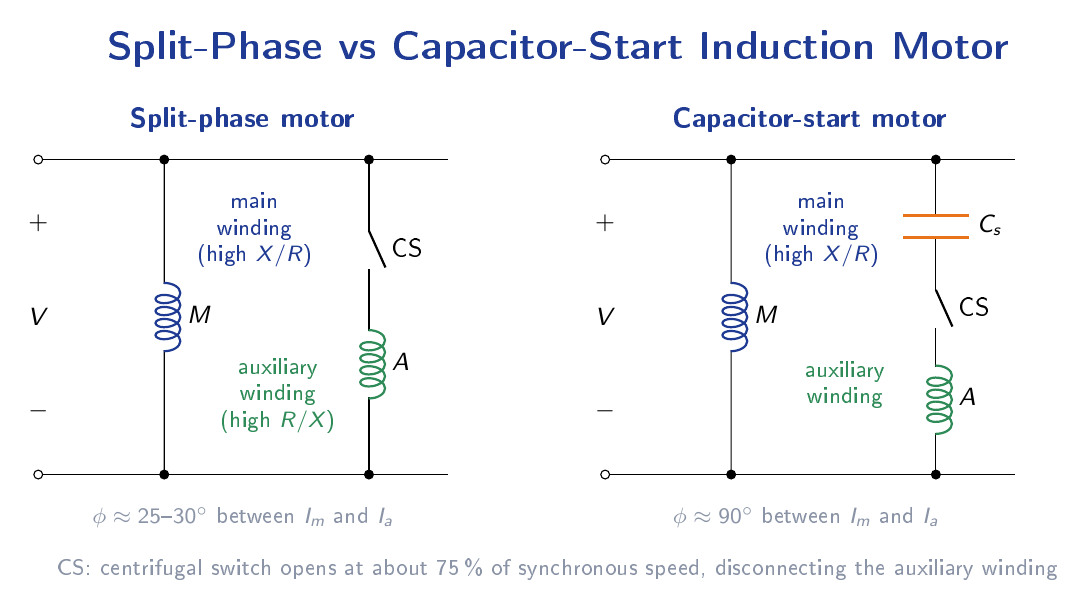
A centrifugal switch disconnects the auxiliary winding once the rotor reaches approximately 75% of synchronous speed, after which the motor runs on the main winding alone. A universal motor (series DC type) operates on both AC and DC, achieving high speed; used in drills, mixers, and vacuum cleaners.
7. Synchronous Machines
Construction
The stator (armature) carries the 3-phase AC winding. The rotor (field) carries DC excitation fed via slip rings or a brushless exciter.
Cylindrical (non-salient): high speed (1500–3000 rpm), 2 or 4 poles, small diameter and long axial length, used in turbo-generators (steam, gas). Uniform air gap gives \(X_d = X_q\).
EMF Equation
Pitch factor: \(\;K_p = \cos(\alpha/2)\) (\(\alpha\) = short-pitch angle)
Short-pitching reduces harmonic content, saves end-turn copper, and lowers slot-leakage reactance. The \(n\)th harmonic is eliminated when \(K_{p,n} = \cos(n\alpha/2) = 0\), i.e., \(\alpha = 180°/n\) (e.g., 5th harmonic at \(\alpha = 36°\)).
Armature Reaction in Synchronous Generators
| Load | Armature Reaction | Effect on Terminal EMF |
|---|---|---|
| Unity pf (resistive) | Cross-magnetising | Distorts field |
| Zero pf lagging (inductive) | Demagnetising | Reduces \(E\) |
| Zero pf leading (capacitive) | Magnetising | Strengthens \(E\) |
Voltage Regulation and SCR
\[ \text{Reg\%} \;=\; \frac{E_0 - V}{V} \times 100 \]Methods of determining regulation: (a) synchronous-impedance (EMF) method — pessimistic; (b) MMF (ampere-turn) method — optimistic; (c) Potier (ZPF) method — most accurate, separates \(X_l\) and \(X_a\); (d) ASA method — accounts for saturation.
Typical SCR values: 0.5–0.7 for turbo-generators; 1.0–1.5 for hydro-generators. A higher SCR means better regulation and stability but a bulkier, costlier machine.
Power Equations
Parallel Operation and Synchronising
Synchronous Motor: V-Curves and Power Angle
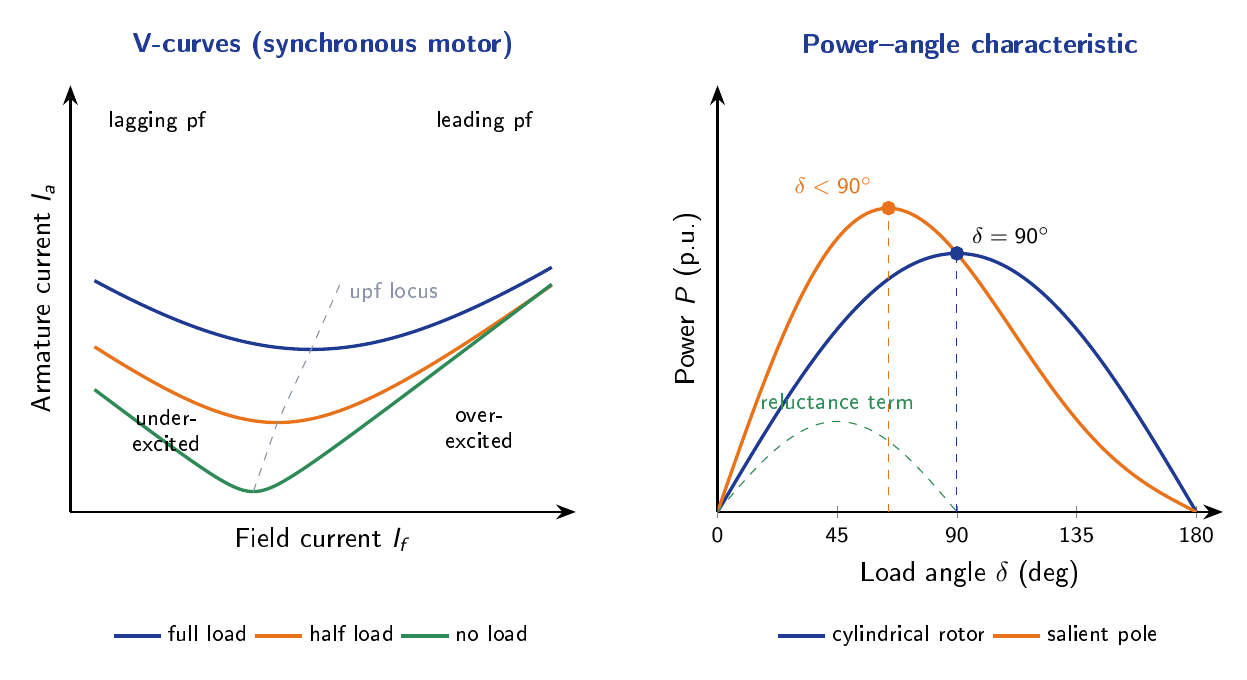
A synchronous motor runs at exactly \(N_s = 120f/P\) regardless of load. It is not self-starting (needs an auxiliary method). Power factor is adjustable via field excitation: under-excited draws lagging current; over-excited draws leading current (acts as a capacitor). Phasor equation: \(\vec{E}_b = \vec{V} - \vec{I}_a(R_a + jX_s)\).
Synchronous Condenser, Hunting, and Pull-Out Torque
Two-Reaction Theory for Salient-Pole Machines
Capability Curve
Park's (dq0) Transformation
Transformation matrix: \[ \begin{bmatrix} f_d \\ f_q \\ f_0 \end{bmatrix} = \frac{2}{3} \begin{bmatrix} \cos\theta & \cos(\theta-120°) & \cos(\theta+120°) \\ -\sin\theta & -\sin(\theta-120°) & -\sin(\theta+120°) \\ \tfrac{1}{2} & \tfrac{1}{2} & \tfrac{1}{2} \end{bmatrix} \begin{bmatrix} f_a \\ f_b \\ f_c \end{bmatrix} \] where \(\theta = \omega_e t\) and \(f\) represents any stator variable (\(v\), \(i\), or \(\lambda\)).
The \(\omega_e \lambda\) speed-voltage terms cross-couple the d and q axes; modern vector-control schemes decouple them. Applications include FOC of PMSM and IM, transient stability studies, and HVDC/wind-turbine controllers.
8. Special Machines
Stepper Motors
Common step angles: 1.8°, 3.75°, 7.5°, 15°. Types: Variable Reluctance (VR) — no permanent magnet, high step rates; Permanent Magnet (PM) — higher torque; Hybrid — most popular, combines VR and PM. Applications include CNC machines, robotic axes, printers, and medical pumps.
Brushless DC Motors (BLDC)
Switched Reluctance Motor (SRM)
Permanent Magnet Synchronous Motor (PMSM)
Linear Induction Motor (LIM)
Servo Motors
High-performance motors (AC or DC type) with closed-loop position and speed control via encoders or resolvers. Used in CNC machining centres, robotic joints, and precision automation.
9. Machine Ratings, Cooling and Insulation
Name-Plate Rating and Duty Cycles (IEC 60034-1)
The name plate specifies rated voltage, current, power (kW/kVA/HP), frequency, speed, number of phases, power factor (AC machines), insulation class, IP enclosure rating, and duty class.
| Class | Description |
|---|---|
| S1 | Continuous duty (pumps, fans) |
| S2 | Short-time duty (valves, gates) |
| S3 | Intermittent periodic, no significant starting heat |
| S4 | Intermittent with significant starting losses |
| S5 | Intermittent with electric braking |
| S6 | Continuous with periodic loading |
| S7 | Continuous with starting and braking |
| S8 | Continuous with periodic load/speed change |
Insulation Classes
| Class | Max Temperature (°C) |
|---|---|
| Y | 90 |
| A | 105 |
| E | 120 |
| B | 130 |
| F | 155 |
| H | 180 |
| C | > 180 |
The industry standard is Class F insulation with Class B temperature rise.
Cooling Methods and IP Enclosure
Common cooling codes: IC 0 (natural convection), IC 01 (shaft-mounted self-cooled fan), IC 06 (external forced-ventilation blower), IC 81W (water-jacket cooling). Hydrogen-cooled turbo-generators exploit H₂'s thermal conductivity (~7× that of air). Enclosures include TEFC (totally-enclosed fan-cooled), ODP (open drip-proof), and IP55 (dust-tight, jet-proof).
10. Worked Numerical Examples
Example 1: DC Generator — EMF and Load Current
Generated EMF: \[ E_g = \frac{\Phi Z N P}{60 A} = \frac{0.025 \times 840 \times 1000 \times 4}{60 \times 4} = 350\,\text{V} \]
Field current: \(I_{sh} = 220/125 = 1.76\,\text{A}\)
Armature current: \(I_a = (E_g - V)/R_a = (350 - 220)/0.25 = 520\,\text{A}\)
Load current: \(I_L = I_a - I_{sh} = 520 - 1.76 = \mathbf{518.24\,\text{A}}\)
Example 2: Transformer — Efficiency and Load at Maximum Efficiency
(a) \[ \eta_{FL} = \frac{40\,000 \times 0.8}{40\,000 \times 0.8 + 450 + 850} = \frac{32\,000}{33\,300} = \mathbf{96.10\%} \]
(b) \[ \text{kVA}_{\eta_{\max}} = 40\sqrt{450/850} = 40 \times 0.728 = \mathbf{29.11\,\text{kVA}} \]
(c) At \(\eta_{\max}\), \(P_{cu} = P_i = 450\,\text{W}\): \[ \eta_{\max} = \frac{29\,110 \times 0.8}{29\,110 \times 0.8 + 450 + 450} = \frac{23\,288}{24\,188} = \mathbf{96.28\%} \]
Example 3: Induction Motor — Slip, Speed, and Torque Ratios
(a) \(N_s = 120 \times 50 / 6 = \mathbf{1000\,\text{rpm}}\)
(b) \(N_r = (1-0.04)\times 1000 = \mathbf{960\,\text{rpm}}\)
(c) \(s_m = R_2/X_2 = 0.01/0.1 = \mathbf{0.1}\)
(d) \[ \frac{T_{\max}}{T_{FL}} = \frac{s_m^2 + s_{FL}^2}{2\,s_{FL}\,s_m} = \frac{0.01 + 0.0016}{2 \times 0.04 \times 0.1} = \frac{0.0116}{0.008} = \mathbf{1.45} \]
Example 4: Synchronous Generator — Voltage Regulation
\(I_a = 10 \times 10^6 / (\sqrt{3} \times 11\,000) = 524.86\,\text{A}\), \(\quad V_{ph} = 11\,000/\sqrt{3} = 6350.85\,\text{V}\)
\[ E_0 = \sqrt{(V\cos\phi)^2 + (V\sin\phi + I_a X_s)^2} = \sqrt{(5080.68)^2 + (3810.51 + 2624.30)^2} = 8198.6\,\text{V} \] \[ \text{Reg\%} = \frac{8198.6 - 6350.85}{6350.85} \times 100 = \mathbf{29.10\%} \]Example 5: Star–Delta Starter — Starting Torque Ratio
DOL: \[ \left.\frac{T_{st}}{T_{FL}}\right|_{\text{DOL}} = \left(\frac{I_{sc}}{I_{FL}}\right)^2\!s_{FL} = 36 \times 0.05 = 1.8 \]
Star–Delta: \[ \left.\frac{T_{st}}{T_{FL}}\right|_{Y\text{-}\Delta} = \frac{1}{3} \times 1.8 = \mathbf{0.6} \] Line starting current: \(I_{st,line}(Y\text{-}\Delta) = I_{sc}/3 = 2\,I_{FL}\).
Star–Delta reduces both starting current and starting torque to exactly one-third of DOL values.
11. GATE-Level Quick Revision Formulas
| Topic | Formula / Key Relation |
|---|---|
| DC Machine EMF | \(E_a = \Phi Z N P / (60 A)\) |
| DC Machine Torque | \(T = \Phi Z I_a P / (2\pi A)\) |
| DC max efficiency | Variable loss = Constant loss |
| Transformer EMF | \(E = 4.44\,f N \Phi_m = 4.44\,f N B_m A\) |
| Transformer max \(\eta\) | \(P_{cu} = P_i\); \(\text{kVA} = \text{kVA}_{FL}\sqrt{P_i/P_{cu,FL}}\) |
| Voltage regulation (approx) | \(\varepsilon \approx v_r\cos\phi \pm v_x\sin\phi\) |
| Synchronous speed | \(N_s = 120f/P\) |
| IM slip | \(s = (N_s - N_r)/N_s\); \(f_r = sf\) |
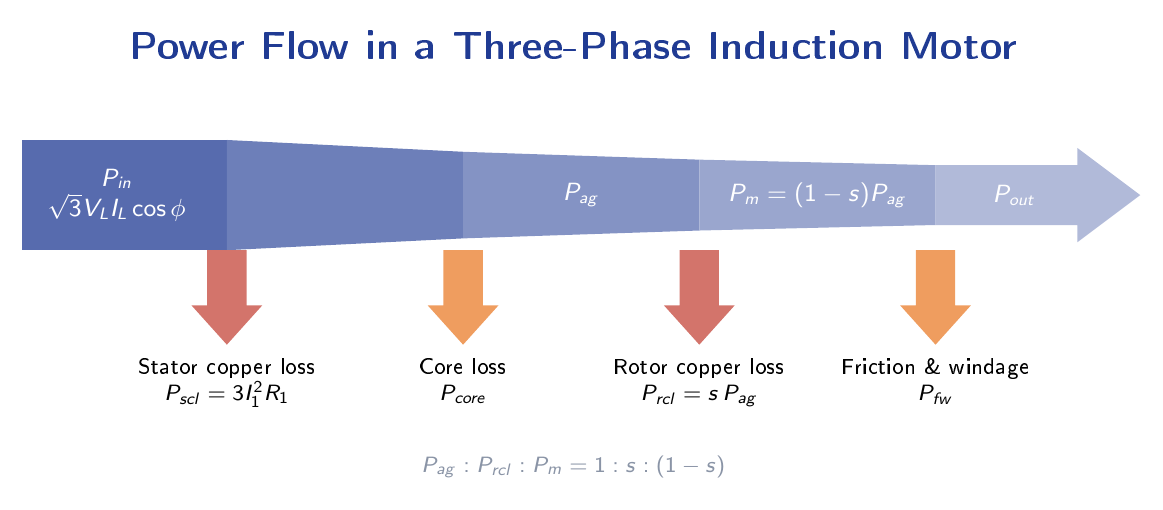
| IM power split | \(P_{ag} : P_{cu2} : P_m = 1 : s : (1-s)\) |
| IM max-torque slip | \(s_m = R_2/X_2\); \(T_{\max}\) independent of \(R_2\) |
| IM torque ratio (Kloss) | \(T/T_{\max} = 2ss_m/(s^2 + s_m^2)\) |
| Star–Delta starting | Line current and \(T_{st}\) both reduce to \(1/3\) of DOL |
| Sync gen EMF | \(E = 4.44\,K_p K_d\,f N_{ph} \Phi_m\) |
| Distribution factor | \(K_d = \sin(m\beta/2)/[m\sin(\beta/2)]\) |
| Pitch factor | \(K_p = \cos(\alpha/2)\) |
| Power (cylindrical rotor) | \(P = (EV/X_s)\sin\delta\) |
| Power (salient pole) | \(P = \tfrac{EV}{X_d}\sin\delta + \tfrac{V^2}{2}\!\left(\tfrac{1}{X_q}-\tfrac{1}{X_d}\right)\!\sin 2\delta\) |
| Reluctance torque | Exists even at \(E = 0\) (salient pole only) |
| Stability limit | \(\delta = 90°\) (cylindrical); \(\delta < 90°\) (salient) |
| SCR | \(\text{SCR} = 1/X_{s,\text{pu}}\) |
| Auto-transformer saving | \((1-K)\times\) two-winding copper weight |
| Scott teaser tap | 86.6% of main winding |
| Stepper step angle | \(\beta = 360°/(mN_r)\) |
| Hysteresis loss | \(P_h = K_h B_m^{1.6} f V\) |
| Eddy-current loss | \(P_e = K_e B_m^2 f^2 t^2 V\) |
- DC motor runaway: series motor on no-load; shunt motor with an open field circuit.
- Transformer polarity: additive vs subtractive affects whether parallel operation is possible.
- IM maximum starting torque: occurs when \(R_2 = X_2\) (i.e., \(s_m = 1\)), not simply when \(R_2 = s_m X_2\).
- Salient-pole machine: maximum power at \(\delta < 90°\) because of the reluctance-power term.
- V-curve minimum: occurs at unity pf, not at maximum excitation.
- CT secondary: must never be opened — huge induced voltage causes insulation failure.
- Armature reaction direction: lagging pf → demagnetising in a generator but magnetising in a motor (and vice versa for leading pf).
- Induction generator: always consumes reactive power; slip is negative (\(N_r > N_s\)).
- Per-unit calculations: always keep base values consistent across all elements.
12. Previous-Year GATE Questions
GATE PYQ 1: DC Machine (GATE EE 2016)
Solution:
Rated \(I_a = 11200/220 = 50.9\,\text{A}\).
Back EMF at 1500 rpm: \(E_{b1} = 220 - 50.9 \times 0.1 = 214.91\,\text{V}\).
Back EMF at 1000 rpm (flux fixed, rated torque ⇒ rated \(I_a\)): \[ E_{b2} = 214.91 \times \frac{1000}{1500} = 143.27\,\text{V} \]
Required armature voltage: \(V_a = 143.27 + 50.9 \times 0.1 = 148.36\,\text{V}\).
For a single-phase full converter: \(V_a = (2\sqrt{2}/\pi)V_s\cos\alpha = 207.07\cos\alpha\). \[ \cos\alpha = 148.36/207.07 = 0.7164 \;\Rightarrow\; \boldsymbol{\alpha \approx 44.3°} \]
GATE PYQ 2: Transformer Voltage Regulation (GATE EE 2019)
Given: \(\cos\phi = 0.8\), \(\sin\phi = 0.6\).
Approximate: \[ \varepsilon \approx v_r\cos\phi + v_x\sin\phi = 0.016 + 0.036 = \mathbf{0.052\,\text{pu} = 5.20\%} \]
Exact (with second-order correction): \[ \varepsilon = 0.052 + \frac{(v_x\cos\phi - v_r\sin\phi)^2}{2} = 0.052 + 0.000648 = \mathbf{5.26\%} \]
GATE Insight For lagging pf the correction term is additive; for leading pf it subtracts.
GATE PYQ 3: Induction Motor Speed at Maximum Torque (GATE EE 2018)
Synchronous speed: \(N_s = 120 \times 50/4 = 1500\,\text{rpm}\).
Slip at maximum torque: \(s_m = R_2/X_2 = 0.2/1.0 = 0.2\).
Rotor speed: \(N_{r,T_{\max}} = (1 - 0.2) \times 1500 = \mathbf{1200\,\text{rpm}}\).
Insight: \(T_{\max}\) is independent of \(R_2\), but \(s_m\) scales linearly with \(R_2\). Inserting external rotor resistance can shift \(s_m\) all the way to 1 (maximum starting torque) without changing \(T_{\max}\).
GATE PYQ 4: Synchronous Generator Power (GATE EE 2020)
Maximum power at \(\delta = 90°\): \[ P_{\max} = \frac{E_f V}{X_s} = \frac{1.5 \times 1.0}{0.5} = \mathbf{3.0\,\text{pu}} \]
GATE Insight For a salient-pole machine, \(P_{\max}\) occurs at \(\delta < 90°\) due to the reluctance-power term, and the total \(P_{\max}\) is typically higher.
GATE PYQ 5: Transformer Testing and Efficiency (GATE EE 2021)
Iron loss (OC, constant): \(P_i = 90\,\text{W}\).
Full-load HV current: \(I_{FL,HV} = 10\,000/2000 = 5\,\text{A}\) ⇒ SC test at rated current ⇒ \(P_{cu,FL} = 110\,\text{W}\).
At 75% load: \(P_{cu,0.75} = 0.75^2 \times 110 = 61.875\,\text{W}\).
Output: \(P_{\text{out}} = 0.75 \times 10\,000 \times 0.8 = 6000\,\text{W}\).
\[ \eta = \frac{6000}{6000 + 90 + 61.875} = \frac{6000}{6151.875} = \mathbf{97.53\%} \]13. References and Further Reading
Standard Textbooks
- P. S. Bimbhra, Electrical Machinery, 7th ed., Khanna Publishers, 2011.
- A. E. Fitzgerald, C. Kingsley, S. D. Umans, Electric Machinery, 7th ed., McGraw-Hill, 2014.
- S. J. Chapman, Electric Machinery Fundamentals, 5th ed., McGraw-Hill, 2012.
- I. J. Nagrath, D. P. Kothari, Electric Machines, 5th ed., Tata McGraw-Hill, 2017.
- P. C. Sen, Principles of Electric Machines and Power Electronics, 3rd ed., Wiley, 2013.
- B. L. Theraja, A. K. Theraja, A Textbook of Electrical Technology, Vol. II, S. Chand, 2014.
- P. C. Krause, O. Wasynczuk, S. D. Sudhoff, Analysis of Electric Machinery and Drive Systems, 3rd ed., IEEE Press/Wiley, 2013.
- R. Krishnan, Electric Motor Drives: Modelling, Analysis and Control, Prentice-Hall, 2001.
Standards and Codes
- IEC 60034-1: Rotating electrical machines — Rating and performance.
- IS 325: Three-phase induction motors — Specification.
- IEEE Std 112: Standard test procedure for polyphase induction motors.
- IEC 60076: Power transformers.
Online Resources
- NPTEL: Electrical Machines (IIT Kharagpur, IIT Delhi).
- MIT OCW 6.685: Electric Machines.
- IEEE Xplore: Transactions on Energy Conversion; Industry Applications.
GATE-Specific Resources
- GATE previous-year papers — EE stream, 2000–2025.
- Made Easy / ACE Engineering Academy handbooks for Electrical Machines.