Electric Drives
A comprehensive guide to motors, converters and control — based on the works of G.K. Dubey & R. Krishnan
An electric drive is the engineered system that turns electrical energy into controlled mechanical motion. This revision note develops the subject end to end: the dynamics that govern every drive, DC and AC machine drives, the power converters that feed them, scalar and vector control, special machines, thermal sizing, industrial and traction applications, power quality, dynamic modelling, advanced control, and a set of fully solved numerical examples. The treatment follows the classic framework of Dubey and Krishnan and is organised for quick revision, GATE preparation and university examinations.
Fundamentals of Electric Drives
What is an Electric Drive?
An electric drive is an electromechanical system that converts electrical energy into mechanical motion with controlled characteristics — speed, torque, position and direction.
Electric drives dominate motion control because they are highly efficient (85–98%), span an enormous power range from milliwatts to megawatts, allow four-quadrant operation, are clean and quiet, are easy to control electronically, and can regenerate energy back to the source.
Historical Evolution of Electric Drives
Drive technology evolved in distinct eras: group (line-shaft) drives and early DC motors (1880s–1920); Ward–Leonard systems and mercury-arc rectifiers (1930s–1960); the thyristor era with current- and voltage-source inverters and analog control (1960s–80s); IGBT/MOSFET power stages with field-oriented control (FOC), direct torque control (DTC) and DSP control (1980s–2000); and today's wide-bandgap (SiC, GaN) devices, sensorless and model-predictive control, digital twins and AI.
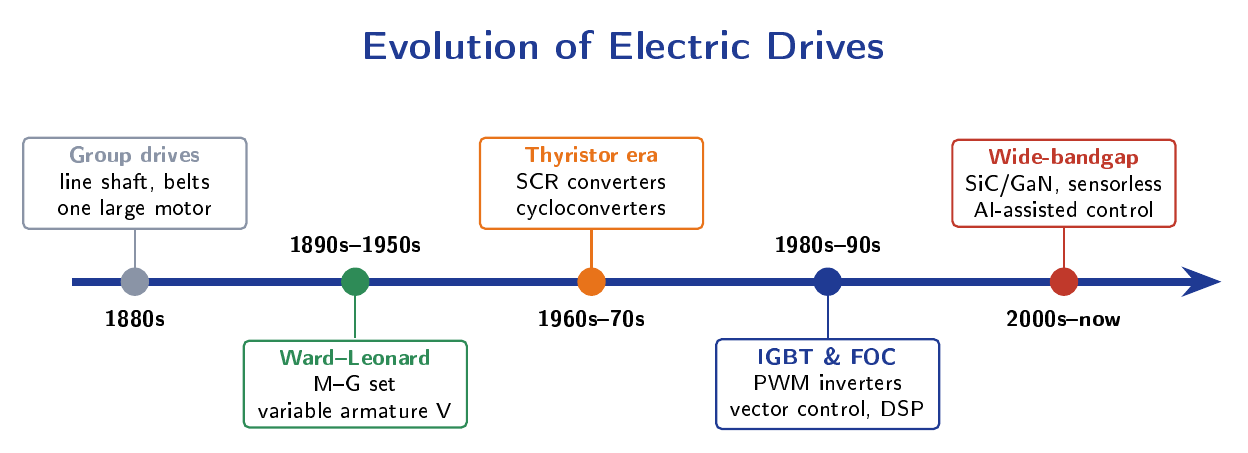
- 1888 — Tesla's induction motor patent
- 1957 — the thyristor (GE) revolutionises drives
- 1971 — Blaschke's field-orientation theory published
- 1985 — Takahashi–Noguchi direct torque control
- 2010+ — commercial deployment of wide-bandgap devices
The global variable-frequency-drive (VFD) market is roughly \$25 billion (2024). About 45% of the world's electricity is consumed by motor systems, which makes VFD penetration the single largest energy-saving lever in industry.
Components of an Electric Drive
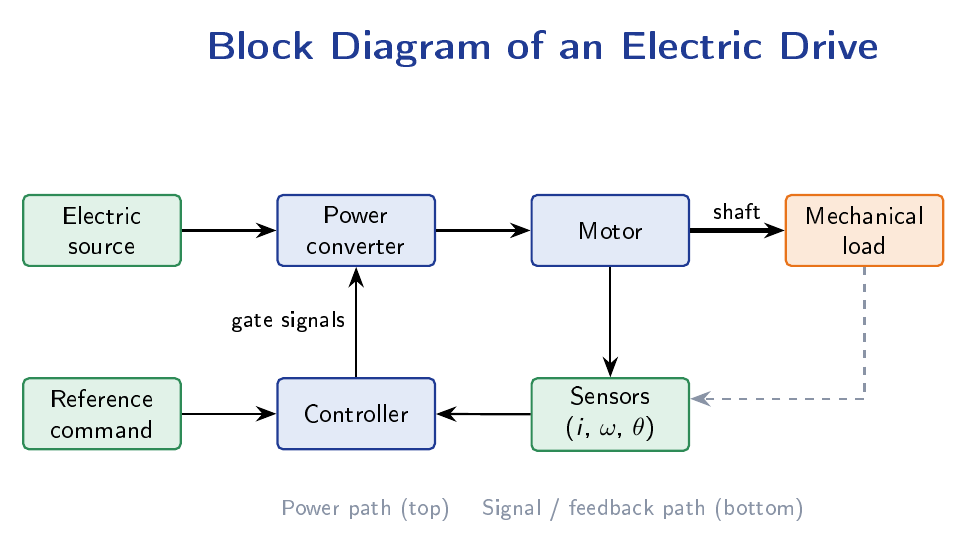
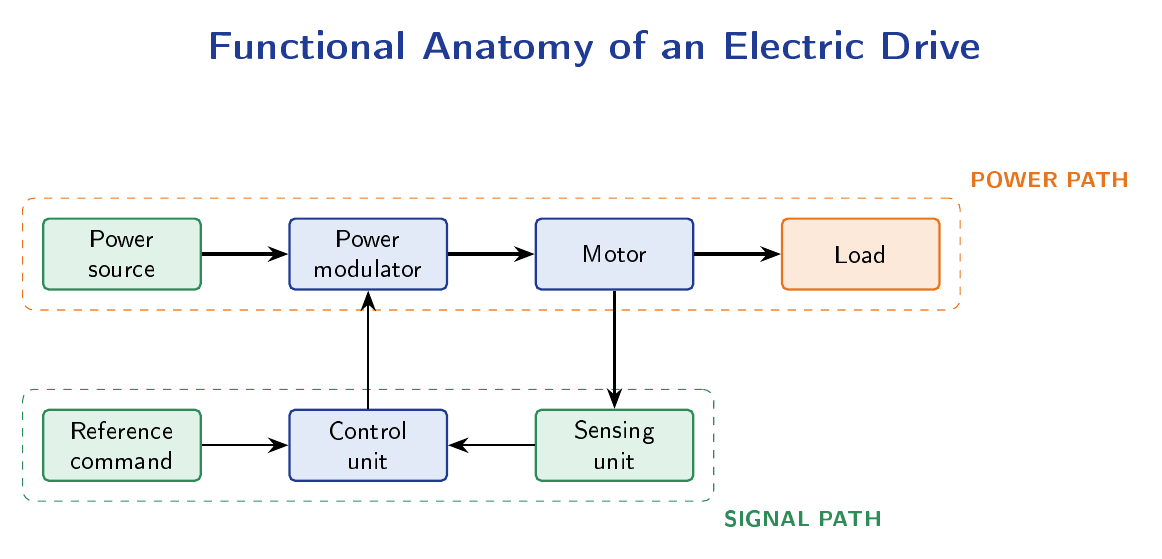
Every drive is built from five essential subsystems plus the mechanical transmission:
- Power source — AC mains, a DC bus, battery, fuel cell or photovoltaic array.
- Power modulator (converter) — adjusts voltage, current, frequency and waveform; rectifiers, choppers, inverters, cycloconverters and AC voltage controllers.
- Electrical motor — DC, induction (IM), synchronous (SM), PMSM, BLDC, switched-reluctance (SRM) or stepper.
- Sensing unit — voltage, current, speed (encoder/resolver), position and temperature.
- Control unit — analog or digital controller (DSP, FPGA, microcontroller) implementing speed, torque and position loops.
Classification of Electric Drives
Drives are classified along four independent axes, and by physical configuration:
- By source: DC drives, AC drives, hybrid.
- By motor: induction, synchronous, DC/BLDC.
- By control: scalar (V/f), vector/FOC, DTC/MPC.
- By application: servo, traction, industrial.
Selection of an Electric Drive — Engineering Trade-offs
Drive selection balances eight criteria: steady-state requirements (rated power, torque, speed, duty cycle S1–S8); transient demands (starting/braking torque, acceleration); speed range and regulation; number of quadrants required (1Q, 2Q or 4Q); environment (ambient temperature, IP rating, hazardous area); power-quality and harmonic limits (IEEE 519, IEC 61000); capital plus life-cycle cost with energy-saving payback; and reliability and maintainability (MTBF, brushed versus brushless).
| Application | Best motor | Best converter |
|---|---|---|
| Servo / robotics | PMSM / BLDC | VSI + FOC |
| EV traction | IPMSM / IM | SiC VSI + FOC/MTPA |
| Pumps, fans | SCIM | Diode rectifier + VSI (V/f) |
| Cranes, lifts | SCIM or DC | 4-Q inverter / dual converter |
| Rolling mill | DC or large IM | 12-pulse + 4Q |
| Wind 2–6 MW | DFIG / PMSG | Back-to-back converter |
| CNC spindle | PMSM | VSI + FOC + field weakening |
| HVAC blower | ECM / PMSM | VSI + sensorless |
Fundamental Torque Equation
The dynamics of every drive follow Newton's law for rotation:
Here \(T_m\) is the motor developed torque (N·m), \(T_L\) is the load torque referred to the shaft (N·m), \(J\) is the polar moment of inertia (kg·m\(^2\)) and \(\omega_m\) is the angular velocity (rad/s). Three operating states follow directly: \(T_m \gt T_L\) gives acceleration, \(T_m \lt T_L\) gives deceleration, and \(T_m = T_L\) is steady state.
When the inertia varies (a robotic arm, reeling drum or winch) an extra term appears:
The associated power balance is \(P_m = T_m\omega_m\), \(P_L = T_L\omega_m\), and the accelerating power
Referring Load Parameters to the Motor Shaft
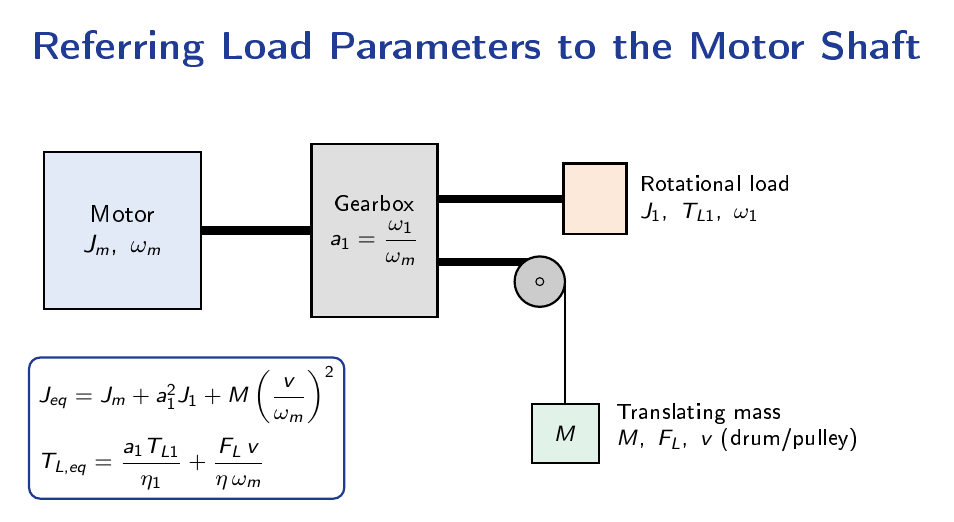
A real drive train contains gears and translating masses. Defining the gear ratio \(a_i = \omega_i/\omega_m\), all inertias and torques are referred to the motor shaft so the single equation of motion still applies.
These follow from energy conservation, \( \tfrac{1}{2}J_{eq}\omega_m^2 = \tfrac{1}{2}J_0\omega_m^2 + \sum_i \tfrac{1}{2}J_i\omega_i^2 + \tfrac{1}{2}M v^2\), with efficiencies \(\eta_i\) accounting for transmission losses.
Load Torque Characteristics
The total load torque combines several components:
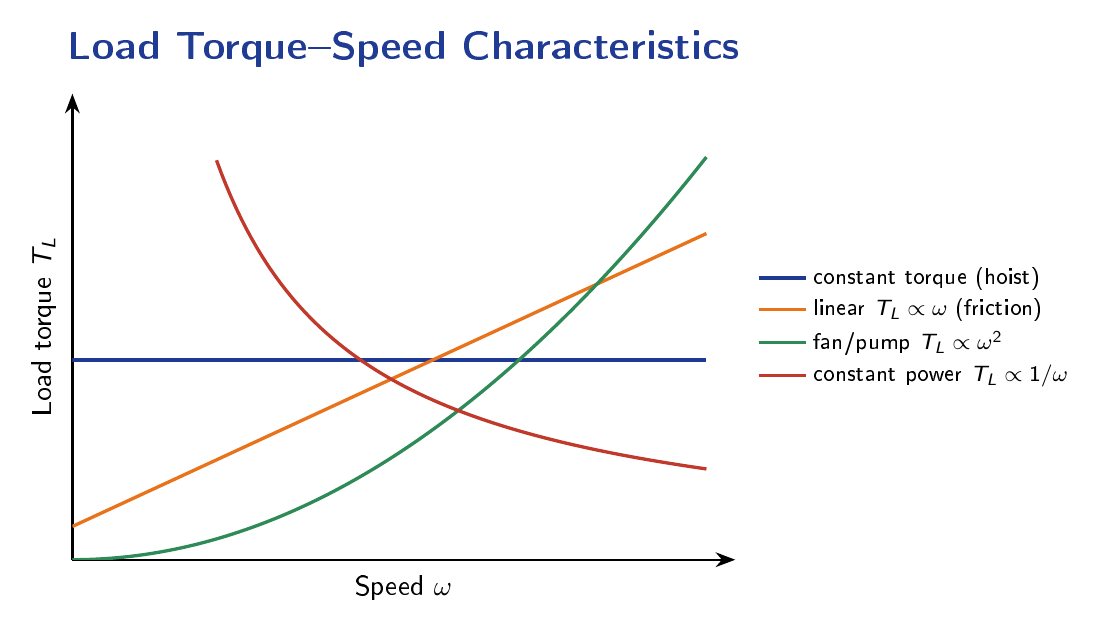
where \(T_{Lf}\) is friction \((C + B\omega_m)\), \(T_{Lw}\) is windage \((C_w\omega_m^2)\), \(T_{Ls}\) is the useful shaft work and \(T_{Lg}\) is a gravity term (hoists). Four canonical speed–torque shapes recur: constant torque (hoist), torque linear in speed (viscous friction), torque proportional to \(\omega^2\) (fans and pumps) and constant-power loads where \(T_L \propto 1/\omega\). Loads are also classified as active (hoist, crane — torque retains its sign and can drive the motor) or passive (drill, mill, press — torque always opposes motion).
Steady-State Stability
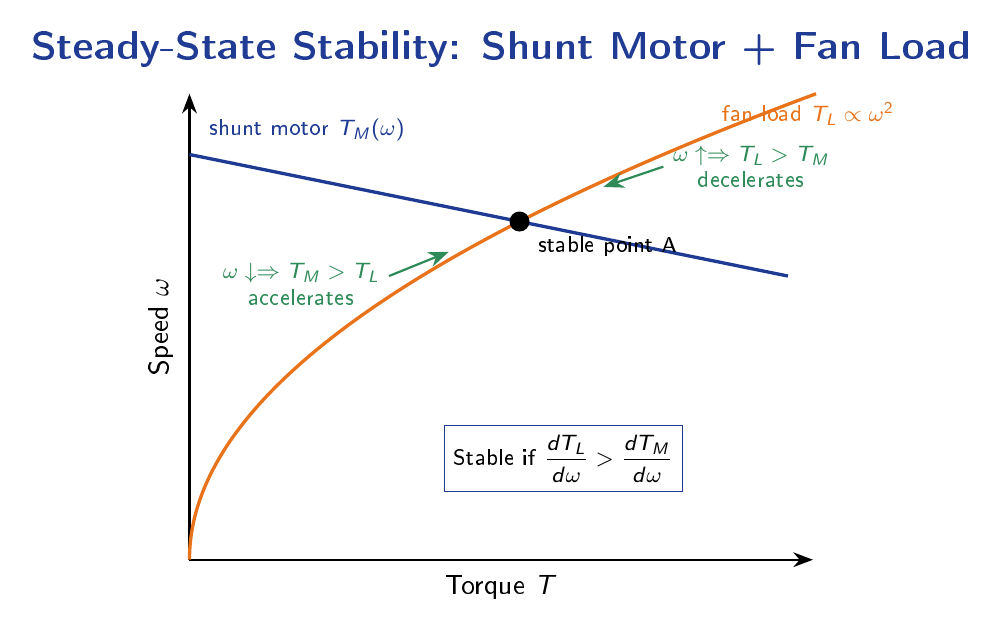
Applying a small perturbation about an operating point and linearising the equation of motion gives
whose solution \(\Delta\omega_m = (\Delta\omega_m)_0\,e^{t/\tau}\) has time constant
\( \dfrac{dT_L}{d\omega_m} \gt \dfrac{dT_m}{d\omega_m} \). A shunt motor driving a fan load (\(T_L \propto \omega^2\)) satisfies this and settles at a stable intersection.
Four-Quadrant Operation
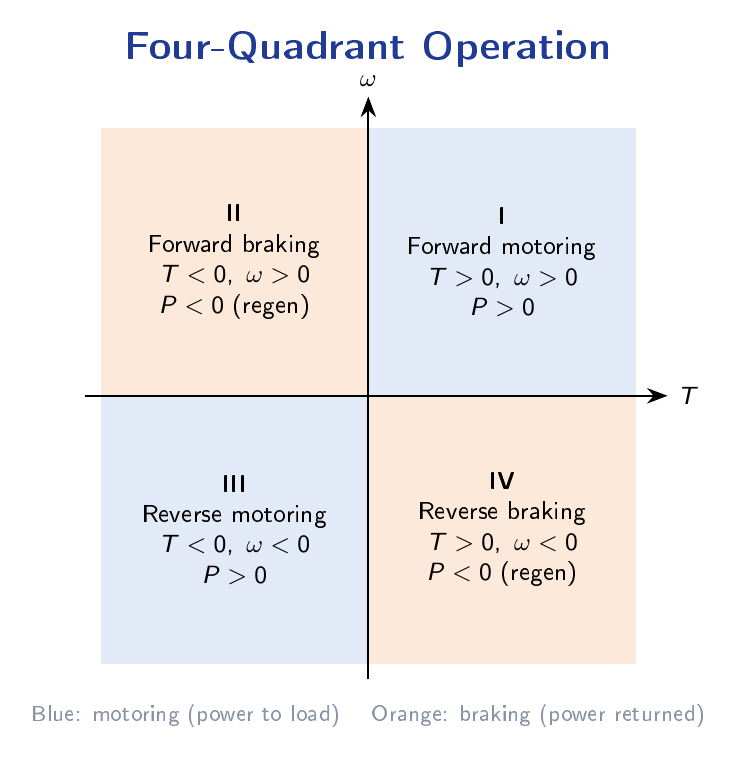
With \(P = T\omega_m\), the sign of power distinguishes motoring \((P\gt0)\) from regeneration \((P\lt0)\). Plotting torque against speed yields four quadrants: Q-I forward motoring, Q-II forward braking, Q-III reverse motoring and Q-IV reverse braking.
| Quadrant | Action | Load | Power flow |
|---|---|---|---|
| I | Lift up | Loaded | Motoring |
| II | Lift down | Loaded | Braking (regen) |
| III | Lift down | Empty | Motoring |
| IV | Lift up | Empty | Braking |
Braking Methods — Comparison
Three electrical braking methods are used in drives. Regenerative braking occurs when \(E \gt V_s\) (or \(\omega \gt \omega_s\)): energy flows back to the source with \(P_{reg} = E I_a\), making it the most efficient method. Dynamic (rheostatic) braking disconnects the supply and connects a braking resistor, dissipating kinetic energy as heat with \(P_{diss} = E^2/(R_a + R_{br})\). Plugging reverses the supply voltage, producing a very large current \(I_a = (V+E)/(R_a + R_{br})\) for fast but inefficient stopping.
| Method | Energy recovery | Stopping time | Heat dissipation | Use case |
|---|---|---|---|---|
| Regenerative | Yes | Medium | Low | Traction, EV, lifts |
| Dynamic | No | Medium | In \(R_{br}\) | General industrial |
| Plugging | No | Fast | High | Emergency stop |
DC Motor Drives
DC Motor — Fundamental Equations
The DC machine is governed by an EMF and a torque relation that share the same machine constant \(K\phi\):
Applying Kirchhoff's voltage law to the armature gives the circuit and speed equations:
There are three control variables — armature voltage \(V_a\), field flux \(\phi\) and series resistance \(R_a\) — and each defines a distinct speed-control region. The mechanical time constant is \( \tau_m = JR_a/(K\phi)^2 \).
DC Machine — Construction and Cross-Section
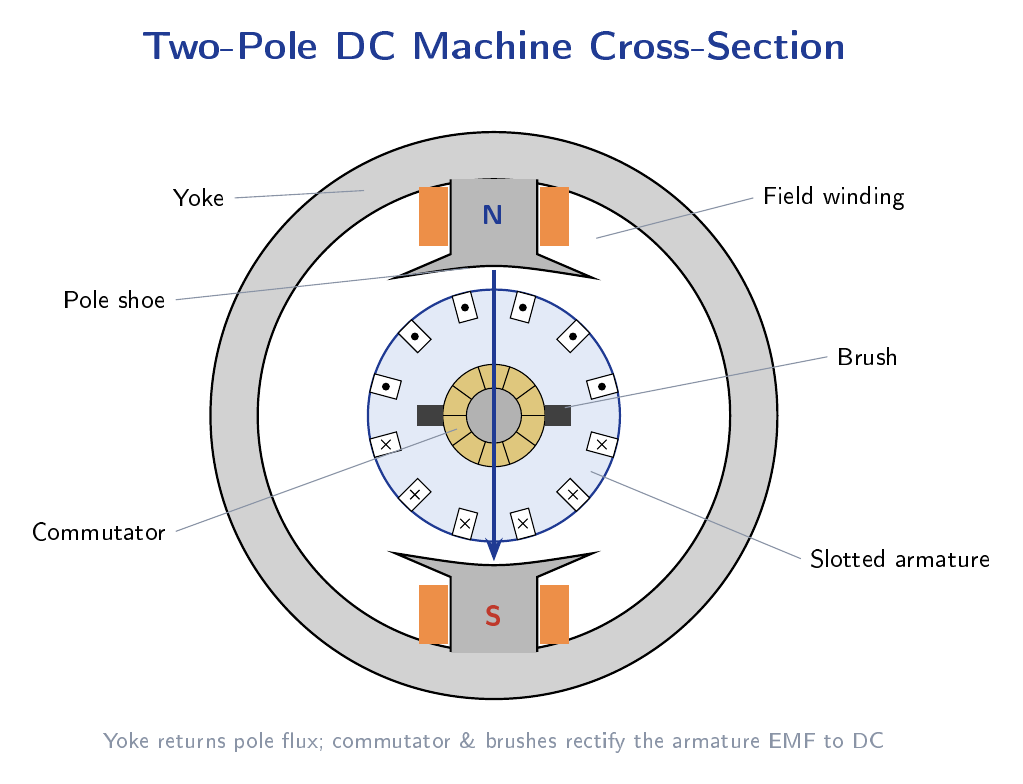
The key parts are the yoke/frame (mechanical support and flux return path), the field poles carrying shunt or series windings that establish \(\phi\), the laminated armature whose slots hold the lap or wave winding, the commutator and brushes (a mechanical inverter that rectifies the internal AC EMF to DC at the terminals), and interpoles and compensating windings that cancel armature reaction and reduce sparking.
where \(P\) is the number of poles, \(Z\) the total conductors and \(A\) the number of parallel paths (\(A=2\) for wave winding, \(A=P\) for lap winding).
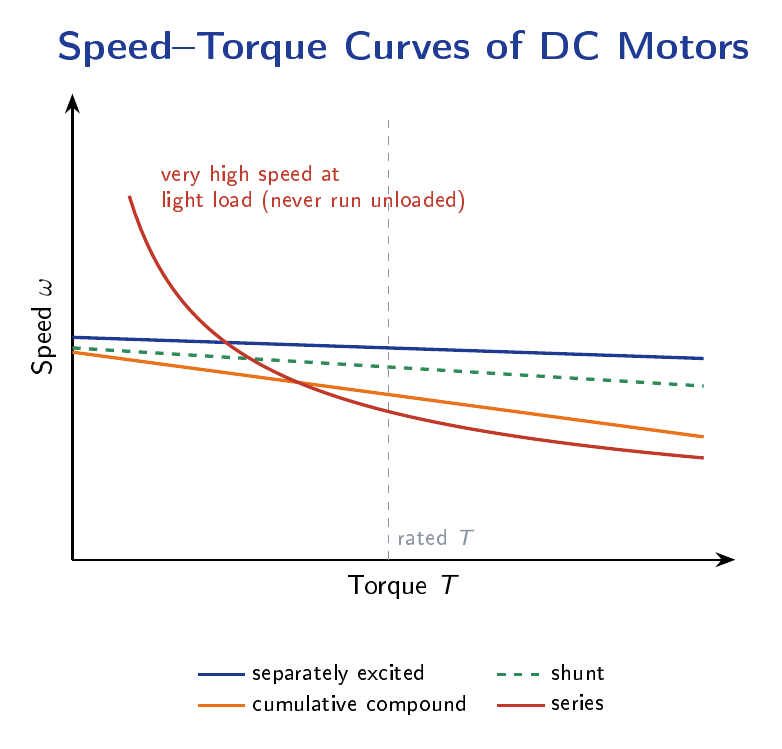
Types of DC Motors — Characteristics
The four excitation arrangements give markedly different speed–torque characteristics, which determine where each is used.
| Type | Speed regulation | Starting torque | Application |
|---|---|---|---|
| Separately excited | Excellent | Medium | Servo, precision drives |
| Shunt | Good | Medium | Fans, pumps, lathes |
| Series | Poor (no-load overspeed) | Very high | Traction, cranes |
| Compound | Good | High | Rolling mills, compressors |
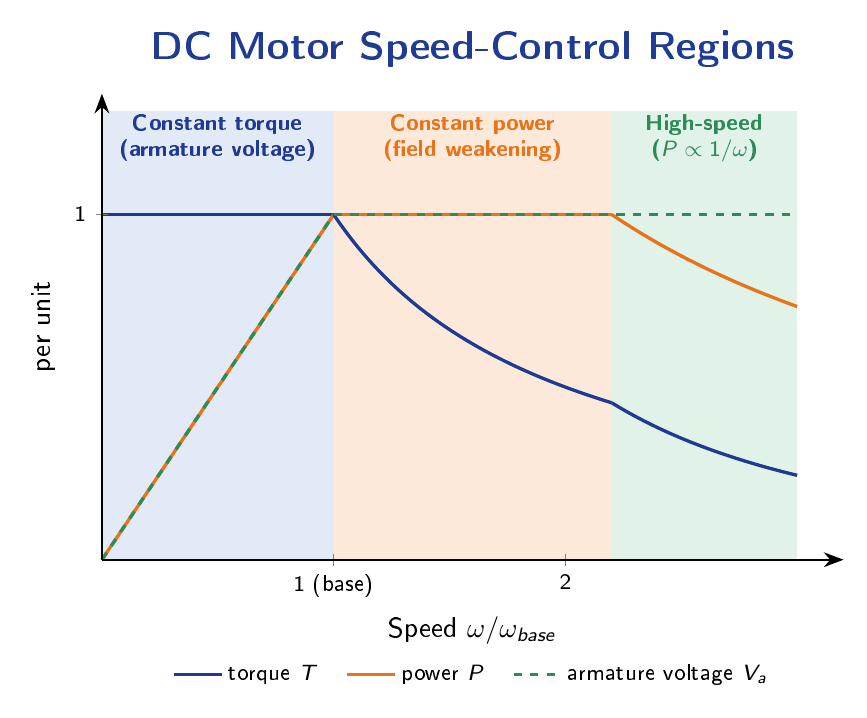
Speed Control — Three Regions
A separately excited DC motor offers two control regions. Below base speed, the flux is held at its rated value and the armature voltage is varied, giving a constant-torque region:
Above base speed, the voltage is capped and the field is weakened, so \( \omega_m \propto 1/\phi \). Power remains constant while \(T_{max} \propto \phi \propto 1/\omega_m\) — the constant-power region.
Starting of a DC Motor
At \(t = 0^+\), the speed is zero so \(E = 0\) and the armature current is limited only by \(R_a\): \( I_{a,start} = V/R_a \approx 10\text{–}20\,I_{a,rated} \). This damages the armature and trips protection.
Three solutions are used: a stepped rheostatic starter (traditional), a reduced-voltage start through a converter (modern), or the Ward–Leonard system (legacy, smooth). For an \(n\)-step starter the current swings between a maximum \(I_1\) and minimum \(I_2\):
Power Semiconductor Devices — the Drive Toolbox
The converter that feeds the motor is built from power semiconductors. The choice of device fixes the achievable voltage, current and switching frequency.
| Device | Voltage | Current | \(f_{sw}\) | Control | Typical drive use |
|---|---|---|---|---|---|
| Diode | 8 kV | 5 kA | 50 Hz–MHz | Uncontrolled | Front-end rectifier, free-wheel |
| SCR | 12 kV | 6 kA | < 1 kHz | Turn-on only | Phase rectifier, LCI, cycloconverter |
| GTO | 6 kV | 6 kA | 1–3 kHz | Turn-on/off | Legacy MV drives, traction |
| IGCT | 10 kV | 5 kA | ~1 kHz | Gate-commutated | MV multilevel inverters |
| MOSFET (Si) | 1 kV | 200 A | 100 kHz–MHz | Gate voltage | Servo, low-power VFD, BLDC |
| IGBT | 6.5 kV | 3 kA | 5–30 kHz | Gate voltage | Workhorse of modern VFDs |
| SiC MOSFET | 10 kV | 300 A | up to 200 kHz | Gate voltage | EV traction, solar, fast chargers |
| GaN HEMT | 650 V | 100 A | MHz | Gate voltage | Servo, on-board chargers, LV drives |
Performance Indices for Phase-Controlled Converters
Phase-controlled converters are characterised by DC-side and AC-side indices. On the DC side,
On the AC side, the efficiency \(\eta = P_{dc}/P_{ac}\), transformer utilisation factor \(\text{TUF} = P_{dc}/(V_sI_s)_{rated}\), displacement power factor \(DPF = \cos\phi_1\), harmonic factor \(HF = \sqrt{I_s^2-I_{s1}^2}/I_{s1}\) and overall power factor \(PF = (I_{s1}/I_s)\cos\phi_1\).
These matter directly for DC drives: a low ripple factor gives smooth armature current and low torque ripple; a high TUF means better transformer utilisation; a high power factor reduces line current and \(I^2R\) loss; and a low harmonic factor secures compliance with IEEE 519 and IEC 61000-3-2.
At light load or large firing angle, \(i_a\) may fall to zero before the next firing — discontinuous conduction mode (DCM). In DCM the output voltage rises and regulation degrades. A smoothing inductor \(L_a\) keeps the drive in continuous conduction mode (CCM).
Single-Phase Phase-Controlled Converters
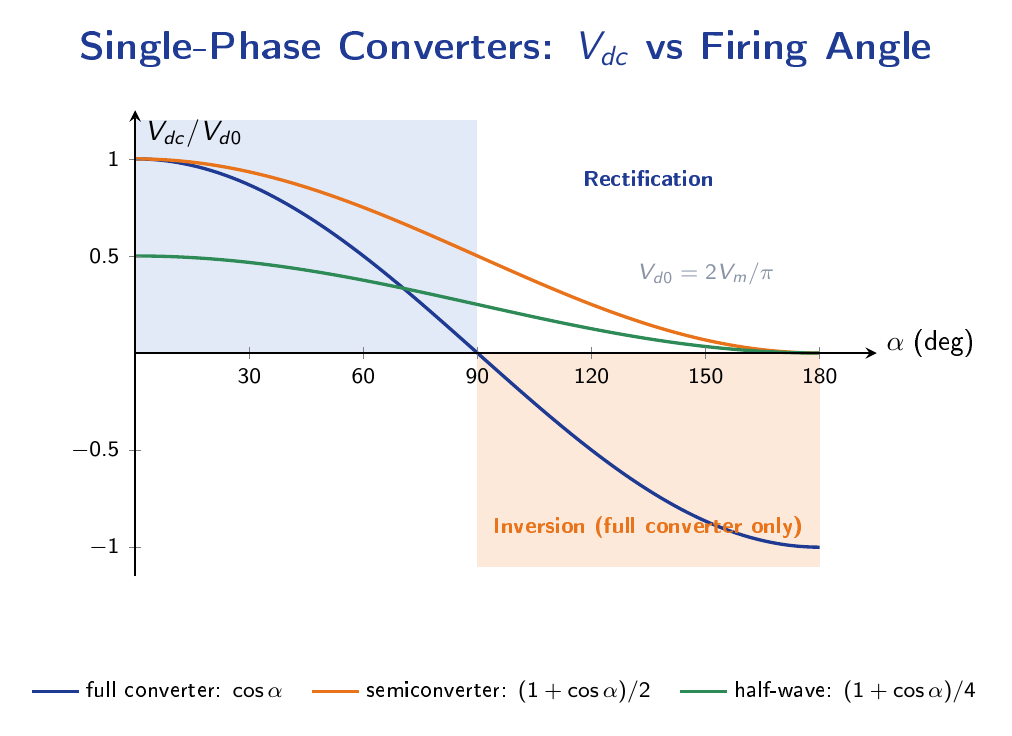
| Topology | Average \(V_a\) (CCM) | Quadrants |
|---|---|---|
| Half-wave (1 SCR) | \(V_a = \dfrac{V_m}{2\pi}(1+\cos\alpha)\) | 1 (Q-I) |
| Semi (2 SCR + 2 D) | \(V_a = \dfrac{V_m}{\pi}(1+\cos\alpha)\) | 1 (Q-I) |
| Full / bridge (4 SCR) | \(V_a = \dfrac{2V_m}{\pi}\cos\alpha\) | 2 (Q-I, IV) |
| Dual (two full) | \(V_a = \pm\dfrac{2V_m}{\pi}\cos\alpha\), with \(\alpha_1+\alpha_2 = 180^\circ\) | 4 |
For the full bridge with inductive load, the key design relations are \(V_a = \tfrac{2V_m}{\pi}\cos\alpha\), \(I_a = (V_a - E)/R_a\), \(V_{a,rms} = V_m/\sqrt{2}\), \(FF = \pi/(2\sqrt{2}\cos\alpha)\), fundamental source current \(I_{s1} = 4I_a/(\pi\sqrt 2)\) and \(PF \approx 0.9\cos\alpha\). With \(\alpha \lt 90^\circ\) the converter rectifies; with \(\alpha \gt 90^\circ\) it inverts and returns energy (regeneration).
Single-Phase Full Converter with R-L-E (DC Motor) Load
Solving \(L_a\dot i + R_a i = v_o(t) - E\) gives the steady-state armature current in continuous conduction:
with \(Z = \sqrt{R_a^2 + (\omega L_a)^2}\), \(\phi = \tan^{-1}(\omega L_a/R_a)\) and \(\tau_a = L_a/R_a\). The average current is \(I_a^{avg} = (V_a - E)/R_a\). The critical inductance for the CCM boundary is approximately \(L_{a,crit} \approx V_m\sin\alpha/(\omega I_{a,min})\); below this the drive enters DCM and \(V_a\) rises.
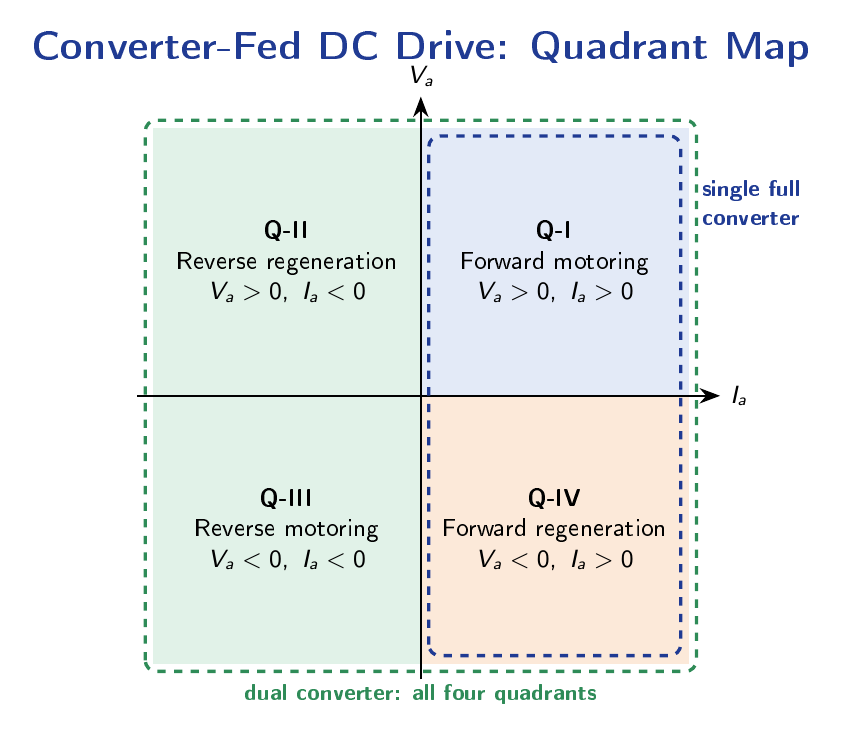
Single-Phase Converter-Fed DC Drives — Quadrant Map
For a single full converter, \(V_a = \tfrac{2V_m}{\pi}\cos\alpha\): with \(0 \le \alpha \lt 90^\circ\) the drive rectifies in Q-I, and with \(90^\circ \lt \alpha \le 180^\circ\) it inverts in Q-IV (regeneration). A semi-converter, \(V_a = \tfrac{V_m}{\pi}(1+\cos\alpha)\), is single-quadrant (no inversion). A dual converter (two anti-parallel full bridges) achieves four-quadrant operation: in non-circulating mode \(\alpha_1 + \alpha_2 = 180^\circ\) with one bridge active; in circulating mode both are active and a reactor limits the circulating current \(i_{circ} = \tfrac{1}{\omega L_r}\!\int (v_{o1}-v_{o2})\,dt\).
Three-Phase Phase-Controlled Converters
| Converter | Average \(V_a\) | Pulse / Quadrants | Input PF (CCM) |
|---|---|---|---|
| Half-wave (3 SCR) | \(\dfrac{3\sqrt 3 V_m}{2\pi}\cos\alpha\) | 3 / Q-I, IV | \(\tfrac{3}{2\pi}\cos\alpha\) |
| Semi (3 SCR + 3 D) | \(\dfrac{3V_{mL}}{2\pi}(1+\cos\alpha)\) | 3 or 6 / Q-I | \(\le 0.955\) |
| Full / 6-pulse | \(\dfrac{3\sqrt 2 V_{LL}}{\pi}\cos\alpha\) | 6 / Q-I, IV | \(\approx 0.955\cos\alpha\) |
| Dual / 12-pulse | \(\alpha_1+\alpha_2=180^\circ\) | 6 / 4-Q (12-pulse) | \(\approx 0.99\cos\alpha\) |
For the three-phase full bridge with inductive load, \(V_a = \tfrac{3\sqrt 2 V_{LL}}{\pi}\cos\alpha\), \(I_{s,rms} = \sqrt{2/3}\,I_a\), \(I_{s1} = \tfrac{\sqrt 6}{\pi}I_a\), \(HF = 0.311\), \(DPF = \cos\alpha\), \(PF = \tfrac{3}{\pi}\cos\alpha\) and the ripple frequency is \(6f\). Source inductance modifies the output to \(V_a = \tfrac{3\sqrt 2 V_{LL}}{\pi}\cos\alpha - \tfrac{3\omega L_s I_a}{\pi}\).
Three-Phase Full Converter-Fed DC Drive — Operating Modes
The speed–torque relation in continuous conduction is a family of parallel lines, one per firing angle:
At light load the converter enters DCM where \(V_a = \tfrac{3V_{mL}}{\pi}[\cos\alpha - \cos(\alpha+\beta)]\) with \(\beta \lt 60^\circ\), and the output becomes load-dependent. Four-quadrant reversing drives (rolling mills) use a dual converter with \(\alpha_1 + \alpha_2 = 180^\circ\) so that \(V_{a1} = -V_{a2}\), a reactor limiting the circulating current.
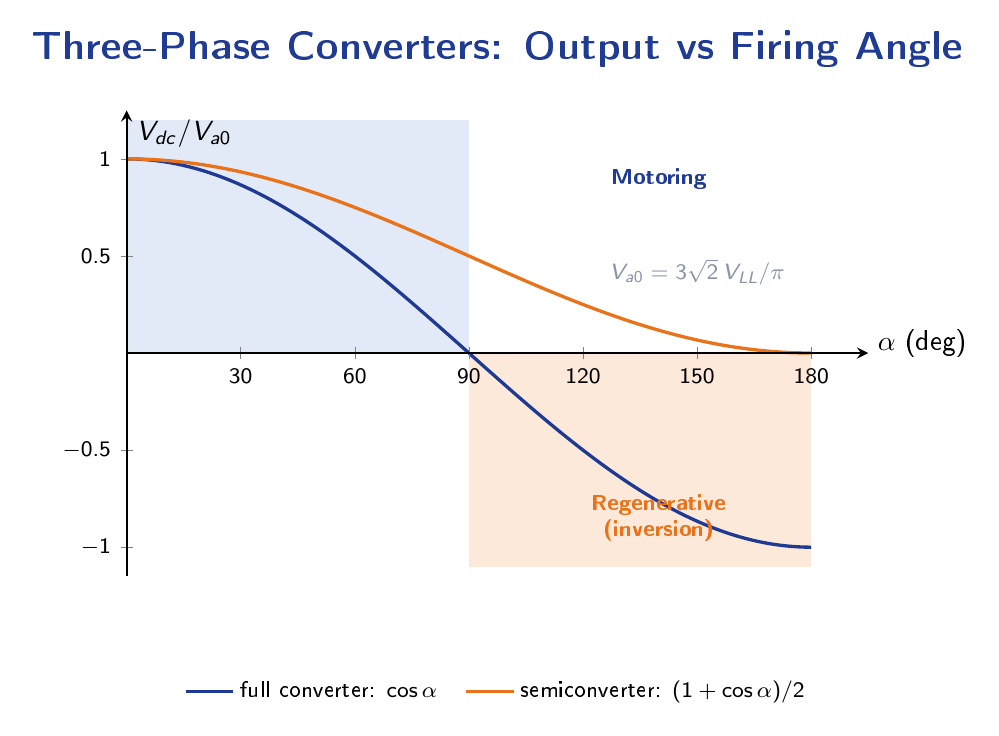
Discontinuous conduction, source inductance and filtering all degrade performance. A critical inductance keeps the three-phase full converter in CCM:
Phase control gives a poor power factor at low speed (\(PF = 0.955\cos\alpha\)). It is improved by asymmetrical or sequence control of multi-stage SCR banks, by a PWM active front-end (giving unity power factor and sinusoidal line current) or by 12-pulse operation for harmonic mitigation.
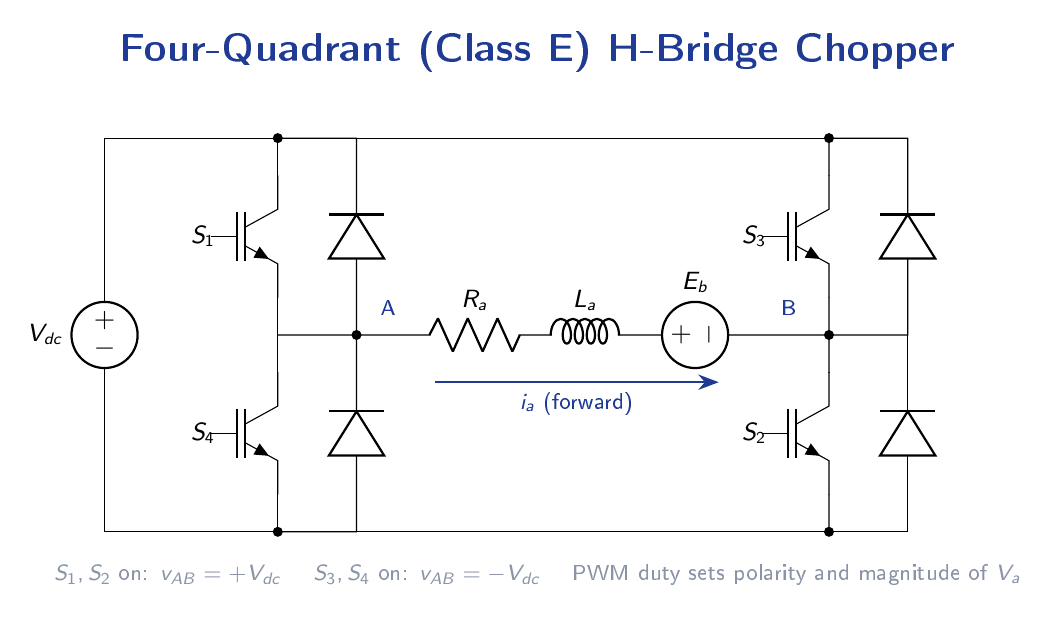
Chopper-Fed DC Drives — Five Classes
DC–DC choppers feed DC motors from a DC bus and are grouped into five classes by the polarity of voltage and current they allow. The duty ratio is \(\delta = t_{on}/T\).
| Class | Polarity | Quadrants | Output |
|---|---|---|---|
| A | \(V_a\gt0,\,I_a\gt0\) | Q-I (motoring) | \(V_a = \delta V_s\) |
| B | \(V_a\gt0,\,I_a\lt0\) | Q-II (regen) | \(V_a = (1-\delta)V_s\) |
| C | \(V_a\gt0,\,\pm I_a\) | Q-I + II | \(V_a = \delta V_s\) |
| D | \(\pm V_a,\,I_a\gt0\) | Q-I + IV | \(V_a = (2\delta-1)V_s\) |
| E | \(\pm V_a,\,\pm I_a\) | 4-Q (H-bridge) | \(V_a = (2\delta-1)V_s\) |
For the Class A buck chopper the ripple is \(\Delta I_a \approx V_s\delta(1-\delta)/(f_c L_a)\), maximal at \(\delta = 0.5\), with critical inductance \(L_{a,crit} = V_s\delta(1-\delta)/(f_c I_{a,min})\). The Class B boost chopper regenerates by boosting the motor EMF onto the bus, with \(\delta_{regen} = 1 - (E - I_aR_a)/V_s\) and \(P_{reg} = E|I_a|\). Class E (the H-bridge) gives full four-quadrant operation, and unipolar PWM offers four times lower ripple than bipolar PWM. Control is usually fixed-frequency PWM (variable \(\delta\)) or hysteretic, where \(i_a\) is bounded between limits and the frequency varies.
Closed-Loop Control — Cascade Structure
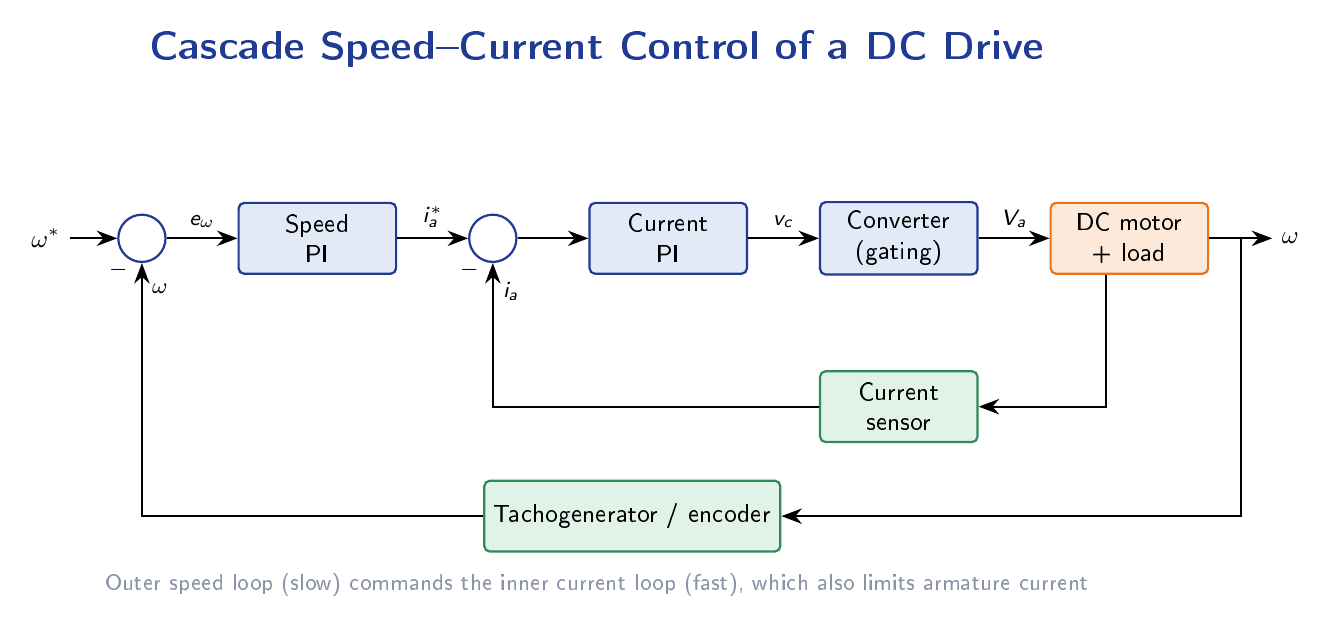
Modern DC drives use a cascade of two loops: a fast inner current loop and a slower outer speed loop. The armature current and mechanical responses are first-order:
The cascade arrangement is preferred because saturation of the speed-loop PI sets a natural current limit, the inner loop gives fast current (and hence torque) control, and the outer loop gives good speed regulation. A bandwidth ratio of about 10:1 between the loops keeps them decoupled.
Ward–Leonard System versus Modern Solid-State Drive
The classical Ward–Leonard system varies DC-motor speed through the field of a motor-generator set — an induction motor drives a DC generator whose field rheostat sets the armature voltage of the DC motor. It is smooth and inherently four-quadrant, but uses three rotating machines, is bulky and only 60–70% efficient. A modern solid-state drive replaces the generator set with a four-quadrant dual converter under closed current and speed loops — compact, 92–97% efficient and with millisecond response.
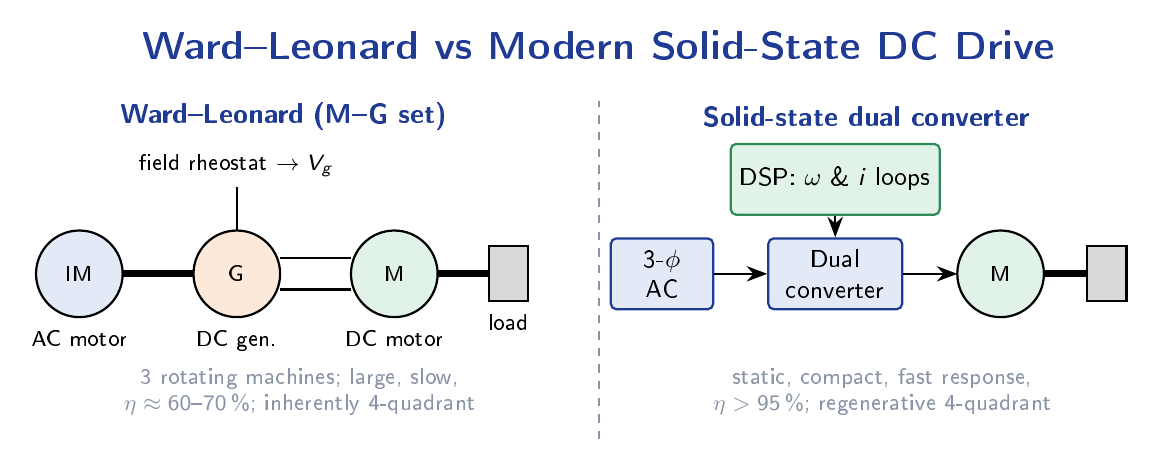
| Aspect | Ward–Leonard | Solid-state |
|---|---|---|
| Efficiency | 60–70% | 92–97% |
| Size & weight | Very large | Compact |
| Maintenance | High (3 rotating machines) | Low (static) |
| Response | Slow (field time constant) | Fast (ms) |
| Status today | Obsolete | Industry standard |
Induction Motor Drives
Induction Motor — Fundamentals
The induction motor runs below the rotating field. Its key speeds and slip are
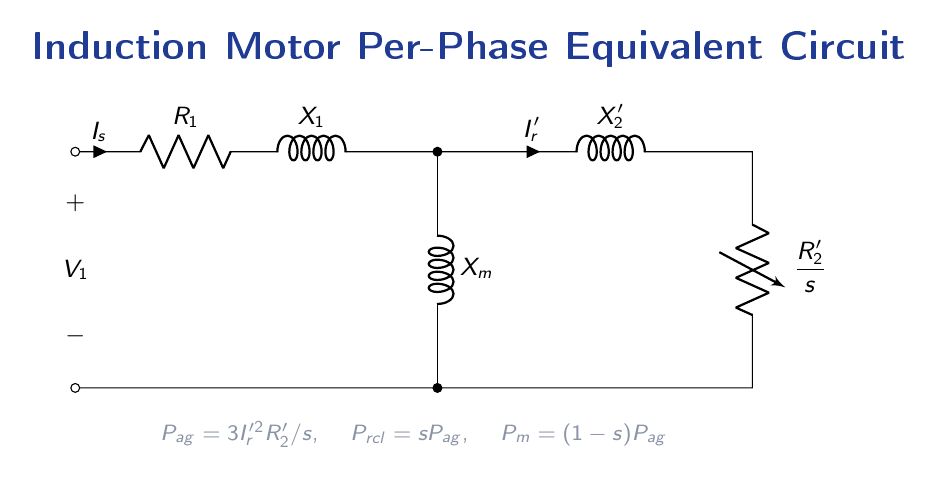
The rotor quantities scale with slip: rotor frequency \(f_r = sf\), rotor EMF \(E_{2s} = sE_2\), rotor reactance \(X_{2s} = sX_2\), so \(Z_{2s} = R_2 + jsX_2\). The per-phase equivalent circuit places \(R_1\) and \(X_1\) in the stator, a magnetising branch \(X_m\), and the referred rotor branch \(X_2'\) in series with \(R_2'/s\).
Parameter Estimation — No-Load and Blocked-Rotor Tests
The equivalent-circuit parameters are found from two tests. In the no-load test (rated voltage and frequency, rotor free, \(s \to 0\)):
In the blocked-rotor test (rotor locked, \(s = 1\), reduced voltage to circulate rated current):
For a NEMA design-B machine, \(X_1 \approx X_2' \approx X_{eq}/2\) and \(R_2' \approx R_{eq} - R_1\). In practice \(R_1\) is measured separately by a DC test (with an AC/DC ratio of about 1.05–1.2), the blocked-rotor test is run at reduced frequency (about 25%) for high-efficiency designs to avoid skin-effect bias, and the no-load friction-and-windage loss is separated by extrapolating to zero voltage.
Power Flow and Efficiency
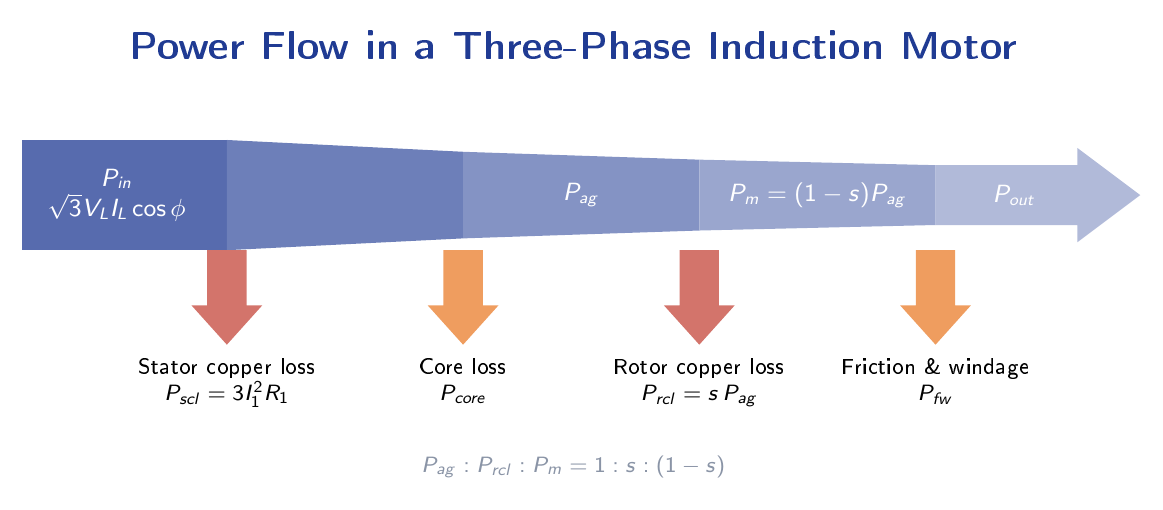
Power passes from the input through stator copper loss, the air gap, rotor copper loss and friction-and-windage loss to the shaft. The core relations are \(P_{ag} = 3I_2'^2 R_2'/s\), \(P_{cu2} = sP_{ag}\), \(P_{mech} = (1-s)P_{ag}\), \(P_{out} = P_{mech} - P_{f+w}\) and \(T_e = P_{ag}/\omega_s\).
Torque–Slip Characteristic
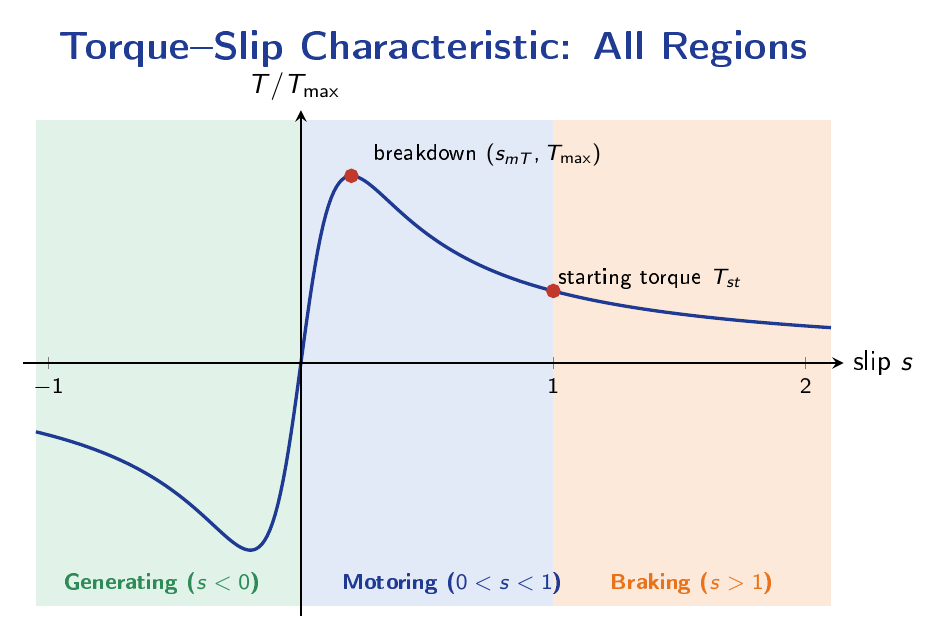
Torque rises with slip to a maximum (the breakdown torque) and then falls. The slip at maximum torque and the Kloss approximation are
The same characteristic describes motoring (\(0 \lt s \lt 1\)), plugging/braking (\(s \gt 1\)) and generating (\(s \lt 0\)).
Starting Methods for Induction Motors
| Method | \(V_{start}\) | \(T_{start}/T_{fl}\) | Remarks |
|---|---|---|---|
| Direct on-line (DOL) | \(1.0\) | 1.5–2.5 | High \(I_{start} \approx 6I_{fl}\); small motors |
| Star–delta | \(V/\sqrt3\) | ↓ to \(1/3\) | Torque and current drop to one-third |
| Auto-transformer | \(kV\) | \(k^2\) of DOL | Adjustable tap; smooth transition |
| Rotor resistance (slip-ring) | \(V\) | up to \(T_{max}\) | \(s_{mT}\) shifted toward \(s = 1\) |
| Soft starter (SCR) | Variable | Variable | Low cost; voltage ramp |
| VFD (VVVF inverter) | \(V \propto f\) | up to \(T_{max}\) | Best: low current, high torque |
For star–delta starting, \(I_Y = I_{DOL}/3\) and \(T_{Y/\Delta} = \tfrac{1}{3}T_{DOL}\). For an auto-transformer at tap \(k\), the line current is \(k^2 I_{DOL}\) and the starting torque is \(k^2 T_{DOL}\).
Braking of Induction Motors
Regenerative braking requires \(\omega_m \gt \omega_s\) (so \(s \lt 0\)) — from an active load (a descending hoist or downhill EV) or by reducing the supply frequency below the rotor speed in a VVVF drive; torque reverses and power flows to the source. Plugging swaps two stator phases to reverse \(n_s\); the slip becomes \(s = 2 - s_{old}\), torque opposes rotation and the motor decelerates rapidly, but it must be disconnected near zero speed to prevent reversal. DC dynamic braking disconnects the AC supply and injects DC into two stator phases, creating a stationary field in which the rotor acts as a loaded synchronous generator; the equivalent AC current for a star connection is \(I_{ac,eq} = \sqrt{2/3}\,I_{dc}\), and the braking torque is adjustable through \(I_{dc}\) and the rotor resistance.
Speed Control Methods — Summary
Induction-motor speed control divides into three families. Stator-side methods change the stator voltage (\(T \propto V^2\)), the frequency (which moves \(n_s\)), the V/f ratio (which preserves flux) or the pole count (discrete speeds). Rotor-side methods, available only on slip-ring machines, add rotor resistance (inefficient) or recover the slip power (static Kramer, Scherbius/DFIG, rotor-EMF injection). High-performance methods give DC-like control: field-oriented control (FOC), direct torque control (DTC) and model-predictive control (MPC).
Stator Voltage Control — AC Voltage Controller
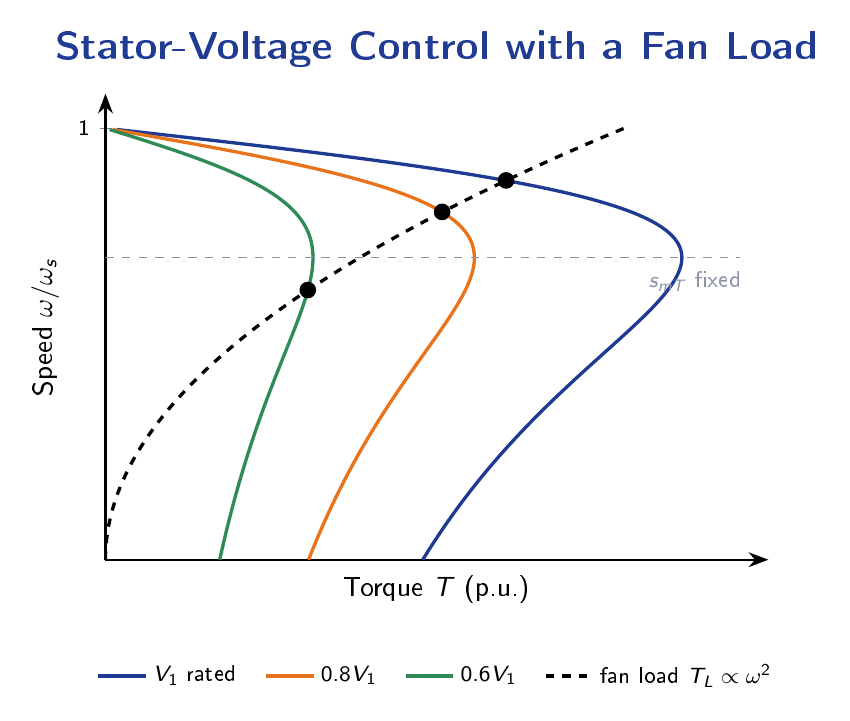
Varying the stator voltage at fixed frequency through an anti-parallel SCR pair (a TRIAC for small motors) changes the torque without holding the rotor flux constant. Because torque scales with the square of voltage at any given slip,
the slip at maximum torque is unchanged while \(T_{max}\) falls as \(V_1^2\). For an R-load with firing angle \(\alpha\), \(V_{1,rms} = V_{ph}\sqrt{1 - \alpha/\pi + \sin 2\alpha/2\pi}\).
Constant V/f Control — the Workhorse
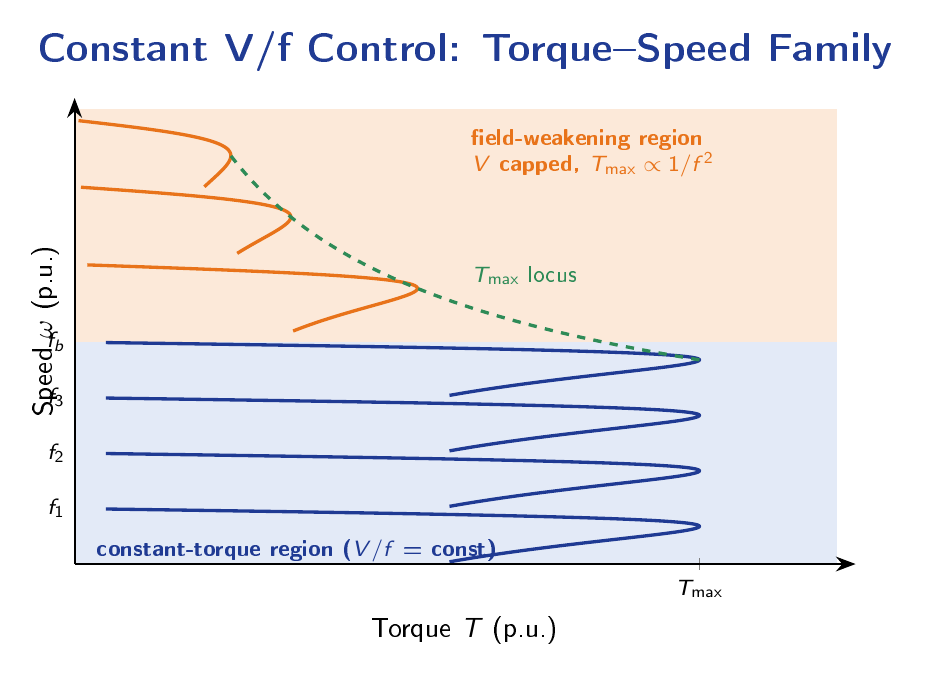
To hold the air-gap flux constant as frequency changes, keep \(V_1/f = \text{constant}\). Since \(\phi \propto V_1/f\), this avoids saturation below base speed and allows field weakening above it.
Below base frequency the drive operates in the constant-torque region; above base frequency it enters the constant-power (field-weakening) region. At low frequency the stator resistance drop becomes significant and the flux collapses, so a voltage boost is added: \(V_1 = V_{boost} + kf\).
VSI versus CSI — Two Inverter Philosophies
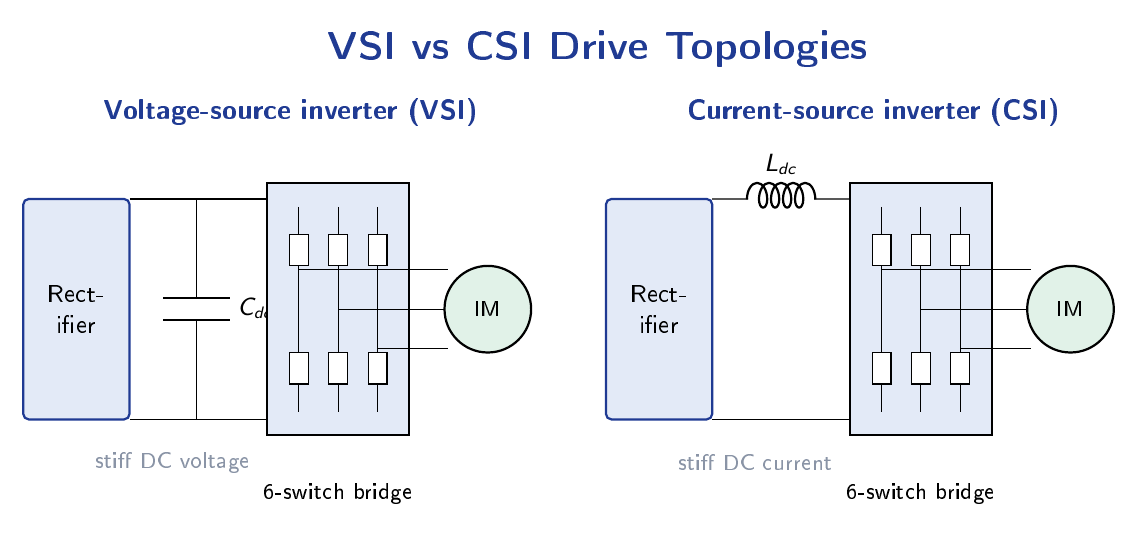
A voltage-source inverter (VSI) presents a stiff DC voltage through a large capacitor and outputs a six-step or PWM voltage; its fundamental in six-step mode is \(V_1 = 2V_d/\pi\), PWM uses modulation index \(m_a = V_{ctrl}/V_{tri}\), and four-quadrant operation needs anti-parallel diodes plus an active front-end. A current-source inverter (CSI) presents a stiff DC current through a large inductor and outputs a quasi-square current; the motor sets the voltage, four-quadrant operation is inherent, and it suits very large machines.
| Aspect | VSI | CSI |
|---|---|---|
| DC-link element | Capacitor | Inductor |
| Output waveform | Voltage (6-step / PWM) | Current (quasi-square) |
| Power rating | 1 kW – MW | Hundreds of kW – MW |
| Typical use | General, servo | Very large induction motors |
Six-Step VSI — Voltage and Harmonic Analysis
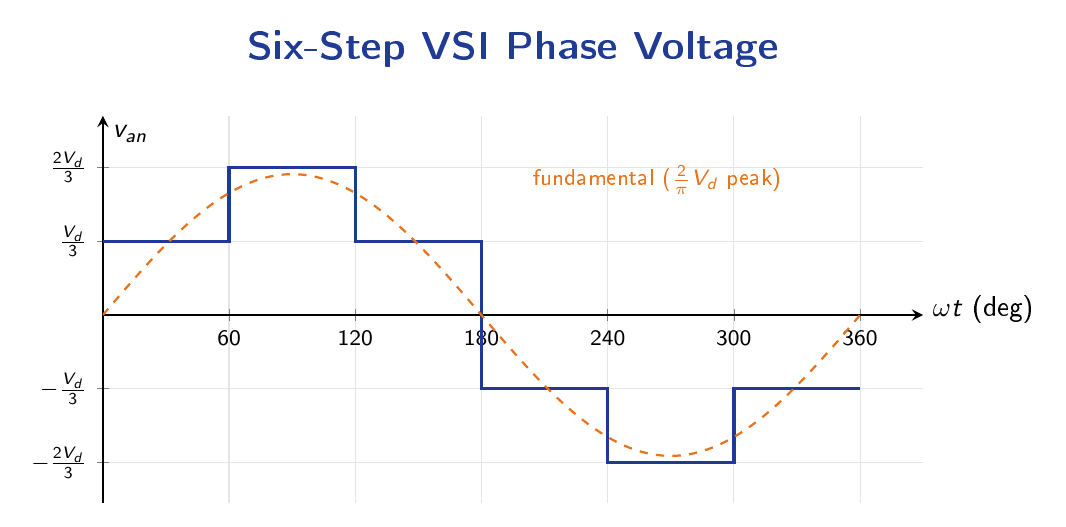
With \(180^\circ\) conduction, each switch conducts for half a cycle and three conduct at once, producing six unique switch combinations and a six-step phase voltage:
The fundamental is \(V_{an,1} = 2V_d/\pi\) with harmonics \(V_{an,n} = V_{an,1}/n\) for \(n = 6k\pm1\); the line-voltage fundamental is \(V_{ab,1} = 2\sqrt3 V_d/\pi\). The RMS values are \(V_{an,rms} = \sqrt{2/3}\,V_d \approx 0.471V_d\) and \(V_{ab,rms} \approx 0.816V_d\), with a voltage THD of about 31%.
PWM Techniques for VSI
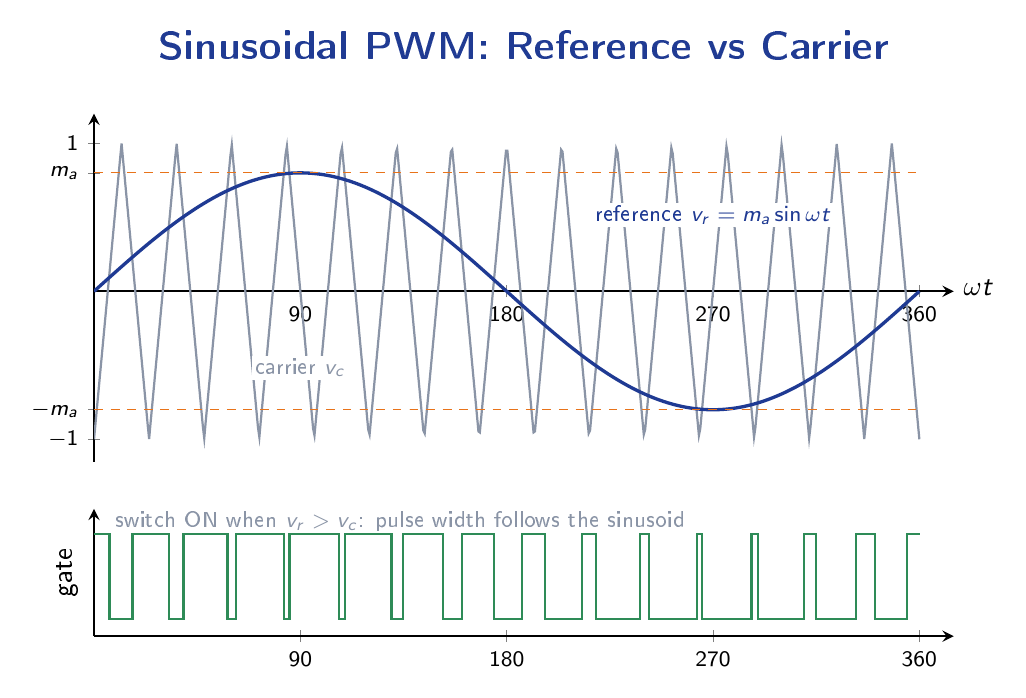
Sinusoidal PWM compares a sinusoidal reference with a high-frequency triangular carrier. The modulation index \(m_a = \hat V_{ref}/\hat V_{tri}\) (with \(0 \le m_a \le 1\) in the linear range) sets the output: \(\hat V_{1,line} = m_a \tfrac{\sqrt3}{2}V_d\). Overmodulation (\(m_a \gt 1\)) adds low-order harmonics.
Advanced schemes improve on basic SPWM: space-vector PWM (SVPWM) raises bus utilisation by 15% (\(V_{1,max} = V_d/\sqrt3\)); third-harmonic injection gives a similar gain; discontinuous PWM lowers switching loss; and random PWM spreads the EMI spectrum.
Inverter Dead-Time and Compensation
The two switches in one leg must never conduct together (shoot-through). A blanking interval \(t_d\) is inserted between turn-off and turn-on, which introduces an average voltage error.
Dead-time produces low-order distortion (5th, 7th harmonics), torque ripple and audible noise, worst at low fundamental amplitude. Compensation uses sign-of-current correction (add or subtract \(\Delta V\)), adaptive observers, or wide-bandgap devices with much smaller \(t_d\) (50 ns versus 2 µs). PWM also produces a common-mode voltage \(V_{cm} = (v_a+v_b+v_c)/3\) that drives bearing currents and EMI, mitigated by common-mode chokes, shielding and CM-aware modulation.
Multilevel Inverters for Medium-Voltage Drives
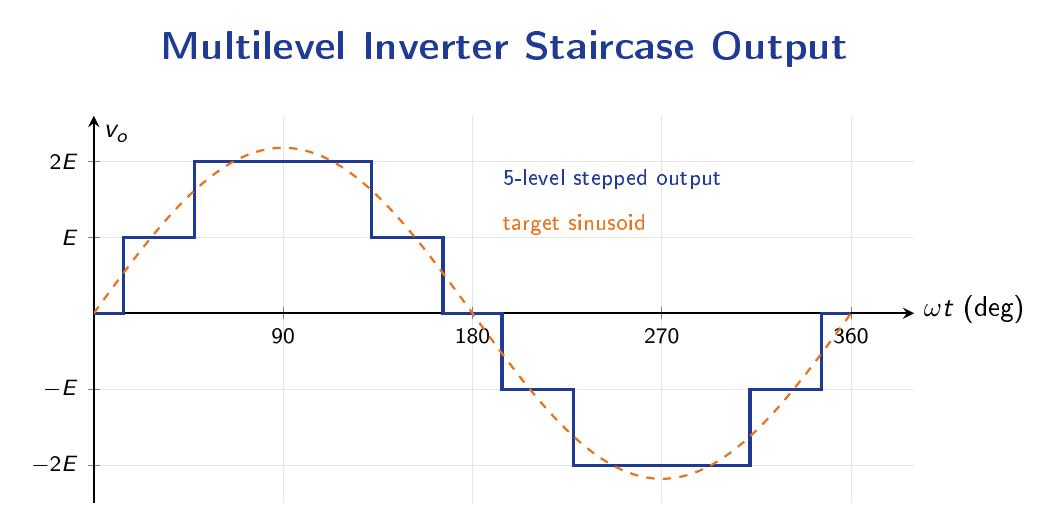
At medium voltage (2.3–13.8 kV) a single switch cannot block the bus, so devices are stacked or the voltage is partitioned across several capacitors to build a stair-step output — lowering \(dv/dt\), reducing THD and shrinking filters.
The common topologies are the neutral-point-clamped (NPC) inverter with clamping diodes, the flying-capacitor (FC) inverter with floating capacitors, the cascaded H-bridge (CHB) with isolated DC sources (modular), and the modular multilevel converter (MMC) used for HVDC and very-high-voltage drives.
Cycloconverter and Slip-Power Recovery
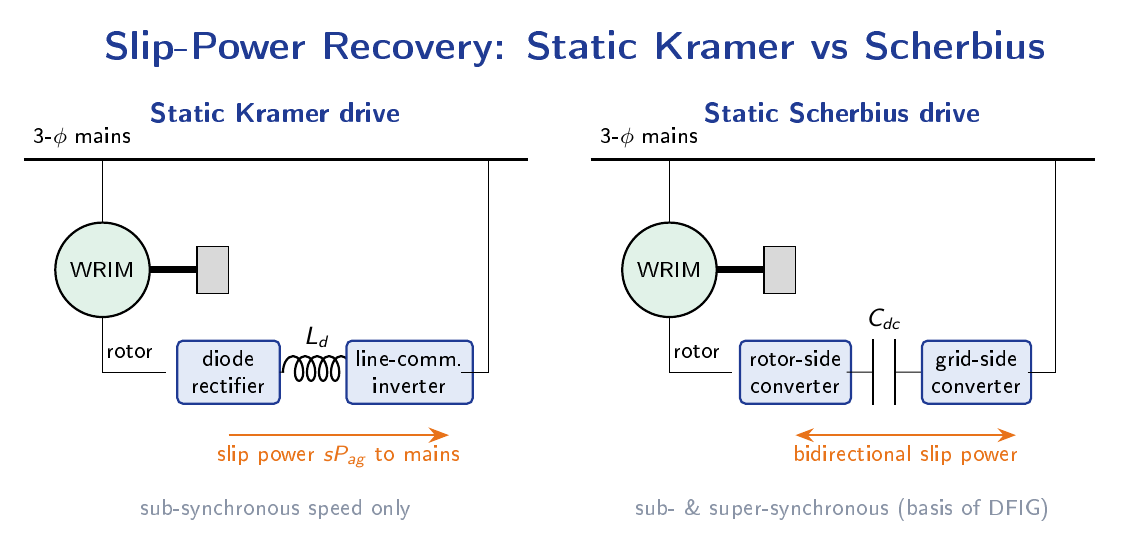
A cycloconverter performs direct AC–AC frequency conversion (output frequency typically \(\le f_{in}/3\)), used for very large low-speed drives such as ball mills and ship propulsion. On slip-ring machines, the slip power can be recovered rather than wasted.
The static Kramer drive rectifies the rotor slip power and inverts it back to the mains through a line-commutated inverter; the converter is rated at only about 30% of the motor rating, but it allows sub-synchronous operation only. The slip-power balance gives \(P_{ag} = T\omega_s\), \(P_{slip} = sP_{ag}\), and \(\omega_m = \omega_s\left(1 - V_{dc,inv}/V_{dc,rect}\right)\).
The Scherbius drive uses a bidirectional rotor converter (cycloconverter or back-to-back), enabling both sub- and super-synchronous operation. This is the basis of the doubly-fed induction generator (DFIG) used in wind turbines.
Vector Control (Field-Oriented Control)
Transform the stator currents into two orthogonal components aligned with the rotor-flux frame: \(i_{ds}\) (flux-producing, like a DC field current) and \(i_{qs}\) (torque-producing, like a DC armature current). The result is decoupled, DC-like control of an AC machine.
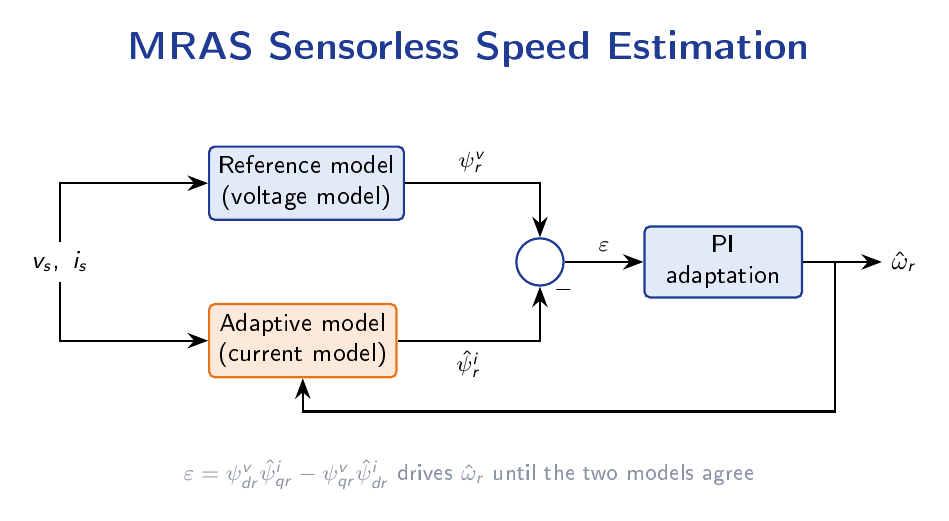
There are two variants: direct FOC, where the flux is measured (Hall/search coil) or estimated from a voltage model, and indirect FOC, where the slip frequency is added to the rotor speed — simpler and more popular. FOC needs an accurate rotor resistance (it drifts with temperature), so online adaptation or a model-reference adaptive system (MRAS) is used, along with an encoder or a sensorless observer.
Direct Torque Control (DTC)
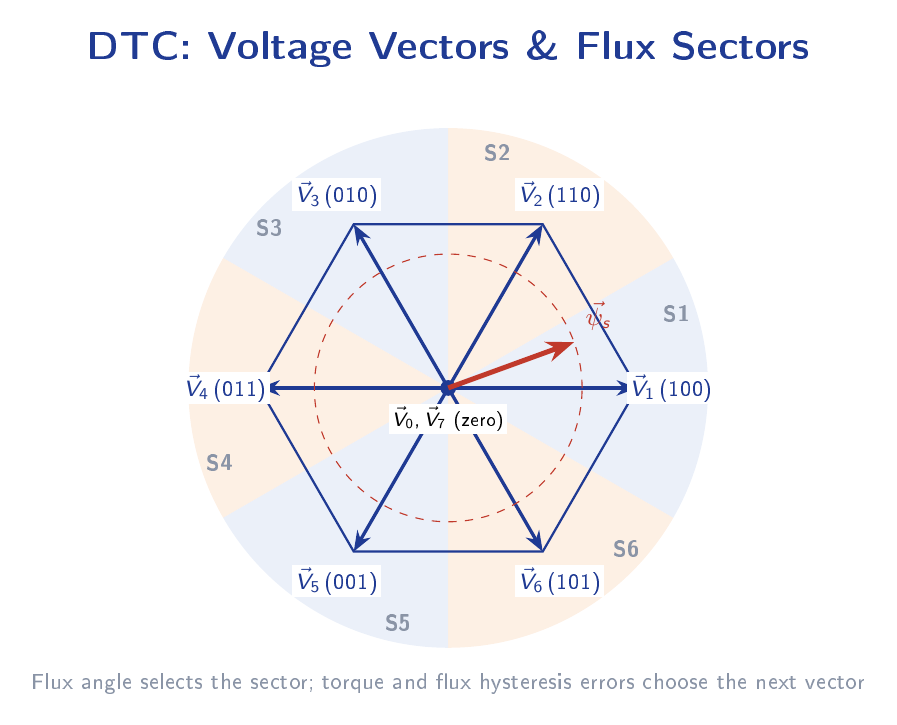
DTC controls torque and stator flux directly, without coordinate transformations or current loops. The torque is
where \(\delta\) is the angle between the stator and rotor flux and \(\sigma = 1 - L_m^2/(L_sL_r)\). Hysteresis controllers on \(|\psi_s|\) and \(T_e\), combined with the flux sector, select an optimal voltage vector from a switching table.
| Feature | FOC | DTC |
|---|---|---|
| Coordinate transform | Required (\(abc \leftrightarrow dq\)) | Stator frame only |
| Current controllers | Yes (PI) | No (hysteresis) |
| Switching frequency | Fixed (PWM) | Variable |
| Torque transient | Fast (~ms) | Faster (< ms) |
| Torque ripple | Low | Higher |
| Parameter sensitivity | High (\(R_r\)) | Low (\(R_s\) only) |
Synchronous, PMSM & BLDC Drives
Synchronous Motor — Fundamentals
The per-phase relation is \(\mathbf{V} = \mathbf{E}_f + \mathbf{I}_a(R_a + jX_s)\). The developed power for a cylindrical rotor is
and for a salient-pole machine the two-reaction theory adds a reluctance term:
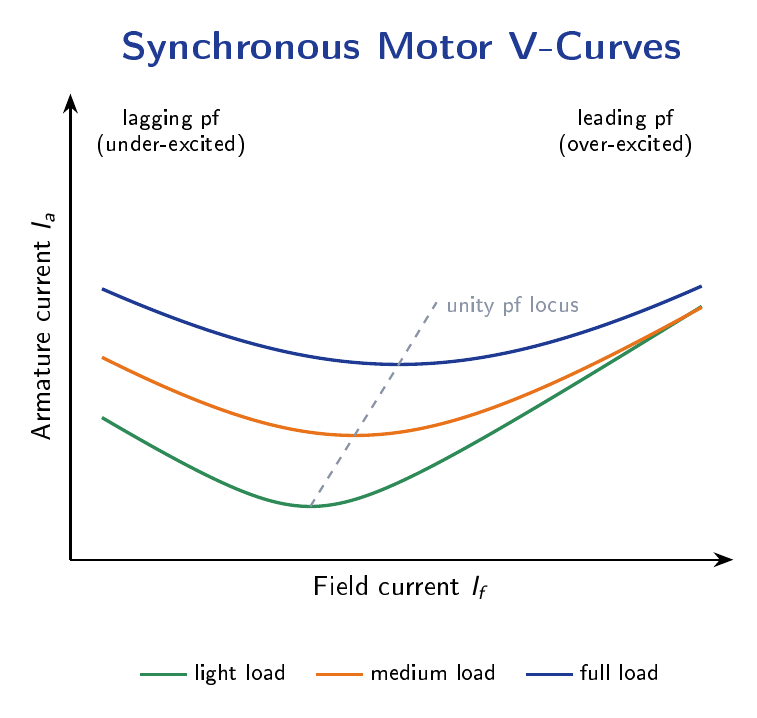
By varying the field current the power factor is controlled: an under-excited machine draws a lagging (inductive) current, unity excitation gives the lowest armature current, and an over-excited machine draws a leading (capacitive) current. Plotting \(I_a\) against \(I_f\) at constant power gives the characteristic V-curves.
Power-Angle Characteristic and Stability
The torque follows the power, \(T = P/\omega_s\). The salient-pole reluctance term peaks earlier in \(\delta\), giving a higher maximum power than the cylindrical machine. Pull-out occurs where \(dP/d\delta = 0\).
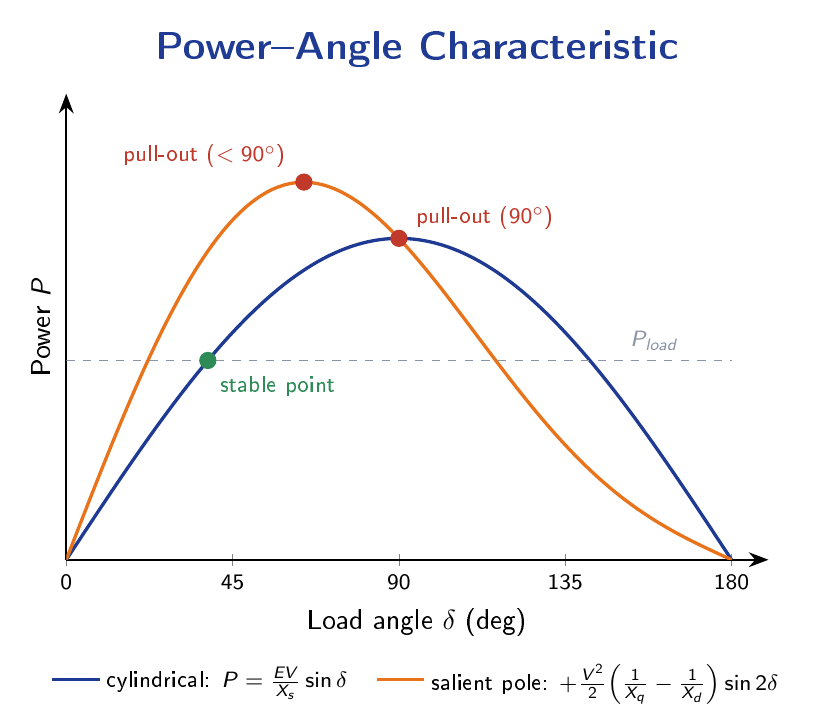
Stable operation lies in \(0 \lt \delta \lt \delta_{po}\). A load step or supply dip makes the rotor oscillate (hunting). A damper (amortisseur) winding suppresses these oscillations; in a self-controlled drive the inverter itself provides the damping.
Synchronous Motor Drives — Types
Four drive arrangements are used. A cycloconverter performs direct AC–AC conversion (\(f_o \le f_{in}/3\)) for ball mills and ship propulsion. A VSI/PWM-fed drive converts constant-frequency input to variable-frequency PWM for PMSMs and general drives. A self-controlled (LCI) drive feeds commutating pulses from rotor position, behaving as a "commutatorless DC motor" for large rugged machines. A true synchronous drive uses an independent frequency source and needs a damper, suited to multi-motor textile mills.
In self-controlled mode the over-excited (leading power factor) motor supplies the reactive power needed for inverter commutation, with no hunting or loss of synchronism — making it popular for large salient-pole machines in the megawatt range. Synchronous motors are started by a damper winding (asynchronous start and pull-in), a pony motor, a variable-frequency inverter ramp, or reduced frequency for an LCI.
Load-Commutated Inverter (LCI) Drive
A line-side phase-controlled rectifier feeds a DC-link reactor; the load side is a six-pulse current-fed thyristor inverter commutated by the back-EMF of the over-excited synchronous motor.
The lead angle \(\gamma\) between the motor current and back-EMF is set to about \(30^\circ\) for safe commutation. The inverter SCRs commutate from the motor EMF only above about 5% speed; below this a pulsed-mode start is used until natural commutation takes over. Rugged thyristors make the LCI the standard for very large pumps, compressors and ID fans up to about 100 MW.
VSI/CSI-Fed Synchronous Motor Drives
A VSI-fed synchronous motor uses sinusoidal PWM, with \(V_{1,LL} = m_a\tfrac{\sqrt3}{2}V_{dc}\) for SPWM or \(V_{1,LL} = m_a V_{dc}/\sqrt2\) for SVPWM (a 15% gain). Scalar V/f suits open-loop operation while FOC is used for high-performance PMSM drives. A CSI-fed machine (auto-sequentially commutated) produces quasi-square current, commutated by capacitors before pickup and then by the motor EMF, with inherent four-quadrant operation. Because there is no slip, the inverter output frequency directly sets the speed: \(n_s = 120f_1/P\).
| Aspect | LCI | VSI-PMSM |
|---|---|---|
| Power range | 1–100 MW | 1 W–5 MW |
| Switches | SCRs | IGBT / SiC |
| Commutation | Motor EMF | Forced / PWM |
| Starting | Pulsed-mode | Inherent |
| Reactive power | Motor over-excitation | Inverter |
| Output waveform | Quasi-square current | PWM voltage |
| Torque ripple | Moderate | Low |
| Cost (\$/kW) | Low | Higher |
PMSM — Permanent Magnet Synchronous Motor
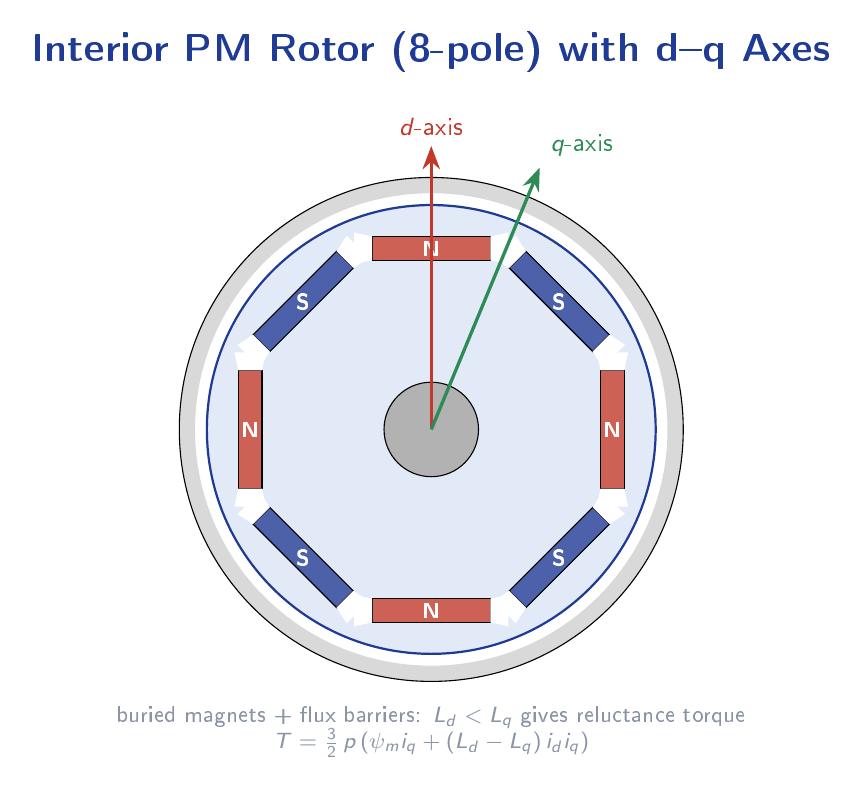
In the rotor \(d\)-\(q\) frame the PMSM voltage and torque equations are
The torque has a magnet (alignment) component and a reluctance component. Two constructions exist: surface PM (SPM), where \(L_d = L_q\), non-salient, with no reluctance torque; and interior PM (IPM), where \(L_d \lt L_q\) and reluctance torque is available.
PMSM Control Strategies
| Strategy | Condition | Use case |
|---|---|---|
| \(i_d = 0\) | SPM, below base speed | Simplest; equals MTPA for SPM |
| MTPA (max torque per amp) | IPM, optimum \(i_d \lt 0\) | Maximises efficiency |
| Flux weakening | Above base speed, \(V_s\) saturated | Extends speed range |
| MTPV (max torque per volt) | Very high speed | Avoids current-limit violation |
| Unity power factor | Minimise inverter VA | Rare, for grid-tied systems |
The voltage-limit ellipse shrinks with speed, driving the operating trajectory toward \(i_d = -\psi_f/L_d\) in deep field weakening.
BLDC Motor — the Rugged Sibling
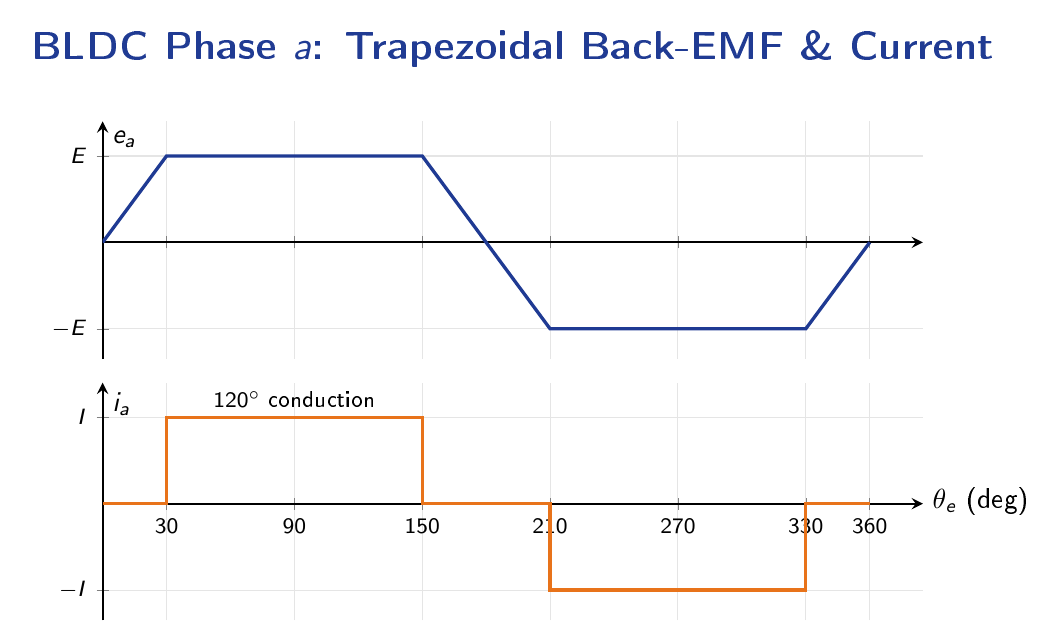
The BLDC machine differs from the PMSM in its waveforms and control: the back-EMF is trapezoidal (with a \(120^\circ\) flat top), the phase current is rectangular (\(120^\circ\) blocks), commutation is electronic at \(60^\circ\) intervals, and position is sensed by three Hall sensors (or estimated sensorlessly). With two phases conducting at any instant,
| Feature | BLDC | PMSM |
|---|---|---|
| Back-EMF shape | Trapezoidal | Sinusoidal |
| Current shape | Rectangular (6-step) | Sinusoidal (PWM) |
| Torque ripple | Moderate (commutation spikes) | Low |
| Control complexity | Simple (6-step) | Higher (FOC) |
| Cost | Lower | Higher |
| Application | HVAC, EV, drones, disk drives | Servo, high-end EV, robotics |
Special Machine Drives
Stepper Motor Drives
Each input pulse advances the rotor by one discrete step, giving open-loop positioning without an encoder.
The step angle is \( \beta = 360^\circ/(N_r\cdot m)\), where \(N_r\) is the number of rotor teeth and \(m\) the number of phases. Three types exist: variable-reluctance (soft-iron rotor, high speed, no detent), permanent-magnet (PM rotor, detent torque, low speed) and hybrid (VR + PM, typically \(\beta = 1.8^\circ\), the most common). Driving modes trade resolution for torque: full-step with one phase on, full-step with two phases on (more torque), half-step (\(\beta/2\)) and microstepping (\(\beta/n\), up to \(n = 256\)). The performance limits are the pull-in rate (maximum starting rate without losing steps), the pull-out rate (maximum running rate) and the holding torque (static torque at rated current).
Stepper Drive Electronics
An \(L\)-\(R\) winding driven by a step voltage rises with time constant \(\tau_e = L/R\):
The step time \(T_s = 1/f_{step}\) must satisfy \(T_s \gtrsim 4\tau_e\), which limits the maximum step rate. Drive techniques extend speed: an L/R drive adds series resistance to raise the voltage (with high losses); a bi-level or chopper drive uses a high voltage for fast current rise with a chopper limiting the current; and a constant-current chopper uses PWM hysteresis tracking. Microstepping feeds two sinusoidal currents \(90^\circ\) apart, \(i_a = I_p\cos(N_r\theta)\) and \(i_b = I_p\sin(N_r\theta)\), giving \(\beta_{micro} = \beta/n\).
Switched Reluctance Motor (SRM)
Salient poles on both stator and rotor, with no magnets and no rotor winding. The unidirectional stator current produces torque from the rotor's tendency to align with the excited pole.
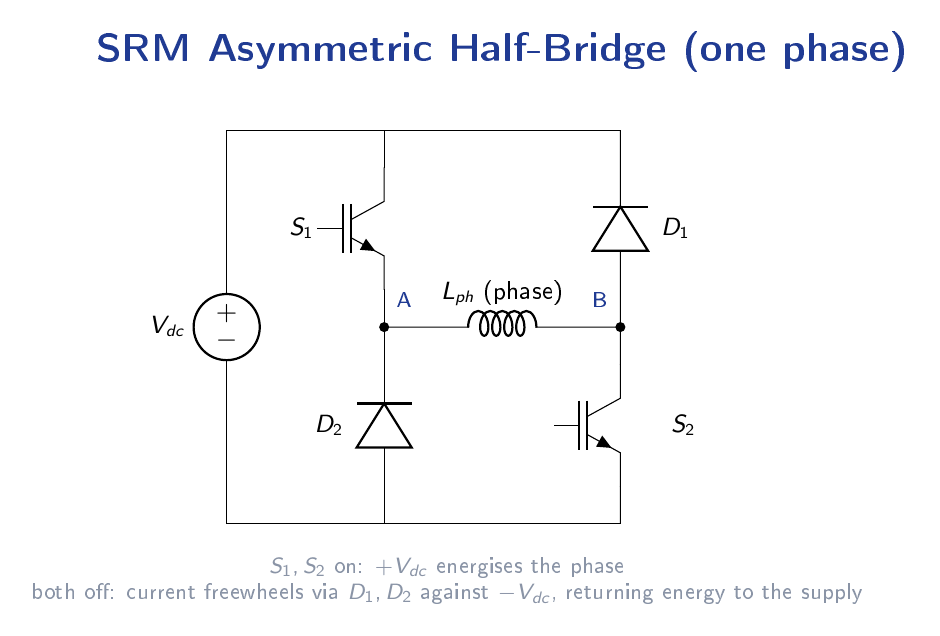
Torque comes from the co-energy: \(T_e = \left.\partial W'(i,\theta)/\partial\theta\right|_{i}\), which in the linear region is \(T_e = \tfrac{1}{2}i^2\,dL(\theta)/d\theta\). Each phase is fed by an asymmetric half-bridge with two switches and two diodes.
| Advantages | Drawbacks | Where used |
|---|---|---|
| Rugged, no magnets, low cost | High torque ripple | EVs (next-gen) |
| Fault tolerant, high-speed | Acoustic noise | Appliances (washers, HVAC) |
| Simple converter per phase | Needs position sensing | Aerospace actuators |
The per-phase voltage equation includes a motional back-EMF term:
Two control modes are used. At low speed, chopping limits the current by chopping the bus, controlling duty and turn-on angle. At high speed, single-pulse operation switches on at \(\theta_{on}\) and off at \(\theta_{off}\). The average torque and base speed are
Above \(\omega_b\) the machine enters its constant-power region. Acoustic noise is reduced by profiled current waveforms (torque-sharing functions), randomised PWM and skewed laminations.
Motor Sizing, Duty & Thermal Design
Heating and Cooling of Motors
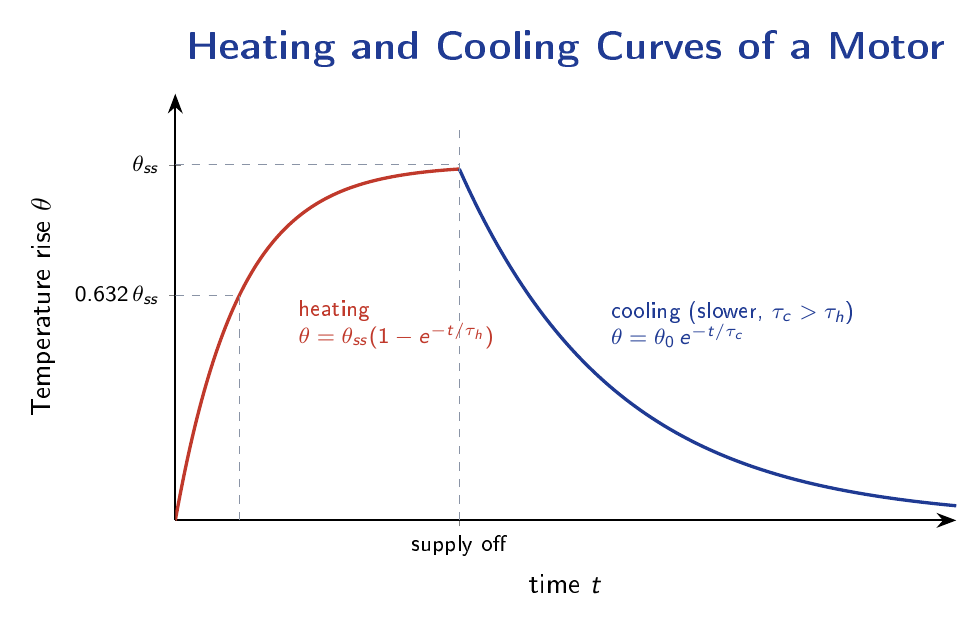
A motor is modelled as a first-order thermal body: the loss power either raises the temperature or is conducted away, \(P_{loss}\,dt = G_h c\,d\theta + A\lambda\,\theta\,dt\). Heating and cooling then follow exponentials:
The cooling time constant often exceeds the heating one because there is no forced cooling at standstill (\(\tau_c \gt \tau_h\)).
Classes of Duty (IEC 60034-1)
Eight standard duty types describe how a motor is loaded over time: S1 continuous (steady-state reached); S2 short-time (stops to cool to ambient); S3 intermittent periodic (cyclic duration factor below 100%); S4 intermittent with heavy starts; S5 intermittent with starting and braking; S6 continuous with intermittent load (never stops); S7 continuous with starting and braking; and S8 continuous with speed changes.
where \(t_N\) is the load (working) time and \(t_R\) the rest time. Most catalogue ratings assume S1; non-S1 duties permit a higher peak at a reduced cycle, verified by the equivalent-current method.
Motor Rating Selection Methods
For loads that vary over a cycle, an equivalent steady value is computed so the catalogue rating can be chosen as \(I_{rated} \ge I_{eq}\):
For short-time duty of length \(t_r\), the allowable overload factor is
so a shorter loading time permits a larger overload. For self-cooled motors that stop during idle, the effective idle (cooling) time is reduced by a factor \(\beta \approx 0.5\): \(t_{idle,eff} = \beta\,t_{idle}\).
Industrial & Traction Applications
Traction Drives — Physics
The tractive effort balances acceleration, gradient and resistance forces:
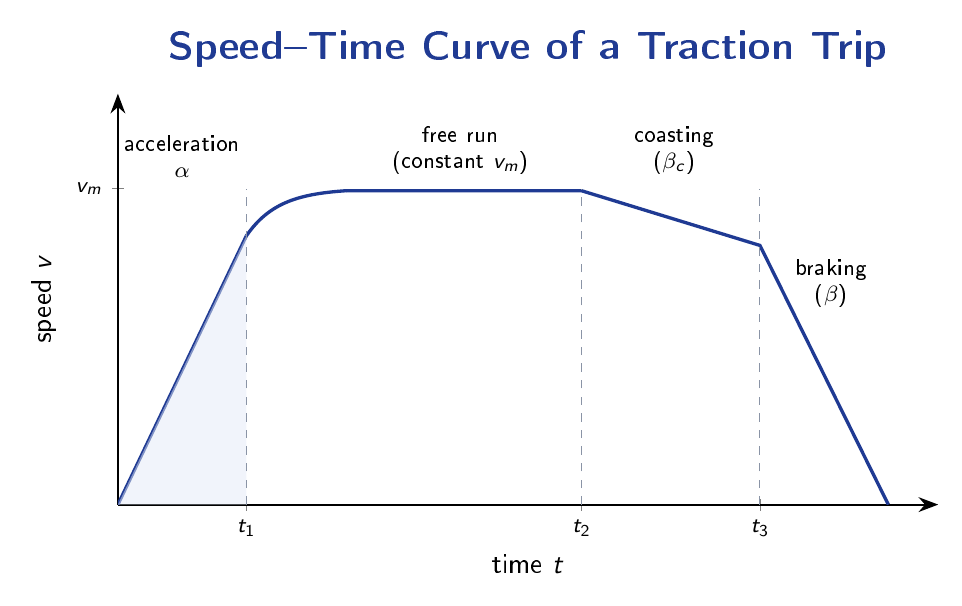
where \(M_e\) accounts for rotational inertia and \(r\) lumps rolling and wind resistance. A typical trip has four phases — acceleration, free run, coast and brake — and energy use is quoted as specific energy \(W_{sp}\) in kWh per tonne-kilometre.
Electric Vehicle (EV) Drive Architecture
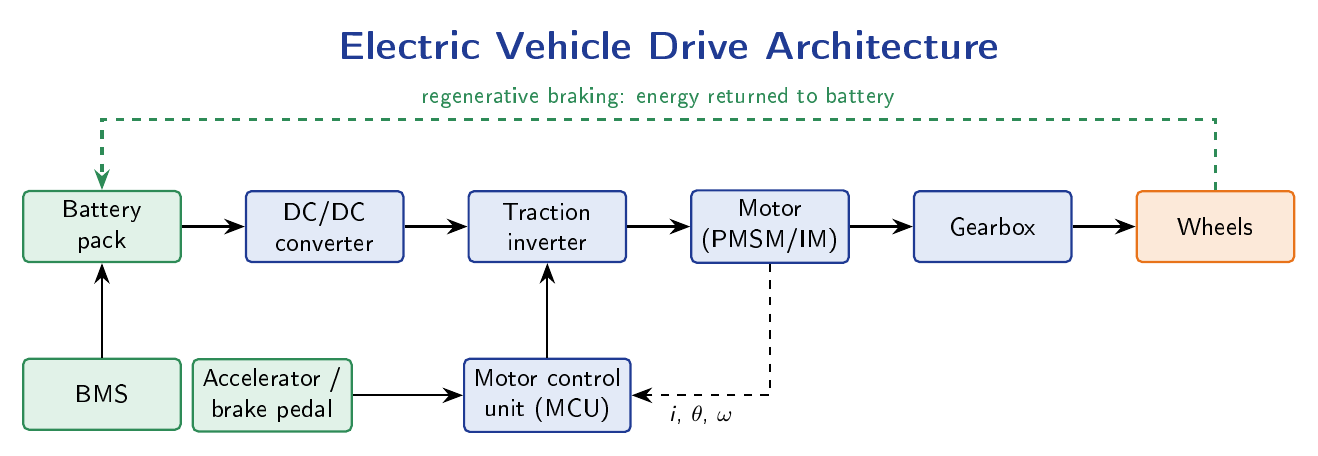
An EV powertrain runs from the battery (48–800 V) through an optional DC/DC boost stage, an inverter (VSI with SVPWM), the traction motor (PMSM or IM), a single-speed gearbox and the wheels. A motor control unit implements FOC/MTPA/field-weakening, a battery management system handles cell balancing and state-of-charge, and regenerative braking returns energy from the wheels to the battery.
- Wide speed range (4:1 to 6:1)
- High peak torque for launch
- High efficiency across the operating map
- Compact, light and thermally robust
- Four-quadrant for regenerative braking
- Tesla Model S (rear) — IPM-SRM hybrid
- Tesla Model 3 (rear) — IPMSM
- Tesla Model Y (front) — induction
- Nissan Leaf — PMSM
- Hyundai Ioniq 5 — PMSM
Wind & Renewable Energy Drives
The doubly-fed induction generator (DFIG) connects its stator directly to the grid and its rotor through a bidirectional (back-to-back) converter, giving variable speed over about \(\pm30\%\) of synchronous speed with a converter rated at only 30% of the nominal power — the standard for 1–5 MW turbines. The direct-drive PMSG is a low-speed, high-torque, multi-pole machine with a full-rated converter and no gearbox (used by Siemens, Enercon and GE). The captured power is
with \(C_p\) optimal at a tip-speed ratio \(\lambda_{opt} \approx 7\); maximum-power-point tracking drives the pitch and rotor speed to stay there. Grid codes require fault ride-through (LVRT), reactive support (\(\pm0.95\) power factor), frequency response and harmonic compliance.
Industrial Applications — Motor Selection Matrix
| Application | Load nature | Drive | Key feature |
|---|---|---|---|
| Paper mill | Tight tension | VFD-IM + FOC | Synchronised speed |
| Steel rolling mill | Shock, reversing | 4-Q DC or large CSI | High overload, fast response |
| Cement kiln | Constant speed, large \(J\) | SRIM + slip recovery | Soft start, efficient |
| Cranes & hoists | 4-Q, overhauling | IM-VFD or DC | Regenerative braking |
| Pumps & fans | \(T \propto \omega^2\) | VFD-IM (V/f) | Energy saving |
| Compressor | Constant torque | VFD-IM or SM | Starting current limit |
| Textile spinning | Multi-motor sync | True synchronous | Matched speed |
| CNC machine | Position loop | PMSM servo | High bandwidth, precision |
| Robotics | High acceleration | PMSM / BLDC | Torque density |
| Elevators | Smooth, position | PMSM gearless | Ride quality |
| Electric vehicle | Wide range, 4-Q | PMSM / IM + FOC | Efficiency map |
| Wind turbine | Variable speed | DFIG or PMSG | Converter rating |
| Railways | Traction, 4-Q | IM + VVVF | Regen, reliability |
| Ship propulsion | Low-speed, MW | Cycloconverter SM | Direct drive |
| HVAC | \(T \propto \omega^2\) | VFD-IM or ECM | Large energy saving |
Power Quality, Harmonics & Efficiency
Power Quality Issues in Drives
- Line side: a six-pulse rectifier produces harmonics at \(h = 6k \pm 1\) (5th, 7th, 11th, 13th, …)
- Machine side: inverter voltage and current harmonics cause torque pulsations
- PWM carrier harmonics
- Common-mode voltage that drives bearing currents
The key metrics are the current total harmonic distortion and the true power factor:
Mitigation uses multi-pulse converters (12, 18 or 24-pulse), an active front-end (PWM rectifier), passive L or LCL filters, active power filters, and phase-shifting transformers. The IEEE 519-2014 limits depend on the short-circuit ratio \(I_{sc}/I_L\): for a low ratio (< 20) the total demand distortion must be \(\le 5\%\), while for a high ratio (> 1000) up to 20% is permitted.
Energy Efficiency in Drives
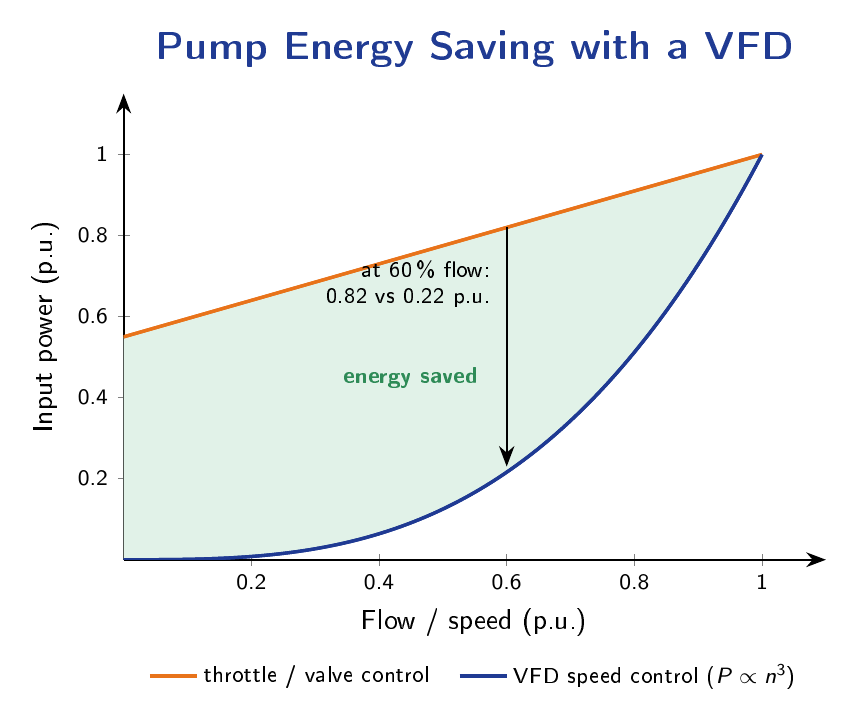
The system efficiency is the product of the converter, motor and transmission efficiencies, typically \(0.97 \times 0.93 \times 0.97 \approx 87\%\). The biggest savings come from variable-speed operation of fan and pump loads, where the affinity law makes power scale with the cube of speed:
so a 20% speed reduction saves about 49% of the power. Motor efficiency classes are defined by IEC 60034-30-1 as IE1 < IE2 < IE3 < IE4 < IE5 (ultra-premium).
Drive and Motor Protection Schemes
| Fault | Protection & detection |
|---|---|
| Overcurrent | Fast fuse plus IGBT desaturation detection (~10 µs) |
| Short circuit | DC-link sensing with gate hardware shutdown |
| Overload (thermal) | \(I^2t\) model in firmware; PTC/NTC in the winding |
| Over/under voltage | DC-bus monitor; brake chopper at over-voltage |
| Phase loss / unbalance | Negative-sequence monitor |
| Earth fault | Residual-current (\(I_0\)) sensor |
| Stall / locked rotor | \(\omega \lt \omega_{min}\) with \(I \gt I_{rated}\) |
| Bearing currents | Insulated bearing or shaft-grounding ring |
Protection is layered by speed of response: hardware (gate driver, fuse) acts in microseconds, firmware (DSP trip logic) in milliseconds, the application supervisor (drive/PLC) in tens of milliseconds, and plant relays and breakers in hundreds of milliseconds. Modern drives implement Safe Torque Off (STO) per IEC 61800-5-2, removing the inverter gate signals and certified to SIL3/PLe.
Dynamic Modelling
State-Space Model — DC Machine
With states \(\mathbf{x} = [i_a,\ \omega_m]^T\) and inputs \(\mathbf{u} = [V_a,\ T_L]^T\), the DC machine is a linear second-order system:
The transfer functions follow as
Induction Motor — d-q Model (Synchronous Frame)
In the synchronously rotating frame the stator and rotor voltage equations are
with flux linkages \(\psi_{ds} = L_s i_{ds} + L_m i_{dr}\) and \(\psi_{dr} = L_r i_{dr} + L_m i_{ds}\) (the \(q\)-axis is analogous). The electromagnetic torque and mechanical equation close the model:
Park Transformation
The Park transformation maps three-phase quantities to the rotating \(dq0\) frame:
with the inverse
The reference-frame choice depends on the application: \(\theta = 0\) gives the stationary \(\alpha\)-\(\beta\) (Clarke) frame; \(\theta = \omega_e t\) gives the synchronous frame (where balanced AC quantities become DC at steady state); and \(\theta = \theta_r\) gives the rotor frame used in PMSM FOC.
Advanced Control Techniques
Feedback Devices — Position and Speed Sensors
| Sensor | Output | Resolution / accuracy | Typical use |
|---|---|---|---|
| Tacho-generator | Analog DC voltage | \(\pm0.1\%\), low bandwidth | Legacy DC drives |
| Incremental encoder | A/B/Z TTL pulses | 256–10000 PPR | Servo, position tracking |
| Absolute encoder (SSI/EnDat) | Digital word | 12–26 bit single-turn | Multi-turn applications |
| Resolver | sin/cos analog | ~12 bit (RDC) | Harsh environment, EV |
| Hall sensors (3×) | Digital, \(60^\circ\) | 6 sectors / electrical rev | BLDC commutation |
| GMR / TMR sensors | Analog / digital | 14–16 bit | Compact, high-temperature |
| Optical linear scale | Pulses or absolute | µm level | CNC, machine tools |
Selection is driven by the required resolution and bandwidth, the environment (temperature, dust, oil, vibration), cost and cabling, and whether absolute position is needed at power-up. Resolver-to-digital conversion excites the resolver at 5–10 kHz and demodulates the sin/cos envelopes through a tracking converter — robust to noise, shock and temperature, hence standard for EV traction motors.
Sensorless Control Techniques
Removing the encoder or resolver lowers cost, raises reliability, shrinks the package and improves tolerance to harsh environments.
At medium and high speed the rotor position is estimated from the back-EMF: EMF integration (voltage model), flux observers, model-reference adaptive systems (MRAS) and Kalman or Luenberger observers. At zero and low speed, where the back-EMF vanishes, saliency-based methods are used — high-frequency signal injection, the INFORM method and rotating HF carriers.
Model Predictive Control (MPC)
At each sampling instant, predict the future states under every candidate control action, pick the one that minimises a cost function, apply it, and repeat.
In finite-control-set MPC (FCS-MPC) the cost is evaluated for all seven inverter voltage vectors and the minimum chosen:
Continuous-control-set MPC (CCS-MPC) instead solves a constrained optimisation over a prediction horizon:
solved by quadratic programming at each step (with explicit solutions possible). MPC handles constraints natively, is inherently multivariable and gives a very fast torque response, at the cost of a high computational burden and (for FCS) a variable switching frequency.
Worked Numerical Examples
The following fully solved problems span the core competencies of the course — DC and AC drive sizing, converter firing-angle selection, induction-motor torque, thermal rating and traction dynamics. Each is worked in the style expected in university examinations and GATE.
Example 1 — DC Motor Speed Control
A 220 V, 1500 rpm, 10 A separately-excited DC motor has armature resistance \( R_a = 0.5\ \Omega \) and drives a constant-torque load. Find the speed when the applied voltage is reduced to 150 V.
First establish the machine constant from rated data. The rated back-EMF and angular speed are
Because the load is constant-torque, the armature current stays at 10 A. At \( V = 150 \) V,
Armature-voltage control gives a proportional reduction in speed below base speed at constant torque.
Example 2 — Three-Phase Full-Converter Drive
A 220 V, 1500 rpm, 50 A DC motor with \( R_a = 0.1\ \Omega \) is fed from a three-phase full converter supplied at 415 V, 50 Hz. Find the firing angle \( \alpha \) for (a) rated operation and (b) half speed.
The mean converter output voltage for a three-phase full converter is
(a) Rated 1500 rpm, 50 A
(b) 750 rpm, 50 A
Example 3 — Induction-Motor Torque
A three-phase, 400 V, 50 Hz, 4-pole induction motor has \( R_1 = 1\ \Omega \), \( R_2' = 0.5\ \Omega \) and \( X_1 + X_2' = 4\ \Omega \). Find the slip at maximum torque \( s_{mT} \), the maximum torque \( T_{max} \) and the starting torque \( T_{st} \).
The synchronous speed is \( n_s = 1500 \) rpm so \( \omega_s = 157.08 \) rad/s, and the per-phase voltage is \( V_1 = 400/\sqrt{3} = 230.9 \) V.
The starting-to-maximum ratio is \( T_{st}/T_{max} = 0.28 \), and the full-load torque at \( s = 0.05 \) is approximately 80 N·m.
Example 4 — V/f Control at Reduced Frequency
Using the motor of Example 3, operate it with constant V/f at 30 Hz. Find the new slip at maximum torque and the new maximum torque.
Scaling voltage and reactance with frequency:
New slip at maximum torque
The slip rises — beneficial for starting.
New maximum torque
\( T_{max} \) drops about 15% because the stator-resistance drop becomes significant relative to the reduced applied voltage. The remedy is voltage boost, \( V_1 = V_{boost} + kf \), to compensate at low frequency.
Example 5 — Motor Rating for Intermittent Load
A constant-speed load follows the duty cycle: 100 N·m for 10 s, 50 N·m for 20 s, 25 N·m for 30 s, then idle for 40 s. Determine the equivalent continuous motor rating.
Using the equivalent-torque (RMS) method:
A standard 50 N·m continuous motor (the next catalogue size) is selected. The peak demand of 100 N·m is twice rated torque, well within the 2–2.5× short-term capability of a typical machine.
With idle-cooling factor \( \beta = 0.5 \)
Reduced cooling while idling slightly increases the required rating.
Example 6 — Thermal Overload
A motor has heating time constant \( \tau_h = 60 \) min and rated steady-state temperature rise \( \theta_{ss} = 60\,^\circ\text{C} \). Find (a) the temperature rise 30 min after a cold start, (b) the time to reach 50 °C, and (c) the permissible 30-min overload from cold.
(a) Heating after 30 min
(b) Time to reach 50 °C
(c) 30-min overload from cold
The motor can carry 1.6× rated current for 30 min when starting from cold.
Example 7 — Chopper-Fed DC Drive
A chopper-fed DC drive has \( V_s = 230 \) V, \( R_a = 0.2\ \Omega \), \( K\phi = 0.08 \) V·s/rpm, and is rated 1200 rpm at 20 A. Find the duty ratio \( \delta \) at (a) rated speed and (b) 600 rpm.
(a) Rated 1200 rpm, 20 A
(b) 600 rpm, 20 A
The armature current ripple, for \( L_a = 10 \) mH, \( f_c = 1 \) kHz and \( \delta = 0.435 \), is
Example 8 — Traction Speed–Time Dynamics
A 200-tonne train coasts on level track with rolling resistance \( r = 0.05 \) kN/tonne. Find the deceleration when the motors are switched off, and compare with coasting on a 1% down-gradient.
Level track
The 8% allowance accounts for the rotational inertia of wheels and motors.
1% down-gradient
Almost identical: gravity nearly offsets the rolling loss. On a steeper gradient the train would accelerate while coasting.
Modern Trends and Emerging Technologies
Wide-Bandgap Devices: SiC and GaN
Silicon power devices are approaching their physical limits. Wide-bandgap (WBG) semiconductors — silicon carbide (SiC) and gallium nitride (GaN) — break through those limits with higher blocking voltage (up to 10 kV for SiC), switching frequencies in the hundreds of kilohertz, operation above 200 °C, roughly half the switching loss of silicon, and consequently much smaller passive components.
| Parameter | Si | SiC | GaN |
|---|---|---|---|
| Bandgap (eV) | 1.12 | 3.26 | 3.39 |
| Breakdown field \(E_{br}\) (MV/cm) | 0.3 | 2.2 | 3.3 |
| Saturation velocity (107 cm/s) | 1.0 | 2.0 | 2.5 |
| Thermal conductivity (W/cm·K) | 1.5 | 4.9 | 1.3 |
| Maximum switching frequency | < 50 kHz | 100s of kHz | MHz |
WBG devices are already standard in EV traction inverters (Tesla, Lucid), wind and solar inverters, high-frequency DC–DC converters, and aerospace and rail systems.
- Very fast \( dv/dt \) drives bearing currents and EMI
- Gate-driver design becomes more demanding
- PCB layout is critical — parasitic inductance must be minimised
- Device cost is still higher than silicon
Emerging Topics in Electric Drives
Several research and product directions are reshaping the field:
Motor and inverter share one housing, cutting cost, size, wiring and EMI.
NPC, flying-capacitor, cascaded H-bridge and MMC topologies deliver low THD at medium voltage.
Neural-network observers and reinforcement learning adapt to nonlinearity and faults.
A real-time virtual replica of the drive enables predictive maintenance.
Pancake geometry gives high torque density in a short stack — ideal for EVs and drones.
Rectangular conductors raise the slot fill factor, improving efficiency and thermal behaviour.
Resonant inductive power transfer enables cable-free charging for EVs and mobile robots.
eVTOL and regional aircraft demand very high power density for zero-emission flight.
Smart Drives and Industry 4.0
Connected drives now embed intelligence and communication far beyond simple speed regulation:
- Edge analytics on board the drive — FFT of stator currents and vibration spectra
- Industrial protocols: EtherCAT, PROFINET, EtherNet/IP, OPC-UA
- Cloud telemetry for fleet-wide KPIs and remote firmware updates
- Cybersecurity: IEC 62443, signed firmware and role-based access
Motor Current Signature Analysis (MCSA) is a powerful predictive-maintenance tool: a broken rotor bar produces sidebands around the line frequency in the current spectrum at
- Bearing wear: vibration and stator-current sidebands at \( f_1 \pm k f_{bearing} \)
- Stator inter-turn shorts: negative-sequence current
- Rotor unbalance / eccentricity: 1× and 2× rotational harmonics
- Insulation degradation: leakage-current trending
Course Synthesis and References
Mental Map of the Subject
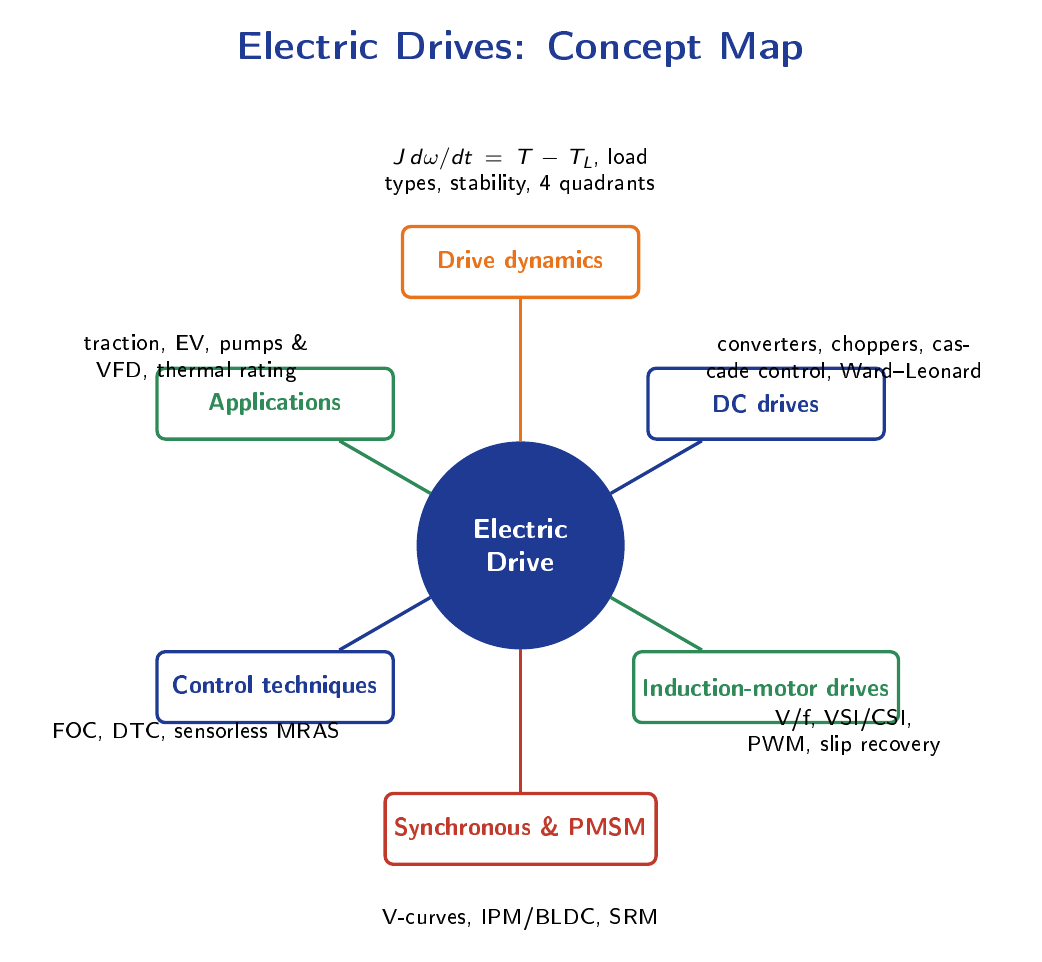
The entire course radiates from a single object — the electric drive — through six branches: drive dynamics and stability, DC drives (rectifier- and chopper-fed), induction-motor drives (V/f, FOC and DTC), synchronous and permanent-magnet drives (LCI, cycloconverter, PMSM and BLDC), advanced control (sensorless estimation and model-predictive control), and applications (electric vehicles, rail, industry and wind).
Key Formulas — Quick Reference Card
Drive Dynamics
DC Motor
Converters
Induction Motor
Synchronous Motor
Field-Oriented Control and PMSM
Thermal and Rating
Traction and Wind
Park Transform (field angle)
References and Further Reading
Foundational Textbooks
- G. K. Dubey, Fundamentals of Electrical Drives, 2nd ed., Narosa, 2001.
- G. K. Dubey, Power Semiconductor Controlled Drives, Prentice-Hall, 1989.
- R. Krishnan, Electric Motor Drives: Modeling, Analysis, and Control, Prentice-Hall, 2001.
- R. Krishnan, Permanent Magnet Synchronous and Brushless DC Motor Drives, CRC Press, 2009.
- R. Krishnan, Switched Reluctance Motor Drives, CRC Press, 2001.
Complementary Texts
- B. K. Bose, Modern Power Electronics and AC Drives, Prentice-Hall, 2002.
- W. Leonhard, Control of Electrical Drives, 3rd ed., Springer, 2001.
- N. Mohan, Electric Machines and Drives: A First Course, Wiley, 2012.
- P. C. Sen, Thyristor DC Drives, Wiley, 1981.
- J. M. D. Murphy and F. G. Turnbull, Power Electronic Control of AC Motors, Pergamon, 1988.
Standards
- IEEE 519-2014 — harmonic limits for industrial drives
- IEC 60034 series — rotating electrical machines
- IEC 61800 series — adjustable-speed electrical power drive systems