Electric Circuits & Networks – Complete Revision Notes
A single-page, exam-ready reference for Electric Circuits and Networks covering every core topic from Kirchhoff's laws through network synthesis and state-space analysis. Formulas, concepts, derivations and worked examples are organised in IEEE-standard notation for fast revision before GATE and university examinations.
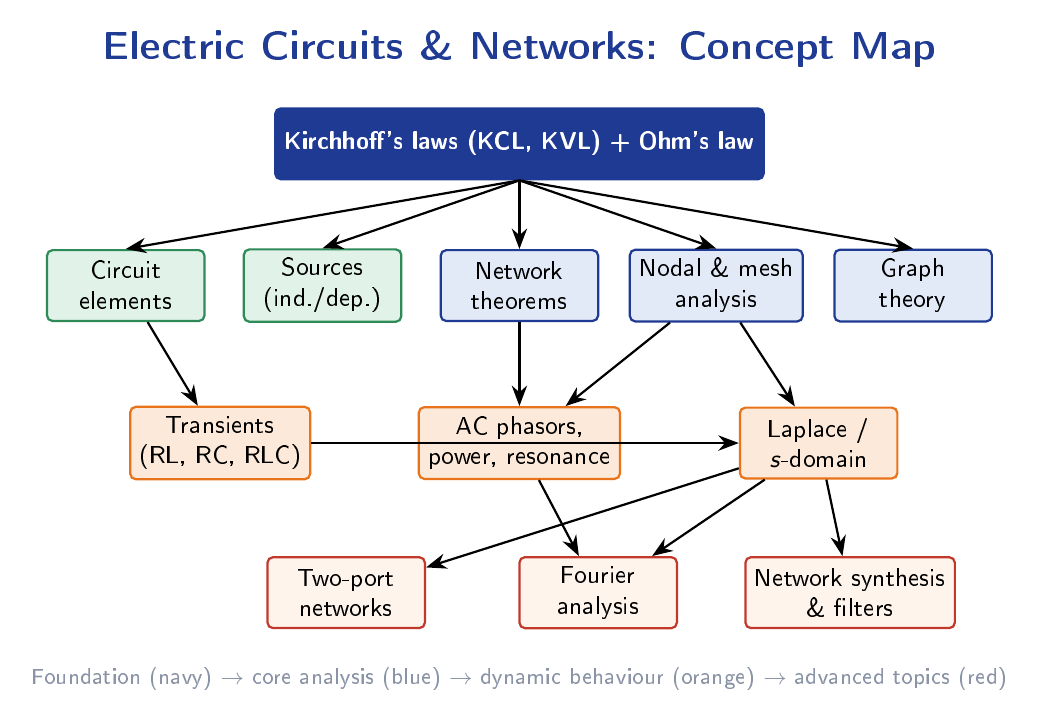
Basic Concepts, Sources & Elements
Charge, Current, Voltage & Power
The defining relations between charge, current, voltage, power and energy are:
\[ i(t) = \frac{dq}{dt}\ \text{(A)} \qquad q = \int i\,dt \] \[ v(t) = \frac{dw}{dq}\ \text{(V)} \qquad p(t) = v(t)\,i(t)\ \text{(W)} \] \[ W = \int_{t_0}^{t_1} p(t)\,dt\ \text{(J)} \]Units: \(1\,\text{C} = 6.24\times10^{18}\) electrons, \(1\,\text{A}=1\,\text{C/s}\), \(1\,\text{V}=1\,\text{J/C}\), \(1\,\text{W}=1\,\text{J/s}\).
When current \(i\) enters the + terminal of an element:
\[ p = +vi \;\Rightarrow\; \text{element absorbs power} \] \[ p = -vi \;\Rightarrow\; \text{element delivers power} \]This single convention fixes the sign of every power calculation in the circuit.
\(\sum P_{\text{delivered}} = \sum P_{\text{absorbed}}\). Tellegen's theorem guarantees this holds for any network obeying Kirchhoff's laws.
SI Units, Prefixes & Engineering Notation
| Quantity | Symbol | Unit | SI base |
|---|---|---|---|
| Charge | \(q\) | C | A·s |
| Current | \(i\) | A | A |
| Voltage | \(v\) | V | kg·m\(^2\)/(A·s\(^3\)) |
| Resistance | \(R\) | \(\Omega\) | V/A |
| Conductance | \(G\) | S | A/V |
| Capacitance | \(C\) | F | C/V |
| Inductance | \(L\) | H | V·s/A |
| Power | \(P\) | W | V·A |
| Energy | \(W\) | J | W·s |
| Frequency | \(f\) | Hz | 1/s |
| Flux | \(\Phi\) | Wb | V·s |
| Prefix | Symbol | Factor |
|---|---|---|
| tera | T | \(10^{12}\) |
| giga | G | \(10^{9}\) |
| mega | M | \(10^{6}\) |
| kilo | k | \(10^{3}\) |
| milli | m | \(10^{-3}\) |
| micro | \(\mu\) | \(10^{-6}\) |
| nano | n | \(10^{-9}\) |
| pico | p | \(10^{-12}\) |
| femto | f | \(10^{-15}\) |
A numeric answer without units is an incorrect answer. Use dimensional consistency as a routine sanity check.
Classification of Sources & Elements
| Type | Description |
|---|---|
| Independent V | \(v\) fixed, \(i\) depends on circuit |
| Independent I | \(i\) fixed, \(v\) depends on circuit |
| VCVS | \(v = \mu v_x\) |
| VCCS | \(i = g\,v_x\) |
| CCVS | \(v = r\,i_x\) |
| CCCS | \(i = \beta\,i_x\) |
Ideal V-source: \(R_s = 0\) (short when off). Ideal I-source: \(R_s = \infty\) (open when off).
Active vs Passive:
- Active: supplies energy (sources, op-amps)
- Passive: absorbs or stores energy (R, L, C)
Linear vs Nonlinear: does it obey superposition?
Bilateral vs Unilateral: same \(v\)–\(i\) both ways?
Lumped vs Distributed: \(\lambda \gg\) size \(\Rightarrow\) lumped.
Time-invariant vs Time-varying: are parameters constant?
Practical voltage source: ideal V in series with small \(R_s\). Practical current source: ideal I in parallel with large \(R_s\).
Op-Amp as an Active Circuit Element
- Open-loop gain \(A \to \infty\)
- Input impedance \(\to \infty \Rightarrow i^+ = i^- = 0\)
- Output impedance \(\to 0\)
- Infinite bandwidth, zero offset
Virtual short (with negative feedback): \(v^+ = v^-\).
Inverting: \(v_o/v_i = -R_f/R_1\)
Non-inverting: \(v_o/v_i = 1 + R_f/R_1\)
Voltage follower: \(v_o = v_i,\ R_{in} = \infty\)
Summer: \(v_o = -R_f\sum(v_k/R_k)\)
Differentiator: \(v_o = -RC\,dv_i/dt\)
Integrator: \(v_o = -\tfrac{1}{RC}\!\int v_i\,dt\)
- Finite open-loop gain \(A\)
- Finite gain–bandwidth: \(A(f)\cdot f_{-3\text{dB}}\) = const.
- Slew-rate limit: \(|dv_o/dt|_{max}\)
- Input-offset voltage and bias currents
- CMRR, PSRR
The op-amp behaves as a VCVS (\(\mu \to \infty\)). It enables active filters, gyrators and negative-impedance converters (NICs) that synthesise inductance from R–C–op-amp combinations.
Fundamental Laws
Ohm's Law & Power Relations
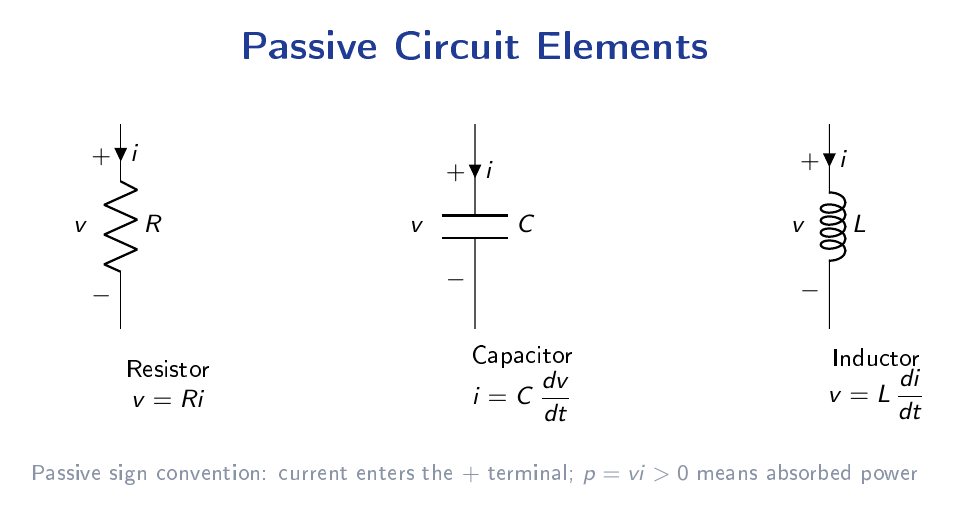
Under the passive sign convention, current entering the + terminal means the element absorbs power.
Kirchhoff's Laws (KVL & KCL)
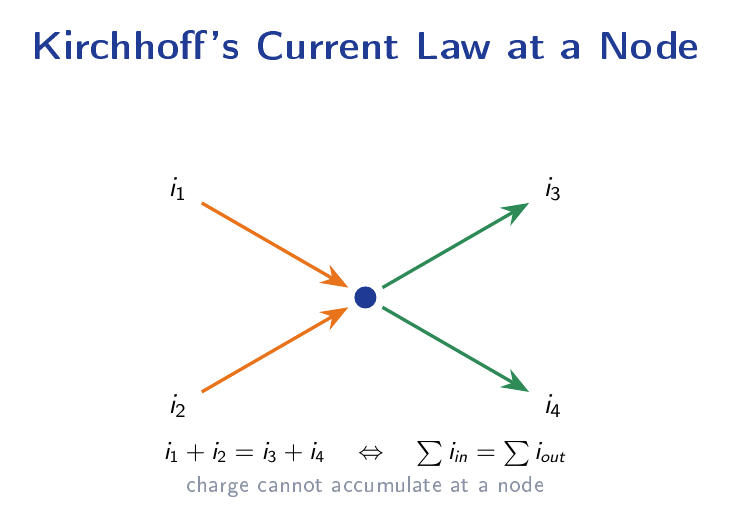
At any node:
\[ \sum_k i_k = 0 \qquad \sum i_{\text{in}} = \sum i_{\text{out}} \]Expresses conservation of charge.
Around any loop:
\[ \sum_k v_k = 0 \qquad \sum v_{\text{rise}} = \sum v_{\text{drop}} \]Expresses conservation of energy.
- Assign branch currents and voltages.
- Choose loop directions (clockwise positive).
- Write the KVL and KCL equations.
- Solve the resulting linear system.
Series & Parallel Combinations
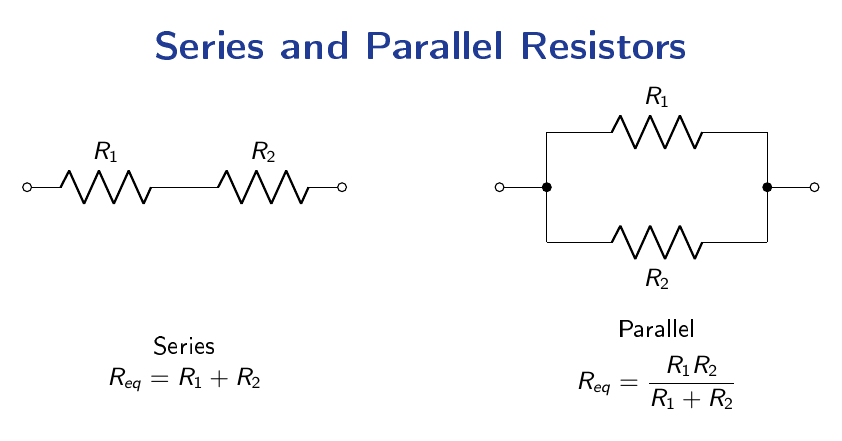
Voltage divider:
\[ V_k = V_s\cdot\frac{R_k}{R_1+R_2+\cdots+R_n} \]Two resistors: \(R_{eq}=R_1 R_2/(R_1+R_2)\)
\[ C_{eq}=\textstyle\sum C_k, \qquad \tfrac{1}{L_{eq}}=\textstyle\sum \tfrac{1}{L_k} \]Current divider: \(I_k = I_s R_{eq}/R_k\)
Star–Delta (Y–\(\Delta\)) Transformation
Rule: product of the two adjacent \(\Delta\) arms divided by the sum of all three.
Rule: sum of the pair-products divided by the opposite Y arm.
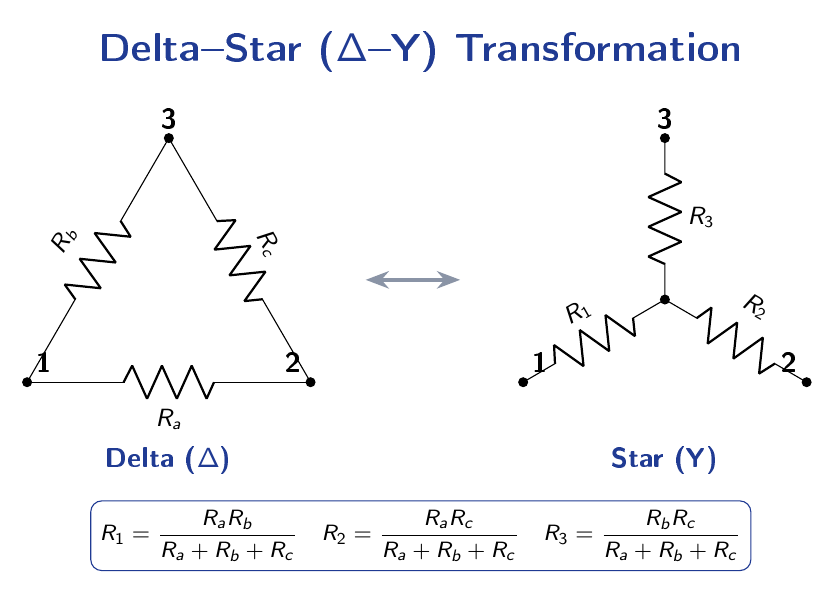
If all arms are equal: \(R_Y = \tfrac{R_\Delta}{3}\) and \(R_\Delta = 3R_Y\). Especially useful for balanced bridge and three-phase circuits.
Duality of Networks
| Original | Dual |
|---|---|
| Voltage \(v\) | Current \(i\) |
| Current \(i\) | Voltage \(v\) |
| Resistance \(R\) | Conductance \(G\) |
| Inductance \(L\) | Capacitance \(C\) |
| Impedance \(Z\) | Admittance \(Y\) |
| KVL (loop) | KCL (node) |
| Series | Parallel |
| Open circuit | Short circuit |
| Mesh | Node |
| Thévenin | Norton |
Rules (planar networks only):
- Place a node inside each mesh of the original; add one outside as reference.
- Draw a dual branch crossing each original branch, connecting adjacent mesh-nodes.
- Replace each element with its dual (\(R\!\to\!G\), \(L\!\to\!C\), \(V\!\to\!I\)).
Solve one circuit and the solution for its dual follows by symbol substitution, halving the workload across problem sets.
Memory Aids & Mnemonics for Quick Recall
ELI: in an inductor (L), EMF (E) leads current (I).
ICE: in a capacitor (C), current (I) leads EMF (E).
\(\Rightarrow\) Inductor: \(V\) leads \(I\) by \(90^\circ\).
\(\Rightarrow\) Capacitor: \(I\) leads \(V\) by \(90^\circ\).
"Capacitor keeps its Voltage, Inductor keeps its current."
\[ v_C(0^+) = v_C(0^-) \qquad i_L(0^+) = i_L(0^-) \]"L is Lazy, C is Closed." In DC steady state, \(L \to\) short circuit (\(v_L = 0\)) and \(C \to\) open circuit (\(i_C = 0\)).
V-source \(\to\) Vanish as a wire (short). I-source \(\to\) Invisible (open circuit).
P: Active power (real, W) — useful work.
A / S: Apparent power (VA) — the hypotenuse.
Q: Reactive power (VAR) — shuttled back and forth.
Network Theorems
Thévenin's & Norton's Theorems
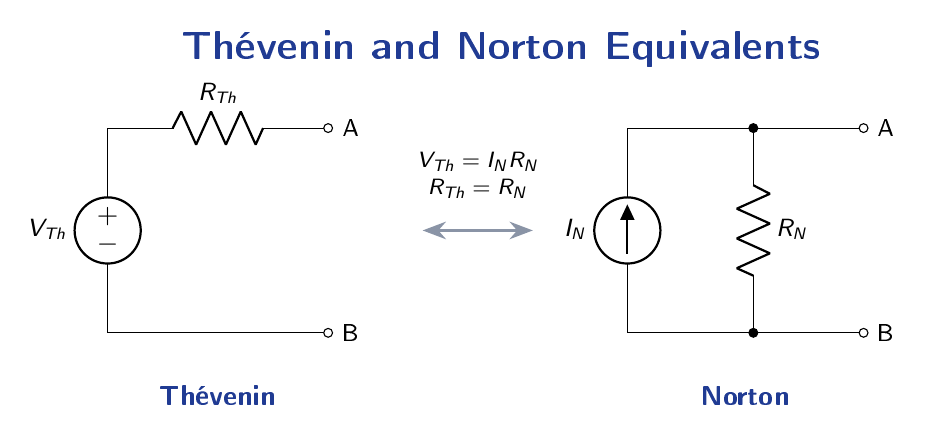
Any linear network seen from two terminals reduces to a single voltage source in series with a resistance:
\[ \boxed{V_{Th}\ \text{(series) with}\ R_{Th}} \]- \(V_{Th}\) = open-circuit voltage \(V_{oc}\)
- \(R_{Th}\) = resistance at the terminals with all independent sources killed
- \(I_N\) in parallel with \(R_N\)
- \(I_N\) = short-circuit current \(I_{sc}\)
Superposition, Maximum Power Transfer & Reciprocity
Linear circuits only. The total response equals the algebraic sum of the responses to each source acting alone.
\[ v = \textstyle\sum_k v_k, \quad i = \textstyle\sum_k i_k \]Activate one source, deactivate the others (V \(\to\) short, I \(\to\) open), and sum the contributions.
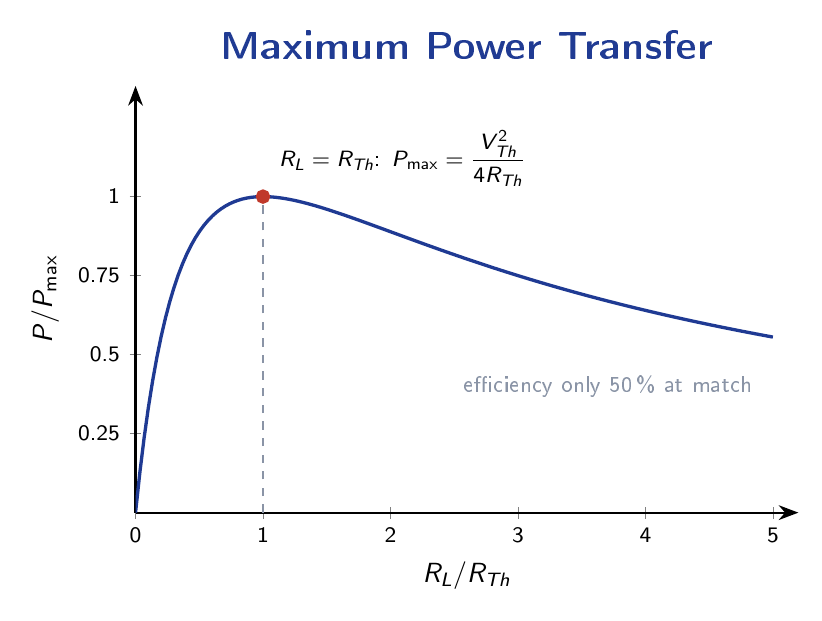
Peak occurs at \(R_L = R_{Th}\); the corresponding efficiency is 50%.
In a linear bilateral network, \(v_1/i_2 = v_2/i_1\): excitation and response are interchangeable.
Advanced Theorems: Tellegen, Substitution & Compensation
For any network (linear or nonlinear, time-varying or invariant) obeying KVL and KCL:
\[ \boxed{\sum_{k=1}^{b} v_k\,i_k = 0} \]- Holds for any \(\{v_k\}\) satisfying KVL
- Holds for any \(\{i_k\}\) satisfying KCL
- \(v_k, i_k\) may come from different circuits of the same topology
- Implies conservation of power
Any branch with known \(v_k, i_k\) may be replaced by a voltage source \(v_k\) or a current source \(i_k\) without disturbing the rest of the network — useful for staged, multi-block problems.
If a branch impedance changes by \(\Delta Z\), the change in network response equals the response produced by an inserted series source
\[ \boxed{V_c = -I_0\,\Delta Z} \]where \(I_0\) is the original branch current and all other sources are set to zero.
Tellegen → energy audits and sensitivity; Substitution → staged analysis; Compensation → tolerance and small-change problems solved without re-analysing the whole circuit.
Nodal & Mesh Analysis
Choose a reference node (ground). For \(n\) nodes, write \(n-1\) KCL equations.
Conductance matrix form:
\[ \mathbf{G}\,\mathbf{V} = \mathbf{I} \] \[ G_{kk} = \sum \text{conductances at node } k \] \[ G_{km} = -\,\text{conductance between } k, m \]Supernode: a voltage source between two non-reference nodes ⇒ combine the nodes and add a constraint.
Assign mesh currents \(\{i_1, i_2, \ldots\}\) and write KVL for each mesh.
Resistance matrix form:
\[ \mathbf{R}\,\mathbf{I} = \mathbf{V} \] \[ R_{kk} = \sum \text{resistances in mesh } k \] \[ R_{km} = -\,\text{shared resistance} \]Supermesh: a current source shared between two meshes ⇒ combine the meshes and add a constraint.
\(x_k = \dfrac{\det(\mathbf{A}_k)}{\det(\mathbf{A})}\), where \(\mathbf{A}_k\) replaces column \(k\) with the right-hand-side vector.
Capacitors & Inductors
Capacitor & Inductor V–I Relations
| DC steady state | \(i_C = 0\) (open circuit) |
|---|---|
| Continuity | \(v_C(0^-) = v_C(0^+)\) |
| DC steady state | \(v_L = 0\) (short circuit) |
|---|---|
| Continuity | \(i_L(0^-) = i_L(0^+)\) |
| Element | Series | Parallel | Duality |
|---|---|---|---|
| \(R\) | \(\sum R_k\) | \(\left(\sum G_k\right)^{-1}\) | \(G\) |
| \(C\) | \(\left(\sum 1/C_k\right)^{-1}\) | \(\sum C_k\) | \(L\) |
| \(L\) | \(\sum L_k\) | \(\left(\sum 1/L_k\right)^{-1}\) | \(C\) |
First & Second Order Circuits
Initial Conditions & Switching Transients
When a switch acts at \(t=0\):
\[ \boxed{v_C(0^+) = v_C(0^-)} \;\text{(capacitor voltage continuous)} \] \[ \boxed{i_L(0^+) = i_L(0^-)} \;\text{(inductor current continuous)} \]But \(i_C\) and \(v_L\) can jump:
\[ i_C(0^+) = C\,\frac{dv_C}{dt}\bigg|_{0^+},\quad v_L(0^+) = L\,\frac{di_L}{dt}\bigg|_{0^+} \]Step 1 — at \(t=0^-\): DC steady state; \(L\) = short, \(C\) = open. Find \(v_C(0^-)\), \(i_L(0^-)\).
Step 2 — at \(t=0^+\): use continuity. Replace \(C\) by a V-source \(v_C(0^+)\) and \(L\) by an I-source \(i_L(0^+)\).
Step 3 — at \(t=\infty\): new DC steady state; again \(L\) = short, \(C\) = open. Find \(x(\infty)\).
Never assume \(v_C(0^-)=0\) or \(i_L(0^-)=0\). Always verify using the pre-switch circuit.
First-Order Circuits: RC & RL
General form:
\[ \boxed{x(t) = x(\infty) + \bigl[x(0^+)-x(\infty)\bigr]e^{-t/\tau}} \]| Circuit | \(\tau\) | State variable |
|---|---|---|
| RC | \(RC\) | \(v_C\) |
| RL | \(L/R\) | \(i_L\) |
\(x(0^+)\) = initial condition; \(x(\infty)\) = final DC steady-state value.
At \(t=\tau\) the response has changed by about 63.2%, leaving \(\approx 36.8\%\) of the initial gap; at \(5\tau\) it is 99% settled.
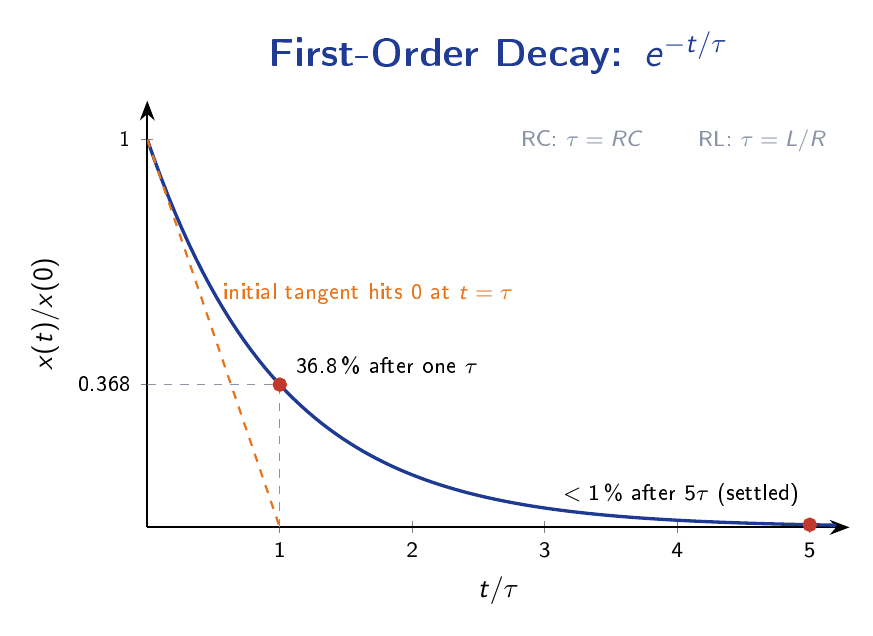
(1) Find \(x(0^+)\) by continuity. (2) Find \(x(\infty)\) at DC steady state (\(L\to\) short, \(C\to\) open). (3) Find \(\tau = RC\) or \(L/R\). (4) Substitute into the general form.
Second-Order Circuits: RLC
Characteristic equation:
\[ s^2 + 2\alpha s + \omega_0^2 = 0 \]\(\alpha = R/(2L)\) (series), \(\alpha = 1/(2RC)\) (parallel); \(\omega_0 = 1/\sqrt{LC}\) (natural frequency).
\[ s_{1,2} = -\alpha \pm \sqrt{\alpha^2 - \omega_0^2} \]| Case | Condition | Response |
|---|---|---|
| Over- | \(\alpha\gt\omega_0\) | \(A_1e^{s_1t}+A_2e^{s_2t}\) |
| Critical | \(\alpha=\omega_0\) | \((A_1+A_2t)e^{-\alpha t}\) |
| Under- | \(\alpha\lt\omega_0\) | \(e^{-\alpha t}(B_1\cos\omega_d t+B_2\sin\omega_d t)\) |
\(\omega_d = \sqrt{\omega_0^2-\alpha^2}\), \(\;Q = \omega_0/(2\alpha)\).
Second-Order Response: Visual Comparison
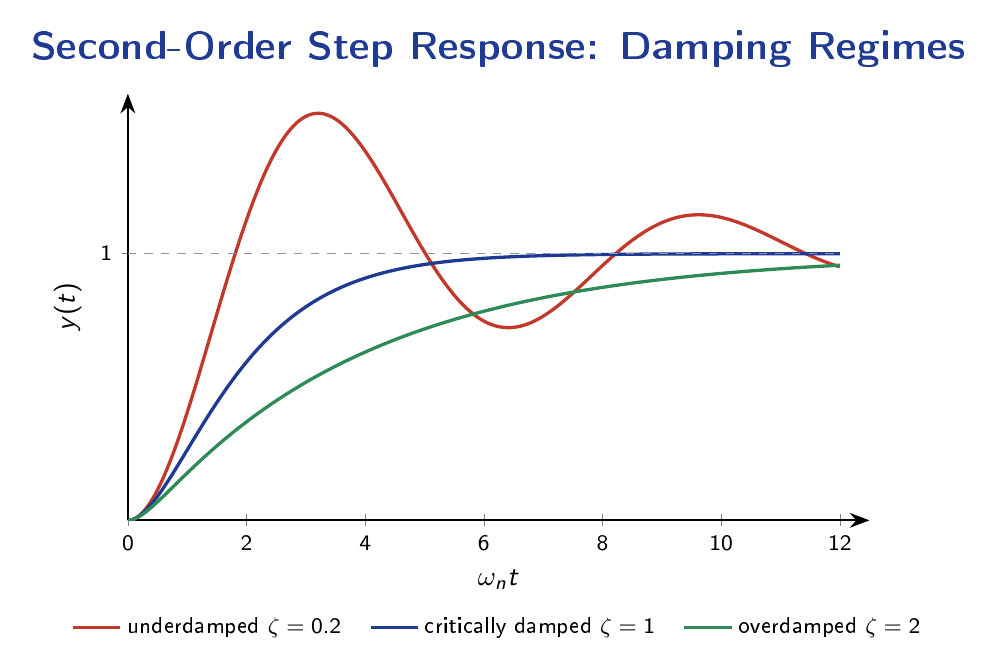
| \(\zeta \gt 1\) | Overdamped (slow) |
| \(\zeta = 1\) | Critical (fastest, no overshoot) |
| \(0\lt\zeta\lt1\) | Underdamped (oscillates) |
| \(\zeta = 0\) | Undamped |
AC Circuit Analysis
Phasors & Impedance
Time \(\to\) phasor: \(\cos(\omega t+\phi)\to\angle\phi\); \(\dfrac{d}{dt}\leftrightarrow j\omega\).
| Element | \(\mathbf{Z}\) | \(\mathbf{Y}=1/\mathbf{Z}\) |
|---|---|---|
| \(R\) | \(R\) | \(G\) |
| \(L\) | \(j\omega L\) | \(1/(j\omega L)\) |
| \(C\) | \(1/(j\omega C)\) | \(j\omega C\) |
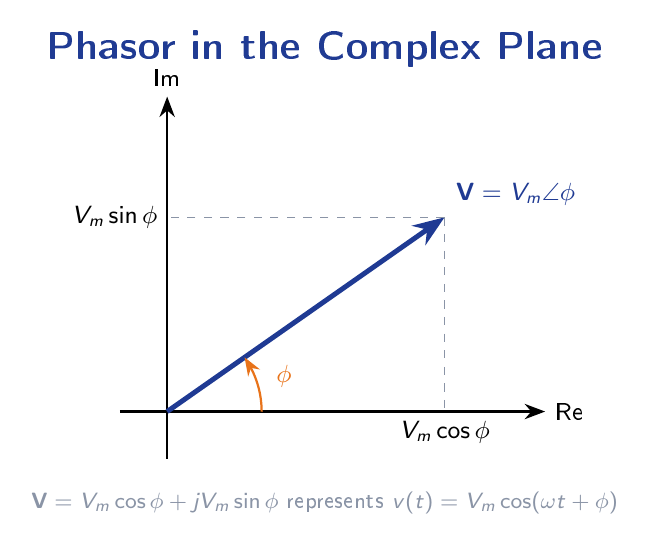
\(R\): \(V\) in phase with \(I\); \(L\): \(V\) leads \(I\) by \(90^\circ\); \(C\): \(V\) lags \(I\) by \(90^\circ\).
AC Power Analysis
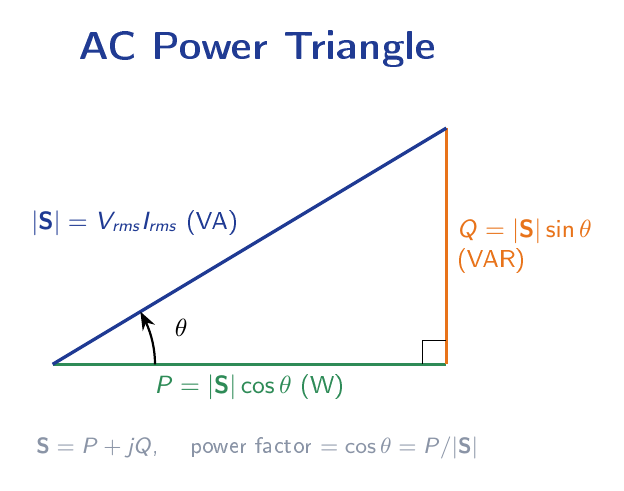
Add a capacitor in parallel to improve a lagging power factor:
\[ C = \frac{P(\tan\theta_1-\tan\theta_2)}{\omega V_{rms}^2} \]Goal: \(\theta_2 \lt \theta_1\), i.e. power factor closer to unity.
\(\mathbf{Z}_L = \mathbf{Z}_{Th}^* \;\Rightarrow\; P_{max}=|V_{Th}|^2/(8R_{Th})\).
Resonance
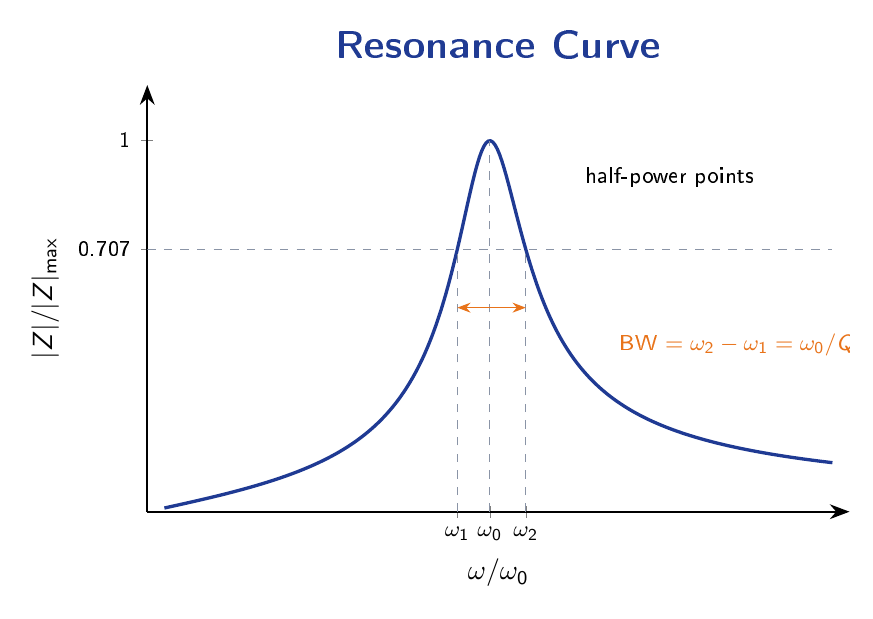
At resonance \(V_L = V_C = Q_s\cdot V_s\) (voltage magnification).
At resonance \(I_L = I_C = Q_p\cdot I_s\) (current magnification).
Non-sinusoidal Periodic Sources
If \(v(t) = V_0 + \sum_{n=1}^{\infty} V_n\cos(n\omega_0 t + \phi_n)\):
\[ \boxed{V_{rms} = \sqrt{V_0^2 + \textstyle\sum_{n\ge 1}(V_n/\sqrt{2})^2}} \] \[ = \sqrt{V_{0}^2 + V_{1,rms}^2 + V_{2,rms}^2 + \cdots} \]Average power into \(R\): \(P = V_{rms}^2/R\).
For \(v, i\) both non-sinusoidal of the same period:
\[ P_{avg} = V_0 I_0 + \textstyle\sum_{n\ge 1}\tfrac{V_n I_n}{2}\cos(\phi_n^V - \phi_n^I) \]Each harmonic contributes independently; the DC terms add.
Total harmonic distortion:
\[ \text{THD} = \frac{\sqrt{\sum_{n\ge 2}V_{n,rms}^2}}{V_{1,rms}} \]Distortion factor: \(\text{DF} = V_{1,rms}/V_{rms}\). Form factor: \(V_{rms}/V_{avg}\). Crest factor: \(V_{pk}/V_{rms}\).
Three-Phase Circuits
Balanced Three-Phase Systems
Y-connection: \(V_L = \sqrt{3}\,V_p,\quad I_L = I_p\)
\(\Delta\)-connection: \(V_L = V_p,\quad I_L = \sqrt{3}\,I_p\)
Total power (balanced):
\[ \boxed{P_T = 3V_pI_p\cos\theta = \sqrt{3}V_LI_L\cos\theta} \] \[ Q_T = \sqrt{3}V_LI_L\sin\theta,\quad S_T=\sqrt{3}V_LI_L \]\(\Delta\to\)Y: \(Z_Y = \dfrac{Z_\Delta}{3}\)
Y\(\to\Delta\): \(Z_\Delta = 3Z_Y\)
Per-phase analysis: convert everything to Y, analyse a single phase, then multiply by three.
Valid for any three-wire, three-phase load.
Unbalanced 3-\(\phi\) & Symmetrical Components
Any unbalanced three-phase phasor set \(\{V_a, V_b, V_c\}\) decomposes into:
\[ V_a = V_{a0} + V_{a1} + V_{a2} \]Zero-sequence: equal magnitude, in phase.
Positive-sequence: balanced, rotation \(abc\).
Negative-sequence: balanced, rotation \(acb\).
With \(a = 1\angle 120^\circ\):
\[ \begin{bmatrix}V_{a0}\\V_{a1}\\V_{a2}\end{bmatrix} = \tfrac{1}{3} \begin{bmatrix}1 & 1 & 1\\ 1 & a & a^2\\ 1 & a^2 & a\end{bmatrix} \begin{bmatrix}V_a\\V_b\\V_c\end{bmatrix} \]Properties: \(1 + a + a^2 = 0\), \(\;a^3 = 1\).
In a balanced load with no neutral wire, \(V_{a0} = 0\) (no zero-sequence path). This is central to power-system fault analysis.
Laplace Transform & s-Domain
Laplace Transform in Circuit Analysis
| \(f(t)\) | \(F(s)\) |
|---|---|
| \(\delta(t)\) | \(1\) |
| \(u(t)\) | \(\dfrac{1}{s}\) |
| \(e^{-at}u(t)\) | \(\dfrac{1}{s+a}\) |
| \(t^n u(t)\) | \(\dfrac{n!}{s^{n+1}}\) |
| \(\cos(\omega_0 t)u(t)\) | \(\dfrac{s}{s^2+\omega_0^2}\) |
| \(\sin(\omega_0 t)u(t)\) | \(\dfrac{\omega_0}{s^2+\omega_0^2}\) |
| \(te^{-at}u(t)\) | \(\dfrac{1}{(s+a)^2}\) |
| \(R\) | \(R\) |
|---|---|
| \(L\) | \(sL - Li(0^-)\) |
| \(C\) | \(\dfrac{1}{sC} + \dfrac{v(0^-)}{s}\) |
| Initial value | \(f(0^+) = \lim_{s\to\infty}sF(s)\) |
|---|---|
| Final value | \(f(\infty) = \lim_{s\to 0}sF(s)\) |
| Differentiation | \(\mathcal{L}\{f'\}=sF(s)-f(0)\) |
| Integration | \(\mathcal{L}\left\{\int f\right\}=\dfrac{F(s)}{s}\) |
Partial Fraction Expansion & Inverse Laplace
Simple poles: \(k_i = (s-p_i)F(s)\big|_{s=p_i}\)
Repeated pole \(p_1\) (order \(m\)):
\[ k_{1,r} = \frac{1}{(m-r)!}\frac{d^{m-r}}{ds^{m-r}}\bigl[(s-p_1)^m F(s)\bigr]_{s=p_1} \]Complex poles \(s=-\alpha\pm j\beta\), \(k = A+jB\):
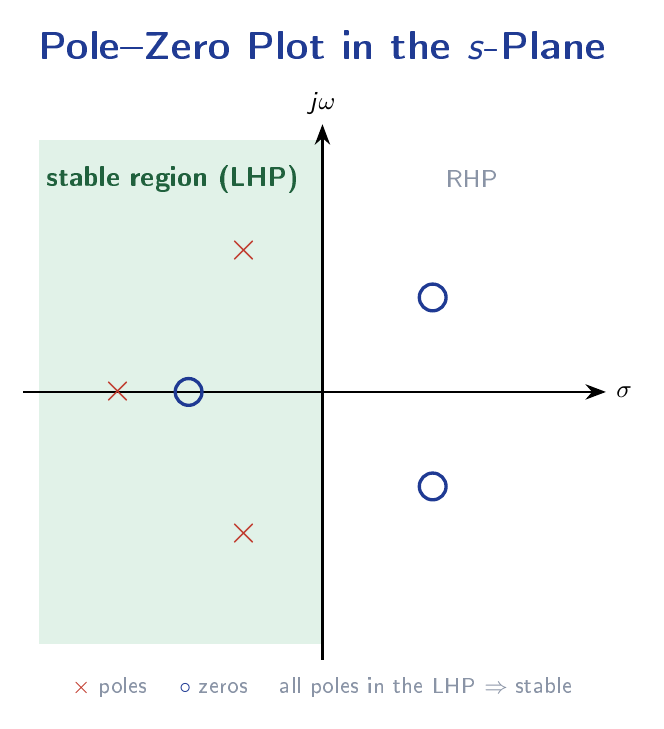
\[ \to 2e^{-\alpha t}\bigl(A\cos\beta t - B\sin\beta t\bigr) \]Stable: poles in the left half-plane; marginal: poles on the \(j\omega\) axis; unstable: any pole in the right half-plane.
Convolution & Impulse Response
For an LTI system with impulse response \(h(t)\):
\[ \boxed{y(t) = h(t)*x(t) = \int_0^t h(\tau)\,x(t-\tau)\,d\tau} \]Graphical steps (flip–shift–multiply–integrate):
- Flip \(h(\tau)\to h(-\tau)\).
- Shift by \(t\): \(h(t-\tau)\).
- Multiply: \(x(\tau)\,h(t-\tau)\).
- Integrate over the overlap region.
Commutative: \(x*h = h*x\)
Associative: \((x*h)*g = x*(h*g)\)
Distributive: \(x*(h_1+h_2) = x*h_1 + x*h_2\)
Identity: \(x(t)*\delta(t) = x(t)\)
s-domain: \(Y(s) = H(s)\,X(s)\)
\(h(t) = \mathcal{L}^{-1}\{H(s)\}\). Knowing \(h(t)\) completely characterises the LTI network's zero-state response to any input.
Frequency Response & Filters
Bode Plots
| Factor | Mag. slope | Phase |
|---|---|---|
| Gain \(K\) | \(20\log K\) | \(0^\circ\) or \(\pm180^\circ\) |
| Zero \((1+j\omega/z)\) | \(+20\) dB/dec | \(+90^\circ\) total |
| Pole \((1+j\omega/p)^{-1}\) | \(-20\) dB/dec | \(-90^\circ\) total |
| \(j\omega\) (origin zero) | \(+20\) dB/dec | \(+90^\circ\) |
| \(1/(j\omega)\) (origin pole) | \(-20\) dB/dec | \(-90^\circ\) |
Phase corner: \(\pm45^\circ\) at the break frequency; \(\pm45^\circ\)/decade over two decades.
| Filter | Pass band | \(H(j\omega)\) |
|---|---|---|
| LPF | \(\omega\lt\omega_c\) | \(\dfrac{1}{1+j\omega/\omega_c}\) |
| HPF | \(\omega\gt\omega_c\) | \(\dfrac{j\omega/\omega_c}{1+j\omega/\omega_c}\) |
| BPF | \(\omega_1\lt\omega\lt\omega_2\) | \(\dfrac{j\omega/\omega_c}{1-(\omega/\omega_c)^2+j\omega Q^{-1}}\) |
| BSF | outside BW | \(\dfrac{1-(\omega/\omega_c)^2}{1-(\omega/\omega_c)^2+j\omega Q^{-1}}\) |
\(\omega_c = 1/(RC)\) for RC filters.
The \(-3\) dB frequency is the half-power point and equals the cutoff; \(|H|=1/\sqrt{2}\) at \(\omega_c\).
Filter Approximations: Butterworth & Chebyshev
No ripple in either band; roll-off \(-20n\) dB/dec; poles on a circle of radius \(\omega_c\) in the LHP; monotonic ("smoothest") magnitude.
\[ s_k = \omega_c e^{j(\pi/2 + (2k-1)\pi/2n)} \]Ripple in the pass band, flat in the stop band; sharper roll-off than Butterworth for the same order \(n\); \(C_n\) is the Chebyshev polynomial of order \(n\).
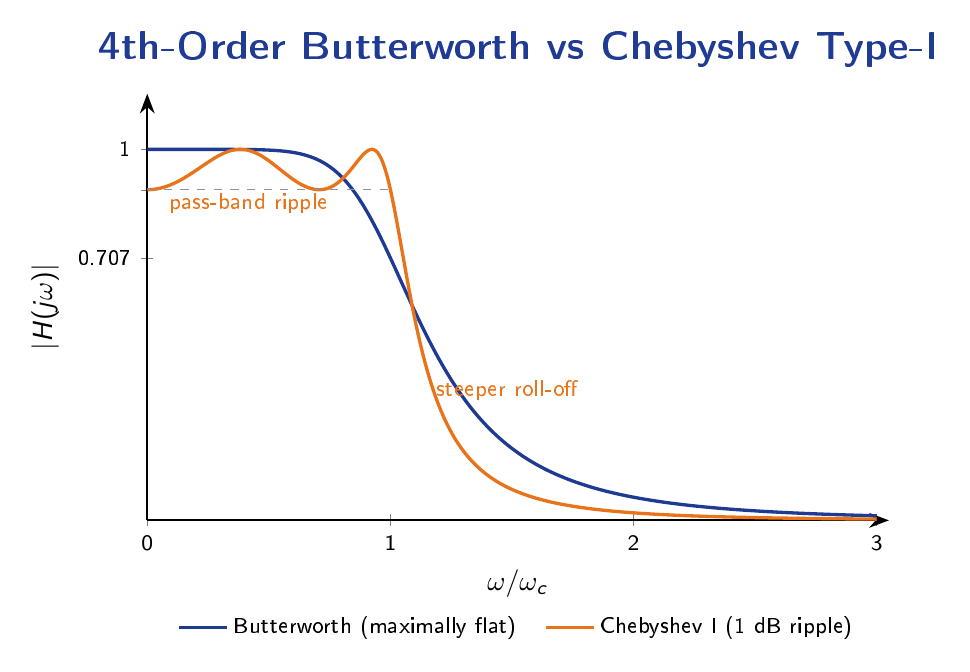
Chebyshev-II: ripple in the stop band.
Elliptic (Cauer): ripple in both bands, steepest transition.
Bessel: linear phase, gentle roll-off.
Magnitude & Frequency Scaling
Multiplies all impedance levels by \(K_m\):
\[ R' = K_m R,\; L' = K_m L,\; C' = C/K_m \]\(H(s)\) is unchanged for voltage-ratio, current-ratio and transfer-admittance functions; the driving-point impedance scales by \(K_m\).
Compresses or expands the frequency axis by \(K_f\):
\[ R' = R,\; L' = L/K_f,\; C' = C/K_f \]Cutoff, resonance and bandwidth all scale as \(\omega' = K_f\,\omega\).
Design a normalised prototype (\(\omega_c=1\), \(R=1\,\Omega\)), then scale to the target.
Normalised LPF: \(R=1\,\Omega\), \(C=1\,\text{F}\), \(\omega_c=1\,\text{rad/s}\). Target \(R=10\,\text{k}\Omega\), \(\omega_c=10^4\,\text{rad/s}\) ⇒ \(K_m=10^4\), \(K_f=10^4\) ⇒ \(C = 10\,\text{nF}\).
Two-Port Networks
Two-Port Network Parameters
| Param | Equations | Condition |
|---|---|---|
| \(z\) (impedance) | \(V_1=z_{11}I_1+z_{12}I_2\); \(V_2=z_{21}I_1+z_{22}I_2\) | Open-circuit |
| \(y\) (admittance) | \(I_1=y_{11}V_1+y_{12}V_2\); \(I_2=y_{21}V_1+y_{22}V_2\) | Short-circuit |
| \(h\) (hybrid) | \(V_1=h_{11}I_1+h_{12}V_2\); \(I_2=h_{21}I_1+h_{22}V_2\) | Hybrid |
| \(ABCD\) (chain) | \(V_1=AV_2-BI_2\); \(I_1=CV_2-DI_2\) | Transmission |
Reciprocal: \(z_{12}=z_{21}\), \(y_{12}=y_{21}\), \(AD-BC=1\).
Symmetric: \(z_{11}=z_{22}\), \(A=D\).
Cascade: \([\mathbf{T}]_{tot}=[\mathbf{T}_1][\mathbf{T}_2]\).
Series: \([\mathbf{z}]_{tot}=[\mathbf{z}_1]+[\mathbf{z}_2]\).
Parallel: \([\mathbf{y}]_{tot}=[\mathbf{y}_1]+[\mathbf{y}_2]\).
Scattering (S) Parameters — High-Frequency Two-Ports
Based on travelling waves normalised to a reference impedance \(Z_0\):
\[ a_i = \frac{V_i + Z_0 I_i}{2\sqrt{Z_0}},\quad b_i = \frac{V_i - Z_0 I_i}{2\sqrt{Z_0}} \] \[ \begin{bmatrix}b_1\\b_2\end{bmatrix} = \begin{bmatrix}S_{11} & S_{12}\\ S_{21} & S_{22}\end{bmatrix} \begin{bmatrix}a_1\\a_2\end{bmatrix} \]Measured with ports terminated in \(Z_0\) (no reflections).
| \(S_{11}\) | Input reflection coefficient |
|---|---|
| \(S_{22}\) | Output reflection coefficient |
| \(S_{21}\) | Forward transmission (gain) |
| \(S_{12}\) | Reverse transmission (isolation) |
Reciprocal: \(S_{12} = S_{21}\). Lossless: \(\mathbf{S}^\dagger\mathbf{S} = \mathbf{I}\) (unitary). Matched: \(S_{11} = S_{22} = 0\).
Fourier Series & Transform
Fourier Series
Periodic \(f(t)\), period \(T=2\pi/\omega_0\):
\[ f(t)=a_0+\textstyle\sum_{n=1}^{\infty}(a_n\cos n\omega_0 t+b_n\sin n\omega_0 t) \] \[ a_0=\tfrac{1}{T}\!\int_0^T f(t)\,dt \] \[ a_n=\tfrac{2}{T}\!\int_0^T f(t)\cos n\omega_0 t\,dt \] \[ b_n=\tfrac{2}{T}\!\int_0^T f(t)\sin n\omega_0 t\,dt \]Complex form:
\[ f(t)=\textstyle\sum_{n=-\infty}^{\infty}c_n e^{jn\omega_0 t},\; c_n=\tfrac{1}{T}\!\int_0^T f(t)e^{-jn\omega_0 t}dt \]| Symmetry | Effect |
|---|---|
| Even: \(f(-t)=f(t)\) | \(b_n=0\) |
| Odd: \(f(-t)=-f(t)\) | \(a_n=0,\ a_0=0\) |
| Half-wave | Even harmonics = 0 |
Average power equals the sum of the harmonic powers.
Square wave: \(a_0=0\); sawtooth: \(A/2\); rectified sine: \(2A/\pi\).
Fourier Transform
Key pairs:
| \(f(t)\) | \(F(\omega)\) |
|---|---|
| \(\delta(t)\) | \(1\) |
| \(1\) | \(2\pi\delta(\omega)\) |
| \(u(t)\) | \(\pi\delta(\omega)+1/(j\omega)\) |
| \(e^{-at}u(t)\) | \(1/(a+j\omega)\) |
| \(\text{rect}(t/\tau)\) | \(\tau\,\text{sinc}(\omega\tau/2)\) |
| \(\cos\omega_0 t\) | \(\pi[\delta(\omega{-}\omega_0)+\delta(\omega{+}\omega_0)]\) |
| Linearity | \(aF_1+bF_2\) |
|---|---|
| Time shift | \(e^{-j\omega t_0}F(\omega)\) |
| Frequency shift | \(F(\omega-\omega_0)\) |
| Scaling | \(\tfrac{1}{|a|}F(\omega/a)\) |
| Differentiation | \(j\omega F(\omega)\) |
| Integration | \(F(\omega)/(j\omega)\) |
| Convolution | \(F_1\cdot F_2\) |
| Multiplication | \(\tfrac{1}{2\pi}F_1*F_2\) |
| Duality | \(F(t)\leftrightarrow 2\pi f(-\omega)\) |
Graph Theory & Network Topology
Network Topology
| \(b\) | Number of branches |
|---|---|
| \(n\) | Number of nodes |
| \(l\) | Number of links (chords) |
| Tree branches | \(n-1\) |
| Links | \(l = b-(n-1)\) |
Independent equations:
\[ \text{KCL}: n-1\ \text{(nodes)} \] \[ \text{KVL}: b-(n-1)\ \text{(loops)} \]Total: \(b\) equations for \(b\) unknowns.
Incidence matrix \(\mathbf{A}\): \(a_{ij}=+1\) (branch \(j\) leaves node \(i\)), \(-1\) (enters), \(0\) (unconnected).
Loop matrix \(\mathbf{B}\): \(b_{ij}=+1,-1,\) or \(0\).
Network equations:
\[ \mathbf{A}\,\mathbf{i}_b = 0\ \text{(KCL)} \] \[ \mathbf{B}\,\mathbf{v}_b = 0\ \text{(KVL)} \] \[ \mathbf{A}\cdot\mathbf{B}^T = \mathbf{0} \]For a planar graph: \(n - b + \text{meshes} = 1\), hence \(\text{meshes} = b - n + 1\).
Cut-set & Tie-set (Fundamental) Matrices
For a chosen tree, each twig (tree branch) defines one fundamental cut-set (the twig plus the links crossing it).
\[ q_{ij} = \pm 1, 0 \] \[ \boxed{\mathbf{Q}\,\mathbf{i}_b = \mathbf{0}}\ \text{(KCL)} \]Size: \((n-1)\times b\); one fundamental cut-set per twig.
Each link (chord) defines one fundamental tie-set: the unique loop formed by that link plus tree branches.
\[ b_{ij} = \pm 1, 0 \] \[ \boxed{\mathbf{B}\,\mathbf{v}_b = \mathbf{0}}\ \text{(KVL)} \]Size: \((b-n+1)\times b\); one fundamental tie-set per link.
Reduced KCL through \(\mathbf{Q}\) eliminates redundant node equations; reduced KVL through \(\mathbf{B}\) yields independent loop equations — together giving \(b\) independent equations for \(b\) branch unknowns.
Coupled Circuits & Transformers
Magnetically Coupled Circuits & Transformers
In the frequency domain:
\[ V_1 = j\omega L_1 I_1 \pm j\omega M I_2 \] \[ V_2 = \pm j\omega M I_1 + j\omega L_2 I_2 \]Dot convention: current entering the dotted terminal makes the mutual voltage aiding.
Maximum storable energy occurs at \(k=1\) (perfect coupling).
Practical Transformer Equivalent Circuits
Two magnetically coupled coils \((L_1, L_2, M)\) can be replaced by a T-network:
\[ L_a = L_1 - M,\; L_b = L_2 - M,\; L_c = M \]Valid only when both coils share a common node and the dot polarities agree with the substitution.
An alternative arrangement places three coupled inductors in a \(\pi\) configuration, common in network analysers and SPICE models.
Non-idealities to include:
- \(R_1, R_2\): winding resistance (copper loss)
- \(L_{l1}, L_{l2}\): leakage inductance
- \(L_m\): magnetising inductance
- \(R_c\): core loss (hysteresis + eddy currents)
Referred to the primary: \(R_2' = R_2/n^2,\; L_{l2}' = L_{l2}/n^2,\; Z_L' = Z_L/n^2\).
Network Functions, Poles & Zeros
Network Function Classification
| Function | Definition | Port |
|---|---|---|
| Driving-point Z | \(V_1/I_1\) | Same |
| Driving-point Y | \(I_1/V_1\) | Same |
| Voltage transfer | \(V_2/V_1\) | Different |
| Current transfer | \(I_2/I_1\) | Different |
| Transimpedance | \(V_2/I_1\) | Different |
| Transadmittance | \(I_2/V_1\) | Different |
- Poles: \(H(s)\to\infty\); zeros: \(H(s)=0\)
- Complex poles always occur in conjugate pairs
- \(n\) poles \(\Rightarrow\) an \(n\)th-order system
Signal Flow Graphs & Mason's Gain Formula
Node: a system variable. Branch: a one-way gain.
Forward path \(P_k\): input-to-output, touching each node once.
Loop \(L_i\): a closed path returning to its start.
Non-touching loops: share no node.
\(\Delta = 1 - \sum L_i + \sum L_i L_j - \sum L_i L_j L_k + \cdots\) (sums over individual loops, non-touching pairs, triples, …).
\(\Delta_k\): the value of \(\Delta\) with all loops touching \(P_k\) removed.
- Identify all forward paths \(P_k\).
- Identify all loops \(L_i\).
- Find the non-touching loop combinations.
- Compute \(\Delta\) and each \(\Delta_k\).
- Apply Mason's formula.
Block-diagram reduction becomes tedious for three or more feedback loops; a signal flow graph with Mason's formula returns the gain \(T\) in a single step.
Network Synthesis
Positive Real Functions & Hurwitz Polynomials
A rational \(F(s)=N(s)/D(s)\) is PR if and only if:
- \(F(s)\) is real when \(s\) is real
- \(\operatorname{Re}\{F(s)\}\ge 0\) whenever \(\operatorname{Re}\{s\}\ge 0\)
Necessary & sufficient tests:
- \(N(s)\) and \(D(s)\) are Hurwitz.
- Poles and zeros on the \(j\omega\)-axis are simple with real, positive residues.
- Degrees of \(N, D\) differ by at most 1.
- \(\operatorname{Re}\{F(j\omega)\}\ge 0\) for all \(\omega\).
⇒ Every driving-point impedance or admittance of a passive RLC network is PR.
\(P(s)\) is Hurwitz if all roots lie in the closed LHP (\(\operatorname{Re}\{s\}\le 0\)); strictly Hurwitz if in the open LHP.
Necessary: all coefficients present (no missing terms) and of the same sign.
Continued-fraction test: form the ratio of even to odd parts,
\[ \frac{m(s)}{n(s)} = q_1 s + \cfrac{1}{q_2 s + \cfrac{1}{q_3 s + \cdots}} \]If all \(q_i \gt 0\), the polynomial is strictly Hurwitz.
PR + Hurwitz together form the realisability conditions for a passive, lumped, linear, time-invariant one-port impedance.
Routh–Hurwitz Stability Criterion
For \(P(s)=a_n s^n + a_{n-1}s^{n-1} + \cdots + a_0\):
\[ \begin{array}{c|cccc} s^n & a_n & a_{n-2} & a_{n-4} & \cdots\\ s^{n-1} & a_{n-1} & a_{n-3} & a_{n-5} & \cdots\\ s^{n-2} & b_1 & b_2 & b_3 & \\ s^{n-3} & c_1 & c_2 & & \\ \vdots & \vdots & & & \\ s^0 & \ast & & & \\ \end{array} \]with \(b_1 = \dfrac{a_{n-1}a_{n-2}-a_n a_{n-3}}{a_{n-1}}\), \(c_1 = \dfrac{b_1 a_{n-3} - a_{n-1} b_2}{b_1}\), and so on.
Stable (all roots in the LHP) if and only if:
- All coefficients of \(P(s)\) are present with the same sign
- All entries in the first column of the Routh array have the same sign
The number of sign changes in the first column equals the number of right-half-plane roots.
Zero in the first column: replace it by \(\epsilon\to 0^+\).
An entire row of zeros: form the auxiliary polynomial from the row above, differentiate it, and use the result as the new row.
Foster & Cauer Realisation Forms
Expand \(Z(s)\) or \(Y(s)\) into partial fractions about its poles.
Foster-I (on \(Z(s)\)): a series of parallel L–C tanks,
\[ Z(s)= \frac{k_0}{s} + k_\infty s + \textstyle\sum_i\frac{2k_i s}{s^2+\omega_i^2} \]where \(k_0/s\) is a series \(C\), \(k_\infty s\) a series \(L\), and each \(2k_i s/(s^2+\omega_i^2)\) a parallel L–C in series.
Foster-II (on \(Y(s)\)): a parallel combination of series L–C branches (the dual).
Expand \(Z(s)\) as a continued fraction.
Cauer-I (about \(s=\infty\)): a ladder of series \(L\), shunt \(C\),
\[ Z(s) = sL_1 + \cfrac{1}{sC_1 + \cfrac{1}{sL_2 + \cdots}} \]Cauer-II (about \(s=0\)): a ladder of series \(C\), shunt \(L\). Both yield easily realised ladder networks.
LC: poles and zeros on the \(j\omega\)-axis, alternating.
RC-\(Z\) / RL-\(Y\): poles on the negative-\(\sigma\) axis.
RL-\(Z\) / RC-\(Y\): the dual arrangement.
Signal Waveforms & Phasor Operations
Important Waveforms & Phasor Operations
| \(V_m\) | peak (amplitude) |
|---|---|
| \(\omega=2\pi f\) | angular frequency (rad/s) |
| \(T=1/f\) | period (s) |
| \(\phi\) | phase angle (rad or \(^\circ\)) |
| \(V_{rms}=V_m/\sqrt{2}\) | RMS value |
| \(V_{avg}=2V_m/\pi\) | half-wave rectified |
Add (rectangular): \((a_1+jb_1)+(a_2+jb_2)=(a_1+a_2)+j(b_1+b_2)\)
Multiply (polar): \(r_1\angle\theta_1 \cdot r_2\angle\theta_2 = r_1r_2\angle(\theta_1+\theta_2)\)
Divide: \((r_1/r_2)\angle(\theta_1-\theta_2)\)
Conjugate: \((a+jb)^*=a-jb\)
Standard Test Signals — Unified Reference
| Signal | Time-domain \(x(t)\) | Laplace \(X(s)\) | Fourier \(X(\omega)\) | Use |
|---|---|---|---|---|
| Impulse | \(\delta(t)\) | \(1\) | \(1\) | Impulse response \(h(t)\) |
| Unit step | \(u(t)\) | \(1/s\) | \(\pi\delta(\omega)+1/j\omega\) | Step response |
| Unit ramp | \(t\,u(t)\) | \(1/s^2\) | — | Tracking tests |
| Parabola | \(\tfrac{1}{2}t^2 u(t)\) | \(1/s^3\) | — | Type-3 inputs |
| Exponential | \(e^{-at}u(t)\) | \(1/(s+a)\) | \(1/(a+j\omega)\) | Transient probe |
| Sinusoid | \(\cos(\omega_0 t)u(t)\) | \(s/(s^2+\omega_0^2)\) | \(\pi[\delta(\omega{\mp}\omega_0)]\) | Frequency response |
| Damped sinusoid | \(e^{-at}\cos(\omega_0 t)u(t)\) | \((s{+}a)/((s{+}a)^2{+}\omega_0^2)\) | — | Underdamped 2nd-order |
| Rectangular | \(\text{rect}(t/\tau)\) | \((1-e^{-s\tau})/s\) | \(\tau\,\text{sinc}(\omega\tau/2)\) | Pulse response |
The impulse response \(h(t)\) fully determines any LTI network; every other response follows by convolution or transform of the appropriate test signal.
State-Space Analysis
State-Space Representation of Circuits
| \(\mathbf{x}\) | state vector (\(n\times 1\)) |
|---|---|
| \(\mathbf{u}\) | input vector (\(p\times 1\)) |
| \(\mathbf{y}\) | output vector (\(q\times 1\)) |
| \(\mathbf{A}\) | system matrix (\(n\times n\)) |
| \(\mathbf{B}\) | input matrix (\(n\times p\)) |
| \(\mathbf{C}\) | output matrix (\(q\times n\)) |
| \(\mathbf{D}\) | feed-through (\(q\times p\)) |
The natural choice is the energy-storage variables:
- \(v_C\) for each capacitor
- \(i_L\) for each inductor
The order \(n\) equals the number of independent storage elements.
Formulation steps:
- Pick \(v_C, i_L\) as states.
- Write \(i_C = C\dot v_C\) and \(v_L = L\,\dot i_L\) using KCL/KVL.
- Express \(\dot v_C, \dot i_L\) in terms of the states and inputs.
The poles of \(H(s)\) are the eigenvalues of \(\mathbf{A}\).
Worked Examples for Quick Revision
Worked Example 1 — Thévenin + Maximum Power Transfer
Find \(R_L\) for maximum power transfer and the value of \(P_{max}\), given \(V_s = 24\,\text{V}\), \(R_1 = 6\,\Omega\) in series, and \(R_2 = 12\,\Omega\) in parallel with the \(R_L\) terminal pair.
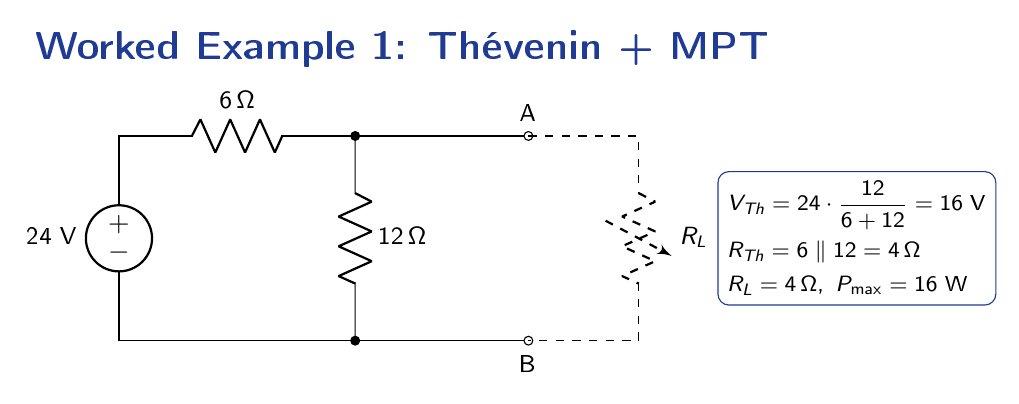
Step 1 — \(V_{Th}\): open-circuit voltage across A–B (voltage divider)
\[ V_{Th} = 24\cdot\frac{12}{6+12} = 16\,\text{V} \]Step 2 — \(R_{Th}\): kill the source; \(R_1 \parallel R_2\)
\[ R_{Th} = \frac{6\cdot 12}{6+12} = 4\,\Omega \]Step 3 — maximum power transfer:
\[ R_L = R_{Th} = 4\,\Omega \] \[ P_{max} = \frac{V_{Th}^2}{4 R_{Th}} = \frac{256}{16} = 16\,\text{W} \]Worked Example 2 — RC Transient Response
A switch closes at \(t=0\), connecting a 10 V source to a series \(R=2\,\text{k}\Omega\) and \(C=5\,\mu\text{F}\). The capacitor is initially uncharged. Find \(v_C(t)\) for \(t\ge 0\) and the energy stored at \(t=\tau\).
Always use the general form \(x(t) = x(\infty) + [x(0^+)-x(\infty)]e^{-t/\tau}\).
(i) Initial: \(v_C(0^+) = v_C(0^-) = 0\)
(ii) Final: at \(t=\infty\), \(C\) is open \(\Rightarrow v_C(\infty) = 10\,\text{V}\)
(iii) Time constant:
\[ \tau = RC = 2000\times 5\times 10^{-6} = 10\,\text{ms} \](iv) Complete response:
\[ \boxed{v_C(t) = 10\bigl(1 - e^{-t/0.01}\bigr)\,\text{V}} \](v) Energy at \(t=\tau\):
\[ v_C(\tau) = 10(1-e^{-1}) = 6.32\,\text{V} \] \[ W = \tfrac{1}{2}Cv^2 = 0.5(5\,\mu\text{F})(6.32)^2 \approx 99.9\,\mu\text{J} \]Worked Example 3 — AC Power & Power-Factor Correction
A load draws \(P = 2.4\,\text{kW}\) at \(V_{rms} = 240\,\text{V}\), 50 Hz, with a lagging power factor of 0.6.
- Find \(|S|\), \(Q\), and the line current \(I\).
- What parallel capacitor \(C\) corrects the power factor to 0.95 lagging?
(a) \(\theta_1 = \cos^{-1}(0.6) = 53.13^\circ\)
\[ |S| = P/\cos\theta_1 = 2400/0.6 = 4000\,\text{VA} \] \[ Q_1 = |S|\sin\theta_1 = 4000(0.8) = 3200\,\text{VAR} \] \[ I = |S|/V_{rms} = 4000/240 \approx 16.67\,\text{A} \](b) \(\theta_2 = \cos^{-1}(0.95)= 18.19^\circ\)
\[ Q_2 = P\tan\theta_2 = 2400(0.3287) = 789\,\text{VAR} \] \[ Q_C = Q_1 - Q_2 = 2411\,\text{VAR} \] \[ C = \frac{Q_C}{\omega V_{rms}^2} = \frac{2411}{2\pi(50)(240^2)} \approx 133\,\mu\text{F} \]Common Pitfalls & Exam Tips
Top 10 Exam Pitfalls to Avoid
- Sign convention: forgetting the passive sign convention gives the wrong power sign.
- Unit mix-ups: \(\mu\text{F}\) vs pF, rad/s vs Hz — always write units.
- Treating a dependent source as independent during Thévenin — keep it active and use a test source to find \(R_{Th}\).
- Applying superposition to power (it is nonlinear) — superpose only currents and voltages.
- Using peak values in \(P = VI\cos\theta\) instead of RMS.
- Forgetting continuity: \(v_C\) and \(i_L\) cannot jump.
- Using \(\tau = RC\) with the total \(R\) instead of the Thévenin \(R\) seen by the capacitor.
- Omitting initial-condition sources in the s-domain (\(L i(0^-)\) and \(v(0^-)/s\)).
- Mixing \(\omega\) and \(j\omega\) in impedance — \(Z_L = \omega L\) is wrong; use \(j\omega L\).
- In three-phase circuits, using line current where phase current is needed (or vice versa).
Draw the circuit, label polarities, write units on every answer, and sanity-check the sign of power. Most marks are lost to carelessness, not to a lack of knowledge.
Problem-Solving Strategy — One-Page Playbook
- Identify sources and unknowns.
- Check for simple series/parallel reductions.
- If unknowns \(\le 2\): use a voltage or current divider.
- Otherwise decide: nodal (few V-sources) or mesh (planar, few I-sources).
- Need only one quantity? ⇒ Thévenin / Norton.
- Multiple independent sources? ⇒ superposition.
- Find \(x(0^-)\) in the old steady state.
- Apply continuity to get \(x(0^+)\).
- Find \(x(\infty)\) in the new steady state.
- Find \(\tau\) (or \(\alpha, \omega_0\) for second order).
- Plug into the general solution form.
- Convert sources to phasors (same \(\omega\)).
- Replace \(R, L, C\) by \(Z_R, Z_L, Z_C\).
- Apply any DC technique (nodal / mesh / Thévenin).
- Solve in the phasor domain.
- Convert back to the time domain if needed.
- Transform sources and elements (include IC sources).
- Solve algebraically for \(X(s)\).
- Perform partial-fraction expansion.
- Inverse-Laplace each term.
- Verify with the initial- and final-value theorems.
Quick Reference Card
Master Formula Reference Card
\(V=IR\); \(P=VI=I^2R=V^2/R\)
KCL: \(\sum i=0\); KVL: \(\sum v=0\)
VD: \(V_k=V_s R_k/R_{eq}\); CD: \(I_k=I_s R_{eq}/R_k\)
\(V_{Th}=V_{oc}\); \(R_{Th}=V_{oc}/I_{sc}\)
MPT: \(R_L=R_{Th}\), \(P_{max}=V_{Th}^2/4R_{Th}\)
\(Z_R=R\); \(Z_L=j\omega L\); \(Z_C=1/j\omega C\)
\(\mathbf{S}=\mathbf{V}\mathbf{I}^*=P+jQ\); \(\text{pf}=\cos\theta=P/S\)
\(V_{rms}=V_m/\sqrt{2}\); \(P=V_{rms}I_{rms}\cos\theta\)
Resonance: \(\omega_0=1/\sqrt{LC}\); \(Q=\omega_0L/R\)
RC: \(\tau=RC\); RL: \(\tau=L/R\)
\(\omega_0=1/\sqrt{LC}\); \(\alpha=R/2L\) (series)
Y: \(V_L=\sqrt{3}V_p\), \(I_L=I_p\); \(\Delta\): \(V_L=V_p\), \(I_L=\sqrt{3}I_p\)
\(P_T=\sqrt{3}V_LI_L\cos\theta\); \(Z_Y=Z_\Delta/3\)
\(\mathcal{L}\{e^{-at}\}=1/(s+a)\); \(\mathcal{L}\{u(t)\}=1/s\)
\(\mathcal{L}\{f'\}=sF-f(0)\)
IVT: \(\lim_{s\to\infty}sF(s)=f(0^+)\)
FVT: \(\lim_{s\to 0}sF(s)=f(\infty)\)
\(H(j\omega)=H(s)|_{s=j\omega}\)
\([z]\): O.C.; \([y]\): S.C.; \([h]\): hybrid
Cascade: \([T]=[T_1][T_2]\); Series: \([z]=[z_1]+[z_2]\)
Reciprocal: \(z_{12}=z_{21}\); Symmetric: \(z_{11}=z_{22}\)
Ideal transformer: \(V_2/V_1=n\), \(Z_{in}=Z_L/n^2\)
Every circuit tells a story — read it with Kirchhoff's eyes. Draw it, label it, check the units and the sign of power, and the rest of network theory unfolds from these foundations.