Control Systems: A Complete Revision Guide
This revision note follows a single thread through the whole subject: we build a mathematical model of a physical system, analyse how it responds in time and frequency, decide whether it is stable, and finally design feedback to shape its behaviour. The same loop — model → analyse → design — reappears in every part below.
The material spans the standard university syllabus and the high-yield areas of competitive examinations such as GATE and ESE: foundations and modelling, time-domain analysis, stability, frequency-domain methods, and advanced topics including state-space, digital control, nonlinear systems and optimal control. Worked examples, formula sheets and common pitfalls are collected at the end.
Part I — Foundations: Modelling and Transfer Functions
What Is a Control System?
A control system is an arrangement of physical components connected to command, direct or regulate another system so as to achieve a desired objective. The controller computes a corrective action from the difference between what is wanted and what is measured.
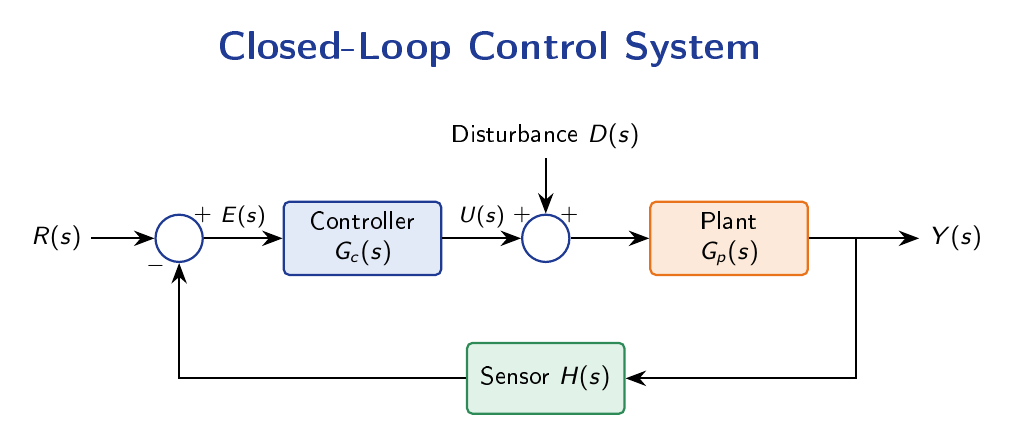
- Plant: the object or process to be controlled.
- Controller: computes the control action \(u(t)\).
- Reference \(r(t)\), output \(y(t)\), disturbance \(d(t)\).
- Stability and low steady-state error.
- Fast transient response.
- Disturbance rejection and robustness.
Open-Loop versus Closed-Loop Systems
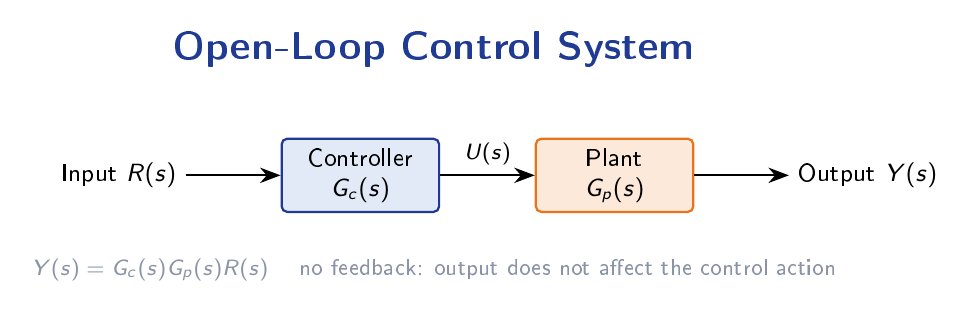
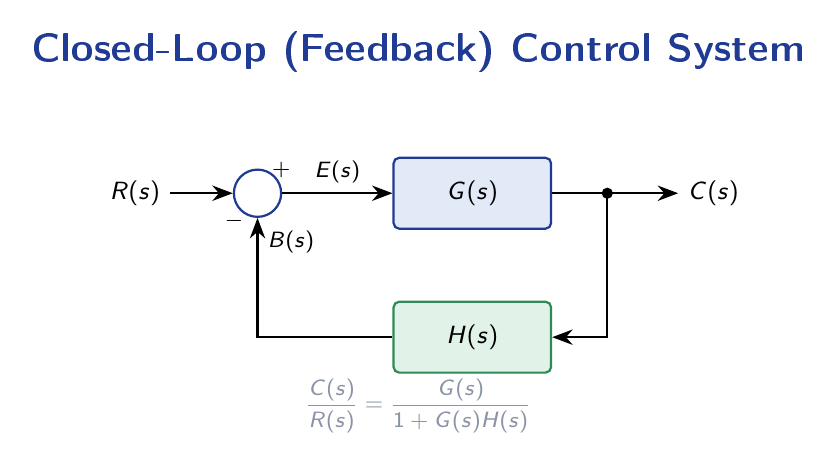
An open-loop system applies a control action without measuring the result; a closed-loop (feedback) system senses the output and compares it with the reference, correcting itself continuously.
| Feature | Open-Loop | Closed-Loop |
|---|---|---|
| Feedback | Absent | Present |
| Accuracy | Low | High |
| Stability | Generally stable | May become unstable |
| Cost & complexity | Low | High |
| Disturbance rejection | Poor | Good |
| Sensitivity to parameter variation | High | Low |
Further Classification of Control Systems
- Continuous-time: signals defined for all \(t\in\mathbb{R}\).
- Discrete-time: signals defined at \(t=kT\).
- Digital: quantised and discrete.
- Linear: superposition holds, \(f(ax_1+bx_2)=af(x_1)+bf(x_2)\).
- Nonlinear: saturation, dead-zone, hysteresis.
- Time-invariant (LTI): parameters constant.
- Time-varying: parameters change with \(t\).
- SISO / MIMO: single or multiple inputs and outputs.
- Regulator: holds the output constant.
- Servo: tracks a varying reference.
Effects of Feedback and Sensitivity
The sensitivity of the closed-loop transfer function \(T\) with respect to a parameter \(\alpha\) measures the fractional change in \(T\) for a fractional change in \(\alpha\):
\[ S^T_\alpha=\frac{\partial T/T}{\partial\alpha/\alpha} =\frac{\alpha}{T}\,\frac{\partial T}{\partial\alpha}. \]For \(T=\dfrac{G}{1+GH}\) this gives the two standard results
\[ \boxed{\,S^T_G=\frac{1}{1+GH}\,},\qquad \boxed{\,S^T_H=\frac{-GH}{1+GH}\,}. \]- Sensitivity to forward-path \((G)\) variations.
- The effect of disturbances by a factor \(1/(1+GH)\).
- Steady-state error.
- The effect of forward-path nonlinearities.
- Sensitivity to feedback-path \((H)\) variations.
- Bandwidth, giving a faster response.
- The risk of instability.
- Complexity and cost.
For a 10% change in \(G\), the change in \(T\) is only \(\dfrac{10\%}{1+GH}\). With \(GH=9\), the variation in \(T\) is just 1% — feedback strongly desensitises the system.
Disturbance Rejection and Noise Suppression
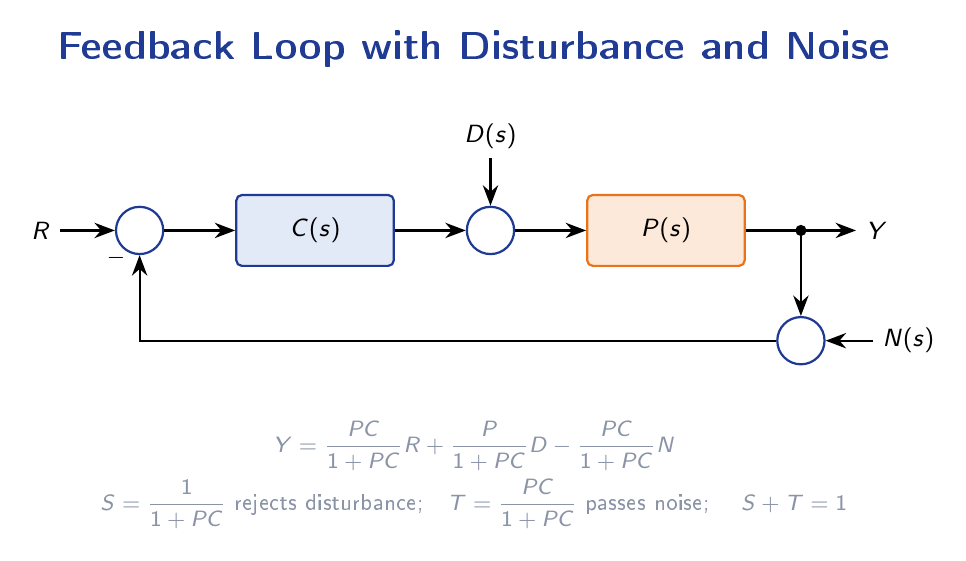
Writing the loop gain as \(L=G_cG_pH\), the closed-loop transfer functions to the various inputs are
- Reference tracking: \(\dfrac{Y}{R}=\dfrac{G_cG_p}{1+L}\;(=T)\).
- Disturbance: \(\dfrac{Y}{D}=\dfrac{G_p}{1+L}\).
- Sensor noise: \(\dfrac{Y}{N}=\dfrac{-L}{1+L}=-T\).
- Error: \(\dfrac{E}{R}=\dfrac{1}{1+L}\;(=S)\).
At low frequency \((\omega\ll\omega_{gc})\), \(|L|\gg1\Rightarrow|S|\ll1\), giving good tracking and disturbance rejection. At high frequency \((\omega\gg\omega_{gc})\), \(|L|\ll1\Rightarrow|T|\ll1\), giving noise rejection. Because \(S+T=1\), both cannot be made small at the same frequency.
Control Components
Armature-Controlled DC Servomotor
The governing electrical and mechanical equations are
\[ e_a=R_ai_a+L_a\dot i_a+e_b,\quad e_b=K_b\dot\theta,\qquad T=K_t\,i_a,\quad J\ddot\theta+B\dot\theta=T. \]Neglecting the armature inductance \((L_a\approx0)\) gives the familiar speed-type transfer function
\[ \boxed{\;\frac{\theta(s)}{E_a(s)} =\frac{K_t}{s\bigl[R_a(Js+B)+K_tK_b\bigr]} =\frac{K_m}{s(1+s\tau_m)}\;} \]with motor gain \(K_m=\dfrac{K_t}{R_aB+K_tK_b}\) and mechanical time constant \(\tau_m=\dfrac{R_aJ}{R_aB+K_tK_b}\). A field-controlled DC motor has an extra field pole, \(\dfrac{\theta(s)}{E_f(s)}=\dfrac{K_m}{s(1+s\tau_f)(1+s\tau_m)}\), and is slower.
The two-phase AC servomotor uses a fixed reference phase and a control phase shifted by \(90^\circ\); torque is proportional to control-phase voltage, giving \(\dfrac{\theta(s)}{E_c(s)}=\dfrac{K_m}{s(1+s\tau_m)}\). A tachogenerator produces a voltage proportional to shaft speed, \(E_t(s)=K_t\,s\,\Theta(s)\), and is used for velocity feedback (damping).
A transmitter–control-transformer (TX–CT) synchro pair acts as an angular error detector, producing \(e=K_s\sin(\theta_r-\theta_c)\approx K_s(\theta_r-\theta_c)\). A potentiometer error detector gives \(e_o=K_p(\theta_r-\theta_c)\) with \(K_p=V/\theta_{\max}\) — cheap and widely used in low-cost servos.
Step angle \(=\dfrac{360^\circ}{N_r\cdot m}\), where \(N_r\) is the number of rotor teeth and \(m\) the number of phases. Used for open-loop position control in printers and CNC machines.
Gear Trains and Reflected Inertia
For an input gear with \(N_1\) teeth driving an output gear with \(N_2\) teeth,
\[ \frac{\theta_1}{\theta_2}=\frac{N_2}{N_1},\qquad \frac{T_1}{T_2}=\frac{N_1}{N_2},\qquad n=\frac{N_1}{N_2}=\frac{\omega_2}{\omega_1}=\frac{T_1}{T_2}, \]with power conserved, \(\omega_1T_1=\omega_2T_2\). Inertia and damping on the output shaft, referred to the input shaft, scale by the square of the gear ratio:
\[ J_{\mathrm{eq},1}=J_1+\Bigl(\tfrac{N_1}{N_2}\Bigr)^{2}J_2,\qquad B_{\mathrm{eq},1}=B_1+\Bigl(\tfrac{N_1}{N_2}\Bigr)^{2}B_2. \]Gears match a high-speed, low-torque motor to a low-speed, high-torque load and reduce reflected inertia. The ratio giving maximum load acceleration is \(n_{\mathrm{opt}}=\sqrt{J_L/J_m}\).
Mathematical Modelling
Translational Mechanical Systems
| Element | Symbol | Force equation |
|---|---|---|
| Mass | \(M\) | \(f=M\ddot{x}\) |
| Damper | \(B\) | \(f=B\dot{x}\) |
| Spring | \(K\) | \(f=Kx\) |
Applying Newton's second law to a mass–spring–damper gives
\[ \boxed{\;M\ddot{x}+B\dot{x}+Kx=f(t)\;} \quad\Longrightarrow\quad \frac{X(s)}{F(s)}=\frac{1}{Ms^2+Bs+K}. \]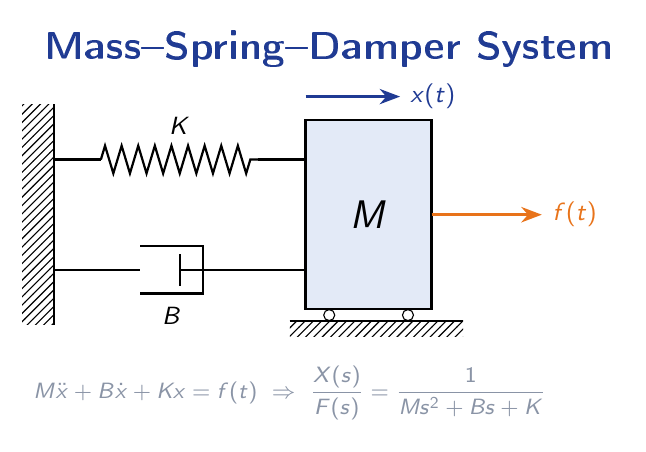
Rotational, Electrical Elements and Analogies
Inertia \(T=J\ddot\theta\), damping \(T=B\dot\theta\), torsional spring \(T=K\theta\), giving \(J\ddot\theta+B\dot\theta+K\theta=T(t)\).
Resistor \(Z=R\); inductor \(Z=sL\) (from \(v=L\,di/dt\)); capacitor \(Z=1/(sC)\) (from \(i=C\,dv/dt\)).
| Mechanical | Electrical (force–voltage) |
|---|---|
| Force \(f\) | Voltage \(e\) |
| Mass \(M\) | Inductance \(L\) |
| Damper \(B\) | Resistance \(R\) |
| Spring \(1/K\) | Capacitance \(C\) |
| Velocity \(\dot x\) | Current \(i\) |
For a series RLC circuit, \(L\ddot q+R\dot q+\dfrac{q}{C}=e(t)\), so \(\dfrac{I(s)}{E(s)}=\dfrac{sC}{s^2LC+sRC+1}\). The dual force–current analogy maps \(f\leftrightarrow i\), \(M\leftrightarrow C\), \(B\leftrightarrow1/R\), \(K\leftrightarrow1/L\).
Laplace Transform Essentials
The Laplace transform converts differential equations into algebraic equations:
\[ F(s)=\mathcal{L}\{f(t)\}=\int_0^{\infty}f(t)\,e^{-st}\,dt,\qquad s=\sigma+j\omega. \]| \(f(t)\) | \(F(s)\) |
|---|---|
| \(\delta(t)\) | \(1\) |
| \(u(t)\) (unit step) | \(1/s\) |
| \(t^n\) | \(n!/s^{\,n+1}\) |
| \(e^{-at}\) | \(1/(s+a)\) |
| \(\sin\omega t\) | \(\omega/(s^2+\omega^2)\) |
| \(\cos\omega t\) | \(s/(s^2+\omega^2)\) |
| \(e^{-at}\sin\omega t\) | \(\omega/\bigl((s+a)^2+\omega^2\bigr)\) |
Key properties used constantly in control work include linearity, the differentiation rules \(\mathcal{L}\{\dot f\}=sF(s)-f(0)\) and \(\mathcal{L}\{\ddot f\}=s^2F(s)-sf(0)-\dot f(0)\), integration \(\mathcal{L}\{\int_0^t f\}=F(s)/s\), the time-shift \(\mathcal{L}\{f(t-a)u(t-a)\}=e^{-as}F(s)\), the frequency-shift \(\mathcal{L}\{e^{-at}f(t)\}=F(s+a)\), and convolution \(\mathcal{L}\{f*g\}=F(s)G(s)\).
\(f(0^+)=\lim\limits_{s\to\infty}sF(s)\) and \(\boxed{f(\infty)=\lim\limits_{s\to0}sF(s)}\). The final-value theorem is valid only when all poles of \(sF(s)\) lie in the left half-plane.
Transfer Functions
The transfer function of an LTI system, with all initial conditions zero, is
\[ \boxed{\;G(s)=\frac{Y(s)}{U(s)}\bigg|_{\text{IC}=0} =\frac{b_ms^m+\cdots+b_0}{a_ns^n+\cdots+a_0}\;} \]- Poles: roots of the denominator.
- Zeros: roots of the numerator.
- Order: \(n\), the degree of the denominator.
- Type: number of poles at the origin.
- Proper: \(m\le n\); strictly proper: \(m\lt n\).
- Causal \(\Leftrightarrow\) proper.
Factored (pole–zero) form:
\[ G(s)=K\,\frac{\prod_{i=1}^m(s-z_i)}{\prod_{j=1}^n(s-p_j)} \]Time-constant (Bode) form:
\[ G(s)=\frac{K\prod(1+s\tau_{zi})}{s^N\prod(1+s\tau_{pj})} \]A transfer function applies to LTI systems only, is independent of the input, and its poles dictate stability and dominant dynamics while its zeros shape the transient response.
Block Diagram Algebra
| Operation | Rule |
|---|---|
| Series (cascade) | \(G_1\cdot G_2\) |
| Parallel (summing) | \(G_1\pm G_2\) |
| Negative feedback loop | \(G/(1+GH)\) |
| Positive feedback loop | \(G/(1-GH)\) |
| Move summing junction ahead of a block | insert \(1/G\) in the moved line |
| Move summing junction after a block | insert \(G\) in the moved line |
| Move take-off point ahead of a block | insert \(G\) in the branch |
| Move take-off point after a block | insert \(1/G\) in the branch |
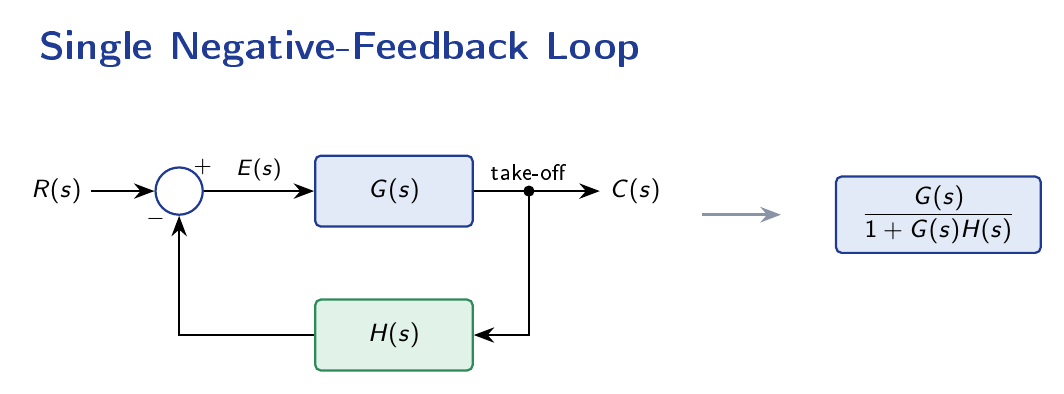
\(\boxed{\dfrac{Y(s)}{R(s)}=\dfrac{G(s)}{1+G(s)H(s)}}\) with characteristic equation \(1+G(s)H(s)=0\).
Signal Flow Graphs and Mason's Gain Formula
In a signal flow graph each node is a variable and each branch is a directed edge with a gain. A forward path runs from input to output without repeating a node; a loop is a closed path repeating no node; non-touching loops share no node.
where \(P_k\) is the gain of the \(k\)-th forward path, \(\Delta=1-\sum L_i+\sum L_iL_j-\sum L_iL_jL_k+\cdots\) (with \(\sum L_i\) the sum of individual loop gains and \(\sum L_iL_j\) the sum of products of pairs of non-touching loops), and \(\Delta_k\) is \(\Delta\) evaluated for the part of the graph not touching the \(k\)-th forward path.
Worked Example
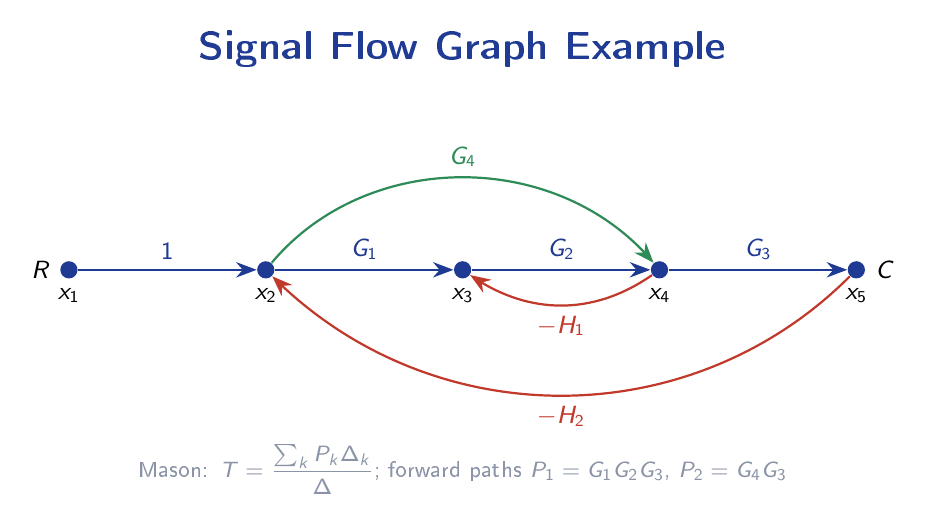
The forward paths are \(P_1=G_1G_2G_3\) and \(P_2=G_1G_4\). The loops are \(L_1=-G_2H_1\), \(L_2=-G_1G_2G_3H_2\) and \(L_3=-G_1G_4H_2\); none are non-touching, so \(\Delta=1-(L_1+L_2+L_3)\) and \(\Delta_1=\Delta_2=1\). Hence
\[ \boxed{\frac{Y}{R}=\frac{G_1G_2G_3+G_1G_4} {1+G_2H_1+G_1G_2G_3H_2+G_1G_4H_2}}. \]Part II — Time-Domain Analysis
Standard Test Signals
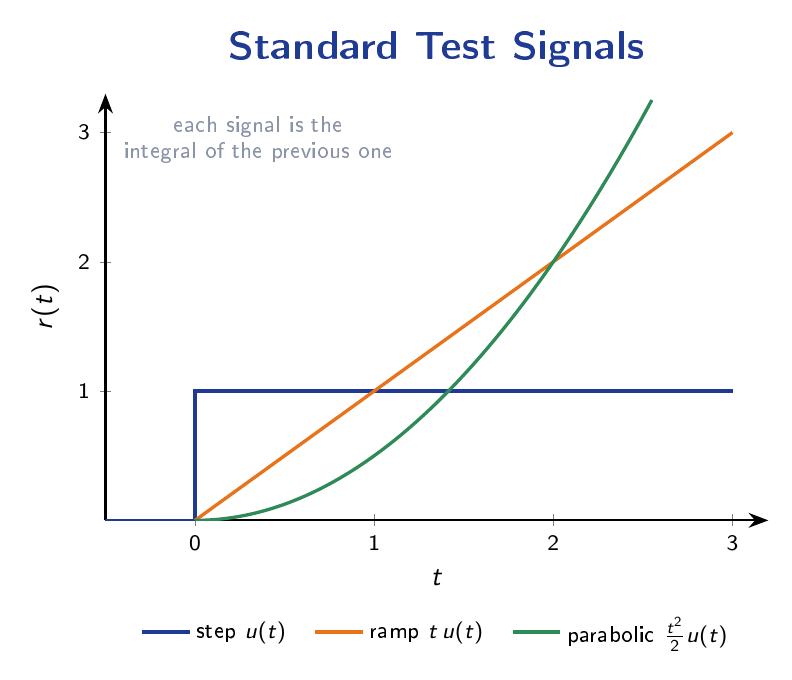
| Signal | \(r(t)\) | \(R(s)\) | Application |
|---|---|---|---|
| Impulse | \(\delta(t)\) | \(1\) | Shock test |
| Step | \(A\,u(t)\) | \(A/s\) | Sudden change |
| Ramp | \(A\,t\,u(t)\) | \(A/s^2\) | Constant velocity |
| Parabolic | \(\tfrac{1}{2}At^2u(t)\) | \(A/s^3\) | Constant acceleration |
| Sinusoidal | \(A\sin\omega t\) | \(\dfrac{A\omega}{s^2+\omega^2}\) | Frequency response |
First-Order Systems
The standard first-order transfer function is \(G(s)=\dfrac{Y(s)}{R(s)}=\dfrac{K}{1+s\tau}\), where \(\tau\) is the time constant. Its unit-step response (for \(K=1\)) is
\[ Y(s)=\frac{1}{s(1+s\tau)},\qquad \boxed{\,y(t)=1-e^{-t/\tau},\;t\ge0\,}. \]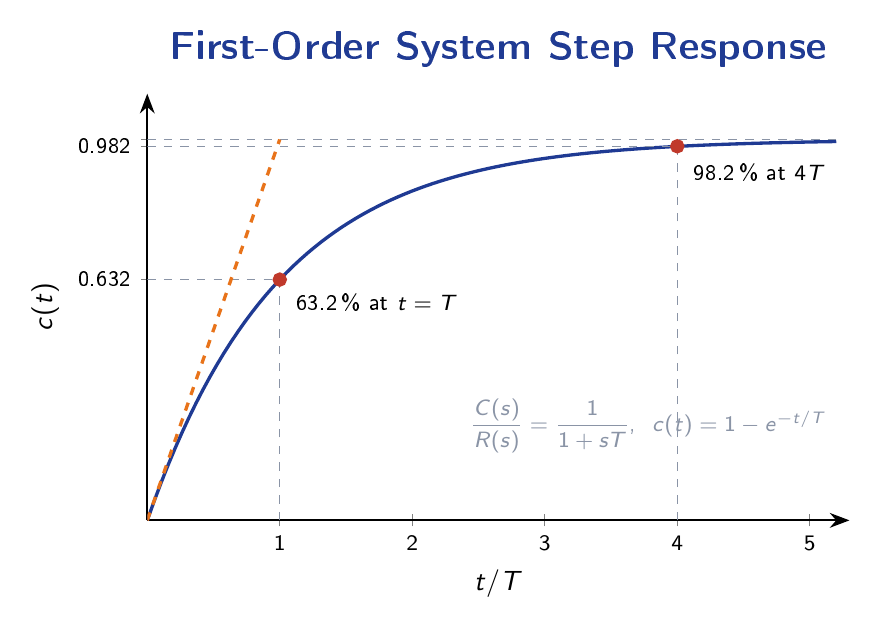
The response reaches \(63.2\%\) at \(t=\tau\), \(86.5\%\) at \(2\tau\), \(95.0\%\) at \(3\tau\), \(98.2\%\) at \(4\tau\) and \(99.3\%\) at \(5\tau\). The settling time is \(t_s\approx4\tau\) (2%) and the rise time \(t_r\approx2.2\tau\) (10–90%). The single pole sits at \(s=-1/\tau\) (real and negative, hence stable): a smaller \(\tau\) gives a faster response.
Second-Order Systems — Standard Form
\[ \boxed{\,G(s)=\frac{\omega_n^2}{s^2+2\zeta\omega_ns+\omega_n^2}\,} \]Here \(\omega_n\) is the undamped natural frequency (rad/s) and \(\zeta\) the dimensionless damping ratio. The characteristic equation \(s^2+2\zeta\omega_ns+\omega_n^2=0\) has poles \(s_{1,2}=-\zeta\omega_n\pm\omega_n\sqrt{\zeta^2-1}\).
| Damping case | \(\zeta\) | Pole nature | Response |
|---|---|---|---|
| Undamped | \(\zeta=0\) | Purely imaginary | Sustained oscillations |
| Underdamped | \(0\lt\zeta\lt1\) | Complex conjugate (LHP) | Decaying oscillations |
| Critically damped | \(\zeta=1\) | Equal, real, negative | Fastest non-oscillatory |
| Overdamped | \(\zeta\gt1\) | Distinct, real, negative | Slow non-oscillatory |
| Unstable | \(\zeta\lt0\) | Right half-plane poles | Grows unbounded |
The damped natural frequency is \(\omega_d=\omega_n\sqrt{1-\zeta^2}\) and the damping coefficient \(\sigma=\zeta\omega_n\).
Second-Order Step Response — All Cases
For the underdamped case \((0\lt\zeta\lt1)\),
\[ y(t)=1-\frac{e^{-\zeta\omega_nt}}{\sqrt{1-\zeta^2}}\sin(\omega_dt+\phi),\qquad \phi=\tan^{-1}\!\left(\frac{\sqrt{1-\zeta^2}}{\zeta}\right). \]For the critically damped case \((\zeta=1)\), \(y(t)=1-e^{-\omega_nt}(1+\omega_nt)\). For the overdamped case \((\zeta\gt1)\), with \(s_{1,2}=-\zeta\omega_n\pm\omega_n\sqrt{\zeta^2-1}\),
\[ y(t)=1+\frac{1}{2\sqrt{\zeta^2-1}}\left[\frac{e^{s_1t}}{(s_1/\omega_n)} -\frac{e^{s_2t}}{(s_2/\omega_n)}\right]. \]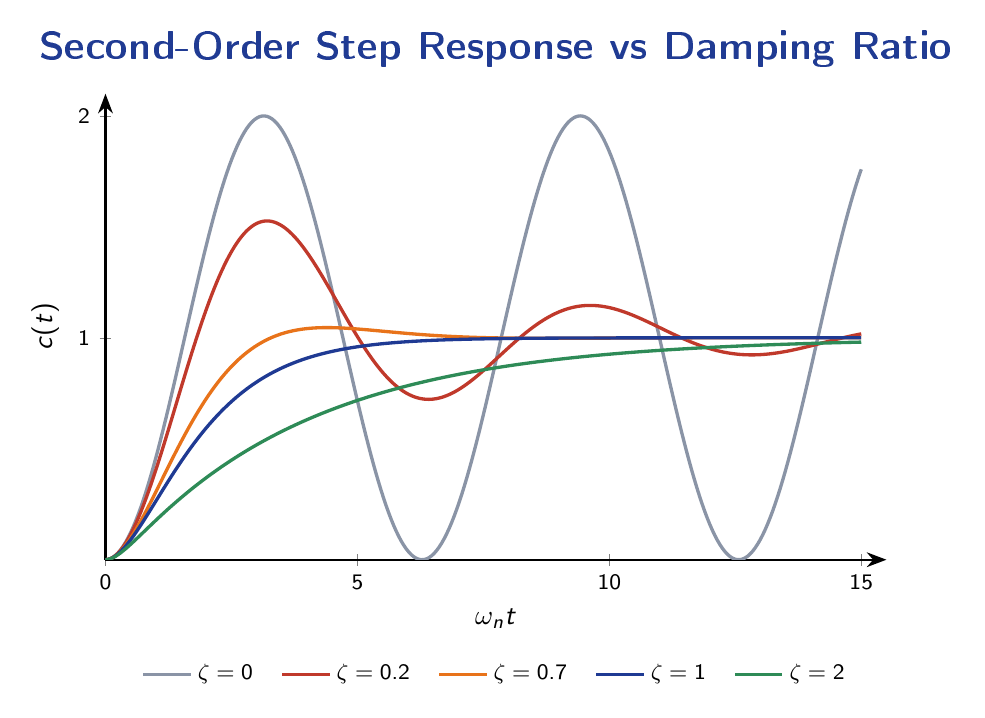
Time-Domain Specifications (Underdamped)
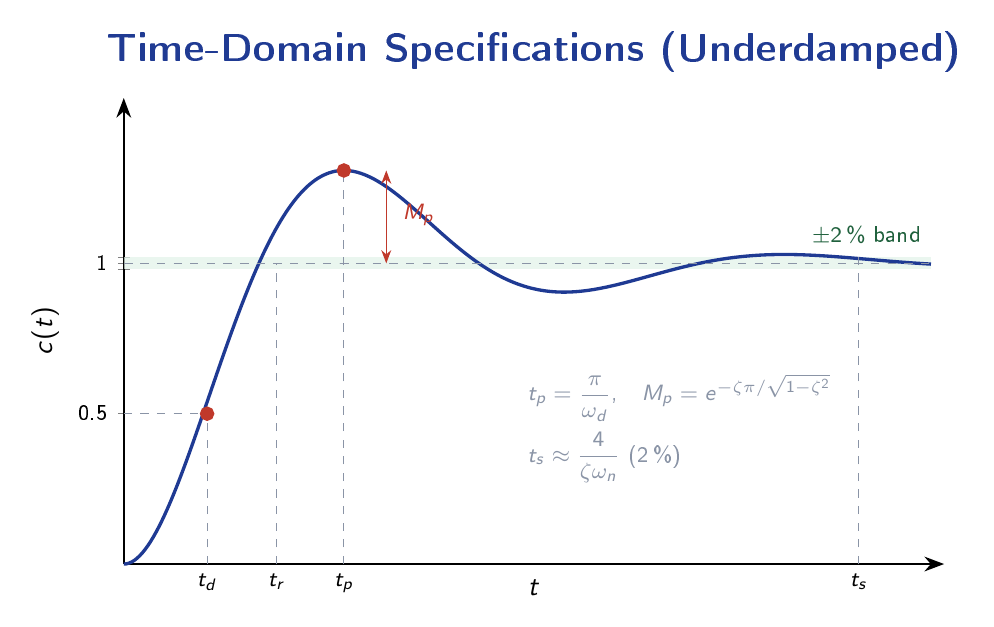
- Delay time (to 50%): \(t_d\approx\dfrac{1+0.7\zeta}{\omega_n}\).
- Rise time (0–100%): \(\boxed{t_r=\dfrac{\pi-\phi}{\omega_d}}\), with \(\phi=\cos^{-1}\zeta\).
- Peak time: \(\boxed{t_p=\dfrac{\pi}{\omega_d}=\dfrac{\pi}{\omega_n\sqrt{1-\zeta^2}}}\).
- Peak overshoot: \(\boxed{M_p=e^{-\pi\zeta/\sqrt{1-\zeta^2}}\times100\%}\).
- Settling time: \(t_s=\dfrac{4}{\zeta\omega_n}\) (2%) or \(\dfrac{3}{\zeta\omega_n}\) (5%).
- Oscillations to settle: \(N=\dfrac{t_s\,\omega_d}{2\pi}\).
Specifications — Quick Reference
\(M_p=e^{-\pi\zeta/\sqrt{1-\zeta^2}}\), \(\quad t_p=\dfrac{\pi}{\omega_d}\), \(\quad t_s=\dfrac{4}{\zeta\omega_n}\) (2%).
| \(\zeta\) | \(M_p\) (%) | \(\zeta\) | \(M_p\) (%) |
|---|---|---|---|
| 0.1 | 72.9 | 0.5 | 16.3 |
| 0.2 | 52.7 | 0.6 | 9.5 |
| 0.3 | 37.2 | 0.7 | 4.6 |
| 0.4 | 25.4 | 0.8 | 1.5 |
Typical designs use \(\zeta\in[0.4,\,0.8]\); the value \(\zeta=0.707\) is often optimal, giving a fast response with about \(5\%\) overshoot. The damping ratio can be recovered from a measured overshoot using \(\zeta=\dfrac{-\ln(M_p)}{\sqrt{\pi^2+\ln^2(M_p)}}\).
Effect of Additional Poles and Zeros; Dominant Pole
- Slower response (larger \(t_r,\,t_s\)).
- Reduced overshoot.
- Decreased bandwidth.
- Faster response (smaller \(t_r\)).
- Increased overshoot.
- Larger bandwidth.
A right-half-plane zero makes the system non-minimum phase, causing initial undershoot and limiting the achievable bandwidth.
Poles closest to the imaginary axis dominate the transient response. A higher-order system can be reduced to second order if the other poles lie at least 5–10× farther into the LHP (and are not cancelled by zeros): a pole at \(-p\) is negligible if \(|p|\ge5\zeta\omega_n\). For example, in \(G(s)=\dfrac{50}{(s^2+4s+25)(s+25)}\) the dominant pair gives \(\omega_n=5,\ \zeta=0.4\); since \(25/(0.4\times5)=12.5\ge5\), it reduces to the DC-matched \(G_{\rm approx}\approx\dfrac{2}{s^2+4s+25}\).
Steady-State Error and Static Error Constants
For a unity-feedback system, the final-value theorem gives
\[ e_{ss}=\lim_{t\to\infty}e(t)=\lim_{s\to0}sE(s)=\lim_{s\to0}\frac{sR(s)}{1+G(s)}. \]The static error constants are
\[ K_p=\lim_{s\to0}G(s),\qquad K_v=\lim_{s\to0}sG(s),\qquad K_a=\lim_{s\to0}s^2G(s). \]| System type | Step \(e_{ss}\) | Ramp \(e_{ss}\) | Parabolic \(e_{ss}\) |
|---|---|---|---|
| Type 0 | \(\dfrac{1}{1+K_p}\) | \(\infty\) | \(\infty\) |
| Type 1 | \(0\) | \(\dfrac{1}{K_v}\) | \(\infty\) |
| Type 2 | \(0\) | \(0\) | \(\dfrac{1}{K_a}\) |
| Type 3+ | \(0\) | \(0\) | \(0\) |
The type \(N\) is the number of poles at the origin in the open-loop transfer function. A higher type tracks higher-order inputs with zero error but tends to degrade stability.
Steady-State Error — Worked Example
For \(G(s)=\dfrac{10}{s(s+2)(s+5)}\) with unity feedback and input \(r(t)=2+3t\), find \(e_{ss}\).
- One pole at the origin makes this a Type-1 system.
- Error constants: \(K_p=\lim_{s\to0}\dfrac{10}{s(s+2)(s+5)}=\infty\) and \(K_v=\lim_{s\to0}\dfrac{10}{(s+2)(s+5)}=\dfrac{10}{2\cdot5}=1\).
- Superposition: the step part (amplitude 2) gives \(e_{ss_1}=\dfrac{2}{1+K_p}=0\); the ramp part (slope 3) gives \(e_{ss_2}=\dfrac{3}{K_v}=3\).
\(e_{ss}=e_{ss_1}+e_{ss_2}=\boxed{3}\).
Part III — Stability Analysis
Concept of Stability
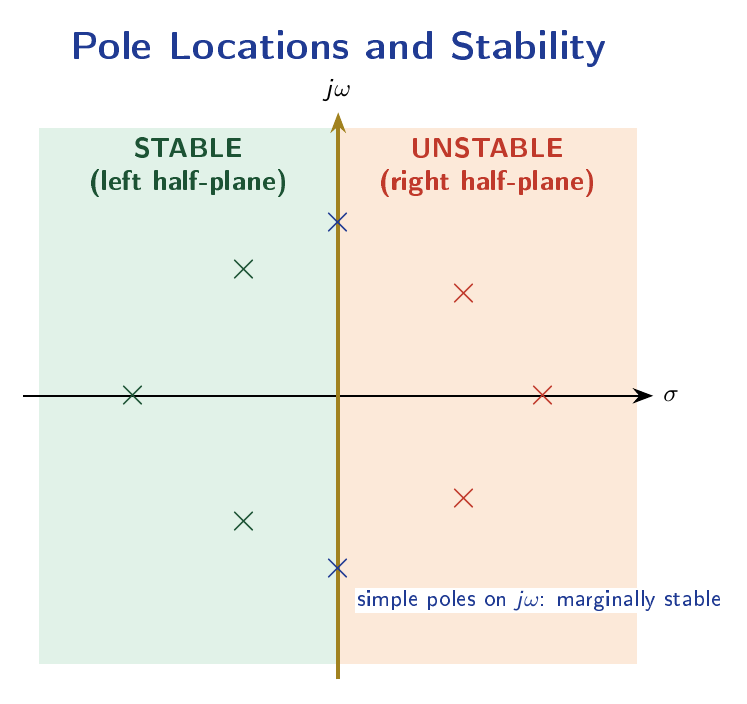
A system is bounded-input bounded-output (BIBO) stable if every bounded input produces a bounded output. For an LTI system this is equivalent to absolute integrability of the impulse response and to all poles lying in the left half-plane:
\[ \text{LTI BIBO stable}\iff\int_0^\infty|h(t)|\,dt\lt\infty\iff\text{all poles in the LHP}. \]| Pole location | Behaviour |
|---|---|
| All poles in LHP | Asymptotically stable |
| Any pole in RHP | Unstable |
| Non-repeated poles on \(j\omega\)-axis (others in LHP) | Marginally stable |
| Repeated poles on \(j\omega\)-axis | Unstable |
Routh–Hurwitz Stability Criterion
The Routh–Hurwitz criterion determines stability without computing the roots. For a characteristic equation \(a_ns^n+a_{n-1}s^{n-1}+\cdots+a_1s+a_0=0\), a necessary condition is that all coefficients are present and of the same sign. The sufficient condition uses the Routh array, whose first two rows hold the coefficients and whose later entries are formed by
\[ b_1=\frac{a_{n-1}a_{n-2}-a_na_{n-3}}{a_{n-1}},\qquad b_2=\frac{a_{n-1}a_{n-4}-a_na_{n-5}}{a_{n-1}},\ \ldots \]The system is stable if and only if there are no sign changes in the first column of the Routh array. The number of sign changes equals the number of right-half-plane poles.
Special Cases
- First element of a row is zero: replace the zero with a small \(\epsilon\gt0\), continue, then let \(\epsilon\to0^+\).
- An entire row is zero: this signals symmetric roots. Form the auxiliary equation \(A(s)=0\) from the row above, differentiate to get \(dA/ds\), and use its coefficients to replace the zero row; the roots of \(A(s)=0\) are also roots of the characteristic equation. For \(s^5+2s^4+24s^3+48s^2-25s-50=0\) the \(s^3\) row vanishes; the \(s^4\) row gives \(A(s)=2s^4+48s^2-50\) and \(dA/ds=8s^3+96s\).
Routh–Hurwitz — Worked Example
For \(1+\dfrac{K}{s(s+1)(s+2)}=0\), the characteristic equation is \(s^3+3s^2+2s+K=0\).
The Routh array is
\[ \begin{array}{c|cc} s^3 & 1 & 2\\ s^2 & 3 & K\\ s^1 & \dfrac{6-K}{3} & 0\\[0.4em] s^0 & K & 0 \end{array} \]No sign changes in the first column requires \(\dfrac{6-K}{3}\gt0\Rightarrow K\lt6\) and \(K\gt0\).
\(\boxed{\,0\lt K\lt6\,}\). At \(K=6\) the system is marginally stable; the auxiliary equation \(3s^2+6=0\) gives \(s=\pm j\sqrt{2}\), an oscillation at \(\omega=\sqrt{2}\) rad/s.
Root Locus — Introduction
The root locus is the trajectory of the closed-loop poles in the \(s\)-plane as the open-loop gain \(K\) varies from \(0\) to \(\infty\). For \(1+KG(s)H(s)=0\) with \(G(s)H(s)=\dfrac{\prod(s-z_i)}{\prod(s-p_j)}\), a point lies on the locus when it satisfies the
- Angle condition: \(\boxed{\angle G(s)H(s)=(2k+1)\cdot180^\circ}\), expanded as \(\sum_{i=1}^m\angle(s-z_i)-\sum_{j=1}^n\angle(s-p_j)=(2k+1)180^\circ\);
- Magnitude condition (used to find \(K\)): \(|KG(s)H(s)|=1\Rightarrow K=\dfrac{1}{|G(s)H(s)|}\).
Rules for Root-Locus Construction
- Symmetry: the locus is symmetric about the real axis.
- Branches: there are \(n\) branches (number of open-loop poles, \(n\ge m\)).
- Start/end: branches start at poles \((K=0)\) and end at zeros or at infinity \((K\to\infty)\); \(n-m\) branches go to infinity.
- Real-axis segments: a point lies on the locus if the total number of real poles and zeros to its right is odd.
- Asymptotes: \(n-m\) asymptotes at angles \(\theta_A=\dfrac{(2k+1)180^\circ}{n-m}\), meeting the real axis at the centroid \(\sigma_A=\dfrac{\sum\text{poles}-\sum\text{zeros}}{n-m}\).
- Breakaway/break-in points: solutions of \(\dfrac{dK}{ds}=0\) that lie on the locus.
- \(j\omega\)-axis crossing: found from the Routh array; the auxiliary equation gives the crossing frequency and critical \(K\).
- Angle of departure (from a pole): \(\theta_d=180^\circ-\sum\angle(\text{other poles})+\sum\angle(\text{zeros})\).
- Angle of arrival (at a zero): \(\theta_a=180^\circ+\sum\angle(\text{poles})-\sum\angle(\text{other zeros})\).
Root Locus — Worked Example
The poles are at \(0,-2,-4\) \((n=3)\) with no finite zeros \((m=0)\), so there are three branches, all tending to infinity. The real-axis segments are \([-2,0]\) and \((-\infty,-4]\). The asymptotes are at \(\pm60^\circ\) and \(180^\circ\), with centroid \(\sigma_A=\dfrac{0-2-4}{3}=-2\). The breakaway point comes from \(K=-s(s+2)(s+4)\), \(\dfrac{dK}{ds}=-(3s^2+12s+8)=0\), giving \(s=-0.845\) (on the locus) or \(s=-3.155\) (rejected).
For the \(j\omega\)-axis crossing, the characteristic equation \(s^3+6s^2+8s+K=0\) gives the Routh array
\[ \begin{array}{c|cc} s^3 & 1 & 8\\ s^2 & 6 & K\\ s^1 & (48-K)/6 & 0\\ s^0 & K & 0 \end{array} \]so at \(K=48\) the auxiliary equation \(6s^2+48=0\) gives \(s=\pm j2\sqrt{2}\).
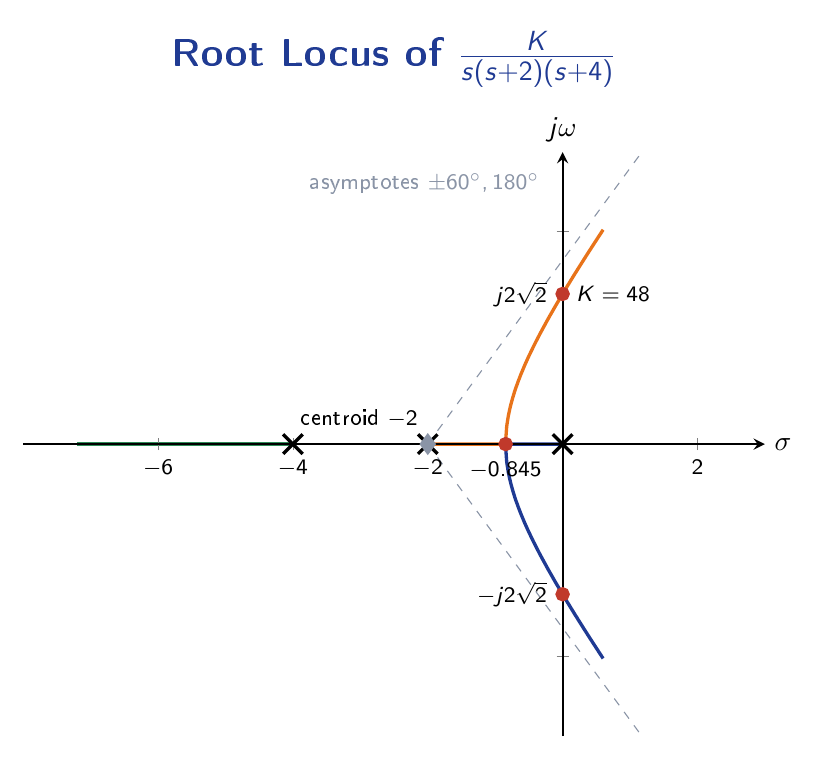
\(\boxed{\,0\lt K\lt48\,}\).
Part IV — Frequency-Domain Analysis
Frequency Response — Basics
The frequency response is the steady-state response of an LTI system to a sinusoid of varying frequency, obtained by setting \(s=j\omega\) in \(G(s)\): \(G(j\omega)=|G(j\omega)|\,\angle G(j\omega)\). For an input \(r(t)=A\sin\omega t\) the steady-state output is \(y_{ss}(t)=A\,|G(j\omega)|\,\sin\!\bigl(\omega t+\angle G(j\omega)\bigr)\) — the same frequency, scaled in amplitude and shifted in phase.
| Specification | Definition |
|---|---|
| Resonant peak \(M_r\) | maximum of \(|G(j\omega)|\) |
| Resonant frequency \(\omega_r\) | frequency at which \(M_r\) occurs |
| Bandwidth \(\omega_b\) | where \(|G(j\omega)|\) drops \(3\) dB below its DC value |
| Gain crossover \(\omega_{gc}\) | \(|G(j\omega_{gc})|=1\) (i.e. \(0\) dB) |
| Phase crossover \(\omega_{pc}\) | \(\angle G(j\omega_{pc})=-180^\circ\) |
For a standard second-order system, \(\omega_r=\omega_n\sqrt{1-2\zeta^2}\), \(M_r=\dfrac{1}{2\zeta\sqrt{1-\zeta^2}}\), \(\omega_b=\omega_n\sqrt{1-2\zeta^2+\sqrt{2-4\zeta^2+4\zeta^4}}\).
Bode Plot — Concept
A Bode plot consists of a magnitude plot of \(20\log_{10}|G(j\omega)|\) (dB) against \(\log_{10}\omega\) and a phase plot of \(\angle G(j\omega)\) (degrees) against \(\log_{10}\omega\). The logarithmic scale turns multiplication of factors into addition, so each factor contributes an asymptotic straight line.
| Factor | Slope (dB/dec) | Phase (deg) |
|---|---|---|
| Gain \(K\) | \(0\) (constant \(20\log K\)) | \(0\) |
| Pole at origin \(1/s\) | \(-20\) | \(-90\) |
| Zero at origin \(s\) | \(+20\) | \(+90\) |
| Simple pole \(1/(1+s\tau)\) | \(0\) then \(-20\) at \(\omega=1/\tau\) | \(0\to-90\) |
| Simple zero \((1+s\tau)\) | \(0\) then \(+20\) at \(\omega=1/\tau\) | \(0\to+90\) |
| Quadratic pole | \(0\) then \(-40\) at \(\omega_n\) | \(0\to-180\) |
Bode Plot — Sketching Procedure
- Convert \(G(s)\) to time-constant (Bode) form.
- Identify the corner frequencies: \(\omega_c=1/\tau\) for first-order factors and \(\omega_c=\omega_n\) for second-order factors.
- At low frequency the initial slope is \(-20N\) dB/dec, where \(N\) is the number of poles at the origin.
- The initial line passes through \(20\log K\) at \(\omega=1\) (Type 0) or through \(20\log K\) at \(\omega=K^{1/N}\) (Type \(N\)).
- At each corner frequency, change the slope by \(\pm20\) (simple) or \(\pm40\) (quadratic) dB/dec.
- Sketch the phase by summing the individual contributions.
Gain margin \(\text{GM}=-20\log|G(j\omega_{pc})|\) dB; phase margin \(\text{PM}=180^\circ+\angle G(j\omega_{gc})\). The system is stable if and only if both margins are positive.
Bode Plot — Example Sketch
This is a Type-1 system with corner frequencies \(\omega_{c1}=10\) and \(\omega_{c2}=50\) rad/s.
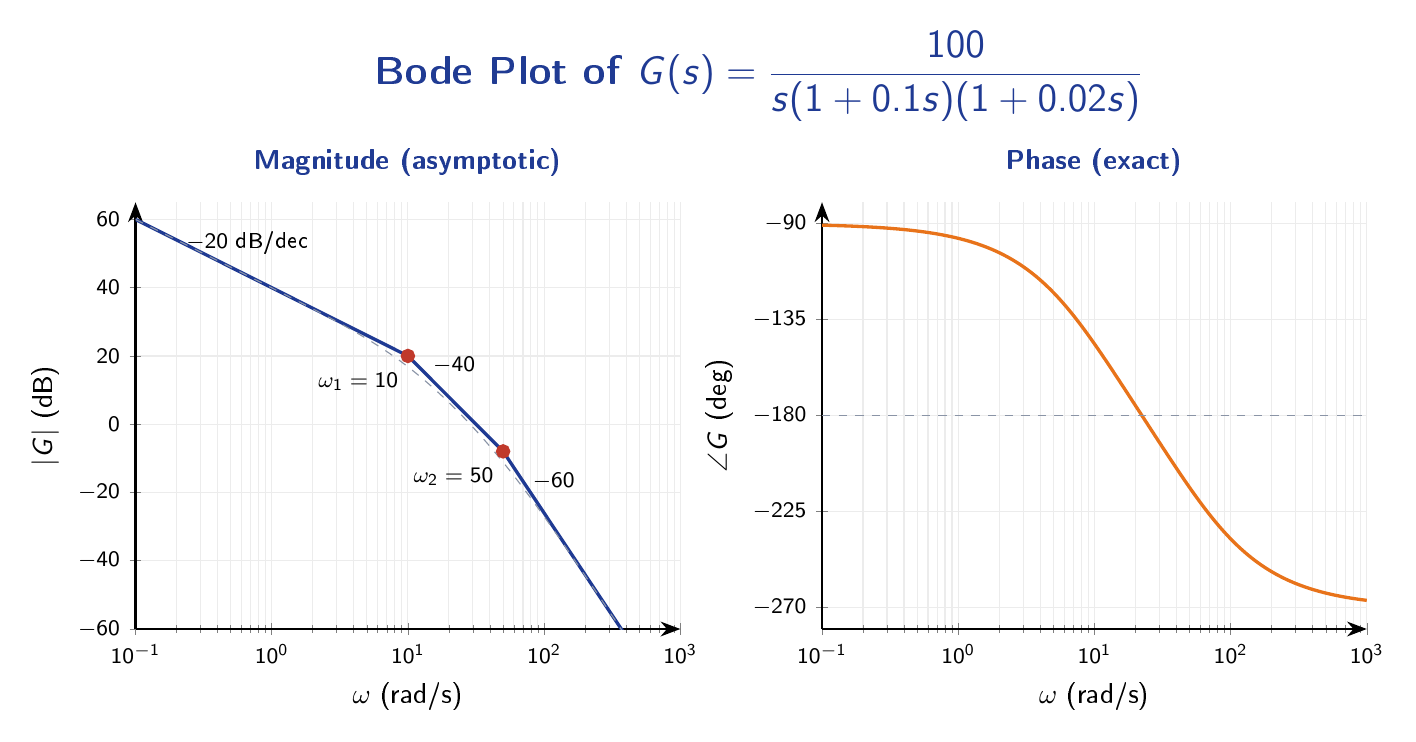
The slope is \(-20\) dB/dec until \(\omega=10\), then \(-40\) up to \(\omega=50\), then \(-60\) beyond. At \(\omega=1\) the magnitude is \(20\log100=40\) dB, and the gain crossover is \(\omega_{gc}\approx\sqrt{100\cdot10}\approx31.6\) rad/s.
Polar Plot
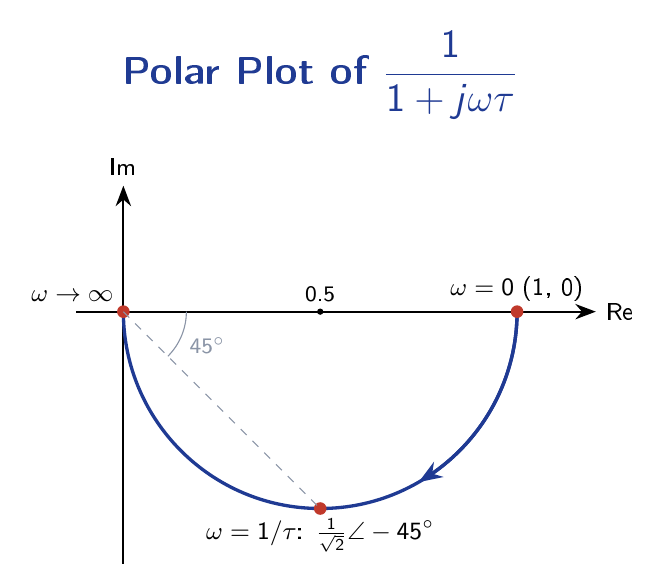
A polar (Nyquist) plot traces \(|G(j\omega)|\angle G(j\omega)\) in the complex plane as \(\omega\) goes from \(0\) to \(\infty\). One computes the start \((\omega=0)\), the end \((\omega\to\infty)\), and the real- and imaginary-axis crossings. For \(G(s)=\dfrac{1}{1+s\tau}\) the plot starts at \(1\angle0^\circ\), passes through \(\tfrac{1}{\sqrt2}\angle{-45^\circ}\) at \(\omega=1/\tau\), and ends at \(0\angle{-90^\circ}\), forming a semicircle in the lower half-plane.
Nyquist Stability Criterion
By Cauchy's argument principle, for a rational \(F(s)\) and a closed contour \(\Gamma_s\), \(N=P-Z\), where \(N\) is the number of counter-clockwise encirclements of the origin by \(F(s)\), \(P\) the poles of \(F(s)\) inside \(\Gamma_s\) and \(Z\) the zeros inside.
Taking \(F(s)=1+G(s)H(s)\) with the Nyquist contour enclosing the whole RHP, \(\boxed{\,N=P-Z\,}\), where now \(N\) is the number of encirclements of \((-1+j0)\) by \(G(j\omega)H(j\omega)\) (counter-clockwise positive), \(P\) the open-loop RHP poles and \(Z\) the closed-loop RHP poles. Closed-loop stability requires \(Z=0\), i.e. \(N=P\). If the open-loop system is stable \((P=0)\), the closed loop is stable if and only if there is no encirclement of \((-1,0)\).
Nyquist Plot Construction
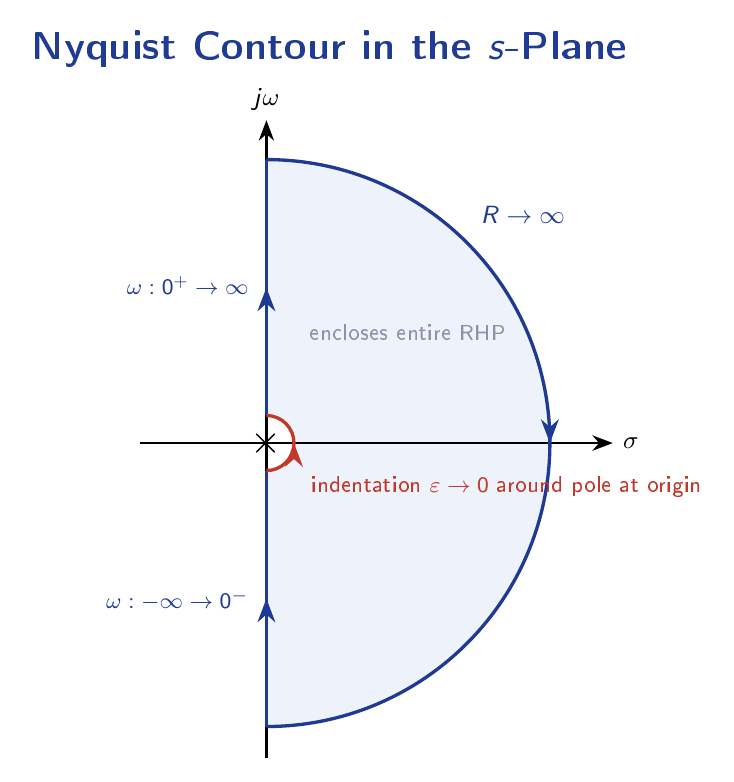
- Compute \(GH(j\omega)\) at \(\omega=0^+\) and as \(\omega\to\infty\).
- Find the real-axis crossings, where \(\mathrm{Im}\{GH\}=0\).
- Find the imaginary-axis crossings, where \(\mathrm{Re}\{GH\}=0\).
- Sketch for \(\omega\gt0\) and mirror about the real axis for \(\omega\lt0\).
- Count the counter-clockwise encirclements \(N\) of \((-1,0)\).
- Apply \(Z=P-N\); the closed loop is stable if and only if \(Z=0\).
Relative stability follows from the same plot: \(\text{GM}=\dfrac{1}{|GH(j\omega_{pc})|}\) (in dB, \(-20\log|GH|\) at \(\omega_{pc}\)) and \(\text{PM}=180^\circ+\angle GH(j\omega_{gc})\).
Correlation Between Time and Frequency Domains
| Time domain | Frequency domain | Correlation |
|---|---|---|
| Peak overshoot \(M_p\) | Resonant peak \(M_r\) | both rise as \(\zeta\) falls |
| Rise time \(t_r\) | Bandwidth \(\omega_b\) | \(t_r\cdot\omega_b\approx\) const |
| Damping ratio \(\zeta\) | Phase margin PM | \(\zeta\approx\text{PM}/100\) |
| Settling time \(t_s\) | Bandwidth \(\omega_b\) | \(t_s\propto1/\omega_b\) |
| Natural frequency \(\omega_n\) | Resonant frequency \(\omega_r\) | \(\omega_r=\omega_n\sqrt{1-2\zeta^2}\) |
Useful design relations: \(t_r\cdot\omega_b\approx1.5\) to \(2.5\); for \(\zeta=0.707\), \(\omega_b=\omega_n\) and \(M_r=1\) (no peaking); a finite \(M_r\) occurs only for \(\zeta\lt1/\sqrt2=0.707\). Higher bandwidth gives a faster response and better tracking but more noise susceptibility; a common target is \(M_r\approx1.1\)–\(1.5\) and PM \(\approx45^\circ\)–\(60^\circ\).
Constant-\(M\)/Constant-\(N\) Circles and the Nichols Chart
For unity feedback the closed-loop frequency response is \(M(\omega)e^{j\alpha(\omega)}=\dfrac{G(j\omega)}{1+G(j\omega)}\).
Centre \(\Bigl(\dfrac{-M^2}{M^2-1},0\Bigr)\), radius \(\Bigl|\dfrac{M}{M^2-1}\Bigr|\). For \(M=1\) the locus is the vertical line \(\mathrm{Re}=-\tfrac12\); for \(M\gt1\) the circles surround \(-1\); for \(M\lt1\) they surround the origin.
Centre \(\Bigl(-\tfrac12,\dfrac{1}{2N}\Bigr)\), radius \(\sqrt{\tfrac14+\tfrac{1}{4N^2}}\). Overlaying the polar plot of \(G(j\omega)\) on the \(M\)–\(N\) contours reads off the closed-loop magnitude and phase directly.
The Nichols chart plots open-loop magnitude (dB) against phase (deg) with constant-\(M\) and constant-\(N\) loci superimposed, which is more convenient than polar plots for compensator design.
Minimum-Phase versus Non-Minimum-Phase Systems
A minimum-phase system has all poles and zeros in the LHP; a non-minimum-phase system has at least one pole or zero in the RHP; an all-pass system has poles and zeros mirror-symmetric about the imaginary axis, so \(|G(j\omega)|=1\) for all \(\omega\). Among systems with the same magnitude response, the minimum-phase one has the smallest phase lag, obeys Bode's gain–phase relation and is invertible. Non-minimum-phase systems exhibit initial undershoot, extra phase lag and limited bandwidth.
\(G_1(s)=\dfrac{s+2}{s+10}\) is minimum phase, while \(G_2(s)=\dfrac{s-2}{s+10}\) is non-minimum phase (RHP zero). They share the same \(|G(j\omega)|\) but differ in phase, and \(G_2\) shows initial undershoot.
Compensator Design in the Frequency Domain
Lead Compensator (Bode Design)
- Adjust the gain \(K\) to meet the steady-state error specification.
- Sketch the Bode plot of \(KG_p\) and find the existing phase margin \(\phi_0\).
- Required lead: \(\phi_{\max}=\phi^*-\phi_0+\epsilon\), with \(\epsilon=5^\circ\)–\(10^\circ\).
- Compute \(\alpha=\dfrac{1-\sin\phi_{\max}}{1+\sin\phi_{\max}}\).
- Find the new gain crossover \(\omega'_{gc}\) where \(|KG_p|=-10\log(1/\alpha)\) dB.
- Set \(\omega_m=\omega'_{gc}\), so \(\tau=\dfrac{1}{\omega_m\sqrt{\alpha}}\).
- Use \(G_c(s)=\dfrac{1+s\tau}{1+s\alpha\tau}\) (with \(K_c=1/\alpha\)).
Lag Compensator (Bode Design)
- Adjust \(K\) for the error specification.
- Find the frequency where the phase of \(KG_p\) gives PM \(=\phi^*+\epsilon\); call it \(\omega'_{gc}\).
- At \(\omega'_{gc}\), with \(|KG_p|_{\text{dB}}=A\), set \(\beta=10^{A/20}\).
- Place the zero at \(\omega_z=\omega'_{gc}/10\), i.e. \(\tau=10/\omega'_{gc}\).
- Use \(G_c(s)=\dfrac{1+s\tau}{1+s\beta\tau}\).
Part V — Advanced Topics
PID Controllers
The standard PID control law and its transfer function are
\[ u(t)=K_p\,e(t)+K_i\!\int_0^t\!e(\tau)\,d\tau+K_d\,\frac{de(t)}{dt} \;\Longleftrightarrow\; \boxed{G_c(s)=K_p+\frac{K_i}{s}+K_ds=\frac{K_ds^2+K_ps+K_i}{s}}. \]| Term | Benefits | Drawbacks |
|---|---|---|
| P \((K_p)\) | reduces \(t_r\) and \(e_{ss}\) | cannot eliminate \(e_{ss}\); may overshoot |
| I \((K_i)\) | eliminates \(e_{ss}\) for a step input | increases overshoot; slower; integrator wind-up |
| D \((K_d)\) | adds damping; reduces overshoot | amplifies high-frequency noise |
Increase \(K_p\) until the system just oscillates, recording the ultimate gain \(K_u\) and period \(P_u\). Then set the parameters as below, with \(K_i=K_p/T_i\) and \(K_d=K_pT_d\).
| Controller | \(K_p\) | \(T_i\) | \(T_d\) |
|---|---|---|---|
| P | \(0.5\,K_u\) | – | – |
| PI | \(0.45\,K_u\) | \(P_u/1.2\) | – |
| PID | \(0.6\,K_u\) | \(P_u/2\) | \(P_u/8\) |
Lead, Lag and Lead–Lag Compensators
The general first-order compensator is \(G_c(s)=K_c\dfrac{s+z}{s+p}\) with \(z,p\gt0\).
| Type | Condition | Purpose |
|---|---|---|
| Lead | \(z\lt p\) (zero nearer the origin) | improves transient: raises PM and \(\omega_b\) |
| Lag | \(z\gt p\) | improves steady state: raises \(K\) |
| Lead–lag | combines both | improves both |
For the lead compensator \(G_c(s)=\alpha\dfrac{1+s\tau}{1+s\alpha\tau}\) with \(\alpha\lt1\), the maximum phase lead is \(\phi_{\max}=\sin^{-1}\!\left(\dfrac{1-\alpha}{1+\alpha}\right)\), occurring at \(\omega_m=\dfrac{1}{\tau\sqrt{\alpha}}\), where \(|G_c(j\omega_m)|=\dfrac{1}{\sqrt{\alpha}}\). For the lag compensator \(G_c(s)=\beta\dfrac{1+s\tau}{1+s\beta\tau}\) with \(\beta\gt1\), the phase contribution is negative, so \(\omega_m\) is placed well below \(\omega_{gc}\) to avoid degrading the phase margin.
Time Delay and Padé Approximation
A pure transport lag, \(y(t)=u(t-T_d)\), has \(G_d(s)=e^{-sT_d}\) with \(|G_d(j\omega)|=1\) (all-pass) and \(\angle G_d(j\omega)=-\omega T_d\) (an unbounded, linear phase lag). Delays arise from transport, sensing and computation; they subtract phase and therefore reduce the phase margin, limiting bandwidth (rule of thumb \(\omega_{gc}T_d\lesssim1\)), and can cause oscillation or instability if ignored.
The Padé approximations replace the exponential with a rational function:
\[ e^{-sT_d}\approx\frac{1-sT_d/2}{1+sT_d/2}\quad(\text{1st order}),\qquad e^{-sT_d}\approx\frac{1-sT_d/2+(sT_d)^2/12}{1+sT_d/2+(sT_d)^2/12}\quad(\text{2nd order}). \]The first-order form introduces an RHP zero at \(2/T_d\), making it a non-minimum-phase approximation. At \(\omega_{gc}\) a delay subtracts \(\omega_{gc}T_d\) rad \(=57.3\,\omega_{gc}T_d\) degrees of phase; the Smith predictor compensates known delays explicitly.
State-Space Representation
The state-space model uses state variables capturing the minimum information needed to predict the system's future behaviour:
\[ \boxed{\;\dot{\mathbf x}(t)=\mathbf A\mathbf x(t)+\mathbf B\mathbf u(t)\;},\qquad \boxed{\;\mathbf y(t)=\mathbf C\mathbf x(t)+\mathbf D\mathbf u(t)\;}. \]Here \(\mathbf x\in\mathbb{R}^n\) is the state, \(\mathbf u\in\mathbb{R}^r\) the input, \(\mathbf y\in\mathbb{R}^m\) the output, with \(\mathbf A_{n\times n}\), \(\mathbf B_{n\times r}\) and \(\mathbf C_{m\times n}\). The transfer function recovered from the model is
\[ \boxed{\;G(s)=\mathbf C(s\mathbf I-\mathbf A)^{-1}\mathbf B+\mathbf D\;}, \]with characteristic polynomial \(|s\mathbf I-\mathbf A|=0\). The state equation solves to \(\mathbf x(t)=e^{\mathbf At}\mathbf x(0)+\int_0^te^{\mathbf A(t-\tau)}\mathbf B\mathbf u(\tau)\,d\tau\), where the state-transition matrix is \(\phi(t)=e^{\mathbf At}=\mathcal{L}^{-1}\{(s\mathbf I-\mathbf A)^{-1}\}\).
Canonical Forms
For a SISO system \(G(s)=\dfrac{b_2s^2+b_1s+b_0}{s^3+a_2s^2+a_1s+a_0}\), two common realisations are the controllable and observable canonical forms.
The diagonal (modal) form uses \(\mathbf A=\mathrm{diag}(p_1,\ldots,p_n)\) for distinct poles, decoupling the system into first-order modes; the Jordan form handles repeated eigenvalues with a block-diagonal structure. All forms describe the same system, related by similarity transformations \(\mathbf x'=\mathbf P\mathbf x\): \(\mathbf A'=\mathbf P\mathbf A\mathbf P^{-1}\), \(\mathbf B'=\mathbf P\mathbf B\), \(\mathbf C'=\mathbf C\mathbf P^{-1}\).
Controllability and Observability
The system can be driven from any \(\mathbf x(0)\) to any \(\mathbf x(t_f)\) in finite time if and only if the controllability matrix has full rank:
\[ \mathbf Q_c=[\,\mathbf B\ \ \mathbf A\mathbf B\ \ \cdots\ \ \mathbf A^{n-1}\mathbf B\,],\quad \mathrm{rank}(\mathbf Q_c)=n. \]The initial state can be determined from the output over a finite time if and only if the observability matrix has full rank:
\[ \mathbf Q_o=\begin{bmatrix}\mathbf C\\\mathbf C\mathbf A\\\vdots\\\mathbf C\mathbf A^{n-1}\end{bmatrix}, \quad\mathrm{rank}(\mathbf Q_o)=n. \]By the duality principle, \((\mathbf A,\mathbf B,\mathbf C)\) is controllable if and only if \((\mathbf A^T,\mathbf C^T,\mathbf B^T)\) is observable. The PBH test gives an equivalent check: controllable if \(\mathrm{rank}[\,s\mathbf I-\mathbf A\ \ \mathbf B\,]=n\) for all \(s\) (checked at the eigenvalues of \(\mathbf A\)), and observable if \(\mathrm{rank}\!\begin{bmatrix}s\mathbf I-\mathbf A\\\mathbf C\end{bmatrix}=n\).
Controllability/Observability — Example
\(\mathbf A=\begin{bmatrix}0&1\\-2&-3\end{bmatrix}\), \(\mathbf B=\begin{bmatrix}0\\1\end{bmatrix}\), \(\mathbf C=[\,1\ \ 0\,]\).
For controllability,
\[ \mathbf A\mathbf B=\begin{bmatrix}1\\-3\end{bmatrix},\quad \mathbf Q_c=\begin{bmatrix}0&1\\1&-3\end{bmatrix},\quad |\mathbf Q_c|=-1\ne0, \]so the system is controllable. For observability,
\[ \mathbf C\mathbf A=[\,0\ \ 1\,],\quad \mathbf Q_o=\begin{bmatrix}1&0\\0&1\end{bmatrix},\quad |\mathbf Q_o|=1\ne0, \]so the system is observable.
State Feedback and Pole Placement
The state-feedback law \(\mathbf u=-\mathbf K\mathbf x+\mathbf r\) gives closed-loop dynamics \(\dot{\mathbf x}=(\mathbf A-\mathbf B\mathbf K)\mathbf x+\mathbf B\mathbf r\), whose eigenvalues are the roots of \(|s\mathbf I-(\mathbf A-\mathbf B\mathbf K)|=0\). For a SISO system, Ackermann's formula gives \(\mathbf K=[\,0\ 0\ \cdots\ 0\ 1\,]\,\mathbf Q_c^{-1}\,\phi_d(\mathbf A)\), where \(\phi_d(s)\) is the desired characteristic polynomial. By the pole-placement theorem, if \((\mathbf A,\mathbf B)\) is controllable, the closed-loop poles can be placed arbitrarily.
When the states are not measured, an observer estimates them: \(\dot{\hat{\mathbf x}}=\mathbf A\hat{\mathbf x}+\mathbf B\mathbf u+\mathbf L(\mathbf y-\mathbf C\hat{\mathbf x})\), with error dynamics \(\dot{\mathbf e}=(\mathbf A-\mathbf L\mathbf C)\mathbf e\). Observer poles are usually placed 5–10× faster than the controller poles.
Digital Control and the Z-Transform
Sampling a signal gives \(x[k]=x(kT)\), and the Z-transform is
\[ \mathcal{Z}\{x[k]\}=X(z)=\sum_{k=0}^{\infty}x[k]z^{-k},\qquad z=e^{sT}. \]| \(x[k]\) | \(X(z)\) |
|---|---|
| \(\delta[k]\) | \(1\) |
| \(u[k]\) | \(\dfrac{z}{z-1}\) |
| \(k\) | \(\dfrac{z}{(z-1)^2}\) |
| \(a^k\) | \(\dfrac{z}{z-a}\) |
- Time shift: \(\mathcal{Z}\{x[k-1]\}=z^{-1}X(z)\).
- Initial value: \(x[0]=\lim_{z\to\infty}X(z)\).
- Final value: \(x[\infty]=\lim_{z\to1}(1-z^{-1})X(z)\).
- Shannon sampling: \(f_s\ge2f_{\max}\); Nyquist frequency \(f_N=f_s/2\).
Discrete-Time Stability and the \(s\to z\) Mapping
Under \(z=e^{sT}\), the left half of the \(s\)-plane maps to the interior of the unit circle, the imaginary axis maps to the unit circle \(|z|=1\), and the right half-plane maps to the exterior.
A discrete-time LTI system is BIBO stable if and only if all poles of \(G(z)\) lie inside the unit circle, \(|z|\lt1\).
Stability can be tested with Jury's test (the discrete analogue of Routh–Hurwitz) or by the bilinear transformation \(z=\dfrac{1+w}{1-w}\) followed by Routh–Hurwitz on the \(w\)-plane. A zero-order hold, \(G_{ZOH}(s)=\dfrac{1-e^{-sT}}{s}\), converts samples into a piecewise-constant signal.
Inverse Z-Transform and Jury's Test
The inverse Z-transform can be obtained by long division (\(X(z)=x[0]+x[1]z^{-1}+x[2]z^{-2}+\cdots\)), by partial fractions of \(X(z)/z\), or by the residue method \(x[k]=\sum\text{Residues of }X(z)z^{k-1}\). For \(F(z)=a_0+a_1z+\cdots+a_nz^n=0\), Jury's test requires \(F(1)\gt0\), \((-1)^nF(-1)\gt0\) and \(|a_0|\lt a_n\), together with the conditions \(|b_0|\gt|b_{n-1}|\), \(|c_0|\gt|c_{n-2}|\), … built from the Jury array whose entries are \(b_k=\begin{vmatrix}a_0&a_{n-k}\\a_n&a_k\end{vmatrix}\).
Discrete State-Space Model
The discrete state equations are \(\mathbf x[k+1]=\mathbf G\mathbf x[k]+\mathbf H\mathbf u[k]\) and \(\mathbf y[k]=\mathbf C\mathbf x[k]+\mathbf D\mathbf u[k]\). Discretising a continuous system with a zero-order hold and sampling period \(T\) gives
\[ \mathbf G=e^{\mathbf AT},\qquad \mathbf H=\Bigl(\int_0^Te^{\mathbf A\tau}\,d\tau\Bigr)\mathbf B, \]and the pulse transfer function is \(G(z)=\mathbf C(z\mathbf I-\mathbf G)^{-1}\mathbf H+\mathbf D\). Controllability and observability use the same forms with \(\mathbf G,\mathbf H\). A feature unique to discrete time is deadbeat control: choosing \(\mathbf K\) to place all closed-loop poles at \(z=0\), giving finite settling in at most \(n\) steps.
Nonlinear Systems — Describing Function
For a nonlinearity \(y=N(x)\) driven by \(x(t)=X\sin\omega t\), the describing function is the ratio of the fundamental Fourier component of the output to the input amplitude:
\[ \boxed{\,N(X,\omega)=\frac{Y_1}{X}\,e^{j\phi_1}\,}. \]| Nonlinearity | Describing function \(N(X)\) |
|---|---|
| Saturation (slope \(K\), limit \(\pm S\), \(X\gt S/K\)) | \(\dfrac{2K}{\pi}\!\left[\sin^{-1}\!\dfrac{S}{KX}+\dfrac{S}{KX}\sqrt{1-\dfrac{S^2}{K^2X^2}}\right]\) |
| Dead-zone (half-width \(D\), slope \(K\), \(X\gt D\)) | \(K\!\left[1-\dfrac{2}{\pi}\!\left(\sin^{-1}\!\dfrac{D}{X}+\dfrac{D}{X}\sqrt{1-\dfrac{D^2}{X^2}}\right)\right]\) |
| Ideal relay (output \(\pm M\)) | \(\dfrac{4M}{\pi X}\) |
| Relay with dead-zone \(\pm D\) | \(\dfrac{4M}{\pi X}\sqrt{1-\dfrac{D^2}{X^2}}\ (X\gt D)\) |
A limit cycle is predicted when \(1+N(X)G(j\omega)=0\), i.e. \(G(j\omega)=-1/N(X)\); plotting \(G(j\omega)\) and \(-1/N(X)\) together, their intersections indicate possible limit cycles.
Phase-Plane Analysis
For a second-order system \(\ddot x=f(x,\dot x)\), trajectories are plotted in the \((x_1,x_2)=(x,\dot x)\) plane, with singular (equilibrium) points where \(\dot x_1=\dot x_2=0\). Linearising at an equilibrium, \(\dot{\mathbf x}=\mathbf A\mathbf x\), the type follows from the eigenvalues.
| Eigenvalues | Type | Stability |
|---|---|---|
| Real, same sign, negative | Stable node | Stable |
| Real, same sign, positive | Unstable node | Unstable |
| Real, opposite signs | Saddle point | Unstable |
| Complex, negative real part | Stable focus (spiral) | Stable |
| Complex, positive real part | Unstable focus | Unstable |
| Pure imaginary | Centre (closed orbits) | Marginally stable |
A limit cycle is an isolated closed trajectory (for example, the Van der Pol oscillator); linear systems cannot have isolated limit cycles — only nonlinear systems can.
Common Nonlinearities and Lyapunov Stability
- Saturation: output capped beyond input limits.
- Dead-zone: no output for small inputs.
- Backlash: hysteresis in mechanical linkages.
- Relay (on–off): discontinuous output.
- Coulomb friction: \(f=\mu N\,\mathrm{sgn}(\dot x)\).
- Hysteresis: output depends on the direction of input change.
With \(V(\mathbf x)\gt0\) (positive definite) and \(V(\mathbf 0)=0\): \(\dot V\lt0\) implies asymptotic stability, \(\dot V\le0\) implies stability in the Lyapunov sense, and \(\dot V\gt0\) implies instability. For a linear system \(\dot{\mathbf x}=\mathbf A\mathbf x\), solve
\[ \boxed{\;\mathbf A^T\mathbf P+\mathbf P\mathbf A=-\mathbf Q\;} \]a positive-definite \(\mathbf P\) existing for some \(\mathbf Q\gt0\) implies asymptotic stability.
Typical Lyapunov candidates include the energy-based \(V=\tfrac12\dot x^2+\int_0^xf(\xi)\,d\xi\) and the quadratic \(V(\mathbf x)=\mathbf x^T\mathbf P\mathbf x\) with \(\mathbf P\gt0\); a radially unbounded \(V\) gives global stability.
Introduction to Optimal Control (LQR)
The linear–quadratic regulator finds the input minimising a quadratic cost. Given \(\dot{\mathbf x}=\mathbf A\mathbf x+\mathbf B\mathbf u\), minimise
\[ J=\int_0^\infty\!\bigl(\mathbf x^T\mathbf Q\mathbf x+\mathbf u^T\mathbf R\mathbf u\bigr)\,dt, \qquad \mathbf Q\succeq0,\ \mathbf R\succ0. \]The optimal control is \(\mathbf u^*(t)=-\mathbf K\mathbf x(t)\) with \(\mathbf K=\mathbf R^{-1}\mathbf B^T\mathbf P\), where \(\mathbf P\succ0\) uniquely solves the algebraic Riccati equation
\[ \boxed{\;\mathbf A^T\mathbf P+\mathbf P\mathbf A-\mathbf P\mathbf B\mathbf R^{-1}\mathbf B^T\mathbf P+\mathbf Q=\mathbf 0\;}. \]- Closed loop always stable under mild conditions.
- Guaranteed gain margin \(\ge6\) dB.
- Guaranteed phase margin \(\ge60^\circ\).
- Optimal cost \(J^*=\mathbf x_0^T\mathbf P\mathbf x_0\).
- Larger \(\mathbf Q\): tighter regulation, more control effort.
- Larger \(\mathbf R\): gentler control, slower response.
- \(\mathbf Q=\mathbf C^T\mathbf C\) penalises output variations.
- The dual problem is the Kalman filter for state estimation.
Additional Worked Examples
Block-Diagram Reduction
Inner loop \(G_1=\dfrac{10}{s+1}\), \(H_1=0.5\); outer block \(G_2=\dfrac{5}{s+2}\); unity outer feedback.
Reducing the inner loop, \(G_{\mathrm{in}}=\dfrac{G_1}{1+G_1H_1}=\dfrac{10}{s+6}\). Cascading with \(G_2\), \(G_{\mathrm{fwd}}=\dfrac{10}{s+6}\cdot\dfrac{5}{s+2}=\dfrac{50}{(s+2)(s+6)}\). Closing the unity outer loop gives
\[ \boxed{\;\frac{C(s)}{R(s)}=\frac{50}{s^2+8s+62}\;}. \]This has \(\omega_n=\sqrt{62}\approx7.87\) and \(\zeta=8/(2\omega_n)\approx0.508\) — stable, underdamped, with \(M_p\approx15.4\%\).
Bode-Plot Analysis
Requiring \(\angle G(j\omega_{gc})=-180^\circ+45^\circ=-135^\circ\),
\[ -90^\circ-\tan^{-1}\!\frac{\omega}{2}-\tan^{-1}\!\frac{\omega}{5}=-135^\circ \;\Rightarrow\;\tan^{-1}\frac{\omega}{2}+\tan^{-1}\frac{\omega}{5}=45^\circ, \]which solves to \(\omega_{gc}\approx1.2\) rad/s. Setting \(|G(j\omega_{gc})|=1\),
\[ K=1.2\cdot\sqrt{1.2^2+4}\cdot\sqrt{1.2^2+25}=1.2\cdot2.33\cdot5.14\approx14.4. \]\(K\approx14.4\) gives a phase margin of \(45^\circ\).
State-Space: Matrix Exponential
The eigenvalues come from \(|s\mathbf I-\mathbf A|=s^2+5s+6=(s+2)(s+3)\), so \(\lambda_1=-2,\ \lambda_2=-3\). The resolvent is
\[ (s\mathbf I-\mathbf A)^{-1}=\frac{1}{s^2+5s+6}\begin{bmatrix}s+5&1\\-6&s\end{bmatrix}, \]and inverting each entry (for example \(\dfrac{s+5}{(s+2)(s+3)}=\dfrac{3}{s+2}-\dfrac{2}{s+3}\)) gives
\[ e^{\mathbf At}=\begin{bmatrix}3e^{-2t}-2e^{-3t} & e^{-2t}-e^{-3t}\\ -6e^{-2t}+6e^{-3t} & -2e^{-2t}+3e^{-3t}\end{bmatrix}, \]which correctly reduces to the identity at \(t=0\).
Summary, Exam Strategy and Common Pitfalls
Master Formula Sheet
- Closed loop: \(\dfrac{G}{1+GH}\).
- Sensitivity: \(S=\dfrac{1}{1+GH}\).
- Complementary sensitivity: \(T=\dfrac{GH}{1+GH}\), with \(S+T=1\).
- Poles: \(-\zeta\omega_n\pm j\omega_n\sqrt{1-\zeta^2}\).
- \(\omega_d=\omega_n\sqrt{1-\zeta^2}\), \(t_p=\pi/\omega_d\).
- \(M_p=e^{-\pi\zeta/\sqrt{1-\zeta^2}}\), \(t_s=4/(\zeta\omega_n)\) (2%).
- \(t_r=(\pi-\cos^{-1}\zeta)/\omega_d\).
- \(K_p=\lim_{s\to0}G(s)\), \(e_{ss}^{\text{step}}=\dfrac{A}{1+K_p}\).
- \(K_v=\lim_{s\to0}sG(s)\), \(e_{ss}^{\text{ramp}}=\dfrac{A}{K_v}\).
- \(K_a=\lim_{s\to0}s^2G(s)\), \(e_{ss}^{\text{para}}=\dfrac{A}{K_a}\).
- \(\omega_r=\omega_n\sqrt{1-2\zeta^2}\) (if \(\zeta\lt0.707\)).
- \(M_r=\dfrac{1}{2\zeta\sqrt{1-\zeta^2}}\).
- \(G(s)=\mathbf C(s\mathbf I-\mathbf A)^{-1}\mathbf B+\mathbf D\).
- \(\mathbf Q_c=[\,\mathbf B\ \mathbf A\mathbf B\ \cdots\ \mathbf A^{n-1}\mathbf B\,]\).
- \(\mathbf Q_o=[\,\mathbf C^T\ (\mathbf C\mathbf A)^T\ \cdots\,]^T\).
- \(\phi(t)=e^{\mathbf At}=\mathcal{L}^{-1}\{(s\mathbf I-\mathbf A)^{-1}\}\).
- GM \(=-20\log|G(j\omega_{pc})|\) dB; PM \(=180^\circ+\angle G(j\omega_{gc})\).
- Nyquist: \(N=P-Z\).
- Bode slopes: pole at origin \(-20\), zero at origin \(+20\), quadratic pole \(-40\) dB/dec.
- RL asymptote angles \(\dfrac{(2k+1)180^\circ}{n-m}\); centroid \(\dfrac{\sum p_i-\sum z_i}{n-m}\); breakaway \(dK/ds=0\).
Other essentials worth memorising: the Z-transform pairs \(\delta[k]\to1\), \(u[k]\to z/(z-1)\), \(a^k\to z/(z-a)\), with discrete stability requiring all poles \(|z|\lt1\) and the mappings \(z=e^{sT}\), \(s=\ln(z)/T\). The PID controller is \(G_c(s)=K_p+\dfrac{K_i}{s}+K_ds\). For a lead network \(\alpha\lt1\) with \(\phi_m=\sin^{-1}\dfrac{1-\alpha}{1+\alpha}\), and for a lag network \(\beta\gt1\). The linear Lyapunov equation is \(\mathbf A^T\mathbf P+\mathbf P\mathbf A=-\mathbf Q\).
GATE / ESE Exam Strategy
- Very high: Routh–Hurwitz; root locus; Bode (GM, PM); second-order specifications; steady-state error; state-space basics.
- High: Mason's gain formula; compensators; Nyquist stability; block-diagram reduction.
- Medium: controllability/observability; Z-transform; PID tuning.
- Conceptual: analogies; type versus order; sensitivity.
- Identify what is asked: stability range, \(e_{ss}\), PM or \(M_p\)?
- Simplify the transfer function first; identify type and order.
- Match a standard form (time-constant or \((\omega_n,\zeta)\) form).
- For multiple-choice, use special values \((\omega=0,\infty)\) to eliminate options.
- Check units and orders of magnitude.
- Verify with physical reasoning — higher order means more overshoot.
Common Pitfalls and Tricks
Order is the degree of the characteristic polynomial (total poles); type is the number of integrators (poles at the origin) in the open-loop transfer function. For instance \(G=\dfrac{10}{s^2(s+5)}\) is Type 2, Order 3.
A transfer function assumes zero initial conditions and applies only to LTI systems; it is not valid for nonlinear or time-varying systems.
\(f(\infty)=\lim_{s\to0}sF(s)\) holds only if all poles of \(sF(s)\) lie in the LHP; it cannot be applied to unstable or marginally stable systems.
For second-order systems \(\zeta\approx\dfrac{\text{PM}}{100}\) (PM in degrees, valid for PM \(\lt70^\circ\)); a PM of \(45^\circ\) corresponds to \(\zeta\approx0.45\).
Marginally stable: simple (non-repeated) poles on the \(j\omega\)-axis with all others in the LHP. Repeated poles on the \(j\omega\)-axis give polynomial growth and are unstable.
Minimum phase has all poles and zeros in the LHP. A non-minimum-phase system has RHP zeros, producing initial undershoot and limited bandwidth.
\(\omega_{gc}\) is where \(|G|=1\) (used for PM); \(\omega_{pc}\) is where \(\angle G=-180^\circ\) (used for GM). A system is stable when \(\omega_{gc}\lt\omega_{pc}\).
The Big Picture
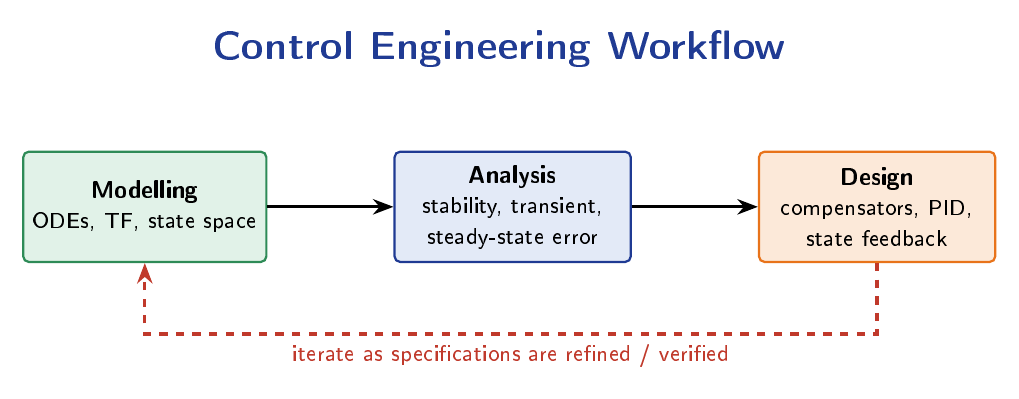
Physical laws give ODEs; the Laplace transform gives transfer functions; states give the state-space form.
Time: \(t_r,t_p,M_p,t_s\). Stability: Routh, root locus. Frequency: Bode, Nyquist.
PID tuning, lead/lag compensators and pole placement shape the response.
Control systems shape the system response through feedback to achieve stability, accuracy and speed.
References and Further Reading
Standard Textbooks
- K. Ogata, Modern Control Engineering, 5th ed., Pearson.
- N. S. Nise, Control Systems Engineering, 8th ed., Wiley.
- B. C. Kuo and F. Golnaraghi, Automatic Control Systems, 10th ed.
- I. J. Nagrath and M. Gopal, Control Systems Engineering, 6th ed., New Age.
- R. C. Dorf and R. H. Bishop, Modern Control Systems, 13th ed., Pearson.
Advanced and State-Space
- G. Franklin, J. Powell and A. Emami-Naeini, Feedback Control of Dynamic Systems.
- H. K. Khalil, Nonlinear Systems, 3rd ed.
- K. J. Åström and R. M. Murray, Feedback Systems.
For Competitive Exams (GATE / ESE / PSU)
- Made Easy, Control Systems (theory and practice sets).
- ACE Engineering Academy materials.
- Past 20 years' GATE and ESE question papers.