0-Mark Questions
QQuestion 1 0 Mark
Consider a power system consisting of \(N\) number of buses. Buses in this power system are categorized into slack bus, PV buses and PQ buses for load flow study. The number of PQ buses is \(N_L\). The balanced Newton-Raphson method is used to carry out load flow study in polar form. \(H\), \(S\), \(M_i\) and \(R\) are sub-matrices of the Jacobian matrix \(J\) as shown below:
The dimension of the sub-matrix \(M\) is
AOptions
- \(N_L \times (N-1)\)
- \((N-1) \times (N-1-N_L)\)
- \(N_L \times (N-1+N_L)\)
- \((N-1) \times (N-1+N_L)\)
SSolution
Given:
- Total number of buses: \(N\)
- Number of PQ buses: \(N_L\)
- Load flow using Newton-Raphson in polar form
- Find: Dimension of sub-matrix \(M\)
Solution:
Step 1: Understand bus classification
In load flow studies:
- Slack bus: 1 bus (voltage magnitude and angle are specified)
- PV buses: Generator buses where \(P\) and \(|V|\) are specified
- PQ buses: Load buses where \(P\) and \(Q\) are specified (count = \(N_L\))
Number of buses:
- Slack buses: 1
- PV buses: \(N - 1 - N_L\) (remaining buses after slack and PQ)
- PQ buses: \(N_L\)
Step 2: Variables in Newton-Raphson
Unknown variables:
- Voltage angles \(\delta\): All buses except slack = \((N-1)\) unknowns
- Voltage magnitudes \(|V|\): Only for PQ buses = \(N_L\) unknowns
Total unknowns: \((N-1) + N_L\)
Step 3: Equations in Newton-Raphson
Mismatch equations:
- Real power mismatches \(\Delta P\): All buses except slack = \((N-1)\) equations
- Reactive power mismatches \(\Delta Q\): Only for PQ buses = \(N_L\) equations
Total equations: \((N-1) + N_L\)
Step 4: Jacobian structure
Dimensions:
- \(H\): \(\frac{\partial P}{\partial \delta}\) → \((N-1) \times (N-1)\)
- \(S\): \(\frac{\partial P}{\partial V}\) → \((N-1) \times N_L\)
- \(M\): \(\frac{\partial Q}{\partial \delta}\) → \(N_L \times (N-1)\)
- \(R\): \(\frac{\partial Q}{\partial V}\) → \(N_L \times N_L\)
Step 5: Dimension of M
Sub-matrix \(M\) represents:
- Rows: Number of \(Q\) equations = \(N_L\) (PQ buses only)
- Columns: Number of \(\delta\) variables = \((N-1)\) (all buses except slack)
Therefore, dimension of \(M\) is: \(\boxed{N_L \times (N-1)}\)
Verification:
Check Jacobian dimensions:
- \(H\): \((N-1) \times (N-1)\) ✓
- \(S\): \((N-1) \times N_L\) ✓
- \(M\): \(N_L \times (N-1)\) ✓
- \(R\): \(N_L \times N_L\) ✓
Total rows: \((N-1) + N_L\) ✓\\ Total columns: \((N-1) + N_L\) ✓
Correct answer: A (\(N_L \times (N-1)\))
QQuestion 2 0 Mark
Two generators have cost functions \(F_1\) and \(F_2\). Their incremental-cost characteristics are
They need to deliver a combined load of 260 MW. Ignoring the network losses, for economic operation, the generations \(P_1\) and \(P_2\) (in MW) are
AOptions
- \(P_1 = P_2 = 130\)
- \(P_1 = 160, P_2 = 100\)
- \(P_1 = 140, P_2 = 120\)
- \(P_1 = 120, P_2 = 140\)
SSolution
Given:
- Generator 1 incremental cost: \(\frac{dF_1}{dP_1} = 40 + 0.2P_1\) (\$/MWh)
- Generator 2 incremental cost: \(\frac{dF_2}{dP_2} = 32 + 0.4P_2\) (\$/MWh)
- Total load demand: \(P_D = 260\) MW
- Network losses ignored
- Find: Optimal generation \(P_1\) and \(P_2\)
Solution:
Step 1: Economic dispatch criterion
For economic operation without transmission losses, the incremental costs of all generators must be equal at the optimal point:
where \(\lambda\) is the system incremental cost (Lagrange multiplier).
Step 2: Set up equations
Equation 1 (Equal incremental costs):
Multiply by 5:
Equation 2 (Power balance):
Step 3: Solve simultaneous equations
From equation (1):
Substitute into equation (2):
From equation (2):
Step 4: Verification
Check power balance:
Check equal incremental costs:
Both are equal ✓
Physical Interpretation:
- Generator 1 has the higher no-load incremental cost (40 vs 32) but the flatter slope (0.2 vs 0.4)
- Its incremental cost rises more slowly with output, so it takes the larger share at this load
- Generator 2 starts cheaper but its incremental cost climbs twice as fast
- Optimal dispatch: Generator 1 produces more (160 MW vs 100 MW)
- At optimum, both generators have same incremental cost (72 \$/MWh)
- Any deviation from this dispatch would increase total cost
Correct answer: B (\(P_1 = 160\) MW, \(P_2 = 100\) MW)
QQuestion 3 0 Mark
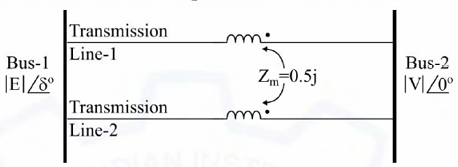
In the figure shown, self-impedances of the two transmission lines are 1.5j p.u each, and \(Z_m = 0.5j\) p.u is the mutual impedance. Bus voltages shown in the figure are in p.u. Given that \(\delta > 0\), the maximum steady-state real power that can be transferred in p.u from Bus-1 to Bus-2 is
AOptions
- \(|E||V|\)
- \(\frac{|E||V|}{2}\)
- \(2|E||V|\)
- \(\frac{3|E||V|}{2}\)
SSolution
Given:
- Bus-1 voltage: \(|E|\angle\delta\)
- Bus-2 voltage: \(|V|\angle 0°\)
- Self-impedance of each line: \(Z_s = 1.5j\) p.u.
- Mutual impedance: \(Z_m = 0.5j\) p.u.
- Two parallel transmission lines with mutual coupling
- Find: Maximum real power transfer
Solution:
Step 1: Model for mutually coupled lines
For two mutually coupled transmission lines, the voltage-current relationships are:
where \(I_1\) and \(I_2\) are currents in lines 1 and 2.
Step 2: Equivalent impedance
For two identical mutually coupled lines in parallel, the equivalent impedance is:
Or alternatively, consider the impedance matrix:
Since both equations give the same voltage drop, adding them: \(2(V_1 - V_2) = (Z_s + Z_m)(I_1 + I_2)\)
\(V_1 - V_2 = \frac{Z_s + Z_m}{2} \cdot I_{total}\)
where \(I_{total} = I_1 + I_2\)
\(Z_{eq} = \frac{Z_s + Z_m}{2} = \frac{1.5j + 0.5j}{2} = \frac{2j}{2} = j \text{ p.u.}\)
Step 3: Power transfer equation
For two buses connected through impedance \(Z_{eq} = jX_{eq}\):
\(P = \frac{|E||V|}{X_{eq}} \sin\delta\)
Maximum power occurs when \(\sin\delta = 1\) (i.e., \(\delta = 90°\)):
\(P_{max} = \frac{|E||V|}{X_{eq}} = \frac{|E||V|}{1} = |E||V| \text{ p.u.}\)
Check by symmetry of the two lines
The two lines are identical and are tied to the same pair of buses, so they must carry equal currents, \(I_1 = I_2 = \frac{I_{total}}{2}\). Substituting in either row of the impedance matrix:
\(V_1 - V_2 = Z_s I_1 + Z_m I_2 = (Z_s + Z_m)\frac{I_{total}}{2}\)
\(Z_{eq} = \frac{Z_s + Z_m}{2} = \frac{1.5j + 0.5j}{2} = j1 \text{ p.u.}\)
\(P_{max} = \frac{|E||V|}{X_{eq}} = \frac{|E||V|}{1} = |E||V|\)
Effect of the coupling:
Without mutual coupling the two \(1.5j\) lines in parallel would give \(X_{eq} = 0.75\) p.u. and \(P_{max} = 1.33|E||V|\). The positive mutual impedance raises \(X_{eq}\) to \(1\) p.u. and so lowers the transfer limit to \(|E||V|\).
Correct answer: A (\(|E||V|\))
QQuestion 4 0 Mark
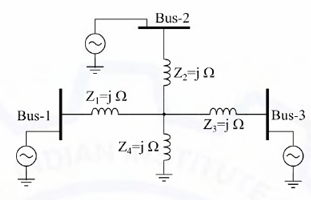
A 3-Bus network is shown. Consider generators as ideal voltage sources. If rows 1, 2 and 3 of the \(Y_{Bus}\) matrix correspond to Bus 1, 2 and 3, respectively, then \(Y_{Bus}\) of the network is
AOptions
- \(\begin{bmatrix} -4j & j & j \\ j & -4j & j \\ j & j & -4j \end{bmatrix}\)
- \(\begin{bmatrix} -4j & 2j & 2j \\ 2j & -4j & 2j \\ 2j & 2j & -4j \end{bmatrix}\)
- \(\begin{bmatrix} -\frac{3}{4}j & \frac{1}{4}j & \frac{1}{4}j \\ \frac{1}{4}j & -\frac{3}{4}j & \frac{1}{4}j \\ \frac{1}{4}j & \frac{1}{4}j & -\frac{3}{4}j \end{bmatrix}\)
- \(\begin{bmatrix} -\frac{1}{2}j & \frac{1}{4}j & \frac{1}{4}j \\ \frac{1}{4}j & -\frac{1}{2}j & \frac{1}{4}j \\ \frac{1}{4}j & \frac{1}{4}j & -\frac{1}{2}j \end{bmatrix}\)
SSolution
Given:
- Buses 1, 2 and 3 are each joined to one common internal node through \(Z_1 = Z_2 = Z_3 = j\ \Omega\)
- That internal node is earthed through \(Z_4 = j\ \Omega\)
- Generators are ideal voltage sources, so they add no shunt admittance
- Find: \(Y_{Bus}\) referred to buses 1, 2 and 3
Solution:
Step 1: Read the topology
The three buses are not connected to one another directly. Each reaches a common internal node (call it node 4) through \(j\ \Omega\), and node 4 is earthed through \(j\ \Omega\). Every branch admittance is
Step 2: Write the admittance matrix of the four-node network
Node 4 carries four branches, so \(Y_{44} = 4(-j) = -4j\); each connection between node \(i\) and node 4 gives \(Y_{i4} = -y = j\); buses 1, 2 and 3 have no branch between them, so their mutual terms are zero.
Step 3: Eliminate the internal node (Kron reduction)
Node 4 has no injection, so it is removed by
Every \(Y_{i4} = Y_{4k} = j\) and \(Y_{44} = -4j\), so the correction term is the same for all entries:
Diagonal entries:
Off-diagonal entries:
Step 4: Result
Check: each row sums to \(-\frac{3}{4}j + \frac{1}{4}j + \frac{1}{4}j = -\frac{1}{4}j\), which is non-zero exactly because the reduced network keeps a path to earth through \(Z_4\).
Correct answer: C
\(\begin{bmatrix} -\frac{3}{4}j & \frac{1}{4}j & \frac{1}{4}j \\ \frac{1}{4}j & -\frac{3}{4}j & \frac{1}{4}j \\ \frac{1}{4}j & \frac{1}{4}j & -\frac{3}{4}j \end{bmatrix}\)
QQuestion 5 0 Mark
Suppose \(I_A\), \(I_B\) and \(I_C\) are a set of unbalanced current phasors in a three-phase system. The phase-B zero-sequence current \(I_{B0} = 0.1\angle 0°\) p.u. If phase-A current \(I_A = 1.1\angle 0°\) p.u and phase-C current \(I_C = (1\angle 120° + 0.1)\) p.u., then \(I_B\) in p.u is
AOptions
- \(1\angle 240° - 0.1\angle 0°\)
- \(1.1\angle 240° - 0.1\angle 0°\)
- \(1.1\angle -120° + 0.1\angle 0°\)
- \(1\angle -120° + 0.1\angle 0°\)
SSolution
Given:
- Phase-A current: \(I_A = 1.1\angle 0°\) p.u.
- Phase-C current: \(I_C = (1\angle 120° + 0.1)\) p.u.
- Phase-B zero-sequence current: \(I_{B0} = 0.1\angle 0°\) p.u.
- Find: Phase-B current \(I_B\)
Solution:
Step 1: Symmetrical components review
For three-phase currents, the symmetrical components are:
\(\begin{bmatrix} I_{A0} \\ I_{A1} \\ I_{A2} \end{bmatrix} = \frac{1}{3} \begin{bmatrix} 1 & 1 & 1 \\ 1 & a & a^2 \\ 1 & a^2 & a \end{bmatrix} \begin{bmatrix} I_A \\ I_B \\ I_C \end{bmatrix}\)
where \(a = 1\angle 120° = e^{j2\pi/3}\) and \(a^2 = 1\angle 240° = 1\angle -120°\)
The zero-sequence component is: \(I_0 = \frac{1}{3}(I_A + I_B + I_C)\)
For all phases, the zero-sequence current is the same: \(I_{A0} = I_{B0} = I_{C0} = I_0 = 0.1\angle 0°\)
Step 2: Use zero-sequence relationship
\(I_0 = \frac{1}{3}(I_A + I_B + I_C)\)
\(0.1 = \frac{1}{3}(I_A + I_B + I_C)\)
\(I_A + I_B + I_C = 0.3\angle 0°\)
Step 3: Calculate \(I_B\)
\(I_B = 0.3 - I_A - I_C\)
Substitute given values: \(I_B = 0.3 - 1.1\angle 0° - (1\angle 120° + 0.1)\)
\(I_B = 0.3 - 1.1 - 1\angle 120° - 0.1\)
\(I_B = -0.9 - 1\angle 120°\)
\(I_B = -1\angle 120° - 0.9\)
Now, \(-1\angle 120° = 1\angle(120° + 180°) = 1\angle 300° = 1\angle -60°\)
\(1\angle 120° = -0.5 + j0.866\)
\(I_C = 1\angle 120° + 0.1 = (-0.5 + j0.866) + 0.1 = -0.4 + j0.866\)
\(I_A = 1.1\)
\(I_A + I_C = 1.1 + (-0.4 + j0.866) = 0.7 + j0.866\)
\(I_B = 0.3 - (0.7 + j0.866) = -0.4 - j0.866\)
Step 4: Write \(I_B\) in the form used by the options
Use the identity \(1 + 1\angle 120° + 1\angle -120° = 0\), that is \(-1\angle 120° = 1 + 1\angle -120°\). Substituting in \(I_B = -0.9 - 1\angle 120°\):
Step 5: Numerical check against the options
\(1\angle -120° + 0.1 = (-0.5 - j0.866) + 0.1 = -0.4 - j0.866\), which is exactly the rectangular value obtained in Step 3, with \(|I_B| = \sqrt{0.4^2 + 0.866^2} = 0.954\) p.u.
The other options evaluate to \(-0.6 - j0.866\) (A), \(-0.65 - j0.953\) (B) and \(-0.45 - j0.953\) (C); none of them matches.
Correct answer: D (\(1\angle -120° + 0.1\angle 0°\))
QQuestion 6 0 Mark
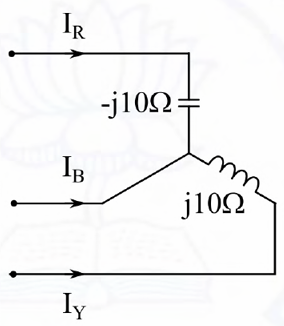
A three-phase balanced voltage is applied to the load shown. The phase sequence is RYB. The ratio \(\frac{|I_B|}{|I_R|}\) is \_\_\_\_\_\_\_.
AOptions
- \(\frac{1}{\sqrt{2}}\)
- \(1\)
- \(\sqrt{2}\)
- \(2\)
SSolution
Given:
- Three-phase balanced supply, phase sequence RYB, three-wire connection (no neutral)
- From the figure the three lines meet at a common star point through
- line R: capacitor \(Z_R = -j10~\Omega\)
- line B: a plain conductor, \(Z_B = 0\)
- line Y: inductor \(Z_Y = j10~\Omega\)
- Find: \(\frac{|I_B|}{|I_R|}\)
Solution:
Step 1: Locate the star point
Line B reaches the star point through zero impedance, so the star point sits at the potential of line B. Each branch therefore has a line voltage referred to B across it:
Step 2: Line voltages
With \(V_R = V\angle 0°\), \(V_Y = V\angle -120°\), \(V_B = V\angle 120°\) for the RYB sequence:
Step 3: Branch currents
Step 4: Current in line B
KCL at the star point gives
Step 5: Ratio
Correct answer: B (1)