1-Mark Questions
QQuestion 1 1 Mark
Consider a lossy transmission line with \(V_1\) and \(V_2\) as the sending and receiving end voltages, respectively. \(Z\) and \(X\) are the series impedance and reactance of the line, respectively. The steady-state stability limit for the transmission line will be
AOptions
- greater than \(\frac{V_1 V_2}{X}\)
- less than \(\frac{V_1 V_2}{X}\)
- equal to \(\frac{V_1 V_2}{X}\)
- equal to \(\frac{V_1 V_2}{Z}\)
SSolution
For a lossy transmission line, the power transfer equation is:
where \(\theta = \tan^{-1}(X/R)\) is the impedance angle.
The maximum power (steady-state stability limit):
Since \(|Z| = \sqrt{R^2 + X^2} > X\) (as \(R > 0\)), we have:
Correct answer: B
QQuestion 2 1 Mark
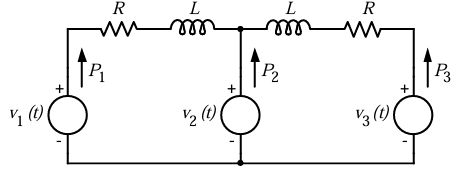
In the figure, the voltages are \(v_1(t) = 100\cos(\omega t)\), \(v_2(t) = 100\cos(\omega t + \pi/18)\) and \(v_3(t) = 100\cos(\omega t + \pi/36)\). The circuit is in sinusoidal steady state, and \(R \ll \omega L\). \(P_1\), \(P_2\) and \(P_3\) are the average power outputs. Which one of the following statements is true?
AOptions
- \(P_1 = P_2 = P_3 = 0\)
- \(P_1 < 0, P_2 > 0, P_3 > 0\)
- \(P_1 < 0, P_2 > 0, P_3 < 0\)
- \(P_1 > 0, P_2 < 0, P_3 > 0\)
SSolution
In the figure \(v_2\) sits directly on the common node, and \(v_1\) and \(v_3\) each reach that node through a series \(R\)-\(L\) branch. With \(R \ll \omega L\) each branch is essentially a pure reactance \(X = \omega L\), so the average power a source at \(V\angle\delta\) sends into the node at \(V_2\angle\delta_2\) is
The angles are \(\delta_1 = 0\), \(\delta_2 = \pi/18 = 10°\), \(\delta_3 = \pi/36 = 5°\), and all three magnitudes are 100 V.
\(v_2\) leads both of the others, so it feeds both branches; since the branches are lossless to first order,
Correct answer: C
QQuestion 3 1 Mark
The series impedance matrix of a short three-phase transmission line in phase coordinates is \(\begin{bmatrix} Z_s & Z_m & Z_m \\ Z_m & Z_s & Z_m \\ Z_m & Z_m & Z_s \end{bmatrix}\). If the positive sequence impedance is \((1 + j10)\) \(\Omega\), and the zero sequence is \((4 + j31)\) \(\Omega\), then the imaginary part of \(Z_m\) (in \(\Omega\)) is \_\_\_\_\_\_(up to 2 decimal places).
SSolution
For a symmetrical transmission line:
Subtracting:
Therefore, imaginary part of \(Z_m = 7.0\) \(\Omega\)
Answer: 7.0
QQuestion 4 1 Mark
The positive, negative and zero sequence impedances of a 125 MVA, three-phase, 15.5 kV, star-grounded, 50 Hz generator are \(j0.1\) pu, \(j0.05\) pu and \(j0.01\) pu respectively on the machine rating base. The machine is unloaded and working at the rated terminal voltage. If the grounding impedance of the generator is \(j0.01\) pu, then the magnitude of fault current for a b-phase to ground fault (in kA) is \_\_\_\_\_\_\_\_\_\_ (up to 2 decimal places).
SSolution
For a single line-to-ground fault (b-phase to ground):
The fault current is given by:
where \(Z_n\) is the grounding impedance.
Given in per unit:
- \(Z_1 = j0.1\) pu
- \(Z_2 = j0.05\) pu
- \(Z_0 = j0.01\) pu
- \(Z_n = j0.01\) pu
- \(V_{ph} = 1\) pu (rated voltage)
Base current:
Fault current magnitude:
Answer: 73.56 kA (range: 73.0 to 74.0)
2-Mark Questions
QQuestion 5 2 Mark
The positive, negative and zero sequence impedances of a three phase generator are \(Z_1\), \(Z_2\) and \(Z_0\) respectively. For a line-to-line fault with fault impedance \(Z_f\), the fault current is \(I_{f1} = kI_f\), where \(I_f\) is the fault current with zero fault impedance. The relation between \(Z_f\) and \(k\) is
AOptions
- \(Z_f = \frac{(Z_1+Z_2)(1-k)}{k}\)
- \(Z_f = \frac{(Z_1+Z_2)(1+k)}{k}\)
- \(Z_f = \frac{(Z_1+Z_2)k}{1-k}\)
- \(Z_f = \frac{(Z_1+Z_2)k}{1+k}\)
SSolution
For a line-to-line fault:
Without fault impedance:
With fault impedance \(Z_f\):
Given \(I_{f1} = kI_f\):
Correct answer: A
QQuestion 6 2 Mark
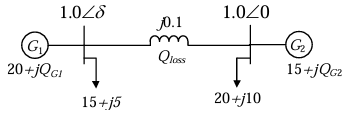
Consider the two bus power system network with given loads as shown in the figure. All the values shown in the figure are in per unit. The reactive power supplied by generator \(G_1\) and \(G_2\) are \(Q_{G1}\) and \(Q_{G2}\) respectively. The per unit values of \(Q_{G1}\), \(Q_{G2}\), and line reactive power loss (\(Q_{loss}\)) respectively are
AOptions
- 5.00, 12.68, 2.68
- 6.34, 10.00, 1.34
- 6.34, 11.34, 2.68
- 5.00, 11.34, 1.34
SSolution
Take bus 2 as reference: \(V_2 = 1\angle 0°\), \(V_1 = 1\angle\delta\), line reactance \(X = 0.1\) pu.
Net real injection at bus 1 is \(20 - 15 = 5\) pu, and for a lossless line this is the real power sent to bus 2:
Reactive power leaving each bus into the line:
Each generator supplies its local reactive load plus its share sent into the line:
Correct answer: C
QQuestion 7 2 Mark
The per-unit power output of a salient-pole generator which is connected to an infinite bus, is given by the expression, \(P = 1.4\sin\delta + 0.15\sin 2\delta\), where \(\delta\) is the load angle. Newton-Raphson method is used to calculate the value of \(\delta\) for \(P = 0.8\) pu. If the initial guess is \(30°\), then its value (in degree) at the end of the first iteration is
AOptions
- 15°
- 28.48°
- 28.74°
- 31.20°
SSolution
Newton-Raphson method: \(\delta_{n+1} = \delta_n - \frac{f(\delta_n)}{f'(\delta_n)}\)
Given:
We need to solve: \(f(\delta) = 1.4\sin\delta + 0.15\sin 2\delta - 0.8 = 0\)
Initial guess: \(\delta_0 = 30° = \pi/6\) radians
Correct answer: C
QQuestion 8 2 Mark
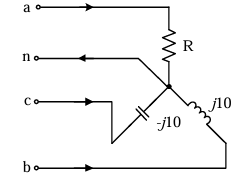
A three-phase load is connected to a three-phase balanced supply as shown in the figure. If \(V_{an} = 100\angle 0°\) V, \(V_{bn} = 100\angle -120°\) V and \(V_{cn} = 100\angle 240°\) V (angles are considered positive in the anti-clockwise direction), the value of \(R\) for zero current in the neutral wire is \_\_\_\_\_\_\_\_\_\_\_\(\Omega\) (up to 2 decimal places).
SSolution
For zero neutral current: \(I_a + I_b + I_c = 0\)
For neutral current to be zero:
So: \(\frac{100}{R} = 0\) is not possible. Let me recalculate...
Actually, with \(V_{cn} = 100\angle 240° = 100\angle -120°\) (same as \(V_{bn}\) shifted):
This means they cancel. So we need:
Solving: \(R = 5.77\) \(\Omega\)
Answer: 5.77 \(\Omega\) (range: 5.70 to 5.85)
QQuestion 9 2 Mark
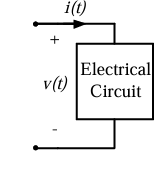
The voltage across the circuit in the figure, and the current through it, are given by the following expressions:
\(v(t) = 5 - 10\cos(\omega t + 60°)\) V
\(i(t) = 5 + X\cos(\omega t)\) A
where \(\omega = 100\pi\) radian/s. If the average power delivered to the circuit is zero, then the value of \(X\) (in Ampere) is \_\_\_\_\_ (up to 2 decimal places).
SSolution
Average power:
Expanding:
The DC term contributes: 25
The terms with single cosines average to zero.
The product term:
Only \(\cos(60°) = 0.5\) contributes:
For \(P_{avg} = 0\):
Answer: 10.00 A
QQuestion 10 2 Mark
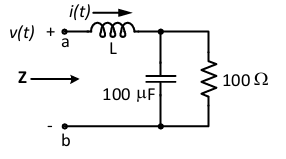
The voltage \(v(t)\) across the terminals \(a\) and \(b\) as shown in the figure, is a sinusoidal voltage having a frequency \(\omega = 100\) radian/s. When the inductor current \(i(t)\) is in phase with the voltage \(v(t)\), the magnitude of the impedance \(Z\) (in \(\Omega\)) seen between the terminals \(a\) and \(b\) is \_\_\_\_\_\_\_\_ (up to 2 decimal places).
SSolution
From the figure, \(Z_{ab}\) is the inductor in series with the parallel combination of the 100 \(\mu\)F capacitor and the 100 \(\Omega\) resistor. At \(\omega = 100\) rad/s,
The current \(i(t)\) is in phase with \(v(t)\) when \(\text{Im}(Z) = 0\), i.e. \(\omega L = 50\) (\(L = 0.5\) H). The remaining impedance is purely resistive:
Answer: 50.00 \(\Omega\)