1-Mark Questions
QQuestion 1 1 Mark
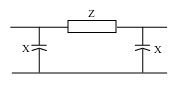
The per-unit impedance of a transmission line on its own base is 0.2 pu. What will be the per-unit impedance on a base that is twice the original voltage base and four times the original MVA base? \begin{figure}[H] \centering
\end{figure}
AOptions
- 0.05 pu
- 0.1 pu
- 0.2 pu
- 0.8 pu
SSolution
\(Z_{pu,new} = Z_{pu,old} \times \frac{MVA_{new}}{MVA_{old}} \times \frac{V_{old}^2}{V_{new}^2}\) \(Z_{pu,new} = 0.2 \times \frac{4MVA}{MVA} \times \frac{V^2}{(2V)^2} = 0.2 \times 4 \times \frac{1}{4} = 0.2\) pu Correct answer: C.
QQuestion 2 1 Mark
The power transfer capability of a transmission line is limited by:
AOptions
- Thermal limits
- Voltage stability limits
- Transient stability limits
- All of the above
SSolution
Power transfer capability is limited by: 1. Thermal limits (conductor heating) 2. Voltage stability limits (voltage collapse) 3. Transient stability limits (loss of synchronism) All three factors must be considered for safe operation. Correct answer: D.
QQuestion 3 1 Mark
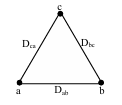
The protection scheme commonly used for transmission lines is: \begin{figure}[H] \centering
\end{figure}
AOptions
- Overcurrent protection
- Distance protection
- Differential protection
- Pilot protection
SSolution
Distance protection is the most commonly used protection scheme for transmission lines. It measures impedance from relay location to fault point and operates when impedance falls within set zones. Correct answer: B.
2-Mark Questions
QQuestion 4 2 Mark
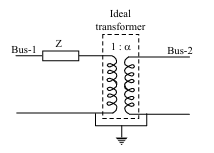
A transmission line has a surge impedance of 400Ω and surge impedance loading of 250MW. What is the line voltage?
\begin{figure}[H] \centering
\end{figure}
AOptions
- 316 kV
- 400 kV
- 500 kV
- 632 kV
SSolution
Surge Impedance Loading: \(SIL = \frac{V^2}{Z_c}\) \(250 \times 10^6 = \frac{V^2}{400}\) \(V^2 = 250 \times 10^6 \times 400 = 100 \times 10^9\) \(V = \sqrt{100 \times 10^9} = 316,227V \approx 316kV\) Correct answer: A.
QQuestion 5 2 Mark
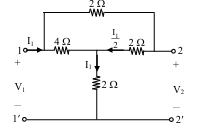
In a power system, the fault current for a line-to-ground fault is: \begin{figure}[H] \centering
\end{figure}
AOptions
- \(\frac{3V_f}{Z_1 + Z_2 + Z_0}\)
- \(\frac{V_f}{Z_1 + Z_2 + Z_0}\)
- \(\frac{\sqrt{3}V_f}{Z_1 + Z_2 + Z_0}\)
- \(\frac{3V_f}{Z_1 + Z_2}\)
SSolution
For a single line-to-ground fault, all three sequence networks are connected in series. Fault current: \(I_f = \frac{3V_f}{Z_1 + Z_2 + Z_0}\) where \(V_f\) is the prefault voltage, \(Z_1\), \(Z_2\), \(Z_0\) are positive, negative, and zero sequence impedances. Correct answer: A.
QQuestion 6 2 Mark
A load bus in a power system has a voltage magnitude of 0.95 pu and the voltage phase angle is -5°. If the base voltage is 132 kV, what is the actual voltage?
AOptions
- 125.4 kV ∠-5°
- 132 kV ∠-5°
- 138.6 kV ∠-5°
- 139.0 kV ∠-5°
SSolution
Actual voltage = per-unit voltage × base voltage \(V_{actual} = 0.95 × 132kV = 125.4kV\) Phase angle remains the same: -5° Therefore: \(V_{actual} = 125.4kV ∠-5°\) Correct answer: A.
QQuestion 7 2 Mark
In a power system, reactive power compensation is primarily used for:
AOptions
- Reducing transmission losses
- Voltage regulation
- Power factor improvement
- All of the above
SSolution
Reactive power compensation serves three purposes at once:
- Voltage regulation: injecting VArs at the load end holds the bus voltage close to its nominal value.
- Power factor improvement: supplying the reactive demand locally raises the pf seen by the source.
- Reduction of transmission losses: the reduced current magnitude lowers the \(I^2R\) loss in the line.
All three listed effects therefore apply. Correct answer: D.