1-Mark Questions
QQuestion 1 1 Mark
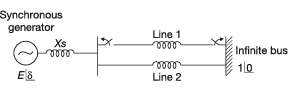
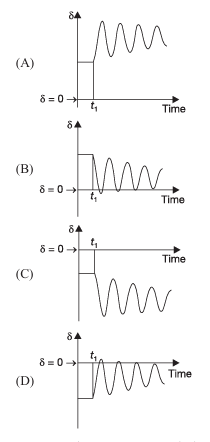
Q46 (Set-1): Synchronous generator supplying infinite bus via two parallel lines, one trips at \(t_1\). Which waveform shows rotor angle \(\delta\) transient correctly?
SSolution
Transient analysis:
Before trip: System stable at operating angle \(\delta_0\)
At \(t_1\): One line trips
- System reactance increases
- Power transfer capability reduces
- If \(P_m >\) new \(P_{max}\sin\delta_0\), rotor accelerates
- \(\delta\) increases
Stable transient characteristics:
- \(\delta\) increases beyond initial value
- Oscillates around new equilibrium
- Eventually settles (with damping)
- Maximum swing < critical angle
Before the trip the machine delivers power to the bus, so \(\delta_0 > 0\). Removing Line 1 raises the transfer reactance and lowers \(P_{max}\); with \(P_m\) unchanged the new equilibrium satisfies \(\sin\delta_{new} > \sin\delta_0\). The rotor angle therefore rises from a positive \(\delta_0\) to a larger positive value and swings about it with decaying amplitude.
Only waveform (A) shows this. (B) has \(\delta\) falling after \(t_1\), and (C) and (D) start from a negative \(\delta_0\).
Answer: A
QQuestion 2 1 Mark
Q47 (Set-1): 3-bus system with bus admittance matrix. If shunt capacitance of all lines 50% compensated, imaginary part of \(Y_{33}\) (in pu) after compensation is
AOptions
- -j7.0
- -j8.5
- -j7.5
- -j9.0
SSolution
Bus admittance element:
Original \(Y_{33} = -j8\) pu
This equals: \(Y_{33} = Y_{30} + Y_{31} + Y_{32}\)
Where \(Y_{30}\) is shunt admittance at bus 3.
From matrix:
This represents shunt capacitive susceptance.
After 50% compensation:
Compensation reduces shunt capacitance by 50%:
\textbf{New \(Y_{33}\):}
Answer: B
QQuestion 3 1 Mark
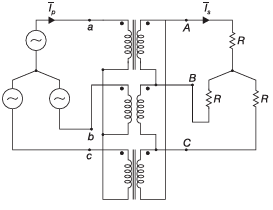
Q53 (Set-1): Star-Delta transformer, 230 V (line) star side, 115 V delta side. If \(I_s = 100\angle 0°\) A, value of \(I_p\) (in A) is
\subsection*{Set-2 Questions}
AOptions
- \(50\angle 30°\)
- \(50\angle -30°\)
- \(50\sqrt{3}\angle 30°\)
- \(200\angle 30°\)
SSolution
Power balance:
Phase relationship:
Star-Delta transformation introduces 30° phase shift.
Line current on star side leads corresponding line current on delta side by 30°.
Answer: A
QQuestion 4 1 Mark
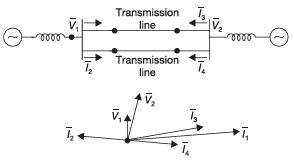
Q54 (Set-2): Sustained three-phase fault in power system. Current and voltage phasors shown. Where is fault located?
SSolution
Fault location analysis:
In the phasor diagram \(\bar{I}_2\) and \(\bar{I}_4\) are equal in magnitude and 180° apart. The lower circuit therefore carries only through-current — whatever enters one end leaves the other — so it is healthy and carries no fault infeed.
\(\bar{I}_1\) and \(\bar{I}_3\) both lag the bus voltages by roughly 90° and both feed into the upper circuit from opposite ends, so the fault lies on that line, between the two measuring points. \(|\bar{I}_1| > |\bar{I}_3|\), consistent with the stronger source seeing the shorter path to the fault.
Answer: B (Location Q)
2-Mark Questions
QQuestion 5 2 Mark
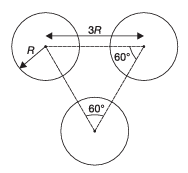
Q51 (Set-1): Composite conductor with 3 conductors of radius R in symmetrical spacing. GMR of composite (in cm) is \(kR\). Value of \(k\) is
SSolution
GMR of composite conductor:
For symmetrical spacing:
For each conductor:
From the figure the three conductors sit at the corners of an equilateral triangle with centre-to-centre spacing \(d = 3R\).
The GMR of the composite is the 9th root of the nine distances from each strand to every strand:
With \(r' = 0.7788R\) and \(d = 3R\):
Answer: 1.85-1.95
QQuestion 6 2 Mark
Q51 (Set-2): Economic dispatch: \(C_1(P_1) = 0.01P_1^2 + 30P_1 + 10\) (100-150 MW); \(C_2(P_2) = 0.05P_2^2 + 10P_2 + 10\) (100-180 MW). For 200 MW load, incremental cost (in ₹/MWh) is
SSolution
Incremental costs:
Equal incremental cost:
With \(P_1 + P_2 = 200\):
This violates minimum constraint.
At limits: \(P_1 = 100\) MW (minimum)
Incremental cost:
Answer: 20 ₹/MWh
QQuestion 7 2 Mark
Q53 (Set-2): 50 Hz generating unit, \(H = 2\) MJ/MVA. Initially \(\delta_0 = 5°\), \(P_m = 1\) pu. Three-phase fault at terminals. Value of \(\delta\) (in degrees) 0.02 s after fault is
SSolution
Swing equation:
During fault: \(P_e = 0\)
Integration:
At \(t = 0\): \(\frac{d\delta}{dt} = 0\) (initially steady)
At \(t = 0\): \(\delta = 5° = 0.0873\) rad
At \(t = 0.02\) s:
Answer: 5.90°
QQuestion 8 2 Mark
Q56 (Set-2): Two-port network: 10 V at Port 1 gives 4 A through short-circuited Port 2. 5 V at Port 1 gives 1.25 A through 1 \(\Omega\) at Port 2. For 3 V at Port 1 with 2 \(\Omega\) at Port 2, current (in A) is
SSolution
Let \(I\) be the current the network delivers into the load at port 2, and write the linear relation
First test: \(V_1 = 10\) V, port 2 shorted so \(V_2 = 0\), \(I = 4\) A:
Second test: \(V_1 = 5\) V, \(R_L = 1\ \Omega\), \(I = 1.25\) A, so \(V_2 = 1.25\) V:
Third test: \(V_1 = 3\) V, \(R_L = 2\ \Omega\), so \(V_2 = 2I\):
Answer: 0.5454 A