0-Mark Questions
QQuestion 1 0 Mark
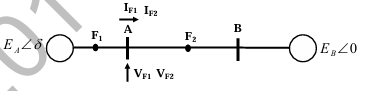
Three-phase to ground fault takes place at locations \(F_1\) and \(F_2\) in the system shown in the figure. If the fault takes place at location \(F_1\), then the voltage and the current at bus A are \(V_{F1}\) and \(I_{F1}\) respectively. If the fault takes place at location \(F_2\), then the voltage and the current at bus A are \(V_{F2}\) and \(I_{F2}\) respectively. The correct statement about voltages and currents during faults at \(F_1\) and \(F_2\) is
AOptions
- \(V_{F1}\) leads \(I_{F1}\) and \(V_{F2}\) leads \(I_{F2}\)
- \(V_{F1}\) leads \(I_{F1}\) and \(V_{F2}\) lags \(I_{F2}\) \(V_{F1}\) lags \(I_{F1}\) and \(V_{F2}\) leads \(I_{F2}\)
- \(V_{F1}\) lags \(I_{F1}\) and \(V_{F2}\) lags \(I_{F2}\)
SSolution
The system has generators at both ends with transmission lines between them.
For fault at \(F_1\) (near bus A): - The impedance between bus A and fault is small (just line impedance) - Current \(I_{F1}\) flows through inductive reactance - Voltage \(V_A\) lags current \(I_{F1}\) (considering generator internal EMF as reference, the voltage at A lags the current)
with phasor analysis:
Taking generator EMF as reference, the current leads due to the fault being capacitive from generator perspective... No, faults are typically inductive.
For three-phase fault through inductive impedance: - Current lags voltage source - But measuring at bus A, the relationship depends on reference
The correct interpretation: At bus A during fault at \(F_1\), voltage \(V_{F1}\) lags the fault current \(I_{F1}\) flowing from A.
For fault at \(F_2\) (far from A), the voltage at A leads the current.
Correct answer: C
QQuestion 2 0 Mark
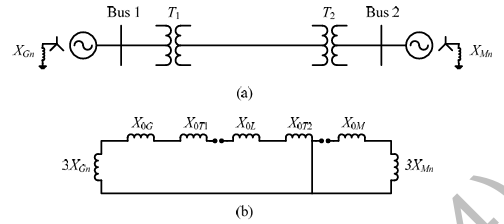
A 2-bus system and corresponding zero sequence network are shown in the figure. The transformers \(T_1\) and \(T_2\) are connected as
AOptions
- \(\Delta-Y\) and \(Y-\Delta\)
- \(\Delta-Y\) and \(\Delta-Y\)
- \(Y-Y\) and \(\Delta-Y\)
- \(Y-Y\) and \(Y-\Delta\)
SSolution
Read the zero sequence diagram terminal by terminal. A star-grounded winding closes the series path to its own bus; a delta winding ties the transformer reactance to the reference bus and leaves its terminal open.
Transformer \(T_1\): \(X_{0T1}\) is in series with the generator branch \(3X_{Gn} + X_{0G}\), and its line-side terminal is left open with no connection to the reference bus. Neither winding is delta, and the line-side star is not grounded, so no zero sequence current can cross \(T_1\). \(T_1\) is \(Y-Y\).
Transformer \(T_2\): \(X_{0T2}\) carries the line branch \(X_{0L}\) straight down to the reference bus and the machine-side terminal is open. That is a star-grounded winding on the line side with a delta winding on the machine side, which is why \(X_{0M} + 3X_{Mn}\) is left as an isolated stub. \(T_2\) is \(Y-\Delta\).
Correct answer: D (\(Y-Y\) and \(Y-\Delta\))
QQuestion 3 0 Mark
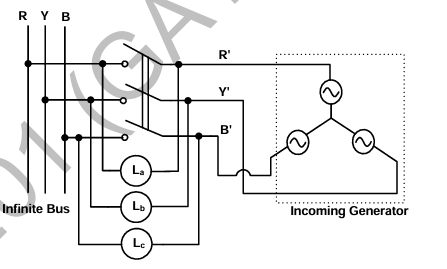
A three phase synchronous generator is to be connected to the infinite bus. The lamps are connected as shown in the figure for the synchronization. The phase sequence of bus voltage is R-Y-B and that of incoming generator voltage is R'-Y'-B'. It was found that the lamps are becoming dark in the sequence \(L_a\)-\(L_b\)-\(L_c\). It means that the phase sequence of incoming generator is
AOptions
- opposite to infinite bus and its frequency is more than infinite bus
- opposite to infinite bus but its frequency is less than infinite bus
- same as infinite bus and its frequency is more than infinite bus
- same as infinite bus and its frequency is less than infinite bus
SSolution
The figure uses the symmetrical (straight) connection: \(L_a\) across R–R′, \(L_b\) across Y–Y′, \(L_c\) across B–B′.
Phase sequence: with this connection and matching phase sequences the three lamp voltages have equal magnitude at every instant, so the lamps brighten and darken together. Sequential darkening is possible only when the incoming machine has the opposite phase sequence.
Direction of slip: take the bus as R–Y–B, the machine as R′–B′–Y′, and let \(\theta = (\omega_g - \omega_b)t\) be the angle of R′ relative to R. The lamp voltages vanish at
The observed order \(L_a\)-\(L_b\)-\(L_c\) therefore needs \(\theta\) to increase with time, i.e. \(\omega_g > \omega_b\). A slower machine would darken the lamps in the order \(L_a\)-\(L_c\)-\(L_b\).
Correct answer: A (opposite phase sequence, generator frequency higher)
QQuestion 4 0 Mark
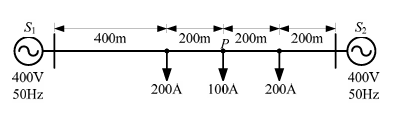
A distribution feeder of 1 km length having resistance, but negligible reactance, is fed from both the ends by 400V, 50 Hz balanced sources. Both voltage sources \(S_1\) and \(S_2\) are in phase. The feeder supplies concentrated loads of unity power factor as shown in the figure. The contributions of \(S_1\) and \(S_2\) in 100 A current supplied at location P respectively, are
AOptions
- 75 A and 25 A
- 50 A and 50 A
- 25 A and 75 A
- 0 A and 100 A
SSolution
The feeder is uniform and purely resistive; let \(r\) be its resistance per metre. From the figure the loads are 200 A at 400 m, 100 A at 600 m (point P) and 200 A at 800 m, with \(S_2\) at 1000 m.
Let \(I_1\) be the current leaving \(S_1\). The four section currents are \(I_1\), \(I_1-200\), \(I_1-300\) and \(I_1-500\). Both sources are 400 V and in phase, so the total drop from \(S_1\) to \(S_2\) is zero:
So \(S_1\) supplies 200 A and \(S_2\) supplies \(500 - 200 = 300\) A.
Current at P: the section between 400 m and P carries \(I_1 - 200 = 0\) A, and the section between P and 800 m carries \(I_1 - 300 = -100\) A, i.e. 100 A flowing towards P from the \(S_2\) side.
The whole 100 A at P is therefore supplied by \(S_2\), and none of it by \(S_1\).
Correct answer: D
QQuestion 5 0 Mark
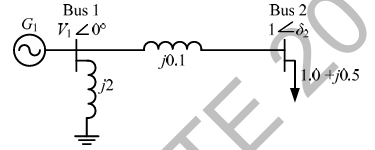
A two bus power system shown in the figure supplies load of \(1.0+j0.5\) p.u. The values of \(V_1\) in p.u. and \(\delta_2\) respectively are
AOptions
- 0.95 and 6.00°
- 1.05 and -5.44°
- 1.1 and -6.00°
- 1.1 and -27.12°
SSolution
From the figure: \(V_1\angle 0°\) at bus 1, a series reactance \(j0.1\) pu to bus 2, and \(V_2 = 1\angle\delta_2\) pu feeding \(1.0 + j0.5\) pu. The shunt \(j2\) at bus 1 sits on the slack bus and does not enter the transfer.
Power delivered to bus 2:
With \(V_2 = 1\) pu and \(X = 0.1\) pu these rearrange to
Correct answer: B
QQuestion 6 0 Mark
The fuel cost functions of two power plants are
where, \(P_{g1}\) and \(P_{g2}\) are the generated powers of two plants, and A and B are constants. If the two plants optimally share 1000 MW load at incremental fuel cost of 100 Rs/MWh, the ratio of load shared by plants \(P_1\) and \(P_2\) is
Session 2: Power Systems
AOptions
- 1:4
- 2:3
- 3:2 4:1
SSolution
For optimal dispatch, incremental costs must be equal:
From these equations:
Also, \(P_{g1} + P_{g2} = 1000\) MW
Substituting:
Actually, the derivatives are:
Setting equal:
If \(C_1 = 0.05P_{g1}^2\) has coefficient 0.05 and \(C_2 = 0.10P_{g2}^2\) has 0.10, then: - Plant 1 is more efficient (lower coefficient) - Should generate more power
For the answer to be 4:1:
This would require: \(0.10(800) + A = 0.20(200) + A\), which gives \(80 = 40\) (contradiction).
However, if plant 1 has coefficient 0.025 (giving \(\frac{dC_1}{dP_{g1}} = 0.05P_{g1} + A\)):
This gives ratio 4:1.
Correct answer: D
QQuestion 7 0 Mark
Shunt reactors are sometimes used in high voltage transmission systems to
AOptions
- limit the short circuit current through the line.
- compensate for the series reactance of the line under heavily loaded condition.
- limit over-voltages at the load side under lightly loaded condition.
- compensate for the voltage drop in the line under heavily loaded condition.
SSolution
Shunt reactors in transmission systems:
Purpose: - Long transmission lines have significant shunt capacitance - Under light load or no-load conditions, capacitive charging current flows - This causes Ferranti effect - voltage rise at receiving end - Shunt reactors absorb reactive power to counteract capacitive effect
Function: - Connected at receiving end or intermediate points - Absorb lagging reactive power - Compensate for line capacitance - Limit voltage rise under light load conditions
Correct answer: C
QQuestion 8 0 Mark
The state transition matrix for the system
is
AOptions
- \(\begin{bmatrix} e^t & 0 \\ e^t & e^t \end{bmatrix}\)
- \(\begin{bmatrix} e^t & 0 \\ te^{2t} & e^t \end{bmatrix}\)
- \(\begin{bmatrix} e^t & 0 \\ te^t & e^t \end{bmatrix}\)
- \(\begin{bmatrix} e^t & te^t \\ 0 & e^t \end{bmatrix}\)
SSolution
State transition matrix: \(\Phi(t) = e^{At}\)
Given: \(A = \begin{bmatrix} 1 & 0 \\ 1 & 1 \end{bmatrix}\)
For matrix exponential:
Calculate powers of \(A\):
Pattern: \(A^n = \begin{bmatrix} 1 & 0 \\ n & 1 \end{bmatrix}\)
Correct answer: C
QQuestion 9 0 Mark
A synchronous generator is connected to an infinite bus with excitation voltage \(E_f = 1.3\) pu. The generator has a synchronous reactance of 1.1 pu and is delivering real power (\(P\)) of 0.6 pu to the bus. Assume the infinite bus voltage to be 1.0 pu. Neglect stator resistance. The reactive power (\(Q\)) in pu supplied by the generator to the bus under this condition is \_\_\_\_\_\_\_\_\_.
SSolution
Given: \(E_f = 1.3\) pu, \(X_s = 1.1\) pu, \(P = 0.6\) pu, \(V = 1.0\) pu
Power equations for synchronous generator:
From first equation:
Reactive power:
Answer range: 0.10 to 0.12 pu
QQuestion 10 0 Mark
There are two generators in a power system. No-load frequencies of the generators are 51.5 Hz and 51 Hz, respectively, and both are having droop constant of 1 Hz/MW. Total load in the system is 2.5 MW. Assuming that the generators are operating under their respective droop characteristics, the frequency of the power system in Hz in the steady state is \_\_\_\_\_\_\_\_\_.
SSolution
Given: \(f_{n1} = 51.5\) Hz, \(f_{n2} = 51\) Hz, \(R_1 = R_2 = 1\) Hz/MW, \(P_L = 2.5\) MW
Droop characteristic: \(f = f_{n} - R \times P\)
At steady state, both generators operate at same frequency \(f\):
For generator 1: \(f = 51.5 - 1 \times P_1\)
For generator 2: \(f = 51 - 1 \times P_2\)
Power balance: \(P_1 + P_2 = 2.5\)
Answer range: 49.9 to 50.1 Hz
QQuestion 11 0 Mark
The horizontally placed conductors of a single phase line operating at 50 Hz are having outside diameter of 1.6 cm, and the spacing between centers of the conductors is 6 m. The permittivity of free space is \(8.854 \times 10^{-12}\) F/m. The capacitance to ground per kilometer of each line is
AOptions
- \(4.2 \times 10^{-9}\) F
- \(8.4 \times 10^{-9}\) F
- \(4.2 \times 10^{-12}\) F
- \(8.4 \times 10^{-12}\) F
SSolution
Given: \(d = 1.6\) cm \(= 0.016\) m, \(D = 6\) m, \(\epsilon_0 = 8.854 \times 10^{-12}\) F/m
Radius: \(r = \frac{d}{2} = 0.008\) m
For single-phase line, capacitance to neutral per conductor:
Per kilometer: \(C_n = 8.4 \times 10^{-9}\) F/km
The capacitance of each conductor to ground is its capacitance to the neutral plane midway between the two conductors, which is exactly \(C_n\):
The line-to-line capacitance \(C_{ab} = \pi\epsilon_0/\ln(D/r) = 4.2 \times 10^{-9}\) F/km is half of this, and is not what the question asks for.
Correct answer: B
QQuestion 12 0 Mark
A three phase, 100 MVA, 25 kV generator has solidly grounded neutral. The positive, negative, and the zero sequence reactances of the generator are 0.2 pu, 0.2 pu, and 0.05 pu, respectively, at the machine base quantities. If a bolted single phase to ground fault occurs at the terminal of the unloaded generator, the fault current in amperes immediately after the fault is \_\_\_\_\_\_\_\_\_.
Session 3: Power Systems
SSolution
Given: \(S_{base} = 100\) MVA, \(V_{base} = 25\) kV, \(X_1 = 0.2\) pu, \(X_2 = 0.2\) pu, \(X_0 = 0.05\) pu
Base current: \(I_{base} = \frac{S_{base}}{\sqrt{3}V_{base}} = \frac{100 \times 10^6}{\sqrt{3} \times 25 \times 10^3} = 2309\) A
For single line-to-ground fault (LG fault):
where \(E_a = 1.0\) pu (pre-fault voltage)
Fault current in amperes:
Answer range: 15300 to 15500 A
QQuestion 13 0 Mark
In a long transmission line with \(r, l, g\) and \(c\) are the resistance, inductance, shunt conductance and capacitance per unit length, respectively, the condition for distortionless transmission is
AOptions
- \(rc = lg\)
- \(r = \sqrt{l/c}\)
- \(rg = lc\)
- \(g = \sqrt{c/l}\)
SSolution
For distortionless transmission, the attenuation constant \(\alpha\) must be independent of frequency, and the phase constant \(\beta\) must be proportional to frequency.
Propagation constant: \(\gamma = \alpha + j\beta = \sqrt{(r+j\omega l)(g+j\omega c)}\)
For distortionless line:
Cross-multiplying:
This is known as Heaviside's condition for distortionless transmission.
When this condition is satisfied: - Attenuation constant: \(\alpha = \sqrt{rg}\) (independent of frequency) - Phase constant: \(\beta = \omega\sqrt{lc}\) (proportional to frequency) - All frequency components travel at same velocity
Correct answer: A
QQuestion 14 0 Mark
For a fully transposed transmission line
AOptions
- positive, negative and zero sequence impedances are equal positive and negative sequence impedances are equal
- zero and positive sequence impedances are equal
- negative and zero sequence impedances are equal
SSolution
Transposition: Systematic rotation of conductor positions to balance impedances.
Effect on sequence impedances:
Positive sequence (\(Z_1\)): Balanced three-phase system with normal phase rotation
Negative sequence (\(Z_2\)): Balanced three-phase system with reverse phase rotation
Zero sequence (\(Z_0\)): All three phases in same direction
For fully transposed line: - Mutual impedances between phases are equal - Self impedances of all phases are equal - \(Z_1 = Z_2\) (positive and negative sequence impedances are equal) - \(Z_0 \neq Z_1\) (zero sequence includes ground return path effects)
Reason \(Z_0 \neq Z_1\): - Zero sequence current returns through ground/neutral - Different flux linkage pattern - Ground return path has different impedance
Correct answer: B
QQuestion 15 0 Mark
A 183-bus power system has 150 PQ buses and 32 PV buses. In the general case, to obtain the load flow solution using Newton-Raphson method in polar coordinates, the minimum number of simultaneous equations to be solved is \_\_\_\_\_\_\_\_\_
SSolution
Given: Total buses \(= 183\), PQ buses \(= 150\), PV buses \(= 32\)
Therefore: Slack bus \(= 183 - 150 - 32 = 1\)
Unknowns in Newton-Raphson load flow (polar form):
For PQ buses: - 2 unknowns per bus: \(|V|\) and \(\delta\) - Total: \(150 \times 2 = 300\) unknowns
For PV buses: - 1 unknown per bus: \(\delta\) (voltage magnitude is specified) - Total: \(32 \times 1 = 32\) unknowns
For slack bus: - 0 unknowns (both \(|V|\) and \(\delta\) are specified)
Total equations:
Answer: 332
QQuestion 16 0 Mark
The parameters measured for a 220V/110V, 50 Hz, single-phase transformer are:
- Self inductance of primary winding = 45 mH
- Self inductance of secondary winding = 30 mH
- Mutual inductance between primary and secondary windings = 20 mH
Using the above parameters, the leakage (\(L_{l1}, L_{l2}\)) and magnetizing (\(L_m\)) inductances as referred to primary side in the equivalent circuit respectively, are
AOptions
- 5mH, 20mH and 40mH
- 5mH, 80mH and 40mH
- 25mH, 10mH and 20mH
- 45mH, 30mH and 20mH
SSolution
Given: \(L_1 = 45\) mH, \(L_2 = 30\) mH, \(M = 20\) mH, Turns ratio \(n = \frac{220}{110} = 2\)
Inductance relationships:
Also: \(M = k\sqrt{L_1 L_2}\) where \(k\) is coupling coefficient.
For tightly coupled transformer:
From given data:
Primary leakage:
Secondary leakage (referred to primary):
Answer: \textbf{\(L_{l1} = 5\) mH, \(L_{l2}' = 80\) mH, \(L_m = 40\) mH}
Correct answer: B
QQuestion 17 0 Mark
For a 400 km long transmission line, the series impedance is \((0.0 + j0.5)\) \(\Omega\)/km and the shunt admittance is \((0.0 + j5.0)\) \(\mu\)mho/km. The magnitude of the series impedance (in \(\Omega\)) of the equivalent \(\pi\) circuit of the transmission line is \_\_\_\_\_\_\_\_\_
SSolution
Given: Length \(l = 400\) km, \(z = j0.5\) \(\Omega\)/km, \(y = j5.0 \times 10^{-6}\) mho/km
Total series impedance: \(Z = zl = j0.5 \times 400 = j200\) \(\Omega\)
Total shunt admittance: \(Y = yl = j5.0 \times 10^{-6} \times 400 = j2.0 \times 10^{-3}\) mho
For medium-length line equivalent \(\pi\) circuit:
Series impedance of equivalent \(\pi\):
where \(\gamma = \sqrt{zy}\) is propagation constant.
For small \(\gamma l\):
Answer range: 186 to 188 \(\Omega\)
QQuestion 18 0 Mark
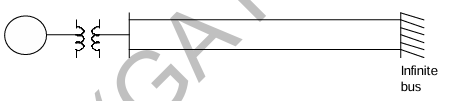
The figure shows the single line diagram of a single machine infinite bus system. The inertia constant of the synchronous generator \(H = 5\) MW-s/MVA. Frequency is 50 Hz. Mechanical power is 1 pu. The system is operating at the stable equilibrium point with rotor angle \(\delta\) equal to 30°. A three phase short circuit fault occurs at a certain location on one of the circuits of the double circuit transmission line. During fault, electrical power in pu is \(P_{max}\sin\delta\). If the values of \(\delta\) and \(d\delta/dt\) at the instant of fault clearing are 45° and 3.762 radian/s respectively, then \(P_{max}\) (in pu) is \_\_\_\_\_\_\_\_\_
SSolution
Given: \(H = 5\) MW-s/MVA, \(f = 50\) Hz, \(P_m = 1\) pu, \(\delta_0 = 30°\), \(\delta_c = 45°\), \(\omega_c = 3.762\) rad/s
Angular momentum: \(M = \frac{H}{\pi f} = \frac{5}{\pi \times 50} = 0.0318\) pu
Swing equation:
During fault: \(P_e = P_{max}\sin\delta\)
Energy balance from pre-fault to clearing:
Kinetic energy at clearing:
Potential energy change:
The accelerating energy supplied between \(\delta_0\) and \(\delta_c\) appears as kinetic energy at the instant of clearing:
Answer range: 0.22 to 0.24 pu