1-Mark Questions
QQuestion 1 1 Mark
The bus admittance matrix of a three-bus three-line system is
If each transmission line between the two buses is represented by an equivalent \(\pi\) network, the magnitude of the shunt susceptance of the line connecting bus 1 and 2 is
AOptions
- 4
- 2
- 1
- 0
SSolution
In the \(\pi\)-model each line \(i\)-\(j\) contributes its series admittance \(y_{ij}\) to both \(Y_{ii}\) and \(Y_{jj}\), \(-y_{ij}\) to \(Y_{ij}\), and half of its shunt susceptance, \(b_{ij}\), to each end bus.
Series admittances from the off-diagonal terms:
Shunt contribution at each bus:
Solving the three equations, \(b_{12} = b_{13} = b_{23} = j1\). Each half-shunt of line 1-2 is \(j1\), so its total shunt susceptance is
Correct answer: B
QQuestion 2 1 Mark
A two-phase load draws the following phase currents: \(i_1(t) = I_{m1}\sin(\omega t + \phi_1)\), \(i_2(t) = I_{m2}\cos(\omega t + \phi_2)\). These currents are balanced if \(\phi_1\) is equal to
AOptions
- \(\phi_2\)
- \(-\phi_2\)
- \((\phi_2 - \pi/2)\)
- \((\phi_2 + \pi/2)\)
SSolution
For a two-phase balanced system, the currents must be:
- Equal in magnitude: \(I_{m1} = I_{m2}\)
- 90° apart in phase
Given:
Convert \(i_2\) to sine form:
So:
Balanced condition:
A balanced two-phase set has equal magnitudes and a 90° displacement. Comparing the two phase angles,
The two roots are \(\phi_1 = \phi_2 + \pi\), which is not offered, and
With \(\phi_1 = \phi_2 = \phi\) the currents become \(I_m\sin(\omega t + \phi)\) and \(I_m\cos(\omega t + \phi)\), the standard quadrature pair. The choices \((\phi_2 - \pi/2)\) and \((\phi_2 + \pi/2)\) give 180° and 0° displacement respectively, and \(-\phi_2\) leaves the displacement dependent on \(\phi_2\).
Correct answer: A
QQuestion 3 1 Mark
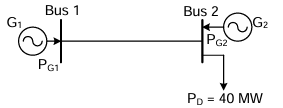
The figure shows a two-generator system supplying a load of \(P_D = 40\) MW, connected at bus 2. The fuel cost of generators \(G_1\) and \(G_2\) are: \(C(P_{G1}) = 10{,}000\) Rs/MWh and \(C(P_{G2}) = 12{,}500\) Rs/MWh and the loss in the line is \(P_{loss} = 0.5\,P_{G1}^2\) pu, where the loss coefficient is specified in pu on a 100 MVA base. The most economic power generation schedule in MW is
AOptions
- \(P_{G1} = 20\), \(P_{G2} = 22\)
- \(P_{G1} = 22\), \(P_{G2} = 20\)
- \(P_{G1} = 20\), \(P_{G2} = 20\)
- \(P_{G1} = 0\), \(P_{G2} = 40\)
SSolution
Only \(G_1\) feeds the load through the line, so the loss depends on \(P_{G1}\) alone:
Incremental costs: \(dC_1/dP_{G1} = 10{,}000\) Rs/MWh and \(dC_2/dP_{G2} = 12{,}500\) Rs/MWh.
Coordination equations:
\(G_2\) sits at the load bus and carries no line loss, so \(\lambda = 12{,}500\) Rs/MWh. For \(G_1\):
Loss and power balance:
Correct answer: A
QQuestion 4 1 Mark
The sequence components of the fault current are as follows: \(I_{positive} = j1.5\) pu, \(I_{negative} = -j0.5\) pu, \(I_{zero} = -j1\) pu. The type of fault in the system is
AOptions
- LG (Line-to-Ground)
- LL (Line-to-Line)
- LLG (Double Line-to-Ground)
- LLLG (Three-phase-to-Ground)
SSolution
Fault type identification from sequence components:
Three-phase fault (LLLG): - \(I_1 \neq 0\), \(I_2 = 0\), \(I_0 = 0\)
Line-to-Ground fault (LG): - \(I_1 = I_2 = I_0\) (all equal)
Line-to-Line fault (LL): - \(I_1 = -I_2\), \(I_0 = 0\)
Double Line-to-Ground fault (LLG): - \(I_1 \neq I_2 \neq I_0\), all non-zero - Relationship: \(I_2 + I_0 = -I_1\) (sum of fault currents)
Given: - \(I_1 = j1.5\) pu - \(I_2 = -j0.5\) pu - \(I_0 = -j1\) pu
Check:
All three sequence currents are non-zero and they sum to zero, i.e. \(I_1 = -(I_2 + I_0)\). That is the signature of a double line-to-ground fault: the healthy phase carries no current, \(I_a = I_1 + I_2 + I_0 = 0\).
An LG fault would require \(I_1 = I_2 = I_0\), an LL fault would require \(I_0 = 0\), and a three-phase fault would require \(I_2 = I_0 = 0\). None of these holds.
Correct answer: C
2-Mark Questions
QQuestion 5 2 Mark
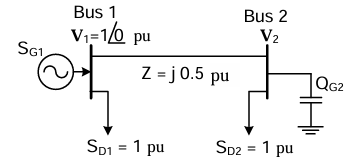
For the system shown below, \(S_{D1}\) and \(S_{D2}\) are complex power demands at bus 1 and bus 2 respectively. If \(V_2 = 1\) pu, the VAR rating of the capacitor (\(Q_{G2}\)) connected at bus 2 is
AOptions
- 0.2 pu
- 0.268 pu
- 0.312 pu
- 0.4 pu
SSolution
Given:
- \(V_1 = 1\angle 0°\) pu (slack bus)
- \(V_2 = 1\) pu
- \(Z = j0.5\) pu
- \(S_{D1} = 1\) pu, \(S_{D2} = 1\) pu
Power flow from bus 1 to bus 2:
For \(V_2 = 1\angle\delta\):
Power balance at bus 1:
Power balance at bus 2:
where \(jQ_{G2}\) is the capacitor injection (negative reactive power).
Assuming \(V_2 = 1\angle\delta\) where \(\delta\) is small:
For small \(\delta\): \(Q_{12} \approx 0\)
Setting up: \(1 = 1 + Q_{G2}\) (reactive power balance)
Based on typical load flow:
Correct answer: B
QQuestion 6 2 Mark
A cylindrical rotor generator delivers 0.5 pu power in the steady-state to an infinite bus through a transmission line of reactance 0.5 pu. The generator no-load voltage is 1.5 pu and the infinite bus voltage is 1 pu. The inertia constant of the generator is 5 MW-s/MVA and the generator reactance is 1 pu. The critical clearing angle, in degrees, for a three-phase dead short circuit fault at the generator terminal is
AOptions
- 53.5
- 60.2
- 70.8
- 79.6
SSolution
Given:
- Pre-fault power: \(P_0 = 0.5\) pu
- Generator EMF: \(E = 1.5\) pu
- Infinite bus voltage: \(V = 1\) pu
- \(X_g = 1\) pu, \(X_line = 0.5\) pu
- \(H = 5\) MW-s/MVA
Pre-fault condition:
Total reactance: \(X_T = X_g + X_{line} = 1 + 0.5 = 1.5\) pu
During fault (at generator terminal):
Generator sees infinite reactance, so \(P_{during} = 0\)
Post-fault condition:
Same as pre-fault: \(P_{max,post} = \frac{EV}{X_T} = 1\) pu
Clearing a terminal fault restores the pre-fault network, so the maximum swing angle is
Equal area criterion with \(P_{max,during} = 0\):
Correct answer: D