1-Mark Questions
QQuestion 1 1 Mark
A nuclear power station of 500 MW capacity is located at 300 km away from a load center. Select the most suitable power evacuation transmission configuration among the following options
AOptions
- 132 kV, 300 km double circuit
- 132 kV, 300 km single circuit with 40% series capacitor compensation
- 400 kV, 300 km single circuit
- 400 kV, 300 km double circuit
SSolution
Factors for selection:
1. Power transmission capability:
Higher voltage increases capacity quadratically.
2. Losses:
Higher voltage reduces losses significantly.
3. Voltage regulation:
Better regulation at higher voltages.
4. Stability: Long transmission (300 km) requires high voltage for adequate stability margin.
Analysis:
(A) 132 kV double circuit:
- [\(\times\)] Too low for 500 MW at 300 km
- [\(\times\)] Very high losses (\(\propto 1/V^2\))
- [\(\times\)] Poor voltage regulation
- [\(\times\)] Requires very large conductors
(B) 132 kV with 40% compensation:
- [\(\times\)] Improves power transfer but still inadequate
- [\(\times\)] High losses remain
- [\(\times\)] Increased complexity and cost
(C) 400 kV single circuit:
- [\checkmark] Adequate voltage for 500 MW
- [\checkmark] Much lower losses
- [\(\times\)] No redundancy - complete shutdown if line fails
- [\(\times\)] Unacceptable for nuclear plant (base load)
(D) 400 kV double circuit:
- [\checkmark] Optimal voltage level
- [\checkmark] Minimum losses (highest efficiency)
- [\checkmark] Excellent voltage regulation
- [\checkmark] High reliability (redundancy)
- [\checkmark] One circuit can carry load during maintenance
- [\checkmark] Standard for nuclear power evacuation
Nuclear plant requirements:
- Base load generation - must be highly reliable
- 500 MW is large capacity
- 300 km is long distance
- Redundancy essential
Surge impedance loading check:
For a 400 kV line with \(Z_c \approx 400\) \(\Omega\),
A single 400 kV circuit falls short of the 500 MW to be evacuated, so a double circuit is required.
Correct answer: D
QQuestion 2 1 Mark
A negative sequence relay is commonly used to protect
AOptions
- an alternator
- a transformer
- a transmission line
- a bus bar
SSolution
Negative sequence components:
In balanced 3-phase system: \(I_2 = 0\)
Negative sequence appears during:
- Unbalanced faults (LG, LL, LLG)
- Unbalanced loads
- Phase-to-phase faults
- Open conductor conditions
Effect on alternator:
Negative sequence currents have devastating effects on generators:
1. Double-frequency heating:
- \(I_2\) rotates opposite to rotor (relative speed = \(2N_s\))
- Induces currents at \(2f\) in rotor body
- Severe heating in: rotor surface, damper windings, pole faces
- Rotor not designed for this frequency
2. Heating magnitude:
Even small \(I_2\) causes large heating.
3. Permissible limits:
Continuous: \(I_2 < 10%\) of rated
Short time: \(I_2^2 t < 30\) to 40 (for large generators)
4. Protection philosophy:
- Alarm at low \(I_2\) levels
- Trip at high \(I_2\) or sustained conditions
- Inverse time characteristic: \(t = K/I_2^2\)
Other equipment:
Transformer: Better tolerance for unbalance, other protections primary
Transmission line: Uses distance relays, \(I_2\) not main protection
Bus bar: Differential protection is primary
Correct answer: A
QQuestion 3 1 Mark
For enhancing the power transmission in a long EHV transmission line, the most preferred method is to connect a
AOptions
- Series inductive compensator in the line
- Shunt inductive compensator at the receiving end
- Series capacitive compensator in the line
- Shunt capacitive compensator at the sending end
SSolution
Power transmission:
where \(X\) is total line reactance.
Methods to enhance power:
(A) Series inductive compensator:
- [\(\times\)] Increases reactance
- [\(\times\)] Reduces power transfer
- [\(\times\)] Worsens stability
(B) Shunt inductive compensator at receiving end:
- [\(\times\)] Absorbs reactive power
- [\(\times\)] Reduces voltage
- [\(\times\)] Decreases power transfer
- Used for controlling overvoltages, not enhancing power
(C) Series capacitive compensator:
- [\checkmark] Reduces effective reactance: \(X_{eff} = X_L - X_C\)
- [\checkmark] Increases power: \(P \propto 1/(X_L - X_C)\)
- [\checkmark] Improves stability margin
- [\checkmark] Better voltage regulation
- [\checkmark] Directly addresses transmission angle limitation
- [\checkmark] Most effective for long lines
(D) Shunt capacitive compensator at sending end:
- Provides reactive power support
- Improves sending end voltage
- Less effective than series compensation
- Doesn't reduce line reactance
Why series capacitive is preferred:
For long EHV lines:
- Line reactance dominates
- Series compensation directly reduces \(X\)
- Typical compensation: 40-70% of line reactance
- Effect: \(P_{new} = P_{old} \times \frac{1}{1-k}\) where \(k\) is compensation degree
Example: 50% compensation doubles power capability!
Correct answer: C
2-Mark Questions
QQuestion 4 2 Mark
A load center of 120 MW derives power from two power stations connected by 220 kV transmission lines of 25 km and 75 km as shown in the figure. The three generators G1, G2 and G3 are of 100 MW capacity each and have identical fuel cost characteristics. The minimum loss generation schedule for supplying the 120 MW load is

AOptions
- \(P_1 = 80\) MW + losses, \(P_2 = 20\) MW, \(P_3 = 20\) MW
- \(P_1 = 60\) MW, \(P_2 = 30\) MW + losses, \(P_3 = 30\) MW
- \(P_1 = 40\) MW, \(P_2 = 40\) MW, \(P_3 = 40\) MW + losses
- \(P_1 = 30\) MW + losses, \(P_2 = 45\) MW, \(P_3 = 45\) MW
SSolution
Key principle:
Transmission loss \(\propto I^2R \propto P^2 \times \text{length}\)
System configuration:
- G1 connected via 25 km line
- G2, G3 connected via 75 km line each
- Load = 120 MW at center
Loss analysis:
Loss coefficient for each line \(\propto\) length
For minimum loss with identical costs:
- Shorter line (25 km) should carry more power
- Longer lines (75 km) should carry less power
Comparing the four schedules:
G1 feeds the load bus over the 25 km line; G2 and G3 share a bus and feed it over the single 75 km line, so that line carries \(P_2 + P_3\). With loss \(\propto \ell P^2\):
- (A) \(25(80)^2 + 75(40)^2 = 160{,}000 + 120{,}000 = 280{,}000\)
- (B) \(25(60)^2 + 75(60)^2 = 90{,}000 + 270{,}000 = 360{,}000\)
- (C) \(25(40)^2 + 75(80)^2 = 40{,}000 + 480{,}000 = 520{,}000\)
- (D) \(25(30)^2 + 75(90)^2 = 22{,}500 + 607{,}500 = 630{,}000\)
Schedule (A) has the least loss. The fuel costs are identical, so the dispatch problem reduces to loss minimisation and as much power as possible should come over the short line.
Correct answer: A
QQuestion 5 2 Mark
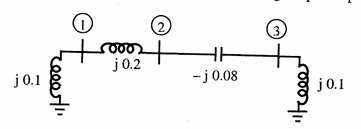
A three-bus network is shown in the figure below indicating the p.u. impedances of each element. The bus admittance matrix, \(Y_{bus}\), of the network is
AOptions
- \(j\begin{bmatrix} -0.3 & 0.2 & 0\\ 0.2 & -0.12 & 0.08\\ 0 & 0.08 & -0.02\end{bmatrix}\)
- \(j\begin{bmatrix} -15 & 5 & 0\\ 5 & 7.5 & -12.5\\ 0 & -12.5 & 2.5\end{bmatrix}\)
- \(j\begin{bmatrix} 0.1 & -0.2 & 0\\ -0.2 & 0.12 & -0.08\\ 0 & -0.08 & 0.10\end{bmatrix}\)
- \(-j\begin{bmatrix} 10 & 5 & 0\\ 5 & 7.5 & 12.5\\ 0 & 12.5 & 10\end{bmatrix}\)
SSolution
From the figure:
- Shunt at bus 1 to ground: \(j0.1\) pu
- Series element between buses 1 and 2: \(j0.2\) pu
- Series element between buses 2 and 3: \(-j0.08\) pu (a capacitor)
- Shunt at bus 3 to ground: \(j0.1\) pu
Admittances:
Diagonal elements:
Off-diagonal elements:
Correct answer: B