1-Mark Questions
QQuestion 1 1 Mark
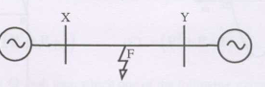
A two machine power system has a transmission line XY with positive sequence impedance \(Z_1\) and zero sequence impedance \(Z_0\). An 'a' phase to ground fault with zero fault impedance occurs at the centre of the transmission line. Bus voltage at X and line current from X to F for phase 'a' are \(V_a\) and \(I_a\). The impedance measured by the ground distance relay located at terminal X will be
AOptions
- \(Z_1/2\) \(\Omega\)
- \(Z_0/2\) \(\Omega\)
- \((Z_0 + Z_1)/2\) \(\Omega\)
- \(V_a/I_a\) \(\Omega\)
SSolution
Distance relay measurement:
The distance relay measures:
Why none of the fixed expressions applies:
The phase-a voltage at X is built from the sequence currents that flow from X towards the fault:
This is a two-machine system, so the fault is fed from both ends and the current divides between X and Y with different distribution factors in the positive-, negative- and zero-sequence networks. At the relay \(I_{a1}\), \(I_{a2}\) and \(I_{a0}\) are therefore unequal, and the ratio \(V_a/I_a\) does not collapse to \(Z_1/2\), \(Z_0/2\) or \((Z_0 + Z_1)/2\).
A ground unit supplied with the phase voltage \(V_a\) and the phase current \(I_a\), with no residual compensation, simply divides the two:
Correct answer: D (\(V_a/I_a\))
QQuestion 2 1 Mark
An extra high voltage transmission line of length 300 km can be approximated by a lossless line having propagation constant \(\beta = 0.00127\) radians per km. The percentage ratio of line length to wavelength will be
AOptions
- 24.24%
- 12.12%
- 19.05%
- 6.06%
SSolution
Wavelength calculation:
Percentage ratio:
Correct answer: D
QQuestion 3 1 Mark
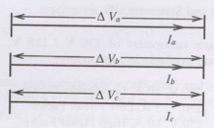
A 3-phase transmission line has voltage drops given by the equation with positive sequence impedance 15 \(\Omega\) and zero sequence impedance 48 \(\Omega\). The values of \(Z_s\) and \(Z_m\) will be
AOptions
- \(Z_s = 31.5\) \(\Omega\); \(Z_m = 16.5\) \(\Omega\)
- \(Z_s = 26\) \(\Omega\); \(Z_m = 11\) \(\Omega\)
- \(Z_s = 16.5\) \(\Omega\); \(Z_m = 31.5\) \(\Omega\)
- \(Z_s = 11\) \(\Omega\); \(Z_m = 26\) \(\Omega\)
SSolution
Sequence impedance relationships:
Solving simultaneously:
From first equation: \(Z_s = Z_1 + Z_m = 15 + Z_m\)
Substitute in second:
Correct answer: B
2-Mark Questions
QQuestion 4 2 Mark
Voltage phasors at two terminals of a 70 km transmission line have magnitude 1.0 pu but are 180° out of phase. Maximum load current is 1/5th of minimum 3-phase fault current. Which protection scheme will NOT pick up?
AOptions
- Distance protection using mho relays with zone-1 set to 80% of line impedance
- Directional overcurrent protection set to pick up at 1.25 times maximum load current
- Pilot relaying with directional comparison
- Pilot relaying with segregated phase comparison
SSolution
Condition analysis:
Voltages 180° out of phase with equal magnitude indicates the system is at stability limit or beyond.
This is an unusual operating condition (system collapse).
Current in the line:
With \(V_X = 1\angle 0°\) and \(V_Y = 1\angle 180°\), the current flowing into the line at X is
The minimum three-phase fault current is at most \(1/Z_L\), so \(I_X \ge 2I_{f,min} = 10 I_{L,max}\). This is a pole-slip condition, not a fault: the current simply passes through the line.
Testing each scheme:
(A) Mho relay, zone-1 at 80%: the apparent impedance at X is \(V_X/I_X = Z_L/2\), that is 50% of the line at the line angle, well inside zone 1. It picks up.
(B) Directional overcurrent at \(1.25 I_{L,max}\): the current is about eight times the setting and is in the forward direction at X. It picks up.
(C) Directional comparison: at Y the current into the line is \(-2/Z_L\) and \(V_Y = 1\angle 180°\), so the apparent impedance there is also \(+Z_L/2\). Both terminals see a forward fault (the electrical centre sits mid-line), so the scheme trips.
(D) Segregated phase comparison: with both sets of CTs referenced into the line, \(I_X = -I_Y\). The two currents are 180° apart, which is the signature of through current rather than of an internal fault, so the comparison restrains.
Correct answer: D
QQuestion 5 2 Mark
A lossless transmission line having Surge Impedance Loading (SIL) of 2280 MW is provided with uniformly distributed series capacitive compensation of 30%. The SIL of the compensated line will be
AOptions
- 1835 MW
- 2280 MW
- 2725 MW
- 3257 MW
SSolution
SIL definition:
where \(Z_c = \sqrt{L/C}\) is characteristic impedance.
With series capacitive compensation:
Effective inductance: \(L_{eff} = L(1 - k)\) where \(k = 0.3\)
New SIL:
Correct answer: C
QQuestion 6 2 Mark
A lossless power system serves 250 MW load. Two generators with cost curves \(C_1(P_{G1}) = P_{G1} + 0.055P_{G1}^2\) and \(C_2(P_{G2}) = 3P_{G2} + 0.03P_{G2}^2\). The minimum cost dispatch will be
AOptions
- \(P_{G1} = 250\) MW; \(P_{G2} = 0\) MW
- \(P_{G1} = 150\) MW; \(P_{G2} = 100\) MW
- \(P_{G1} = 100\) MW; \(P_{G2} = 150\) MW
- \(P_{G1} = 0\) MW; \(P_{G2} = 250\) MW
SSolution
Economic dispatch condition:
Equal incremental costs:
Load constraint:
From first equation:
Substitute \(P_{G2} = 250 - P_{G1}\):
Correct answer: C
QQuestion 7 2 Mark
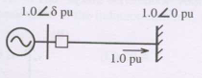
A lossless single machine infinite bus system: synchronous generator transfers 1.0 pu power to infinite bus. Critical clearing time is 0.28 s. If identical generator connected in parallel and each supplies 0.5 pu, the critical clearing time will
AOptions
- reduce to 0.14 s
- reduce but will be more than 0.14 s
- remain constant at 0.28 s
- increase beyond 0.28 s
SSolution
Critical clearing time dependency:
Equal area criterion:
where \(H\) is inertia constant.
Original system: - Single generator: inertia \(H_1\), power \(P_1 = 1.0\) pu - \(t_{cr,1} = 0.28\) s
New system: - Two identical generators in parallel - Total inertia: \(H_{total} = 2H_1\) - Each generator: power \(P = 0.5\) pu - Total power: still 1.0 pu to infinite bus
Effect on critical clearing time:
The system inertia doubles, which increases the critical clearing time:
The critical clearing time increases because the combined system has more inertia.
Correct answer: D
QQuestion 8 2 Mark
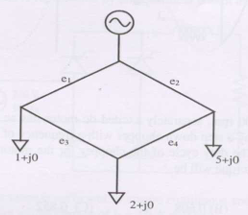
Single line diagram of 4-bus distribution system with branches \(e_1, e_2, e_3, e_4\) having equal impedances. Load currents shown in per unit. Company policy requires radial operation with minimum loss. This can be achieved by opening branch
SSolution
Minimum loss in radial distribution:
Network from the figure:
The source is at bus 1. Branch \(e_1\) runs from bus 1 to bus 2, \(e_2\) from bus 1 to bus 3, \(e_3\) from bus 2 to bus 4 and \(e_4\) from bus 3 to bus 4. The loads are 1 pu at bus 2, 5 pu at bus 3 and 2 pu at bus 4. There is a single loop, so exactly one branch has to be opened.
Loss for each choice:
All four impedances are equal, so the loss is proportional to \(\sum I^2\):
- Open \(e_1\): \(I_{e_2} = 8\), \(I_{e_4} = 3\), \(I_{e_3} = 1 \Rightarrow 64 + 9 + 1 = 74\)
- Open \(e_2\): \(I_{e_1} = 8\), \(I_{e_3} = 7\), \(I_{e_4} = 5 \Rightarrow 64 + 49 + 25 = 138\)
- Open \(e_3\): \(I_{e_1} = 1\), \(I_{e_2} = 7\), \(I_{e_4} = 2 \Rightarrow 1 + 49 + 4 = 54\)
- Open \(e_4\): \(I_{e_1} = 3\), \(I_{e_2} = 5\), \(I_{e_3} = 2 \Rightarrow 9 + 25 + 4 = 38\)
Opening \(e_4\) gives the smallest total: it leaves the heavy 5 pu load fed directly from the source through one branch.
Correct answer: open branch \(e_4\)