1-Mark Questions
QQuestion 1 1 Mark
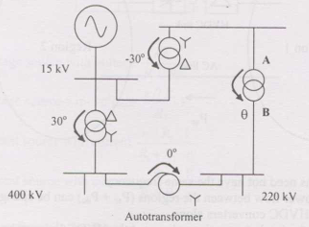
Consider transformer connections in power system. Given connections and phase shifts, which connection and phase shift \(\theta\) should be used for transformer between A and B (between 400 kV and 220 kV)?
AOptions
- Star-Star (\(\theta = 0°\))
- Star-Delta (\(\theta = -30°\))
- Delta-Star (\(\theta = 30°\))
- Star-Zigzag (\(\theta = 30°\))
SSolution
Principle:
Two paths that meet at the same pair of terminals must accumulate the same phase shift from the source, otherwise they cannot be paralleled.
Path 1 - through the upper transformer:
The upper transformer is marked \(-30°\) in the direction top bus \(\rightarrow\) 15 kV bus, so the top bus, and with it terminal A, leads the generator bus by \(30°\):
Path 2 - through the 400 kV bus:
The generator transformer contributes \(+30°\) from 15 kV to 400 kV and the autotransformer contributes \(0°\) from 400 kV to 220 kV. Terminal B sits on the 220 kV bus, so
Required shift:
Star-delta (\(-30°\)), delta-star (\(+30°\)) and star-zigzag (\(+30°\)) all introduce a shift; only a star-star connection gives \(\theta = 0°\).
Correct answer: A (Star-Star, 0°)
QQuestion 2 1 Mark
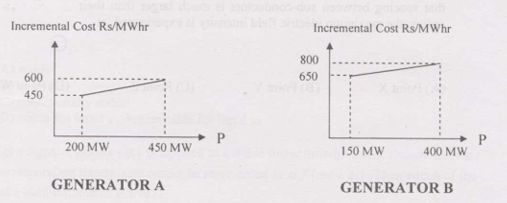
Incremental cost curves for two generators supplying common 700 MW load. Generator A: 200-450 MW range, Generator B: 150-400 MW range. The optimum generation schedule is:
AOptions
- Generator A: 400 MW, Generator B: 300 MW
- Generator A: 350 MW, Generator B: 350 MW
- Generator A: 450 MW, Generator B: 250 MW
- Generator A: 425 MW, Generator B: 275 MW
SSolution
Economic dispatch principle:
At optimum: \(\frac{dC_A}{dP_A} = \frac{dC_B}{dP_B} = \lambda\)
Equal incremental costs.
From incremental cost curves:
Looking at the curves (described in problem):
- Gen A: Incremental cost ranges from ~450 Rs/MWhr at 200 MW to ~600 Rs/MWhr at 450 MW
- Gen B: Incremental cost ranges from ~650 Rs/MWhr at 150 MW to ~800 Rs/MWhr at 400 MW
Observation:
Generator A has lower incremental cost throughout its range compared to Generator B.
Optimal strategy:
Load Generator A to maximum (450 MW) first, then load Generator B for remainder.
Verification:
At these loadings, incremental costs are closest to equal (or Gen A at limit).
Correct answer: C
QQuestion 3 1 Mark
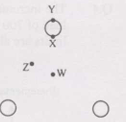
Bundled conductor of overhead line with three identical sub-conductors at corners of equilateral triangle. Neglecting other phases and ground, maximum electric field intensity experienced at
AOptions
- Point X (on the top sub-conductor, facing the centre of the bundle)
- Point Y (on the top sub-conductor, outer surface)
- Point Z (a point inside the triangle)
- Point W (near the centre of the bundle)
SSolution
Electric field of a bundled conductor:
All three sub-conductors carry charge of the same sign, \(q/3\) each. The gradient is largest on a conductor surface, so only X and Y are candidates; Z and W lie inside the bundle, where the three contributions largely cancel.
At Y (outer surface of the top sub-conductor):
The conductor's own field points radially outward, away from the bundle. The two lower sub-conductors lie on the far side, so their fields at Y point in that same outward direction and add.
At X (inner surface of the same sub-conductor):
Here the conductor's own field points towards the centre of the bundle, while the fields of the two lower sub-conductors point away from them, back towards the top conductor. The contributions oppose, so the resultant is smaller than at Y.
This is exactly why bundling lowers the surface gradient: the maximum always occurs on the outer periphery of the bundle.
Correct answer: B
2-Mark Questions
QQuestion 4 2 Mark
A solid sphere of insulating material has radius R and total charge Q uniformly distributed in volume. Magnitude of electric field intensity E at distance r (0 < r < R) inside sphere is
AOptions
- \(\frac{1}{4\pi\epsilon_0}\frac{Qr}{R^3}\)
- \(\frac{3}{4\pi\epsilon_0}\frac{Qr}{R^3}\)
- \(\frac{1}{4\pi\epsilon_0}\frac{Q}{r^2}\)
- \(\frac{1}{4\pi\epsilon_0}\frac{QR}{r^3}\)
SSolution
Gauss's law:
Charge density:
For Gaussian surface at radius r < R:
Enclosed charge:
Electric field:
By symmetry, field is radial and uniform on Gaussian surface:
Correct answer: A
QQuestion 5 2 Mark
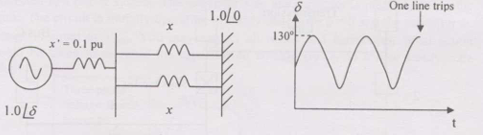
Synchronous generator connected to infinite bus by two parallel transmission lines. Transient reactance \(x' = 0.1\) pu, mechanical power 1.0 pu. Rotor angle undergoes undamped oscillation with maximum \(\delta(t) = 130°\). One line trips at instant when \(\delta = 130°\). Maximum per unit line reactance x such that system doesn't lose synchronism is
AOptions
- 0.87
- 0.74
- 0.67
- 0.54
SSolution
Network reactances:
Each line has reactance \(x\), so before the trip the transfer reactance is \(x' + x/2 = 0.1 + x/2\) and after the trip it is \(x' + x = 0.1 + x\).
Post-trip power-angle curve:
With \(E = 1.0\) pu and \(V = 1.0\) pu,
State at the instant of tripping:
The oscillation is undamped and \(\delta = 130°\) is its maximum, so at that instant \(d\delta/dt = 0\). The rotor therefore starts from rest on the post-trip curve at \(\delta = 130°\).
Stability condition:
Because \(130° > 90°\), the post-trip electrical power falls as \(\delta\) grows. If \(P_e(130°) < P_m\) the rotor accelerates, \(P_e\) drops further and synchronism is lost; if \(P_e(130°) \ge P_m\) the rotor decelerates and swings back. The limiting case is therefore
Correct answer: C
QQuestion 6 2 Mark
A 230 V (phase), 50 Hz, three-phase, 4-wire system with phase sequence ABC. Unity power-factor load of 4 kW connected between phase A and neutral N. To achieve zero neutral current using pure inductor and capacitor in other two phases, the value of inductor and capacitor is
AOptions
- 72.95 mH in phase C and 139.02 \(\mu\)F in phase B
- 72.95 mH in phase B and 139.02 \(\mu\)F in phase C
- 42.12 mH in phase C and 240.79 \(\mu\)F in phase B
- 42.12 mH in phase B and 240.79 \(\mu\)F in phase C
SSolution
Given:
- Phase voltage: \(V_{ph} = 230\) V
- Phase A: Resistive load, \(P = 4\) kW
- Phase B: Capacitor (to be determined)
- Phase C: Inductor (to be determined)
- Objective: \(I_N = 0\)
Phase currents:
Phase A (resistive):
For zero neutral current:
With phase sequence ABC:
- \(V_A = 230\angle 0°\) V
- \(V_B = 230\angle -120°\) V
- \(V_C = 230\angle 120°\) V
Required currents:
For capacitor in phase B:
Reactances:
Phase assignment:
Capacitor in phase B (leads) Inductor in phase C (lags)
Correct answer: A