1-Mark Questions
QQuestion 1 1 Mark
The input voltage \(v(t)\) and current \(i(t)\) of a converter are given by,
where, \(\omega = 2\pi \times 50\) rad/s. The input power factor of the converter is closest to
AOptions
- 0.845
- 0.867
- 0.887
- 1.0
SSolution
Given:
- \(v(t) = 300 \sin(\omega t)\) V
- \(i(t) = 10 \sin(\omega t - \frac{\pi}{6}) + 2 \sin(3\omega t + \frac{\pi}{6}) + \sin(5\omega t + \frac{\pi}{2})\) A
- \(\omega = 2\pi \times 50\) rad/s
Solution:
The power factor is defined as:
Step 1: Identify voltage and current components
Voltage (only fundamental):
Current (fundamental + harmonics): \begin{align*} i(t) &= 10 \sin(\omega t - \frac{\pi}{6}) \text{(fundamental)}\\ &+ 2 \sin(3\omega t + \frac{\pi}{6}) \text{(3rd harmonic)}\\ &+ \sin(5\omega t + \frac{\pi}{2}) \text{(5th harmonic)} \end{align*}
Step 2: Calculate RMS current
where: \begin{align*} I_{1,rms} &= \frac{10}{\sqrt{2}} = 7.071 \text{ A}\\ I_{3,rms} &= \frac{2}{\sqrt{2}} = 1.414 \text{ A}\\ I_{5,rms} &= \frac{1}{\sqrt{2}} = 0.707 \text{ A} \end{align*}
Step 3: Calculate real power
Only the fundamental components contribute to real power:
where \(\phi_1\) is the phase angle between fundamental voltage and fundamental current.
Voltage phase: \(0°\)\\ Fundamental current phase: \(-30°\) (or \(-\frac{\pi}{6}\))
Step 4: Calculate apparent power
Step 5: Calculate power factor
Alternative approach:
Power factor can also be expressed as:
This is called displacement power factor × distortion factor.
Correct answer: A (0.845)
QQuestion 2 1 Mark
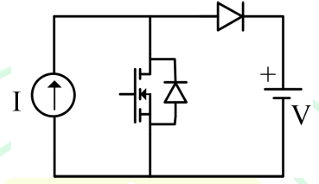
In the circuit with ideal devices, the power MOSFET is operated with a duty cycle of 0.4 in a switching cycle with \(I = 10\) A and \(V = 15\) V. The power delivered by the current source, in W, is ____________ (round off to the nearest integer).
SSolution
Given:
- Duty cycle: \(D = 0.4\)
- Current source: \(I = 10\) A
- DC source: \(V = 15\) V
- All devices are ideal
Circuit Analysis:
The current source drives 10 A into the upper node. From that node there are exactly two paths: down through the MOSFET, or to the right through the diode into the 15 V source. Since the source current is constant, one of the two carries all 10 A at every instant.
MOSFET ON (\(DT = 0.4T\))
The MOSFET shorts the upper node to the return rail, so the diode sees \(-15\) V and blocks. The full 10 A circulates through the MOSFET and the voltage across the current source is
MOSFET OFF (\((1 - D)T = 0.6T\))
The 10 A must now flow through the diode into the 15 V source, which clamps the upper node:
Average power delivered by the current source
The ideal MOSFET and diode dissipate nothing, so all 90 W is absorbed by the 15 V source.
Answer: 90 W
2-Mark Questions
QQuestion 3 2 Mark
The 3-phase modulating waveforms (\(v_a(t)\), \(v_b(t)\) and \(v_c(t)\)), used in sinusoidal PWM in a Voltage Source Inverter (VSI) are
where \(\omega = 2\pi \times 40\) rad/s is the fundamental frequency. The modulating waveforms are compared with a 10 kHz triangular carrier whose magnitude varies between +1 and −1. The VSI has a DC link voltage of 600 V and feeds a star connected motor. The per phase fundamental RMS motor voltage, in volts, is closest to
AOptions
- 169.71
- 300.00
- 424.26
- 212.13
SSolution
Given:
- Modulating waveforms: \(v_a(t) = 0.8 \sin(\omega t)\) V (and similar for phases b, c)
- Fundamental frequency: \(f = 40\) Hz
- Carrier frequency: \(f_c = 10\) kHz
- Carrier magnitude: \(\pm 1\) V
- DC link voltage: \(V_{dc} = 600\) V
- Load: Star connected motor
Solution:
Step 1: Determine modulation index
The modulation index (amplitude modulation index) is:
Peak of modulating signal: \(V_{m,peak} = 0.8\) V\\ Peak of carrier signal: \(V_{c,peak} = 1\) V
Step 2: Output voltage for sinusoidal PWM
For a 3-phase VSI with sinusoidal PWM, the peak fundamental phase voltage (line-to-neutral) is:
This is for linear modulation region where \(m_a \leq 1\).
Step 3: Calculate RMS phase voltage
The RMS value of the fundamental component:
Verification:
For a 3-phase VSI with sinusoidal PWM: - DC link voltage: \(V_{dc} = 600\) V - Modulation index: \(m_a = 0.8\) - RMS phase voltage: \(V_{ph,rms} = \frac{m_a \times V_{dc}}{2\sqrt{2}} = \frac{0.8 \times 600}{2\sqrt{2}} = \frac{480}{2.828} = 169.71\) V
Note on other options:
- 300.00 V would be \(V_{dc}/2\)
- 424.26 V would be \(V_{dc}/\sqrt{2}\) (line-to-line RMS)
- 212.13 V would be \(V_{dc}/(2\sqrt{2})\) without modulation index
Correct answer: A (169.71 V)
QQuestion 4 2 Mark
An ideal sinusoidal voltage source \(v(t) = 230\sqrt{2} \sin(2\pi \times 50t)\) V feeds an ideal inductor \(L\) through an ideal SCR with firing angle \(\alpha = 0°\). If \(L = 100\) mH, then the peak of the inductor current, in ampere, is closest to
AOptions
- 20.71
- 0
- 10.35
- 7.32
SSolution
Given:
- Voltage source: \(v(t) = 230\sqrt{2} \sin(2\pi \times 50t)\) V
- Inductance: \(L = 100\) mH \(= 0.1\) H
- Firing angle: \(\alpha = 0°\)
- Ideal SCR and ideal inductor
Solution:
Step 1: Identify voltage parameters
where: - Peak voltage: \(V_m = 230\sqrt{2} = 325.27\) V - Angular frequency: \(\omega = 2\pi \times 50 = 314.16\) rad/s - Frequency: \(f = 50\) Hz
Step 2: Current through inductor
For an inductor:
Integrating:
Step 3: Apply initial conditions
With SCR firing at \(\alpha = 0°\): - SCR turns ON at \(\omega t = 0\) - At \(t = 0\): \(i(0) = 0\) (current through inductor cannot change instantaneously)
Therefore:
Step 4: Find peak current
The maximum value of \(i(t)\) occurs when \(\cos(\omega t) = -1\) (at \(\omega t = \pi\)):
Alternative approach using inductive reactance:
Peak current would be:
But this gives the steady-state AC amplitude, not the peak with DC offset.
With firing angle \(\alpha = 0°\) and pure inductive load, the current will have a DC offset, and the peak reaches:
Correct answer: A (20.71 A)
QQuestion 5 2 Mark
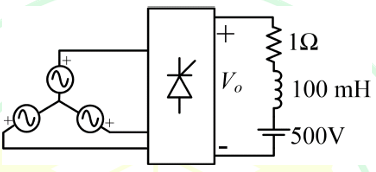
In the following circuit, the average voltage
where \(\alpha\) is the firing angle. If the power dissipated in the resistor is 64 W, then the closest value of \(\alpha\) in degrees is
\vspace{3cm}
AOptions
- 35.9
- 46.4
- 41.4
- 0
SSolution
Given:
- Average output voltage: \(V_o = 400\left(1 + \frac{\cos\alpha}{3}\right)\) V
- Power dissipated in resistor: \(P = 64\) W
- Circuit: Controlled rectifier with resistive load
Solution:
Step 1: Load current from the resistor loss
The load is \(1\) \(\Omega\) in series with 100 mH and a 500 V battery. Since \(\omega L = 2\pi \times 50 \times 0.1 = 31.4\) \(\Omega \gg R = 1\) \(\Omega\), the load current is essentially ripple free, so
Step 2: Average KVL around the load
Averaged over a cycle the inductor voltage is zero, so
Step 3: Solve for the firing angle
The larger angles are ruled out: they give \(V_o < 500\) V, which would need current to flow out of the battery back through the converter, and thyristors cannot conduct in that direction.
Correct answer: A (35.9°)
QQuestion 6 2 Mark
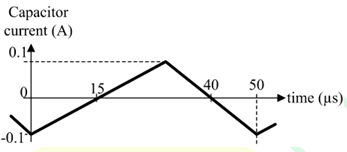
The steady state capacitor current of a conventional DC-DC buck converter, working in CCM, is shown in one switching cycle. If the input voltage is 30 V, the value of the inductor used, in mH, is _____________ (round off to one decimal place).
SSolution
Given:
- DC-DC Buck converter in CCM (Continuous Conduction Mode)
- Input voltage: \(V_{in} = 30\) V
- Capacitor current waveform is provided (steady state)
- Need to find: Inductance \(L\) in mH
Step 1: Read the waveform
The capacitor current is the ac part of the inductor current, \(i_C = i_L - I_o\). It ramps up from \(-0.1\) A at \(t = 0\) to \(+0.1\) A at \(t = 30\) μs and back down to \(-0.1\) A at \(t = 50\) μs; the zero crossings at 15 μs and 40 μs are the midpoints of the two ramps. Hence
Step 2: Output voltage
Step 3: Inductance from the ripple
During the on-time the inductor sees \(V_{in} - V_o\):
The off-time gives the same figure: \(L = V_o t_{off}/\Delta i_L = 18 \times 20 \times 10^{-6}/0.2 = 1.8\) mH.
Answer: 1.8 mH