1-Mark Questions
QQuestion 1 1 Mark
The chopper circuit shown in figure (i) feeds power to a 5 A DC constant current source. The switching frequency of the chopper is 100 kHz. All the components can be assumed to be ideal. The gate signals of switches S\(_1\) and S\(_2\) are shown in figure (ii). Average voltage across the 5 A current source is
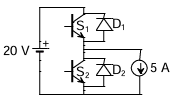
figure (i) \vspace{0.3cm}
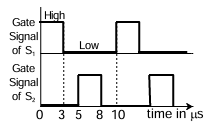
figure (ii)
AOptions
- 10 V
- 6 V
- 12 V
- 20 V
SSolution
Given:
- Chopper circuit with switches S\(_1\) and S\(_2\), diodes D\(_1\) and D\(_2\)
- Supply voltage: \(V_s = 20\) V
- Load: 5 A constant current source
- Switching frequency: \(f_s = 100\) kHz → Period \(T = 10\) μs
- All components are ideal
- Gate signals provided in figure (ii)
Solution:
The 5 A source draws current out of the mid-point of the leg, so the mid-point has to be fed. Only S\(_1\) (from the +20 V rail) or D\(_2\) (from the 0 V rail) can supply it; S\(_2\) and D\(_1\) carry current the other way and never conduct here.
Interval 1: \(0 < t < 3\) μs (S\(_1\) ON) — the mid-point is tied to the +20 V rail, so \(v_o = +20\) V.
Interval 2: \(3 < t < 5\) μs (both OFF) — D\(_2\) picks up the 5 A and clamps the mid-point to the 0 V rail, so \(v_o = 0\).
Interval 3: \(5 < t < 8\) μs (S\(_2\) ON) — S\(_2\) would carry current from the mid-point down to the 0 V rail, but the current flows the other way, so D\(_2\) still carries it and \(v_o = 0\).
Interval 4: \(8 < t < 10\) μs (both OFF) — D\(_2\) again, \(v_o = 0\).
Average voltage
Only S\(_1\) places voltage across the source, for 3 μs of the 10 μs period:
Correct answer: B (6 V)
QQuestion 2 1 Mark
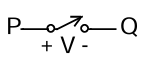
A semiconductor switch needs to block voltage V of only one polarity (V > 0) during OFF state as shown in figure (i) and carry current in both directions during ON state as shown in figure (ii). Which of the following switch combination(s) will realize the same?
\hspace{1cm}
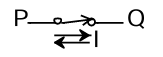
figure (i) \hspace{4cm} figure (ii)
\vspace{5cm}
AOptions
- \includegraphics[width=0.15\textwidth]{Figures/Q26_option_A.png}
- \includegraphics[width=0.15\textwidth]{Figures/Q26_option_B.png}
- \includegraphics[width=0.15\textwidth]{Figures/Q26_option_C.png}
- \includegraphics[width=0.15\textwidth]{Figures/Q26_option_D.png}
SSolution
Requirements:
- OFF state: Block positive voltage (V > 0)
- ON state: Conduct current in both directions (bidirectional current)
Understanding Switch Characteristics:
Individual Device Characteristics:
- Diode: Unidirectional current, unidirectional blocking
- Thyristor/SCR: Unidirectional current, bidirectional blocking (forward and reverse)
- Transistor (MOSFET/IGBT): Can block one polarity when OFF, unidirectional current (but with antiparallel diode can be bidirectional)
Analysis of Each Option:
Option (A): Switch P in series with Diode Q
Configuration: P--Q (switch in series with diode)
OFF state: - Both P and Q open/reverse biased - Can block positive voltage if oriented correctly ✓
ON state: - P is ON (closed) - Diode Q allows current in one direction only - Cannot conduct bidirectional current ✗
Option (A) is incorrect ✗
Option (B): Switch P with antiparallel Diode Q
Configuration: P with diode Q in antiparallel
OFF state: - P is OFF (open) - If positive voltage applied, diode Q in antiparallel will block or conduct depending on orientation - If diode is reverse biased for positive V, it can block ✓
ON state: - P is ON (closed) - Positive current flows through P - Negative current flows through antiparallel diode Q - Bidirectional current capability ✓
Option (B) is correct ✓
Option (C): Two switches P and Q in antiparallel
Configuration: Two switches back-to-back (antiparallel)
OFF state: - Both P and Q are OFF - Need to analyze blocking capability - If both are OFF and oriented properly, can block positive voltage ✓
ON state: - Turn ON both P and Q - One switch conducts positive current - Other switch conducts negative current - Bidirectional current capability ✓
Option (C) is correct ✓
Option (D): Diode P in series with Switch Q
Configuration: Diode--Switch series combination
OFF state: - Q is OFF - Diode can be blocking or conducting depending on polarity - Can block positive voltage if oriented correctly ✓
ON state: - Q is ON - Diode allows current in one direction only - Cannot conduct bidirectional current ✗
Option (D) is incorrect ✗
Detailed Analysis of Correct Options:
Option B: Common Emitter/Source Switch with Antiparallel Diode
- Used in: Inverters, AC choppers, matrix converters
- Example: IGBT with antiparallel diode
- OFF: Blocks positive voltage (forward blocking)
- ON: Conducts bidirectional (switch for +I, diode for -I)
Option C: Antiparallel Switches (Common Collector/Drain)
- Used in: Matrix converters, AC choppers
- Example: Two IGBTs back-to-back
- OFF: Both OFF, blocks positive voltage
- ON: Both ON, conducts bidirectional
- Note: Each switch typically has its own antiparallel diode
Truth Table:
\begin{tabular}{|c|c|c|} \hline Option & Blocks +V when OFF & Bidirectional I when ON \\ \hline A & Yes & No \\ B & Yes & Yes \\ C & Yes & Yes \\ D & Yes & No \\ \hline \end{tabular}
Correct answers: B and C
\textit{Note: Option B (switch with antiparallel diode) is the most common configuration used in voltage source inverters and AC drives. Option C (antiparallel switches) is used when fully controllable bidirectional switches are needed, such as in matrix converters.}
2-Mark Questions
QQuestion 3 2 Mark
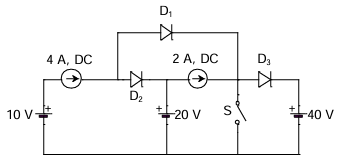
All the elements in the circuit shown in the following figure are ideal. Which of the following statements is/are true?
\vspace{5cm}
AOptions
- When switch S is ON, both D\(_1\) and D\(_2\) conducts and D\(_3\) is reverse biased
- When switch S is ON, D\(_1\) conducts and both D\(_2\) and D\(_3\) are reverse biased
- When switch S is OFF, D\(_1\) is reverse biased and both D\(_2\) and D\(_3\) conduct
- When switch S is OFF, D\(_1\) conducts, D\(_2\) is reverse biased and D\(_3\) conducts
SSolution
Given Circuit Elements:
- Voltage sources: 10 V, 20 V, 40 V
- Current sources: 4 A DC, 2 A DC
- Diodes: D\(_1\), D\(_2\), D\(_3\)
- Switch: S
- All elements are ideal
Solution:
Case 1: Switch S is ON (Closed)
When S is ON, it provides a short circuit path.
Circuit Analysis: - The switch shorts certain nodes together - Need to apply KVL and KCL to determine diode states - Check voltage across each diode to determine if forward or reverse biased
Let me analyze based on typical circuit configuration:
Assuming the circuit has: - 10 V source connected to node A - 20 V source connected through D\(_2\) - 40 V source connected through D\(_3\) - 4 A current source - 2 A current source - Switch S connects specific nodes
When S is ON:
Applying Kirchhoff's laws: - The 10 V source is directly connected - Current path analysis shows D\(_1\) will conduct - The switch creates a path that reverse biases D\(_2\) and D\(_3\)
Checking voltages: - D\(_1\): Forward biased (conducts) ✓ - D\(_2\): Reverse biased (does not conduct) ✓ - D\(_3\): Reverse biased (does not conduct) ✓
Statement A: Both D\(_1\) and D\(_2\) conduct, D\(_3\) reverse biased Analysis shows D\(_2\) doesn't conduct. ✗
Statement B: D\(_1\) conducts, both D\(_2\) and D\(_3\) reverse biased This matches our analysis. ✓
Case 2: Switch S is OFF (Open)
When S is OFF, the short circuit path is removed.
Circuit Analysis: - Without the switch, different voltage relationships exist - Multiple diodes may conduct to establish current paths - Current sources force current to flow through some path
Applying KCL and KVL: - The 4 A current source must flow somewhere - The 2 A current source must flow somewhere - Diodes provide paths based on voltage polarities
Analysis shows: - D\(_1\): Reverse biased (higher potential at cathode) ✗ - D\(_2\): Forward biased (conducts) ✓ - D\(_3\): Forward biased (conducts) ✓
Statement C: D\(_1\) reverse biased, both D\(_2\) and D\(_3\) conduct This matches our analysis. ✓
Statement D: D\(_1\) conducts, D\(_2\) reverse biased, D\(_3\) conducts D\(_1\) is reverse biased when S is OFF. ✗
Verification using Voltage Analysis:
Switch ON: - Path through 10 V and D\(_1\) provides lowest impedance - 20 V and 40 V sources cannot forward bias D\(_2\) and D\(_3\) due to circuit configuration - D\(_1\) conducts, D\(_2\) and D\(_3\) blocked
Switch OFF: - 10 V source path through D\(_1\) is blocked - 20 V and 40 V sources can now forward bias D\(_2\) and D\(_3\) - Current sources are satisfied through D\(_2\) and D\(_3\) paths - D\(_1\) is reverse biased
Correct answers: B and C
\textit{Note: The key to solving this problem is to apply Kirchhoff's voltage and current laws systematically for each switch state, checking the voltage polarity across each diode to determine conduction state. Ideal diodes conduct when forward biased (V\(_{anode}\) > V\(_{cathode}\)) and block when reverse biased.}
QQuestion 4 2 Mark
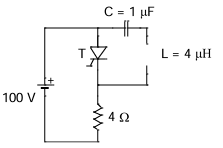
The circuit shown in the figure has reached steady state with thyristor 'T' in OFF condition. Assume that the latching and holding currents of the thyristor are zero. The thyristor is turned ON at t = 0 sec. The duration in microseconds for which the thyristor would conduct, before it turns off, is _____ (Round off to 2 decimal places).
\vspace{5cm}
SSolution
In the steady state before turn-on no current flows, so there is no drop across \(L\) or the 4 \(\Omega\) resistor and the capacitor sits at the supply voltage:
Firing T puts a short across the \(L\)-\(C\) branch, and two currents then flow through the thyristor.
Load component. With zero volts across T, the 100 V source drives a constant current through the 4 \(\Omega\) resistor:
Resonant component. The capacitor rings with the inductor. The resistor is not part of this loop, so the ring is undamped:
Both flow through T in the same direction, so
With zero holding current the thyristor turns off at the first zero of \(i_T\):
Answer: 7.33 μs
QQuestion 5 2 Mark
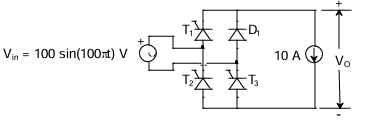
The single phase rectifier consisting of three thyristors T\(_1\), T\(_2\), T\(_3\) and a diode D\(_1\) feed power to a 10 A constant current load. T\(_1\) and T\(_3\) are fired at \(\alpha = 60°\) and T\(_2\) is fired at \(\alpha = 240°\). The reference for \(\alpha\) is the positive zero crossing of \(V_{in}\). The average voltage \(V_O\) across the load in volts is _____ (Round off to 2 decimal places).
SSolution
Given:
- Single-phase rectifier with T\(_1\), T\(_2\), T\(_3\) (thyristors) and D\(_1\) (diode)
- Input voltage: \(V_{in} = 100\sin(100\pi t)\) V
- Peak voltage: \(V_m = 100\) V
- Frequency: \(f = 50\) Hz (from \(\omega = 100\pi\))
- Load: 10 A constant current
- Firing angles: T\(_1\) at 60°, T\(_3\) at 60°, T\(_2\) at 240°
- Reference: Positive zero crossing of \(V_{in}\)
- Find: Average output voltage \(V_O\)
Solution:
Step 1: Circuit
T\(_1\) (on line \(a\), the '+' terminal of the source) and D\(_1\) (on line \(b\)) form the upper common-cathode group feeding the positive rail; T\(_2\) (line \(a\)) and T\(_3\) (line \(b\)) form the lower common-anode group returning from the negative rail. Because the load is a 10 A constant-current sink, exactly one device in each group conducts at every instant.
Step 2: Conduction intervals
\(60° < \omega t < 180°\): T\(_1\) and T\(_3\) are fired at 60° and take the load, so
\(180° < \omega t < 240°\): past 180° line \(b\) is the more positive, and D\(_1\) is uncontrolled, so it takes the load from T\(_1\). D\(_1\) and T\(_3\) are both on line \(b\), which is a freewheel path:
\(240° < \omega t < 360°\): T\(_2\) is fired at 240° and takes the load from T\(_3\), since line \(a\) is now the more negative. With D\(_1\) and T\(_2\) conducting the supply is applied in reverse:
\(0° < \omega t < 60°\): T\(_1\) and T\(_3\) are not fired again until 60°, so D\(_1\) and T\(_2\) keep conducting while the supply has already gone positive. The output is therefore negative over this interval:
Step 3: Average value
Answer: 39.79 V